Category: Cabinet

  • Envisioning the Future: John Cotton Dana Library

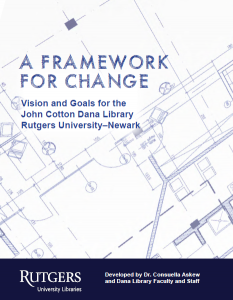
    As the nexus of a dynamic university in the midst of transforming and reinventing its brand, Dana Library/Institute of Jazz Studies is poised to move into its next iteration. Our goal is to become a user-centered library that can nimbly respond to our users’ continually changing needs in innovative ways. The Dana Library/IJS faculty and staff embarked on a six-month process in order to identify our priorities and objectives needed to achieve this goal.  The resulting document, Framework for Change: Vision and Goals for the John Cotton Dana Library Rutgers University–Newark, provides readers with a high-level view of our path to success.

    We began our work in spring 2016 by identifying three high priority focus areas–services, collections and space. These focus areas supported not only the Rutgers University Libraries priorities, but also the Rutgers University–Newark Strategic Plan. Each priority area was given individual attention and consideration by a dedicated group of Dana faculty and staff who volunteered to compile and consider available data about the area, add their valuable expertise on the area topic, and provide recommendations for how we can enhance these areas to better meet the needs of our users in the 21st century. The resulting compilation of this work led to a 30+ page document which detailed specific services enhancements, space needs, and collection management activities. This document will serve as our road map for next several years.

    The Framework for Change document presents a broad overview of the detailed steps necessary for us to achieve success. This document will be used as an advocacy tool for our local university administrators and could also be used as a fundraising tool for donors. No matter how this document might be used externally, Dana Library has charted its course and is ready to embark on a journey to success!

  • Retirement & You

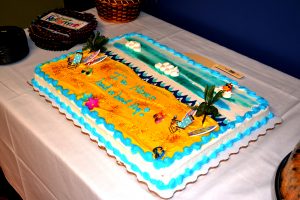
    Gary Golden's retirement cake
    Gary Golden’s retirement cake!

    Retirement is defined as “withdrawal from one’s position or occupation or from active working life”.  Retirement is the goal most employees look forward too.  Others not so much.  There are a lot of decisions to make and for many the process can be daunting! Educating yourself on this important process is extremely important.  To help explain the vital steps, please take note of the following info below:

    1.) Attend a retirement seminar here at Rutgers

    • Retirement seminars are offered through UHR: You can register for a session through the UHR Learning and Development Course Registration System under the Human Resources Development tab:   https://hrservices.rutgers.edu/crs/ then Employee Benefit and Work Life Programs drop down
    • PERS members – Tuesday, December 6, 2016 -10-NOON
    • ABP members – Wednesday, January 25, 2017 – 10-11:30

    2.) Review accumulated leave balances (must take all accumulated leave prior to retirement date) with supervisor or Libraries HR to figure out last physical day at work

    3.) Choose a retirement date (must be 1st of the Month)

    4.) Write a brief letter to advise your supervisor of your retirement plans, making sure the letter includes your retirement date (i.e. 3/1/2017) and last physical day at work

    5.) Complete and submit PERS or ABP pension paperwork to UHR

    6.) Libraries HR finalizes retirement and confirms pension paperwork completed

  • Announcing the Discovery Working Group

    Announcing the Discovery Working Group

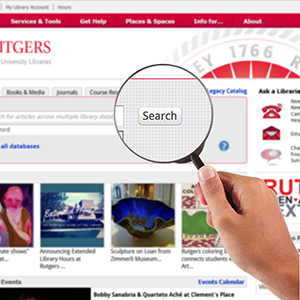
    discoveryThe Discovery Working Group was charged by the University Librarian in early July 2016 to improve identification and access to materials in our collections. Key to the group’s charge is the guiding principle, “Create a comprehensive digital environment that is based on user need, optimizing navigation to ensure successful search, identification, and retrieval.”

    Fortunately, the Working Group has access to a powerful key indicator of user need in the form of the LibQUAL+survey results. Among the tasks the group has taken on, they have read thousands of comments left on the survey that relate to discovery (search, website, library catalog, interlibrary loan, and resources). The Working Group has also devoted time to understanding the current architecture of our systems in order to best incorporate the influx of new resources (predominantly e-books) which have been recently acquired.

    Chaired by Joseph Deodato, the group is comprised of members from all of the universities and Technical and Automated Services. Judy Cohn is the cabinet liaison to the group. The Working Group looks forward to sending an interim report to cabinet at the end of October. The charge and complete list of members is available at the Working Group’s website in Staff Resources – University Librarian – Committees and Task Forces.  http://www.libraries.rutgers.edu/rul/staff/admin/committees.shtml.

    Save

  • Rutgers Joins the E-book Revolution

    vivaOn December 26, 2015, Izzy Stern tweeted: “Today is the day I found out that Rutgers doesn’t even have full ebrary access. So many sad faces.” As a graduate student in a major humanities department at Rutgers–New Brunswick, Izzy might have expected to use ebrary, one of the largest academic e-book resources, for her research in the winter break, but then had a rude awakening that day when she found out that it was not available at Rutgers, yet. So she went online and shared her frustration on Twitter with the entire world, which was totally understandable. As a matter of fact, the lack of access to e-books was a major source of complaint from our students and faculty about the library collections—hundreds of similar comments can be found in the results of the LibQual+ and previous Counting Opinions surveys. Here, I quoted only Izzy’s tweet because it is on the open web, but the problem she reported was a common one.

    What a difference a few months have made! Izzy and her fellow students may be glad to hear that the Libraries have made great strides to improve their access to e-books. Here are the major e-book resources that became available at Rutgers in the last several months:

    • Ebrary Academic Complete: a subscription-based collection of about 140 thousand e-books on all academic subjects.
    • Springer Nature frontlist e-book collections: 7,175 purchased e-books published in 2016 in STM (Science, Technology, and Medicine) and Social Sciences.
    • PALCI/EBSCO Demand-Driven Acquisitions Program: about 1,000 new e-books expected to be purchased during the academic year.

    In addition, we are evaluating a new PALCI/JSTOR e-book program. The program will purchase several hundred high-use titles and also provide academic year-round access to all the JSTOR e-books, a collection of over 40,000 high quality scholarly monographs from many of the major university presses.

    Over a decade ago, the Libraries began to acquire small, subject-based e-book collections. In 2014 we joined HathiTrust, which gives us access to several million out-of-copyright works. However, the availability of large, comprehensive collections of current e-books today represents a quantum leap or a sea change. Since the Rutgers community is celebrating the 250th anniversary of the University this year with a revolutionary spirit, it may be befitting to call this significant change a revolution, an e-book revolution.

    Stepping outside Rutgers, we will find that the e-book revolution is sweeping through the academic and research libraries in the region and the country. Actually, all of our major e-book acquisitions I mentioned earlier were made or will be made together with our partners in BTAA, PALCI, and VALE. This shows that Rutgers is adopting e-books at about the same pace as the majority of academic libraries. Being in the majority does not seem as glorious as playing the role of innovator or early adopter, but it is still an advantageous position, especially from a user perspective. Of course, if we moved any slower, we would have been left behind or characterized as reactionary by our peers.

    Peer pressure is not why we are joining the e-book revolution. It is for the good of our own community. Within our organizational context, there are many reasons why the large-scale shift to e-books is happening now:

    • The arrival of Krisellen as our University Librarian last year set a new direction for the Libraries.
    • E-books provide convenient, equal, and equitable access to the entire Rutgers community, which happens to be a mandate under the University’s RCM budgeting model as well as a core value of librarianship.
    • The loss of $1 million purchasing power in the collections budget in FY15, combined with the ongoing inflationary pressures, forces us to rethink our collection development priorities and strategies.
    • When adopted by instructors as textbooks, e-books can generate substantial savings for students struggling with high textbook costs (see one reported example at Rutgers), which is important in the context of a large public university.
    • The adoption of e-books can be part of the solution to our space shortage problem. As the Library Annex is full, our largest library locations are experiencing the stacks overflow problem at the same time that the universities want the Libraries to create more study space for a growing student population.

    Relating to the last point, I distinctly remember a scene from the Library Town Hall meeting in the spring—a brave staff member stood up and asked everyone: “Since there is really no space in the Libraries, why do we keep buying print books?” Does this remind you of that fabled child who cried “The emperor has no clothes!” or what? I believe that print books are not obsolete and probably won’t be for a long time. There are also situations when only print is available. But we do have to be mindful of our space constraints when making book purchase decisions.

    The e-book revolution is giving our community unprecedented access, but what it cannot do is bring a paradise to libraryland, not at Rutgers nor anywhere else. On the contrary, profound changes are always messy, chaotic, and uncomfortable and this one will be no exception. We have already started to face a new set of problems: how to make print available to the users who need it, in spite of our space and financial constraints; how to minimize the inevitable duplication between different e-book providers; and how to improve the discoverability of e-books, just to name a few. As we navigate these complex and difficult issues and find solutions, we will continuously improve our collections for the benefit of students like Izzy Stern.

    Save

    Save

  • New Brunswick Libraries Pilot Overnight Hours

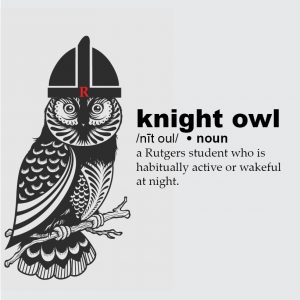
    knight-owlsOvernight library hours are among the most frequently requested service enhancements students would like to see in the New Brunswick Libraries. Popular during finals, students would like the option to work 24/7 during other parts of the academic year too. Twenty-four hour spaces are also standard in most of our peer libraries—in fact, only two of our Big Ten partner institutions do not provide this service.
    In response to user request and with one-year pilot funding from the New Brunswick Chancellor, the New Brunswick Libraries are launching 24/5 hours in two locations starting on October 10. Kilmer Library and parts of the first floor and basement level in Alex will be open overnight Sunday – Thursday. That means those libraries will open for their regular Sunday operations and remain open through regular closing time on Friday nights. 24/5 hours will operate during the fall and spring semesters including reading days and finals, excluding university holidays and intersession periods.

    Overnight operations will support student study in quiet, collaborative, and group environments. OIT and Libraries computers will also be available. Library student workers will be onsite until 2 a.m., providing some circulation services, but from 2 a.m.–8 a.m., the spaces will be monitored by Rutgers University Police Department security staff and no library services will be available. Rutgers students and affiliates will have to show a Rutgers ID in order to gain entry to the building from 10 p.m. to 8 a.m.

    Throughout the year we will take hourly headcounts to measure usage and identify patterns. We will also set assessment benchmarks to determine whether the pilot was successful and whether the 24/5 hours should be continued.

    I’m excited to bring this pilot to the students in New Brunswick this fall and look forward to seeing how the spaces are used overnight to support student work, learning, and success!

    Save

  • Transforming the Way We Work at Rutgers

    cornertstoneThe new administrative information systems under Cornerstone are scheduled to go live over the next week. Cornerstone is the University’s strategic approach to unify, upgrade, and streamline its administrative information systems for Finance, Human Resources and Payroll, Procurement, etc. Upgrading and improving these systems will significantly improve how we work and collaborate across the university. These projects are also particularly exciting to the library because they will enable all of our units to finally utilize the same systems for administrative functions.

    Be on the look-out for future announcements about process updates and training opportunities related to this implementation. If you have any questions about how the new systems may or may not impact you, please see your local business staff.

    Save

  • New Library Resources for a New Academic Year

    Like most other people, I cringe at the very thought that the fall semester is only a month away. Didn’t the summer just start? Where did all the time go? Why couldn’t we have a summer that is all year long? Oh well, such is life. But here is the good news, if there is good news in contemplating that the summer days are numbered: in September when tens of thousands of students return to or come to Rutgers for the first time, the Libraries will have a better collection of information resources waiting for them.

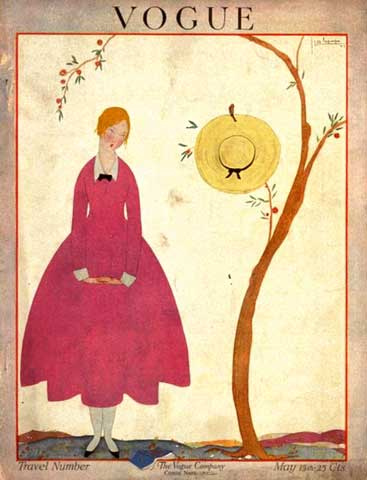
    Cover of 1917 Vogue
    Cover of the May 1917 issue. (American Vogue) https://commons.wikimedia.org/wiki/File:Vogue,_portada_de_mayo_de_1917.jpg

    Fiscal Year 2016 that ended on June 30 started off as a very challenging year for collection development, due to the loss of about $1 million of purchasing power in the collections budget in the previous year. Thanks to the strong support and guidance from the new Libraries administration and the tireless work of all the colleagues involved in collection development, we have more or less turned a corner. The University Librarian’s Report from the July issue of the newsletter includes a summary of major acquisitions that the Libraries made in FY16. Additionally, at the end of FY16 we purchased the British Periodicals collections and Vogue archive, two valuable humanities resources that have been on our wish list for a very long time. It is fair to say that, since last year, the Libraries have been making considerable progress to improve access to all kinds of scholarly resources (online journals, e-books, and primary sources) that the entire Rutgers community can benefit from.

    Our collection development program is continuing the upward trend that began last year. Since July 1, which is when the new fiscal year started, we have been focusing on acquiring and upgrading resources essential to the education mission of the University, in anticipation of the beginning of the new academic year. These new resources include:

    • ProQuest ebrary Academic Complete: a collection of about 140,000 current scholarly e-books on all academic subjects.
    • Springer Nature STM (Science, Technology, and Medicine) and social sciences frontlist e-books: over 7000 newly published titles from the largest STM e-book publisher, paid for with a funding increase from the universities.
    • Academic Video Online: Premium (AVON): over 50,000 videos on Social Sciences, Arts & Humanities, Science & Engineering, and Health Sciences topics from many reputable producers such as BBC and PBS.
    • ProQuest Dissertations and Theses (PQDT) Global: 1.7 million full-text dissertations and theses from both American and international institutions.
    • Clinical resources: In the spring, the Libraries received a funding increase from the universities for five new clinical resources. UpToDate and Bates’ Visual Guide are already available. VisualDx, DynaMed Plus, and JAMA Evidence will be added soon.

    Some of the resources are available now and others will be available later in the fiscal year. We are confident that these new resources will greatly enhance the Libraries’ support for undergraduate, graduate, and medical education at Rutgers. Yes, even when summer is ending, there will be a lot to look forward to in the fall!

  • New Brunswick Libraries Examines Service Points and User Experience

    In the seven library buildings located across New Brunswick, we have more than 15 service points where we provide circulation, reference, and specialized services. These desks are staffed by undergraduate students, graduate student reference/information assistants, and library staff and faculty. We know that each desk serves a different role and that the staff at each desk are trained to answer different questions. But we also know that when users have a question, they are not interested in the differences between the desks functions—they just want help.

    I am leading the Service Points Team, one of the new groups in the New Brunswick Libraries (NBL) organization, as we start examining services points (physical and virtual) across NBL in order to improve the user experience. Potential areas for exploration include hours, staffing, triage, training, and use analysis, as well as determining how physical service points best complement online services including live chat and Ask a Librarian.

    To start our work, the team hosted a series of forums for the NBL staff and faculty during the spring semester. The forums were designed to bring together all of the people who work at the various service points to talk about what works in our current environment and to identify areas where there are opportunities for improvement. The team also gathered feedback online from student workers and those who were unable to attend a forum in person. More than 50 people participated and provided input.

    Participants were asked to respond to these three questions:

    • When thinking about the service points in the New Brunswick Libraries, what barriers or challenges do you think our users encounter?
    • What do you think works well in our current service desk environment?
    • From the patron’s point of view, describe an enjoyable/satisfying experience at a library service point.

    Service Points Team members took notes during the rich and engaging conversations. We coded more than 400 comments and identified themes that emerged across the sessions. The team will also review the themes identified here along with the LibQUAL survey results, paying particular attention to the general satisfaction, policies, reference, spaces, and staff comments and the “affect of service” ratings to set goals for their work in the coming year.

    The full summary from the Service Points Forum will be discussed at the upcoming NBL ALL meetings, and then shared widely across the organization. Generally speaking, we believe our staff and faculty working at service points are our greatest assets—they are friendly, knowledgeable, and helpful. We provide a wide range of services through a variety of delivery methods and have experts available to refer specialized questions. However, the number and variety of service points is confusing to our users. They must often visit more than one desk to get the help they need. They have trouble navigating between our desks, in part because we lack clear and jargon-free signage. And although we have experts available for referral, the refer process itself does not always results in a seamless handoff or escalation.

    Over the next year, the Service Points Team will gather additional information, particularly about usage patterns, and will begin working on projects to address some of the identified challenges. I welcome any feedback or suggestions you have!

  • News from The New Brunswick Libraries’ Undergraduate Experience Team

    Lily Todorinova and Rose Barbalace describe some of the activities the New Brunswick Libraries’ Undergraduate Experience Team have undertaken in recent months or have planned for the summer.

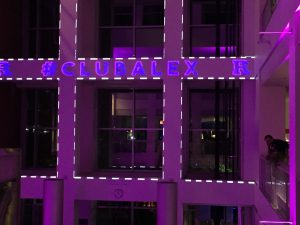
    #ClubAlex

    IMG_7530The Libraries partnered with Student Affairs once again to bring Club Alex back to Alexander Library during Senior Days. This much-anticipated annual event, which sold out within minutes, saw hundreds of graduating seniors and their guests descend upon the library-turned-nightclub on the day following the conclusion of finals. Alexander was transformed with all the trappings one would expect of an actual club: mood lighting and pipe and drape walls helped set the tone in the reference room—which featured a DJ, dance floor, and bar—and an R&B lounge was installed on the ground floor for those who preferred a more intimate atmosphere. A photo booth allowed partygoers to capture the excitement of the evening, and a massive Pac-Man-themed light show was projected onto the atrium walls to the delight of all in attendance.  The buzz on social media was considerable, with many students expressing their gratitude and enthusiasm—and perhaps even more alumni wishing that they had had the chance to party at the library when they were still at Rutgers! Club Alex is a great opportunity for us to create an impression of the Libraries that will last in students’ minds well beyond graduation, and we are grateful to be a partner in this event each year.
    Aresty Undergraduate Research

    The Summer Science Program of the Aresty Research Center offers sophomores an intensive research experience with a dedicated faculty adviser, as well summer  housing and a $3000 stipend. This year, students are working on a diversity of fascinating topics, from cancer prevention, to wearable devices and impact on dietary behaviors, to cataloging emission lines from simulated galaxies. Recognizing the importance of information literacy to the success of these students, the Center has recently reached out to Lily Todorinova, Undergraduate Experience Librarian, to lead several research sessions for the students. With the help of Laura Palumbo, Chemistry & Physics Librarian and Science Data Specialist, we will hold several active learning-based workshops for the 60 or so students in the program, which will focus on finding, evaluating, and using scholarly sources. We are excited to support these students and help them navigate the wealth of academic research resources available to them.

    -Lily Todorinova

    Undergraduate Experience Team Exam Week Stressbuster Report

    IMG_7438
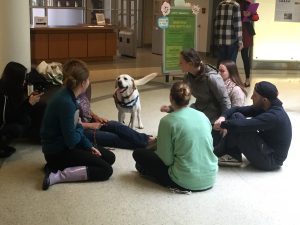
    Students relax with therapy dogs in the lobby of Douglass Library during Spring 2016 Stressbusters.

    During the spring semester exam period (May 2 – May 11) the New Brunswick libraries hosted over 22 stressbuster events and activities, engaging with hundreds of students. New this semester we expanded our stressbuster activities to the Art Library, Math/Physics Library, and Chang Science Library each offering snacks and bottled water. The students expressed their thanks and appreciation as they waited patiently in line for their cookie or coffee. The pet therapy sessions were also extremely popular with many students staying nearly the whole hour with their favorite dog.

    Here are some of the highlights of items distributed during finals week:

    • 1480 bottles of water
    • 1000 ear plugs
    • 768 cookies
    • 675 sandwiches
    • 500 cups of coffee
    • 480 granola bars
    • 388 bags of chips
    • 160 packs of fruit snacks
    • 126 packages of cookies
    • 20 gallons of iced tea
    • 20 gallons of lemonade
    • 7 pet therapy sessions
    • 5 lbs. of chocolate
    • brunch at the Library of Science and Medicine serving coffee, orange juice, bagels, croissants, muffins, and pound cake. (Tried something new, students loved it!)
    • hundreds of coloring pages, stickers, stamps, and other craft supplies offered at two de-stress stations.

    Special thanks to Bright and Beautiful Therapy Dogs, RU Seeing Eye Puppy Raising Club, Creature Comfort Pet Therapy, Jimmy John’s, New Brunswick Libraries Administration, and Rutgers Health, Outreach, Promotion and Education for sponsoring these events.

    -Rose Barbalace

  • Dana Library Staff Development Day 2016

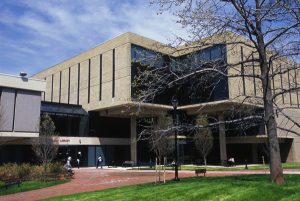
    NR04DanaLibrarySpringNewark01On May 13th, 2016, Dana Library hosted its second annual staff development day which was centered on exploring the question, “What does it mean to be a user centered academic library in the 21st century?” A “user centered” library was defined as one that optimizes the library experience around how users can, want, or need to use it, rather than forcing the users to change their behavior to accommodate it. Impending renovations to our third floor and the concurrent Rutgers University Library master facilities planning process for an overall building renovation prompted the need for us to take a critical look at where we are now in terms of services, collections and space and where we envision ourselves to be in the future. The full day agenda included invited speakers from the Rutgers University–Newark (RU-N) Division of Student Affairs representing the Office of ADA Services and Veteran Affairs, Counseling Services, and Judicial Affairs, and Student Development/Educational Programming, along with the Rutgers University Center for Organizational Leadership and Development.

    After a brief welcome and introduction to the day, the RU-N Division of Student Affairs started the program of events off with a highly informative and engaging session on student wellness and campus safety. The Dana faculty and staff learned more about the resources and processes concerning our students’ care and well-being while attending RU-N. Topics covered include the Campus Awareness Response and Education (CARE) Team, ADA Services, and understanding student behaviors. The latter portion of the presentation included an interactive role play activity based on the five basic styles for conflict management. This experiential activity, was entertaining—we identified a number of potential Emmy award winning actors amongst us—and allowed us to more easily identify conflict styles, along with potential methods to manage them.

    The Dana faculty had already been engaged in a data gathering process to inform our self-analysis. The remainder of the morning consisted of presenting the data collected and compiled, sharing demographic information about the community we serve, and getting a detailed look at the services we provide, along with usage data. The information shared in the presentations served as background and context for the facilitated small group discussions regarding our services that took place in the afternoon. Recognizing that our services are for the most part centralized with little room for experimentation, faculty and staff discussed services that we would continue, those that might be discontinued or tweaked, and the potential for creating new services. The afternoon was full of rich and seemingly robust discussion evidenced by the resulting recommendations.

    The activities of the 2016 Dana Staff Development Day serve to move us closer to the user centered library we aspire to be, as we become more aware and self-reflective of how we interact with our users and each other. Our work continues as we take action on those recommendations that can be easily realized in the short turn and enfolding those with long term implications into future goals for our library.