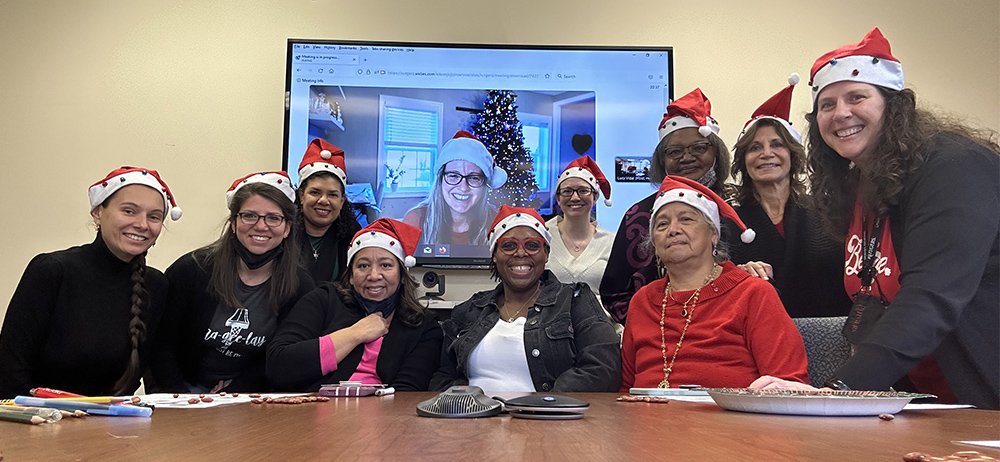
On December 22, members from the Collection Acquisitions department gathered to celebrate the holidays and their accomplishments over the past year. We were happy to see so many smiling faces!

On December 22, members from the Collection Acquisitions department gathered to celebrate the holidays and their accomplishments over the past year. We were happy to see so many smiling faces!
The Ex Libris Implementation Team is hard at work on the Alma Post Implementation Review. We look forward to sharing the results in the new year and wish everyone a restful and peaceful holiday break!
The Ex Libris Implementation Team continues to keep busy with a variety of initiatives, projects, and issues. Here are some highlights:
Over 1,000 patrons have downloaded and registered their Library Mobile app as of mid-October. Weekly drawings are occurring to award swag and gift cards to students who register and respond to Quick Polls. Feedback has been overwhelmingly positive, and we are excited to grow our user base even more. Representatives from the Rutgers Library Mobile implementation team presented on the app and our implementation process at the Ex Libris Northeast User Group (ENUG) conference on October 21.
Over the course of FY23, representatives from the Implementation Team will lead a post-implementation review of each of their functional areas. During this process, we will review current backend Alma workflows in an effort to identify areas where improvement is necessary or desired. Once identified, we will prioritize issues for deeper analysis and potential solution implementation. We encourage everyone working with Alma to participate in this process and to reach out to your Implementation Team Representative with any ideas for areas that could use improvement.
Starting October 17, a chosen/preferred name provided by students, faculty, and staff began appearing in Alma patron records in place of the patron’s legal first name. The chosen name is being used in QuickSearch once a patron has signed in and in any email communication from the Ex Libris platform. For more information on managing your chosen name at Rutgers, please visit the University Inclusion and Equity site.
The version updates performed by Index Data on October 2 resulted in many issues that continue to disrupt processes at all PALCI member institutions. While some bugs have been resolved, Index Data continues to address the outstanding issues. Most of the interruptions are specific to the staff interface, but we have been able to continue receiving items with manual intervention. However, patron notifications are currently suspended. As a result, patrons are not receiving emails confirming their request or notifying them of a failed request. We have requested that an alert be placed on the VuFind landing page so patrons are aware of this suspension. PALCI has done a good job of keeping all members informed with updates. We will continue to monitor progress and share updates as they are available.
Q&A sessions were held for library faculty interested in learning more about Esploro’s researcher profiles. Researcher profiles gather and present information about faculty scholarship, activities, and achievements in order to showcase and promote faculty research, facilitate collaboration and identification of experts, attract external funders and industry partners, and enhance institutional reputation. As proof of concept, publication data was imported using Esploro’s smart harvesting technology, and profiles were created and temporarily activated for all library faculty. Q&A sessions were then held to show faculty how to edit and manage their profile and discuss potential benefits, use cases, and configuration options. Library faculty were also invited to take a brief survey to assess the completeness and accuracy of their profile, share feedback, and offer suggestions for improvement.
During Memorial Day weekend Ex Libris will migrate our cloud platform which includes Alma, QuickSearch(Primo VE), Leganto, and Esploro to a new datacenter. From 9:00 PM on Saturday, May 29th until 09:00 PM Sunday, May 30th we expect the entire platform to be unavailable due to this migration activity. The Ex Libris Implementation Team will be updating the libraries as the date approaches with more details.
The technical implementation of Rialto is progressing well. The firm order buying cycle configuration is complete and work on transitioning the DDA from Oasis to Rialto will finalize soon. We hope to train Selectors on the use of Rialto over this coming summer.
User request history in EzBorrow will not be migrated to ReShare. Instructions are being developed for users who wish to export this data in advance of the transition and will be shared in the near future.
Alma Analytics will be upgraded the week of November 1. Users who want to retain their personal reports in My Folders after the upgrade will need to save a copy in the Analytics shared folder’s Migration directory by October 31. Instructions to save your reports for the upgrade can be found here.
Ex Libris has introduced a new layout for Alma and items such as the main menu and persistent search box have moved to new locations on the screen. The new layout is currently in a testing phase. Users who want to familiarize themselves with the new layout can toggle it on themselves by following the instructions found here. The new layout becomes the default on November 1.
The Esploro implementation is proceeding apace. All of our research assets have now been migrated from RUcore to Esploro. Next steps will include data cleanup, system and UI configuration, staff and user training, and integration with the library website. The Esploro research portal is scheduled to be released in January 2021. The rollout will be accompanied by the creation of a new support channel in LibAnswers to answer inquiries related to using the repository, depositing works, and the open access policy.
The Chapter Delivery button is now available on many monograph collections in QuickSearch. At a time when access is limited, the addition of button raises awareness of this service and provides our patrons with expedient access to our monograph collection. These requests are being brokered by ILLiad and filled electronically via Document Delivery. Patrons can also continue to access the Book Chapter Request form via their ILLiad account to place requests.
Click and Collect usage rose from an average of 211 items per week during the summer to an average of 320 items per week during the semester. The week with the most requests so far was the first week of the semester (August 31-September 6) with 368 requests completed. Graduate students are the most frequent users of Click and Collect at 48% followed by faculty and staff at 36% and undergraduates at 17%. Thanks to the work of our onsite fulfillment teams we have circulated over 3,000 items to users via Click and Collect since the program began on August 3rd.
Efforts to review and redesign workflows supporting Course Reserves, Chapter and Article Delivery, ILL, etc. have begun. High level process mapping is being completed along with preparation for the impending switch to Leganto. Meetings with each campus will be scheduled to discuss the efforts and potential new workflows in more detail. Be on the lookout for more info!
 The annual Ex Libris Users of North America conference, ELUNA, scheduled for May was cancelled due to the pandemic. However, the planners of the annual conference have scheduled a set of free half-day webinars during the month of July to share product and working group updates. The webinars will be spread over seven days and each day’s session has a separate theme. Staff members are encouraged to review the conference schedule and sign up for the sessions of interest to you. If you are not able to attend or have a prior commitment, the webinars will be recorded and made available for later viewing.
Please note that you need to register for each webinar that you would like to attend during the scheduled time or to access the recording.
Ex Libris updates its products every month with enhancements recommended by customers and other users. There are two primary ways customers can suggest development enhancements. The Idea Exchange platform (http://ideas.exlibrisgroup.com/) is a system that anyone can use at any time during the year. This open platform allows all Ex Libris users to submit ideas for development and vote on their favorite ideas. The Ex Libris project management teams monitor this system and considers these ideas for their development cycle.
The other primary way that users can influence Ex Libris development is through the formal product enhancement process offered through the official user groups ELUNA (Ex Libris Users of North America) and IGeLU (International Group of Ex Libris Users). This process is offered every year for each product and members can submit enhancement requests through NERS (New Enhancement Request System). These requests are monitored by the customer product interest groups to ensure there are no duplicates before voting and reviewed by Ex Libris. Each member site in the user group is provided with a points allocation for voting on enhancement ideas. At Rutgers, the Ex Libris Team solicits feedback from relevant groups such as the Fulfillment Working Group to help understand which enhancements will have the most beneficial impact on our workflow. Once the votes are collected, Ex Libris makes a commitment to implement the top enhancements that fit into their designated development budget for the year.
The monthly releases for each product are available in the knowledge center (https://knowledge.exlibrisgroup.com/) or via the release highlights emails available through the product email lists (https://exlibrisusers.org/listinfo). The Ex Libris Team minutes (https://apps.libraries.rutgers.edu/ex-libris/resources) are also a good way to monitor the voting process and monthly enhancements that may impact our workflow.
In Spring 2020, Ex Libris will release its new Central Discovery Index (CDI), an expanded search index with an upgraded infrastructure that will replace the current Primo Central Index (PCI). The central index is a collection of records describing hundreds of millions of scholarly resources, including articles, books, conference papers, and audiovisual recordings harvested from publishers, aggregators, and open-access repositories. The new index will offer several improvements, including:
Although the transition to CDI is expected to be seamless, users may notice the following changes:
To minimize disruption, the new index will be activated after the spring semester ends on May 18th, 2020. If you have any questions, please contact exlibris@rutgers.libanswers.com.
The Law Libraries Append Project added a large number of physical and electronic resources to Alma and QuickSearch in January 2020. For physical, 188,572 titles and 463,395 items were added. For electronic, 95,216 titles representing 117,237 electronic resources were added. Also, 3,042 user records were loaded containing 1,451 new user records and 1,591 updated records and 3,583 checkout records attached to these users were loaded.
Sixty-two unique course sections are actively using Leganto for Spring 2020. This includes at least one course from every campus and courses that span eight Rutgers schools and colleges. The School of Social Work in New Brunswick’s online and hybrid courses have continued to make active use of the Reading List tool, but there are also notable numbers from the College of Arts and Sciences in Camden and the School of Nursing at RBHS.
Rutgers University Libraries have contracted with Ex Libris to integrate Esploro, an institutional repository platform for collecting, managing, and showcasing the university’s research output. Esploro offers a variety of useful features including:
Integration of Esploro into our Alma environment begins March 2020 and will be carried out in two phases. The first phase will focus on data migration and system configuration and is expected to be completed by the end of summer. The second phase will focus on education, promotion, and campus engagement. Stay tuned for further updates as the project unfolds.
 Happy Birthday QuickSearch!
It’s hard to believe that we’ve been using Alma and Primo for over a year! Please check out our presentation from the State of the Libraries if you’d like to see some statistics about what we’ve accomplished together since last June. It’s thanks to all of you that this launch has been so successful and we are incredibly grateful for all of your hard work and support.
As we continue to dig deeper into the impact QuickSearch has had and to explore where further improvement is necessary, we would like to hear from you. The implementation team will hold another round of open question and answer sessions on each campus (details below). We sincerely hope that you will attend a session and share any feedback or questions you might have about Alma and Primo.