Author: Consuella Askew

  • Letter to the Libraries

    Since our last issue, we’ve weathered some big storms. After the intense snowfall we saw in late January, I know we were all surprised by the rapidly intensifying Blizzard of 2026. Thank you all for pivoting to remote services without skipping a beat, ensuring undisrupted support for the university.

    I wish the weather was the only way in which our climate feels uncertain right now, but the reality is that some aspects of our future direction remain unclear. While we await that clarity, I would like to reassure everyone of something.

    We will remain steadfast in the values and ethical responsibilities of our profession, as laid out in the ALA Code of Ethics. Allow me to highlight a few:

    • We uphold the principles of intellectual freedom and resist all efforts to censor library resources.
    • We treat co-workers and other colleagues with respect, fairness, and good faith, and advocate conditions of employment that safeguard the rights and welfare of all employees of our institutions.
    • We distinguish between our personal convictions and professional duties and do not allow our personal beliefs to interfere with fair representation of the aims of our institutions or the provision of access to their information resources.
    • We affirm the inherent dignity and rights of every person.

    I am thankful to be in a profession with such clear ethics and values, and I am thankful to have all of you as colleagues. I know we can weather any storm that comes our way.

  • Letter to the Libraries

    At this midpoint in the academic year—which of course is also the end of the calendar year—I find myself reflecting on just how much we’ve accomplished as an organization in the past six months. We have implemented a reorganization that had been years in the making, are making significant progress toward our One Libraries model, and are more than midway through our strategic planning process. 

    This large-scale progressive movement as an organization has occurred at a time of shifting institutional and national tides. At Rutgers, we have welcomed a new president and executive vice president for academic affairs, among several other institutional leaders, while facing significant budgetary challenges. Nationally, we’ve seen monumental changes, including the dismantling of many institutions and norms we had previously taken for granted. 

    I’m proud of our resilience and how we’ve been able not only to weather the storm but also to keep pushing forward through it. I’m proud of our collective accomplishments and of each of you for your individual contributions to our collective success. Although our work oftentimes is not visible, it’s indisputably important to the academic and research enterprises of our institution.  

    I want to thank you for your contributions all year long and wish you the happiest holidays. Enjoy the upcoming break, and may 2026 be our best year yet!

  • Letter to the Libraries

    When I wrote my previous message for The Agenda in August, we were just beginning to implement the results of our multiyear reorganizational process. 

    Now, as we settle into our new organizational structure, we are bringing into focus our strategic goals for the next three years. I cannot overstate the importance of this effort. Having a strategic plan will reinforce our ability to work as One Libraries and help us meaningfully assess and clearly demonstrate our impact. 

    I want to express my appreciation to Tony Nguyen, chair, and all the members of the Strategic Goal Writing Task Force, who have recommended goals in five key areas: 

    • Student Success  
    • Engagement and Outreach  
    • Research and Clinical Enterprise  
    • User Experience  
    • Employee Development  

    I also want to thank everyone who engaged in the recent town hall, which can be viewed on the UL Plan of Action Hub: Resetting the Rutgers University Libraries page of the staff resources site, and followed up with Tony providing feedback via Padlet or by email. As a reminder, Tony has asked for feedback by the end of the day on Friday, October 31. 

    I look forward to bringing our strategic plan to fruition in the coming months. With a shared vision for our future, we will all have greater clarity on what work to prioritize, what success looks like, and how effectively we are advancing our mission and the university’s priorities in education, research, health care, and public service. 

    Thank you all for your hard work each day, and for your ongoing commitment to our shared future.

  • Letter to the Libraries

    I am pleased to announce the re-launch of The Agenda, a newsletter first issued in February 1979 to improve internal communication within Rutgers University Libraries. At that time, The Agenda was a weekly printed newsletter, and it has since taken on many revised formats.

    Today, of course, we have many more technologies and platforms to keep us connected across campuses – but I firmly believe in the importance of continuing to produce a publication through which we can stay informed as a community and celebrate our successes. From this point forward, The Agenda will publish as an online newsletter once every two months.

    This has been and will continue to be a period of great change for Rutgers University Libraries. I mean “great” in multiple senses of the word: huge, remarkable, and excellent.

    First, it goes without saying that in our lives and work, we have faced huge changes for many years – whether we are talking about a global pandemic, political and social unrest, rapid technological advancements, or many levels of transitions in leadership – from the Libraries to Rutgers to world leaders. In the past year alone, we have faced a rapid succession of federal orders impacting Rutgers, and Jonathan Holloway, a well-respected and historic president, left the university at the end of June. At Rutgers University Libraries more specifically, we have undergone remarkable changes in moving toward our One Libraries model and a reorganization.

    We need to give ourselves space to acknowledge how unsettling all this change can be. This is why, through Engagement Day and a virtual professional development leading up to it, we chose to focus on post-crisis leadership and wellness.

    “Great” change also can mean “excellent” change. Our reorganization and One Libraries focus will help us work smarter and serve our communities better. We also can look forward to the opportunities presented by new leadership as President William F. Tate IV ushers Rutgers into its next chapter, and as Tonya Smith-Jackson takes over as chancellor of Rutgers University–Newark, effective August 1. Multiple new leaders, faculty, and staff members have recently joined us or taken on new roles at Rutgers University Libraries. I encourage you to read about them on the Faculty and Staff News page.

    I hope you enjoy this new issue and iteration of The Agenda. Your thoughts on future content for this publication are always welcome! Please send your ideas to Lara De Meo Hoyt at lara.hoyt@rutgers.edu.

  • UL Letter to the Libraries – January–February 2023

    As we continue settling into 2023, I am excited to reiterate our three-phase plan for the Libraries’ organizational realignment, what we have accomplished to date, and the work that lies ahead of us. During Phase I, we agreed upon a new leadership structure to best position us for success. This decision was informed by the October 2022 town halls, where many of you shared your ideas and perspectives and when the online voting results were revealed. This process established two Libraries administrative positions: Assistant Vice President for Research and Learning Services and Associate Vice President for Campus Libraries. We have engaged the executive search firm Isaacson, Miller to lead our recruitment efforts and will shortly embark on a nationwide search for this critical position. The person in this role will provide focused day-to-day support for the AULs and work directly with them to identify synergies across the Libraries’ large and diverse geographical footprint.

    Phase II will focus on determining the functional areas and services reporting up through each AVP position. As one example, additional conversations are needed to identify where RUL’s distinctive collections and archives most appropriately fit under this leadership hierarchy. As always, our priority is to ensure our services directly align with and are nimble enough to meet the evolving needs of our users across the university. Phase III will follow and emphasize our workforce organization across the Libraries system. We expect to complete Phase III in early 2024.

    The realignment process requires careful deliberation, along with your steady engagement. By maximizing and leveraging our considerable human, intellectual, digital, and physical resources as one Libraries, we can more efficiently provide the vital and dynamic services expected of a 21st-century academic library. As we move into the next phases of this process, I encourage you to continue sharing your thoughts by contacting me directly or through the VP/UL anonymous comment form.

  • UL Letter to the Libraries – December 2022

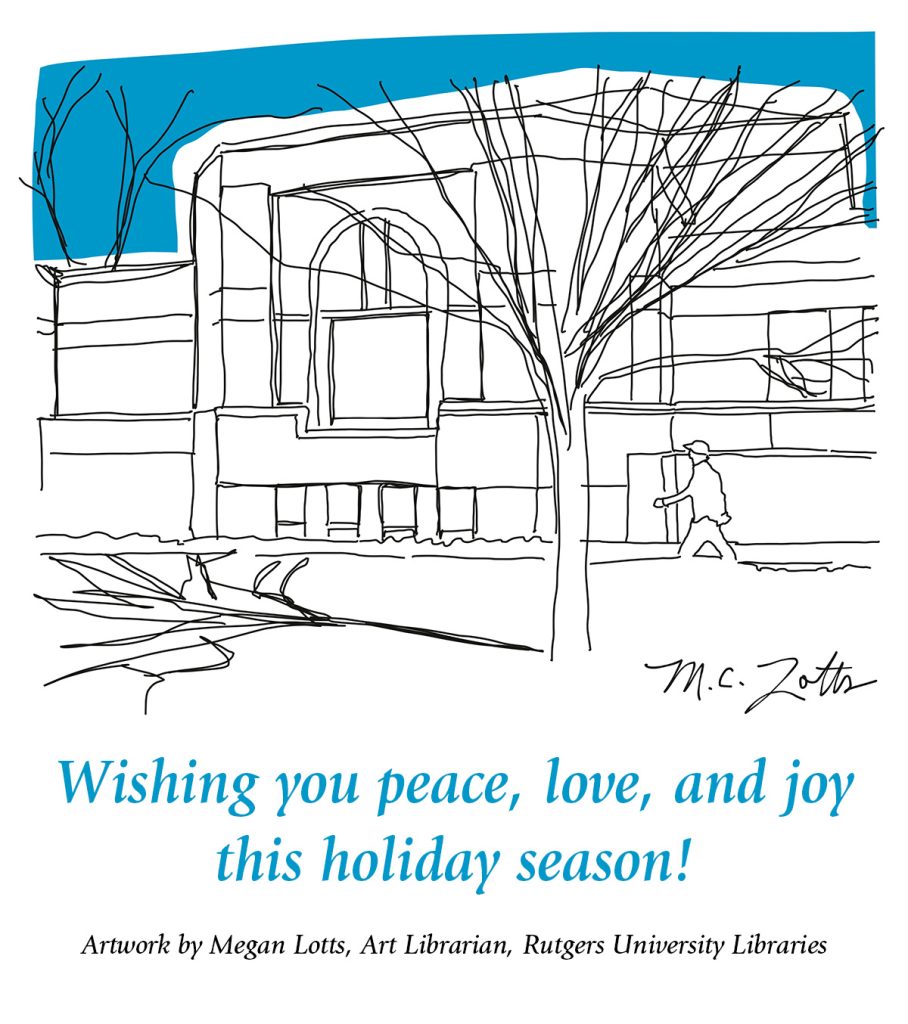
    Another semester has come and gone. Despite the many challenges, I am incredibly proud of what RUL staff, faculty, and students have accomplished this year. From expanding our resources and services to opening innovative new spaces, we have much to celebrate. Thank you for your hard work and dedication. I wish you and your families a safe, peaceful, and joyous holiday season and all the best for the new year!

    Art Library by Megan Lotts.

  • UL Letter to the Libraries – November 2022

    Although the Thanksgiving holiday is behind us, expressing thanks does not have a time limit. I want to express my gratitude for your extraordinary dedication, perseverance, and hard work. In a year filled with change, your commitment to delivering exceptional service to our users remained constant. On behalf of the Libraries Leadership Team, I thank each of you for your service.

    I also want to thank you for the thoughtful discussions and incisive feedback received regarding our organizational restructure. We are moving forward with option 2 as it resonated with many of you and best positions us to address the evolving expectations and priorities of our university community. Although we have much work in front of us, this decision marks an exciting milestone in this three-phase process.

    In Phase I of the organizational restructure, the immediate next steps will be filling new leadership roles, particularly the AVP for Campus and Special Libraries. (These are currently working titles and may slightly change as we think through the details of these roles.) It is important to highlight that the AVP for Campus and Special Libraries will provide focused day-to-day support for the AULs. Additionally, this position will work directly with the AULs to identify synergies across our local libraries to leverage resources that can lead to increased efficiencies. The intent is to have this position filled and solidified by the end of spring 2023, so they can serve as part of the transition team during Phase II.

    Phase II will focus on the functional areas and services reporting up through each AVP. We must ensure the services the Libraries offer directly align with the university’s needs and priorities. Phase III will focus on the organization of our workforce across the system.

    The restructure will be a long and deliberate process that will take us the better part of 18 months. During this critical juncture for the Libraries, your continued contributions and support throughout this process are deeply appreciated.

    I am very pleased to announce the revised RUL Mission Statement and RUL Aspirations Statement were overwhelmingly approved and will be formally adopted (view them on the Libraries’ website at this link). They will serve as our North Star as we move forward with our organizational structure and strategic planning process. As we get further into both those efforts, we may need to revisit and tweak the statements to ensure they fully reflect the work we are doing and aspire to do. I want to thank the RUL Affirmation Group (Isaiah Beard, Laura Costello, Joseph Deodato, Bart Everts, Francesca Giannetti, John Gibson, Tom Glynn, Naomi Gold, Krista Haviland, Amy Joyner, Nancy Kranich, Triveni Kuchi, Barry Lipinski, Mei Ling Lo, Yan Lu, Christie Lutz, Orla Mejia, Tracey Meyer, Ermira Mitre, Sue Oldenburg, Cathy Pecoraro, Michele Petosa, Ayesha Salim, Elizabeth Surles, Roberta Tipton [retired], Bob Vietrogoski, Victoria Wagner, Mary Beth Weber, Zara Wilkinson, Drue Williamson, and Phil Wilson) for their diligence and thoughtfulness as they worked through the process for the last eight months or so, which resulted in these statements. I also appreciate your taking the time to vote and share your thoughts about these statements.

    Lastly, we have added a new section to The Agenda to reinforce our commitment to diversity, equity, and inclusion in the workplace. The DEI Spotlight highlights the vital work of the DEI Committee, upcoming training and events, DEI resources, and more. I encourage you to explore the Spotlight and the resources highlighted (see the link in the top navigation bar).

  • Laura Costello Appointed Director of Strategic Planning and Assessment

    Laura Costello was appointed Rutgers University Libraries’ new Director of Strategic Planning and Assessment, effective October 10. Laura came to RUL from Stony Brook University Libraries in 2018 as our Virtual Reference Services Librarian. In 2021, she was promoted to Research and Instruction Services Coordinator. Laura brings to this leadership position a set of skills informed and honed by her responsibilities here at Rutgers and by her previous roles as Head of Research and Emerging Technologies at Stony Brook University and Head of Library Materials and Acquisitions at Teachers College, Columbia University.

    Laura Costello

    Laura has been an integral part of the implementation, administration, and training activities for several of our current data collection platforms, including Alma analytics and Springshare’s LibAnswers and LibInsight. She was also instrumental in the implementation of Leganto. This past year, she stepped in and took on the responsibility for compiling and submitting RUL’s statistical data for the ACRL, ARL, and IPEDS surveys in the absence of a full-time assessment person.

    Her interest in assessment is evidenced by her body of scholarship. She has written and presented on library topics such as reference, space programming, and collections with a focus on assessment. A productive scholar, Laura has authored or co-authored three books, seven book chapters, and over 20 peer-reviewed articles and other publications. Laura is currently the managing editor for the Virtual Reference Bibliography and serves as a peer reviewer for Evidence Based Library and Information Practices. Her interest in assessment methods has led her to pursue a Ph.D. in Communication, Information, and Media at Rutgers with a focus on Library and Information Science. She expects to complete her degree in 2024.

    Her record of service to the Libraries, the University, and the profession is extensive; the following are some highlights. On the national level, her activities include being a member of the Big Ten Academic Alliance Virtual Reference Peer Group since 2020 and the LITA Assessment & Research Committee since 2016, for which she has served as Vice-Chair and Chair. Laura has been actively engaged in the governance structure and informing Libraries operations as Vice Chair of the Faculty Planning Committee and a member of the RUL Scholarly and Professional Activities Committee.

  • RUL Affirmation Town Halls 2022

    One of the first steps of achieving organizational clarity is establishing a common understanding of who we are, what we do, and what we aspire to achieve. Along with our guiding principles and values, the responses to these fundamental questions would help bring clarity to our organizational identity. To this end, we formed the RUL Affirmation Group consisting of faculty and staff from across the libraries. They were responsible for drafting a mission statement and a statement of aspiration. We are pleased to announce they have completed this important work. Their results were shared during two town halls on July 29, 2022, at 9:30 a.m. and 2:00 p.m.:

  • Consuella Askew’s First Letter to the Libraries

    I am honored and excited to be appointed Rutgers’ 15th University Librarian. One of the most gratifying aspects of this role is the opportunity to witness your skills and talents in action at the Libraries. Your loyalty to RUL is admirable, and your determination to work with grace and dignity and in the university’s best interests is inspiring.

    This letter for The Agenda comes at a time of evolution and opportunity. We continue our initiatives designed to address your concerns about RUL’s organizational clarity, culture, and communication. The RUL Affirmation group has worked diligently to define our aspirations and reframe our mission statement. They are incorporating your input from their recent town halls into final statements that will provide a common framework from which we can springboard. We are close to formally establishing the Staff Advisory Committee (SAC), which will serve as a counterpart to the Faculty Planning Committee. Thanks to the stellar work of the SAC Planning Task Force, bylaws have been drafted and are undergoing final revisions. Once that is completed, the task force will focus on stewarding the adoption of the bylaws and conducting the committee’s initial elections process. The goal is to have the SAC up and running by year’s end. We are also reviewing the Libraries’ organizational structure and how our core services are best delivered. We want to ensure we offer comprehensive student and research support across the university’s broad footprint in the most efficient and responsive manner possible.

    We aspire to be the intellectual and creative center of the Rutgers community and recognized as essential to the university’s academic mission. It is a noble and obtainable goal. The future holds great promise if we continue to work smart, act with intent, listen to our colleagues and constituents, and pivot to meet the needs of today’s dynamic academic environment.

    Since my arrival at RUL, I have been impressed by your ability to imagine and implement creative solutions, often in the midst of change. While things continually evolve, I know your willingness and desire to collaborate and meet challenges with intelligence and good humor will serve us well. I look forward to us working together for the benefit of the faculty, students, and staff of Rutgers University and the broader New Jersey community.