Category: Dana Library

  • Erosion of Truth: A Workshop on Mis/Disinformation in the Age of AI

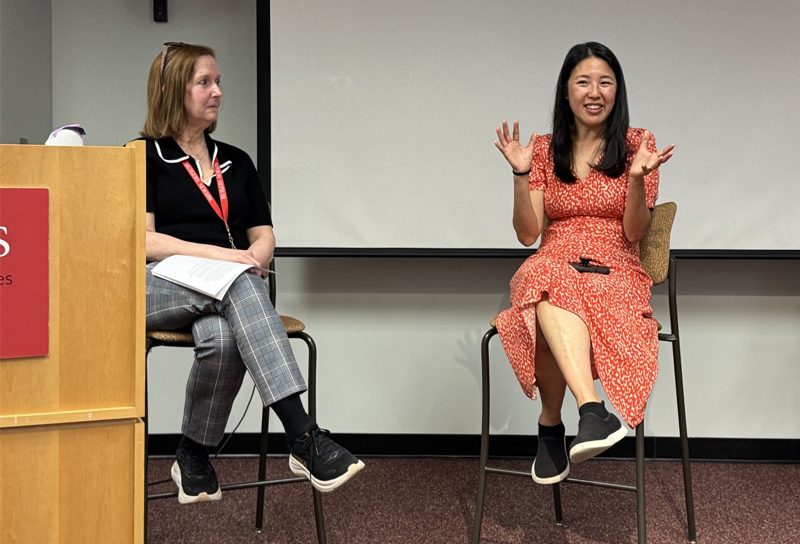
    Two people are seated in high chairs at the front of a room. One smiles and gestures with her hands while talking.
    The highlight of the workshop was a Q&A session with New York Times technology journalist Tiffany Hsu, who specializes in misinformation reporting.


    On April 1, librarians at Dana Library hosted The Erosion of Truth: How to Protect Yourself from Mis/Disinformation in the Age of AI, a hybrid virtual/in-person workshop. Mis- and disinformation in society’s information landscape is not new; however, the proliferation of generative artificial intelligence has compounded its impact on individuals, society, and our democracy. This workshop introduced foundational information literacy strategies for critically evaluating news and media content, along with available online tools to support this work. Students, faculty, and staff explored the rapid development of AI-generated deepfake videos, manipulated images, and viral misinformation, and tested their ability to distinguish between AI-generated and authentic content. Attendees were also introduced to real-world examples and professional fact-checking techniques, leaving with a personal toolkit for verifying information. 

    The highlight of the workshop was a Q&A session with New York Times technology journalist Tiffany Hsu, who specializes in misinformation reporting. Hsu fielded questions on topics including how New York Times reporters verify images and video, the challenges posed by AI-generated content to investigative journalism’s ability to establish credibility and truth, and the role that social media platforms play in the spread of misinformation. Participants enthusiastically expressed appreciation for her insights into these critical issues. 

    We hope to continue this discussion as technologies used to fabricate, manipulate, and mislead grow increasingly sophisticated, with the library planning additional workshops and learning opportunities to strengthen our community’s information resilience in the age of generative AI. 

    Co-Organizers of the event: Joanne Dera, Diane Biunno, and Naomi Gold 

  • Data for Change: Women in STEM Wikidata Edit-a-Thon

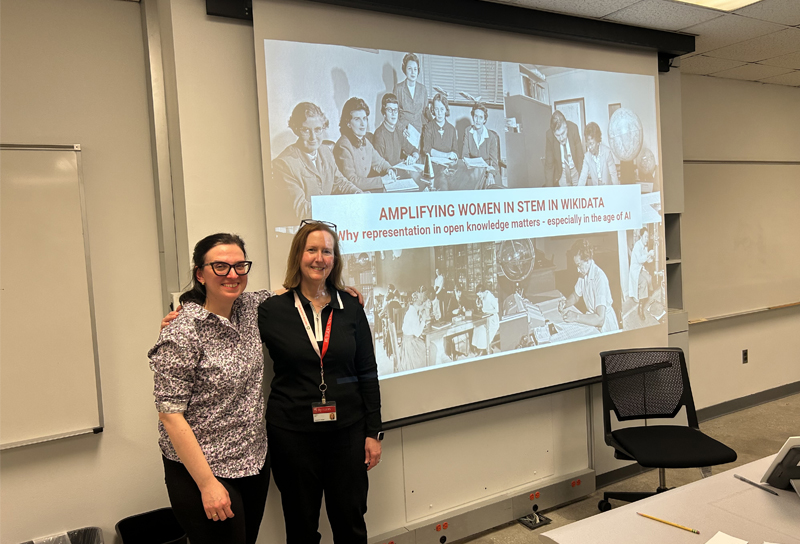
    Two people pose smiling in front of a large screen with an image projected that reads, "AMPLIFYING WOMEN IN STEM IN WIKIDATA: Why representation in open knowledge matters - especially in the age of AI
    Diane Biunno and Joanne Dera were among the co-organizers of the Women in STEM Wikidata Edit-a-Thon.


    On March 4, Dana Library hosted a Wikidata mini edit-a-thon focused on Women in STEM in collaboration with librarians from NJIT. The event brought together 13 participants ranging from beginner to advanced contributors, including students, librarians, and experienced Wikipedians. Attendees represented Drew University, NJIT, Smith Library, and Dana Library, along with members of the regional Wikimedia community. We were especially fortunate to have leadership from Wikipedia NYC and the Philadelphia Wikisalon in attendance. Their expertise was invaluable in supporting participants who were new to Wikidata and helping guide the editing process throughout the session. 

    During the edit-a-thon, participants expanded and strengthened approximately 30 Wikidata entries related to Rutgers and NJIT graduates. Contributors added new data points, improved existing information, and incorporated reliable references to support the entries. Participants also drew on Rutgers University Libraries and NJIT Libraries resources to enhance the records, demonstrating how library collections and research materials can be used to improve structured data and increase the visibility of our libraries’ collections and resources. 

    In addition to the hands-on editing work, participants learned what Wikidata is, how it functions as structured linked data, and why contributing to it matters. The session highlighted how improving data about women in STEM helps make their contributions more visible and discoverable. Because major platforms, such as Google, and large generative language models, such as ChatGPT and Google Gemini, draw on Wikipedia and Wikidata, expanding these records helps broaden public knowledge and address systemic gaps and biases in how women’s achievements are represented online and in AI-driven systems. 

    The event was a strong success and demonstrated significant growth potential. As a result, we are now in conversations with Wikipedia NYC and NJIT about organizing additional events and expanding this collaboration. With greater support from the Wikimedia community, future edit-a-thons could scale to larger participation and further leverage Rutgers and NJIT library collections to enrich Wikidata entries, both strengthening the global knowledge graph and helping drive researchers and readers back to our library resources and collections. 

    Co-organizers of the event:
    Dana Library Team: Joanne Dera, Diane Biunno, and Angela Lawrence
    NJIT Libraries Team: Bob Vietrogoski and Jill Lagerstrom

  • Introducing the Clement Alexander Price Archive and Circulating Collection

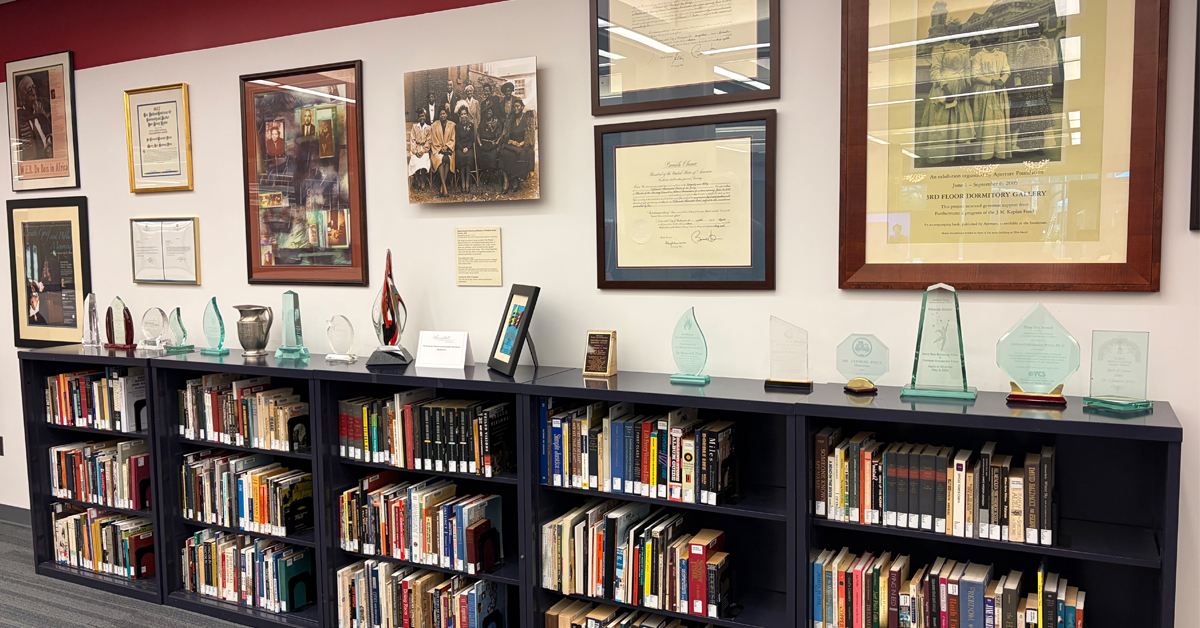
    A long bookshelf against a wall with various artifacts displayed on top and tightly grouped framed images on the wall above.
    The Clement Alexander Price Archive and Circulating Collection was unveiled at Dana Library in October.

    On October 24, the John Cotton Dana Library hosted a reception for the grand opening of the Clement Alexander Price Archive and Circulating Collection. The event featured an exhibition of items from Price’s archival collection and personal library. It also kicked off a year of programming called Clement@80, which is taking place around what would have been the 80th year of Price’s life. Speakers at the event included Amanda Clay Powers, associate university librarian for Rutgers University–Newark; Mary Sue Sweeney Price, Clement’s wife and Director Emerita of the Newark Museum; and Spencer Crew, Robinson Professor of American History at George Mason University, who coauthored a book with Price.

    Price was an eminent professor, renowned scholar, and dedicated citizen. His influence can still be felt in the very fabric of Rutgers–Newark, the city of Newark, and the entire nation. He was the Board of Governors Distinguished Service Professor of History at Rutgers–Newark; the founding director of the Institute on Ethnicity, Culture, and the Modern Experience (now the Price Institute); the vice chair of President Barak Obama’s Advisory Council on Historic Preservation; the chair of Obama’s transition team for the National Endowment for the Humanities; a member of the Scholarly Advisory Committee of the Smithsonian’s National Museum of African American History and Culture; and a trustee of the National Trust for Historic Preservation. You can read more about his tremendous legacy in this story on the Rutgers website.

    The Dana Library faculty and staff are pleased and proud to make the Price archive and collection available. Special recognition goes to two former associate university librarians for Rutgers–Newark, Consuella Askew and Rhonda Marker, for the acquisition of the collection, and to Mary Sue Sweeney Price for making it available.

  • Save the Date for the Dana Library Celebration

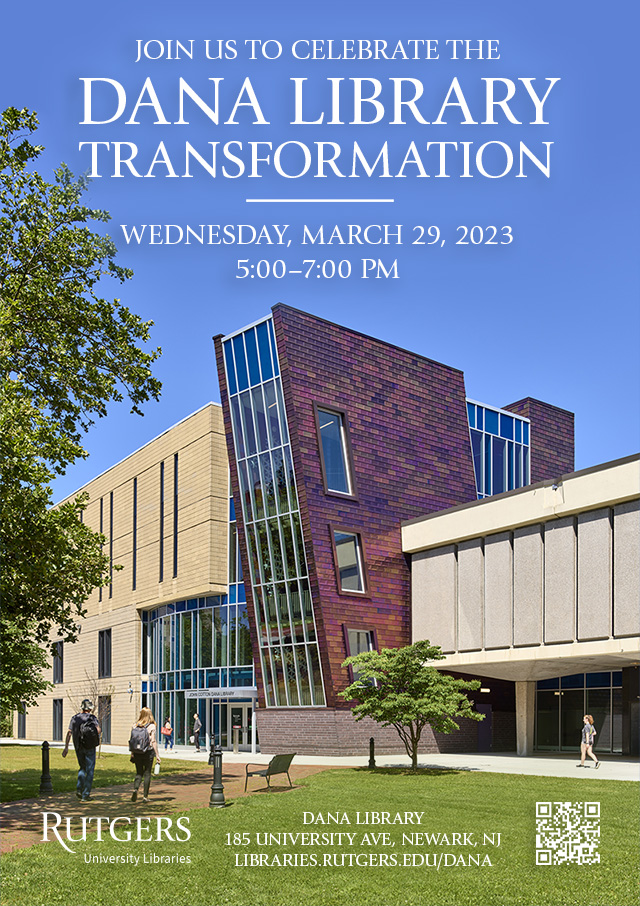
    Please save the date for a celebration of the Dana Library Transformation!

    Date: Wednesday, March 29, 2023
    Time: 5:00–7:00 p.m.
    Location: Dana Library, 185 University Ave, Newark, NJ 07102

    This is an invitation-only event, so please stay tuned for RSVP information.

    Dana Library Transformation Celebration poster.

  • Spring 2023 Workshops

    RUL spring 2023 workshops.

    Want to learn a new skill or refresh an existing one? Enroll in our free workshops today at libraries.rutgers.edu/workshops!

    Rutgers University Libraries’ spring 2023 workshops feature instructors, presenters, and subject-matter experts from our Camden, Newark, New Brunswick, and Health Sciences libraries. Our workshops are open to all members of the Rutgers community and offer instruction in:

    • Topics such as the digital humanities, data science, health sciences, Black history, library research, research papers, citation management, career development, digital privacy, software training, the Open and Affordable Textbooks Program, and more.
    • Research tools and methods such as Python, R, GIS, CINAHL, NVivo, data visualization, data management plans, systematic reviews, and more.

    Most of these workshops will be held online; several offer hybrid options. Please check back often as new workshops are added throughout the semester.

  • Maggie Harris-Clark Retires after 50 Years of Service

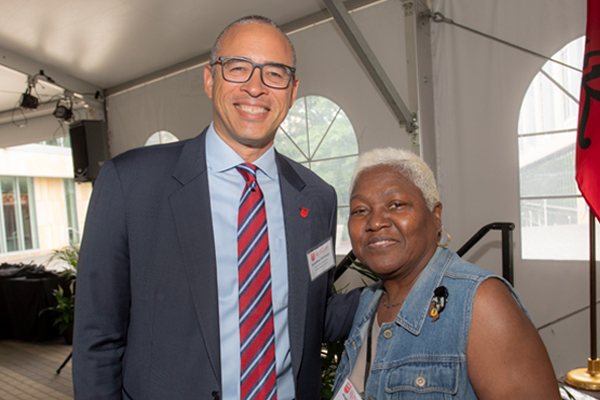
    Maggie Harris-Clark with Rutgers President Jonathan Holloway
    Rutgers President Jonathan Holloway with Maggie Harris-Clark at the 2022 Rutgers Staff Service Recognition Reception in the President’s Tent on Bishop Place (photo by Nick Romanenko/Rutgers University)

    After an extraordinary 50 years of service to the John Cotton Dana Library, Maggie Harris-Clark retired on July 1, 2022.

    Maggie began working at Rutgers University in January 1972. It was a cold and clear day. The temperature eventually climbed to 34 degrees, from a low of 10 degrees. William T. Cahill was governor of New Jersey, and Kenneth A. Gibson was Mayor of Newark, the first African American Mayor of Newark. Edward Bloustein was president of Rutgers University, and Horace Depodwin was Acting Provost, succeeded by James Young, the first Provost of Rutgers-Newark. Thomas Shaughnessy was the director of Dana Library. Maggie would work with several more directors: Eugene Neely (1981), Lynn Mullins (1987), Mark Winston (2008), and Consuella Askew (2015), as well as several interim directors (most recently, Jeanne Boyle and Rhonda Marker). Maggie also served under 10 University Librarians/Interim University Librarians.

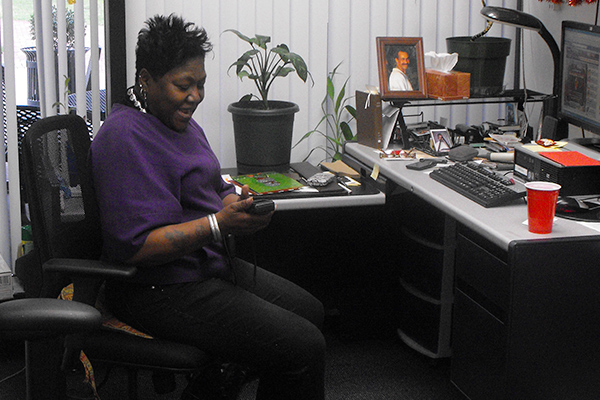
    Maggie Harris-Clark in her Dana Library office, ca. 1980s
    Maggie in her Dana Library office, ca. 2009

    Initially, Maggie worked at the Rutgers Law Library (Newark) in the Government Documents Department in a grant-funded position for six months. She then spent another six months at Dana Library in the Technical Services Department before Dr. Shaughnessy hired Maggie full time. Maggie worked for another long-time Dana Library employee, Madeline DeSantis, to maintain the card catalog and the shelf list. At that time, the library was using physical library cards to charge out books, but progress took over and advanced to using keypunch cards. Maggie transferred to the Circulation Department to work in course reserves for almost 10 years under the supervision of Mrs. Mann. About 20 years ago, Maggie was promoted to a Library Supervisor position in Circulation. Maggie is retiring as the head of Access Services at Dana Library. She has successfully navigated many changes from implementing the first automated circulation system through our current Ex Libris products. She has represented Dana Library on many cross-campus groups, including the Fulfillment Working Group.

    Although Maggie spent all her years at Rutgers on the Newark campus, she could be counted on to participate in Libraries-wide events. She has many friends throughout the Libraries who will miss her irrepressible optimism and kindness.

    Reflecting on her five decades at the university, Maggie fondly said, “Rutgers was my home away from home. I enjoyed working with my colleagues to advance the Libraries’ mission and to ensure our faculty and students received excellent service.”

    Maggie Harris-Clark at Dana Library
    Maggie in the Dana Library’s new third-floor open study space, June 2022 (photo by Dennis Mark/Rutgers University Libraries)

    This past June, President Jonathan Holloway and the university honored Maggie at the Rutgers Staff Service Recognition Reception. “I very much appreciated the recognition and respect,” Maggie remarked. “It’s wonderful knowing that I made a difference in the Rutgers community.”

    In retirement, Maggie plans to continue being active in her church and the Eastern Star. Her pastor has already announced her expanded role to the congregation. She has many plans for volunteer work and is looking forward to doing more at home. She is especially looking forward to the birth of her first great-grandchild in August. As busy as she will be, Maggie promises to keep up with her friends at Rutgers.

    We wish Maggie a long and happy retirement and express our warmest appreciation for her many years of steadfast service to Dana Library and Rutgers University.

  • Quick Takes on Events and News – January 2020

    Targum Documentary Spotlights NBMSA

    Islamic Art Wiki-a-Thon Returns to Dana Library 

    Dana Library hosted its second Islamic Art Wiki-a-Thon last semester. Professor Alex Seggerman’s Islamic Architecture course was one of a group of classes participating in the December 9 Islamic Art Wiki-a-Thon. Students spent the semester learning how to do research and edit Wikipedia pages. They prepared and wrote drafts, updating current Wikipedia articles on various Islamic architecture sites. During the event, they came together and made official changes to articles. They were joined asynchronously by students at Temple University and the University of Texas. 

    On Exhibit at Douglass Library 

    MARY H. DANA WOMEN ARTISTS SERIES GALLERIES
    Gendering Protest: Deborah Castillo and Érika Ordosgoitti
    Exhibition: January 21April 3, 2020
    Curator: Tatiana Flores, Associate Professor of Latino & Caribbean Studies and Art History
    Gallery Hours: M-F 9 a.m.–10 p.m.
    Public Event
    Reception and Artist’s Lecture: Wednesday, March 25 | 5:006:45 p.m.
    RSVP: womenart@cwah.rutgers.edu
    Galleries and event are free and open to the public.
    cwah.rutgers.edu @CWAHatRutgers #GenderingProtest 


  • Dana Library Transformation Project

    3D render of building
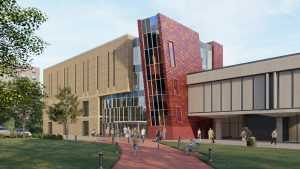
    An architectural rendering of the exterior addition.

    These are exciting times for Dana Library. Last month, we began a series of renovations that will address the highest priorities for improving the library that were identified through the Rutgers University–Newark strategic planning process several years ago. The changes will make the library more user friendly in numerous ways, including finally fitting out the third floor, which has been shell space since the construction of that wing decades ago.

    The results of this project involve enhancements that will create new study and learning spaces for students, facilitate ease of access to the collections and departments within, and the construction of a new center to support teaching faculty:

    Construction fence around building
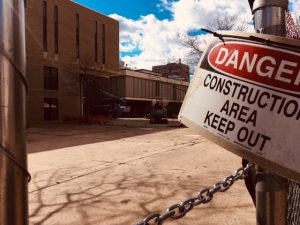
    Construction on the library began in March and is scheduled to be completed in April 2020.
    • An addition to the library is being built to better facilitate the flow of traffic to all five floors of the building. A larger stairwell and high-capacity, high-speed elevator are being installed to allow for large groups of people to move up and down the stairwell with ease, as well as shorten elevator wait time and accommodate more people.
    • The centerpiece of this project is the construction that will take place on the third floor. This includes additional quiet study space for our students and the new P3 Collaboratory for Pedagogy, Professional Development, and Publicly-Engaged Scholarship at Rutgers University–Newark. This open study space will provide an additional 60+ seats, along with numerous conveniently located outlets for devices.
    • This construction will also allow us to enhance our archives spaces and services. A space will be created to house the new Dana Archives departments providing our local university archives collections with a formal home. The Dana Archives and IJS will share the newly created reading room that will accommodate a larger number of classes and independent researchers at one time.
    • This is topped off by an iconic architectural feature on the plaza side of the building that will serve as a beacon to campus visitors, students, faculty, and staff alike.

    Construction has already begun and is scheduled to be completed in April 2020. I’ll plan to deliver updates from time to time in the Agenda, but if you want the latest information as it’s available, head over to the Dana Library Transformation Project blog, where we post updates at least once a week after our meetings (and don’t forget to sign up for the email list to receive alerts when new posts are published).

    Thank you for following along on this journey toward the future of Dana Library!

  • Dana Library and Institute of Jazz Studies Host Society of American Archivists Workshops

    workshop photo
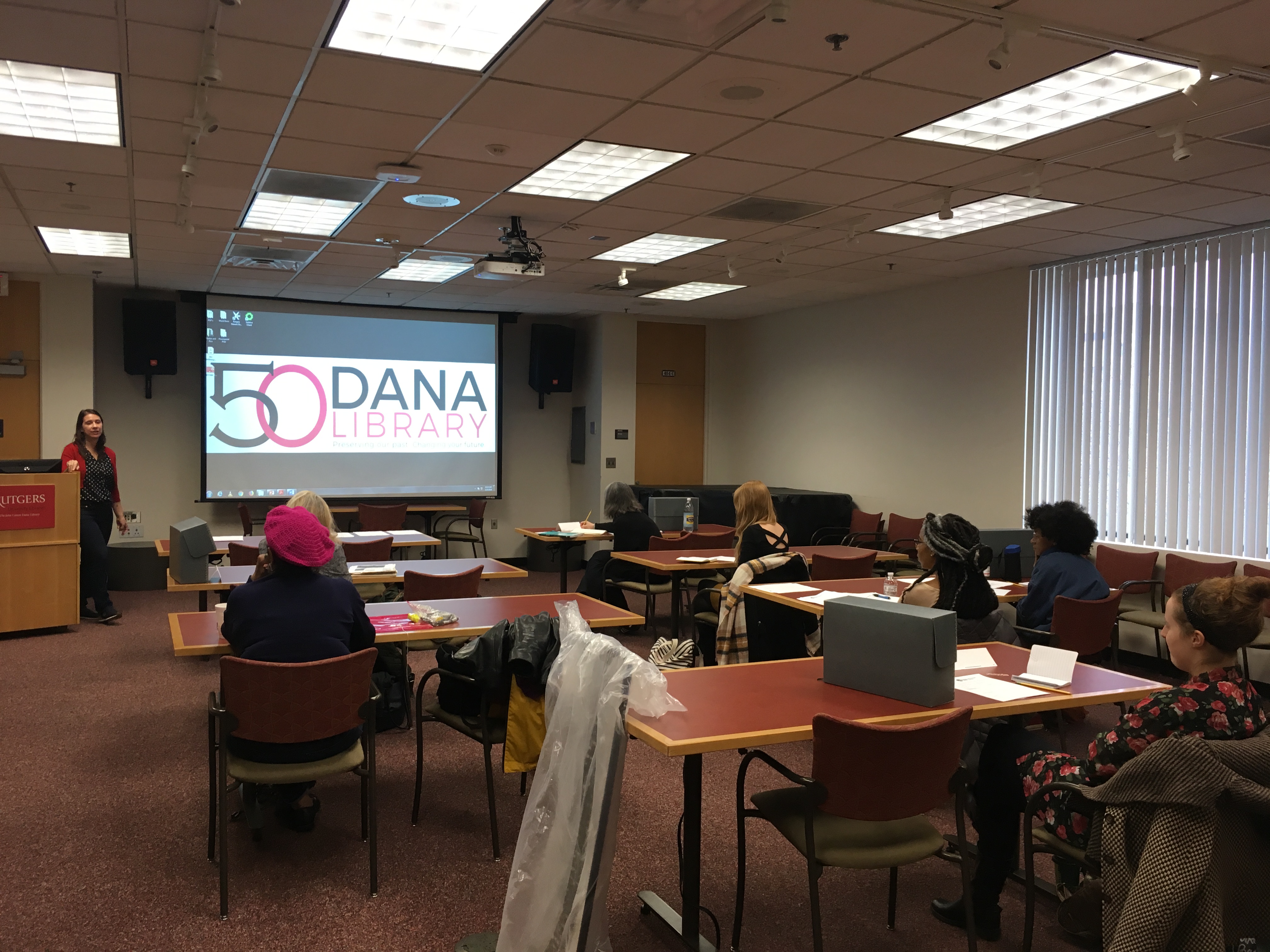
    The SAA workshops provided free training on archival basics to non-professionals who work or volunteer at institutions that cannot afford to employ professional archivists.

    In November and December 2018, Dana Library and the Institute of Jazz Studies hosted a series of five workshops presented by the Society of American Archivists (SAA) via SAA’s “Lone Arranger” Section. The workshops provided free training on archival basics to non-professionals who work or volunteer at institutions that cannot afford to employ professional archivists. The overall goal was to help preserve and provide access to archival collections in New Jersey, hidden due to limited access to information on professional archival practice. Similar workshops were held across the state in Atlantic City, Trenton, and Chester, including one led by the Libraries’ Tara Maharjan. Special thanks to Adriana Cuervo for arranging for refreshments and to Mark Papianni for setting up the workshop space.

  • Latino New Jersey History Project

    New Jersey has a remarkably diverse, though largely understudied, Latino population.  In 2016, according to the American Community Survey, people who identify as Hispanic or Latino were estimated to number over 1.7 million making them nearly 20 percent of all New Jersey residents.  Yet we know very little about their roots. Who are the Garden State’s Latinos? What is their history? This summer, seven Rutgers undergraduates and history Ph.D. student Carie Rael worked with Lilia Fernandez, Henry Rutgers Term Chair in Latino & Caribbean Studies and History, to find out as part of the Latino New Jersey History Project.  Their goal was to research, document, and record the history of New Jersey’s diverse Latino populations. Along the way, they received important assistance on digital tools and platforms from New Brunswick Libraries personnel Stacey Carton, Jan Reinhardt, and Francesca Giannetti.

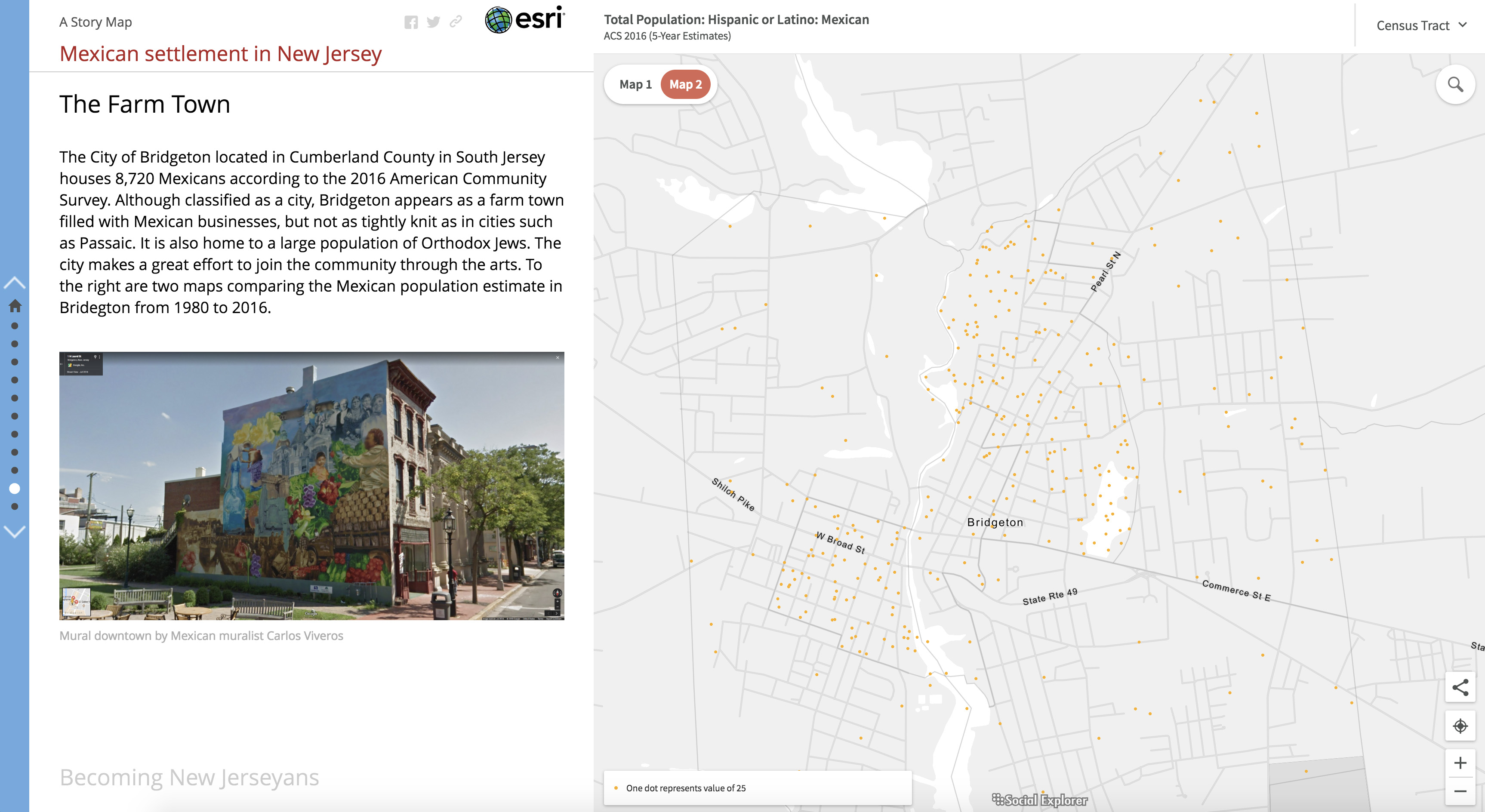
    The students used a variety of sources and methods. They gathered census data, for example, to produce maps and tables enumerating Latinos throughout the state, its counties, and its main cities and towns. Some were surprised at what they learned. While we might expect Newark, Elizabeth, and Paterson to have large Latino enclaves, few realized that New Brunswick is 56 percent Hispanic and West New York is 78 percent Hispanic (both as of 2016).  The town of Bridgeton in South Jersey has one of the largest concentrations of Mexican immigrants in the state. Census data revealed unexpected trends and unlikely settlement destinations.
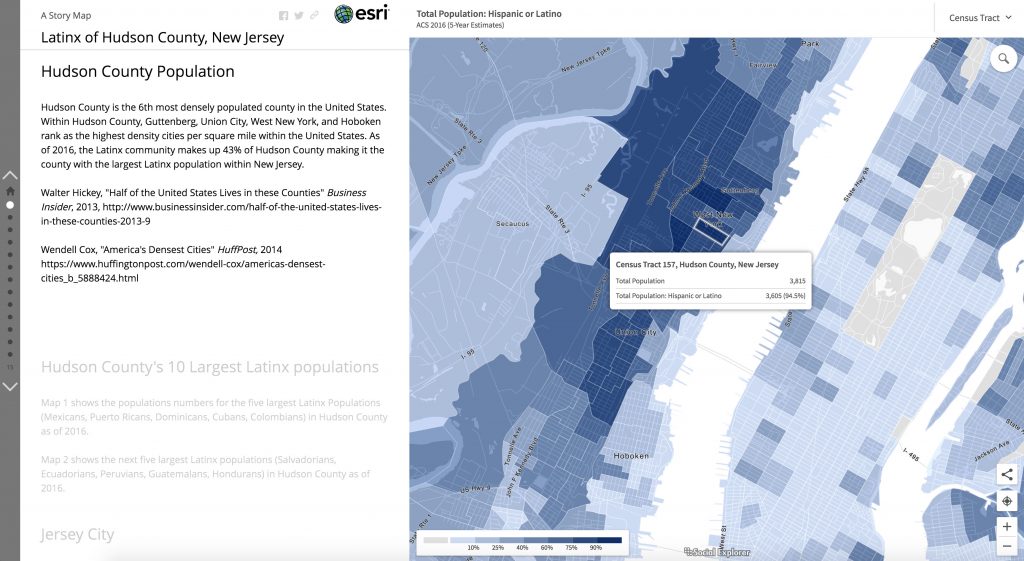
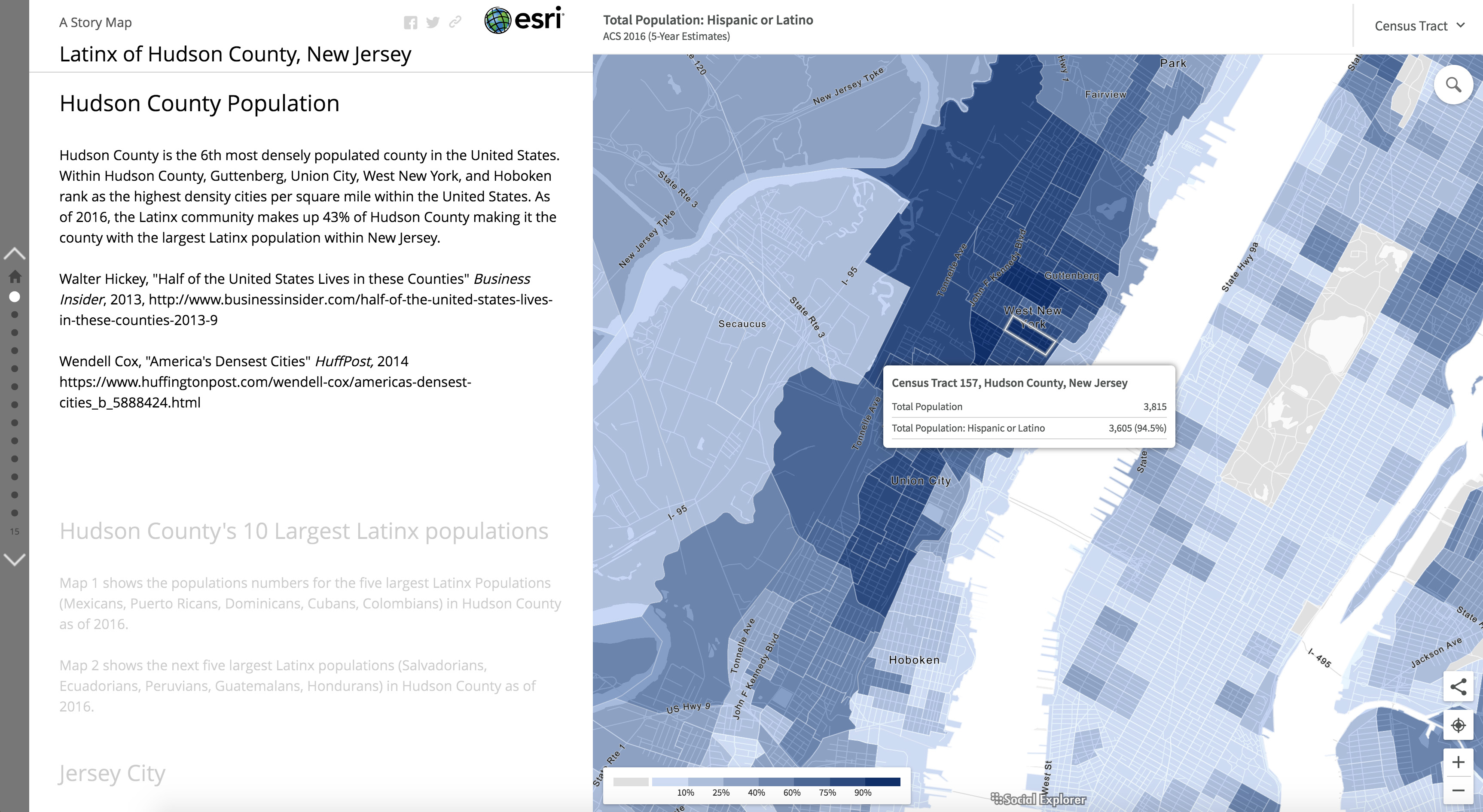
    Hudson county map

    With training from Francesca Giannetti, digital humanities librarian, students learned how to create thematic maps in Social Explorer and multimedia narratives integrating images, text, and multimedia embeds in ArcGIS’s Story Maps.  They learned about theories of place and space in spatial narratives, as well as elements of data and visual literacy through the strategic exploration of Social Explorer’s data sources, spatial geometries, and visualization types. Through the students’ mapmaking efforts, they were able to trace demographic changes over time, settlement patterns, and the migration stories of individuals and entire communities.
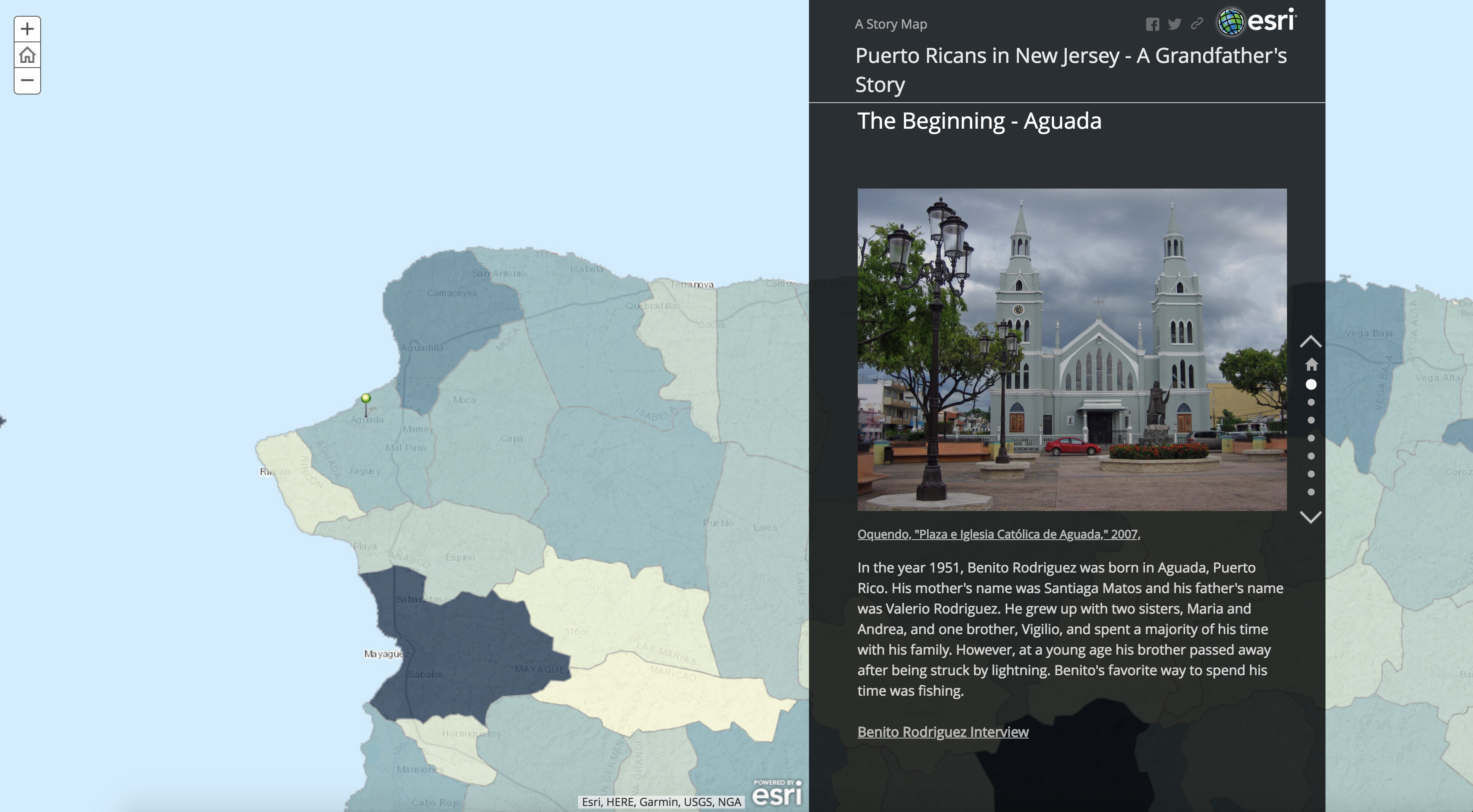
    Aguada

    Students also visited the Puerto Rican Community Archives (PRCA) at the Newark Public Library to learn about how the PRCA has collected more than one hundred oral histories over the past two decades and has gathered many archives and records of New Jersey’s Puerto Rican communities.

    Perhaps the most exciting part of the summer was completing oral histories with local residents. Shaun Illingworth and Kathryn Rizzi of the Rutgers Oral History Archives (ROHA) provided training and guidance on ethical and practical considerations in conducting oral histories.  After extensive training, background research, and preparation, students went out and recorded oral history interviews with various Latino residents and community leaders. Some were able to interview members of their own communities, while others interviewed important figures like Board of Governors member and Rutgers alum Martin Perez, or Irving Linares, the publisher of a Spanish language newspaper in Newark for the past 40 years.

    Since the group created audio or video recordings of their oral histories, they also benefited from basic video editing training at the Douglass Media Library with Stacey Carton. Students attended a workshop that focused on Adobe Premiere video editing software (available at the Fordham spaces in Douglass Library), but also covered topics relating to storytelling, project organization, and the history of editing. They later utilized the Fordham spaces to continue working on their projects.  Jan Reinhart provided support with audiovisual equipment as well.  Using their video training, two groups of students were able to produce short videos—one on the history of New Brunswick and another on the Latino populations of Union City.  These will be posted online, along with the oral histories and map projects, so they can be made available to public audiences.

    The students and Professor Fernandez learned a great deal about New Jersey’s rich history. They discovered that the state’s sizeable Latino population is relatively recent, having grown mostly since the mid-1980s through migration waves that brought Mexicans, South Americans, Central Americans, and Dominicans to the Garden State. In 1970, for example, the census counted only 135,656 people of “Spanish origin” (what today we generally refer to as “Latinos” or “Hispanics”), compared to the 1.5 million the census counted in 2010. The largest subgroups, as of that year, include Puerto Ricans (27% of all Latinos), Mexicans (14%), Dominicans (13%), Spaniards (7.7%), Colombians (6.5%), and Ecuadorians (6.5%). Today, one in five Jersey residents identifies with some type of Hispanic or Latino ancestry.

    The project team included Amy Castillo (Criminology and Latino and Caribbean Studies ’20), Tania Mota (Journalism and Media Studies and Latino and Caribbean Studies ’20), Aracely Ortega (Sociology and Africana Studies ’20), Aziel Rosado (Mathematics and Latino and Caribbean Studies ’20), Kevin Rosero (History and Political Science ’19), Laura Sandoval (Sociology ’20), and Luz Sandoval (History and Public Health ’19).

    Their work is beginning to be shared online. The following are links to individual projects built using the Story Maps platform.

    Mota, Tania. “Mexican Settlement in New Jersey.”

    Rael, Carie. “Latinx of Hudson County, New Jersey.”

    Rosado, Aziel. “Puerto Ricans in New Jersey: A Grandfather’s Story.”

    Rosero, Kevin. “A Grandmother’s Journey.”

    Sandoval, Laura. “Latino History of New Brunswick.”

    Professor Fernandez plans to continue the Latino New Jersey History Project in the future to keep exploring and documenting the diverse and varied origins of the state’s Hispanic communities. The maps, oral histories, and other digital humanities elements will help make this history accessible to audiences beyond the university and beyond the state.

    Lilia Fernandez, Stacey Carton, and Francesca Giannetti