Author: Tao Yang

  • Now on View at the East Asian Library: “Akiko’s Dolls: The Story of a Nagasaki A-Bomb Survivor”

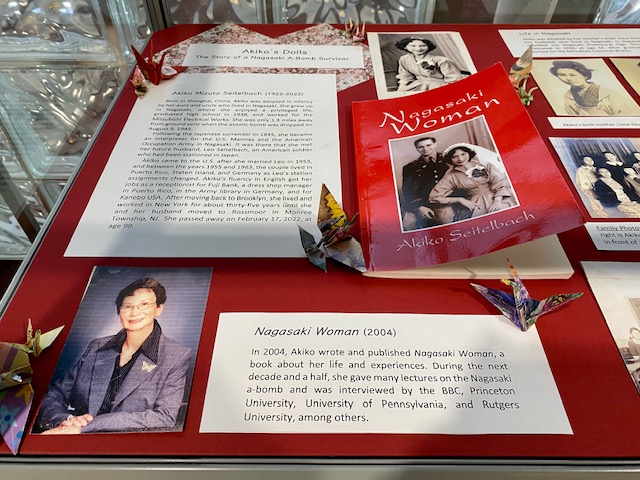
    Akiko’s Dolls: The Story of a Nagasaki A-Bomb Survivor is a special exhibition at the East Asian Library that will be displayed through February 2023. The exhibit features dolls, photos, and writings of Akiko Mizuta Seitelbach, a Japanese woman who survived the atomic bombing of Nagasaki. Please stay tuned for more East Asian Library exhibitions.

    Akiko's dolls.
    Dolls for Doll’s Day/Girls’ Day (Hinamatsuri), gift of Akiko Mizuta Seitelbach.

    Akiko Mizuta Seitelbach was born on October 25, 1922, in a section of Shanghai that, at the time, was a colony of Japan. Adopted by her aunt and uncle when she was just five months old, Akiko grew up in Nagasaki. She graduated high school in 1938, just as World War II started in Japan. During the war, she worked in the supply office of Mitsubishi Electrical Works. On August 9, 1945, when the atomic bomb was dropped, Akiko was about 1.3 miles from ground zero. She felt firsthand the destruction and desperation of the Japanese people in the days following and after the war ended.

    This slideshow requires JavaScript.

    Following the Japanese surrender in 1945, Akiko became an interpreter for the U.S. Marines and then the American Army of Occupation in Nagasaki. After marrying an American soldier of the 34th Infantry Regiment in 1953, she came to America and lived at an Army base in Fort Hamilton, Brooklyn. Between 1955 and 1963, Akiko resided in Puerto Rico, Staten Island, then Germany as her husband’s station assignments changed. She worked as a receptionist for Fuji Bank, a dress shop manager in Puerto Rico, in the Army library in Germany, and for Kanebo USA. Following the Cuban Missile Crisis, Akiko moved back to Brooklyn, where she lived and worked for about 35 years until she and her husband moved to Monroe Township, NJ. Akiko passed away aon February 17, 2022.

    "Nagasaki Woman" by Akiko Mizuta Seitelbach.

    Nagasaki Woman by Akiko Mizuta Seitelbach
    Rutgers Oral History Archives

    Read Akiko’s interviews with the Rutgers Oral History Archives at oralhistory.rutgers.edu.

    BBC Interviews
    Sponsors

    This exhibition is co-sponsored by the Rutgers School of Arts and Sciences’ Department of Asian Languages and Cultures and the East Asian Library.

    "Akiko's Dolls" exhibition poster.

  • Ex Libris Implementation Project Update – June 2018

    quicksearch logo
    QuickSearch goes live on June 5.

    Our new library system Alma and Primo (a.k.a QuickSearch) are expected to go live next week. It is incredibly exciting to be in the home stretch after more than a year of hard work. We truly appreciate what library colleagues, especially those on the Implementation Team and working groups, have done to get us to this point. We anticipate that the last few days before launch will be full of questions and new developments, so we have started to send daily emails to RUL everyone with updates and additional information. Please follow these daily messages for up-to-date information. In this report, we will summarize the progress made in the previous month.

    Migration Update

    The Libraries began technical services freeze to extract Sirsi data for the migration to Alma in early May. The Implementation Team submitted the data on May 11 and received the migrated data in the Alma implementation environment from Ex Libris on May 25, both on schedule. Over the Memorial Day weekend, we discovered some errors in the migrated data and had a conference call with Ex Libris. Ex Libris assured us that they would work with us to correct the errors but several additional days would be required to complete the necessary work. Therefore, we determined the launch of the new system would be delayed until Tuesday, June 5. The delay has ramifications for workflows, work schedules, and more, but there are also benefits to the change. Going live early in the work week is much better and the extra time can be used for additional preparations. We thank everyone for their patience and support as we work through these unexpected hiccups.

    The Access Services staff started to use Alma offline client for circulation activities on May 26. On May 28, we delivered to Ex Libris the Sirsi circulation (or fulfillment) data for migration to Alma. The offline client will be in use until go-live on June 5.

    In anticipation of the launch of the new system, the Implementation Team and working groups made significant progress on many issues related to the new system, including the access for barcode and PIN users, simplification of location codes, digitization and ILL workflows, and Alma permissions and roles. The content on the library website has been updated to reflect the adoption of Primo, and further changes will be planned and implemented after go-live. Our communications activities were strengthened by the expert advice and support from the Communications Department. In the meantime, we are continuing to investigate some outstanding issues, such as book delivery to offsite locations.

    Primo Training and Important Links

    Earlier in May, a total of over 150 library faculty and staff attended nine Primo (QuickSearch) training sessions across all four campuses. We thank everyone who participated in the training. Here are some additional resources about Primo features and functionalities:

    Search Box and Website

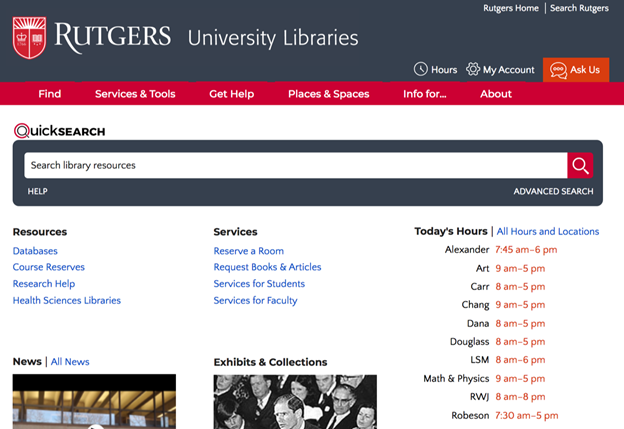
    We have finalized what the search box and website will look like at go-live. We are happy to share with you this sneak peek (see below). The decision was made to use a full-width single search box and you can see the QuickSearch logo in place.

    Please feel free to email the Implementation Team at exlibris@rutgers.libanswers.com for any questions. Thank you!

    Tao Yang and Abbey DiPaolo

  • Ex Libris Implementation Project Update – May 2018

    ExLibris graphicMigration Milestones 

    The implementation project continued to move forward as scheduled in April. We submitted the final migration form and link resolver form to Ex Libris. To address issues encountered during the Alma/Primo testing, we have been having weekly functional calls with Ex Libris and communicating with them constantly via the project’s Basecamp site. The Data Migration and System Integration Working Group has also been working hard on the third-party integration issues. The extract of Sirsi data for the final data load to Alma will start on May 5.  

    QuickSearch Announcements and News Page 

    Primo will be known as QuickSearch to the Rutgers community after we go live on June 1. In her recent messages to the university and RUL communities, Krisellen announced the release date of QuickSearch (June 1) and its impact on students and faculty. The Libraries also created a QuickSearch news page for the public. Please use the news page as a resource to answer user inquiries. Students and faculty can also submit questions or comments about QuickSearch directly to reference@rutgers.libanswers.com 

    Upcoming Service Changes 

    In her message to RUL everyone, Krisellen also highlighted the following service changes that are coming up:  

    • Acquisitions: There will be a freeze of acquisitions and cataloging activities (except reserve purchases) between May 5 and June 1. Normal acquisitions functions will resume after June 1, but we will prioritize the purchase of course reserves and faculty requests. The process of allocating funds for selector-initiated acquisitions will resume in the fall, which is in line with previous years. 
    • Reserves: Starting May 5, we will have a special process in place to accept and place reserve orders, but we anticipate the turnaround time will be longer than usual. Reserves that are placed after May 5 will not transfer automatically to Alma and will be manually transferred after June 1. Additional summer programs like EOF may be similarly affected. 
    • Circulation and ILL: From May 29 to May 31, we will transition to an Alma offline client for circulation. This step is necessary to populate Alma with existing circulation data prior to launch. Users will not experience down time, but during this three-day period, Access Services staff will stop using Sirsi and instead work with the Alma client. On June 1, the data from the offline client will be merged back into Alma, so there will be no data loss and everything will be synced. This will also impact Interlibrary Loan, as there will be potential delays and interruptions in processing loans and borrows of physical items. More information on these workflows and training opportunities will be available soon. 

    These temporary or short-term service changes are necessary for the successful implementation of Alma and Primo. We thank all the library faculty and staff for the help to minimize disruption.  

    Primo Training Schedule 

    Discovery Services Librarian Joseph Deodato recently announced a Primo/QuickSearch training schedule (see following) for public services librarians and staff. Many library faculty and staff have registered to attend the training sessions. Even though the registration is now closed, Joseph welcomes colleagues who did not register to attend any of the sessions. Please contact Joseph if you have any questions.  

    Primo Training Schedule (as of April 25, 2018) 

    Date  Location  Time 
    May 1  Dana Electronic Classroom II  2 p.m. – 4 p.m.
    May 2*  Robeson Electronic Classroom  2 p.m.. – 4 p.m.
    May 4*  Alexander SCC Lecture Hall  2 p.m. – 4 p.m.
    May 8  RWJ Electronic Classroom  2 p.m. – 4 p.m.
    May 9  Dana Electronic Classroom II  10 a.m. – 12 p.m.
    May 11  Smith Electronic Classroom I  10 a.m. – 12 p.m.
    May 15*  Carr Conference Room  2 p.m. – 4 p.m.
    May 18  Alexander Pane Room  10 a.m. – 12 p.m.

    *indicates a new session or change of location 

    Submitted by Tao Yang and Abbey DiPaolo.

  • Ex Libris Implementation Project Update – April 2018

    ExLibris graphicAlma Workshop 

    From March 13 to 15, an Ex Libris consultant came to the Libraries and facilitated a three-day workshop on Alma workflows. The first one and half days of the workshop were devoted to technical services topics, from ordering to receiving/activating to invoicing to cataloging. The second half of the workshop covered fulfillment issues, such as user management, circulation, requests, resource sharing, and course reserves. The participants of the workshop included the Implementation Team members, the working group members, and staff from technical, collection, and access services. The university librarian also attended most of the sessions. The feedback on the workshop was generally positive: The Ex Libris facilitator was very knowledgeable and well prepared. The demonstrations went smoothly. The discussions were both lively and calm, perhaps thanks to the puppy pictures the facilitator included throughout her presentation.  

    An important takeaway for everyone at the workshop is that we need to think about changing our workflows and sometimes policies to maximize the benefits of Alma, instead of simply trying to transfer our current practices in the Sirsi environment to Alma. This will guide the work of the team and working groups in the coming months. 

    Other Developments 

    Preparing for and participating in the Alma workshop was the main activity for the Implementation Team and working groups in March. All the working groups were also busy with both internal training and testing. The Implementation Team had four weekly training sessions with Ex Libris, two on Alma and two on Primo VE. On the migration front, the Data Migration and System Integration Group is currently working hard on third-party integration issues. 

    Submitted by Tao Yang and Abbey DiPaolo 

  • Notable Library Acquisitions in the First Quarter of 2018

    Q1 2018 purchasesCompiled by the Collection Analysis Group 

    Journals and Periodicals 
    Ebooks and Encyclopedias 
    Databases 


  • Ex Libris Implementation Project Update – March 2018

    Ex Libris Implementation Project Update – March 2018

    ExLibris graphicMigration Milestones in February

    The implementation project continued to move forward at a brisk pace. The Libraries’ Implementation Team finished the Alma configuration form and the Primo Central Index activation form. Ex Libris completed the Alma test data load and has released the Alma/Primo environments to us for data review and testing. Our Ex Libris consultants have given the library team very positive feedback: All of the tasks assigned to the Implementation Team have been completed on schedule or ahead of schedule. We are told that our data looks cleaner and has fewer problems than other libraries also migrating from Sirsi to Alma. The consultants are very confident about the successful launch of Alma and Primo on June 1st.

    Training for the Team and Working Groups

    In February, the Implementation Team continued the weekly training required by Ex Libris. All the working groups affiliated with the project were also engaged in extensive training in their functional areas. The considerable amount of time we are spending on internal training is paying off. Following a demo by two CTS staff on resource management at a training session, our Alma consultant remarked that she had never seen a client who could walk in at this stage of implementation and complete the tasks so smoothly!

    New Staffing Need

    As the implementation project progresses, we discovered an urgent need for an electronic resources librarian who has experience with Alma and Primo, so a new position was created and is being advertised. The new Electronic Resources Librarian will report to the Discovery Services Librarian and work closely with the CSRS staff responsible for licensing and renewing online journals and databases. In the past, we in the Libraries often talked about the need to increase staffing for e-resources management and support, since the library collections have shifted decisively from print to electronic. The new Electronic Resources Librarian position is an important step in that direction.

    Upcoming Workshop on Alma Workflows

    From March 13-15, an Ex Libris consultant will be onsite at Rutgers to conduct a three-day workshop on Alma. The primary goal of the workshop is to assist us with reviewing and defining major workflows using Alma. The format of the sessions will primarily be discussion as this is not a training exercise. The Implementation Team is working with Ex Libris to finalize the workshop agenda, which will likely include sessions on acquisitions, resource management, e-resources, and fulfillment. The working groups will decide who should attend the sessions in their respective areas.

    Plan for All Staff Trainings

    The Libraries’ working groups are also hard at work designing training and developing a related delivery plan to provide the training to our librarians and staff. As we reported last month, the all-staff training sessions will be conducted in person, by library staff, and with Rutgers data and configurations. Please stay tuned for more information about all staff training opportunities from the working groups.

    Tao Yang and Abbey DiPaolo

  • Ex Libris Implementation Project Update – February 2018

    New Milestones in January

    Throughout January, the Ex Libris Implementation Team focused on preparing for Symphony to Alma test load. Thanks to the hard work of Chris Sterback, Gracemary Smulewitz, and other team members, we successfully turned in the migration forms, the P2E (Physical to Electronic) files, and the Symphony data files to Ex Libris on time. The work has been very time-consuming and painstakingly detailed, but our team understands that it laid the foundation for the next steps of migration – test load configuration, integration

    with third party systems, cutover load, and go live. We continued to receive valuable feedback and support from Access, CTS, CSRS, and IIS staff.

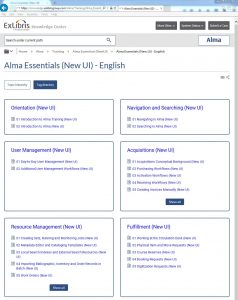
    The Implementation Team spent a lot of time in January going through an extensive training program using pre-recorded videos in the Alma Essentials (New UI) series.
    The Implementation Team spent a lot of time in January going through an extensive training program using pre-recorded videos in the Alma Essentials (New UI) series.
    Internal Training Becomes A Priority

    The Implementation Team also spent a lot of time in January on learning the functionalities of Alma. Guided by Ex Libris staffers, the team is going through an extensive training program using pre-recorded videos in the Alma Essentials (New UI) series. The Primo training series is forthcoming. Every week all the team members are required to watch videos on a certain topic, such as acquisitions, and then meet with the Ex Libris consultants for one hour via WebEx to perform sample tasks and discuss issues. The training program for the team will continue from January to March.

    Internal training is also a priority for all the affiliated working groups. With input from the lead members on the Implementation Team, each group is responsible for identifying relevant training materials and choosing the most appropriate format for internal training – self-study, group sessions, or a combination of both.

    Preliminary Timeline for All Staff Trainings

    The working groups are expected to design and deliver trainings specific to their roles for all the library faculty and staff. For instance, the Discovery Working Group will develop trainings on Primo discovery environment for all the public services librarians and staff. The all staff trainings will be conducted in person by library staff with Rutgers data and configurations, so the opportune time for these trainings will be after the Alma/Primo test environment has been set up with our own data and configurations, but before our June 1 go live date. This means an April to May timeline is most likely. As we get closer to April, the Implementation Team and working groups will provide more information on all staff training opportunities.

    Information You Can Use – Primo and Alma Fulfillment Videos

    We asked Joseph Deodato and Chris Sterback, the team liaisons to Discovery and Access groups, to recommend some introductory materials on Primo discovery environment and Alma circulation function. Joseph recommended two Primo videos for public services librarians: Using Primo and How Primo Works. Chris suggested that all Access Services staff watch these two user management and five fulfillment videos.

    Got Questions?

    Please feel free to contact us or reach out to the other members of the Implementation Team. The library also has a website for Alma/Primo implementation, on which you can get more information about the project or ask questions via the “Contact” form. Thank you for your interest!

    Tao Yang and Abbey DiPaolo

  • Ex Libris Implementation Project Update – November 2017

    Ex Libris Implementation Project Update – November 2017

    In spring 2017, the Libraries decided to adopt the new library service platform (Alma and Primo) from Ex Libris. The decision was made in support of two major librarywide priorities: improving information control and optimizing collection development and management. What this means to the Libraries is that Alma will replace the current SirsiDynix system and Primo will replace both the EBSCO Discovery Service and VuFind catalog. Unlike our current configurations, Alma and Primo are fully integrated with each other. They also provide other important benefits: a unified interface to manage our entire collections of electronic and print resources, rich analytics for making better decisions about collections, the potential of improving the discovery experience of library users, and the opportunities to collaborate with other Alma/Primo libraries.

    The Ex Libris Implementation Project officially began at Rutgers in late September, when the Implementation Team was formed and met for the first time. The team includes seven members from the Libraries’ infrastructure units – Tao Yang, Abbey DiPaolo, Joseph Deodato, Chad Mills, Gracemary Smulewitz, Chris Sterback, and Mary Beth Weber, with Tao and Abbey as the co-leads. The team has had a busy and productive month: we completed and submitted to Ex Libris the Alma Implementation Form, which is the first step of the implementation process. We have also begun to work on the validation of SIRSI Symphony data extracts, creation of the project website, and development of internal goals, among other things. As a happy coincidence, the Ex Libris Northeast User Group held its annual meeting in Jersey City in mid-October, so all the team members and several other colleagues had an outing to Jersey City and learned the experiences of many libraries who have adopted Alma and Primo.

    Currently, the project is still at the pre-implementation phase, which is when the library team works with an Ex Libris consultant to get ready for the implementation. The project will kick into high gear in early December, when the implementation phase officially begins. The new system is expected to go live on June 1, 2018. Between early December and June, there will be many opportunities for library colleagues to get involved in the project and become familiar with the new system. Please stay tuned. Thank you!

    Tao Yang & Abbey DiPaolo


    Save

  • Rutgers Joins the E-book Revolution

    vivaOn December 26, 2015, Izzy Stern tweeted: “Today is the day I found out that Rutgers doesn’t even have full ebrary access. So many sad faces.” As a graduate student in a major humanities department at Rutgers–New Brunswick, Izzy might have expected to use ebrary, one of the largest academic e-book resources, for her research in the winter break, but then had a rude awakening that day when she found out that it was not available at Rutgers, yet. So she went online and shared her frustration on Twitter with the entire world, which was totally understandable. As a matter of fact, the lack of access to e-books was a major source of complaint from our students and faculty about the library collections—hundreds of similar comments can be found in the results of the LibQual+ and previous Counting Opinions surveys. Here, I quoted only Izzy’s tweet because it is on the open web, but the problem she reported was a common one.

    What a difference a few months have made! Izzy and her fellow students may be glad to hear that the Libraries have made great strides to improve their access to e-books. Here are the major e-book resources that became available at Rutgers in the last several months:

    • Ebrary Academic Complete: a subscription-based collection of about 140 thousand e-books on all academic subjects.
    • Springer Nature frontlist e-book collections: 7,175 purchased e-books published in 2016 in STM (Science, Technology, and Medicine) and Social Sciences.
    • PALCI/EBSCO Demand-Driven Acquisitions Program: about 1,000 new e-books expected to be purchased during the academic year.

    In addition, we are evaluating a new PALCI/JSTOR e-book program. The program will purchase several hundred high-use titles and also provide academic year-round access to all the JSTOR e-books, a collection of over 40,000 high quality scholarly monographs from many of the major university presses.

    Over a decade ago, the Libraries began to acquire small, subject-based e-book collections. In 2014 we joined HathiTrust, which gives us access to several million out-of-copyright works. However, the availability of large, comprehensive collections of current e-books today represents a quantum leap or a sea change. Since the Rutgers community is celebrating the 250th anniversary of the University this year with a revolutionary spirit, it may be befitting to call this significant change a revolution, an e-book revolution.

    Stepping outside Rutgers, we will find that the e-book revolution is sweeping through the academic and research libraries in the region and the country. Actually, all of our major e-book acquisitions I mentioned earlier were made or will be made together with our partners in BTAA, PALCI, and VALE. This shows that Rutgers is adopting e-books at about the same pace as the majority of academic libraries. Being in the majority does not seem as glorious as playing the role of innovator or early adopter, but it is still an advantageous position, especially from a user perspective. Of course, if we moved any slower, we would have been left behind or characterized as reactionary by our peers.

    Peer pressure is not why we are joining the e-book revolution. It is for the good of our own community. Within our organizational context, there are many reasons why the large-scale shift to e-books is happening now:

    • The arrival of Krisellen as our University Librarian last year set a new direction for the Libraries.
    • E-books provide convenient, equal, and equitable access to the entire Rutgers community, which happens to be a mandate under the University’s RCM budgeting model as well as a core value of librarianship.
    • The loss of $1 million purchasing power in the collections budget in FY15, combined with the ongoing inflationary pressures, forces us to rethink our collection development priorities and strategies.
    • When adopted by instructors as textbooks, e-books can generate substantial savings for students struggling with high textbook costs (see one reported example at Rutgers), which is important in the context of a large public university.
    • The adoption of e-books can be part of the solution to our space shortage problem. As the Library Annex is full, our largest library locations are experiencing the stacks overflow problem at the same time that the universities want the Libraries to create more study space for a growing student population.

    Relating to the last point, I distinctly remember a scene from the Library Town Hall meeting in the spring—a brave staff member stood up and asked everyone: “Since there is really no space in the Libraries, why do we keep buying print books?” Does this remind you of that fabled child who cried “The emperor has no clothes!” or what? I believe that print books are not obsolete and probably won’t be for a long time. There are also situations when only print is available. But we do have to be mindful of our space constraints when making book purchase decisions.

    The e-book revolution is giving our community unprecedented access, but what it cannot do is bring a paradise to libraryland, not at Rutgers nor anywhere else. On the contrary, profound changes are always messy, chaotic, and uncomfortable and this one will be no exception. We have already started to face a new set of problems: how to make print available to the users who need it, in spite of our space and financial constraints; how to minimize the inevitable duplication between different e-book providers; and how to improve the discoverability of e-books, just to name a few. As we navigate these complex and difficult issues and find solutions, we will continuously improve our collections for the benefit of students like Izzy Stern.

    Save

    Save

  • New Library Resources for a New Academic Year

    Like most other people, I cringe at the very thought that the fall semester is only a month away. Didn’t the summer just start? Where did all the time go? Why couldn’t we have a summer that is all year long? Oh well, such is life. But here is the good news, if there is good news in contemplating that the summer days are numbered: in September when tens of thousands of students return to or come to Rutgers for the first time, the Libraries will have a better collection of information resources waiting for them.

    Cover of 1917 Vogue
    Cover of the May 1917 issue. (American Vogue) https://commons.wikimedia.org/wiki/File:Vogue,_portada_de_mayo_de_1917.jpg

    Fiscal Year 2016 that ended on June 30 started off as a very challenging year for collection development, due to the loss of about $1 million of purchasing power in the collections budget in the previous year. Thanks to the strong support and guidance from the new Libraries administration and the tireless work of all the colleagues involved in collection development, we have more or less turned a corner. The University Librarian’s Report from the July issue of the newsletter includes a summary of major acquisitions that the Libraries made in FY16. Additionally, at the end of FY16 we purchased the British Periodicals collections and Vogue archive, two valuable humanities resources that have been on our wish list for a very long time. It is fair to say that, since last year, the Libraries have been making considerable progress to improve access to all kinds of scholarly resources (online journals, e-books, and primary sources) that the entire Rutgers community can benefit from.

    Our collection development program is continuing the upward trend that began last year. Since July 1, which is when the new fiscal year started, we have been focusing on acquiring and upgrading resources essential to the education mission of the University, in anticipation of the beginning of the new academic year. These new resources include:

    • ProQuest ebrary Academic Complete: a collection of about 140,000 current scholarly e-books on all academic subjects.
    • Springer Nature STM (Science, Technology, and Medicine) and social sciences frontlist e-books: over 7000 newly published titles from the largest STM e-book publisher, paid for with a funding increase from the universities.
    • Academic Video Online: Premium (AVON): over 50,000 videos on Social Sciences, Arts & Humanities, Science & Engineering, and Health Sciences topics from many reputable producers such as BBC and PBS.
    • ProQuest Dissertations and Theses (PQDT) Global: 1.7 million full-text dissertations and theses from both American and international institutions.
    • Clinical resources: In the spring, the Libraries received a funding increase from the universities for five new clinical resources. UpToDate and Bates’ Visual Guide are already available. VisualDx, DynaMed Plus, and JAMA Evidence will be added soon.

    Some of the resources are available now and others will be available later in the fiscal year. We are confident that these new resources will greatly enhance the Libraries’ support for undergraduate, graduate, and medical education at Rutgers. Yes, even when summer is ending, there will be a lot to look forward to in the fall!