Category: Cabinet

  • QuickSearch Logo

    quicksearch logo
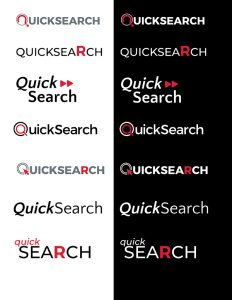
    Help us select the new QuickSearch logo! Click the image to take the survey.

    Hello all –

    I know I said we’d return to Frameworks this month, but events of the day (or month) have once again intervened. As we’ve seen from recent communications from the ExLibris Implementation Team, we are moving ahead full steam toward the June 1 go live date. I know many of you are preparing for the technical freeze and helping to communicate these changes to our users, but I write today with a different purpose.

    We recently announced that the name of our search interface will be QuickSearch, and I am writing today to invite you to help us with the selection of a graphic to build recognition and visibility for our new service.

    We want your input. You know your users and the Rutgers community – what they

    like and dislike and what works for them.

    We want to use this visual on our website and in marketing materials, so it has to be eye-catching and work in multiple formats. It will be used alongside messaging that emphasizes that QuickSearch allows users to search across our collections with greater efficiency, accuracy, and relevancy. With the help of the ExLibris Implementation Team, we have managed to whittle the options down to a top 7. We need your help to get this down to the final graphic.

    So, with that in mind, please let us know:

    • What would be most appealing to Rutgers faculty and students?
    • What communicates the excitement of QuickSearch most clearly to you?
    • Which graphic most clearly matches your vision of what QuickSearch does?

    Conversely, let us know:

    • What visuals simply don’t work in your opinion?
    • Which ones aren’t clear or don’t match the function of QuickSearch?
    • Is there anything confusing about the graphics? Would you mix and match any elements of the graphics to create a new graphic?
    • Or do you have a completely new concept you would like to share?

    Please click here to let us know what you think of our leading QuickSearch graphics so far. We are in a time crunch, so please get your comments in by Tuesday, May 8 at 5 p.m.

    Thanks in advance! We’ll announce the QuickSearch graphic next Wednesday!

    if you prefer to email your comments, please send them to me or Jessica Pellien.
     

  • Notable Library Acquisitions in the First Quarter of 2018

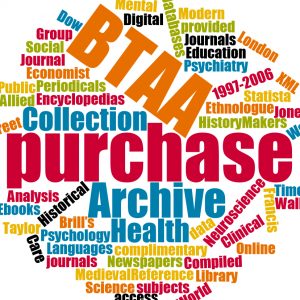
    Q1 2018 purchasesCompiled by the Collection Analysis Group 

    Journals and Periodicals 
    Ebooks and Encyclopedias 
    Databases 


  • New Brunswick Faculty Author and Creator Event

    New Brunswick Faculty Author and Creator Event

    celebration of scholarship 2018New Brunswick Libraries is inviting faculty from Rutgers University-New Brunswick to join their New Brunswick Faculty Author and Creator Event.

    This year’s event will be an immersive experience, showcasing the full range of RU-NB intellectual output. We will create neighborhoods of content, featuring works such as monographs, journal articles, patents, startups, dances, musical scores, poems, stories, artworks…

    Event details:

    Date: Wednesday April 11, 2018

    Time: 5-7 p.m.

    Where: Alexander Library Reference Room, 169 College Avenue, New Brunswick

    What: Neighborhoods of content, a panel discussion, faculty lightning talks and demonstrations

    Wine and refreshments will be served.

    All faculty are invited to attend the celebration — even if they have not submitted a work for display. Please share this information widely — we would love to see a big crowd.

    RSVP here: https://rutgers.qualtrics.com/jfe/form/SV_8oVMnXzKcMx2gyF

  • News from the Communications Department

    News from the Communications Department

    Lots of new marketing materials available on the communications department website this month. Let us know if you have any other ideas for things that would be useful:

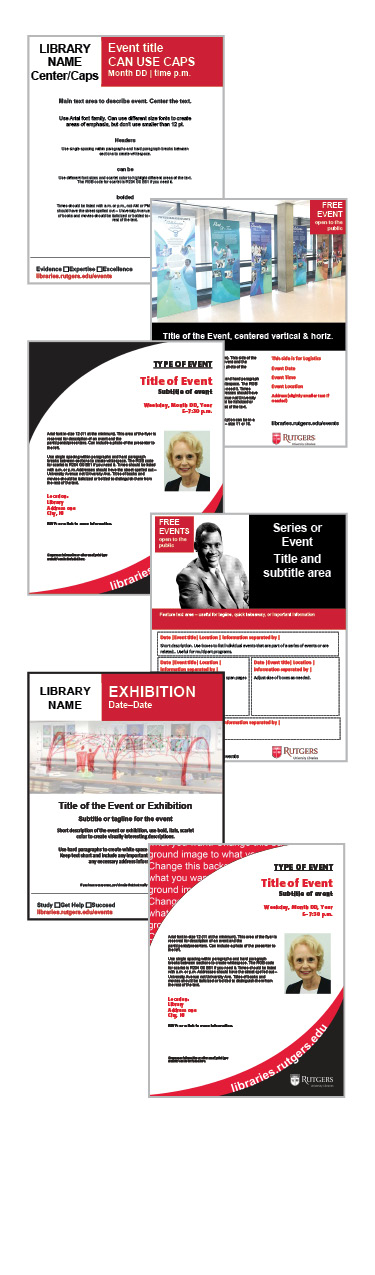
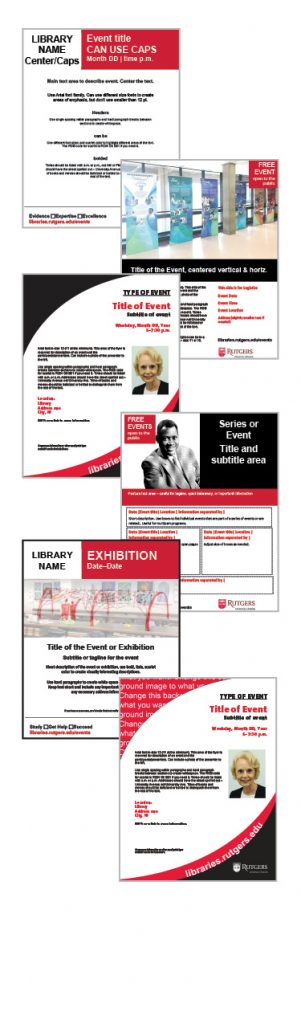
    Event & Exhibit Flyer Templates

    These flyer templates are available to local units to help promote their upcoming events and exhibits. The templates are available in Word and Powerpoint, so they require no special software. We’ve tried to provide enough options and variations to allow some personalization and tailoring for specific locations and events. If you would like me to conduct any training on how to use these materials, please let us know. We also welcome any feedback and/or requests for variants of these templates.

    Group Study Room Sign Templates

    With the recent changes in how group study rooms are reserved, we have updated the signage templates with new QR codes. These are now available for libraries that are using the libcal service. If you have group study rooms that don’t use the libcal reservation system or other types of spaces that need signage, let us know. Scroll down on the Signage Templates page to find the new group study room signs.

    Materials for Library Liaisons

    There is a new section on the communications page for Project Outreach Materials. RASE-WG has provided materials for library liaisons who are doing outreach for the following projects. You can download presentations, flyers, and information sheets:

    Community Bulletin Board

    “Wouldn’t it be great if there was a space where people from the Libraries could post notices for one another if they have an item for sale or are selling Girl Scout Cookies or are playing a local gig with their band?” Yes– this would be great. Introducing the Rutgers University Libraries Bulletin Board. This is an open space where you can post any type of notice you would like to share with your colleagues. Thanks for the suggestion, Dee Magnoni!

    This bulletin board is powered by Padlet. If you want to create a post, click on the + sign in the lower right of the bulletin board. You can create a Padlet account for free OR you can post anonymously (in which case, I’d recommend including your name at the bottom of the post so people know who the post is from).

    You can access this bulletin board directly at https://padlet.com/rulibraries/bulletin (bookmark it!) or via the sidebar menu on The Agenda.


  • Library of Science and Medicine Update


    An architect’s rendering of what the new space in LSM.

    New Brunswick (NB) and Rutgers Biomedical and Health Sciences (RBHS) are collaborating to upgrade spaces and publicize library services to our users, in particular those from RBHS schools (Robert Wood Johnson Medical School (RWJMS), School of Public Health, Ernest Mario School of Pharmacy, Graduate School of Biomedical Sciences, the Physician Assistants program in the School of Health Professions), in Piscataway. One of the goals in recent draftsof the Libraries master plan for the Library of Science and Medicine (LSM) is to “create a science-focused atmosphere and establish a connection with RBHS.” In addition, the plan includes creating both “dedicated graduate study space,” and “dedicated RBHS study space” within the library.

    A plan is in place to encourage RBHS students to identify and use LSM and its resources. Survey data from RWJMS reveals that medical students do not currently identify with the library. The upcoming accreditation at RWJMS (March 5-7, 2018), spurred a feasibility study to upgrade study space and librarian support space at LSM to better serve the needs of graduate students in the health and life sciences on the Piscataway campus. Students from Pharmacy and Public Health are also in close proximity to LSM. Even though Pharmacy has recently opened their beautifully renovated building, LSM is still a very popular destination for Pharmacy students seeking serious study space.

    An open house for RWJMS students was held at LSM on Tuesday, February 13, to re-introduce students to LSM, view potential floor plans, the phased design for renovating space on the third floor, and view the location of the recently relocated MED-TEXT collection, approximately 1000 books recently relocated from the medical school to LSM. Approximately 100 medical students attended the event, which was positively received. Victoria Wagner and the librarians from Robert Wood Johnson Library of the Health Sciences (RWJ), along with faculty and staff from LSM, interacted with RWJMS students and faculty in attendance.

    The completed feasibility study, along with proposed floor plans, renderings, phasing plan and cost are nearing completion. Presenting and socializing the plan to stakeholders (RBHS schools and NB life sciences schools) and funders is a critical next step toward potential implementation. Mei Ling Lo has taken the lead on planning for the weeding of the bound journal collections on the north side of the LSM third floor. Journals are labeled for relocation to the Annex or discard, and a company will start moving items on April 2nd.

    An office, previously occupied by DTS on the LSM third floor, will provide the space for the RWJ librarians, who will begin providing services to students from that location in early March.

    A full meeting LSM and RWJ libraries took place on Friday, February 23rd at LSM. Plans were on display, updates were provided by Dee Magnoni and Judy Cohn, and then the 20 plus attendees broke into groups focused on space, access services, and deepening collaboration. One listserv for all LSM and RWJ librarians and staff was proposed to enhance communication. Other recorded recommendations are being transcribed to share back with the full group, which agreed to meet again in 2 months.

    These are exciting plans! We look forward to gaining momentum to fund this project.


    Save

  • Thinking about Frameworks

    It seems that in every aspect of the work of academic libraries, there is an increased interest in frameworks. For example, in response to the ”rapidly changing higher education environment,” the ACRL Information Literacy Competency Standards for Higher Education transitioned to the Framework for Information Literacy in Higher Education.  I am involved in a Big Ten initiative to develop a Framework for Discovery-to-Fulfillment Systems. Rutgers is also not immune to the charms of developing frameworks. Internally, there is a Libraries group developing a framework to describe the technical infrastructure and architecture of special collections (charge | minutes).

    The framework presented in OCLC’s Realities of Research Data Management report may be useful as we think about the categories and framework we could use to describe our services.
    The framework presented in OCLC’s Realities of Research Data Management report may be useful as we think about the categories and framework we could use to describe our services.

    Frameworks provide a way to divide complex goals and processes into manageable chunks while retaining information about relationships and dependencies between the components. Frameworks allow organizations to map multiple approaches to a goal and to tailor these pathways based on context. We have discussed the need to develop a better understanding of central and local services and responsibilities. We also need to develop infrastructure and services that advance the missions of our three campuses and a statewide health system. It seems that we would benefit from a framework that describes our services and illustrates the relationships and interdependencies between central and local units.

    I have been following the OCLC Research Library Partnership Reports on the Realities of Research Data Management. This is a “four-part series that explores how research universities are addressing the challenge of managing research data throughout the research lifecycle.” The first three parts are now available and are quite good, digging a little below the surface to discover underlying drivers that influence practices. This topic alone is worthy of quite a bit of conversation that is beyond the scope of this post; however, I mention it here because, in Part One of the series, OCLC develops a framework for describing categories of services related to Research Data Management that may be useful as we think about the categories and framework we could use to describe our services. These are not going to map directly onto the needs of Rutgers University Libraries as a whole, but they demonstrate a way of thinking about these issues that will be valuable.

    The categories of services included in Part One: A Tour of the Research Data Management (RDM) Service Space are:

    • Education—educating researchers and other stakeholders on the importance, and in some cases, the necessity, of responsibly managing their data and making arrangements for its long-term curation
    • Expertise—providing decision support and customized solutions for researchers working through specific research data management problems
    • Curation—supplying technical infrastructure and related services that support data management throughout the research cycle

    It seems to me that by generalizing and extending these concepts, we could develop service categories that would help us plan and implement new services. In recent years, we have been reacting to extensive changes occurring in the university, but with the larger environment stabilizing, we can start thinking more about the structure that will best support campus missions and begin to develop a common vocabulary to discuss planning and priorities. There will be more on this in the coming months, but I encourage you to visit the links in this post and start thinking about how these ideas can be applied to our work.

  • Retirement and YOU!

    Retirement and YOU!

    A new year is approaching! If you are thinking about retirement and what is involved in the process you should check out the important on-line links below that offer key information to help you prepare.
    ABP Retirement: Welcome to the Alternate Benefit Program Retirement Seminar Presentation [PDF].

    PERS Retirement: Welcome to the Public Employees’ Retirement System (PERS) Retirement Seminar Presentation [PDF].

    Additionally, UHR offers seminars to both ABP and PERS members contemplating retirement.  If you are interested in attending a seminar, please check the Learning and Development Course Registration System under Employee Benefit and Work-Life Programs managed by University Human Resources.

    Please note: Employees will need to submit an intent to retire letter to their supervisors to advise of the effective date of retirement once they have fully committed to retire.


    Save

    Save

    Save

    Save

  • Where in the World is Shared User Services?

    Where in the World is Shared User Services?

    Nearly a year ago, the Libraries reorganized to form a central user services unit, Shared User Services. While we are still building, major structures are coming together. Here’s a progress report to let you know who we are, where you can find us, and some of the things we are up to.

    SUS began with several people in the former Scholarly Communication Center department: Isaiah Beard (Digital Data Curator), Ron Jantz (Digital Library Architect), Peter Konin (Digital Project Coordinator), and Rhonda Marker (Director of Shared User Services). Marty Barnett (Digital Library Applications Specialist) moved from IIS to join us. This summer, Joseph Deodado (Digital User Services Librarian) and Amy Kimura (Web Services Librarian) came on board. We are currently recruiting for a new Virtual Reference Services Librarian.

    Our physical work home is in Alexander Library on the 4th floor. Our online home is on the Staff Resources pages of the Libraries website. We have an up to date SUS Contacts list where you can see who to contact, from digital curation and digital file questions (Isaiah Beard) to virtual reference services (currently, Joseph Deodato and Natalie Borisovets). No, Natalie has not moved to SUS. She is still at Dana Library, where she has been the glue holding together the chat reference schedule across all of RUL. When we hire the new Virtual Reference Services Librarian, we’ll update our contacts list.

    SUS coordinates discovery, the shared components of reference (chat, email), and the public-facing libraries website. We also have a coordinating role for digital projects – but that story will have to wait for a future issue of The Agenda. Two working groups that support improvements to discovery of library resources, the Discovery Working Group and the Library Catalog Committee, report to the Head of Shared User Services. Their minutes and other useful information are now located on the SUS web pages of Staff Resources. Cabinet recently charged the Web Improvement Team, which is ambitiously meeting on the first day of the fall semester. We are all looking forward to seeing the fruits of their labors – and you will be able to read all about it on the SUS web pages.

    From time to time, the Libraries identify other services that call for a central user services role. This was the case for the modernization of our library hours information. Staff in SUS and IIS collaborated on configuring the information in LibCal (from SpringShare) and worked with many people in all our library locations to assemble the details of buildings, service points, and shifting calendars. We could not have done it without you. We are still adding details and features so that this new way of presenting our library hours gives our users the information they need. Ongoing support for library hours resides in SUS (Marty Barnett).

    There is a lot more that we are doing, and we are excited about the work ahead of us. Most of all we look forward to working with all of you in the Libraries. If you ever want to chat, now you know where to find us!

    Save

  • Performance Evaluations for Nonaligned Employees

    The FY 2017–2018 performance evaluation process for nonaligned employees (MPSC and Senior Administrators) is nearly upon us!
    The appraisal period is from July 1, 2016 through June 30, 2017. MPSC employees should ready their self-appraisals and share with their direct supervisors. Supervisors should review self-appraisals, complete the formal performance evaluation form, and discuss the completed form with the second-level supervisor.

    Additional details will be forthcoming. Questions on this process should be directed to the Libraries’ HR Office.

  • Rutgers Launches Rutgers Health – Here’s What It Means for the Libraries

    Rutgers Launches Rutgers Health – Here’s What It Means for the Libraries

    What is Rutgers Health?

    “Rutgers Health is the clinical arm of Rutgers–the areas of Rutgers Biomedical and Health Sciences and other Rutgers units devoted to caring for patients. A single brand for all of Rutgers’ patient care and services.” (from: www.rutgershealth.org/about-rutgers-health/rutgers-health-structure)

    The Rutgers Health Group will serve as a single faculty practice, unifying existing specialties and clinical practices, comprising approximately 1,000 Rutgers-employed health care professionals. Members of the faculty practice will be from New Jersey Medical School, Robert Wood Johnson Medical School, and other RBHS and Rutgers schools–dentists, nurses, pharmacists, social workers and psychologists, and other health care professionals working in clinical settings throughout New Jersey.

    The Rutgers Health Network will be an integrated network of Rutgers’ affiliated hospitals, community clinics, medical groups, wellness centers, and other affiliates collaborating to provide value-based care to patient populations across the state.

    How will the Rutgers University Libraries support Rutgers Health?

    There are two major user groups with full access to library resources–members of the RBHS faculty, students, and staff and members of the clinical (voluntary) faculty who oversee students and residents in affiliated hospitals and clinics throughout New Jersey.

    As Rutgers Health launches, it is challenging to predict how utilization and demand for libraries-licensed high quality clinical and patient care resources will grow. Should you encounter questions about Rutgers Health which impact the libraries, please contact your colleagues at the RBHS Libraries.


    Contributed by Judy Cohn and Victoria Wagner

    Judy CohnSave

    Save

    Save

    Save