Category: Collections

  • New Digital Collection: Rutgers Meets Japan

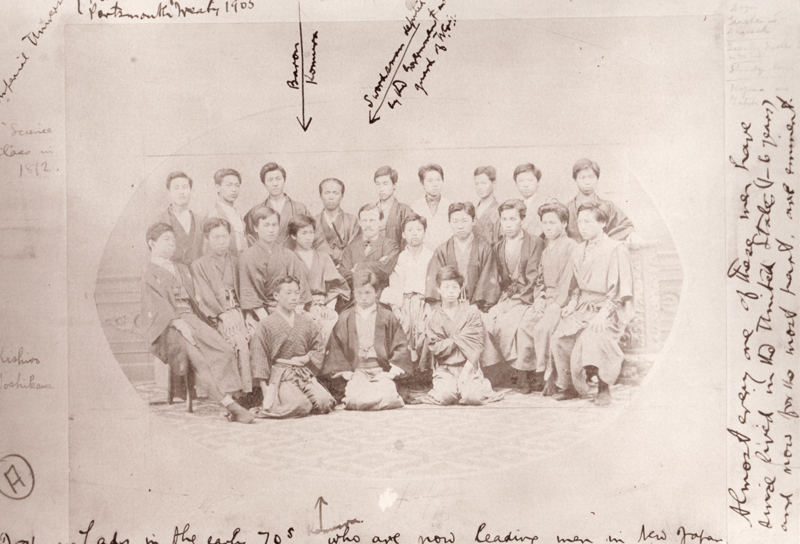
    Old, sepia-toned portrait of a group of people
    The Rutgers Meets Japan digital collection invites users to explore the people and places that shaped a pivotal moment in global education and cultural exchange.


    We are pleased to announce the launch of Rutgers Meets Japan, a new digital companion collection that brings to life a remarkable trans-Pacific story of intellectual exchange, cultural connection, and shared history. Developed in conjunction with the book Rutgers Meets Japan: A Trans-Pacific Network of the Late Nineteenth Century, this digital collection expands upon the book’s narrative by providing open access to a rich set of historical photographs drawn from the William E. Griffis Collection.

    The collection features portraits of some of Rutgers’ earliest Japanese students, as well as images of alumni who traveled to Japan as teachers and missionaries during the late 19th century. These photographs offer a rare visual window into a formative period of U.S.-Japan relations, capturing individuals, institutions, and everyday scenes across locations such as Fukui, Yokohama, Tokyo, and Shizuoka. In addition to images reproduced in the book, the digital companion includes many photographs that could not be published due to space constraints, significantly broadening access to these materials for researchers, students, and the public.

    Funded by a grant from the New Jersey Historical Commission, the project involved the careful digitization, transcription, and annotation of materials, ensuring both accessibility and scholarly value. By pairing rigorous historical scholarship with digital access, Rutgers Meets Japan invites users to explore the people and places that shaped a pivotal moment in global education and cultural exchange.

    The launch of this digital collection also coincided with an event held on April 17, Rutgers Meets Japan: In Conversation with the Authors. This event was held in the Alexander Library Pane Room and featured presenters Haruko Wakabayashi and Fernanda Perrone, with Janet Walker moderating.

  • Generative AI Features in Major Databases and Platforms

    Conceptual AI illustration featuring a computerized profile of a human head
    A new LibGuide provides information about generative AI features that are available to users within the Libraries’ major databases and platforms.

    Several platform providers have recently added generative AI features to Rutgers University Libraries’ e-resources. To bring this information together, we created a LibGuide: Generative AI Features in Major Databases & Platforms. This new guide provides information about generative AI features that are available to Rutgers University Libraries users within the Libraries’ major databases and platforms.  

    The guide is written at a general introductory level and may be used by librarians, students, staff, and faculty. Though it cannot exhaustively cover every aspect of each feature, it gives users the basic information they need to get started. Where possible, it includes links to more extensive tool documentation provided by the platforms. As new features are released and updated, the guide will be updated accordingly. In addition, future announcements about new features and updates will link to the guide. 

    This is a focused guide that introduces generative AI features currently available within our major databases and platforms; it is intended to be manageable in scope and useful to a broad audience. It does not cover AI features that are unavailable to Rutgers University Libraries users or AI tools that are located outside of the Libraries’ major e-resources. In this changing environment, the guide will be reviewed periodically to ensure the information is accurate and to confirm that this is still the best way of sharing this information. 

    Rutgers University Libraries faculty and staff are encouraged to familiarize themselves with this guide, consider incorporating these new AI features into their instruction and research, and share it with a broader audience.

  • Collection Acquisitions Department Holiday Party

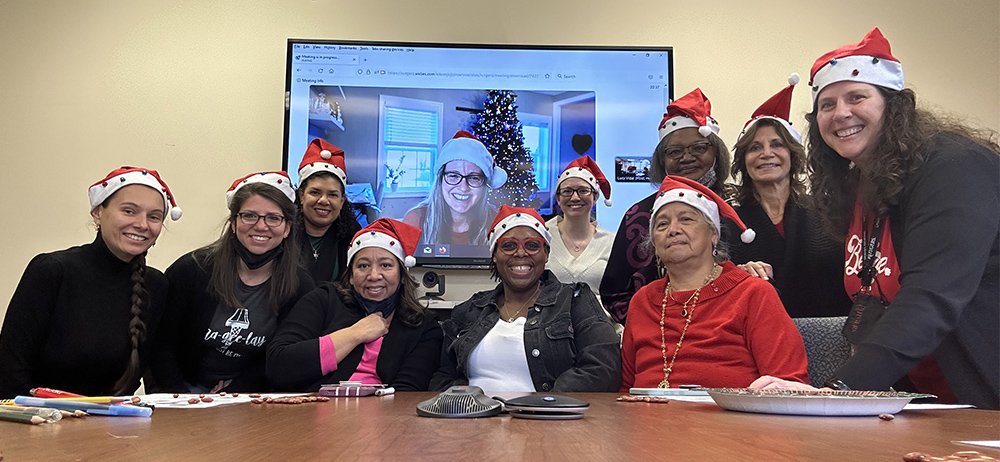
    Collections Acquisition holiday party 2022.

    On December 22, members from the Collection Acquisitions department gathered to celebrate the holidays and their accomplishments over the past year. We were happy to see so many smiling faces!

  • RUL Acquires Volumes I and II of National Theatre Collection Database

    National Theatre Collection, Volumes I and II.
    Photo courtesy of Alexander Street

    Rutgers University Libraries are pleased to announce their acquisition of Volumes I and II of the National Theatre Collection. This collection contains 50 high-definition streaming videos of live theatre productions by the U.K.’s National Theatre, accompanied by archival materials such as prompt scripts and costume designs. It includes both productions of new works by contemporary playwrights and new productions of classic plays, including Greek theatre, works by Shakespeare, and 20th-century classics. These new productions feature contemporary settings, diverse casts and production staff, and modern applications of enduring social issues. Productions feature major directors and actors as well as emerging talent. Rutgers permanently owns the entire contents of Volumes I and II of this collection.

  • Collections Budget Statement for Fiscal Year 2021

    The public-facing document on the FY21 collections budget has now been posted to our website.

    You can view it here or by navigating to About > Mission, Vision, & Strategic Plan from the homepage.

  • Introducing Browzine

    Rutgers University Libraries are pleased to introduce BrowZine, a current awareness tool that allows users to find, read, and monitor the top scholarly journals in their field from almost any device.

    BrowZine improves discovery of current issues of academic journals and provides streamlined access to full-text via PC, tablet, or smartphone. It also offers useful personalization features so users can keep current with their favorite publications.

    BrowZine users can:

    • Browse thousands of top academic journals by subject, title or ISSN; review current tables of contents, and download full-text articles published since 2005
    • Follow and receive new article notifications for their favorite journals by creating a personal bookshelf
    • Save and export articles to services such as DropBox, Mendeley, RefWorks, EndNote, and Zotero

    Although it provides access to thousands of titles from major academic publishers, BrowZine does not include every journal available at Rutgers or cover issues published before 2005. It also does not include non-scholarly periodicals such as newspapers, magazines, and trade publications. Access to the Libraries’ complete periodical holdings is available via QuickSearch.

    For more information, see What is BrowZine?

  • Glenn Sandberg Retiring After 30 Years

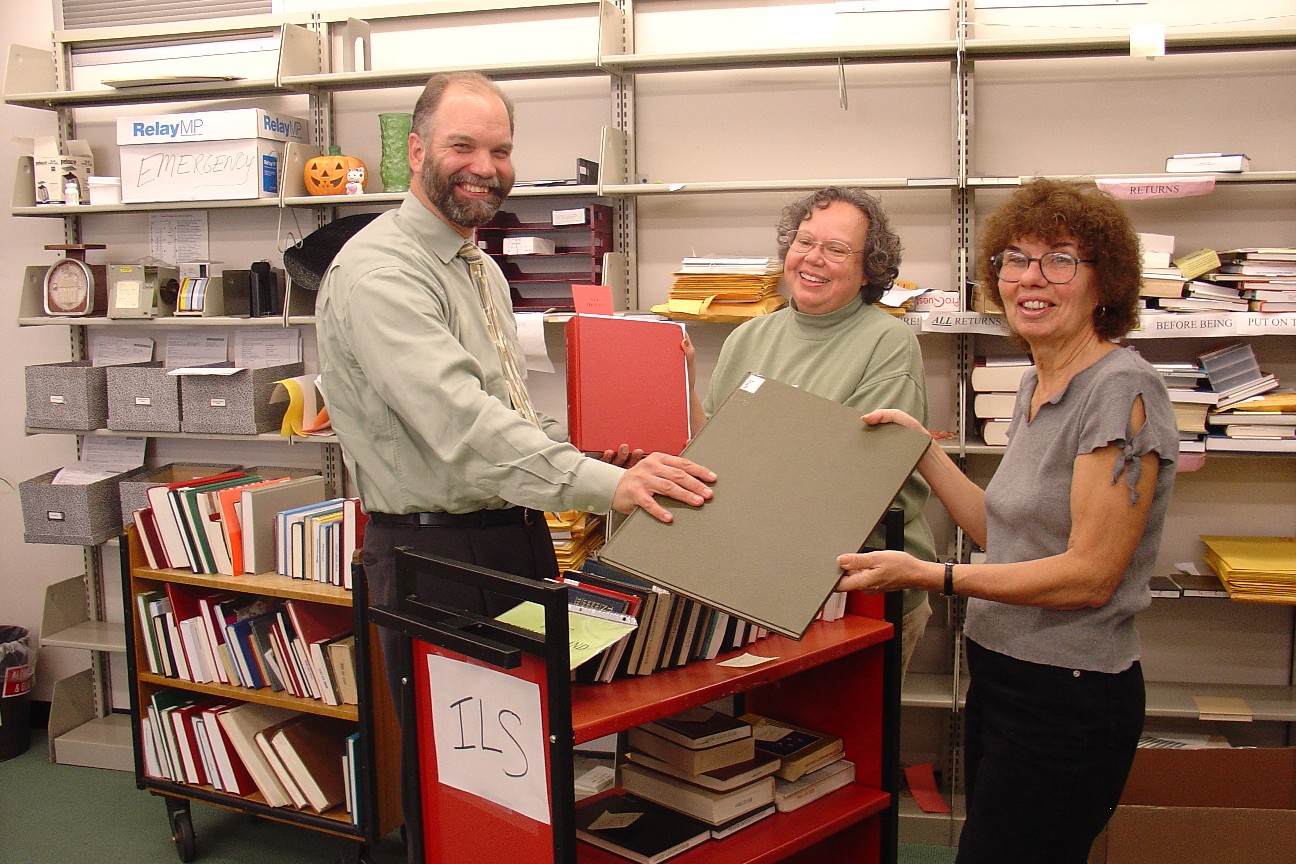
    ILL staff
    Glenn with ILL staffers Mary Belasco (l.) and Lilly Miller (r.) in 2005.

    Glenn Sandberg will retire on August 1, 2018, after 30 years of service to the university. His last day in the office is June 1.

    Glenn’s career at the Libraries began in 1988, when he was hired as the supervisor of the Media Department within the Laurie Music Library (now part of the Douglass Library) in New Brunswick. He became the supervisor of Access Services at the Library of Science and Medicine in Piscataway in 1999. Among his many contributions to the Libraries, Glenn has the distinction of having created “The place to go, when you need to know!”—a slogan for the Libraries he developed as a member of the Marketing/PR Team.

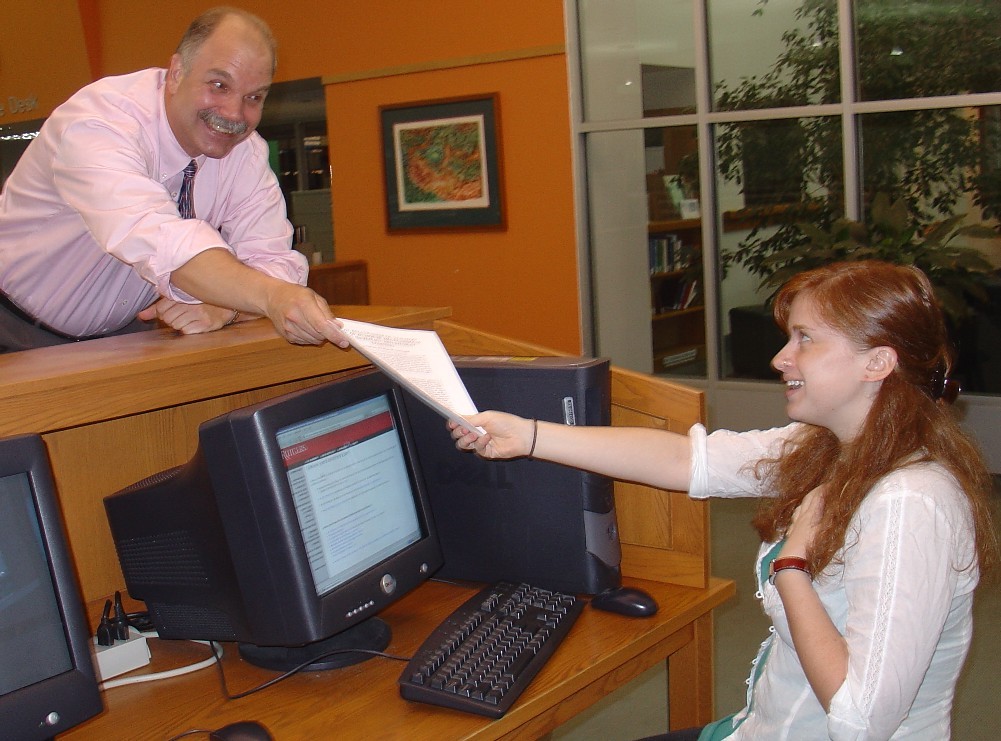
    promo photo
    Glenn poses for a promotional photo in 2007.

    Since 2004, Glenn has been the supervisor of Interlibrary Loan Services. Beginning his tenure in ILL at about the same time as the start of the E-ZBorrow service, Glenn is proud of the role he has played in bolstering Rutgers’ standing within the E-ZBorrow community. After Rutgers joined the CIC (now BTAA) in 2013, Glenn contributed to the adoption of the UBorrow service. In the last three years, Glenn has helped ensure the successful implementation of several major improvements to ILL services, including removal of copyright fees charged to ILL users, adoption of ReprintsDesk as an alternative article delivery service, and further integration into the Get it @ R service. Glenn also contributed his knowledge of ILL services to the ongoing implementation of Alma and Primo.

    glenn with slogan
    Glenn shows off the Libraries slogan he coined in 2008.

    Glenn has deep ties with the university. He graduated from Rutgers College in 1980 with a bachelor’s degree in German and music and received his doctoral degree in German from Rutgers University in 1995. He taught in the German Department as an adjunct faculty in New Brunswick from 1994 to 1997 and worked as a manager at the Rutgers University Foundation from 2001 to 2004.

    Glenn served in the U.S. Army from 1984 to 1988 and received a certificate in Czech from the Defense Language Institute in 1985. Last, but not least, Glenn is a talented musician—he received a master’s degree in trumpet from the Julliard School in 1983.

    Please join us in thanking Glenn for his decades-long service to the Libraries and wishing him all the best in his new adventure!

  • Quick Takes on Events and News — May 2017

    StressbustersThe New Brunswick Libraries announced their schedule of #Stressbusters events for the spring exam period. Highlights include a photo booth at the Math/Physics Library, button making at the Art Library, and pet therapy sessions at Alexander, Douglass, Kilmer, and LSM.


    MARAC Spring 2017 was held April 20–22 in Newark.

    Don’t despair if you happened to miss out on the recent Mid Atlantic Regional Archives Conference in Newark, as Tara Maharjan put together a comprehensive Storify of the event (titled Adaptable Archives: Redefine, Repurpose, and Renew) that’s the next best thing to having been there in person.


    Several new exhibits opened across the Libraries this past month:

    At the Art Library, a display of undergraduate student work from the Environmental Planning Studio of the Department of Landscape Architecture will be on view through May 31. Students in the studio were challenged to create a master plan for the Bergen County park system, and the exhibit communicates their creative solutions and work through large-scale posters.

    There's a Run in My Tights

    At Paul Robeson Library, There’s a Run in My Tights: Classic Comic Book Covers from the Golden Age and Beyond is on display through May 4. This display, which opened in advance of the 2017 Camden Comic Con, highlights superheroes such as Bat Girl, Aquaman, Luke Cage and the X-Men, as well as villains like Cat Woman and misunderstood monsters like Werewolf By Night.

    A group exhibition of works by students in the Women, Gender, and Creativity House of Douglass Residential College is on display now at Douglass Library. Students in this community explore topics of gender, sexuality, identity, creativity, perception, and visual communication of women in the arts. The exhibition highlights the self-portraits, sculptures, video performances, and written works produced by the student artists during the course of the academic year. It closes on May 1, so be sure to check this one out while you can.


    Finally, many new resources were announced in April:

    • The Andrew Hill Collection at the Institute of Jazz Studies contains the papers, music, and audiovisual recordings of acclaimed pianist, composer, bandleader, and educator Andrew Hill (1931–2007). The collection was processed as part of the 2016 Jazz Archives Fellows residency.
    • Attitude Check - Independent voices
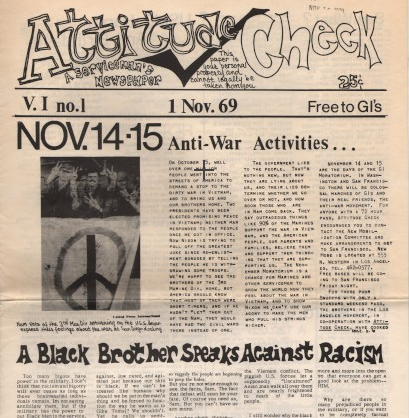
      Attitude Check (vol. 1 no. 1, 1969) via Independent Voices.

      JAMAevidence provides guides to the systematic consideration of validity, importance, and applicability of problems and outcomes in health care. It consists of three textbooks, user tools, and forms useful to the critical appraisal process. See more in our deep dive.

    • Academic Video Online Premium provides access to over 50,000 videos from reputable producers such as BBC and PBS, mostly on the subjects of social sciences, American history/American studies, music and performing arts, science and engineering, and health sciences.
    • Independent Voices is a full-text database of alternative press periodicals published in the U.S. in the second half of the 20th century. It includes publications like Aegis (1978-87), Death Ship Times (Fat Albert’s) (1972-74), The Feminist Voice (1971-72), Meatball (1969-71), Off Our Backs (1970-76), The People’s Voice (1980-1983), San Francisco Good Times (1969-72), Up from the Bottom (1971-74), Where It’s At (1968-70), the Yardbird Reader (1972-76), and Zeitgeist (1965-69), among dozens of others.

    Save

  • Rutgers Joins the E-book Revolution

    vivaOn December 26, 2015, Izzy Stern tweeted: “Today is the day I found out that Rutgers doesn’t even have full ebrary access. So many sad faces.” As a graduate student in a major humanities department at Rutgers–New Brunswick, Izzy might have expected to use ebrary, one of the largest academic e-book resources, for her research in the winter break, but then had a rude awakening that day when she found out that it was not available at Rutgers, yet. So she went online and shared her frustration on Twitter with the entire world, which was totally understandable. As a matter of fact, the lack of access to e-books was a major source of complaint from our students and faculty about the library collections—hundreds of similar comments can be found in the results of the LibQual+ and previous Counting Opinions surveys. Here, I quoted only Izzy’s tweet because it is on the open web, but the problem she reported was a common one.

    What a difference a few months have made! Izzy and her fellow students may be glad to hear that the Libraries have made great strides to improve their access to e-books. Here are the major e-book resources that became available at Rutgers in the last several months:

    • Ebrary Academic Complete: a subscription-based collection of about 140 thousand e-books on all academic subjects.
    • Springer Nature frontlist e-book collections: 7,175 purchased e-books published in 2016 in STM (Science, Technology, and Medicine) and Social Sciences.
    • PALCI/EBSCO Demand-Driven Acquisitions Program: about 1,000 new e-books expected to be purchased during the academic year.

    In addition, we are evaluating a new PALCI/JSTOR e-book program. The program will purchase several hundred high-use titles and also provide academic year-round access to all the JSTOR e-books, a collection of over 40,000 high quality scholarly monographs from many of the major university presses.

    Over a decade ago, the Libraries began to acquire small, subject-based e-book collections. In 2014 we joined HathiTrust, which gives us access to several million out-of-copyright works. However, the availability of large, comprehensive collections of current e-books today represents a quantum leap or a sea change. Since the Rutgers community is celebrating the 250th anniversary of the University this year with a revolutionary spirit, it may be befitting to call this significant change a revolution, an e-book revolution.

    Stepping outside Rutgers, we will find that the e-book revolution is sweeping through the academic and research libraries in the region and the country. Actually, all of our major e-book acquisitions I mentioned earlier were made or will be made together with our partners in BTAA, PALCI, and VALE. This shows that Rutgers is adopting e-books at about the same pace as the majority of academic libraries. Being in the majority does not seem as glorious as playing the role of innovator or early adopter, but it is still an advantageous position, especially from a user perspective. Of course, if we moved any slower, we would have been left behind or characterized as reactionary by our peers.

    Peer pressure is not why we are joining the e-book revolution. It is for the good of our own community. Within our organizational context, there are many reasons why the large-scale shift to e-books is happening now:

    • The arrival of Krisellen as our University Librarian last year set a new direction for the Libraries.
    • E-books provide convenient, equal, and equitable access to the entire Rutgers community, which happens to be a mandate under the University’s RCM budgeting model as well as a core value of librarianship.
    • The loss of $1 million purchasing power in the collections budget in FY15, combined with the ongoing inflationary pressures, forces us to rethink our collection development priorities and strategies.
    • When adopted by instructors as textbooks, e-books can generate substantial savings for students struggling with high textbook costs (see one reported example at Rutgers), which is important in the context of a large public university.
    • The adoption of e-books can be part of the solution to our space shortage problem. As the Library Annex is full, our largest library locations are experiencing the stacks overflow problem at the same time that the universities want the Libraries to create more study space for a growing student population.

    Relating to the last point, I distinctly remember a scene from the Library Town Hall meeting in the spring—a brave staff member stood up and asked everyone: “Since there is really no space in the Libraries, why do we keep buying print books?” Does this remind you of that fabled child who cried “The emperor has no clothes!” or what? I believe that print books are not obsolete and probably won’t be for a long time. There are also situations when only print is available. But we do have to be mindful of our space constraints when making book purchase decisions.

    The e-book revolution is giving our community unprecedented access, but what it cannot do is bring a paradise to libraryland, not at Rutgers nor anywhere else. On the contrary, profound changes are always messy, chaotic, and uncomfortable and this one will be no exception. We have already started to face a new set of problems: how to make print available to the users who need it, in spite of our space and financial constraints; how to minimize the inevitable duplication between different e-book providers; and how to improve the discoverability of e-books, just to name a few. As we navigate these complex and difficult issues and find solutions, we will continuously improve our collections for the benefit of students like Izzy Stern.

    Save

    Save

  • 200 Coins Added to the Roman Coins Project over the Summer

    The Roman Coins project is a collaborative effort to bring the Rutgers’ Ernst Badian Collection of Roman Republican Coins fully into the digital realm and to contextualize its 1200+ items in such a way that students, researchers, and a broad section of the public can readily understand the general patterns of development in Roman money during its first 250 years.

    coin
    Aureus – Sydenham 1153 – Crawford 491/1a. Retrieved from http://dx.doi.org/doi:10.7282/T31N82ZC

    The collection holds many coins that hold particular historic, economic, or artistic interest and is one of the largest of its type in North America. However, for a variety of reasons, the coins are not readily consulted in person. In order to make them broadly accessible for study and teaching, the Classics Department and Rutgers University Libraries are working together to create a web-based public portal and archive.

    This summer with additional funding from the Classics Department and the dedicated efforts of three summer part-time employees, we were able to add another 200 coins to the portal, bringing the total to some 700 coins.

    The portal features multi-faceted display of high-resolution images of individual coins and metadata specifically designed to render ancient numismatics comprehensible to non-specialists, while offering experts much in the way of original and unpublished research.

    High-resolution digital imaging available in the Digital Curation Research Center was used to capture archival and presentation images for each coin in a format called Pyramid Tiff (or ptiff) that allows us to represent the same image at different spatial resolutions. This feature was developed for RUcore and is useful for viewing other formats such as maps.

    To see ptiff in action, click on “view slideshow” below the coin image at https://rucore.libraries.rutgers.edu/rutgers-lib/47436/. Use the buttons to pan, zoom, and rotate the image. These are truly beautiful artifacts and the ptiff technology allows users to explore them like never before.

    The user experience is further enhanced by specialized metadata detailing the legends and images found on the coins and newly implemented faceted browsing. Faceted browsing is available at the Coins portal where users can narrow searches by denomination, material, time period, moneyer, subject, and method.

    To complete the digitization of the Badian collection, professor Corey Brennan (Classics Department) will apply for another grant from the Loeb Classical Library Foundation. These additional funds will enable us to image and ingest the remaining 500 coins into the RUcore portal. Professor Brennan will also use the Coins portal in a graduate seminar this Fall.


    Save

    Save

    Save

    Save

    Save

    Save