
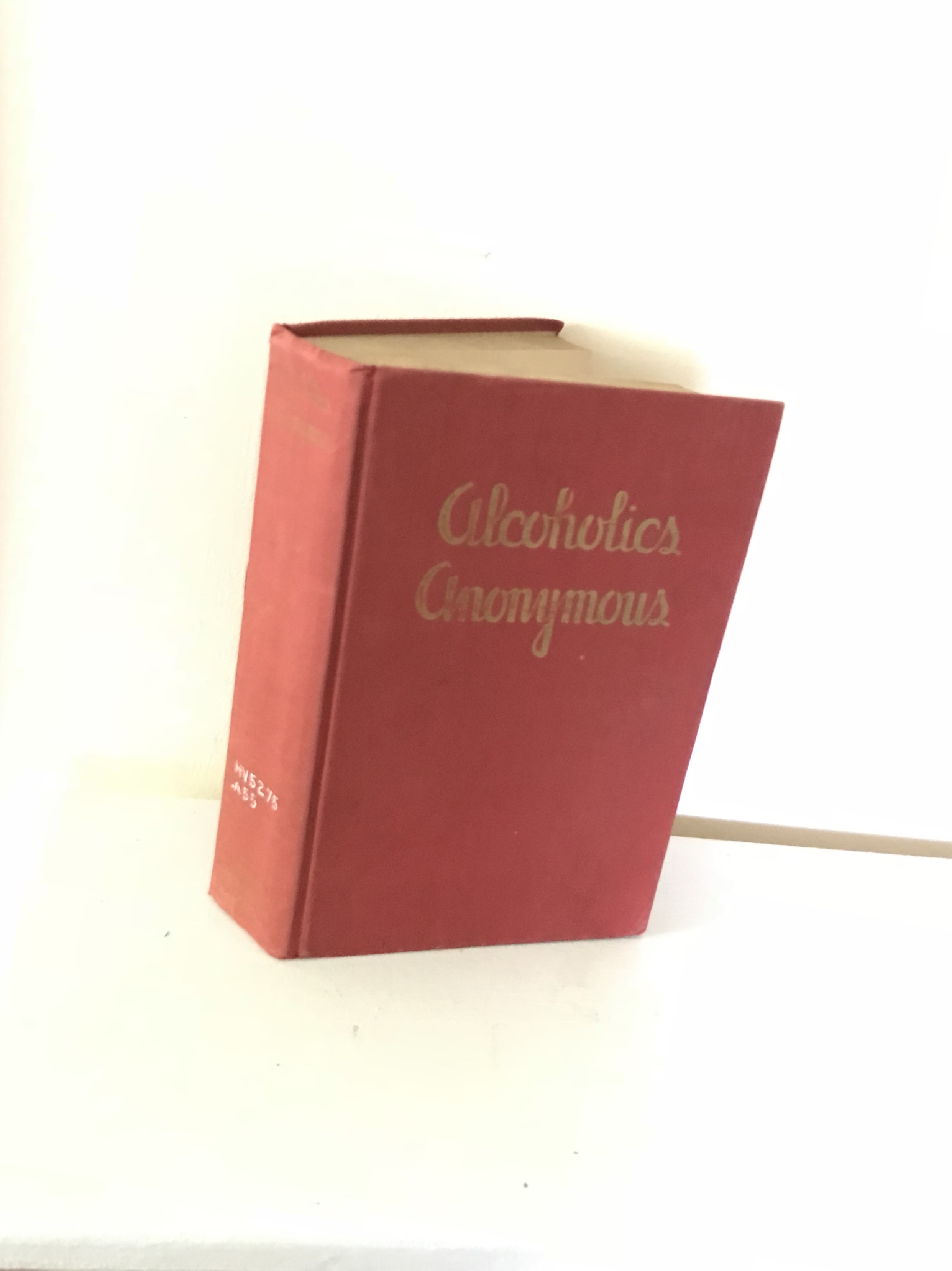
 The New Brunswick Libraries have acquired a first edition of “The Big Book,” the popular name for Alcoholics Anonymous: The Story of How More Than One Hundred Men Have Recovered from Alcoholism, written by the A.A. founder, Bill Wilson (or Bill W).
Since it was first published in 1939, in an edition of 4,650 copies, “The Big Book” has sold over 30 million copies, making it one of the best-selling regularly updated books of all time. The Library of Congress named it one of the 88 “Books that Shaped America.” The fellowship, Alcoholics Anonymous, took its name from the book’s title.
The Rutgers copy of “The Big Book,” so called for the thickness of the paper in the original edition, was probably the one reviewed by E.M. Jellinek through a project, also launched in 1939, funded by a Carnegie Corporation grant that essentially birthed the field of alcohol studies. As Jellinek reflected in a piece written for AA Today,
One day that year, I found on my desk a book with a yellow and red dust cover. Its title was Alcoholics Anonymous. With a sigh, picked it up and said to myself: “some more crank stuff.” But I hardly read a few pages when I realized that I had one of the precious gems before me.
After the Center of Alcohol Studies (CAS) moved from Yale to Rutgers in 1962, the book became part of the McCarthy Collection, named after Raymond McCarthy, the director of education and training at CAS. The annotations are believed to be in his hand.
An unassuming trade book bound in red cloth, “The Big Book” hardly resembles the “precious gem” it is. From across the room, it might be mistaken for a copy of Webster’s Desk Dictionary. However, due to its historical significance, copies of the first edition regularly sell for five and even six figures. For comparison, a copy of Webster’s A Compendious Dictionary of the English Language, a first ed. of Webster’s first dictionary (1806), is priced at $4,063, a Babylonian clay tablet from Syria, ca. 1600-1500 BC, which provides a list of fish used for teaching purposes, is valued at $1,500-$2,500 and a Coptic-Greek glossary, written on vellum in Egypt in the sixth or seventh century, likely intended for use by a professional scribe in the civil service, is estimated at between $12,000 and $18,000. Moreover, the profound emotion “The Big Book” stirs in the A.A. fellowship surpasses the admiration of even the most devoted logophile.
William Bejarano, former senior information specialist at CAS, recalls preparing for the center’s annual Summer School of Addiction Studies, which traditionally included an open Alcoholics Anonymous meeting. “John,” who was running the meeting, asked if the rumor that the center owned a copy of “The Big Book” was true, and if he might see it.
“We were taken aback by his response — jaw agape, he treated the item almost as a sacred text, going so far as to kiss the cover and speak in hushed tones.”
After being cataloged and preserved in a conservation housing, “The Big Book” will safely repose in Special Collections and University Archives, along with The King James Bible, and the editio princeps of Homer.
Michael Joseph, Judit Ward
Further reading:
Bejarano, W., & Ward, J. (2015). AA and the Center of Alcohol Studies: Our story. SALIS News, 35(3), 10-12.
Bejarano, W., 2015. CAS Archives: A First Edition of the AA “Big Book”. CAS Information Services Newsletter, 9(3) 6-10.
Ward, J. H., Bejarano, W. & Allred, N. (2016). Reading for Recovery (R4R): Bibliotherapy for addictions. Substance Abuse Library and Information Studies, 3, 50-69.
 Faculty are inundated with email invitations to publish in scholarly journals or to serve on their editorial boards. Many of these solicitations are completely valid, but an increasing number of these journals are engaging in predatory publishing practices.