On March 14, we hosted a visit from the Joseph Kohn Training Center for the Blind (130 Livingston Avenue, New Brunswick). The idea for the visit originated in a phone conversation initiated by Amo Musharraf, an instructor at the center, with Christie Lutz, the New Jersey regional studies librarian and head of public services. Since Amo expressed a desire for his class, consisting of 15 blind and visually impaired students and three sighted aids, to look at some of our rare books, Christie put him in touch with me. I remembered meeting Amo several years ago when he dropped by to look at copies of early editions of Paradise Lost, and I was delighted to be back in touch and to be included in what promised to be an adventure. In my 26 years at Rutgers, I had never addressed a class comprised of blind and visually impaired students. Seeing feels indispensable to me, and a lot of the pleasure I find in rare books and art derives from the visual. The question was, what would a blind class find pleasurable in our collection?
Without sight, other senses—like touch and sound—would be more important. We started by gathering volumes that had interesting tactile elements, for example, a brace of bindings in various animal skins—goatskin, calf, sheep, and vellum. Snakeskin, cowhide, and velvet were suggestions from our rare book cataloger, Silvana Notarmaso, who agreed to speak about them. Not only is Silvana knowledgeable about these materials, but it seemed to us that the class might benefit from hearing different voices.
It also seemed a good idea to refine the touch experience. Feeling the difference between rough sheep and smooth goatskin would be a nice introduction, because everyone would easily know what they were supposed to be feeling; but touching and analyzing differently finished grains of goatskin would be more challenging and rewarding. After a second or two, students were engrossed in contrasting the milky smoothness of a flat grain finish (which feels like the arm of a leather couch or car seat) with the grooves of a straight grain finish (resembling the surface of a vinyl record, only slightly softer). We told them that, like writers, bookmakers made an effort to appeal to all of the senses. Bookbinders wanted their customers to luxuriate in the sense of touch, and that historical bookbinding was a complex trade.
To these books we added 15th-century wooden bindings, and 19th-century cloth. As well as helping the students to connect sensually with the objects, we wanted to engage them intellectually by sharing some of their history and contents. So, we talked a little bit about binding history, pointing out that the earliest printed books were bound simply in durable wooden boards with tough leather spines, or workaday vellum, and we shared notes about the texts themselves and our personal experiences with them. For example, we explained that the small octavo book with wooden boards (knuckles rapping for emphasis) and the remnants of a scallop shell clasp was a 1480 edition of the first cookbook ever printed (the same book the great French chef Julia Childs had handled when she came to Rutgers to accept her honorary doctorate); and we noted that the grooved finish of the clothbound first edition of Cooper’s The Song of Hiawatha represents the trade binder’s attempt to manufacture for a wider audience an imitation of the surface of the elegant bespoke goatskin bindings handmade for the wealthy collectors.
This turn of the discussion led into an aside about book collecting in which we explained that historically, books finely-bound with gold decorations were prestige items acquired by the wealthy and powerful, generally male—a cultural phenomenon that went back to the great Renaissance libraries of collectors like the Medicis—and that the spines of these books were often lavishly tooled in gold because they would be showcased glittering on private library shelves. The boards were less often or more humbly adorned because the books would seldom be taken down and hardly ever read. One of the older students, an African American female whose eyes were almost completely white, commented insightfully, “Oh, that’s why there were so many power paintings of men holding books.”
Other students made similarly perceptive comments, so that the class often resembled an extended conversation or symposium. And we were constantly reminded of the students’ range of experience: when Silvana talked about the snakeskin and crude cowhide bindings used on Argentine publications, and mentioned that SC/UA holds three copies of Martin Fierro (el Gaucho), a 2,316-line epic poem by the Argentine writer José Hernández, all bound in cowhide, one of the Latina students spoke briefly about Fierro’s popularity.
We also selected books of unusual proportions and mass. Bodies respond in different ways to books of different size. The highlight of a group of large, tall, and chunky books was a massive early volume of musical notation hand-drawn on parchment sheets measuring approximately three feet in height bound in stiff, well-wormed leather over wooden boards decorated with metal bosses and the remnants of heavy, metal clasps. The students were taken by the sweep of the vellum pages, by the harsh, lumpy, pitted surface of the boards, and by the immense weight of the thing. They congregated around this book, and continually asked questions about it, such as what causes worming (one of the students was surprised and delighted to learn that bookworms were an actual thing), what purpose the clasps served, how such an immense book was used and by whom, and whether anyone who could read the musical notation ever came by. The commanding dimensions of the volume made it the focal point or perceptual center of the class, and I pointed out the obvious fact that it would have been so in a church or monastery. The auratic power of the book, realized in this particular volume, was a cultural reality, one we forget when we examine texts on computer screens.
And we talked about how the authority of the book could be subverted for artistic purpose in a discussion of artists’ books. Most of the students had never heard of artists’ books and some expressed reservations about the concept (they laughed when I pointed out that they were frowning), but they regarded the objects with a great deal of intense interest and open-mindedness.
Recently acquired glass books by Amanda Thackray were passed around gently, almost reverently. The students showed great respect for the integrity of the object and thoughtfully considered the artist’s statement that books are bodies and she wanted her artists’ books to be held. To contrast Amanda’s weighty, artistically rounded glass, I handed them a book by Anna Pinto consisting of calligraphy on light driftwood shaped by the sea. The diverse non-traditional materials used in Suellen Glashausser’s artists’ books (margarine wrappers, aluminum foil, pieces of metal from a Sprite soda can, cigar labels, cardboard collars, brown paper bags, etc.) provoked side conversations. The students were impressed by Suellen’s ability to find the voice in virtually any material, as well as her belief that every material has something valuable to say. One of the aids intensified our sense of communing with the artist by telling us she had studied with Suellen at Montclair State University and that she had been a fabulous teacher.
The class responded thoughtfully to Buzz Spector’s elegant single sheet work Cage. Buzz deliberately printed Cage on a handmade paper that crackles when handled. (I passed the sheet around for the students to hear.) His intention seems to have been for beholders of the work to have an acoustic experience to facilitate a connection with John Cage’s famously silent 4’ 33”.
The most popular artists’ book was Marcia Wilson’s provocative All the Men I Ever Slept With, a coffin-shaped wooden book with a metal screw through the bottom that serves as a binding agent. The joke of the screw poking through the images and becoming a three-dimensional extension of the imagery is immediately comprehensible (the students were eager to feel the book and explain the joke to each other as they passed it around). Having already handled driftwood and glass books, they grasped the idea that form is information, and laughed at the fresh ingenuity of the object; they responded to my reading a page of the author/artist’s text by pointing out that while it was amusing, it was also wistful—that the book wasn’t the cartoon (my word) it first appeared to be.
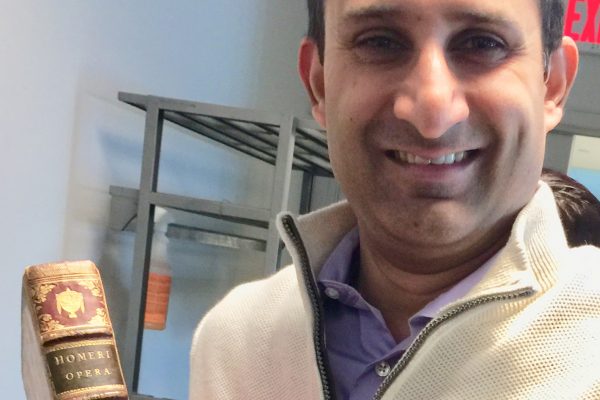
Naturally, since Paradise Lost inspired Amo to arrange the visit, we featured it in a selection of iconic texts including our editio princeps of Homer (1488), the second folio of Shakespeare (1634), and The King James Bible (1611). It seemed important to say that according to legend, the great Homer was also blind, and we sought to emphasize its importance by processing around the room with the book in hand inviting everyone to touch the cover. The students asked us to open the book so they could feel the pages as well.
The class was intensely responsive, engaging, inquisitive, and astute. Their visit to our library was clearly important to them, as it was to us, and midway through, the director of the program, Dell Bashar, drove over to be a part of it. One of the students, Dave, who was graduating at the end of the week, caught him up on some of what he’d missed, summarizing a good 40 minutes of our talk in about five minutes. Another student wanted us to discuss a book we had overlooked (a multivolume edition of Lawrence Sterne’s Tristram Shandy housed in a slipcase with a false front that resembled the curved spines of three substantial volumes side-by-side). She had found the object on her own and she couldn’t work out by touch what it could be. She wanted to know.
Although we had arranged in advance to take photographs, the demands of the class made it impossible. The photographs here were taken by Amo and by one of his aids. When Amo texted the photos he jokingly captioned one of me looking surprised: “Your reaction when three vans full of blind people showed up looking for you :)”
Amo deemed the visit successful, calling it “history,” and Dell said he would like to bring future classes to see our collections.

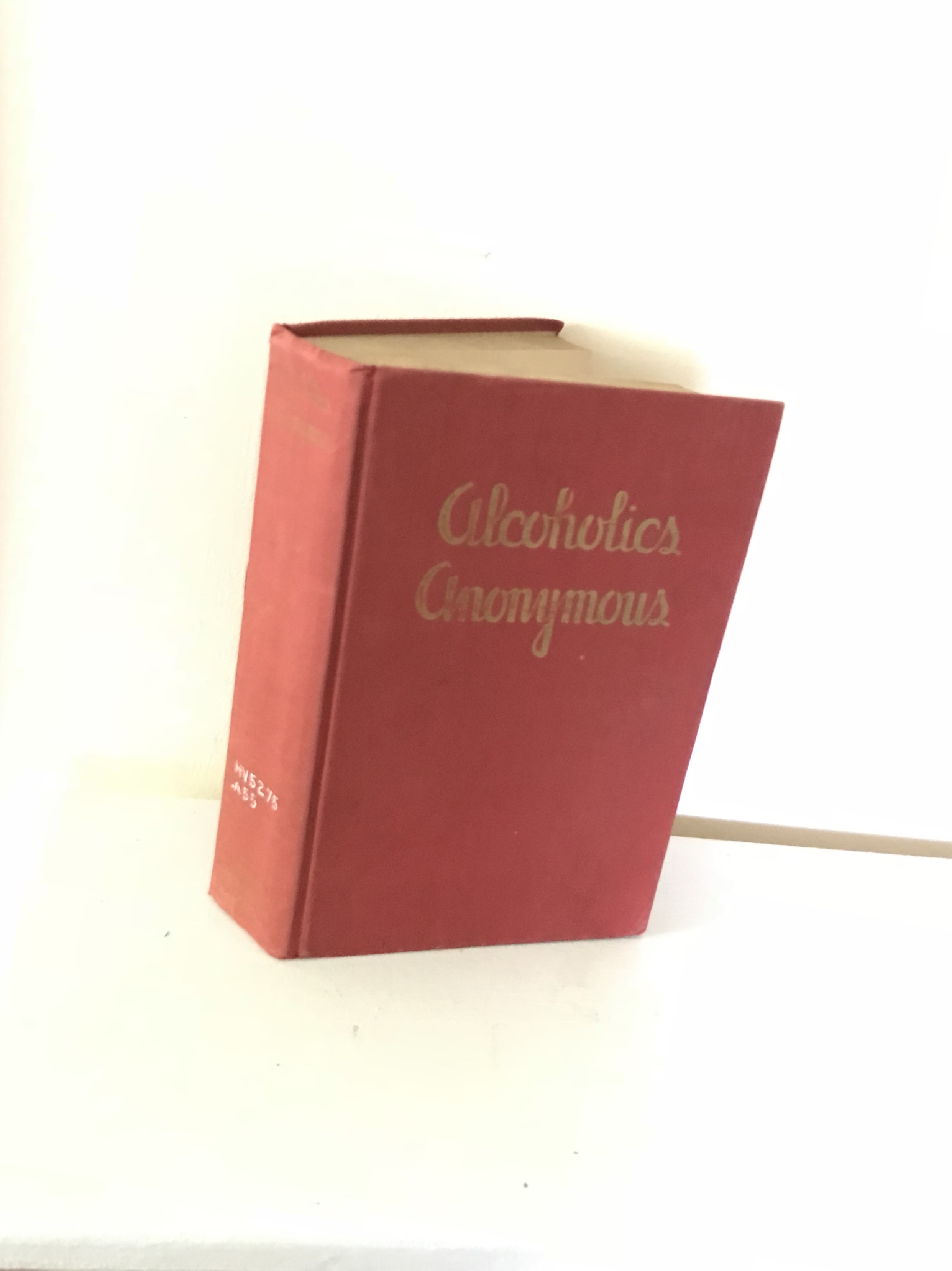 The New Brunswick Libraries have acquired a first edition of “The Big Book,” the popular name for Alcoholics Anonymous: The Story of How More Than One Hundred Men Have Recovered from Alcoholism, written by the A.A. founder, Bill Wilson (or Bill W).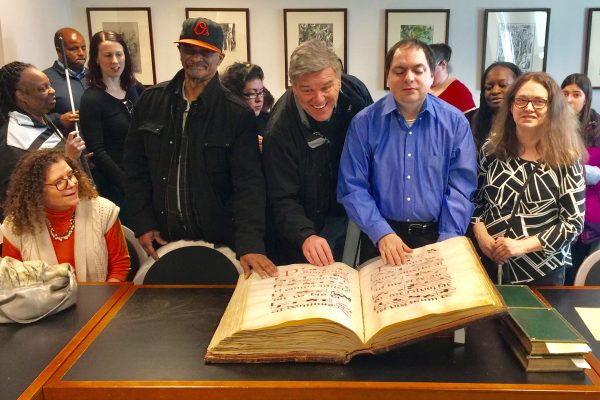


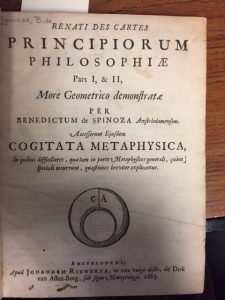 A request from the Spinoza Society sent us into the stacks in search of Baruch Spinoza’s
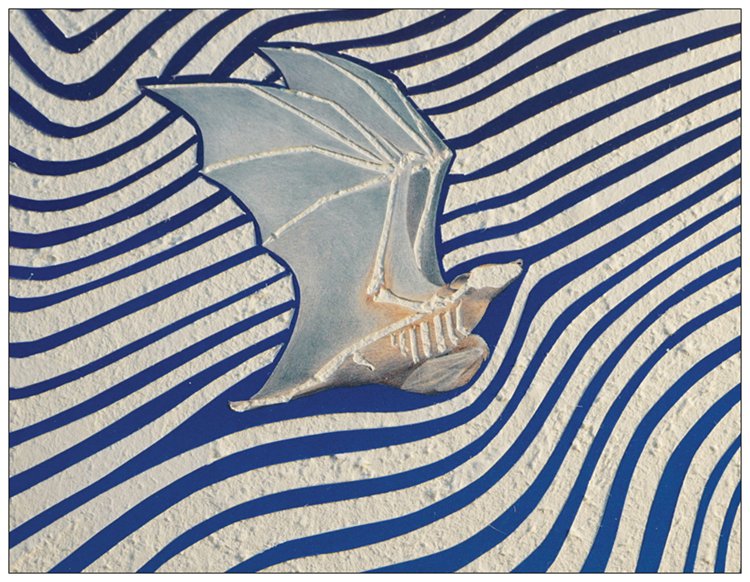
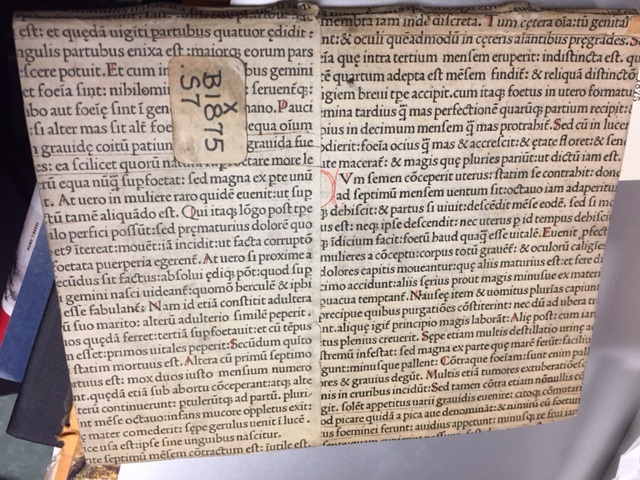
  Moreover, in identifying and classifying groups of animals and in explicating their functioning as a part of nature, Aristotle provided the basis for his philosophical analyses of relationships between structure, function, and purpose. De animalibus epitomizes Aristotle’s organizing principle.
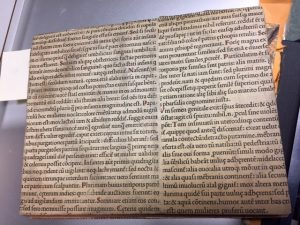 The Rutgers De animalibus (such as it was) was published in Venice by Johannes de Colonia and Johannes Manthen in 1476, a work translated by Theodorus Gaza and edited by Ludovicus Podocatharus. The printers Johannes de Colonia and Johannes Manthen were German merchants-turned-printers who acquired their printing material from Venice’s first printer (also a German immigrant), Vindelinus de Spira in 1473, during a slump in Venetian printing. Along with Nicolas Jenson, Colonia and Manthen dominated the highly-competitive Venetian printing business during the 1470s, producing 86 editions from 1474 to 1480, and merged their business with his in 1480. Intact copies of this edition of De animalibus are rare and highly valued. The last copy to go up to auction in 1998 sold for $96,000. While the Libraries own extraordinary samples of early Venetian printing in the form of intact works by Vindelinus, Jenson, and Aldus Manutius, these leaves are (as far as we know) the lone examples of work by Colonia and Manthem in our collection.