Category: Central Technical Services

  • An Evening with LIS Students

    As the editor of a peer-reviewed scholarly journal, I interact with many people. I work closely with potential authors during the review and publication process, and often keep in touch with some of them after their papers have been published. This was the case with Dr. Keren Dali, whose paper I accepted for publication (see Keren Dali and Leah K. Brochu, “The Right to Listen: A Not So Simple Matter of Audiobooks,” Library Resources and Technical Services volume 64, no. 3 [2020]). Keren and I bonded over some mutual interests. She recently invited me to speak to the students in her Collection Management Course, which is offered by the Research Methods and Information Science Department of the Morgridge College of Education at the University of Denver. In her email invitation to me, Keren wrote, “This is a class on the selection and weeding of library materials, as well as related policies and HR procedures. It would be great if students could hear from a high-level manager in one of the top research academic libraries in the country.” Resource description and technical services work, particularly weeding and transfer projects, are important aspects of collection development and management and I was flattered to have been asked to discuss my work. When I was in graduate school, I found it beneficial to hear firsthand from practitioners about their work and experiences.

    I’ve spoken to LIS classes before, and this was the first time I did it via Zoom. Pre-pandemic, I would’ve still needed to use videconferencing to speak to a class in Denver. The difference this time is that everyone participated via Zoom. I’ve become used to participating in meetings, conferences and webinars remotely. Keren’s class was small (14 students) and was a good size for discussion.

    The evening was an informal, freely flowing discussion instead of a lecture. I was asked about my personal trajectory into librarianship, specifically academic librarianship. I discussed how I chose technical services librarianship (which actually wasn’t my first choice) and my experience managing a busy department in a large academic library. I truly enjoy the complexities of resource description and like that my work provides the infrastructure to enable my public services colleagues to successfully deliver reference service and to teach courses. It also gives our users the ability to find and select the resources they need.

    Not surprisingly, the conversation touched on how our normal operations have changed due to COVID-19 and what implications it has had for collections and organizational processes. I described the challenges and successes of transitioning our cataloging operation to function remotely. That included making sure everyone had the equipment and access to the necessary technology to do their work. Fortunately, the cataloging resources we use (Classification Web, RDA Toolkit, Connexion) are all available remotely, and Alma is cloud based. Using WebEx for meetings was new for some of my staff, as was accessing files via Box. We developed a work plan before we began working remotely that specified who would do what work, which helped immensely with the transition to remote. Additionally, I noted that Rutgers, like many other research libraries, is using HathiTrust’s Emergency Temporary Access Services (ETAS), and also offering services like Click and Collect and home delivery to meet the needs of our users.

    Questions that I was asked included how my work at Rutgers informs my work as the editor of Library Resources and Technical Services (great question!). The two are closely related, and my professional experience and knowledge come into play when I provide authors with feedback on their manuscripts. I’m aware of trends, past and present, that have a bearing on technical services work.

    The importance of belonging to a professional organization (very important) was another question posed to me. I emphasized the benefits of sharing your expertise, as well as acquiring new expertise and gaining professional contacts. Although many conferences this year were virtual and a trend that may likely continue due to the benefits such as holding down costs and reducing time out of the office, I encouraged the students to attend them to find an organization that aligns with their interests and needs.

    Librarianship has evolved so much since I was in graduate school. Remote classes weren’t even offered then. Technology is now such an important part of technical services work. Shared databases make it easier to obtain copy for the resources we catalog. Discussion lists and Facebook communities allow us to share information and resolve our problems. Speaking to a class of future library professionals was an uplifting experience. I was impressed by their enthusiasm and perceptive questions.
  • The Inaugural ALCTS Mentoring Program

    The Association for Library Collections and Technical Services (ALCTS) issued a call for participation in its new Mentoring Program earlier this year. I submitted a mentor application because I have enjoyed serving as a mentor at Rutgers and welcomed the opportunity to work with ALCTS’ early career librarians—who are amazing! I’m a proponent of mentorship opportunities since they are mutually beneficial to both parties and I’ve personally benefitted from past mentoring relationships.  Here’s how the experience has been so far.

    Background of the ALCTS Mentoring Program

    The program resulted from the work of the ALCTS Leadership and Development Committee’s Mentoring Subcommittee, and runs from June 1, 2017 to April 30, 2018.  The call for participation sought applications from those interested in serving as a mentor or mentee—or both.

    The program’s goal are to

    • develop strong leadership in the areas of librarianship covered by ALCTS (acquisitions, cataloging and metadata, collection management, continuing resources, and preservation and reformatting),
    • support ALCTS members in developing professional skills,
    • cultivate leadership and involvement in ALCTS,
    • provide networking opportunities, and
    • expand members’ professional learning circles.

    The Requirements for Mentors and Mentees

    The first cohort of mentors and mentees consists of 41 pairs of librarians who are working with assigned program liaisons. The program is fairly formal. Matches were based on mentees’ expressed interests and each pair must complete a mentoring agreement form that addresses matters such as expectations, including how much time will be committed to the relationship and how often and in what mode(s) the pair will communicate. The mentor and mentee were required to develop three goals and detail how the mentor can best assist the mentee in achieving those goals. The pairs are also required to participate in an online training program at the beginning of their mentoring relationship.

    Resources:

    The time and effort that the Mentoring Subcommittee devoted to developing the program is evident through the resources they’ve made available, particularly the LibGuide (http://alcts.libguides.com/mentoring). Additionally, the program is based on a Mentoring Framework developed by the 2015 ALA Emerging Leaders. The program consists of four components for the matched pairs: planning, connecting, advancing, and transitioning.

    What’s It Like?

    I was thrilled to be selected for the program and very excited to learn with whom I had been paired. I’m also honored to be part of the program’s inaugural cohort. As instructed by our mentoring liaison, I reached out to my mentee right away with an email and we scheduled a phone call for later that week. We were both excited at the prospect of working together.

    Our initial conversation included completing the mentoring agreement, setting three goals, and deciding how often we would communicate with each other. One of my mentee’s goals is to become more involved with publishing. She has some solid ideas, but has not had a chance to follow up on them and welcomed guidance. We typically talk two times a month, and she will share with me the manuscript of a paper on which she is working. Our formal relationship ends in April, which feels as though it’s quickly approaching. The last part of our relationship will be to determine next steps, and I anticipate that while this is the end of one phase of our relationship, it won’t be the end.

    My Takeaways

    In my experience, mentoring is a mutually beneficial experience. In addition to guidance and advice I have provided to others, I, in turn, have learned things from mentees, which has helped me to develop my professional skills. For those who doubt the effectiveness of mentoring, consider this: Audrey J. Murrell, author of “Five Key Steps for Effective Mentoring Relationships,” indicates that research has shown that those individuals who have been mentored report higher salaries, more frequent promotions, greater job satisfaction, and are less likely to leave their jobs.


  • Rutgers Connect Migration Postmortem

    Rutgers Connect Migration Postmortem

    Office_365_logoRutgers University Libraries faculty and staff had a busy summer preparing for the email and calendar migration to Rutgers Connect. The migration took place over three days between August 23 and August 25, 2016, but by the time we reached this milestone, over two months of work by Unit Computing Specialists (UCSs) and Integrated Information Systems (IIS) staff had already been invested into planning the process, preparing for the transition, and learning the new environment.
    Here are some of the highlights:

    • 261 users responded successfully to the pre-migration questionnaire
    • 151 RUL members attended one of seven Information Sessions before the migration
    Please fill out a brief survey by Friday, October 14, and let us know how we did and what you are looking for, in terms of Rutgers Connect training and support, in the future.
    • 277 user accounts, 61 distribution lists, and 59 shared (resource) accounts were migrated
    • 146 RUL member participated in 9 hands-on training sessions conducted by Comparex and IIS (and paid for by the Rutgers Office of Information Technology)
    • 227 support requests have been completed since August 1
    • RUL retirees are also getting help migrating to ScarletMail, but that is a slower process and we respect their schedules
    • IIS was successful in arguing for reduced University requirements related to central management of personal mobile devices when accessing Rutgers Connect mail

    The migration went relatively smoothly, without any significant data loss, but there were inevitable glitches given the complex nature of the system and the four-way handling of the process: Microsoft as the owner of the platform, Rutgers as the customer (represented by OIT), Comparex as the University’s partner performing the actual migration, and, in RUL’s case, IIS as the local IT support unit, together with our UCS colleagues.

    We want to thank everyone for your patience and understanding as we have worked, and still keep working, to make the new tools perform efficiently for all. The Rutgers Connect environment is new to all of us, and there is still a lot to learn. IIS will transform the Rutgers Connect Migration Support website into an ongoing support site in the next couple of weeks. We will also try to prepare advanced training classes in the coming months.

    Since the Rutgers Connect/Office 365 platform lives in the Microsoft cloud, several features are difficult or impossible to adjust to our exact requirements. Rutgers is still working with the vendor to make changes, including the ability to set the default Sender address.

    All IIS members and UCSs added supporting the migration to their regular responsibilities, and they deserve our thanks. Tracey Meyer has been, and remains, our lead support person, and Kalaivani Anathan coordinated the migration process. We hope we have been able to help you all, and look forward to respond to any future question or support request.

    Please fill out a brief survey by Friday, October 14, and let us know how we did and what you are looking for, in terms of Rutgers Connect training and support, in the future.


    Save

    Save

    Save

    Save

    Save

  • Central Technical Services Participates in Big Ten Academic Alliance Cataloging Partnership

    A translation from one language to another graphicLibraries operate on the premise of cooperation and support. Technical services, in particular, embodies this ideal, as evidenced by international union catalogs such as OCLC’s WorldCat and programs like the Program for Cooperative Cataloging (PCC), which contribute catalog records that are created to specific standards that are shared with other libraries, ensuring an efficient, accurate, and timely workflow.
    One of the most challenging aspects of cataloging is handling foreign languages, especially when in-house expertise is lacking. Outsourcing materials is costly and a challenge when funding isn’t available. Hiring someone short-term to handle a gift isn’t always feasible or productive. The Big Ten Academic Alliance (BTAA) recently instituted a partnership to solve this problem in a collaborative and cost effective way.

    Catalogers from Central Technical Services (CTS) are participating in the BTAA Cataloging Partnership, a collaboration between 12 of the 14 BTAA institutions’ libraries to cooperatively share cataloging expertise for languages and formats. The partnership, coordinated by The University of Chicago, enables participants to leverage expertise across their libraries and is effective for the next two years (July 1, 2016–June 3, 2018).

    Here’s a broad overview of how the partnership works and the benefits to Rutgers:

    Step One – take inventory, create a work plan

    The first step was to conduct an inventory of language expertise and needs, plus format expertise and needs. A spreadsheet with this information was compiled that includes a proposed work plan that details which institutions will handle what work. Rutgers will contribute expertise in Hungarian, Polish, and Hindi, as well as music scores.

    A photo of books packaged for translation.
    Source: https://sites.psu.edu/librarynews/2016/08/01/big-ten-academic-alliance-cataloging-partnership-formed/

    Step Two – develop a work flow

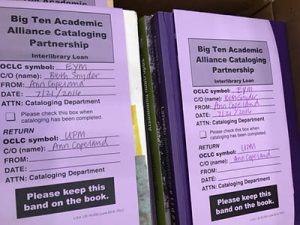
    Materials cataloged for the partnership are sent via the BTAA’s Uborrow interlibrary loan program to hold down costs. All resources are marked by a purple band that stays on them until they are cataloged and returned to the owning institution. Cataloging can be done either using Resource Description and Access (RDA), the prevailing cataloging standard, or AACR2 (RDA’s predecessor). Materials will receive copy cataloging or original cataloging treatment, and all work is done using OCLC’s Connexion cataloging client. Catalogers will follow the BIBCO* Standard Record (BSR), which emphasizes access points over description. Participating libraries are required to commit to a minimum of ten hours of cataloging per month (ten hours per institution, not ten hours per cataloger).

    Step Three – stay in touch and assess

    A discussion list has been established for the heads of technical services at each participating institution, and there is a monthly conference call to discuss progress, concerns, etc. Statistics are submitted online monthly via a Google documents form and include language, format, number of titles cataloged (titles, not volumes, are counted), and any anomalies encountered while cataloging.

    Outcomes

    Thanks to this collaborative program, we will be able to catalog dozens of foreign language publications, exposing these valuable resources and making them discoverable. We have already sent Persian and Hebrew books to Maryland, Belarussian books to Northwestern, and Greek books to the University of Minnesota. Michigan will catalog 130 Arabic books and 72 serials for Rutgers later in 2016.

    We are also providing cataloging for many of our peer libraries. To date, Rutgers is cataloging 32 music scores for the University of Chicago and 25 Hungarian books from the University of Illinois. Rutgers will also receive 100 Polish books to catalog from Michigan and Hindi books from Northwestern.

    Roman Frackowski, Bela Gupta, Julianna (Kati) Ritter, and Catherine Sauceda are providing cataloging for Rutgers and Mary Beth Weber is Rutgers’ point person for the partnership. If you have questions about this program or the materials that are being processed, please contact Mary Beth.


    *BIBCO is a program within the PCC that contributes high quality bibliographic records for books.

    Save