Author: Mary Beth Weber

  • Let Me Reintroduce Myself: Coordinator for Training and Mentorship

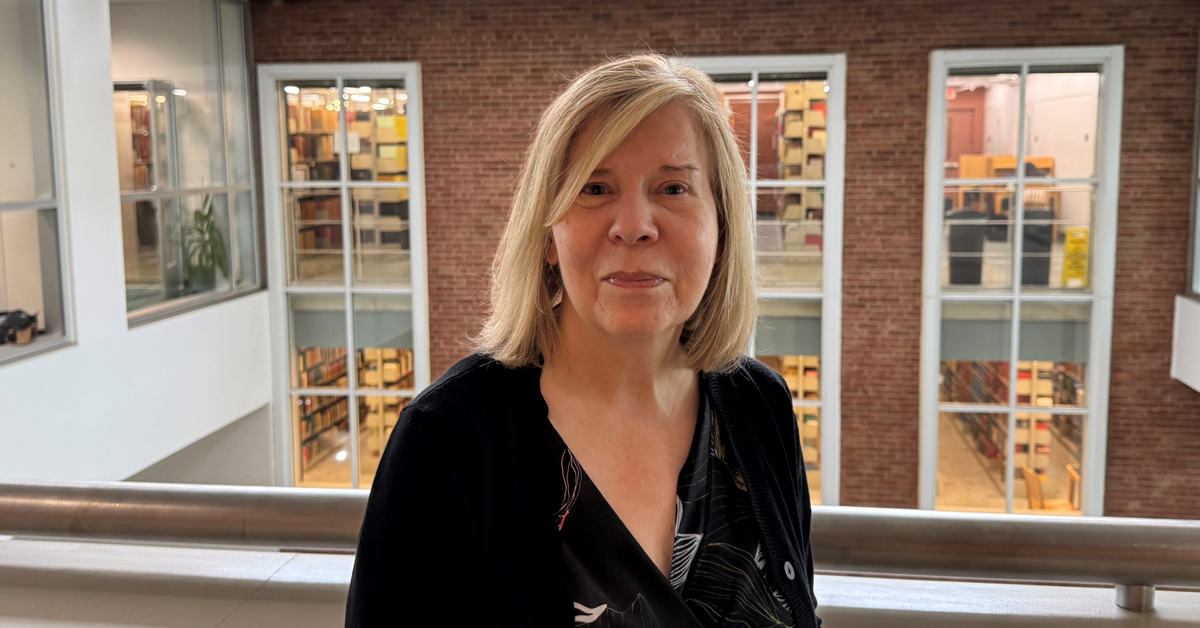
    head shot of an adult
    As the inaugural Libraries-wide coordinator for training and mentorship, Mary Beth Weber has moved to a new office within Alexander Library.

    Much of my career at Rutgers University Libraries has been in technical services, primarily in resource description (aka cataloging), and I’ve collaborated with many colleagues regarding projects, gift collections, and related concerns. As part of our recent reorganization, I was offered a new role that’s different in many ways from the work I had been doing. While I don’t have direct reports, I’m managing projects and initiatives.  

    As the inaugural coordinator for training and mentorship, I’ve been charged by our vice president for university libraries (VPUL) to oversee the Libraries’ enrichment program and to implement strategies to maximize success and promote continuous learning. The intent is to foster a learning community and unify training initiatives across our organization. The primary goals of my position are: 

    • Collaborate with the Libraries Leadership Team, communications director, Libraries Human Resources, Staff Advisory Committee, and faculty Planning Committee to identify professional development needs and implement targeted enrichment activities that support library personnel. Partnerships are essential for success. Through our collective wisdom, we can meet the needs of our workforce through all stages of their careers. Learning never ends, and there will be new skills and standards that we’ll need to master and apply to our work. 
    • Expand the scope of the Mentoring Program to be more inclusive and available to all library personnel. This will be a big change that will require input from both faculty and staff. While there are some differences between employment requirements for faculty and staff, there are more things they have in common, such as the need for guidance and connection. The program traditionally paired new hires with experienced colleagues. That will continue, and I’d like to consider expanding the types of mentoring offered to include just-in-time assistance for a specific short-term need.  
    • Develop a leadership program for frontline supervisors, middle managers, and executive personnel. The VPUL has previously mentioned EmpowerU; the goal is to prepare leaders across the Libraries to effectively handle the challenges and changes that our organization is facing and to prepare for the future. Our leaders have various backgrounds, skills, and experience, and the intent is to develop and strengthen those skills. By fostering foundational leadership principles such as strategic thinking, communication, and talent development, participants will be empowered to lead proactively and innovatively.   
    • Develop a master calendar of professional development opportunities. This will help with planning new offerings and avoid the conflict of scheduling multiple programs at the same time. Additionally, I’d like to create a streamlined means to share continuing education and professional development activities with the entire organization. People have emailed items to me, and that’s been great. I want to strike a balance between overwhelming people with emails and ensuring that they get information in a timely manner. One way to handle this is through a regular column in The Agenda. Another is to post events to the staff site.

    Some recommended resources for continuing education and enrichment follow: 

    • WebJunction is provided by OCLC support. WebJunction is free and open to personnel from all types of libraries. Access is provided to courses and webinars. 
    • The Carterette Series is produced by the Georgia Library Association. These webinars are free and open to anyone. Past webinars, including recordings, slides and resource links are in the organization’s archives 
    • The Training Magazine Network requires users to create a free account to access webinars (upcoming and past), a calendar of events, and regular emails about training resources. 
    • The Insperity Blog provides resources on business management and leadership that are applicable to library work.  

    I’ve relocated from my long-term “home” in the Technical Services Building on Busch Campus to the administrative suite on the third floor of Alexander Library on the College Avenue Campus. Feel free to stop by to say hello. Have other ideas? You can also call me or book an appointment to speak with me.  
  • Rutgers University Libraries Mentoring Program Committee Hosts Authors and Editors Panel Discussions

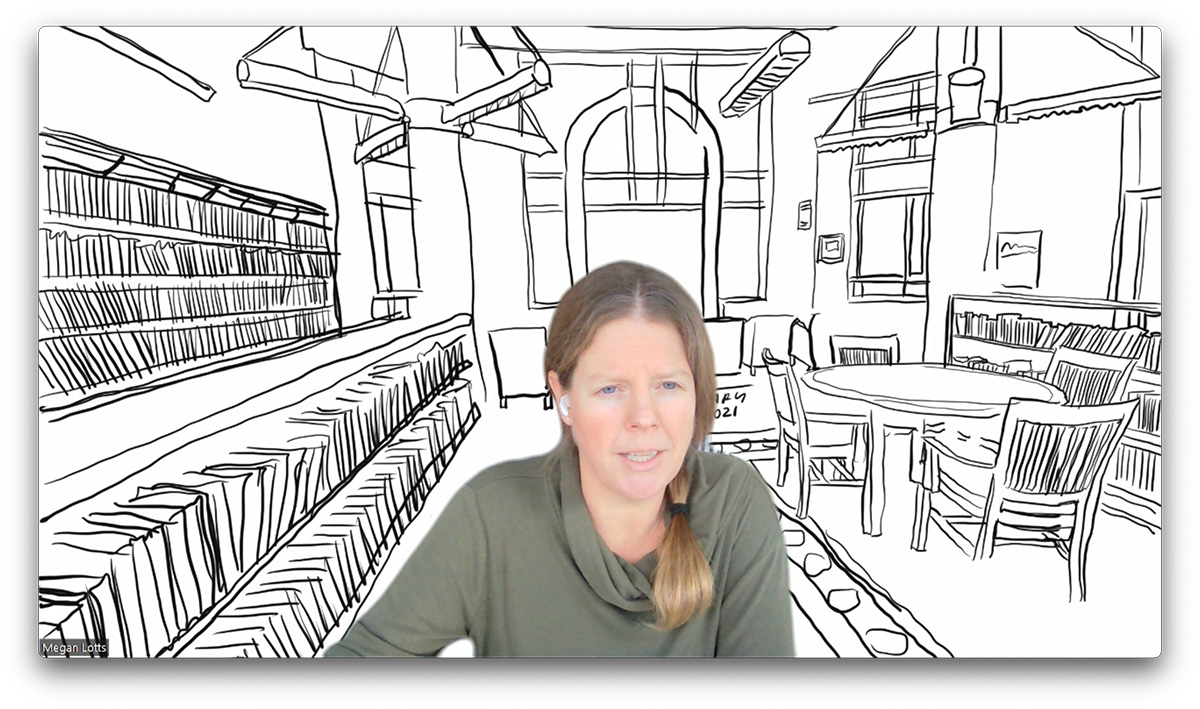
    RUL Mentoring Program Committee Authors Panel.

    In November 2022, the Rutgers University Libraries Mentoring Program Committee hosted a two-part program to give authors insight and confidence to share their ideas and expertise through publishing: “Part 1: Editors Panel” (November 2) and “Part 2: Authors Panel” (November 17).

    Experienced editors and authors discussed the fundamentals of research, writing, and publishing. They addressed topics such as turning an idea into a publication, dealing with deadlines and writer’s block, and collaborating with co-authors.

    For more information about the Mentoring Program Committee, please visit staff.libraries.rutgers.edu/faculty-mentoring.

    Authors Panel Panelists

    Laura Costello is the director for strategic planning and assessment for Rutgers University Libraries. Laura has authored and co-authored three books, seven book chapters, and over 20 peer-reviewed articles and other publications. Her research focuses on assessment in diverse areas of the library, including reference and user services, collections, and library spaces. She serves as a regular peer reviewer for the open-access journal Evidence Based Library and Information Practice (EBLIP). Her most recent publication is a co-authored article on the impact of the COVID-19 pandemic on virtual reference services published in The Journal of the Association for Information Science and Technology (JASIST).

    Melissa De Fino is the special collections and formats metadata librarian for Rutgers University Libraries. Melissa is the co-author of the recently published book Virtual Technical Services: A Handbook, which stemmed from her experiences during the COVID-19 quarantine period and has led to conference presentations and an interview invitation for the Lucidea “Think Clearly” blog. She served as the editor of the Technical Services Quarterly column “Tech Services on the Web” for five years. Melissa has published peer-reviewed articles about the changing nature of technical services librarianship and has served as a peer reviewer for several articles. Melissa was an ALA Emerging Leader in 2008 and was RUL’s first Emerging Leader.

    Megan Lotts is the art librarian at the Art Library of Rutgers University Libraries. Megan teaches research workshops, builds collections, facilitates programming and events, and closely engages with students and faculty researching in the arts. She has presented her research nationally and internationally and published articles in portal: the Libraries and the Academy, Art Documentation, Journal of Library Administration, College and Research Libraries News, and more. In 2021, the American Libraries Association published her book Advancing a Culture of Creativity in Libraries: Programming and Engagement. Her research interests include creativity, outreach and engagement, makerspaces, play, and the work of library liaisons. She is known for her work in implementing LEGO® play, creating a culture of creativity, and curating the exhibition spaces at the Rutgers University Art Library. She also teaches a semester-long seminar, “Playing to Learn in Higher Education.”

    Caryn Radick is the digital archivist for Special Collections and University Archives of Rutgers University Libraries. Caryn was a Special Collections and University Archives processing archivist from 2004 until 2011, when she assumed her current role. She oversees the New Jersey Digital Newspaper Project, which provides digitized historic newspapers. Her research interests include the intersection of archives and fiction and surfacing mysteries and puzzles found in archives. She has published articles in The American Archivist, Archivaria, and Nursing-Clio. Caryn served as an associate editor for the Journal of Archival Organization and the Journal of the Rutgers University Libraries. She is the 2021 recipient of the New Jersey Studies Academic Alliance’s Teaching Award for her Byrne Seminar class “Only in New Jersey! New Jersey’s History in Newspapers.”

    Yingting Zhang is the research services librarian at the Robert Wood Johnson (RWJ) Library of the Health Sciences of Rutgers University Libraries and an adjunct assistant professor in the RWJ Medical School Department of Medicine, Rutgers University. Yingting also serves as the liaison librarian to the School of Public Health and the Cancer Institute of New Jersey. She is a Distinguished Member of the Academy of Health Information Professionals. She serves on the Rutgers Health Sciences Institutional Review Board (IRB) and the Executive IRB. Yingting has authored and co-authored 14 peer-reviewed journal articles and six non-peer-reviewed papers. She is currently working on a book chapter related to research on digital identity and writing an article on her experience providing systematic reviews for the past seven years.

    Editors Panel Panelists

    Marianne Ryan is the dean of University Libraries at Loyola University Chicago. Since 2015, Marianne has served as the editor of portal: Libraries and the Academy, published by Johns Hopkins University Press and part of its Project Muse collection. Marianne also served as the Management column editor of Reference and User Services Quarterly and on the editorial board of Library Leadership & Management. She has published numerous articles, including “How to Get Your Article Published: Twenty Tips from Two Editors.”

    Ken Varnum is the senior program manager and discovery strategist at the University of Michigan Library. Ken’s research and professional interests include discovery systems, library analytics, and technology in the library setting. He has been the editor of Information Technology and Libraries (ITAL) since 2017 and has edited five books, the most recent being New Top Technologies Every Librarian Needs to Know, published in 2019. ITAL is one of ALA Core’s three official journals and is open access.

    Adriana Cuervo is the head of Archival Collections and Services at the Institute of Jazz Studies in the John Cotton Dana Library, Rutgers University–Newark. Adriana oversees the day-to-day operations of the Institute of Jazz Studies—the world’s largest and most comprehensive jazz research facility. She has had a long career in music and performing arts special collections and previously worked at the Sousa Archives and Center for American Music at the University of Illinois at Urbana-Champaign. She enjoys working in the preservation, access, and promotion of cultural heritage and has published several articles. Adriana served on the editorial board of American Archivist for four years.

    Nancy Kranich teaches at the Rutgers University School of Communication and Information and conducts special projects for Rutgers University Libraries. She served as President of the American Library Association in 2000–2001, focusing on the role of libraries in democracies. Nancy is currently editing a special issue on reimagining the civic role of libraries for Library Quarterly. She serves on the editorial boards of Library Quarterly: Information, Community and Policy and the Journal of Information Policy. She is also a frequent pre-publication peer reviewer for several scholarly journals. She has published countless articles and has served as editor and contributor to Libraries and Democracy for ALA Editions.

  • AvramCamp 2022: My Experience

    AvramCamp 2022

    AvramCamp is a one-day preconference offered by Core, a division of American Library Association (ALA). The event is named in honor of Henriette Avram, the creator of MARC format. It was offered on July 29 as a virtual event. Core describes AvramCamp as “a safe and welcoming space for women and non-binary technology library workers to explore common challenges faced, learn strategies for dealing with them, and discuss specific tools to build confidence….” AvramCamp is open to anyone, and registrants don’t need to be ALA members. Attendance was limited to 60 participants, who were from a range of libraries and at different points in their careers.

    The event opened with a discussion of ALA’s code of conduct, an overview of a jamboard (a virtual bulletin board with virtual post-its), and a guided meditation. The meditation was led by Ginger Stevens, a certified meditation coach and certified life coach. It was the first event I’ve attended that began with a guided meditation!

    The meditation was followed by a keynote by Dr. Sharon Whitfield, Electronic Resources and User Access Librarian, Rider University. Dr. Whitfield is also a researcher, and her primary focus is gender and library technology. Her keynote was titled “Schrodinger’s Workplace: Existing in Multiple States of Being,” and focused on the impact of external departments and constant interruptions on our work. Whitfield stressed that we tend to make more mistakes when we’re fragmented. Other drivers include increased workloads due to post-COVID retirements and vacancies and an uncertain future. She discussed how we can take control in such circumstances.

    Attendees were asked to reflect on our workplace and the various roles in which we serve. Whitfield asked attendees to discuss how they felt fragmented, both at work and in their personal life at home. We discussed whether we felt successful at multitasking and if we were effective at decision-making amid numerous interruptions. Whitfield addressed fragmentation and Imposter Phenomenon. Fragmentation can lead one to feel like an imposter, and she asked participants to acknowledge if they had felt that way.

    The next topic was gendered fragmentation, a common part of the culture of academia. Women are often viewed as nurturers and take on more service. This is particularly true for BIPOC women. Women who are in technology fields often lack mentors. Whitfield noted that Imposter Phenomenon isn’t exclusive to women and reported that 70% of the general population have experienced imposter tendencies in relation to their work.

    Whitfield shared a working definition of Imposter Phenomenon, which is common to high achievers, who are unable to internalize and accept their success. They often attribute their success to luck and fear that they will be revealed as a fraud. Although men may also suffer from Imposter Phenomenon, Syndrome, Whitfield reported that they tend not to internalize their feelings.

    The discussion moved to an examination of the unintended consequences of fragmentation and Imposter Phenomenon, which include workplace mobbing (i.e., bullying), decision making that doesn’t balance short- and long-term consequences, toxic work environment, and burnout from taking on too much responsibility. Workplace mobbing is common in libraries due to lack of clear job descriptions and this results in people being pulled into different fragmented areas. Attendees were asked to consider what we might do to stop fragmentation and feelings of imposter phenomenon.

    The remainder of the day was devoted to two breakout sessions and a closing discussion. Participants were asked to use virtual sticky notes to suggest discussion topics for the two afternoon breakout sessions. The suggestions with the most votes were selected (imposter phenomenon and invisible disability/neurodiversity). Feedback from the Imposter Phenomenon session included:

    • Adopting the mindset that there’s no true emergency in the work we do.
    • Recognizing that we may be our own worst critic.
    • The phrase “just say no” isn’t just about drugs and may be used at work.

    Feedback from the invisible disability/neurodiversity discussion included:

    • Provide training tools and resources for student employees/co-workers based on how you wish you had been trained.
    • Disclose to co-workers; explain the things that you need to be successful at work to those who need to know.
    • Ask students at hiring if they need accommodations—mental/physical/religious accommodations.

    The session ended with a recap of the breakout sessions and an open discussion.


  • Ex Libris Implementation Team Update – September 2022

    The Ex Libris Implementation Team provides regular updates to inform the Rutgers University Libraries (RUL) community of its activities and accomplishments, which benefit RUL and our user community.

    Primo

    Primo (aka “QuickSearch”) marked its 5th anniversary this year and continues to be one of the most heavily used library services, ending FY22 with over 2.2 million searches, 1.7 million record views, and 1 million full-text downloads. This year’s enhancements included the addition of ebook license information, search and indexing improvements, integration of the library link resolver with EndNote, improved error reporting, and various bug fixes. Enhancements for the coming year include persistent login, improved deduping, linked data enrichment, and improved collection discovery.

    Notable statistics for FY22 include:

    • 2 million searches
    • 7 million record views
    • 1 million downloads
    • 450 support requests
    Esploro

    Last year, the Libraries launched a new and improved version of SOAR (Scholarly Open Access at Rutgers) that’s powered by Esploro. Esploro improves and extends the Libraries’ ability to capture and manage institutional research output using automated data harvesting and machine learning techniques. SOAR staff imported over 22,000 new research assets via smart harvesting and accepted over 500 faculty deposits. Planned enhancements for the coming year include a redesigned research portal, enhanced ORCID integration, and implementation of public researcher profiles.

    Notable statistics for FY22:

    • 22,000 assets ingested
    • 56,000 record views
    • 62,000 downloads
    • 100 support requests
    Alma

    A pilot project to expedite the cataloging of donated books was conducted using two donations, the International Youth Literature Collection (IYLC) and the Tanner Collection. Two hundred ten IYLC donated titles were added to Alma, and 61 donated items were added for the Tanner gift. The pilot will be refined based on feedback from key stakeholders and is a work in progress. The goal is to expand the workflow to include other donations from across RUL.

    The ArchivesSpace Users Working Group was reinstated in July. They are working to establish local practices and standards for finding aids across all RUL archives and are using the ArchivesSpace plug-in tools for subject and name authority access. This initiative is led by Melissa De Fino, and group members include representatives from IIS, SC/UA, IJS, Smith Library, Robeson Library, and SMLR.

    A sustainable method to track withdrawn serial titles for the BTAA Shared Print Repository was developed by CTS, HMU, and IIS using Alma’s statistical notes feature. This information will be available in Alma Analytics in perpetuity.

    CTS and IIS personnel are working with SC/UA to improve the configuration of SC/UA locations and related changes in support of the SC/UA Migration Project for resources located in remote storage due to damage from Hurricane Ida.

    A new and innovative process is being developed for scores cataloging to meet a need in an area where expertise is currently lacking in CTS due to the departure of the music cataloger. The process is being developed in collaboration with Backstage Library Works.

    A total of 474 support requests were handled in response to queries and requests sent to the Cataloging Queue.

    Library Mobile

    The Library Mobile team is excitedly preparing for the Fall 2022 launch of our new student app. We encourage everyone to check out the tour on RUL’s YouTube channel and to download instructions so that you can start using the app.

    Rapido

    We’ve been working with Ex Libris on the implementation of Rapido, a resource-sharing platform that’s integrated with Alma and QuickSearch. Rapido will provide our patrons with a streamlined requesting experience, allowing them to search for and request all materials from within QuickSearch. Patrons will no longer need to log into and search multiple platforms. If the material isn’t available from RUL, background configurations will allow Rapido to source the requested materials using our existing sources via OCLC and ReShare as well as our new Rapido partners.

  • An Evening with LIS Students

    As the editor of a peer-reviewed scholarly journal, I interact with many people. I work closely with potential authors during the review and publication process, and often keep in touch with some of them after their papers have been published. This was the case with Dr. Keren Dali, whose paper I accepted for publication (see Keren Dali and Leah K. Brochu, “The Right to Listen: A Not So Simple Matter of Audiobooks,” Library Resources and Technical Services volume 64, no. 3 [2020]). Keren and I bonded over some mutual interests. She recently invited me to speak to the students in her Collection Management Course, which is offered by the Research Methods and Information Science Department of the Morgridge College of Education at the University of Denver. In her email invitation to me, Keren wrote, “This is a class on the selection and weeding of library materials, as well as related policies and HR procedures. It would be great if students could hear from a high-level manager in one of the top research academic libraries in the country.” Resource description and technical services work, particularly weeding and transfer projects, are important aspects of collection development and management and I was flattered to have been asked to discuss my work. When I was in graduate school, I found it beneficial to hear firsthand from practitioners about their work and experiences.

    I’ve spoken to LIS classes before, and this was the first time I did it via Zoom. Pre-pandemic, I would’ve still needed to use videconferencing to speak to a class in Denver. The difference this time is that everyone participated via Zoom. I’ve become used to participating in meetings, conferences and webinars remotely. Keren’s class was small (14 students) and was a good size for discussion.

    The evening was an informal, freely flowing discussion instead of a lecture. I was asked about my personal trajectory into librarianship, specifically academic librarianship. I discussed how I chose technical services librarianship (which actually wasn’t my first choice) and my experience managing a busy department in a large academic library. I truly enjoy the complexities of resource description and like that my work provides the infrastructure to enable my public services colleagues to successfully deliver reference service and to teach courses. It also gives our users the ability to find and select the resources they need.

    Not surprisingly, the conversation touched on how our normal operations have changed due to COVID-19 and what implications it has had for collections and organizational processes. I described the challenges and successes of transitioning our cataloging operation to function remotely. That included making sure everyone had the equipment and access to the necessary technology to do their work. Fortunately, the cataloging resources we use (Classification Web, RDA Toolkit, Connexion) are all available remotely, and Alma is cloud based. Using WebEx for meetings was new for some of my staff, as was accessing files via Box. We developed a work plan before we began working remotely that specified who would do what work, which helped immensely with the transition to remote. Additionally, I noted that Rutgers, like many other research libraries, is using HathiTrust’s Emergency Temporary Access Services (ETAS), and also offering services like Click and Collect and home delivery to meet the needs of our users.

    Questions that I was asked included how my work at Rutgers informs my work as the editor of Library Resources and Technical Services (great question!). The two are closely related, and my professional experience and knowledge come into play when I provide authors with feedback on their manuscripts. I’m aware of trends, past and present, that have a bearing on technical services work.

    The importance of belonging to a professional organization (very important) was another question posed to me. I emphasized the benefits of sharing your expertise, as well as acquiring new expertise and gaining professional contacts. Although many conferences this year were virtual and a trend that may likely continue due to the benefits such as holding down costs and reducing time out of the office, I encouraged the students to attend them to find an organization that aligns with their interests and needs.

    Librarianship has evolved so much since I was in graduate school. Remote classes weren’t even offered then. Technology is now such an important part of technical services work. Shared databases make it easier to obtain copy for the resources we catalog. Discussion lists and Facebook communities allow us to share information and resolve our problems. Speaking to a class of future library professionals was an uplifting experience. I was impressed by their enthusiasm and perceptive questions.

  • Ex Libris Implementation Project Update – September 2018

    quicksearch logoThe fall semester has started, and September 5 marks the third month of Alma and QuickSearch implementation. We have focused on rectifying known problems in preparation for the new school year, and have made many improvements to the system and the services it provides. Thanks to feedback from users and library staff, we are continually making improvements to the system. We encourage and welcome your input and questions—submit them by visiting https://apps.libraries.rutgers.edu/ex-libris/contact.

    As reported in the July update, the Implementation Team visited all four campuses in August. During those meetings, the team reported on the respective working groups and held discussions with library personnel. We appreciate the fact that people took the time to participate in these sessions and provided thoughtful feedback and questions. The discussions were lively and productive.

    The Implementation Team would like to take this opportunity to share the following updates:

    • A QuickSearch tutorial has been created and will be available this fall. An announcement is forthcoming.
    • The library names facet in Primo has been revised to reflect abbreviated and more commonly known library names, making it more usable for patrons. For example, Archibald S. Alexander Library will now display as “Alexander Library”.
    • 856 links to finding aids and other materials are now available in the “Links” section of QuickSearch records.
    • Sign in has been improved to allow users to sign in with fewer actions and to more easily access account options such as loans, requests, and favorites.
    • Database lookup has been enabled so that users who enter database names (PubMed, JSTOR, Factiva) in the search box get a direct link to that resource at the top of their search results.
    • An open access filter is now available in QuickSearch, enabling users to limit results to content published in open access publications.
    • A number of fields are now available in QuickSearch record displays, including uniform title, language, identifier, related work, and several local note fields (e.g., general, bound with, performer, production credits, donor, and finding aid). Additionally, the donor note is now searchable, making it easier to identify specific gift collections and to retrieve records for items in those collections.
    • Harvard has been added to the list of citation options and MLA has been updated to the 8th edition.
    • Users can now save records to Zotero.
    • Users are now able to pick up materials from off-site delivery locations, such as the law libraries.
    • A new marketing campaign for QuickSearch will be unveiled this fall.

    The Implementation Team’s website is available at https://apps.libraries.rutgers.edu/ex-libris. It includes the various teams and working groups associated with the implementation, a timeline for the project, resources, an FAQ, and a list of known issues for Alma and QuickSearch (alias Primo). The team is working through both lists of issues, and the lists are updated as progress is made and issues are resolved.

    We are fully aware that our experience with QuickSearch and Alma is one of learning and trial and error. The Implementation Team values input and collaboration from the Libraries as well as our user community to continually refine and improve this service.

  • The Inaugural ALCTS Mentoring Program

    The Association for Library Collections and Technical Services (ALCTS) issued a call for participation in its new Mentoring Program earlier this year. I submitted a mentor application because I have enjoyed serving as a mentor at Rutgers and welcomed the opportunity to work with ALCTS’ early career librarians—who are amazing! I’m a proponent of mentorship opportunities since they are mutually beneficial to both parties and I’ve personally benefitted from past mentoring relationships.  Here’s how the experience has been so far.

    Background of the ALCTS Mentoring Program

    The program resulted from the work of the ALCTS Leadership and Development Committee’s Mentoring Subcommittee, and runs from June 1, 2017 to April 30, 2018.  The call for participation sought applications from those interested in serving as a mentor or mentee—or both.

    The program’s goal are to

    • develop strong leadership in the areas of librarianship covered by ALCTS (acquisitions, cataloging and metadata, collection management, continuing resources, and preservation and reformatting),
    • support ALCTS members in developing professional skills,
    • cultivate leadership and involvement in ALCTS,
    • provide networking opportunities, and
    • expand members’ professional learning circles.

    The Requirements for Mentors and Mentees

    The first cohort of mentors and mentees consists of 41 pairs of librarians who are working with assigned program liaisons. The program is fairly formal. Matches were based on mentees’ expressed interests and each pair must complete a mentoring agreement form that addresses matters such as expectations, including how much time will be committed to the relationship and how often and in what mode(s) the pair will communicate. The mentor and mentee were required to develop three goals and detail how the mentor can best assist the mentee in achieving those goals. The pairs are also required to participate in an online training program at the beginning of their mentoring relationship.

    Resources:

    The time and effort that the Mentoring Subcommittee devoted to developing the program is evident through the resources they’ve made available, particularly the LibGuide (http://alcts.libguides.com/mentoring). Additionally, the program is based on a Mentoring Framework developed by the 2015 ALA Emerging Leaders. The program consists of four components for the matched pairs: planning, connecting, advancing, and transitioning.

    What’s It Like?

    I was thrilled to be selected for the program and very excited to learn with whom I had been paired. I’m also honored to be part of the program’s inaugural cohort. As instructed by our mentoring liaison, I reached out to my mentee right away with an email and we scheduled a phone call for later that week. We were both excited at the prospect of working together.

    Our initial conversation included completing the mentoring agreement, setting three goals, and deciding how often we would communicate with each other. One of my mentee’s goals is to become more involved with publishing. She has some solid ideas, but has not had a chance to follow up on them and welcomed guidance. We typically talk two times a month, and she will share with me the manuscript of a paper on which she is working. Our formal relationship ends in April, which feels as though it’s quickly approaching. The last part of our relationship will be to determine next steps, and I anticipate that while this is the end of one phase of our relationship, it won’t be the end.

    My Takeaways

    In my experience, mentoring is a mutually beneficial experience. In addition to guidance and advice I have provided to others, I, in turn, have learned things from mentees, which has helped me to develop my professional skills. For those who doubt the effectiveness of mentoring, consider this: Audrey J. Murrell, author of “Five Key Steps for Effective Mentoring Relationships,” indicates that research has shown that those individuals who have been mentored report higher salaries, more frequent promotions, greater job satisfaction, and are less likely to leave their jobs.


  • Central Technical Services Participates in Big Ten Academic Alliance Cataloging Partnership

    A translation from one language to another graphicLibraries operate on the premise of cooperation and support. Technical services, in particular, embodies this ideal, as evidenced by international union catalogs such as OCLC’s WorldCat and programs like the Program for Cooperative Cataloging (PCC), which contribute catalog records that are created to specific standards that are shared with other libraries, ensuring an efficient, accurate, and timely workflow.
    One of the most challenging aspects of cataloging is handling foreign languages, especially when in-house expertise is lacking. Outsourcing materials is costly and a challenge when funding isn’t available. Hiring someone short-term to handle a gift isn’t always feasible or productive. The Big Ten Academic Alliance (BTAA) recently instituted a partnership to solve this problem in a collaborative and cost effective way.

    Catalogers from Central Technical Services (CTS) are participating in the BTAA Cataloging Partnership, a collaboration between 12 of the 14 BTAA institutions’ libraries to cooperatively share cataloging expertise for languages and formats. The partnership, coordinated by The University of Chicago, enables participants to leverage expertise across their libraries and is effective for the next two years (July 1, 2016–June 3, 2018).

    Here’s a broad overview of how the partnership works and the benefits to Rutgers:

    Step One – take inventory, create a work plan

    The first step was to conduct an inventory of language expertise and needs, plus format expertise and needs. A spreadsheet with this information was compiled that includes a proposed work plan that details which institutions will handle what work. Rutgers will contribute expertise in Hungarian, Polish, and Hindi, as well as music scores.

    A photo of books packaged for translation.
    Source: https://sites.psu.edu/librarynews/2016/08/01/big-ten-academic-alliance-cataloging-partnership-formed/

    Step Two – develop a work flow

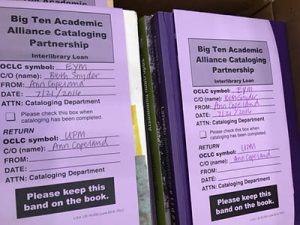
    Materials cataloged for the partnership are sent via the BTAA’s Uborrow interlibrary loan program to hold down costs. All resources are marked by a purple band that stays on them until they are cataloged and returned to the owning institution. Cataloging can be done either using Resource Description and Access (RDA), the prevailing cataloging standard, or AACR2 (RDA’s predecessor). Materials will receive copy cataloging or original cataloging treatment, and all work is done using OCLC’s Connexion cataloging client. Catalogers will follow the BIBCO* Standard Record (BSR), which emphasizes access points over description. Participating libraries are required to commit to a minimum of ten hours of cataloging per month (ten hours per institution, not ten hours per cataloger).

    Step Three – stay in touch and assess

    A discussion list has been established for the heads of technical services at each participating institution, and there is a monthly conference call to discuss progress, concerns, etc. Statistics are submitted online monthly via a Google documents form and include language, format, number of titles cataloged (titles, not volumes, are counted), and any anomalies encountered while cataloging.

    Outcomes

    Thanks to this collaborative program, we will be able to catalog dozens of foreign language publications, exposing these valuable resources and making them discoverable. We have already sent Persian and Hebrew books to Maryland, Belarussian books to Northwestern, and Greek books to the University of Minnesota. Michigan will catalog 130 Arabic books and 72 serials for Rutgers later in 2016.

    We are also providing cataloging for many of our peer libraries. To date, Rutgers is cataloging 32 music scores for the University of Chicago and 25 Hungarian books from the University of Illinois. Rutgers will also receive 100 Polish books to catalog from Michigan and Hindi books from Northwestern.

    Roman Frackowski, Bela Gupta, Julianna (Kati) Ritter, and Catherine Sauceda are providing cataloging for Rutgers and Mary Beth Weber is Rutgers’ point person for the partnership. If you have questions about this program or the materials that are being processed, please contact Mary Beth.


    *BIBCO is a program within the PCC that contributes high quality bibliographic records for books.

    Save