Category: Department

  • Founded in 1766: An Exhibit and an Event Celebrating the Archives of the Medical Society of New Jersey

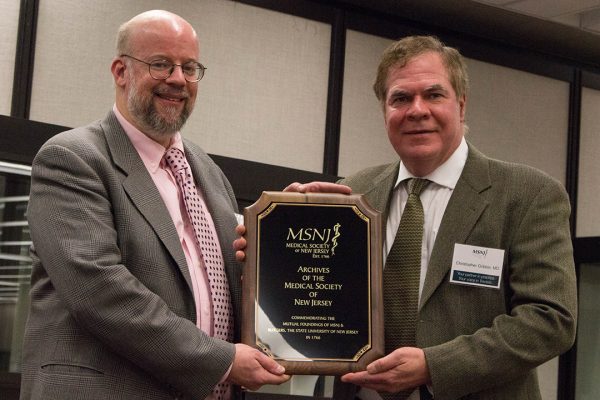
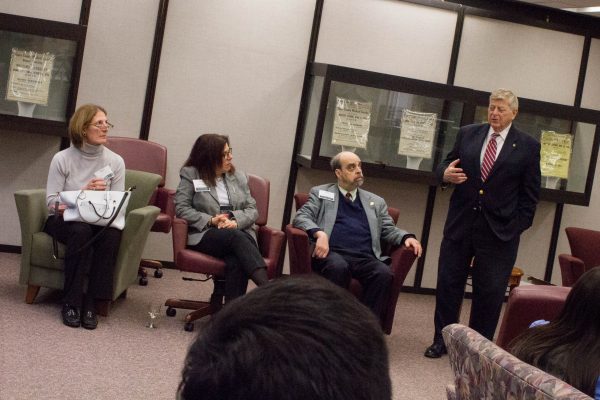
    • Bob Vietrogoski receives a plaque commemorating the donation from MSNJ president Christopher Gribbin.

    In 2016, Rutgers University was not the only major New Jersey institution celebrating its 250th anniversary. On July 23, 1766, at Duff’s Tavern in New Brunswick, a group of physicians met and formed the Medical Society of New Jersey (MSNJ). The MSNJ is America’s oldest state medical society, and indeed, is America’s oldest professional society.

    The George F. Smith Library of the Health Sciences, Rutgers University Libraries, is pleased to announce that the MSNJ has donated its 20th- and early 21st-century records to Smith Library’s Special Collections in the History of Medicine. The donation consists of 52 archival boxes of records, and 85 volumes of MSNJ Board of Trustees minutes from 1931 to 2005. These valuable historical records will be preserved and made available to MSNJ administrators, members, and officers; Rutgers University students and faculty; historians of medicine; and local and family historians.

    Special Collections already holds a nearly complete run of MSNJ journal publications from 1848 to 2005, as well as substantial archival holdings of its constituent Bergen, Burlington, Essex, Hudson, Monmouth, Passaic, and Warren County Medical Societies, and the records of the Medical Society of New Jersey Alliance (formerly the Women’s Auxiliary).

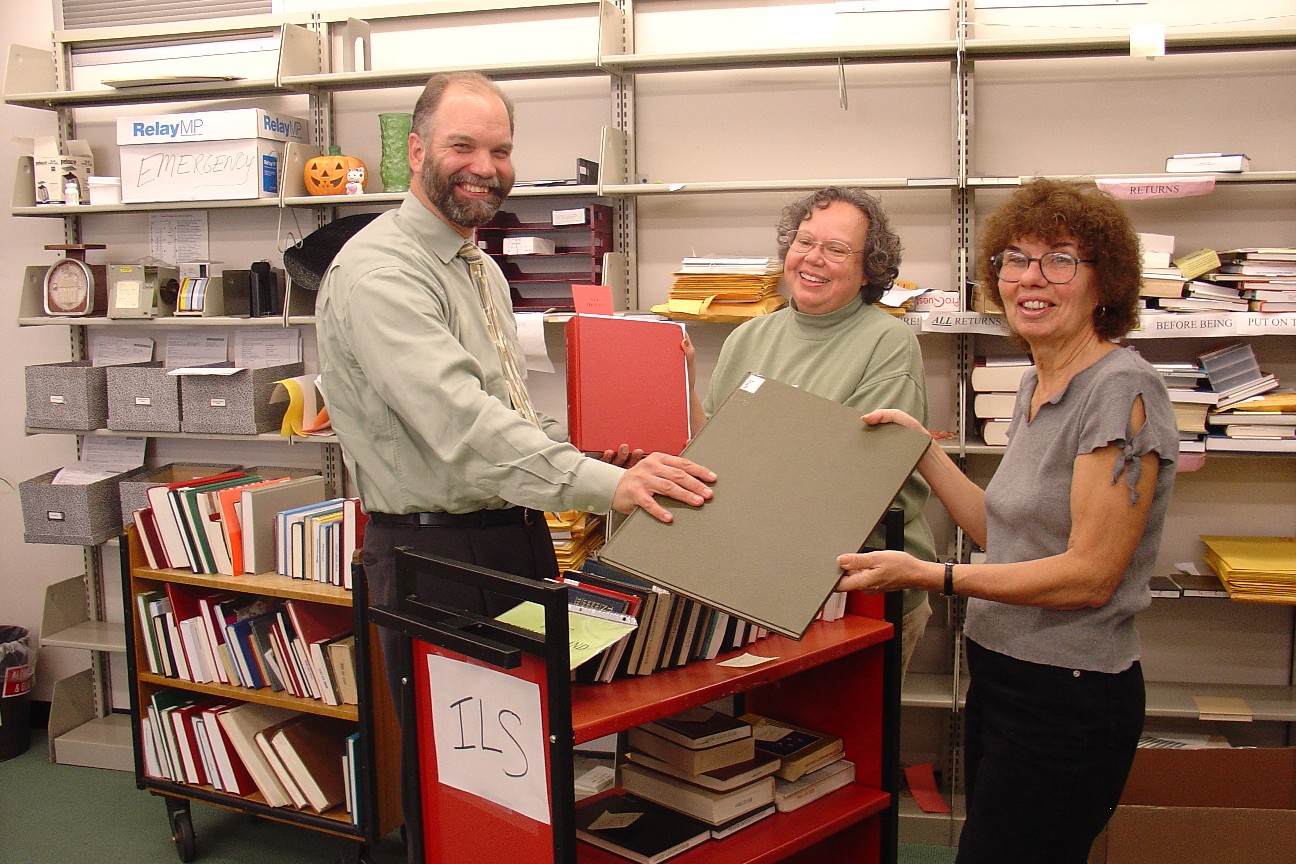
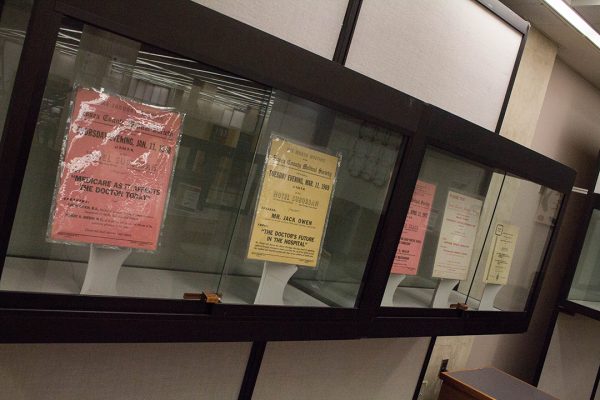
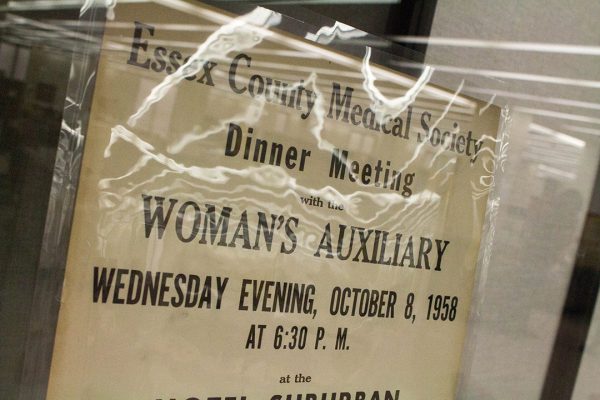
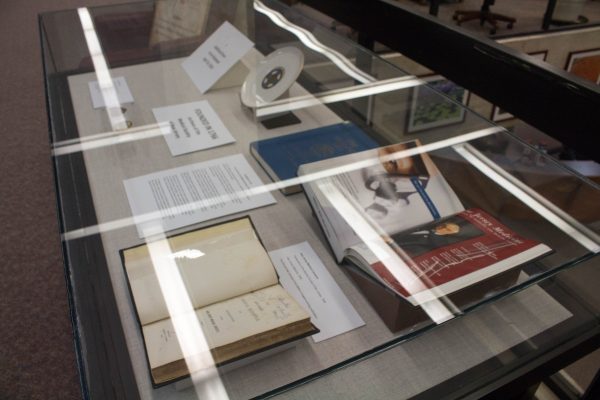
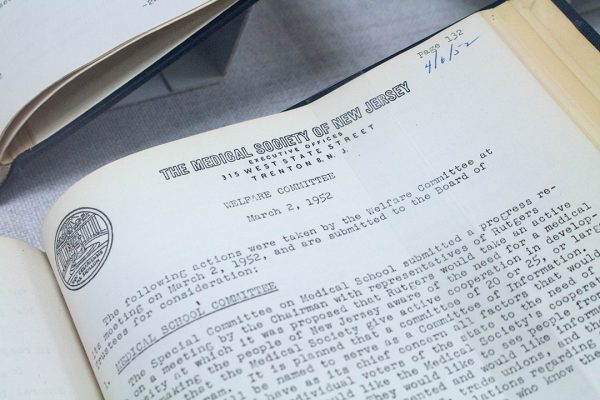
    An exhibit of materials from this accession was curated by Bob Vietrogoski, with the help of Nancy Blankenhorn, medical student Stephanie Yuen, and Tim Corlis and his preservation team. On display are a selection of artifacts related to the 200th and 250th anniversaries of the MSNJ; Board of Trustees minutes discussing physicians joining the military during World War II, plans for a New Jersey medical school in 1952, the introduction of the polio vaccine in 1955, and the discouragement of smoking in hospitals in 1967; photographs from two issues of New Jersey Medicine on the history of New Jersey’s pioneering women physicians; and meeting posters from the Essex County Medical Society from 1954 to 1979 concerning the perpetual topic of “New Legislation Affecting the Medical Profession.”

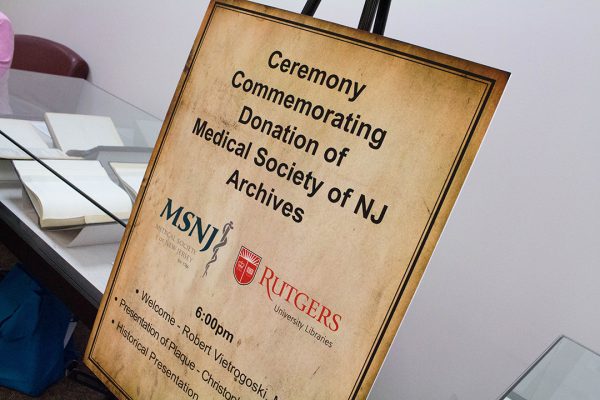
    The exhibit opening on April 19 was attended by MSNJ administrators including its past, present, and future presidents; members of the Medical History Society of New Jersey; Rutgers New Jersey Medical School faculty and students; and Rutgers librarians. At this reception, MSNJ President Christopher Gribbin presented Special Collections librarian Bob Vietrogoski with a plaque commemorating the MSNJ archival donation. This donation brings together Rutgers and the MSNJ, two New Jersey institutions founded in 1766.

  • Sharing Rare Books and Artists’ Books with the Blind and Visually Impaired

    On March 14, we hosted a visit from the Joseph Kohn Training Center for the Blind (130 Livingston Avenue, New Brunswick). The idea for the visit originated in a phone conversation initiated by Amo Musharraf, an instructor at the center, with Christie Lutz, the New Jersey regional studies librarian and head of public services. Since Amo expressed a desire for his class, consisting of 15 blind and visually impaired students and three sighted aids, to look at some of our rare books, Christie put him in touch with me. I remembered meeting Amo several years ago when he dropped by to look at copies of early editions of Paradise Lost, and I was delighted to be back in touch and to be included in what promised to be an adventure. In my 26 years at Rutgers, I had never addressed a class comprised of blind and visually impaired students. Seeing feels indispensable to me, and a lot of the pleasure I find in rare books and art derives from the visual. The question was, what would a blind class find pleasurable in our collection?

    Without sight, other senses—like touch and sound—would be more important. We started by gathering volumes that had interesting tactile elements, for example, a brace of bindings in various animal skins—goatskin, calf, sheep, and vellum. Snakeskin, cowhide, and velvet were suggestions from our rare book cataloger, Silvana Notarmaso, who agreed to speak about them. Not only is Silvana knowledgeable about these materials, but it seemed to us that the class might benefit from hearing different voices.

    It also seemed a good idea to refine the touch experience. Feeling the difference between rough sheep and smooth goatskin would be a nice introduction, because everyone would easily know what they were supposed to be feeling; but touching and analyzing differently finished grains of goatskin would be more challenging and rewarding. After a second or two, students were engrossed in contrasting the milky smoothness of a flat grain finish (which feels like the arm of a leather couch or car seat) with the grooves of a straight grain finish (resembling the surface of a vinyl record, only slightly softer). We told them that, like writers, bookmakers made an effort to appeal to all of the senses. Bookbinders wanted their customers to luxuriate in the sense of touch, and that historical bookbinding was a complex trade.

    To these books we added 15th-century wooden bindings, and 19th-century cloth. As well as helping the students to connect sensually with the objects, we wanted to engage them intellectually by sharing some of their history and contents. So, we talked a little bit about binding history, pointing out that the earliest printed books were bound simply in durable wooden boards with tough leather spines, or workaday vellum, and we shared notes about the texts themselves and our personal experiences with them. For example, we explained that the small octavo book with wooden boards (knuckles rapping for emphasis) and the remnants of a scallop shell clasp was a 1480 edition of the first cookbook ever printed (the same book the great French chef Julia Childs had handled when she came to Rutgers to accept her honorary doctorate); and we noted that the grooved finish of the clothbound first edition of Cooper’s The Song of Hiawatha represents the trade binder’s attempt to manufacture for a wider audience an imitation of the surface of the elegant bespoke goatskin bindings handmade for the wealthy collectors.

    This turn of the discussion led into an aside about book collecting in which we explained that historically, books finely-bound with gold decorations were prestige items acquired by the wealthy and powerful, generally male—a cultural phenomenon that went back to the great Renaissance libraries of collectors like the Medicis—and that the spines of these books were often lavishly tooled in gold because they would be showcased glittering on private library shelves. The boards were less often or more humbly adorned because the books would seldom be taken down and hardly ever read. One of the older students, an African American female whose eyes were almost completely white, commented insightfully, “Oh, that’s why there were so many power paintings of men holding books.”

    Other students made similarly perceptive comments, so that the class often resembled an extended conversation or symposium. And we were constantly reminded of the students’ range of experience: when Silvana talked about the snakeskin and crude cowhide bindings used on Argentine publications, and mentioned that SC/UA holds three copies of Martin Fierro (el Gaucho), a 2,316-line epic poem by the Argentine writer José Hernández, all bound in cowhide, one of the Latina students spoke briefly about Fierro’s popularity.

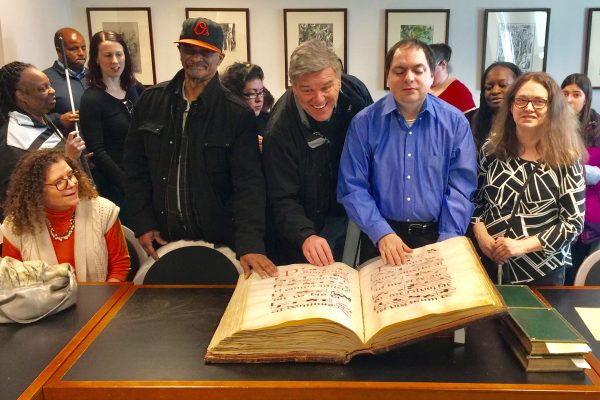
    We also selected books of unusual proportions and mass. Bodies respond in different ways to books of different size. The highlight of a group of large, tall, and chunky books was a massive early volume of musical notation hand-drawn on parchment sheets measuring approximately three feet in height bound in stiff, well-wormed leather over wooden boards decorated with metal bosses and the remnants of heavy, metal clasps. The students were taken by the sweep of the vellum pages, by the harsh, lumpy, pitted surface of the boards, and by the immense weight of the thing. They congregated around this book, and continually asked questions about it, such as what causes worming (one of the students was surprised and delighted to learn that bookworms were an actual thing), what purpose the clasps served, how such an immense book was used and by whom, and whether anyone who could read the musical notation ever came by. The commanding dimensions of the volume made it the focal point or perceptual center of the class, and I pointed out the obvious fact that it would have been so in a church or monastery. The auratic power of the book, realized in this particular volume, was a cultural reality, one we forget when we examine texts on computer screens.

    And we talked about how the authority of the book could be subverted for artistic purpose in a discussion of artists’ books. Most of the students had never heard of artists’ books and some expressed reservations about the concept (they laughed when I pointed out that they were frowning), but they regarded the objects with a great deal of intense interest and open-mindedness.

    Recently acquired glass books by Amanda Thackray were passed around gently, almost reverently. The students showed great respect for the integrity of the object and thoughtfully considered the artist’s statement that books are bodies and she wanted her artists’ books to be held. To contrast Amanda’s weighty, artistically rounded glass, I handed them a book by Anna Pinto consisting of calligraphy on light driftwood shaped by the sea. The diverse non-traditional materials used in Suellen Glashausser’s artists’ books (margarine wrappers, aluminum foil, pieces of metal from a Sprite soda can, cigar labels, cardboard collars, brown paper bags, etc.) provoked side conversations. The students were impressed by Suellen’s ability to find the voice in virtually any material, as well as her belief that every material has something valuable to say. One of the aids intensified our sense of communing with the artist by telling us she had studied with Suellen at Montclair State University and that she had been a fabulous teacher.

    The class responded thoughtfully to Buzz Spector’s elegant single sheet work Cage. Buzz deliberately printed Cage on a handmade paper that crackles when handled. (I passed the sheet around for the students to hear.) His intention seems to have been for beholders of the work to have an acoustic experience to facilitate a connection with John Cage’s famously silent 4’ 33”.

    The most popular artists’ book was Marcia Wilson’s provocative All the Men I Ever Slept With, a coffin-shaped wooden book with a metal screw through the bottom that serves as a binding agent. The joke of the screw poking through the images and becoming a three-dimensional extension of the imagery is immediately comprehensible (the students were eager to feel the book and explain the joke to each other as they passed it around). Having already handled driftwood and glass books, they grasped the idea that form is information, and laughed at the fresh ingenuity of the object; they responded to my reading a page of the author/artist’s text by pointing out that while it was amusing, it was also wistful—that the book wasn’t the cartoon (my word) it first appeared to be.

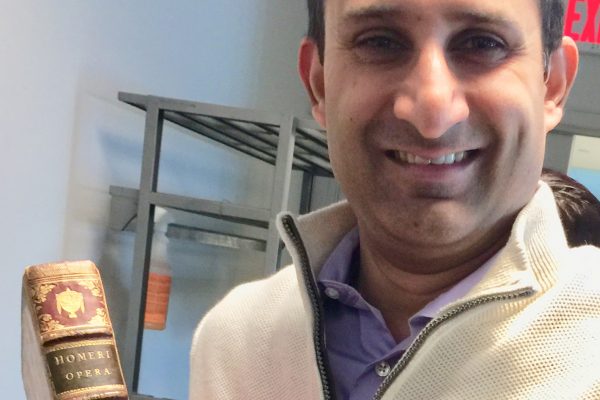
    Naturally, since Paradise Lost inspired Amo to arrange the visit, we featured it in a selection of iconic texts including our editio princeps of Homer (1488), the second folio of Shakespeare (1634), and The King James Bible (1611). It seemed important to say that according to legend, the great Homer was also blind, and we sought to emphasize its importance by processing around the room with the book in hand inviting everyone to touch the cover. The students asked us to open the book so they could feel the pages as well.

    The class was intensely responsive, engaging, inquisitive, and astute. Their visit to our library was clearly important to them, as it was to us, and midway through, the director of the program, Dell Bashar, drove over to be a part of it. One of the students, Dave, who was graduating at the end of the week, caught him up on some of what he’d missed, summarizing a good 40 minutes of our talk in about five minutes. Another student wanted us to discuss a book we had overlooked (a multivolume edition of Lawrence Sterne’s Tristram Shandy housed in a slipcase with a false front that resembled the curved spines of three substantial volumes side-by-side). She had found the object on her own and she couldn’t work out by touch what it could be. She wanted to know.

    Although we had arranged in advance to take photographs, the demands of the class made it impossible. The photographs here were taken by Amo and by one of his aids. When Amo texted the photos he jokingly captioned one of me looking surprised: “Your reaction when three vans full of blind people showed up looking for you :)”

    Amo deemed the visit successful, calling it “history,” and Dell said he would like to bring future classes to see our collections.

  • WebEx Conferencing Available to All

    WebEx Conferencing Available to All

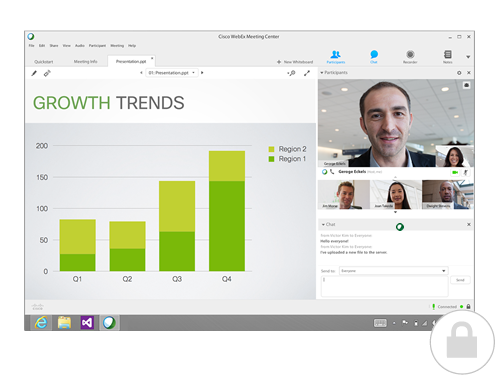
    webex screenshotThere are so many ways for video/web conferencing. Why should I use WebEx?
    Who: All RUL faculty and staff can initiate a WebEx call to hold virtual meetings.

    What: A WebEx meeting is an online meeting that allows you to meet and collaborate with other people. Attendees will need a computer, a laptop, a mobile device with Internet access, or even just a telephone to participate. For a full experience, use a webcam with a microphone. Videoconference endpoints can also be added to the meeting.

    When: WebEx is recommended for use in formal, informal, or even ad hoc situations involving small groups or large audiences, with both Rutgers employees and external participants.

    Where: WebEx can be used from any location with Internet, cellular, or telephone connectivity. Most of the RUL conference rooms are equipped to participate. When conference rooms are booked or when you would like to conference from your own office, or from the road, WebEx is the solution for you.

    Why: WebEx is ideal for easily connecting with internal or external participants, since invitees do not have to have any special software beyond a browser. To compliment your collaboration, Through WebEx, you can share your screen and present applications, share lectures, or co-edit documents. Meetings can be recorded through the click of a button and made available later.

    How:  Request the use of one of RUL’s WebEx licenses by emailing webex@rulhelp.rutgers.edu or by creating an RULHelp ticket. Bookroom also integrates the option to request a WebEx meeting when scheduling your conference location. Your local UCS, or IIS staff will then create your WebEx meeting, supply you with directions for using WebEx, and provide you with email invitations to send out to your participants. We can also provide a hands-on training session for anyone in RUL.

    Once the WebEx meeting is set up, you can join from any browser using a link found in the meeting invitation. In seconds, your browser will automatically download a plugin or app (if needed) after which you will be directly connected to the meeting. When joining by phone, call the WebEx number and enter the meeting number supplied in the meeting invitation.

    Want to know more? Contact IIS or your local UCSs. We are here to help!

    Save

    Save

  • This Month in the Agenda: March 2000

    This month we take a look at the Agenda in the aughts. Is it just me, or does 2000 not feel like almost two decades ago?

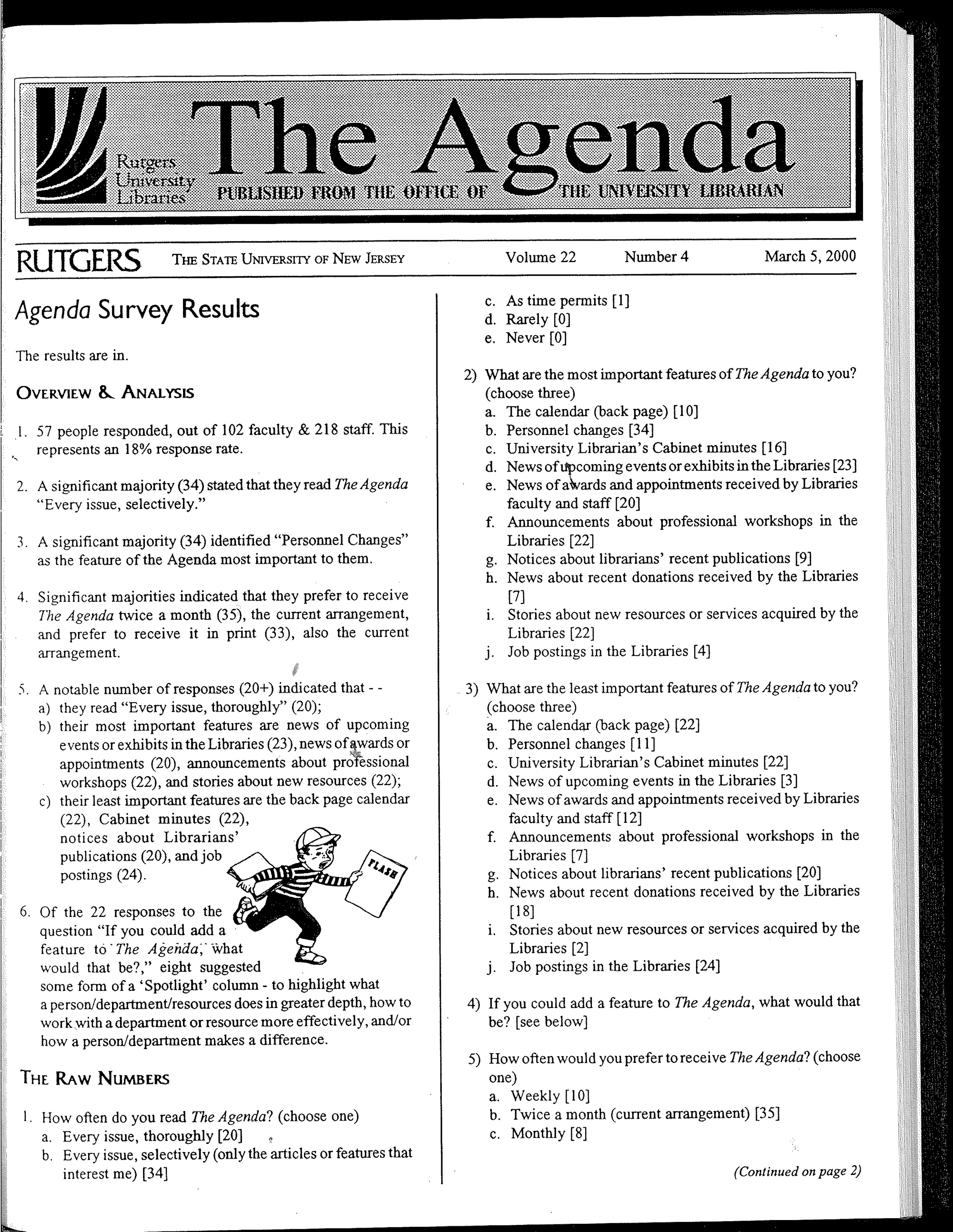
    Survey Says
    The Agenda 22, no. 4 (March 5, 2000)
    Reader survey from the Agenda 22, no. 4 (March 5, 2000).
    Systematic Thinking

    MESSAGE FROM THE UNIVERSITY LIBRARIAN

    At the last Cabinet meeting we discussed what it means to be a system. This might seem needless for an organization that has described itself as operating system-wide for many years, but it’s always useful to step back and take stock. This is especially important as we continue to develop our long-range plan, the Digital Library Initiative (DLI), and seek ways to be more effective.

    Typically, a system shares the same vision, philosophy, and goals. It shares common infrastructure and operates with system-wide policies and practices. There is considerable interdependency among units and a heightened need for communication. There’s also a shift to systems thinking, where operations are examined across the system rather than just locally. This helps to improve and expand the entire system’s capabilities to be effective. Each unit is each other unit’s best customer and best supporter. Information and expertise are shared readily, so that everyone in the organization benefits.

    As we implement the DLI we need to ensure that we are all working towards system-wide goals, using our resources effectively, thinking strategically, collaborating across units, and present a consistent, quality presence to our users. Communication and open discussion will be important as we gain new understandings in what it means to sustain and enhance a system in the digital environment.

    The Agenda 22, no. 5 (March 19, 2000)

    Getting Medieval

    The Medieval Studies Program and the Friends of the
    Rutgers University Libraries invite you to

    The Dedication of the
    Ernest McDonnell
    Medieval Culture Seminar Room
    in Alexander Library

    featuring a talk by
    Barbara Newman,
    Professor of English and Religion
    at Northwestern University

    “You Can’t Speak To Men
    Until You’ve Spoken With God:
    Medieval Women And The Church”

    Thursday, March 23, 2000
    4:00–6:00 p.m.
    Alexander Library

    The Agenda 22, no. 4 (March 5, 2000)

  • News from the Communications Department

    News from the Communications Department

    Lots of new marketing materials available on the communications department website this month. Let us know if you have any other ideas for things that would be useful:

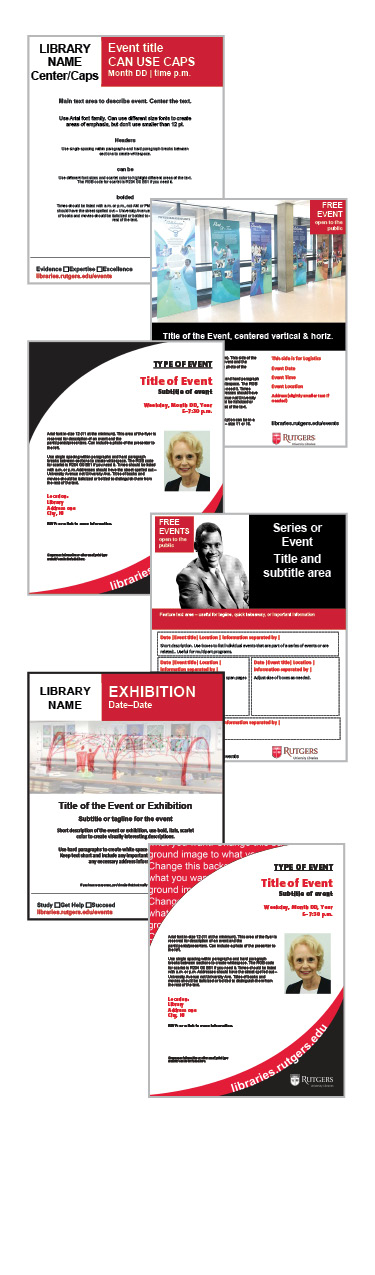
    Event & Exhibit Flyer Templates

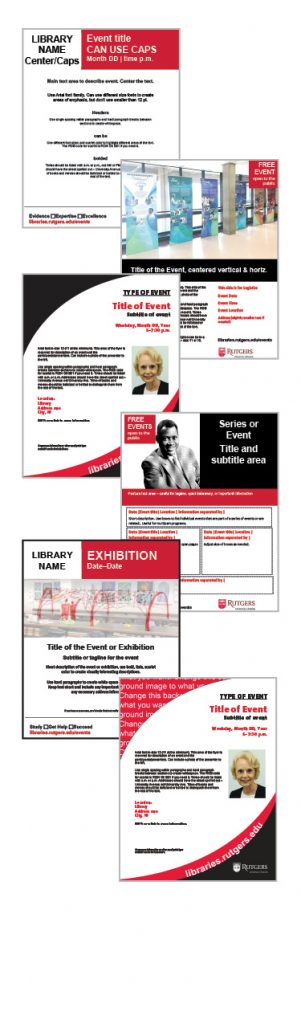
    These flyer templates are available to local units to help promote their upcoming events and exhibits. The templates are available in Word and Powerpoint, so they require no special software. We’ve tried to provide enough options and variations to allow some personalization and tailoring for specific locations and events. If you would like me to conduct any training on how to use these materials, please let us know. We also welcome any feedback and/or requests for variants of these templates.

    Group Study Room Sign Templates

    With the recent changes in how group study rooms are reserved, we have updated the signage templates with new QR codes. These are now available for libraries that are using the libcal service. If you have group study rooms that don’t use the libcal reservation system or other types of spaces that need signage, let us know. Scroll down on the Signage Templates page to find the new group study room signs.

    Materials for Library Liaisons

    There is a new section on the communications page for Project Outreach Materials. RASE-WG has provided materials for library liaisons who are doing outreach for the following projects. You can download presentations, flyers, and information sheets:

    Community Bulletin Board

    “Wouldn’t it be great if there was a space where people from the Libraries could post notices for one another if they have an item for sale or are selling Girl Scout Cookies or are playing a local gig with their band?” Yes– this would be great. Introducing the Rutgers University Libraries Bulletin Board. This is an open space where you can post any type of notice you would like to share with your colleagues. Thanks for the suggestion, Dee Magnoni!

    This bulletin board is powered by Padlet. If you want to create a post, click on the + sign in the lower right of the bulletin board. You can create a Padlet account for free OR you can post anonymously (in which case, I’d recommend including your name at the bottom of the post so people know who the post is from).

    You can access this bulletin board directly at https://padlet.com/rulibraries/bulletin (bookmark it!) or via the sidebar menu on The Agenda.


  • The URA-AFT Performance Appraisals Are Due April 30

    The URA-AFT Performance Appraisals Are Due April 30

    URA-AFT Performance Appraisal Process is upcoming with the appraisal period running from 5/1/2017 – 4/30/2018.

    Appraisals must be completed by 4/30/2018.

    Please feel free to contact Libraries HR with any questions!

  • Library of Science and Medicine Update


    An architect’s rendering of what the new space in LSM.

    New Brunswick (NB) and Rutgers Biomedical and Health Sciences (RBHS) are collaborating to upgrade spaces and publicize library services to our users, in particular those from RBHS schools (Robert Wood Johnson Medical School (RWJMS), School of Public Health, Ernest Mario School of Pharmacy, Graduate School of Biomedical Sciences, the Physician Assistants program in the School of Health Professions), in Piscataway. One of the goals in recent draftsof the Libraries master plan for the Library of Science and Medicine (LSM) is to “create a science-focused atmosphere and establish a connection with RBHS.” In addition, the plan includes creating both “dedicated graduate study space,” and “dedicated RBHS study space” within the library.

    A plan is in place to encourage RBHS students to identify and use LSM and its resources. Survey data from RWJMS reveals that medical students do not currently identify with the library. The upcoming accreditation at RWJMS (March 5-7, 2018), spurred a feasibility study to upgrade study space and librarian support space at LSM to better serve the needs of graduate students in the health and life sciences on the Piscataway campus. Students from Pharmacy and Public Health are also in close proximity to LSM. Even though Pharmacy has recently opened their beautifully renovated building, LSM is still a very popular destination for Pharmacy students seeking serious study space.

    An open house for RWJMS students was held at LSM on Tuesday, February 13, to re-introduce students to LSM, view potential floor plans, the phased design for renovating space on the third floor, and view the location of the recently relocated MED-TEXT collection, approximately 1000 books recently relocated from the medical school to LSM. Approximately 100 medical students attended the event, which was positively received. Victoria Wagner and the librarians from Robert Wood Johnson Library of the Health Sciences (RWJ), along with faculty and staff from LSM, interacted with RWJMS students and faculty in attendance.

    The completed feasibility study, along with proposed floor plans, renderings, phasing plan and cost are nearing completion. Presenting and socializing the plan to stakeholders (RBHS schools and NB life sciences schools) and funders is a critical next step toward potential implementation. Mei Ling Lo has taken the lead on planning for the weeding of the bound journal collections on the north side of the LSM third floor. Journals are labeled for relocation to the Annex or discard, and a company will start moving items on April 2nd.

    An office, previously occupied by DTS on the LSM third floor, will provide the space for the RWJ librarians, who will begin providing services to students from that location in early March.

    A full meeting LSM and RWJ libraries took place on Friday, February 23rd at LSM. Plans were on display, updates were provided by Dee Magnoni and Judy Cohn, and then the 20 plus attendees broke into groups focused on space, access services, and deepening collaboration. One listserv for all LSM and RWJ librarians and staff was proposed to enhance communication. Other recorded recommendations are being transcribed to share back with the full group, which agreed to meet again in 2 months.

    These are exciting plans! We look forward to gaining momentum to fund this project.


    Save

  • Thank you! Here is the Giving Tuesday 2017 Report

    Thank you! Here is the Giving Tuesday 2017 Report

    Last November, the Libraries participated in Giving Tuesday at Rutgers University. This is an annual event that follows the consumer traditions of Black Friday, Small Business Saturday, and Cyber Monday, to encourage individuals to support their favorite non-profits and charities.

    This year, Rutgers University received $174,483.19 in Giving Tuesday donations and we are happy to announce that the Libraries received over $6,500 in donations from 18 donors. This is excellent and actually places us 8th at the university overall in terms of total dollars raised. This outcome shows we are are supported and valued by our users and colleagues. These funds will help us do a lot of good at the Libraries.

    Giving Tuesday is far from a solo or even a departmental effort. We owe many thank yous — thank yous to colleagues who made donations in support of the Libraries and thank yous to faculty and staff who shared our Giving Day initiative and promoted it via your communications channels. This type of success is a group effort, and it is not possible without your help!

    Save

    Save

  • News from the Communications Department

    News from the Communications Department

    The Communications Department shared our new website at the State of the Libraries poster session. We have been actively updating the site with more resources and materials that may be of use to you. Our most recent additions are:

    Brochures
    Sample of the brochures available via the Communications Department.

    Marketing Brochures and Bookmarks

    A visual list of the various brochures and bookmarks we have available. If you are interested in copies of these materials, send us an email.

    Social Media Resource

    Here you can find resources and tips and tricks for using social media at the Libraries. The social media guidelines, process for requesting a new social media account, and the social media manual are stored here. But you can also find information about joining the Libraries’ social media list serv (useful if you are managing any library social media account) and our social media directory. Eventually, I hope to move the social media directory to a more visible, public site as part of a refresh of the news and communications sites on the Libraries’ website. In the meantime, if you have a social media account that is not listed here, please let us know.

    Libraries Banner image
    This retractable banner is available for your events.

    New Retractable Banner

    We placed an order for a new retractable banner and this is available for loan if you need it. For more information on this and to see other items we have available for event support, please visit Loanable Equipment A/V and Events.

    Project Outreach Materials

    You can find project outreach materials for both ORCID and Open and Affordable Textbooks Program. Here you will find PDF copies of promotional brochures, powerpoint presentations for faculty outreach, and more. If you have other projects for which this type of resource center would be useful, let us know.


    Save

    Save

  • Quick Takes on Events and News – February 2018

    Quick Takes on Events and News – February 2018

    The Douglass Century will be published by Rutgers University Press next month.
    The Douglass Century will be published by Rutgers University Press next month. Check out the March Agenda for your chance to win a free copy!
    Celebrating the Douglass Century

    Congratulations are in order for our colleagues Kayo Denda and Fernanda Perrone, who, along with Mary Hawkesworth of the departments of Political Science and Women’s and Gender Studies, have penned a history of Douglass Residential College entitled The Douglass Century: Transformation of the Women’s College at Rutgers University.  The book will be published by Rutgers University Press next month. From the press:

    The Douglass Century celebrates the college’s longevity and diversity as distinctive accomplishments, and analyzes the contributions of Douglass administrators, alumnae, and students to its survival, while also investigating multiple challenges that threatened its existence. This book demonstrates how changing historical circumstances altered the possibilities for women and the content of higher education, comparing the Jazz Age, the Great Depression, the Second World War, the post-war Civil Rights era, and the resurgence of feminism in the 1970s and 1980s. Concluding in the present day, the authors highlight the college’s ongoing commitment to Mabel Smith Douglass’ founding vision, “to bring about an intellectual quickening, a cultural broadening in connection with specific training so that women may go out into the world fitted…for leadership…in the economic, political, and intellectual life of this nation.” In addition to providing a comprehensive history of the college, the book brings its subjects to life with eighty full-color images from the Special Collections and University Archives, Rutgers University Libraries.”

    But wait—there’s more! March’s issue of the Agenda will include a contest for a free copy of The Douglass Century, so tune in next month for your chance to win.

    LSM opens house on February 13.
    LSM open house on February 13.
    LSM Open House

    Spread the word! The Library of Science and Medicine will open its doors to Robert Wood Johnson Medical School students and faculty on Tuesday, February 13 at 4 p.m.

    There will be ample opportunity to meet health sciences librarians and learn about the resources, tools, study spaces, and collections that are available on Busch campus.

    Refreshments will be served and complimentary retractable ID card holders will be available while supplies last.

    Watch: State of the Libraries
    Krisellen Maloney presents at State of the Libraries.
    A video of Krisellen Maloney’s State of the Libraries presentation is now available on our YouTube channel.

    Krisellen’s presentation from State of the Libraries is now available on our YouTube channel. It includes an introduction of new employees, an overview of the Ex Libris implementation, and a discussion of the budget. Kudos to Rich Sandler for his work on the video. And in case you missed it, a video playlist of the poster sessions from State of the Libraries was posted in last month’s issue of the Agenda.

    The New Jersey Digital Newspaper Project Goes Live

    The New Jersey Digital Newspaper project celebrated a major milestone last month when the first batch of pages from the Perth Amboy Evening News became available to the public via the Library of Congress website Chronicling America. Colleagues from the Libraries, the New Jersey State Library, New Jersey State Archives, and the New Jersey research community gathered at Alexander Library to commemorate the occasion with presentations, tours of the project facilities, and of course—cupcakes!

    • Dee Magnoni, Maxine Lurie, Caryn Radick, Mary Chute, and Grace Agnew at the NJDNP launch celebration.
      Dee Magnoni, Maxine Lurie, Caryn Radick, Mary Chute, and Grace Agnew at the NJDNP launch celebration.

    During the proceedings, state librarian Mary Chute read a letter on behalf of Congressman Frank Pallone, which said in part: “I would like to commend the New Jersey State Library, Rutgers University Libraries and the New Jersey State Archives for undertaking this important project. Here in New Jersey we have a rich history and innumerable contributions in science, innovation, politics and the humanities. The digitization of these newspapers will provide user friendly access of these historical records to all individuals across the globe. I am proud that The Perth Amboy Evening News is the first New Jersey newspaper available through this invaluable project.”

    Read more about the project in our press release.

    Robeson Library's John Maxymuk has authored more than a dozen books on professional football.
    John Maxymuk.
    Catching up with the Libraries’ NFL Expert

    Paul Robeson Library’s John Maxymuk has authored over a dozen books about the history of the NFL in addition to an entry on professional football in the Encyclopedia of Greater Philadelphia? In advance of Super Bowl LII this weekend, we caught up with John to discuss his love of football and penchant for research—and, of course, whether the Eagles stand a chance against Tom Brady and the Patriots.

    A New Look for the IJS
    The new IJS logo.
    The new IJS logo.

    The Institute of Jazz Studies recently unveiled a new logotype, which you can view on our visual identity resources website. Congrats to our colleagues at the IJS for adopting this fresh new look!

    What’s Happening is the Libraries’ monthly events enewsletter.
    Do You Know What’s Happening?

    Did you know we publish a monthly enewsletter of events happening around the Libraries? If not, check out this month’s edition to see what you’ve been missing and feel free to subscribe!

    Do you have an upcoming exhibit, workshop, or other event that you’d like the world to know about? Submit it at https://www.libraries.rutgers.edu/events and we’ll include it in forthcoming issues of the newsletter.

    The Jersey Collective exhibit at Robeson Library. Credit: John Powell.
    The Jersey Collective exhibit at Robeson Library. Credit: John Powell.
    Closing Soon: Catch These Displays while You Still Can!

    Jersey Collective: The Third Year @ Robeson Library through February 9

    Milton to Milton: The Legacy of J. Milton French @ Alexander Library through February 28

    Save

    Save