Category: Department

  • Humanism in Medicine: Teaching Poetry to Residents

    I serve as the clinical medical librarian for the Internal Medicine department at Rutgers New Jersey Medical School in Newark. This means I attend the residents’ morning reports every Thursday and Friday at 8 a.m. as they discuss patient cases to help them learn how to diagnose and treat the patients they serve. When a question comes up which can be answered by an article, I look up the answer in the medical literature and the chief residents share the results with the others via Sakai. I also train the residents in searching techniques in various databases such as PubMed, Scopus, or VisualDx.
    Dr. Mirela Feurdean, internal medicine residency program director at New Jersey Medical School, approached me in September 2017 about doing something a bit different with the residents. “I know you’re a poet,” she said to me. “Would you be interested in teaching a poetry workshop to the residents?” In my personal life, I’m a published poet who teaches a weekly workshop in Jersey City, and I just published my first chapbook this year. So of course, I said yes.

    The first workshop was held at noon on September 22, alongside free pizza for the residents. The residents were a bit shy, but 11 (out of 20 or so) ended up participating. I shared handouts with them that included a poem written by an award-winning internal medicine doctor, Rafael Campo, as well as a patient. I also shared a couple articles about how to use metaphors effectively when explaining science to patients. For example, research has shown that breast cancer patients who use battle or war metaphors to describe their experience with cancer have a higher incidence of depression than those who use positive words like “challenge” or “journey.” The words we use matter. The residents wrote poems employing medical metaphors, and some even submitted their finished poems to Ars Literarium, the literary journal of Rutgers New Jersey Medical School and other RBHS Schools.

    The chief residents asked me to return the following month, and on October 20, we focused on short poems, learning a bit about the form haiku. This time, virtually all 20 or so residents participated. Even if they weren’t writing themselves, they snapped their fingers or clapped their hands to celebrate each other’s work as they started to share their writing. Dr. Ahmad Al Turk was inspired to write a clever quatrain, Odgen Nash-style.

    NSAIDs work for all
    Conditions that end with –itis,
    Summer, spring, or fall,
    But don’t get fooled with gastritis!

    By Ahmad Al Turk, MD

    The medical “joke” of the poem, for those without the medical background, is that NSAIDs (non-steroidal anti-inflammatory drugs like aspirin or ibuprofen) can irritate the stomach and cause gastritis.

    However, not all the poems were strictly linked to medicine, and some of the doctors wrote about other aspects of their lives. One resident was inspired to share a rap he had previously written, and he nervously approached the front of the conference room. As he closed his rap, which shared a story about a patient who survived a dire medical situation, he encouraged his fellow doctors not to “go numb” as they continue their work as physicians. His fellow doctors cheered and clapped, and there were tears in the eyes of many.

    I look forward to continuing these workshops to my residents, as I hope to help them de-stress during a hectic time of their lives.

    Save

  • Rutgers Hosts Nobel Laureate for 14th Annual Weisse Lecture (with some librarian help!)

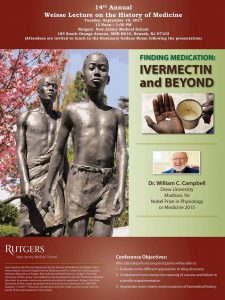
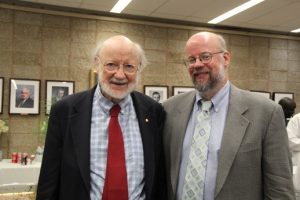
    On September 19, 2017, Rutgers New Jersey Medical School (NJMS) hosted the 14th Annual Weisse Lecture on the History of Medicine. This year’s Weisse Lecturer was Dr. William C. Campbell, who shared the 2015 Nobel Prize in Physiology and Medicine with Dr. Satoshi Omura of Japan “for their discoveries concerning a novel therapy against infections caused by roundworm parasites.”
    In his presentation, “Finding Medication: Ivermectin and Beyond,” Dr. Campbell recounted the story of Ivermectin’s development and its antiparasitic uses in both animal and human health. A single pill taken yearly is preventative against river blindness (onchocerciasis), a disease found in South America, Africa, and Yemen. Since 1988, Merck has donated the drug (under the name Mectizan) for distribution within affected regions, and river blindness has been eliminated in most South American countries, with efforts to eliminate the disease in Africa still ongoing. In what he termed a “tirade,” Dr. Campbell stressed the need for much more drug discovery in an era of increasing drug resistance. He concluded his presentation with charming photographs and stories about the Nobel Prize ceremonies and banquets in Stockholm.

    Since its inception in 2004, the Weisse Lecture has been overseen by Dr. Allen Weisse. He and his wife Dr. Laura Weisse have endowed the lecture, which is presented as a grand rounds by the NJMS Department of Medicine. Previous Weisse Lectures have featured prominent medical historians and physician-historians, including T. Jock Murray, Michael Bliss, Barron Lerner, and Nancy Tomes. Dr. Allen Weisse himself is an accomplished physician-historian, having published two volumes of oral histories (Conversations in Medicine, and Heart to Heart) and several volumes of essays on medical history.

    Caption: Nobel Laureate (left) and librarian (right). Photo credit: Devayani Kumaran, Rutgers New Jersey Medical School.

    In 2016, Dr. Weisse designated me to assume the role of Weisse Lecture Coordinator. Over this past year, he and I worked together to organize this year’s lecture and luncheon. My duties ranged from choosing the luncheon menu with the caterer, to chauffeuring the Nobel Laureate to NJMS and back to the train station. Best of all, I had the honor of introducing Dr. Campbell to the standing-room-only crowd. I made sure to emphasize that even though he was born in Ireland, was educated at Trinity College in Dublin and the University of Wisconsin, and is now living in Massachusetts, his true home state is New Jersey. Both Dr. Weisse and Dr. Campbell served as presidents of the Medical History Society of New Jersey, an organization I have also actively supported, which has actively supported both Special Collections and me as well!

    With the support of colleagues in the NJMS Department of Medicine, I am assuming responsibility for the Weisse Lecture going forward. The annual Weisse Lecture is the premier medical history event at Rutgers New Jersey Medical School. Thanks to the generosity of Dr. Allen Weisse and Dr. Laura Weisse, and their love of medical history, the Weisse Lecture series is well positioned for a long and successful future.

  • University and City Celebrate 150 Years of Friendship with Fukui, Japan

    This week, Rutgers University Libraries and other New Brunswick institutions will welcome a delegation from Japan as part of the New Brunswick Sister Cities project. Fernanda Perrone is vice president of the group and has invited the delegation to visit Alexander Library and will give a presentation related to the Griffis Collection. The Global Experience Team is sponsoring refreshments after the presentation. If you are interested in learning more about this event, please contact Fernanda.

    Seems like a good time to revisit this terrific video:


    Sister Cities  Project Press Release:

    One hundred and fifty years ago, a young samurai from the province of Echizen (today Fukui prefecture) in the far west of Japan came to New Brunswick with the goal of entering Rutgers College. Kusakabe Taro arrived fired with the desire to “fulfill my duty to the Imperial realm by clarifying the defects in the relations between us Japanese and the foreigners in the light of the international law of all nations and universal principles.” Ranked number one in his class, Kusakabe became the first Japanese to graduate from Rutgers College, the first to become a member of Phi Beta Kappa, and, along with Niijima Jo at Amherst, the first to graduate from an American college. Tragically, Kusakabe died of tuberculosis on April 13, 1870, only weeks before commencement. He is buried in the Willow Grove Cemetery in New Brunswick along with seven other young Japanese. The following year, Kusakabe’s friend and classmate William Elliot Griffis traveled to Fukui to introduce Western-style educational methods into the local school system. Griffis would spend four years in Japan and a lifetime writing, teaching, and collecting information about Japan. His collection was bequeathed to the Rutgers University Libraries in 1928.

    Indeed Rutgers was an important destination for international students from Japan during the nineteenth century. Many of those who studied at Rutgers returned to Japan to become leaders in education, industry, and commerce. Although the last of this early group of Japanese students attended Rutgers in the 1920s, the relationship between the university and Fukui was re-discovered in the late 1950s by Rutgers administrator and professor of political science Ardath Burks. Working closely with the city of New Brunswick, programs and exchanges were initiated, and the William Elliot Griffis collection was organized and made available to the public. Rutgers and Fukui Universities became sister universities in 1981, and in 1982 New Brunswick and Fukui became sister cities. As well as the 150th anniversary of Kusakabe’s arrival, 2017 marks the 35th anniversary of the sister cities relationship.

    From October 4 to 7, New Brunswick will welcome a large delegation from the city of Fukui including the mayor and members of the City Council, members of the Junior Chamber of Commerce, and members of the Fukui International Citizens Association. Among the events planned are a Buddhist ceremony at Kusakabe’s grave on Thursday, October 5 and a lecture on “Kusakabe and His Friends,” which will held at Alexander Library on Friday, October 6. The delegation will also visit the Zimmerli Art Museum and the new Johnson and Johnson Museum and be entertained by the Rutgers Centers for Global Advancement and International Affairs, Rutgers Community Affairs, and Rutgers University Libraries at Rutgers University–New Brunswick. The Fukui Junior Chamber of Commerce will accompany two middle-school students who have written the best essays of the year about Kusakabe Taro. These children will have a chance to visit the New Brunswick Middle School and meet with their contemporaries there.

    In November 2017, New Brunswick mayor James Cahill will lead a delegation from New Brunswick to visit Fukui.

  • The Inaugural ALCTS Mentoring Program

    The Association for Library Collections and Technical Services (ALCTS) issued a call for participation in its new Mentoring Program earlier this year. I submitted a mentor application because I have enjoyed serving as a mentor at Rutgers and welcomed the opportunity to work with ALCTS’ early career librarians—who are amazing! I’m a proponent of mentorship opportunities since they are mutually beneficial to both parties and I’ve personally benefitted from past mentoring relationships.  Here’s how the experience has been so far.

    Background of the ALCTS Mentoring Program

    The program resulted from the work of the ALCTS Leadership and Development Committee’s Mentoring Subcommittee, and runs from June 1, 2017 to April 30, 2018.  The call for participation sought applications from those interested in serving as a mentor or mentee—or both.

    The program’s goal are to

    • develop strong leadership in the areas of librarianship covered by ALCTS (acquisitions, cataloging and metadata, collection management, continuing resources, and preservation and reformatting),
    • support ALCTS members in developing professional skills,
    • cultivate leadership and involvement in ALCTS,
    • provide networking opportunities, and
    • expand members’ professional learning circles.

    The Requirements for Mentors and Mentees

    The first cohort of mentors and mentees consists of 41 pairs of librarians who are working with assigned program liaisons. The program is fairly formal. Matches were based on mentees’ expressed interests and each pair must complete a mentoring agreement form that addresses matters such as expectations, including how much time will be committed to the relationship and how often and in what mode(s) the pair will communicate. The mentor and mentee were required to develop three goals and detail how the mentor can best assist the mentee in achieving those goals. The pairs are also required to participate in an online training program at the beginning of their mentoring relationship.

    Resources:

    The time and effort that the Mentoring Subcommittee devoted to developing the program is evident through the resources they’ve made available, particularly the LibGuide (http://alcts.libguides.com/mentoring). Additionally, the program is based on a Mentoring Framework developed by the 2015 ALA Emerging Leaders. The program consists of four components for the matched pairs: planning, connecting, advancing, and transitioning.

    What’s It Like?

    I was thrilled to be selected for the program and very excited to learn with whom I had been paired. I’m also honored to be part of the program’s inaugural cohort. As instructed by our mentoring liaison, I reached out to my mentee right away with an email and we scheduled a phone call for later that week. We were both excited at the prospect of working together.

    Our initial conversation included completing the mentoring agreement, setting three goals, and deciding how often we would communicate with each other. One of my mentee’s goals is to become more involved with publishing. She has some solid ideas, but has not had a chance to follow up on them and welcomed guidance. We typically talk two times a month, and she will share with me the manuscript of a paper on which she is working. Our formal relationship ends in April, which feels as though it’s quickly approaching. The last part of our relationship will be to determine next steps, and I anticipate that while this is the end of one phase of our relationship, it won’t be the end.

    My Takeaways

    In my experience, mentoring is a mutually beneficial experience. In addition to guidance and advice I have provided to others, I, in turn, have learned things from mentees, which has helped me to develop my professional skills. For those who doubt the effectiveness of mentoring, consider this: Audrey J. Murrell, author of “Five Key Steps for Effective Mentoring Relationships,” indicates that research has shown that those individuals who have been mentored report higher salaries, more frequent promotions, greater job satisfaction, and are less likely to leave their jobs.


  • Mid-Atlantic Futures Conference Report

    • Irina Radeva (r) and SC&I scholarship recipients.

    Last week, I attended the Mid-Atlantic Futures Conference held in Atlantic City, NJ. Four other School of Communication and Information students and I attended this exciting two-day event thanks to a scholarship provided by the Library and Information Science Department and were accompanied by two SC&I instructors, Dr. Ross Todd and Dr. Joyce Valenza. The gathering was a great way to come together with like-minded library professionals and discover how libraries can thrive in a world full of ever-changing technology and vast information.

    The main question posed by the conference was, “How do we predict the future?” Among those trying to answer were keynote speakers Kevin Mitnick, the most elusive computer hacker in history; David Pescovitz, the research director at the Institute of the Future; Nicole Baker Rosa from the Future Schools; and Rutgers’ own Dr. James Hughes, University Professor and former dean of the Edward J. Bloustein School of Planning and Public Policy. Each speaker touched on the importance of knowing what libraries are and what they stand for, as well as keeping their eyes open not for trends, but for patterns that will point to the next big thing. There was a lot of discussion about artificial intelligence and virtual and augmented reality, and how they will affect both libraries and society. Acceleration strategist Phil Bowermaster proposed that the convergence of information and society is accelerating change, while communication specialist Rakia Reynolds shared a communication strategy that is both noticeable and disruptive.  Finally, Cindy Ball from Oculus Rift gave a demonstration of a virtual reality future that may be much closer than we think.

    So, how do we predict the future? We create it–with knowledge and imagination.

    I would like to thank Lilia Pavlovsky, director of the Master of Information program, who facilitated this opportunity for me, as well as Andy Martinez and Janet Croft for giving me approval to attend.

  • Quick Takes on Events and News – October 2017

    Chicago-Bound for Research Data Summit

    Congratulations to Yingting Zhang whose application for the Association of Academic Health Sciences Libraries’ Data Scholarship has been accepted. The award will support Yingting’s participation in the Research Data Access and Preservation Summit next year in Chicago. We look forward to hearing Yingting’s report from the conference!

    Fight the Flu. Get Your Shot!

    Don’t forget that Occupational Health will be providing flu shots for employees on Wednesday, October 4 from 11 a.m. to noon in the Pane Room of Alexander Library.

    Please RSVP to Michele Petosa at petosa@rutgers.edu by October 2. Be sure to download the consent form at http://occhealth.rutgers.edu/FluVaccine2017.html, print, complete, and bring it with you.

    It’s a Bird, It’s a Plane, It’s—The Artists’ Bookmobile!
    Peter and Donna Thomas return to Rutgers with their Artists’ Bookmobile on October 4.

    Rutgers University Libraries and art librarian Megan Lotts are delighted to welcome Peter and Donna Thomas and their traveling Artists’ Bookmobile back to Rutgers. Peter and Donna are known for their workshops in paper and book arts. Visit the Artists’ Bookmobile—a self-contained exhibit of book arts—and learn how they make their books. Join in a book arts sing along at 3 p.m. featuring a ukulele book.

    The Bookmobile will be parked outside Alexander Library on October 4 from 2 to 3:30 p.m. See you there!

    Carr is Cutting the Ribbon

    Join us on Tuesday, October 17 at 10 a.m. as we dedicate the James Dickson Carr Library in honor of Rutgers University’s first African American graduate. The program includes remarks by Rutgers–New Brunswick chancellor Debasish Dutta, an exhibit of materials about Carr and the history of the former Kilmer Library, as well as a reception. Please register to attend at https://www.eventbrite.com/e/carr-library-dedication-ceremony-registration-38281939311.

    #RutgersDana50 Kicks Off on a High Note

    Dana Library kicked off its 50th anniversary celebration with a birthday bash during Rutgers–Newark’s Fall Fest in September. The festivities included cupcakes and a live performance by hip-hop/jazz fusion band Nickel and Dime OPS. Check out a clip of the band courtesy of @RUNewark_Dana on Twitter.

    Exploring the Wonderful World of Illusions

    Thomas V. Papathomas, director of the Rutgers Laboratory of Vision Research, visited the Library of Science and Medicine last week for a special presentation on optical illusions, how our minds process perspective, and even how illusions can be used as accurate measures of schizophrenia.

    Aiding the Relief Effort in Puerto Rico

    Alexander and Dana Libraries hosted open data editathons last week in response to the Red Cross’s request for geospatial data to help with their relief operations on the island. Participants mapped from pre-hurricane imagery to give those involved in the relief efforts an operating picture of the island before the storm made impact. Kudos to our colleagues Francesca Giannetti and Krista White for their part in bringing this program together so quickly!

    New Video for Banned Books Week

    Save

  • The Rutgers University Libraries Website Style Guide from Integrated Information Systems

    The Rutgers University Libraries Website style guide explains the rules and conventions that go into defining typography and the appearance of website elements on our website. Its goal is to provide a cohesive and coherent experience for website users and content creators. An internal style guide has been in existence since the redesign of the libraries’ website in June 2013. However, growing demand for custom content from colleagues and requests for mini-sites, established a need to make the style guide available to users across the libraries. Not everyone knows – or should be expected to know – how to create a webpage. The style guide provides a clear idea of what to expect when, for example, you want to display tabular data or, have an article on the website that uses pull quotes. Content creators amongst our library colleagues can use it when visualizing their pages. Developers can use it as a reference when coding new pages. It functions as a common reference for both.

    On a technical level, the style guide is structured such that it provides an example of the treatment of a website element, followed by the CSS code used to style the element, and the HTML code that displays it in the browser. On a general, stylistic level, it defines how pages are structured on the website, such as addressing questions regarding the appearance and location of navigational links within a mini-site. It also informs us about overarching style rules that users might be interested in knowing, such as the font family (Droid Sans) and generic typeface (sans-serif) that body copy defaults to throughout the site.

    The developers and designers in Integrated Information Systems are available to create webpages that use the style guide as a guideline, rather than a limitation, with possibilities for creativity and experimentation, to build the best experience for our users and our colleagues.

    Access the website style guide here: https://www.libraries.rutgers.edu/styleguide


  • Report from Social Media Summit 2017


    Video: Rutgers communications professionals discuss social media planning and how to best reach users.


    The Libraries held our second Social Media Summit on July 20, 2017. The full-day event, hosted by the Social Media Task Force, was broken into several sessions and attended by over 25 of our colleagues.

    During the introductory session, director of communications Jessica Pellien presented the work of the social media task force and reviewed the new social media guidelines, manual, and process for requesting a new social media account. This PowerPoint presentation is available below. Following this presentation, round-table discussions (15 minutes per topic – like speed dating but for social media topics) allowed the group to share ideas and experiences. Notes were taken at each table and are available below.

    Following lunch, there were two more sessions:

    • A workshop/training on HootSuite presented by Dory Devlin of University Communications and Marketing
    • A panel of Rutgers University communicators, including Stefanie Charles, social media manager for all of Rutgers–Camden; Brice Hammack, marketing professional from Rutgers University Press; and Jennifer Valera,  marketing manager of  Rutgers University-New Brunswick, Division of Continuing Studies.

    If you have any questions about the materials below or the Social Media Summit, please reach out to a member of the Social Media Task Force.

    Social Media Summit Documents:

    Social Media Documents

  • Friends Toast the Life of Ed Berger

    Ed Berger by Joe Wilder - 2001e
    Ed Berger, 2001. Photograph by Joe Wilder. Berger’s biography of trumpeter and fellow photographer Joe Wilder, Softly with Feeling, was published in 2014.

    Tears and laughter punctuated remembrances of longtime Institute of Jazz Studies associate director Ed Berger, during a celebration of his life on August 18 at the Dana Library.

    Berger, who died of heart failure January 21 at his home in Princeton Junction, joined the staff of the Institute in 1975. He filled many roles with uniform excellence: administrator, librarian, educator, discographer, scholar, editor, photographer, author, record producer, and label owner. He was known by those who met him in casual encounters and others who interacted with him over decades for his dedication to disseminating jazz history and for his compassion, modesty, and quiet killer wit.

    Among those taking the podium in the Dana Room included Institute colleagues: former director Dan Morgenstern; director of operations Vincent Pelote; executive director Wayne Winborne; associate director Adriana Cuervo; archivists Elizabeth Surles, Angela Lawrence, and Tad Hershorn; public service associate Joe Peterson; and collections manager Elsa Alves. Morgenstern, who led the Institute for 36 years, stressed his admiration for Berger’s expertise and many talents that, along with the efforts of Pelote, positioned the Institute to extend its international reputation.

    Morroe Berger and Malcolm X listen to jazz records. photo credit: Ed Berger.
    Morroe Berger and Malcolm X listen to jazz records in the Bergers’ apartment in Cairo in 1964. Photograph by Ed Berger

    Hershorn produced a slide show of images of Berger’s life and photography, entitled “Triumph of the Quiet Man,” which focused on his family, jazz photography, and years at the Institute. (Among the photos was one of his father Morroe Berger, a famous Princeton sociologist, whose work took him to the Middle East in the 1950s and 1960s. Ed’s picture shows his father with Malcolm X in the living room of the Bergers’ Cairo apartment in 1964 listening to recordings of Louis Armstrong and Ella Fitzgerald.)

    Other guests included vice president for information services and university librarian Krisellen Maloney and Tom Frusciano and Erika Gorder from Special Collections and University Archives.

    Benny Carter, credit: Ed Berger
    The long association between the Benny Carter and the Berger families, which went on from the early 1970s until Berger’s death in January, was one their most fruitful associations. Photograph by Ed Berger, 1989.

    Musical tributes were offered by Newark veteran tenor saxophonist Leo Johnson and New York singer and pianist Daryl Sherman, both of whose CD covers were graced by the work of Berger (gratis, of course). Drummer Kenny Washington, one of the busiest drummers in New York and a frequent Institute patron, said Berger was one of the go-to guys to answer questions on the history and the music, as did Scott Wenzel, a 30-year veteran of Mosaic Records, jazz’s premiere reissue label.

    Berger’s younger brother Ken, also of Princeton Junction, who–along with another brother Larry of San Francisco–provided images for the slide show, represented the family at the event at Dana Library.

    Another gathering in Berger’s honor will take place between 3-5:30 on Sunday, September 24 at Jazz at Lincoln Center, where Berger taught courses as part of Jazz at Lincoln Center’s Swing University. Please RSVP by September 1 by contacting Larry Berger at rsvp@lpb.com.

    The Berger-Carter Jazz Research Fund at the Institute, memorializing the relationship between the Berger family and jazz great Benny Carter, will soon be renamed to include Ed’s name.

    Save

    Save

  • Human Resources – Dates to Remember for Open Enrollment & Flu Shots

    Two bits of news from the Rutgers University Libraries Human Resources Department:

    • There will be a clinic for annual flu shots on October 4, 2017 at 11:00 in the Pane Room at Alexander Library.
    • University Human Resources (UHR) will host a series of Open Enrollment Benefits Fairs throughout the month of October to educate employees about their SHBP benefits options, as well as other benefits and services that are available and may be of interest. Save the date and plan to attend the Open Enrollment Benefit Fair that is most convenient for you:

    October 10, 2017 10 a.m. – 4 p.m. – Rutgers University – Newark Campus, Robeson Campus Center, Multipurpose Room, 350 Martin Luther King Blvd, Newark, New Jersey 07102

    October 12, 2017 10 a.m. – 4 p.m.– Rutgers University – New Brunswick, College Avenue Campus, Student Center Multipurpose Room, 126 College Ave, New Brunswick, NJ 08901

    October 17, 2017 10 a.m. – 3 p.m. – Rutgers University – Camden Campus, Camden Campus Center, 326 Penn St, Camden, New Jersey 08102

    DETAILS TO BE DETERMINED– RBHS Piscataway/New Brunswick

    October 24, 2017 10 a.m. – 4 p.m. – RBHS Newark, Medical Science Building, Grand Foyer Lobby, 185 South Orange Ave, Newark, New Jersey 07101

    October 25, 2017 10 a.m. – 4 p.m. – Rutgers University – Piscataway, Busch Student Campus, Student Center Multipurpose Room, 604 Bartholomew Rd, Piscataway, New Jersey 08854

    As always, if you have any questions about your employee benefits, please contact the Benefits Administration staff at 848-932-3990 or via email at benefits@hr.rutgers.edu.

    Save

    Save