Category: University Librarian Report

This the collection of monthly newsletter articles from Krisellen Maloney, Vice President for Information Services and University Librarian.

  • Thinking about Frameworks

    It seems that in every aspect of the work of academic libraries, there is an increased interest in frameworks. For example, in response to the ”rapidly changing higher education environment,” the ACRL Information Literacy Competency Standards for Higher Education transitioned to the Framework for Information Literacy in Higher Education.  I am involved in a Big Ten initiative to develop a Framework for Discovery-to-Fulfillment Systems. Rutgers is also not immune to the charms of developing frameworks. Internally, there is a Libraries group developing a framework to describe the technical infrastructure and architecture of special collections (charge | minutes).

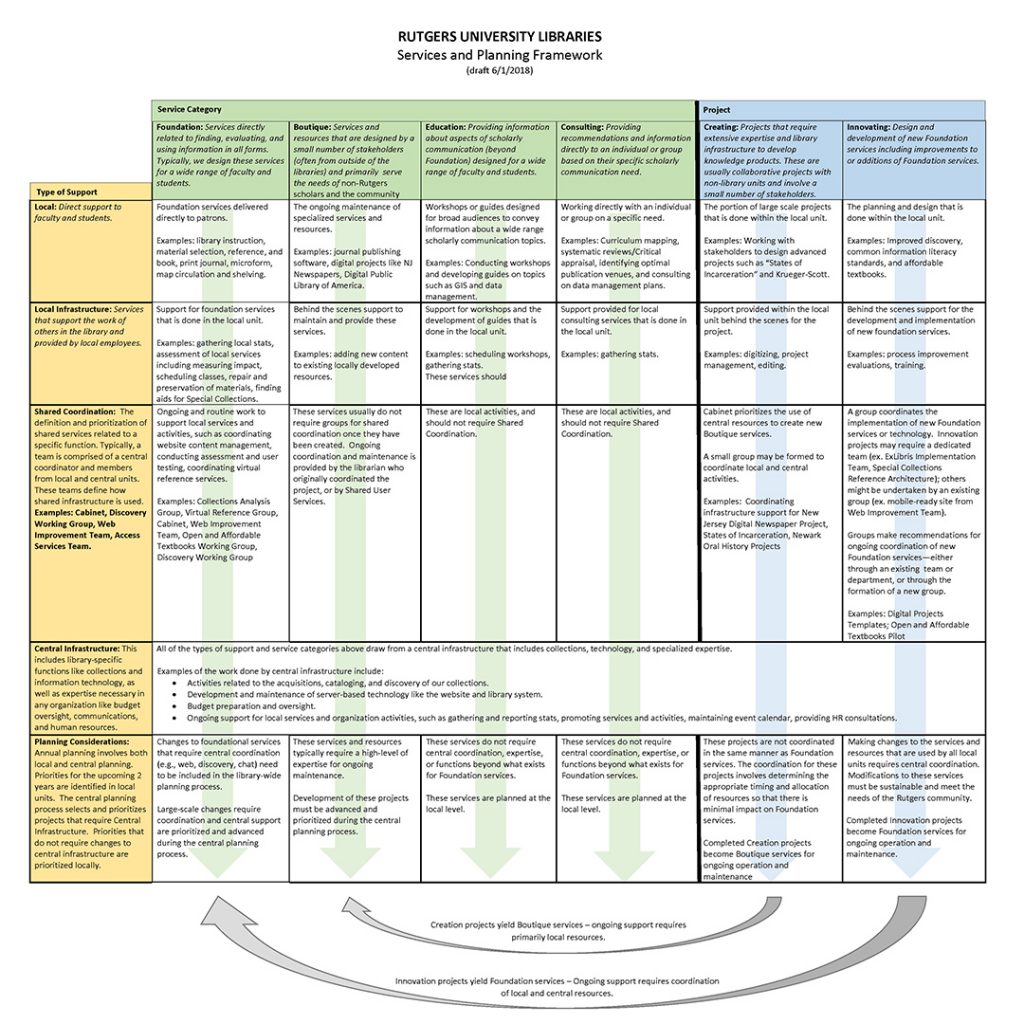
    The framework presented in OCLC’s Realities of Research Data Management report may be useful as we think about the categories and framework we could use to describe our services.
    The framework presented in OCLC’s Realities of Research Data Management report may be useful as we think about the categories and framework we could use to describe our services.

    Frameworks provide a way to divide complex goals and processes into manageable chunks while retaining information about relationships and dependencies between the components. Frameworks allow organizations to map multiple approaches to a goal and to tailor these pathways based on context. We have discussed the need to develop a better understanding of central and local services and responsibilities. We also need to develop infrastructure and services that advance the missions of our three campuses and a statewide health system. It seems that we would benefit from a framework that describes our services and illustrates the relationships and interdependencies between central and local units.

    I have been following the OCLC Research Library Partnership Reports on the Realities of Research Data Management. This is a “four-part series that explores how research universities are addressing the challenge of managing research data throughout the research lifecycle.” The first three parts are now available and are quite good, digging a little below the surface to discover underlying drivers that influence practices. This topic alone is worthy of quite a bit of conversation that is beyond the scope of this post; however, I mention it here because, in Part One of the series, OCLC develops a framework for describing categories of services related to Research Data Management that may be useful as we think about the categories and framework we could use to describe our services. These are not going to map directly onto the needs of Rutgers University Libraries as a whole, but they demonstrate a way of thinking about these issues that will be valuable.

    The categories of services included in Part One: A Tour of the Research Data Management (RDM) Service Space are:

    • Education—educating researchers and other stakeholders on the importance, and in some cases, the necessity, of responsibly managing their data and making arrangements for its long-term curation
    • Expertise—providing decision support and customized solutions for researchers working through specific research data management problems
    • Curation—supplying technical infrastructure and related services that support data management throughout the research cycle

    It seems to me that by generalizing and extending these concepts, we could develop service categories that would help us plan and implement new services. In recent years, we have been reacting to extensive changes occurring in the university, but with the larger environment stabilizing, we can start thinking more about the structure that will best support campus missions and begin to develop a common vocabulary to discuss planning and priorities. There will be more on this in the coming months, but I encourage you to visit the links in this post and start thinking about how these ideas can be applied to our work.

  • State of the Libraries Recap

    State of the Libraries Recap

    This month, I just want to express my gratitude once again to everyone who helped make State of the Libraries so special. From the major events committee to the poster presenters to those of you in the audience–our colleagues are what make this a great event. For 2017, we experimented with the format of the event in several ways, introducing new elements while also retaining what makes this such a special event. In a significant departure, we invited an external speaker to visit us and discuss unconscious bias works and what we can do to mitigate its influence in the Libraries. Calvin Lai’s presentation was as entertaining as it was informative, and it is my sincerest hope that it helps us to better appreciate and accommodate diversity and inclusion in what we do.

    I hope everyone who attended had a chance to tour the always-popular poster session. It is fitting that at the close of the year, we get to survey the many great activities and initiatives underway at the Libraries. From Libraries-wide initiatives like ORCID and the Open and Affordable Textbook Program to the exhibits program at Robeson and the enhanced coin scanning project from the Digital Humanities Lab–these posters are a reminder of the positive impact we have on the university and the work of the Libraries. For those who were unable to attend or did not make it around to see all the posters, the communications team has recorded short videos with the presenters that can be viewed on YouTube (see below). Also, a special note of thanks to Dee Magnoni and James Hartstein who provided professional quality printing for the posters. They looked great!

    There will be much more to say in the coming months, but for now, I want to wish you all a happy New Year! We have so much to look forward to in 2018.


  • We Are Not Alone – Thoughts on the BTAA Meeting

    We Are Not Alone – Thoughts on the BTAA Meeting

    I know that we spend a lot of time focused on building infrastructure. Our top priorities involve undergraduate success and strengthening information control to ensure that our users have efficient, reliable access to information resources.

    I just got back from a Big10 meeting at Purdue. At the meeting, we reviewed the results of a survey of the BTAA library directors’ top priorities for future collaborative activities. Each director picked three areas of interest. The results:

    • Collection Management 54%
    • Student Success Measures 46%
    • OER 46%
    • Data Management/Curation 38%
    • Analytics/Assessment 38%
    • Open Access 15%

    The remaining four items: Special Collections, Professional Development, Digital Humanities, and Library Publishing all were 8%.

    In another part of the survey, the directors listed the most important BTAA initiatives as Discovery to Delivery, Collections Infrastructure and Management, and Student Success.

    Although these priorities and initiatives do not represent the most important work of the libraries, the selections do say something about initiatives that are most effective when done ‘at scale’ with the broader community. As I listened to my colleagues share their experiences and challenges, it struck me that we are not the only research library that is focusing on basics.

    In a meeting back here at Rutgers, Judy Cohn brought up the NMC Horizon Report: 2017 Library Edition. This report from the New Media Consortium looks at trends in libraries, technology, and education to imagine what is on the five-year horizon for academic and research libraries. It is produced in collaboration with University of Applied Sciences (HTW) Chur, Technische Informationsbibliothek (TIB), ETH Library, and the Association of College & Research Libraries (ACRL). It identifies trends, challenges, and developments in technology that will impact how libraries plan to meet the needs of their users, how we function day to day and year to year, and the services that will be in highest demand. The first of the top 10 highlights listed was:

    Libraries remain the gatekeepers to rich tapestries of information and knowledge. As the volume of we resources increases, libraries are charged with finding new ways to organize and disseminate research to make it easier to discover, digest, and track.

    It was surprised to see that improving ‘information control’ was featured so prominently in the report. It seems that academic and research libraries have a renewed focus on the fundamentals and are redesigning infrastructure so that it better meets the changes in the environment. I know there are times when we feel like we are behind; however, it appears that we are actually in sync with many of our peers.

    Over the next week, we will have meetings with Office of Information Technology and the Office of Research and Economic Development to discuss potential collaboration on research and digital humanities infrastructure. This will move us closer to another one of our priorities: identifying and communicating our role in the broader research environment of Rutgers. We are making progress!

    While we are moving fast, our activities continue to be guided by the expertise and research of our colleagues. There are several examples of this that come to mind, all with librarywide participation. The Discovery Working Group has offered a model of how to harness data and best practices to make impactful changes in how our users discover and access collections via our website. Their work continues to propel us forward, even as the Ex Libris Implementation Team works to create nimble and knowledgeable teams to accommodate the anticipated workload over the next 7 months. And the Website Improvement Team is rolling out an impressive, incremental website refresh derived from extensive user research and analytics. The work that we are doing now will pay off in the coming years with flexible and easy to manage systems. It is my hope that these changes will make it easier for you to do the important work that you do.

    As we move into the holiday season, I would like to thank you for your dedication and patience. It has been a difficult few years of change in response to the new environment, but, thanks to your efforts, these challenges continue to be met with creativity, hard work, and shared purpose. Your dedication to Rutgers, our students, and our faculty is impressive and collectively, we are creating libraries—digital and physical—that encourage learning and exploration and support to the success of our users. I am very grateful to count you all as my colleagues and I wish you and your families the happiest of holidays and all the best for the New Year!

    Save

    Save

  • How Do We Handle New Requests in the Planning Process?

    How Do We Handle New Requests in the Planning Process?

    As busy as we all are, sometimes it can be difficult to see the tremendous progress we’ve made in the last couple of years—particularly with something as diffuse as the priorities planning process. Our most recent cabinet meeting provides a snapshot of how far we’ve come.

    As indicated in cabinet minutes, earlier this year cabinet produced a set of priorities to guide our activities over the next 18 months or so. These priorities have specific projects in mind and reflect the capacity of our central units. This planning document is intended to be the scaffolding for our collective work and, by definition, we must work within its bounds. While this may sound limiting—“We only do what’s on the list!”—when it is working well, the opposite is true. A good plan enables us to take advantage of unexpected opportunities as they arise. And in recent weeks, four such opportunities have been brought to the Libraries.

    These requests are for activities that are not currently part of our plan and must be weighed against our existing commitments. Our recent discussion at Cabinet illustrates the give and take negotiations that must take place when we consider new projects or services.

    Our shared list of priorities forms the foundation of purposeful discussions about tradeoffs and how best to shift priorities to new opportunities. For example, we have been asked to create space for a new OIT Lab in Alexander Library and to provide dedicated health sciences library services at LSM. Both of these requests stem from strategic initiatives within the university. We have also been approached about integrating ORCID into our journal platform and providing ETD support for honors undergraduate theses. Each of these is a reasonable request, but they require time and effort from the same central units that support our existing weeding projects, the implementation of ExLibris, and the development of digital projects templates, among other items identified through the planning process.

    Cabinet considered the source of the requests; the anticipated benefit to local users; staffing and capacity in the central Libraries units; the amount of development vs. coordination required; and more, before deciding which opportunities to pursue. The outcomes, communicated in the minutes, are to move forward with adding ORCID iDs to the Open Journal System workflow and to shift weeding priorities to accommodate the deadlines for the Alexander OIT Lab and the LSM renovations. We also decided to hold off on the development of honors ETDs process.

    This is not because including honors theses in RUCore is a bad idea—we simply don’t have capacity this year and we have other priorities to complete. But this is where the planning process kicks in. A local need has been identified, and while we don’t have capacity to follow through this year, the proposal will be moved forward to next year’s planning process for consideration.

    No doubt, there will be additional requests from the university and additional local needs identified throughout the year. In fact, I would argue that the level of attention we are receiving from the university is an indicator of the important role of the Libraries on campus. We are viewed as strong partners and collaborators, our spaces are appreciated student resources, and our services are recognized as key to student success.

    Thankfully, we now have a planning model that allows us to assess these opportunities in objective, realistic, and equitable ways that balance the needs of Camden, Newark, New Brunswick, and RBHS. We must continue to take on high priority projects for the university, but we must also make sure we have the capacity, technology, and resources to succeed. The only thing worse than saying “not now,” is saying “yes,” and not completing the task. These types of discussions are much easier to have when we have a shared understanding of priorities and capacity.

  • The Budget Process and Library Impact on Student Outcomes

    With the last of the Welcome Days events now completed and the start of the fall semester fully complete, it is time to turn our attention to another annual tradition: the preparation of our annual budget request.

    Each year, we are asked to put together a budget request for the following fiscal year, so this October we are in the process of requesting budgets for 2018–2019. The budget process has changed quite a bit in the last few years. Historically, budgets were distributed through the ‘all funds’ budget process in which the ‘administration’ made decisions about how best to allocate resources. The process was not transparent, and in the last few years of the all funds process, the Libraries did not fare well.

    The shift to the RCM model may have been turbulent, but the result is a much more transparent budget process and a way for us to request needed funds. In fact, anyone can view a lot of detail related to the sources of allocations to cost centers (including the Libraries) at budget.rutgers.edu. In addition to being more transparent, RCM has moved decision-making from ‘administration’ to the chancellors and the chancellors are now in the process of engaging the deans.  This means that more of the budget decisions are being made by people who use our resources and services.

    I have now participated in two budget requests through the RCM process with some success (see reports on FY2017 and FY2018 requests). It is clear that the chancellors face difficult decisions in allocating funds because of competing factors, including other cost centers such as Student Affairs and Facilities and internal needs such as new faculty and startup packages.

    During this process, the Libraries are asked to provide a description of our services. We routinely include figures that demonstrate our impact on students or the use of our resources (such as the estimated savings of the OAT Program, the use of resources, or the cost per use for journal articles), so we know it is helpful to have strong evidence that Libraries make a difference. However, because of the complexity of the educational environment, it has been difficult to measure the impact that libraries have on student success.

    That is what makes this news out of the University of Minnesota so exciting.

    The Impact of Academic Library Resources on Undergraduates’ Degree Completion: https://doi.org/10.5860/crl.78.6.812

    A large, rigorous study by the University of Minnesota—“The Impact of Academic Library Resources on Undergraduates’ Degree Completion”—assessed whether first-year students who used the library at least once during their first year were more likely to graduate or continue to be enrolled in four years (indicating progress towards degree completion).

    The survey followed the 2011 entering class of 5,368 students, controlling for factors related to differences in students, including first-generation, socioeconomic status, participation in support programs for underrepresented students, on-campus vs. off-campus housing, SAT scores, AP courses taken, and enrolled college.

    They analyzed the students’ records to determine if they had used at least one of five major library services—borrowing books (including interlibrary loan and ebooks), using electronic resources, using a computer workstation, enrolling in library instruction, or asking a reference question—in their first academic year

    The results indicate that, overall, first-year students who used any of the library services at least once during their first year of enrollment were nearly 40% more likely to be enrolled in four years or 44% more likely to have graduated in four years than peers who did not use any library resources.

    Further analysis of the individual services showed that first-year students who used:

    • electronic resources at least once in their first year, were 45% more likely to continue to be enrolled and nearly twice as likely to graduate;
    • books at least once in their first year, were 34% more likely to graduate in four years; or,
    • instruction, either by enrolling for a class or having library instruction embedded in classes, were 40% more likely to continue to be enrolled after four years.

    There was no significant relationship with the use of workstations, reinforcing the fact that workstations are simply a tool. There was also no significant relationship with the use of reference services (including chat), perhaps because a very low number of students—only 5%—used this service.

    This survey is a tremendous accomplishment and is directly relevant to our work, in part because of the parallels between Rutgers and the University of Minnesota.  Like us, UMN is a large public land-grant institution and member of the Big10. I hope you will take time to read the report and think about how its findings might be useful to what we do and how we do it. I’d love to hear your thoughts on this.

    These findings couldn’t arrive at a better time! Although I have never been asked to prove the value of the Libraries during the budget request process, evidence of library impact on student outcomes will be very useful in our budget request and I hope to have good news for the Libraries later this year when we receive our budget allocation.

  • 2017 Faculty and Staff Appreciation Picnic

    This video of the picnic includes photos by Janet Brennan-Croft, Janie Fultz, Tara Kelley, Jessica Pellien, Tonie Perkins, and Joanne Polgar.

    I know everyone has been busy over the summer preparing for the fall semester (or recovering from not one, but two major floods in a week!) and it is almost here. Before we get caught up in the work of the Libraries, I wanted to take a moment to thank everyone who made the Faculty and Staff Appreciation Picnic an event so memorable—the planners, the volunteers, and the attendees—and to celebrate some of the accomplishments and milestones of the last year.

    Most people think of faculty and staff appreciation events as a bookend to a fantastic year—a chance for the administration to acknowledge and thank people for work they have completed. While this is true, it doesn’t capture the full story. When these events are done well (as our picnic was), they also serve to create connections with our colleagues, reaffirm our joint purpose, and nurture future projects and collaborations. In other words, the “appreciation” part of the event should flow in all directions. So, with this in mind, it was wonderful to see people from Camden, Newark, and RBHS at the picnic. I also appreciate that special care was made to shuffle schedules and allow people who missed last year’s picnic to attend this year. Events like this provide opportunities for serendipity and reflection, and my big takeaway is that we work with a great group of people.

    We lucked out on the weather. It was sunny and dry, but with an occasional breeze to cool us off. We enjoyed terrific food from Food Architects, played lawn games, and made buttons. A fun ice-breaker game helped us to mingle and meet our colleagues. It was a stellar event by any measure and I hope everyone had a good time. I am particularly grateful to the members of the Major Events Committee who worked hard to make this event a success: Matt Badessa, Janie Fultz, Pam Hargwood, Tad Hershorn, Tara Kelley, Rhonda Marker, Erica Parin, Jessica Pellien, Daphne Roberts, Rich Sandler, and Monique Whittle.

    I mentioned these milestones in my speech at the picnic, but I think it is worth mentioning them here for those who were not in attendance. This is by no means a comprehensive list, but even in its sheer volume and variety, it hints at the depth of our accomplishments over the last year.

    • We won grants for initiatives ranging from the New Jersey Digital Newspaper Project to the Virtual Data Collaboratory to the Digital Scholarship as 21st-Century Pedagogy courses at Rutgers University-Newark.
    • Launched the Open and Affordable Textbooks Project, saving Rutgers students nearly $1.6 million
    • Participated in the From Practice to Preceptor Program to help train the next generation of dental school faculty
    • Far exceeded our fundraising goals on the second annual Rutgers Giving Day, thanks in no small part to the contributions of our faculty and staff
    • Celebrated 50 years of the Institute of Jazz Studies at Rutgers–Newark and 50 years of Dana Library as a Federal Depository
    • Welcomed Carla Hayden, the first woman and the first African American Librarian of Congress, to Rutgers–Camden
    • Successfully made the transition from Kilmer Library to Carr Library
    • Participated in the implementation of a new financial system and transitioned to a new email system
    • Added countless new resources including thousands of ebooks, new databases, and collections of rare books and art
    • Successfully completed a search for a new AVP/Director of New Brunswick Libraries
    • And of course there are so many more achievements both large and small.

    These accomplishments are only possible through your efforts. We all have a lot to be proud of and I look forward to seeing what the new school-year brings.

  • Toward a Hybrid Model of Organizational Structure

    The summer has been flying by! I can’t believe it is already August!

    In reviewing the past few issues of The Agenda, I realize that most of my posts have related to the structural changes within the university and changes that we are making within our organization to adapt. This month I would like to take a step back and look more broadly at organizational structures—especially those that are most effective in rapidly changing environments—and how these might apply to Rutgers University Libraries.

    Essentially every large organization today (including the Libraries) is structured according to principles developed by Max Weber’s industrial revolution-era organizational theory and management practices for running large organizations. Weber proposed a top-down structure in which each element of the structure (he called them offices, but today they more likely represent departments or divisions) has a specific role within the organization. These hierarchical structures are stable and predictable, but hierarchical organizations need robust communication—horizontal, vertical, and within units—to be effective.

    During periods of rapid change, hierarchical organizations often face communication challenges. Communication from the top, related to mission and strategies—vertical communication—can be slow to reach all parts of the organization. Also, the connections between the well-defined units within the hierarchy—horizontal communication—can be weak. The hierarchical organization places impossible demands on a unit head who must manage both horizontal and vertical communication while keeping abreast of the functional requirements and activities. With insufficient information about mission and strategy and in the absence of strong connections to other units, units can become internally focused and inadvertently act at cross-purposes with other parts of the organization.

    In recent years, organizations, including many academic libraries, have experimented with replacing hierarchies with more adaptive structures that circumvent these communication challenges. I spent five years working in the University of Arizona Libraries, an organization that pioneered a team-based approach for academic libraries. The goal of these experiments is to create organizations where all decisions were data-driven and could be made at any level. We hoped that the availability of good data could replace some of the communication necessary to be effective. The experiment at the UA Libraries—and, I believe in other academic libraries—eventually failed and they reorganized into a traditional hierarchical model. It seems that establishing reliable data sources is at least as complicated as improving communication.

    People are beginning to look at networked structures for organizations. Networked structures lack formal hierarchical relationships and units can freely communicate with other units. This is quite effective in small organizations; however, as organizations grow, the lack of structure can become a problem. I do not know of any large organization that relies solely on a network structure; however, the Occupy Wall Street movement is a useful case study of the pitfalls associated with a large organization that has strong vertical coordination but lacks structure. Although the movement might have had some impact on society, it essentially dissolved, possibly due to its lack of structure.

    Among these three organizational structures, it seems that hierarchical models are the best structure for large organizations. However, in order for organizations to adapt during periods of rapid change and to react accordingly, communication must be strengthened. While newsletters like this are important—as are agendas and minutes—in communicating activities and decisions, organizations need deeper communication to truly adapt in times of change. It is important for every individual to understand three interdependent things: the mission and strategies of the organization at large; their unit’s vertical and horizontal impact on the organization; and the effect of their workplace decisions on the organization.

    The structure of the Libraries is hierarchical, but we are drawing on lessons from these experiments and taking big strides to improve communication. In Cabinet, we spent the last few weeks developing charges for new groups to help manage our shared infrastructure. You can see a list of the issues that we are addressing in my post from last month. While these groups are being charged to address specific short-term priorities, most of them will eventually become cross-unit workgroups. It is through these workgroups that communication will be improved and the charges for these groups pave the way by including specific communication requirements.

    These workgroups have important work to do and the work includes rich bidirectional communication between the work groups and the functional units. We have spent some time at Cabinet discussing the communication responsibilities of Cabinet representatives, group members, and group chairs. The expectation is that Cabinet representatives act as conduits of information—providing two-way communication that includes direction from Cabinet-level discussions and boots-on-the-ground experiences from members of the workgroup to help guide the work of the group.

    Members of the group, including the group chair, are responsible for considering organizational goals and developing a deeper understanding of broader issues, but they also must act as representatives of their functional groups (most often, this is their department and/or university). In this representative role, they must clearly communicate issues, findings, and actions back to their functional units; develop mechanisms for gathering feedback from their constituents; and then report to the workgroup on how their functional unit will be impacted by the proposals of the workgroups. Group chairs bear an additional responsibility of making good communication a priority for the group by encouraging and using this multidirectional communication to improve outcomes.

    As we shift the loci of work to these shared workgroups, we know we need to be proactive to avoid communication and work silos. It is also important to acknowledge the impact on our workloads and our organization. Our new task force charges include a section on Timeline/Communications and an Appendix that explains members’ participation is a significant part of their primary job responsibilities and will be evaluated as such. What this means in practice is that meetings are not extra work, but an essential part of our organization. And good communication is not optional, it’s a priority.

    I know that activity never stops in the Libraries, but I hope that the slightly slower pace of summer is giving you some time to catch up, reflect, and rest. I look forward to working together to continue our progress in the academic year to come.

  • Update on the Priorities Process

    An archive of Krisellen Maloney’s articles is available here.


    In March, just ahead of the first Cabinet retreat, I described the three-step process by which we are drafting priorities and related budget requests for the Libraries. Things have been moving along quickly, but I wanted to circle back and talk about the outcomes of the second retreat that we had in early June.

    As a recap, prior to the first retreat, the directors worked with their faculty and staff to develop lists of local priorities. At the same time, the infrastructure units conducted environmental scans to identify projects that are already in the works and ongoing work. In preparation for the second retreat in June, the infrastructure units were tasked with assigning “costs”—including staff time—to various activities. The idea here was to develop a deep understanding of local needs and the capacity available in the central infrastructure units to support those needs.

    When all was said and done, we had a daunting list of almost 200 priorities (or more accurately activities) that the local units want to undertake over the next 12 to 18 months. These activities ranged from renovating bathrooms and piloting 24/5 hours at the RBHS Libraries to implementing new information literacy tutorials and purchasing new ebook and journal packages. It was important to see the lists. In addition to conveying real needs, the sheer volume of items also conveyed the frustration people are feeling throughout the Libraries. Although I believe we have made some progress towards clarifying communication and decision-making, there is more to do.

    As the infrastructure units began the process of assigning costs to the priorities, some patterns began to emerge. Through a series of iterations between subsets of the infrastructure units (Tibor, Mary Beth, Jessica, Abbey, Rhonda, and Tao) and Cabinet, we identified clusters of priorities where improved infrastructure—both decision-making processes and systems—are needed. For example, the library directors identified numerous weeding projects (20 priorities worth) that require support from the holdings management unit. Members of Cabinet are not necessarily the people best positioned to make these operational decisions. In addition to overarching issues that Cabinet should be addressing, there are several rapidly changing operational factors that come into play. We decided that what we really need is a mechanism to prioritize weeding projects throughout the Libraries. As a result, we are charging a group to “recommend” a transparent process to prioritize collection management projects (weeding, moves, etc.) that takes into account the available staff.

    All together, we plan to charge 8 new groups that will, collectively, address 70 of the priorities:

    Priorities Category Group’s Charge # of Priorities Charges Due: Who Is Following Up
    Cataloging Develop a process to prioritize cataloging projects (ongoing) 11 July 11, 2017 Agnew, Askew
    Weeding Develop a process to prioritize collection management projects (ongoing) 20 July 18, 2017 Yang, Cohn
    Digital Projects Develop a template for routine digital projects (ongoing) 9 July 18, 2017 Marker, Anderson
    Digital Projects Develop a process to prioritize digital projects  included above October 2017 TBD
    Web Recommend improvements to the Web environment 4 July 11, 2017 Marker, Pellien
    Tutorials for Instruction Investigate new information literacy modules 21 July 11, 2017 Directors
    Special Collections Recommend system architecture for special collections 5 July 18, 2017 Agnew, Yang
    Special Collections Recommend standards, policies and procedures for special collections  included above October 2017 TBD

    We anticipate that another 9 priorities will be addressed by the implementation of a new ILS or will need to be rearticulated once the new ILS is in place. Now that the contract has been signed, we will be moving forward with new groups to guide the implementation.  We are working on scheduling a kick-off meeting where ExLibris will provide us with best practices related to the number of teams that should be formed for a successful implementation.

    Four priorities are already underway or even complete. We anticipate one priority will be passed to the Discovery Working Group to handle and one will be put to the reference team when they are in place.

    We also identified 81 priorities that rely primarily on local expertise and resources and do not require significant support from the central infrastructure units. The directors will prioritize these with their local units. The library directors will also meet with the director of communications to discuss 12 activities related to communications and marketing.

    After all of this whittling, what remained were 19 activities that required clarifications about the scope or the amount of support expected from infrastructure units. We discussed these at the June 20 Cabinet meeting and you can review the outcomes in the Cabinet meeting minutes.

    The overarching theme that emerged through this process is a need to continue to focus on building infrastructure, particularly in developing transparent processes for decision-making. This may seem to be highly bureaucratic, but in reality, it will push decisions closer to the work and enable people with the most relevant information to be part of the process.


  • Lessons from Town Hall – Connecting at the Local Level

    Lessons from Town Hall – Connecting at the Local Level

    Last week we tried something new with the Libraries Town Hall. We shifted our focus north to Rutgers University–Newark and spent some time looking at the relationship between the mission of the University and the planning and activities within the libraries.

    We were fortunate to have Sherri-Ann Butterfield, who will assume the position of executive vice chancellor and chief operating officer in July, provide us with an overview of the Rutgers–Newark initiatives where Dana Library plays a central role: the Honors Living-Learning Community (HLLC), Express Newark, and the P3 Collaboratory (Pedagogy, Professional Development, and Publicly-Engaged Scholarship). Dr. Butterfield gave us a whirlwind tour through these initiatives, highlighting the role of the library from teaching one of the foundation courses in the HLLC, to being one of the founding pillars of the P3 Collaboratory, to the amazing “Records at Play: The Institute of Jazz Studies @50” exhibit currently on display at Express Newark.

    Rutgers–Newark has made remarkable progress under the leadership of chancellor Nancy Cantor. In her short tenure, the university has achieved a distinct identity as an anchor institution in the community. Its focus on excellence in student inclusion and success and community-engaged scholarship is setting Rutgers–Newark as a national model. She has a robust and active strategic planning process as demonstrated by regular updates of the strategic plan, with the newest released in Spring 2017.

    Following Dr. Butterfield’s presentation, Consuella Askew and Adriana Cuervo gave us an overview of Dana Library’s year-long planning process and the resulting document, “Framework for Change: Vision and Goals for the John Cotton Dana Library.” The framework describes an evidence-based approach to the development of services, collections, and spaces that contribute to the success of the university’s students and faculty and to the perception of Dana Library as a valuable and active campus partner.

    As part of the annual RCM process, we have received new funding for a full-time archivist and the renovations necessary to develop an archive in Dana Library. In 2016 we also received $100,000 for renovations and new furniture in Dana Library and will receive another $100,000 in 2017. The chancellor has also acknowledged the work of librarians with seed grants to Adriana Cuervo for the Citizen Historian Project (2015), Bonnie Fong for Boot Camps for Graduate Students (2016) and Krista White for Digital Storytelling as 21st-Century Pedagogy (2017). Under Consuella’s leadership, Dana Library will house and be full partners in the P3 Collaboratory.

    The energy surrounding the Rutgers–Newark transition is contagious and the university is gaining national recognition for its innovation. What is best, however, is that the library is at the center of these important campus initiatives. Kudos to the efforts of our colleagues in Dana Library and the Institute of Jazz Studies.

    What does this mean for RUL? In the March Agenda, I talked about Rutgers University Libraries’ planning process. I would like to take some time now and talk about how the process that Consuella has undertaken in Newark fits within the library-wide planning environment. The risk of being first under the spotlight is that you become an example. However, if they are not in development now, each of our locations—Rutgers–Camden, Rutgers–New Brunswick, and RBHS—will all have plans or frameworks that describe how the libraries fit into the broader University environment. These efforts will directly tie us to the distinct missions of our campuses and provide the foundation for our planning.

    The challenge is that even at the very highest levels, our four university environments are different. For example, the Overarching Goals for Dana Library are to:

    • Innovate to support 21st-century library use.
    • Increase community engagement.
    • Increase operational excellence, efficiency, and fiscal sustainability.

    Short-term objectives include developing the Dana Archives and selective weeding of the collection to make space for study and collaboration. Longer-term objectives include enhanced educational technology, rethinking strategies related to Government Documents, and improved digital services (e.g., digital humanities). These goals and objectives are tailored to meet the needs of the Rutgers–Newark environment and mission, and we cannot simply transplant them to RBHS or Rutgers–New Brunswick. Simply put: unique university goals require unique library goals. In the February Agenda, I discussed the challenges that we face as we support the multiple unique missions of the University.

    As we go into Phase 2 of our planning, we will have to determine how to balance the finite central infrastructure to meet the needs of Rutgers–Newark, while continuing to advance the wider university. Ultimately, we will be most successful when we can find broad-based initiatives or areas of focus that support more than one campus. Those of us not in Dana know that there are needs in each of the campuses, including data management, research information management, digital humanities, improved instructional objects, improved collections, and Open Access initiatives. Internally, we know, for example, that we need improved support technology support for Special Collections, improved discovery, an improved website, improved ability to track internal policies and procedures, and improved collection assessment capacity. In our current environment, it is highly unlikely that we will receive increased funds for central services. Instead, we will need to create scalable, reusable infrastructure to extend our existing capacity.

    With three senior level interim positions, FY2018 will likely be another year of building infrastructure. It will also be a great time to step back and connect with our campuses to determine where our libraries fit and how we can become further integrated into campus needs and missions. Thanks to Consuella and Adriana’s presentation at Town Hall, we know this works. In Rutgers–Newark, we see that this is a great time for libraries. Through careful planning and collaboration with administrators, the expertise of the library is central to almost every aspect of research and education. We need to learn from this experience and find ways to replicate this success across four very different campus environments, while also maintaining the balance and economies of scale that our infrastructure units provide.

    Save

    Save

  • The Results of Our Budget Request for FY2018

    The Results of Our Budget Request for FY2018

    In recent months, we have spent a lot of time talking about organizational changes and the advantages of breaking down silos. This month, I want to discuss a shining example of what we accomplish when we work together—the outcome of our FY2018 budget request.

    As noted in the meeting minutes for cabinet on April 11, we recently received our FY18 permanent budget allocation and there is a lot of good news to share. Overall our budget is increasing, even if the increases are small. There are, of course, also some disappointments, so let’s delve into the specifics.

    Let’s start with the very good news: we received a commitment of $500,000 to purchase Elsevier backfiles. This is a major collections purchase—possibly the largest in the Libraries’ history—and it required a lot of effort from Tao Yang, Gracemary Smulewitz, Abbey DiPaolo, and others to make it happen. Having these backfiles will dramatically expand our support for the university’s academic programs and bring us in line with our Big Ten peers.

    Each year, at minimum we ask for two budget items: funds to cover inflation for subscriptions to journals and databases and funding to cover negotiated salary increases. These items are areas where we have annual contractual increases in expenses. When our expenses increase in these areas and our budget does not, we must find other places to cut. The difficult problem is that both the contractual salary increases and inflation are ongoing, so we have to cut an ongoing expense. Here, we got a mixed response.

    We finally received funding for inflation. This is good news for us and even better news for our faculty and students. As you know, the costs of journal and database subscriptions go up each year, but in previous years, we have had to accommodate these increases within our existing budget. With inflation costs covered, we won’t have to have to cut existing subscriptions in order to cover the higher ongoing costs. We have new ongoing funding to cover the higher costs for materials.

    Unfortunately, we did not get funds to cover salary increases. This means that we will have to permanently use funding from some open positions. The total number of positions that will be affected is small with most having been open for a long time. The good news is that we remain committed to supporting salary increases for the excellent faculty and staff that we have, even if we have a small reduction in the number of employees.

    Lastly, a surprise! In addition to our requests to cover expenses, we also ask for additional funding to cover new services in the libraries. We limit these requests to items where the campus administrations have indicated support. This year we asked for funding for archives in Dana Libraries. Initially, we were disappointed to learn that our funding request was denied. However, we just received a revised budget from Rutgers University-Newark and they have decided to fund a full-time archivist and the renovations necessary to create an archive space. In addition, they are providing $100,000 to purchase new furniture for Dana Library

    This reversal is the result of the work of Consuella Askew and many of the faculty and staff in Newark in developing strong local relationships and an understanding of local needs, as well as their conscientious and creative use of earlier funds. The RU-N administration is committed to building an archive in Newark. Consuella recognized the need and was able to make a case for archives being in the library rather than in a separate unit. The resources that will come to Dana to create an archive will relieve some of the pressure that we have across the university for stewarding this important content. However, in order to benefit, all of the units with special collections must work together to create infrastructure that supports the broader system. I expect that this will be one of the priorities that come from our planning this year.

    Our initial budget request was deliberately targeted on items that would bring a demonstrable improvement or impact to our constituents. And as we continue to shift our priorities and strategies toward addressing the unique local needs of our libraries, it becomes more important than ever for us to find ways to work together to build common, reusable infrastructure that has noticeable benefits for our campuses.