Category: University Librarian Report

This the collection of monthly newsletter articles from Krisellen Maloney, Vice President for Information Services and University Librarian.

  • What Can We Learn from Toy Story? Toward an Open and Collaborative Culture

    What Can We Learn from Toy Story? Toward an Open and Collaborative Culture

    March 29th, Cabinet had our first of three retreats designed to set priorities for [2017-2019] and action plans for 2018. The time we spent together reminded me of how important and at times challenging collaborative work is. In the face of rapid changes in higher education, the scholarly information environment, and user expectations, the kind of problem solving and innovation that comes from working together is more important than ever.
    Working together is not new for those of us working in the libraries. We have decades of experience with councils, committees, and task forces that have made libraries examples of organizational cooperation within the broader higher education community. Almost everything we do in the libraries requires expertise from multiple units.

    I have challenged myself to come up with examples of services that we provide that do not benefit from multiple perspectives and can’t think of one. Everything from designing the discovery interface to making a sign is improved when people with different ideas and points of view work together.

    Unfortunately, the same forces that make working together so important also create organizational and logistical challenges. These include the need for clarity related to decision-making; accountability and authority to assign work; group norms that enable productive work; and time. Each of these could (and may) be its own topic for The Agenda. But for today, I want to reaffirm the value of and need to work together.

    A few years ago, I went in search of examples of effective teams from outside of libraries. During that search, I read Creativity Inc.: Overcoming the Unseen Forces that Stand in the Way of True Inspiration by Ed Catmull and Amy Wallace. Ed Catmull is (among other things) the cofounder of Pixar Animation Studios. In the book, he describes how teams worked together to create Oscar-winning movies like the Toy Story series and Up.

    When I began reading the book, I thought that there would be little that libraries could learn from an animation studio. As I read, I saw many parallels between the unseen forces that the folks at Pixar faced and what we face as an organization. I realized that the similarities made perfect sense—providing information resources and support for faculty and students in a time of such rapid change require true inspiration.

    Toy Story happened to come out at a period in my life where I was following Disney animation. It was interesting to hear the messy, non-linear process that went into developing the movie. When I watched Toy Story and other animated films, I assumed that they began with a script and added animation and voices. They don’t. They start with an idea (a loosely define goal) and the details of the story emerge through a collaborative development process.

    Catmull’s idea for a script seems to map well to the libraries’ goal for a project or the purpose of an initiative. The book describes the approach that Pixar used to move from an idea to a complex and convincing story. What I liked about the book was that he didn’t just describe ‘what they did good’ at Pixar. He talked in depth about serious challenges and how the group worked together to produce consistently excellent results. It was shocking to me that the didn’t start a project knowing what the outcome would be.

    He talked a lot about the importance of sharing expertise, valuing perspectives, and still making progress. He believes that the ability for groups to have open, honest discussions ultimately results in the best outcomes. At one point in the book, Catmull states that “The healthiest organizations are made up of departments whose agendas differ but whose goals are interdependent. If one agenda wins, we all lose.”

    In this time of rapid change, many of the carefully designed formal communication structures and group processes that we have developed over the years may be a thing of the past. But we still need to work together. We live in a time of multiple competing priorities, continuous reexamination of goals against our intentions, and digging deep to ensure that we understand the evolving information and education landscape. We need the kind of creativity and problem-solving that can only happen with active exploration of problems from multiple perspectives.

    Our challenge will be to develop an organizational culture that supports the way we need to function in this environment. We can’t feel like we are always stumbling into the future. We have to appreciate that we are learning to do new work that lacks established models and best-practices and to value openly exploring issues and group problem-solving. Catmull’s approach “is to accept that we can’t understand every facet of a complex environment and to focus, instead, on techniques to deal with combining different viewpoints. If we start with the attitude that different viewpoints are additive rather than competitive, we become more effective because our ideas or decisions are honed and tempered by that discourse.”

    We addressed some difficult issues at the Cabinet retreat. We had multiple perspectives at the table and we had some difficult but productive discussions. We didn’t make any decisions, but I think we made progress toward developing a clearer understanding of the issues that we are facing. We will be looking for your insight as we make decisions regarding priorities. These may be small steps towards creating a more open and collaborative culture, but I think we are heading in the right direction.


    Save

  • 2018 and 2019 planning kicks off this month

    2018 and 2019 planning kicks off this month

    Say it isn’t so!

    Believe it or not, the 2018-2019 planning process is beginning.  This will be our third planning cycle under the RCM model, so we are gaining an understanding of the flow of things.  Over the last few weeks, Cabinet has developed a planning calendar to guide our strategic discussions and budget requests.

    Based on what we have learned in past years, our planning process can be thought of in three phases.  In each of the three phases, we have to address library planning for the upcoming fiscal year (2018) and future year (2019) budget requests.  (I know, this is where everyone’s eyes glaze over, but it isn’t as bad as it sounds!)

    Why three phases?  Rutgers Libraries serves the needs of three distinct campuses and a health system.  We need to support the unique needs of each of the communities with a single shared infrastructure.  In the first phase of the process, we address the feasibility of initiatives and look for ways to optimize our infrastructure.  By doing this together, we have a transparent process with many voices at the table. The second and third phases address two necessary parts of planning – creating a plan and creating a budget.

    Phase 1: Environmental scan.  During this part of the process, the library directors will assess the needs of their local communities, identify gaps, and develop a list of local priorities for their collections, services, and spaces.  It will be up to each library director to determine how they conduct their local process, so if you have questions, be sure to ask your director.

    At the same time, infrastructure units will be assessing their capacity.  What projects are starting and ending, are there projects waiting to start?  Are elements of the infrastructure outdated or at capacity?  This analysis will result in a better understanding of the capacity of our infrastructure and whether we can take on new services.

    In late March, Cabinet will meet in an all-day retreat to review priorities and activities and to identify themes and overlap. We will look at the capacity of our infrastructure and determine which priorities we can accomplish with our existing infrastructure, which will need additional funding, and which should be tabled until the next planning process.  This meeting will result in list of priorities that have been vetted for feasibility for further consideration.

    One of the challenges we face is that because we have yet to receive our working budget for 2018, we can’t be certain which priorities will be covered by our 2018 plan and which may have to become part of a future budget request. So, for the time being, we will include all priorities in a master list so we don’t miss anything important. In April, we expect to receive our working budget for 2018, which will give us essential information into the staging of the priorities.

    Phase 2: Develop a 2018 plan.  At this point of the process, we will have all the information we need to establish our plan for 2018, which we will do at a late May retreat.  We will use the working budget to separate the master list of priorities into two categories: priorities that have 2018 funding and are therefore part of the 2018 plan, priorities for which we do not have capacity.Before finalizing, the 2018 plan will be returned again to the units giving directors a chance to discuss these activities more broadly on campus. Since many items on this plan will take more than a year to accomplish, the 2018 plan is then incorporated into the Library Priorities spanning 2017-2019 that will be announced at the State of the Libraries meeting in December 2017.

    Once we have made our plan for 2018, we are left with a list of priorities for which we do not have capacity. This is where things become more difficult as we have limited resources and must decide which priorities will be included in the 2019 budget request and which will be postponed.  I have learned in my time at Rutgers that it is difficult for us to say that we are not going to do something.  We have a talented, capable group and I have seen amazing things accomplished; but it is important for us to be clear about what is possible. Which brings us to developing our 2019 budget request.

    Phase 3: Develop a 2019 budget request.  In this phase, we take the list of priorities that do not have funding and determine what we should do.  Are the priorities important enough to develop budget requests?  We have learned that the most successful budget requests are based on data.  For example, we received funding for new information resources because we could provide evidence of use of similar resources.  If the priority is not well suited for an external budget request, is it something that we might internally fund through the reallocation of resources?  Or is it something that has to be put on hold?  At a Cabinet retreat in August we will finalize the budget requests.

    After a few months, the entire process will commence again with the plan for 2018 and budget request for 2019 quickly seguing into the plan for 2019 and the budget request for 2020. The planning calendar that cabinet has developed will help us stay on top of this process and  ensure that we are doing the right things to make Rutgers better. The process takes months and is continuous, but this has hidden benefits – there are breaks throughout the process that give Cabinet members time to communicate and seek feedback about the progress and because the process is thorough and transparent, we will end up with a cohesive and targeted plan that we can all support.


  • Change Is in the Air

    Change Is in the Air

    For the last few months, I’ve written about changes in the organizational structure of the Libraries as we clearly distinguish central vs. local functions, most recently talking about the role of the library directors in coordinating local services. It is easy to get lost in the details, so I think it is worth taking a step back and looking at what is driving this change. The 2014 Strategic Plan describes a vision for the University in the following way:

    As one Rutgers, all of our campuses and units share common values, features, resources, and administrative and other centralized services. As distinct entities, however, the campuses and RBHS each have differentiated missions and future visions that emanate from this unified core. An important outcome of our planning process has been each campus’s and RBHS’s articulation of its own sense of self, each with unique elements of mission and future direction.

    We are in the process of implementing this vision by developing an organization—structure, function, decision-making, communication, etc.—with a unified core that is responsive to distinct missions.

    Something that has been clear to many of you, and is becoming clearer to me each day is that we—the Libraries—are a microcosm of the broader university. Just as the former executive vice president for academic affairs was responsible for New Brunswick and many of the central functions of the university, the former associate university librarian for research and instructional services was responsible for New Brunswick and many of the central functions of the Libraries. I could be wrong, but I think that the Libraries are the only academic unit that has central and local functions and, by extension, the only unit that is experiencing the full breadth and depth of these changes in roles, responsibilities, and culture.

    Recently, I had a day with an interesting sequence of meetings that highlights the parallel structure of University and Libraries and underscores how profound the organizational changes are. In the morning, I attended a meeting of the Rutgers–New Brunswick chancellor search committee. In the afternoon, I met with the AVP/director of New Brunswick Libraries search committee.

    Throughout the chancellor search meeting, conversations returned to two main themes. The first broadly addressed the relationship between the chancellor and the central units.  Members of the chancellor’s search committee spent time discussing the relatively new (and narrower) scope of the position. It was clear that search committee, primarily comprised of Rutgers–New Brunswick faculty, had not had a chance to internalize the implications of this change for decision-making. Throughout the meeting, the question, “Is that New Brunswick or is it central?”, was raised repeatedly as discussion returned to the role of the chancellor within the University. Several of the search committee members asked detailed questions about the relationship between the chancellor and central services such as the Office of Information Technology, the Libraries, and Facilities, and wondered aloud how the new chancellor would get things done if key elements of the infrastructure were not a part of the position’s portfolio.

    These questions struck a chord for me because they are the same questions we’ve been circling and addressing in recent months as we carefully separated Research and Instructional Services and New Brunswick functions. We have created structures, most notably the Shared User Services department and the Library Directors Group, to coordinate work across the campuses. Even with all of this progress, there are some details that we will need to resolve. Just as the New Brunswick faculty expressed concern related to the ability of the new chancellor to affect change, I think there are still questions that need to be resolved about how each of our library directors gets things done for their campuses.

    I already see the transformation. Chancellors and other stakeholders on campuses are working directly with library directors to request specialized services, resources, and partnerships. As this shift occurs, we need to be sure that our central services can respond. Some questions this raises for me include: How do we create clear lines of communication and accountability between central services (Collections, Technical and Automated Services, Budget and Finance, Communications, Development) and the library directors? What is the relationship between coordinating bodies (e.g., Collections Analysis Group, Discovery Task Force) and the library directors? What does this shift mean for our decision-making regarding the structure of the website, the function of discovery, the collection allocation process, and more?

    Although we have made an immense amount of progress is establishing clearer lines of responsibility within the Libraries, I am not certain that we have all of the infrastructure in place to enable library directors to effectively address the unique needs of the campuses. In recent weeks, Cabinet has worked on a planning calendar to help us all schedule and better understand major milestones throughout the year. In providing a cross-departmental look at what is happening each month, the planning calendar identifies activities that rely on this infrastructure. It also highlights activities that require feedback and information from financial and administrative contacts at the universities. Hopefully this will improve workflow and empower the library directors to anticipate and troubleshoot issues that may arise.

    The second issue that surfaced during these search committee meetings is the identity, or lack thereof, of Rutgers–New Brunswick. Just as each of our library directors has developed an identity for their libraries that is tailored for their community and strengths, so have the universities. Rutgers Biomedical and Health Sciences is “leading the way in academic health care.” Rutgers–Newark is “where opportunity meets excellence.” In Rutgers–Camden you can have “all of the benefits of a world-class research university plus the personalized experience of a small campus.” However, until recently Rutgers–New Brunswick has always been, well, Rutgers.

    This is about to change. Rutgers–New Brunswick recently announced a new identity, using the tagline of “America converges here,” drawn from President Obama’s historical commencement speech last year. The new chancellor will have to formalize and strengthen an identity for New Brunswick. Given the parallel structures of the libraries and the university, it is not surprising, therefore, that our new AVP/director of New Brunswick Libraries will face a similar challenge to establish an identity for the New Brunswick Libraries.

    While I am on the topic, I want to spend a minute clarifying an issue that I know has cause substantial confusion. These changes are not happening because of RCM. RCM is the new budget model that is being established because of these changes. The definition of Rutgers’ special version of RCM, helps to operationalize the vision of four distinct entities that emanate from a unified core of values, features, and services.

    That is a lot of simultaneous change! Needless to say, interesting days lay ahead for us all.


    Save

    Save

    Save

  • Changes in Committees Reporting Structures

    Changes in Committees Reporting Structures

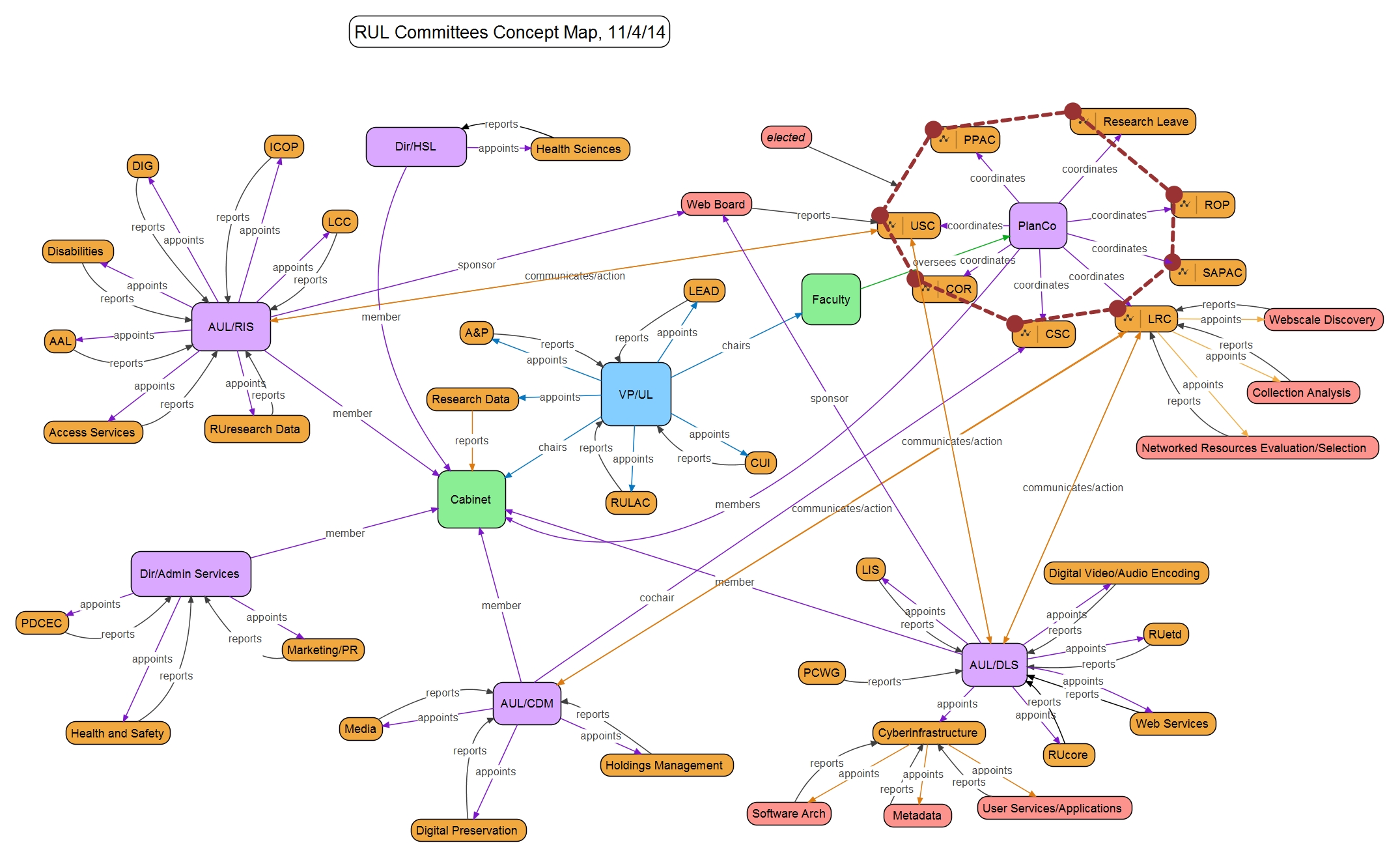
    The original Committee Concept Map from 2014.

    When I arrived at Rutgers, I was charged with clarifying central vs. local functions. In the October and November issues of The Agenda, I talked about changes in the organizational structure that (among other things) moved central and shared librarieswide functions from purview of the AUL for Research and Instruction to central units.

    In December, Cabinet reviewed the Committee Concept Map—a now historical document developed in late 2014 to better understand decision-making responsibilities and flows in the libraries. The diagram showed many different types of groups, including committees, working groups, taskforces, etc. and their reporting relationships. During the review process, we discussed each group—what work it was assigned, whether that work was complete, where it falls within the current organization’s footprint, and who ultimately is responsible for the output of the group. As a result of this work, some groups were sunsetted or moved to new reporting structures. These outcomes were already communicated via the cabinet minutes.

    Finalizing the review of the Committee Concept Map enabled us (among other things) to clarify a few more areas where the lines between central and local responsibility were not clear—especially in the area of public services. Coordination of shared public services—LCC, Ask a Librarian, and Webscale Discovery—were all moved to Shared User Services (SUS). An additional 3 groups on the Committee Concept Map—Access Services, Disabilities, and ICOP—did not fit under the SUS umbrella. Instead, the work of these groups needs some level of central coordination even though their functions are local and the responsibility of the library director.

    Access Services, for example, used to report to the AUL for research and instruction in her central coordinating role, even though they were addressing local policies (e.g., bulletin boards). While the committee itself has representatives from many locations, this reporting structure essentially meant that central was creating policies to govern local services and spaces (a perception further complicated by the former structure where the AUL for research and instruction was also the director of New Brunswick Libraries).

    Under the new system, Access Services, along with Disabilities and ICOP, will report to a newly formed Directors Group that is composed of the library directors—Consuella Askew, Katie Anderson (in her role as interim director of Robeson Library), Judy Cohn, and Jeanne Boyle (in her role as interim director of New Brunswick Libraries)—and Rhonda Marker, the director of shared user services. This will align the important work of these committees more closely with their local units and clarify the director’s role in decision-making, while ensuring two-way flow of information about the needs and resources required for the work.

    Since I know there have been a lot of questions, it is worth spending a little more time talking about the purpose and goals of the Directors Group. The directors convene to address local concerns, discuss shared issues and how they can work together to establish best practices and avoid duplicating effort. This group does not extend the responsibility or authority of the Library directors. Instead, it provides a means for Library directors to work together collectively to solve problems and to benefit from each other’s experience. Ultimately, each Library director is responsible for providing the vision, leadership, and management necessary to deliver collections, services, and spaces that are tailored for their local community.

    Some of the comments that I heard noted that the Directors Group seemed to have taken on many of the responsibilities that USC used to have. As I think about the changes that are occurring at the University-level, and of my charge to clarify local vs. central function, I realize that the comments accurately reflect the changes in the libraries. In the past, decisions related to public services occurred centrally with a goal of developing the most cost-effective library system possible. Rutgers Libraries had a long history of successful internal collaboration. Now, each campus expects services that are tailored to meet local needs. Directors are being held accountable on their campuses for ensuring that the library system provides services (and collections) that directly support local initiatives and programs. The shift from a large, representative decision-making body to a more federated model that favors local decision-making is necessary to support the changes within the broader University context.

    Before ending, I do want to acknowledge the hard work that went into finalizing the Committee Concept Map. We originally worked from a single-page document with over 40 administrative and faculty groups. On the administrative side, we now have a structured list 17 active committees, taskforces, and working groups with clearly defined “homes” in the Libraries. The faculty have also made substantial progress refining their committee structure. This project required a lot of heavy lifting and input from our colleagues, so please accept my thanks for your efforts.

    If you have additional questions about these changes, please speak with your AUL or Director.


    Save

    Save

    Save

  • Happy Holidays

    Happy Holidays

    captureHello all –

    My message this month is simple. I wish you all the happiest of holidays and the joy of the New Year as we enter this festive season.

    As you all know, 2016 has been an incredibly productive and busy year and I am grateful for all of your efforts in moving the Libraries plans and priorities forward. In a few weeks, we will circulate our annual report which paints a vibrant picture of our accomplishments of the last 12 months. The theme of the annual report is “Transform,” which is a nod to the internal changes the Libraries have undertaken in 2016, as well as a reflection of the transformative effect our activities have on our students, faculty, and the university at large. We have truly made a difference this year and our good work will continue in the coming months.

    I hope you enjoy time with your family and friends this month and look forward to seeing all the good things 2017 brings our way.

    Thank you so very much,

    Krisellen


    Save

  • Organizational changes clarify collections acquisitions and processing, holdings management, and interlibrary loan

    Organizational changes clarify collections acquisitions and processing, holdings management, and interlibrary loan

    In this column last month, I talked about changes in the organization that were designed to separate central and local responsibilities and to improve our information control functions, particularly in relation to the website, discovery infrastructure, and collections. Shifting the coordinating functions for shared users services from RIS to the newly formed Shared User Services department has created an independent central unit that will work equally with all of the Directors to establish priorities for the website, discovery, shared reference services, and digital projects across the University.

    This month, I want to follow up on a second round of organizational changes designed to similarly clarify central/local responsibilities and this time to also focus on the coordination of information related to collections. Previously, the AUL for Collection Development and Management (CDRM) did not have a direct reporting relationship with the units that acquired and managed collections. This reduced opportunities for coordination and accountability.

    The changes announced in October will significantly improve the transparency of our practices and decisions by creating teams that are focused on different aspects of collections—acquisitions, holdings management, interlibrary loan, and collections processing.

    So, what happened and who is affected?

    • DTS has been redefined as Collection Services and Resource Sharing (CSRS). This new unit, reporting to the AUL/CDRM, will include ILL and provide an integrated view of acquisitions where ILL is considered a strategy for providing access to content. Shifting the ILL unit from RIS to CDRM has the added benefit of further clarifying central and local decision-making.
    • To keep the efforts of the newly defined CSRS focused on the complexities of acquisitions, the Holdings Management Unit (HMU) will move from the department to report directly to the AUL/CDRM. In the future, we will look for ways to use the mountains of valuable information that is captured in CSRS to formalize an assessment function. When it is established, this function will work closely with the HMU which relies heavily on information about collection use for its operations.
    • Not all of the DTS employees moved to CSRS. Some employees became a part of CTS, thus consolidating most of the physical resource workflow processing in that department.

    With these changes, we have created an organization that aligns much better with the University’s structure and with our RCM budget requirements. We have created a single unit that is completely focused on managing the central components of collections from acquisitions to holdings management. And, while there are still some details related to access services and some committees that need to be addressed, the major universitywide functions of RIS have officially shifted to central units. Although RIS did an excellent job coordinating shared services, there was always ambiguity regarding decision-making within the unit. Hopefully, these changes will provide more clarity and allow New Brunswick Libraries, together with Special Collection and University Archives, to establish their unique identity.

  • Welcome to the New Shared User Services Department

    Welcome to the New Shared User Services Department

    Krisellen Maloney, Vice President for Information Services and University Librarian

    I recently announced the formation of the Shared User Services Department, headed by Rhonda Marker as director of shared user services. This month, I want to provide a bit more context for this shift and how it fits into the priorities for the Libraries.

    To begin, it is best to look at the budgetary issues and priorities that we discussed at the State of Libraries in 2015, what we have learned, and how what we have learned is shaping our actions and the priorities for this year.

    A major priority—because it is at the heart of everything that we do—has been to clarify decision-making within the libraries. At the State of the Libraries, we talked about several ways in which we would do this, but the two that are most relevant to this discussion are the roles and decision-making authority of the AULs and directors and improving budget transparency.

    Throughout the year, as we began to define roles, it became apparent that having the coordinating function for shared public services and the leadership of the New Brunswick Libraries combined under one AUL was causing confusion. This is the same structural problem that the University addressed when they separated the executive vice president for academic affairs position into two positions: a senior vice president for academic affairs and the chancellor of Rutgers–New Brunswick. Following the university structure, we knew that we needed to separate the coordinating function and the leadership of New Brunswick Libraries.

    Budget transparency is also a driver for clearly defining central and university functions. We are now in the thick of the RCM budget process, and we know that the four chief financial officers expect us to accurately report expenses. A clearly defined central unit would bring more clarity to our accounting. The RCM budget model and our funding levels brought in another factor. With no funds available to create a new unit, the function of an existing unit would need to be modified.

    Two more priorities from the State of the Libraries provided us with ideas of how we could redefine our central units to support the changing university environment: the need to better understand and imporove our collections and the need to clearly articulate our vision for advanced research support, including scholarly communication.

    This year, we have begun to address collection management and development. We’ve used central and New Brunswick reserves to make large purchases that fill some holes in our collection. However, the results from our recent LibQUAL+ survey indicate that the negative perceptions of our collections are linked to discovery issues and problems with the website. Based on these findings, we have set a new priority for this year to improve information control which we will discuss more fully at the 2016 State of the Libraries.

    We are pioneers in the areas of advanced research support and scholarly communication, but internally we lack the infrastructure—organizational structure, connection to Cabinet, clear sources of funding—to support a path forward. This is something that we will study over the next year.

    With a need for improved information control and a lack of direction for scholarly communication priorities, we looked at the Scholarly Communications Center to see if there was an opportunity to restructure. Over many weeks this summer, I worked with a team to tease out the various functions of the Scholarly Communications Center, assessing each responsibility and aligning it with the appropriate unit or department. These were not easy decisions because advanced research support and discovery are complex aspects of what we do as a library system.

    Our goal was to create a department that could play a central coordinating role and be a single point of entry to access ongoing scholarly communications projects and to bring new projects into the fold.  The Shared User Services Department will also coordinate discovery, the website, and the shared components of reference. The Libraries have put a great emphasis on transparency and accountability over the previous year and SUS will work closely with University Library Directors and Cabinet to prioritize projects and communicate with infrastructure units to make sure that resources are available and requirements are clear. In essence, they will be the one-stop shop for project management on these larger initiatives.

    I noted this in my earlier announcement, but it is worth reiterating that this transition also involves significant changes in the role of the directors, IIS and RIS.  I will explore each of these in upcoming issues of the Agenda.

    These are exciting changes for the Libraries and I anticipate the work of the SUS department will further shift and mold our priorities over the coming year. During this period of transition and change, I encourage you to speak with the directors and AULs if you have concerns, suggestions, and ideas that will help us move forward in a smart, efficient way.


    Save

  • A Two-day Cabinet Retreat Initiates Discussion of Libraries-wide Priorities

    We are at a strange point of the year where, like time travelers, we must work and plan in three different fiscal years. The close of FY16 necessitates the activities of closure and assessment; FY17 is already galloping along with its own demands; and in some circles, we are already planning for the priorities FY18 in anticipation of State of the Libraries meeting in November.

    In order to get a handle on that last item, I invited members of cabinet to join me for a two-day retreat to discuss where we see our priorities in the future. Over the course of two days, we reviewed SWOT analyses, LibQUAL+ survey results, budgets, previous State of the Unions, and on. We considered the impact of changes in the Libraries’ environment ranging from the master space plan to the needs of the Giddings collection. And we assessed the priorities we established at State of the Libraries in November 2015, asking what have we accomplished this year? And how do these accomplishments provide opportunity for further refinement and, in some cases, expansion of these priorities?

    While I don’t have a finalized list of priorities to share at this time, I want to give you a sense of the tone and the focus of these discussions. Much of our discussion centered on the priorities established at the last State of the Libraries:

    • Enhance undergraduate support
    • Conduct a holistic review of special collections
    • Optimize Collection development and management
    • Clarify communication and decision-making
    • Define the Libraries role in and identify resources for advanced research support

    We have made tremendous strides in each of these areas, but what became clear through our discussion was that each “accomplishment,” was also a new beginning. For example, we considered the report of the completed special collections holistic review (an executive summary is available here), but this brought up questions about strategy, resources, and next steps.

    So, I suspect when all is said and done, our priorities will fall into similar areas as last year, but with shifts in focus or additional avenues to explore. The one exception is that we will undoubtedly add a priority related to strengthening information control. Additional threads running through our conversations included the impact of the RCM budget model and the use of assessment in decision-making and planning.

    I anticipate sharing the outcome of this retreat with you all in the coming weeks. We will all benefit from a set of clearly articulated, aspirational, and achievable priorities to guide our activities in the following year. The discussions initiated during the retreat will continue in cabinet and within units before the priorities are finalized. I thank you in advance for your participation and support during this process.


  • Kicking off Annual Planning and Budget Process with LibQUAL+ Results

    Kicking off Annual Planning and Budget Process with LibQUAL+ Results

    Welcome to July!

    For me, summer has always been a time to catch up, tidy loose ends, reflect, and prepare for the upcoming academic year. As with so many other things, I am learning that at Rutgers things are different.

    As a cost-center, the summer is a time of planning. Our budgets and plans for the following fiscal year have to be ready by October. That means that our plans for 2018 have to be in place this summer. This month, there will be two Cabinet retreats to begin to establish priorities, look at potential projects, and consider budget requests. There will be many conversations in the coming months.

    As we move into planning, one of the most important issues that we will address is the LibQUAL+ results. I talked about these a bit at the Spring Town Hall, but since these will be at the heart of our planning efforts, it is worth spending more time studying these.

    Overall, our results were good. However, there was a consistent finding, across libraries and universities, that the Information Control dimension did not meet faculty expectations. This graph from the LibQUAL+ results shows the combined results for all 1,200 faculty respondents:

    lib qual survey graph
    This graph is from section 6.2 – Core Questions Summary for Faculty (page 73 of 13501-2 Rutgers University Libraries.pdf available on T:\CENTRAL\Assessments\LibQUAL 2016 Reports).

    Here is a table form of the same information:

    lib qual chart
    The first column represents the minimum mean, the second is the desired mean, the third is the perceived mean, and the fourth is the adequacy mean.

    But what does this mean? LibQUAL+ does a good job of showing us where we are doing well and where we might improve. However, LibQUAL+ doesn’t tell us why and understanding why is the first step in solving the problems.

    When we look at IC-1 and IC-8 together, it is not clear if the problem is lack of collections or difficulty finding the collections. How do the website (IC-2) and access tools (IC-6) contribute to the perception that our collections are below expectations? These are not problems that are simply solved by purchasing more collections or by making improvements to the search functions of our website. They require a multi-pronged approach that balance collections needs and ease of discovery.

    This year, using both one-time funding and new funding from the chancellors, we have made some substantial additions to our collections. These additions include:

    • SWANK Digital Campus subscription: 250 feature films selected by instructors
    • UpToDate: an evidence-based clinical resource
    • Sage Journals: Approximately 180 additional Social Sciences, Health Sciences and Science Journals
    • Wiley Journals: Approximately 880 Science, Technology, Medicine, Social Sciences and Humanities Journal
    • EBSCO e-books: 850 e-book titles selected by faculty and students
    • Springer e-books: Approximately 2300 Biomedical/Life Sciences, Engineering, and Medicine
    • American Institute of Physics (AIP) Digital Archive: Digital backfiles of 12 journals and conference proceedings
    • Oxford Journal Archive: Backfiles of about 150 Science and Medicine Journals
    • Wiley Journal: Digital backfiles of about 800 Science, Technology, Medicine, Social Sciences and Humanities Journals

    In addition, we eliminated the fees charged for requesting articles through ILL.

    In the coming year, we need to continue to make smart decisions about new collections and resources and I am confident that the Collection Analysis Group and the Selectors are moving in the right direction. But we must also look more deeply into our access infrastructure, making it easier for faculty to find the information they need. Moving in this direction will take a large amount of coordination, an effort kicked off by the new discovery working group charge.

    The LibQUAL+ results provide us with a tremendous amount of information and highlight opportunities for improvement. I expect that looking deeper at these issues will be a priority in the upcoming year and look forward to seeing what we can accomplish together.

    Save

  • From Townhall to Rutgers Day, We Have a Lot to Celebrate

    From Townhall to Rutgers Day, We Have a Lot to Celebrate

    Hello all –

    I hope you all enjoyed the Townhall meeting last week. It was great to see so many of our colleagues virtually and in-person and to review all the ways we’ve moved forward on the priorities we identified at the State of the Libraries in the fall. The presentation by the architects provided us with a glimpse of how the spaces in our libraries are currently configured providing a baseline for planning for the changes that will meet the needs of the students and faculty. The LibQUAL+ survey results give us insight into what our users really think of the services we provide – which are necessary or optional, where we meet their expectations and where we don’t.  Together, these provide us with a strong foundation for planning.

    We are coming up with ways to share all the graphs and comments from LibQUAL+ with the Libraries’ faculty and staff, so look for this soon. I expect this will generate a lot of discussion and activity for us all, but in the meantime, with Memorial Day behind us and the summer yawning ahead, I wanted to take a breather and look back at one of the most popular and fun events the Libraries take part in…Rutgers Day!

    As you all know, Rutgers Day was expanded to Newark and Camden this year, in addition to sites in New Brunswick at Busch and College Ave. Each site celebrated the day a little differently, but across the board, I heard nothing but praise for our displays and activities. Thank you for taking the time to make the Libraries’ contributions to Rutgers Day exceptional in every way.

    From Newark bringing a bona fide Star Wars actor to campus and showcasing the activities of the archivists and IJS, to Camden collaborating with the public library branch to bring touches of superhero whimsy to campus, to New Brunswick inviting some impressive student athletes to read in our children’s reading corner—major effort went into making sure the Libraries’ booths and stands stood out from the crowd. Thank you to all of the volunteers who took time out of a sunny weekend day to participate in Rutgers Day and a special thanks to the members of the Rutgers Day committee who put it all together!

    Most of us only get to see one part of Rutgers Day, so I hope you enjoy the photographs below.

    Thank you,

    Kris


    • Hands-on Rutgers Day activities on the Busch campus.


    Thank you to our Rutgers Day volunteers:

    Busch:

    Students:

    Jenali Patel

    Jacek Zmuda


    Faculty & Staff:

    Mei Ling Lo (Chair)


    Camden:

    Students:

    Amanda Deptula

    Alex Carrigan


    Faculty & Staff:

    Zara Wilkinson (Chair)

    Julie Still

    Vibiana Cvetkovic

    Monique Whittle

    John Gibson

    Melinda Aviles

    Theresa Macklin


    New Brunswick:

    Joe Abraham

    Matt Badessa

    Marty Barnett

    Isaiah Beard

    Jeanne Boyle

    Stacey Carton

    Henry Charles

    Judith Cohn

    Peggy Dreker

    Melissa Gasparatto

    Marianne Gaunt

    Mina Ghajar

    Erika Gorder

    Bela Gupta

    Pam Hargwood (co-chair)

    Zachary Johnson

    Melissa Just

    Kim Kaiser

    Rob Krack

    Linda Langschied

    Tara Maharjan

    Jackie Mardikian

    Jim Niessen

    Erica Parin (co-chair)

    Jessica Pellien

    Tonie Perkins

    Roselyn Riley

    Kati Ritter

    Sheridan Sayles

    Connie Wu

    Tao Yang

    Katrina Zwaaf


    Newark:

    Consuella Askew

    Dorothy Grauer

    Maggie Harris-Clark

    Tad Hershorn (chair)

    James McElroy (Graduate student, assistant to IJS Associate Director Adriana Cuervo)

    Mark Papianni

    Vincent Pelote

    Marlene Reilly

    Chris Singh

    Wen-Hua Ren

    Elizabeth Surles

    Ann Watkins

    Krista White


    If your name does not appear on this list and you volunteered at Rutgers Day, please email Jessica Pellien to have it corrected.