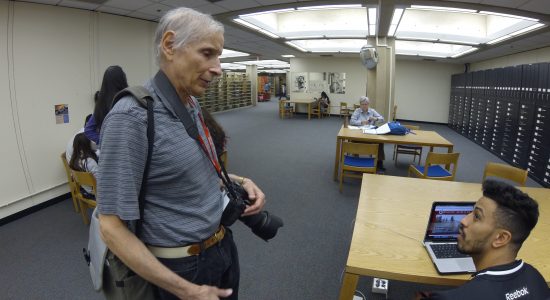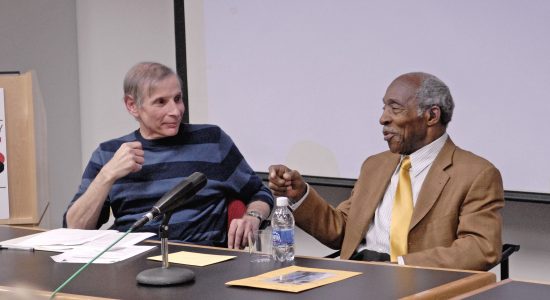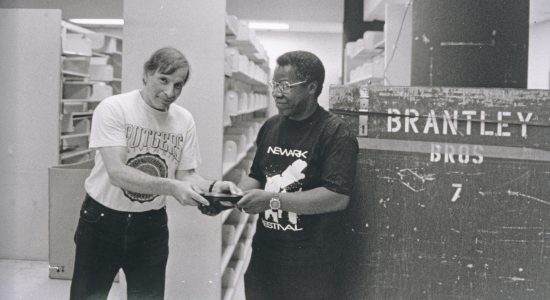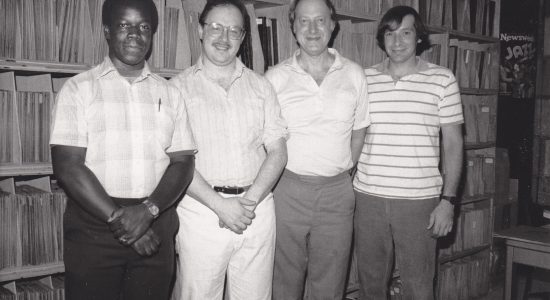
Rutgers-Newark students show their support for Dana Library. Credit: Ed Berger.
Dana Library had some little red boxes from the Giving Day planning team to distribute. Credit: Ed Berger.
Dana Library had a table set aside for Giving Day activities. Credit: Ed Berger.
Dana Library had a lot of support throughout the day. Credit: Ed Berger.
Consuella Askew stands in front of the Giving Day board where Dana Library tracked their leaderboard stats. Credit: Ed Berger.
One last student support sheet photo from Dana Library. Credit Ed Berger.
We couldn’t agree more — Dana Library is a place to get stuff done! Credit: Ed Berger.
An informal bulletin board showcased all the support sheets. credit: Ed Berger.
Dana Library gathered support sheets from students. credit: Ed Berger.
More medical students showing their support for the RBHS Libraries!
Smith Library had steady traffic throughout Giving Day.
The table at Smith Library was in a prominent location right near the front door which made it hard to miss!
What a great display for the support sheets and a self-serve station.
The display of support sheets in Alexander Library’s lobby.
Prior to Giving Day, we got these photos for our social media campaign to show donors what they are giving to support.
Nice to see our faculty and staff lending a hand to make Giving Day a success!
We had dozens of photos of students showing why they care about the Libraries!
Thanks to all of your efforts and support, the Libraries greatly exceeded our goals for Giving Day this year. Last year, we had 22 donors and our goal this year was to slightly more than double this with 50 donors. We blew our goal out of the water with 134 donors and the Libraries are on the Top Ten leaderboards for both Rutgers-Newark and Rutgers-New Brunswick. We raised a total of $13,375.00. Here are the specifics for each location:
#11 – RBHS Libraries, 6 donations, $300.00
#12 – Camden Libraries, 10 donations, $170.00
#7 – Newark Libraries, 18 donations, $1433.00
#9 – New Brunswick Libraries, 100 donations, $11,472.00
This banner ran on Instagram on Giving Day.
The figures above may shift slightly as the Foundation does their final accounting, but clearly, we did a great job!
Thank you to everyone who took time to set up donation computer stations or to sit at tables and solicit support sheets and donations in their libraries. I hope you all had a chance to see the fantastic social media campaign we ran on Twitter, using many photos of our real students and colleagues sounding off on matters most to them. Matt Badessa also created our first Instagram banner/photo grid.
If you have photos of Giving Day at your location, send them to jessica.pellien@rutgers.edu and I’ll add them to the slideshow!
Grace Agnew, associate university librarian for digital library systems , photo credit: Isaiah Beard.
Rutgers University Libraries is a key part of a team that won a $4 million grant to establish a regional data-sharing network called the Virtual Data Collaboratory. This is a huge grant that involves other departments at Rutgers University, as well as several regional university partners. We shared a press release about this initiative on our website in October, but I recently sat down with Grace Agnew who is coordinating the Libraries’ participation, to get a better sense of what it means for the Libraries and for Rutgers.
Jessica Pellien: You are part of a team that has won a multimillion dollar grant from the National Science Foundation. What is the grant for?
Grace Agnew: The grant will build an infrastructure where research data created at Rutgers and other collaborating universities can be stored, discovered, and reused. Rutgers is among the nation’s top 20 public universities in terms of obtaining research grants and number 7 among Big Ten universities, yet the university lacks a cohesive strategy for efficiently managing research data. Research data often ends up silo-ed in individual departments where it is not easily discovered and reused. Also, because we do not have a shared infrastructure that can be easily repurposed, financial and personnel resources that could be dedicated to the research itself are instead expended on duplicating infrastructure that exists in silos around Rutgers. A large scale research data infrastructure is critical for Rutgers to continue to advance as a research institution, which is part of the university’s three-fold mission.
JP: This grant involves many units at Rutgers and other regional universities. What role will Rutgers University Libraries play?
GA: The Libraries are uniquely positioned because we engage with and support Rutgers users across the spectrum, from incoming first year students to faculty members engaged in groundbreaking research. What we bring to the table is understanding and representing user needs. We are tasked with designing the data services layer which is the user-facing part of the project. Our design encompasses adding, discovering, and reusing data. We took a unique approach to ensuring the discoverability and reuse of data by designing an interface that links data with the person who created it, the tools used to analyze it, and the intermediate research products–analyses, reports, etc.–that are created around the data before the peer-reviewed publications begin. In other words, we designed a strategy that not only supports the workflow of the researcher but helps other researchers, perhaps in other disciplines, understand the context of the data and how it is used, as part of the discovery process. We will work with the lead department, Rutgers Discovery Informatics Institute (RDI2) to implement the data services layer according to our design. In addition to myself, Ron Jantz is helping to design the architecture for the data services layer and Ryan Womack will be working closely with the two use cases, the Protein Data Bank with Helen Berman, Center for Integrative Proteomics Research at Rutgers and Vasant Honavar of Penn State and with Jie Gong. Civil and Environmental Engineering at Rutgers, to ensure that the design of the data services layer meets their research and workflow needs. Other librarians involved in the data services design are Karen Estlund at Penn State and Joe Lucia at Temple University.
JP: So, what is the Virtual Data Collaboratory?
GA: The Virtual Data Collaboratory is intended, ultimately, as a “one stop shop” for the storage, discovery and reuse of data. It is immediately collaborative because we are building parallel facilities at Rutgers and Penn State. Other participating universities in Pennsylvania, include Drexel and Temple. The VDC will ultimately be available to other universities in both states through the Internet2 high speed networking facilities, KINBER in Pennsylvania and NJEdge in New Jersey. The term collaboratory references both the universities involved in the design, as well as the opportunities for collaboration that the data services layer will promote. The VDC is also designed to bridge to existing collaboratories, such as the Protein Data Bank, so much of the data in the VDC will be “virtual” because they exist in other collaboratories but are accessible via the VDC.
JP: There are existing places to store data. What will distinguish our effort from others?
GA: Other universities have collaboratories. We believe the VDC has a unique focus on both robust storage and preservation of data and a user focus on multidisciplinary discovery and reuse of data. Also, the existing places are largely single university initiatives or single discipline initiatives. They are very well designed and very supportive of their users, particularly those with a disciplinary focus. The VDC will work with existing facilities and will bring new users and increased impact from other disciplines through bridges to those facilities.
JP: You note that the VDC will integrate with other regional and national efforts. Can you paint a picture of what this actually means for your average researcher? If I am a scientist doing research on X, how would VDC help me?
GA: VDC is leveraging the technologies already funded in the NSF DIBBS initiative, so the design is inherently collaborative with other large scale data facilities. What the VDC will provide is an infrastructure that the researcher can use to ensure her data is preserved, is accessible, and can be analyzed and reused by the researcher and by others. Currently, researchers at Rutgers have to build an infrastructure according to granting agency requirements to ensure that data is preserved and made openly available to others or they can deposit in disciplinary repositories. Once deposited in a disciplinary repository, the researcher generally cannot continue to work with the data, unless the data is downloaded for use. VDC is envisioned as a workflow-oriented repository with a suite of tools for reusing data and the ability to store and link data products, such as analyses, which otherwise reside on the researcher’s local server or desktop. So the VDC is somewhat unique in designing full integration in merging storage and working space for the active scientist.
JP: Will faculty and researchers at non-participating universities have access to the VDC?
GA: It is open to everyone for discovery of data. I don’t think policies for membership in the collaboratory have been developed yet. Membership enables you to upload your data, use tools, etc. The Advisory Board will assist with the development of policies for membership.
JP: When will the VDC be available?
GA: This is a four year grant that began in September 2016. The goal is to use agile methodologies to build a prototype and layer on functionality, so hopefully there will be something real to show early in 2018.
So there you have it, the team behind the VDC is already hard at work. Currently, their focus is on designing a collaboratory for sciences, though Grace was quick to point out that social sciences and humanities wouldn’t be turned away if they were interested.
When it is completed, the VDC will meet or exceed requirements for open access data management by granting agencies and will be a tremendous accomplishment for Rutgers.
We’re all attending lots of videoconferences and there are ways to make the experience better for both the host and remote sites. Here are some tips to insure everyone can see, hear, and participate regardless of where they are.
Courtesy and empathy are the key factors of a successful video conference. Hosts and participants at the host site are responsible for removing all barriers to participation for remote attendees. Remote attendees need to be engaged and inform the host if they encounter any difficulties in their abilities to participate.
Host:
Please share any documents remotely at least one day before the scheduled meeting. All participants need to have all documents that will be discussed and it can disenfranchise participants at a remote location to hand out and discuss materials only to those physically present in the room.
A few minutes before the meeting starts do an audio-visual check with participants at the remote sites.
Check the placement of the furniture and positions of the participants at the host site. Everyone should be facing the screen and should be able to be seen and heard by the Video conferencing attendees.
Host should begin the meeting by going around the table and clearly identifying the people in the room of the host location. Host should also greet teleconferencing participants.
Check with the remote attendees throughout the meeting to see if they have questions or comments.
If “pushing screens” make sure to return to room view ASAP so that remote attendees can once again see their colleagues and join the discussion. If during a presentation a lengthy discussion ensues switch back to room view to bring the remote attendees back into the conversation.
Attendees at Host Sites:
Speak clearly and audibly. Be aware of the position of the microphones in the room.
Be aware of the line of sight of remote colleagues.
Refrain from noise near the microphones such as tapping and paper shuffling.
Attendees at Remote Sites:
Arrive several minutes early for an audio-visual check and to confirm connection.
Alert the host ASAP to any audio-visual problems.
Mute the microphone when not speaking to diminish distracting noise.
Upon leaving take leave of the host and the other participants.
If unable to attend, let the host know ASAP so as the meeting is not broadcast into an empty room.
Richardson, Nicole Marie. Inc. “11 Dos & Don’ts of Video Conferencing Etiquette.” January 13, 2011. Available http://www.inc.com/ss/video-conferencing-best-practices.
President Robert Barchi adjusts a tallcase clock in the Rutgers University Libraries Special Collections and University Archives.
A couple of weeks ago, Special Collections and University Archives hosted a special visitor — President Robert Barchi.
A big fan of tallcase clocks (AKA grandfather clocks), President Barchi saw all of four of the clocks in SCUA’s collection and even took a moment to perform an on-the-spot repair to an early nineteenth-century clock that was donated by the family of Wallace Todd Eakins (1889-1968), RC’11. After a quick adjustment, the clock was once again happily tick-tocking away.
In honor of this visit, we’re proud to highlight this collection of tallcase clocks. Read below for photos of the beautiful clock faces and information about their provenance and donation.
Movement: 8-day clock; square clock face not signed
Case: intended for a (later) clock movement with an arched clock face; attributed to Nicholas Williamson Parsell (1797-1877) by the donor and is likely the same clock cited by Margaret E. White in Early Furniture Made in New Jersey, 1690-1870 ([Newark, N.J.]: The Newark Museum Association, c1958): “A tall clock with case attributed to Nicholas Parsell is owned by Catharine Schneeweiss.”
Location: Special Collections and University Archives reading room (behind sign-in desk), Alexander Library
Donor: Ralph Heyboer (1918-2011) of Linden, New Jersey
Provenance: movement created in 18th century; case created in 19th century; evidently owned at one time by Catharine Hardenbergh Schneeweiss (1893-1977), the daughter of Henry P. Schneeweiss; per donor: “from estate of Henry P. Schneewiess family”
Note: per Somerset County Historical Quarterly (vol. 8): Nicholas W. Parsell had a daughter Mary who married F.M. Schneeweiss, the father of a Henry Schneeweiss. Per Rutgers University Biographical Files: Alumni (Class of 1877): Henry P[arsell] Schneeweiss (1856-1930), who served as the treasurer of Rutgers from 1915 to 1928, was the son of Franz Maxmillion Schneeweiss and Mary (Parsell) Schneeweiss. He married Mary Cornelia Hardenbergh, a descendant of the first president of Queens College [now Rutgers University], and resided at 56 College Avenue at the time of his death.
Received: 1992; acquired, from the same donor, with other items (e.g., monogrammed china, said to be from the Parsell family, and a mahogany secretary bookcase) identified as having the same provenance
Movement: 8-day musical clock; arched clock face not signed, but movement perhaps by Leslie & Williams, per similar musical clock at Monmouth County Historical Association [see: William E. Drost, Clocks and Watches of New Jersey (c1966)]
Case: Federal era; includes linear inlay; attributed to Matthew Egerton, Jr., New Brunswick, N.J., per similar clock cases with cabinetmaker’s labels [in addition to Drost, see, for example: “Silver Jubilee Exhibitors,” Antiques, LX (October 1951)]
Location: Special Collections and University Archives office area, Alexander Library
Donor: G. Willard Quick (1892-1970) [bequest]
Provenance: per donor: belonged to Tunis Quick (1762-1836), Readington Township, Hunterdon County; per donor’s widow: “moved from the Quick home in Hunterdon County, New Jersey to Loudon County, Virginia, in 1871”
Note: Also per donor’s widow: “Restored to its present condition and put in running order, early in 1940.” Weights augmented at this time?
Received: December 1987 [from Florida, evidently following the death of the donor’s surviving spouse]
Movement: 8-day clock; presumably by “J. Martin & Son, New York” as stated on the arched clock face
Case: Mahogany?; maker unknown
Location: Clifford P. Case Room, Special Collections and University Archives, Alexander Library
Donor: Wallace Todd Eakins (1889-1968), a member of the Rutgers College Class of 1911 [bequest]
Provenance: created about 1825; “the Eakins family grandfather clock” per donor
Received: destined for or received in Special Collections by March 1970
Movement: 8-day clock; arched clock face signed by retailer (Tiffany & Co.), but movement itself (likely to name a maker such as Korfhage) not examined
Case: likely German
Location: Special Collections and University Archives reading room (between windows), Alexander Library
Donor: per small metal plaque: “Presented by the Class of 1903”
Provenance: created about 1900; per Hand-Book of the Grounds and Buildings . . . of Rutgers College ([New Brunswick, N.J.]: The College, 1904): “presented to the College on Class Day, June 16th, 1903, on behalf of the Class of 1903. The clock is a large ‘grandfather’s’ clock, in an oak case, and is the work of Messrs. Tiffany & Company. It is placed in the reading room of the Ralph Voorhees Library” [a building dedicated in 1903]; presumably transferred to new library building [now Alexander Library] about 1956; in Libraries’ central administrative offices immediately prior to 2016 transfer to Special Collections and University Archives
Retirement is defined as “withdrawal from one’s position or occupation or from active working life”. Retirement is the goal most employees look forward too. Others not so much. There are a lot of decisions to make and for many the process can be daunting! Educating yourself on this important process is extremely important. To help explain the vital steps, please take note of the following info below:
1.) Attend a retirement seminar here at Rutgers
Retirement seminars are offered through UHR: You can register for a session through the UHR Learning and Development Course Registration System under the Human Resources Development tab: https://hrservices.rutgers.edu/crs/ then Employee Benefit and Work Life Programs drop down
PERS members – Tuesday, December 6, 2016 -10-NOON
ABP members – Wednesday, January 25, 2017 – 10-11:30
2.) Review accumulated leave balances (must take all accumulated leave prior to retirement date) with supervisor or Libraries HR to figure out last physical day at work
3.) Choose a retirement date (must be 1st of the Month)
4.) Write a brief letter to advise your supervisor of your retirement plans, making sure the letter includes your retirement date (i.e. 3/1/2017) and last physical day at work
5.) Complete and submit PERS or ABP pension paperwork to UHR
6.) Libraries HR finalizes retirement and confirms pension paperwork completed
Interaction of Color on display at Rutgers Art Library. Photo credit: Megan Lotts.
Rutgers Art Library recently unearthed a 1963 copy of a book by Josef Albers, Interaction of Color. The 1963 copy is special, in part, because of its size and format. It was, according to Yale University Press, originally published “as a limited silkscreen edition with 150 color plates.” There were only 2000 original copies made and they sold out quickly. Some copies of this valuable book have made it to auction in recent years.
Following this limited run, Interaction of Color was released in smaller format books (shown in the photo above is art librarian Megan Lotts’ version from the 1990s) and eventually an app from Yale University Press.
The book was on display at the Art Library as part of the launch for the coloring book and will be put to good use in several courses in the spring, according to Lotts.
“I personally feel that this is a spectacular example of the evolution of a book, and will definitely be showing this off to my Byrne seminar in the spring, as well as the Color classes out of Mason Gross Visual Arts. I’ve been fortunate to show this book off to many people from the Zimmerli, MGVA, and arts enthusiasts since we have found it. This book really leaves a lot of mouths dropping.”
Back in August, Instagram announced a new feature called Stories. Similar to their counterparts on Snapchat, Instagram stories allow users to create a “slideshow” of images and/or videos that is viewable for 24 hours before disappearing.
As is suggested by their name, stories allow you to shape a narrative around your subject in a way that a single image or video may not.
Much like Snapchat stories, Instagram stories are well-suited to capturing action as it is happening. This allows you to leverage the “fear of missing out” to generate excitement around your programming.
When you post or update a story, your account appears in a list that runs across top of others’ Instagram feeds. This extra visibility is a welcome boon given recent changes to the platform’s timeline algorithm.
You can experiment with the story-based approach to social media without having to build a new audience from scratch on a different platform.
Cons
While you can download your story content to your camera roll as it is published, the preferred portrait orientation makes it difficult to repurpose your content elsewhere. Shooting in landscape orientation requires your viewers to either turn their heads awkwardly or rotate their phones, an inconvenience that puts your content at risk of being skipped over.
The 10 second limit on video clips presents some challenges. For example, a speaker’s comments can easily run over and get cut off, necessitating additional takes.
Viewing statistics disappear along with the image or video they are attached to, complicating assessment.
Instagram’s story editing tools (basic text and drawing) are limited compared to Snapchat’s, especially its robust filter system.
Next Steps
Identifying more story opportunities to allow for additional testing. (If you have any ideas, please get in touch!)
Incorporating stories into the Instagram content schedule.
Formalizing the procedure for recording and reporting story viewing statistics.
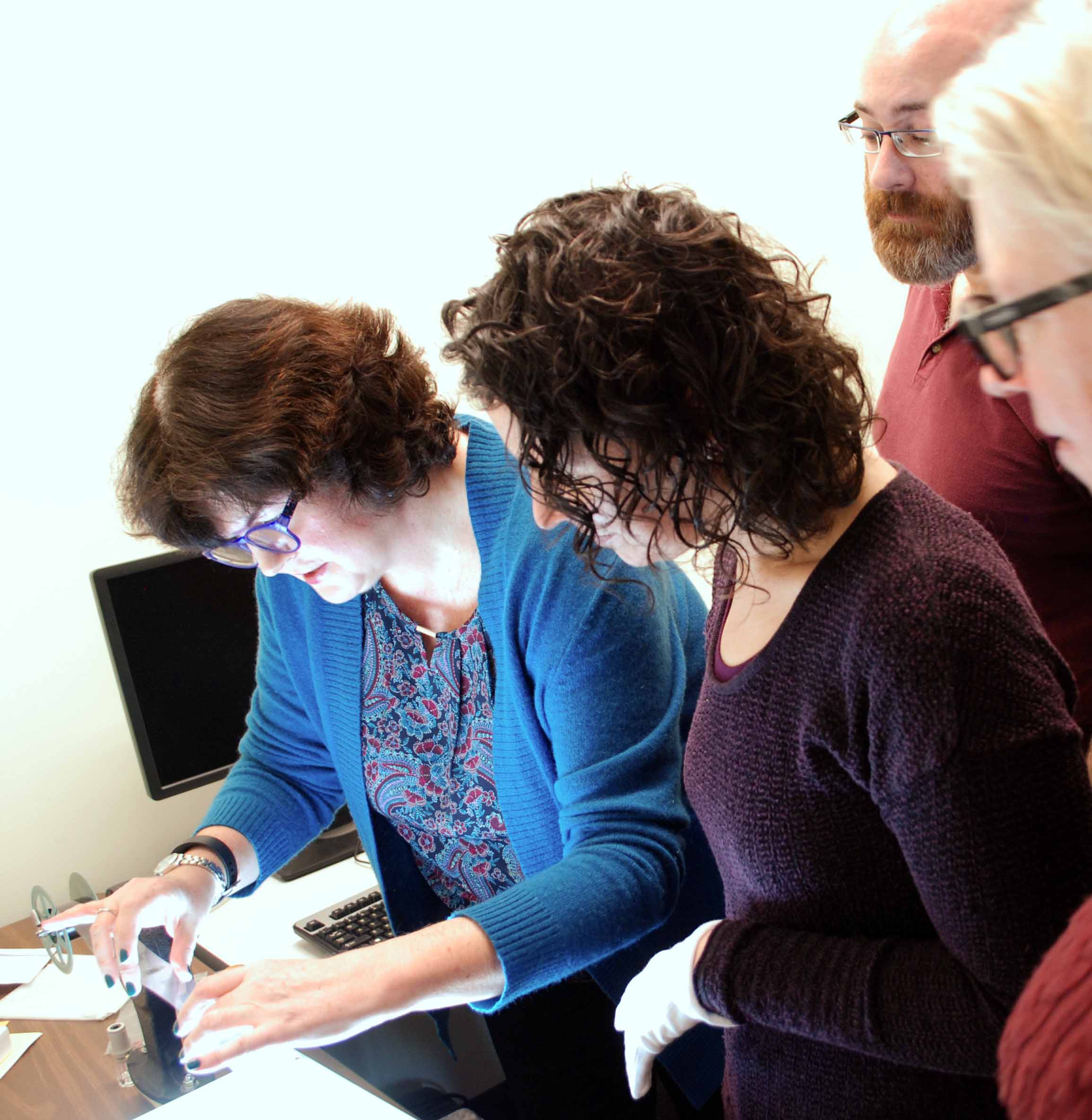
Ben Knysak, left, of RIPM and assistant Gabriel Caballero scanning 1930s issues of Down Beat in October. The effort at IJS is part of an international project to digitize music publications going back to the eighteenth century. Photograph by Mark Papianni.
For two weeks in October, the Baltimore-based research center RIPM set up a scanner in the reading room of the Institute of Jazz Studies. The main objective was scanning the first few years of the venerated magazine Down Beat and a few others of the hundreds of jazz, pop and related periodicals and journals collected by IJS since its founding in 1952.
RIPM (Retrospective Index to Music Periodicals) was founded in 1980 by H. Robert Cohen at the behest of the International Association of Music Libraries (IAML) and the International Musicological Society (IMS). The goal was access to some 5,000 international music journals and publications published from 1760 through the 1960s.
“The goal was to create access to journals both for historians and lovers of music,” said Benjamin Knysak, managing associate director of RIPM. “Through these publications, people can put themselves in places where music history happened.”
Knysak said digitizing jazz periodicals face some of the same issues as other periodicals. Some issues are more unique to jazz, such as relative scarcity.
“Many jazz journals are very rare sources of documentation,” he said. “They may have been printed in the limited numbers and had limited distribution because they were not published by large corporations. Many were published by individuals: musicians, aficionados, critics and collectors.”
In many cases, RIPM has tracked down those solo publishers or their heirs who he said have been uniformly thrilled to have their labors of love preserved for posterity.
The Jazz Database will be online in 2017. It will provide fully searchable text and photos based on technology developed by RIPM.
Knysak hopes the relationship between RIPM and the Institute will continue for many years.
“IJS is amazing, simply amazing,” Knysak said. “The breadth and depth of publications held there is unique. We are honored to work with the collection and wonderful colleagues.”
“For many years jazz researchers have been dreaming of having the kind of access to the jazz periodical literature that RIPM will be providing,” said IJS director of operations Vincent Pelote. “I am both proud and happy to have had a part in making that happen.”
In addition to Pelote, associate director Adriana Cuervo and collections manager Elsa Alves are coordinating the project on behalf of the Institute.
On October 9, Capetown Mayor Patricia de Lille was feted during a reception at Clement’s Place, a new jazz venue operated by the Institute of Jazz Studies and the Office of the Chancellor of Rutgers University-Newark. From are Newark Mayor Raz Baraka, de Lille, City Council President Mildred Crump, Linda Juma, and IJS Executive Director Wayne Winborne. Photograph by Bronwyn Douman.
The recent visit of Cape Town, South Africa Mayor Patricia de Lille furthers a relationship to the Institute of Jazz Studies that began in June when IJS Executive Director Wayne Winborne paid a two-week visit to the city.
De Lille arrived in Newark on October 9 and went immediately to a dinner reception held at Clement’s Place. There she was greeted by city officials–led by Mayor Raz Baraka and City Council President Mildred Crump–and Rutgers-Newark Chancellor Nancy Cantor. Music was provided by a sextet led by drummer T.S. Monk, son of the legendary pianist and composer Thelonious Monk. The following morning de Lille attended a breakfast in the Special Collections Room at the Dana Library.
Winborne said de Lille’s visit to Newark was one stop in a tour that also included New York, Los Angeles, and Atlanta. Among the topics of discussion were democratic institutions, civil society, and jazz.
On his trip to Cape Town, Winborne was dazzled by the diverse music scene he encountered. He visited such local clubs as The Crypt, The Drawing Room, and Straight No Chaser, and met with musicians, students and educators at the University of Cape Town and the University of Western Cape Town.
“I heard everything from straight ahead jazz to South African to pop-oriented fusion,” said Winborne. He also pointed to the success of the Cape Town International Jazz Festival which has brought in such mainstays on the American jazz scene as pianists Chick Corea and Herbie Hancock and saxophonist Gary Bartz as well as well-known local and regional musicians.
Winborne might return to Cape Town as early as January to meet with the mayor, as well as the regional minister of culture to set up some exchange programs between IJS and the city. He predicts IJS will host performances of South African musicians.
Cape Town jazz enthusiasts have already spoken to him about their interest in establishing an archives there to preserve the history of the music. This may result in workshops given by IJS staff members to help get the project off the ground.
“I think this idea has huge potential,” Winborne concluded.
Sixty years ago Hungary was in revolution against the one-party Communist state. Soviet armed forces entered Budapest to restore order, then withdrew in the face of stiff popular resistance. Prime Minister Imre Nagy announced a multi-party government and declared the country’s withdrawal from the Warsaw Pact alliance. This prompted a second Soviet intervention, the ouster of the Nagy government, and the flight of 200,000 Hungarians who feared the Communist crackdown and took advantage of an open border.
These many years later, post-Communist Hungary’s conservative government is inclined to celebrate the Revolution as a rejection of everything the Soviet regime represented. Meanwhile, the current government is confronting the European Union over the EU’s proposal that member countries be required to accept refugees according to a quota. On this issue, the government organized a national referendum for October 2 and is dominating the media with stories about the refugees entering Europe today and the need to reject the EU proposal. Scholars and opponents of the government are proposing different views of both the socialist character of the Revolution and the humane reception of refugees, then and now. I gave a paper (in Hungarian) at an exciting conference in Eger, Hungary on September 8-10: 1956 and Socialism: Crisis and Reconsideration.
The Hungarian Academy is one of many organizations that encourage their scholars to make their research freely available. It is helped in this effort by the strong position of authors in the Hungarian publishing system: copyright transfers are not standard as in the US when publishing in a journal. Therefore, the editor of Világtörténet immediately assured me there was no obstacle to my posting the English original of my article—and the Hungarian translation when it is available—in the Rutgers institutional repository. Now the English version is available online in SOAR and accessible for readers in Hungary, with the Hungarian version soon to follow. SOAR’s ability to accommodate multiple versions of the same article is ideal for situations requiring prompt dissemination and different languages.