Category: Feature

  • Books That Heal: Reading for Recovery Project completed

    Some of the titles highlighted on the R4R @ Rutgers Libguide.

    In December, the Center of Alcohol Studies Library completed Reading for Recovery (R4R), a two-year ALA-funded project. Judit H. Ward formerly of CAS Library and now Reference & Instruction librarian at LSM was Principal Investigator for the project. The central hub of the project deliverable is already available at: http://libguides.rutgers.edu/R4R. Here, she describes the project and explains what information is available on the libguide.


    As traditional gatekeepers of alcohol literature in the oldest institution related to substance abuse in the United States, the Rutgers Center of Alcohol Studies (CAS) Library applied for this grant with a noble ambition in mind: they wished to connect those affected by addiction to helpful and inspiring books by developing an authoritative and easily accessible resource for bibliotherapy, clinical practice, and education.

    In its modern application, bibliotherapy has been used to treat a variety of disorders, including insomnia, anxiety, obsessive compulsive disorder, and addiction, and it has shown promise for use by both children and adults. Moreover, there is great variety in how bibliotherapy is performed, with some readers working directly under the supervision of their doctor or counselor, while others choose to pursue an entirely self-directed course of treatment. R4R also endorses book clubs that are organized or supported by public libraries, providing ample resources on how to lead book discussions.

    Based on the established selection criteria, R4R has accomplished its primary goal of providing discoverability of titles hidden on the shelves of public libraries for potential readers. The three different R4R platforms, LibGuides, LibraryThing, and Goodreads, provide an opportunity to fill the gap between the selected titles and their readers and to reach as broad an audience as possible.

    A Guide to the Information in R4R @ Rutgers: Reading for Recovery Libguide:

    Three tabs address the three main user groups (i.e., librarians, addiction professionals, and readers in general). Each tab contains several subpages available via pull down menus. Content was collected and organized throughout the entire project for these tabs, covering all areas the project intended in its directives.

    Besides promoting bibliotherapy resources and providing book lists, a popular feature at the Libraries’ State of the Libraries poster display and other conference displays is the collection of supplementary materials, such as word documents, .pdf files, templates, and links to resources that could make the daily work of a public librarian easier. These are in the For Librarians section, under the title Download & Share. At the suggestion of our public librarian member, the R4R team put together its own collection of discussion sheets, bookmarks, and fliers to facilitate book clubs and reading books solo, in addition to collecting and sharing similar resources from other public libraries and publishers.

    Under the For Addiction Professionals tab, a page highlights current information on scholarly resources. In addition to books, recent scholarly articles are also showcased. Material related to twelve step programs are also included, with credits to Alcoholics Anonymous where appropriate. Promoting bibliotherapy for addiction with the help of the appropriate books, training options, and media coverage, this section guides those wishing to turn their personal experience with addiction for the benefit of others via training to become counselors, a significant potential user group in our experience.

    The needs of R4R’s main but hard-to-reach audience are addressed on the For Readers pages detailing the potential benefits of bibliotherapy. The pulldown menu provides select material, organized by genre or audience, with a widget linking to the broader LibraryThing and Goodreads pages for further browsing.

    Conclusion:

    As explained in the final report to ALA, it is fitting that the ALA Carnegie-Whitney Grant supported the final project undertaken by the Center of Alcohol Studies Library. It was a grant from the Carnegie Corporation in 1938 that funded the original project designed to index and organize the entirety of scientific alcohol literature, known as the Classified Abstract Archive of the Alcohol Literature (CAAAL). CAAAL would later serve as a foundation of the institution that would become the Center of Alcohol Studies. Taking inspiration from CAS founders E. M. Jellinek and Mark Keller, broad thinkers instrumental in the design and structure of both the CAAAL project and the CAS, the Reading for Recovery (R4R) project extends this spirit, spanning broader literary, cultural, and philosophical arenas in order to reach populations most vulnerable to substance use.


    Save

    Save

  • Do not fall for phishing!

    Spam and phishing messages are pouring into our inboxes almost every day. Some of these messages cleverly mimic the look and feel, and in some cases naming conventions, of trusted sites, leading people to accept the legitimacy of the messages.

    Rutgers Connect email administrators in the Office of Information Technology have put powerful filters in place to keep the number of incoming malicious messages low, but it is impossible to completely eliminate them. The messages sneaking in past the filters entice you to click on links/attachments or to reveal confidential information about yourself (NetID and password, date of birth, SSN, etc.). Clicking on a link or opening an attachment may install malicious software on your computer, or steal the data entered in good faith to use it later for criminal gain, like illegal downloading research content the Libraries are paying for – or worse.

    Recognizing and avoiding spam/phishing messages minimizes your chances of becoming a victim. The following are some tips that will help you identify such attempts:

    • Look for spelling and grammatical errors
    • Look for suspicious links and/or the sender’s email address
    • Do not click on links in an email to connect to a website unless you are sure that the link is authentic.
    • Hover with your mouse to reveal the actual URL.
    • Do not reply.
    • Look for unusual/generic-looking requests
    • Fraudulent emails are often not personalized.
    • Be wary of emails asking for confidential information. Do not disclose sensitive information in response to an email you don’t know where it is coming from. Phishers like to use scare tactics and may threaten to disable your account or delay services until you “update certain information.”
    • Do not open attachments in any suspicious email messages.
    • Make sure you are keeping your computer’s security software up to date.
    • IIS sends out a reminder on last Wednesday of each month to download and install Windows security updates. Please be sure to install them immediately.

    Here is an example of a recent phishing attempt. Can you spot a few clues?

    • “i” is missing from President Barchi’s last name in the “From” address
    • Suspicious “mailto” email address
    • Unusual formatting of the greetings line
    • Poorly written message body: “president bill nash” indicates lack of attention to detail. Not capitalizing title and name gives away sloppy authoring skills.
    • Poor English: “All staffs are advised to go through.”

    If you are uncertain about the legitimacy of an email, ask your local UCS or IIS to confirm the authenticity. If you have clicked on a suspicious link, or have provided your confidential information, call IIS immediately at 848-445-5896 #7.

    Save

    Save

  • Duck Decoys, Fly Fishing Flies, Abdominal Procedures, and New Jersey Medical History: The 2017 MHSNJ Lunar Society Meeting

    • Click image to view full version.
    Edgar Burke
    Dr. Edgar Burke in his penthouse apartment at the Jersey City Medical Center.

    On February 8, 2017, the Medical History Society of New Jersey (MHSNJ) and Rutgers University Libraries co-hosted the MHSNJ’s fifth annual Lunar Society winter meeting, held in the Pane Room at Alexander Library. Over 30 MHSNJ members, surgeons, librarians, and even an art history graduate student attended.

    Not only was the meeting a series of three presentations about New Jersey medical history, it was also an art show. On display prior to the formal program were a selection of small paintings (mostly 4” x 4”) of surgical procedures and anatomical structures created by Dr. Edgar Burke (1890 – 1950). A longtime surgeon at the Jersey City Medical Center, Dr. Burke was also an artist of considerable skill. His realistic paintings of wildfowl, duck decoys, and fly fishing flies were published in several books in the 1930s and 1940s, and sell at auction to this day. Last spring, RBHS – Special Collections received a donation of over 800 previously unknown Burke medical artworks. These were the gift of Mr. and Mrs. James Neumeister, the son-in-law and daughter of Dr. Burke’s last surgical resident. While Dr. Burke undoubtedly used these paintings in teaching and in his own surgical practice, this Lunar Society event was likely their very first public exhibition.

    In my presentation, I discussed Dr. Burke’s biography (such as is known – he seems to have been a rather private person), archival challenges in preserving and describing his artworks, and potential uses of this unique collection by medical and surgical historians, and perhaps even art historians.

    I was followed by Dr. Theodore Eisenstat of Robert Wood Johnson Medical School, who provided a surgeon’s perspective on Dr. Burke’s paintings. Both of our presentations were enhanced by digitized images of Burke’s artwork, produced in the Digital Curation Research Center with the support of Isaiah Beard and James Hartstein.

    The meeting’s final presentation was by Dr. Linda Whitfield Spinner, an authority on the history of medicine in Middlesex County. She discussed the role of women in the formation of two early New Brunswick hospitals. Founded in 1884 with support from Mrs. Grace Wells and other local women, the New Brunswick City Hospital became the John Wells Memorial Hospital, which later became Middlesex General Hospital and is now Robert Wood Johnson University Hospital. The Sisters of Charity of the Order of Grey Nuns of Montreal were instrumental in establishing St. Peter’s Hospital in 1907.

    Following the presentations, many attendees enjoyed lunch and fine conversation at the  Rutgers Club. The next meeting of the Medical History Society of New Jersey will be held in May, at the Nassau Club in Princeton.

  • Another hidden gem in our rare books collections

    Another hidden gem in our rare books collections

    A request from the Spinoza Society sent us into the stacks in search of Baruch Spinoza’s René Descartes’ Principiorum Philosophiae. The Dutch philosopher’s response to René Descartes’ ontological arguments concerning substance (dualistic views that Spinoza, arguably a pantheist, sought to correct) was the first and only work of his to appear in print bearing his name, and Rutgers University Libraries’ copy, published in Amstelodami by Johannem Riewerts, is from the first edition. What particularly interested us was the binder’s waste on the covers, which clearly belonged to an early printed book.

    It was a practice of book binders, dating back to the Medieval Period, to use whatever paper they had to hand to reinforce the strength of and to decorate a book’s covers. The paper covering the Libraries’ Principiorum Philosophiae included scribal marks (rubrications) and type that resembled the Roman types in other volumes in our rare book collection (specifically, in our copies of Nicolas Jenson’s Suetonius, and Vindelinus’s letters of Francesco Filelfo. It seemed highly possible that we had discovered leaves from an incunabulum we hadn’t recorded in our archives, but what we actually had proved to be even more exciting.

    Working with our rare book cataloger, Silvana Notarmaso and Jeroen M.M. van de Ven, a postdoc researcher at Utrecht University in the Faculty of the Humanities, Department of Philosophy and Religious Studies, we determined that the leaves had once belonged to the editio princeps (first edition), of Aristotle’s De animalibus, a notable work in the history of Western philosophy inasmuch as it incorporates Aristotle’s thinking about the natural world, represents the first work on animal physiology, the first text on embryology, and includes a lengthy and quite graphic discussion on generation—with which Silvana notes our leaves are specifically concerned. Moreover, in identifying and classifying groups of animals and in explicating their functioning as a part of nature, Aristotle provided the basis for his philosophical analyses of relationships between structure, function, and purpose. De animalibus epitomizes Aristotle’s organizing principle.

    Of course, we don’t know whether the binder of the Libraries’ copy of René Descartes’ Principiorum Philosophiae intended or even realized the intellectual connections he was drawing between cover and text (or the graphic nature of the reproductive passages), but Aristotle’s interest in relating natural specimens to a holistic system conceptually anticipates Spinoza’s central concern in his text, describing materiality and material objects as but modes of substance. Regardless of the binder’s intent or interests, we may claim that the Libraries’ Spinoza is one of those rare instances in which one can tell a book by its cover.

    The Rutgers De animalibus (such as it was) was published in Venice by Johannes de Colonia and Johannes Manthen in 1476, a work translated by Theodorus Gaza and edited by Ludovicus Podocatharus. The printers Johannes de Colonia and Johannes Manthen were German merchants-turned-printers who acquired their printing material from Venice’s first printer (also a German immigrant), Vindelinus de Spira in 1473, during a slump in Venetian printing. Along with Nicolas Jenson, Colonia and Manthen dominated the highly-competitive Venetian printing business during the 1470s, producing 86 editions from 1474 to 1480, and merged their business with his in 1480. Intact copies of this edition of De animalibus are rare and highly valued. The last copy to go up to auction in 1998 sold for $96,000. While the Libraries own extraordinary samples of early Venetian printing in the form of intact works by Vindelinus, Jenson, and Aldus Manutius, these leaves are (as far as we know) the lone examples of work by Colonia and Manthem in our collection.

    Note: The specific leaves covering the Libraries’ copy are from book 7, chapters 4 and 7 (sigs |1v, |2v,  |3v and |4v).


    Michael Joseph

    Rare Books Librarian

    February 2017

  • Quick Takes on Events and News — February 2017

    Records at Play: The Institute of Jazz Studies @50

    A new exhibit of materials from IJS titled Records at Play: The Institute of Jazz Studies @50 is the inaugural exhibit in the Paul Robeson Galleries at Express Newark ( 54 Halsey Street, Newark, NJ 07102). On display through the end of the calendar year, this will be the first time the IJS has exhibited so many of its treasures at once. Although they represent only a small fraction of the Institute’s collections, the artifacts, documents, and sound recordings in this exhibit provide a record of IJS history and the music at its core.

    From the Boarding House to the Board Room: 250 Years of Women at Rutgers

    The Libraries collaborated with multiple university partners on the documentary “From the Boarding House to Board Room:  250 years of Women at Rutgers” by award winning filmmaker June Cross which was shown last October. Kayo Denda just received notice that the YouTube video for the panel discussion following the film screening is now available.

    About “From the Boarding House to Board Room”: Rutgers was founded in 1766 to educate young men, and so it remained for the first 152 years. Yet from the beginning women played vital but unrecognized roles. This film, directed by award-winning filmmaker June Cross and produced by the Institute for Women’s Leadership consortium, highlights the multiple layers of Rutgers’ ongoing transformation – from the campaign to create a separate, co-ordinate women’s college to the first female students to enter Rutgers College. While Rutgers’ story is distinctive, it is also universal. The film considers the radical transformation of higher education and how this revolution continues to meet the needs of 21st century students.

    Staff examines microfilm
    Tara Kelley trains NJDNP staff in operation of the equipment.

    New Jersey Digital Newspaper Project February Update

    The latest blog from the New Jersey Digital Newspaper Project introduces us to the new dedicated office space that has been prepared for the project at Alexander Library. It is replete with all the equipment needed for analyzing the papers on microfilm: “film reel arms, a light box, densitometer, jeweler’s loupe, a 100x handheld microscope, static-free cloths and (of course) white gloves,” writes project director Caryn Radick. Reach out to Peter Konin if you are interested in seeing the space.

    Perhaps even more exciting, the advisory board has selected the newspapers that they hope to digitize and submitted them for approval to the Library of Congress. Once the titles are approved an announcement will follow shortly, so stay tuned for more from the NJDNP!

    SCUA Archivists Teach NJ Librarians Practical Skills

    Tim Corlis and Erika Gorder teamed up in January to teach the NJLA workshop, “Archival Basics for Librarians: A workshop for new archivists and special collections librarians.” This workshop is geared toward public libraries who may encounter historical materials or have archival issues come up. It provides practical advice on immediate issues of preservation, writing a finding aid, archival materials, etc. This year, around 25 people participated and they had to turn additional registrations away. The need for this type of course is increasing. Winnowing library budgets mean there aren’t funds to hire archivists, though there continues to be a real need for archiving and conservation skills.

    Pony Wilson exhibit
    The Pony Wilson exhibit at Robeson Library. Credit: John Powell.

    Exhibit at Robeson Library Remembers Longtime Athletic Director

    Remembering Coach Wilbur “Pony” Wilson is on display now through March 8 at Paul Robeson Library. Wilson was the athletic director at Rutgers–Camden for over 28 years and coached the Pioneers basketball team to the first 20-win season in Rutgers–Camden athletics history. Under his leadership, the university expanded its varsity sports program from five to 14 teams, and his was the first name enshrined in the Rutgers–Camden Circle of Honor in February 2000.

    The exhibit was recently featured on the official Scarlet Raptors website.

    Showcasing the Kalmyk Journey

    The Kalmyks originated in Dzhungaria (today’s northern Xinjiang, China) in the 16th century. They proceeded via Russia and western Europe and, during the 1950s, established unique diasporic communities in Philadelphia as well as in Paterson and Howell. hrough illustrations, photographs, artifacts, and music recordings drawn from the Kalmyk Diaspora Archives Project, this exhibition showcases the Kalmyk journey from pastoral nomadism to post-WWII urban and suburban America.

    From Pastoral Nomadism to Global Urbanism: The Complex Journey of Kalmyks in America and Russia is on display at Douglass Library from January 20 through March 31, 2017.

    NLM Director Appointed Interim NIH Associate Director for Data Science

    The National Institutes of Health (NIH) announced that National Library of Medicine director Patricia Flatley Brennan, RN, PhD will assume an additional role as NIH interim associate director for data science.

    The associate director for data science and team provide input to the overall NIH vision and actions undertaken by each of the 27 institutes and centers in support of biomedical research as a digital enterprise. Among other duties, the office oversees the Big Data to Knowledge (BD2K) initiative, stimulating the best developments in the data science community.

    “I believe the future of health and health care rests on data—genomic data, environmental sensor-generated data, electronic health records data, patient-generated data, research collected data,” Dr. Brennan observed. “The data originating from research projects is becoming as important as the answers those research projects are providing.”

    Read more in the full news release form the National Library of Medicine.


    GIF IT UP? Winners

    The Digital Public Library of America announced the winners of the GIF IT UP competition. Enjoying this example? See more at their website.

    Save

    Save

    Save

    Save

    Save

    Save

    Save

    Save

  • In Memoriam – Ed Berger

    • Ed captured this self-portrait last year.

    Recently Consuella Askew and Wayne Winborne sent around a note announcing that our colleague Ed Berger passed away suddenly and quite unexpectedly in January. Ed was a wonderful photographer and spent many hours documenting the spaces and faces of Dana Library and the Institute of Jazz Studies. Many of his photographs are posted on his Flickr site. Here, we take a moment to turn the camera back toward the photographer and offer a glimpse into his time and the people who he called colleagues and friends at the Institute of Jazz Studies.


    Ed played a vital role in the growth and development of the Rutgers Institute of Jazz Studies where he filled a number of positions for nearly four decades.  He was also an award-winning jazz writer and accomplished photographer, teacher, producer, and road manager.

    A graduate of Indiana University with an M.L.S. from Rutgers, his most recent book was Softly, With Feeling: Joe Wilder and the Breaking of Barriers in American Music (Temple University Press, 2014), which received the Association for Recorded Sound Collections’ Award for Best Historical Research in Recorded Jazz in 2015.  He was a frequent contributor to Jazz Times as writer and photographer and for many years served as co-editor of the Journal of Jazz Studies.

    Berger taught at Jazz at Lincoln Center’s Swing University, and from 1979 to 2014 was co-host of Jazz from the Archives on WBGO-FM. He enjoyed a long association with jazz master Benny Carter, serving as Carter’s road manager for nearly two decades, as well as producing two Grammy-winning recordings for the saxophonist.  Berger’s other publications include Free Verse and Photos in the Key of Jazz (2015, with Gloria Krolak); Benny Carter: A Life in American Music (2002, with Morroe Berger and James Patrick); Basically Speaking: An Oral History of George Duvivier (1993); and Reminiscing in Tempo: The Life and Times of a Jazz Hustler (1990, with Teddy Reig).

    He was a beloved friend, colleague, mentor, raconteur, and a true lover of jazz and jazz musicians. His loss is devastating to all of us at the IJS and to the broader jazz community across the globe.

    A public celebration of Ed’s life is being planned and will be announced at a later date.


    Save

    Save

    Save

    Save

    Save

    Save

    Save

  • You never know who is listening

    Our librarians are out there every year, making presentations, leading panels, writing articles – and it really does make a difference. Sometimes it’s a contribution to the field and sometimes the impact is much more personal.

    In 2010, Connie Wu gave a talk in titled: “From a Patent Examiner to an Academic Librarian,” at Life Beyond Patent Information Session of International Patent Information User Group 2010 Annual Conference in Washington, DC.  Six years have now passed, but she received the following letter in January:

    Hi Connie,

    I am a fellow PIUG member.   I just wanted to let you know how much you inspired me when you gave a talk at a PIUG meeting about being a librarian.   I think that was in 2009 or 2010.   I was so inspired that I enrolled in Kent State University’s program in 2010.   Since I work full-time at LexisNexis, it took me 6 years to complete the program plus an additional program in Information Architecture.   I graduated from Kent State on December 16, 2016 with a dual MLIS and M.Sc. in Information Architecture degree.

    Thanks very much!   I hope to thank you in person someday.

    The un-named Sender is a Global Content and Project Specialist for Copyright,  E-Commerce,  Patent,  Trademark, Trade Secret at LexisNexis.

    Way to go, Connie!

  • Interview with Megan Lotts about Art Library Coloring Books

    Interview with Megan Lotts about Art Library Coloring Books

    During the Fall 2016 semester, the Art Library distributed a unique coloring book to introduce students to the library’s services and spaces. Drawing on her fine art and graphic design skills, Megan Lotts illustrated and wrote the Art Library Coloring Book to connect in a creative and fun way with students and to educate individuals about the resources and possibilities available at the Art Library. I touched base with Megan about the inspiration behind this project and the response so far.

    Jessica Pellien: What inspired you to start this project?

    Megan Lotts: There are several reasons I undertook this project: I’m always looking for ways to connect with the departments that I liaise, and 3/4 of the individuals that I liaise to are makers, so this is a great way to connect with them. I’ve also been researching a fair amount about play and how to incorporate playing educational experiences inside and outside of the classroom. I would also say that I LOVE to color. I’m an only child, so I’ve spent a lot of time coloring, making, etc. And lastly, I’m tired of hearing students talk about how boring their one shot bibliography session was. I’ve never heard anyone walk away from a library session saying, man life is going to be great now that I know to use the EBSCOhost database. I believe it’s important to share in a conceptual way what the libraries are about & what can happen in a library.

    JP: What was the process like to create the coloring book?

    ML: I came up with an idea of what I thought patrons should know about the Art Library. Then I began making drawings, based on the space. After the initial drawings I worked with a variety of individuals, including faculty, students, and staff at Rutgers, as well as colleagues from other universities to fine tune the coloring book. I also worked with New Brunswick libraries administration to get approval and funding for the project and with the communications department on proofreading and the placement of the Libraries’ logo.

    JP: How did your background in art help you?

    ML: I’ve been an artist for over 20 years, trained as a painter, but I would consider myself a conceptual or installation artist, because I generally make site specific works, or conceptual projects that engage the user. In the case of the Art Library coloring book, the viewer or participant add the color to the artworks.

    JP: Did this project require any special skills or resources?

    ML: I used, pen, paper, and when needed I referred to images of the library I had taken or to the physical space. To put the book together, I used Microsoft publisher, because that was a program that I knew the Libraries’ printing department would be able to work with.

    JP: How did you promote the coloring book to your users?

    ML: All total, we printed 500 booklets and we also purchased small crayon packets which I labeled with stickers. We hosted a free, public pop-up making event in October at which we handed out coloring books and crayons. We also had some snacks to further entice people to participate. We encouraged users to share their coloring with us on social media, using the hashtag #RutgersColoring. We posted pages from coloring books, as well. Rutgers Today made a video about the coloring book and there were a lot of positive responses on social media from other Rutgers and library groups.

    JP: How has the response been so far?

    ML: I work in a very organic fashion and I never assume that a project I undertake will have a positive impact. However, I can report, that since I started this project I have had nothing but positive feedback from faculty, staff, and students. Many individuals have indicated they would like a similar coloring book for their library or campus department and have asked me how they would go about making one.


    If you have a unique project to share, please let us know. We’d love to feature it in an upcoming issue of The Agenda.

  • Digital Publishing in WordPress and Omeka

    The Libraries’ Digital Humanities Working Group, with the support of Integrated Information Systems, just launched an informal digital publishing service offering two popular open source platforms: WordPress and Omeka. Both are relatively easy to learn, and allow users to develop digital publishing skills, such as the integration of texts, images, and multimedia, digital citation practices, and digital collaboration on course projects and informal research in an online environment.

    WordPress and Omeka are both used for digital publishing, although they have different strengths. WordPress is widely known as a blogging platform. As the name implies, it is a text-centric application, even if themes and plugins greatly extend its appearance and functionality. Omeka excels at the presentation of small to medium-sized digital collections, which can then be curated to create digital exhibits integrating text and media. Dublin Core metadata connect items to their presentation in collections and exhibits, ensuring that context and provenance are not lost. Omeka was created by the Center for History and New Media at George Mason University.

    Libraries faculty and staff and Rutgers graduate students and faculty in humanities and adjacent fields (meaning interdisciplinary research with a humanist twist) may request a site in WordPress, Omeka, or both. Potential users should contact their Digital Humanities library liaison to request a site. The liaison for Camden is Zara Wilkinson; for New Brunswick, Francesca Giannetti; and for Newark, Krista White (for Rutgers-Newark) and Bob Vietrogoski (for RBHS). In the first phase of this service, priority will be given to users whose projects integrate Libraries resources.

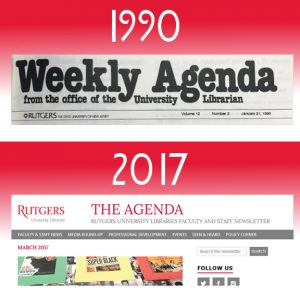
    Many Rutgers librarians already use one or both of these applications. Laura Palumbo shares news on important resources in scientific disciplines at ChemInformer. Ryan Womack posts regular reflections on the data librarianship profession at RyanData. Kayo Denda created the blog of the Margery Somers Foster Center to provide an informal publication venue for student interns. Christie Lutz and other Special Collections colleagues write about rare and unique New Jerseyana at What Exit? And The Agenda newsletter itself is published in WordPress! The following three case studies demonstrate how these platforms can be used in support of library and scholarly work.

    Pedagogy and Professionalization

    A section of the exhibit on Gennett Records on the IJS Archives Fellowship site.

    The Institute of Jazz Studies Archival Fellowship Program, instituted in 2010, supports the professional development of early career archivists and is dedicated to promoting diversity in the field of archives. The Institute of Jazz Studies (IJS) has its home in the John Cotton Dana Library at Rutgers–Newark. Krista White, the digital humanities librarian at the Dana Library, works beside IJS archivists Elizabeth Surles, Angela Lawrence, and Tad Hershorn; IJS Fellowship Program coordinator Ed Berger; and current associate director Adriana Cuervo in mentoring the IJS Archives Fellows through the process of archiving a single, small collection each year.

    Krista White spearheads a digital project for the fellows each year and has used Omeka for the last two years. White chose Omeka because it is free and open source. Many archives and cultural institutions need to establish an online presence, but may not have the resources to produce expensive digital exhibits. By using Omeka as a learning tool, the fellows gained hands-on experience designing digital exhibits, evaluating copyright and intellectual property issues, and administrating metadata for public display in an online environment. Furthermore, exposure to open source tools provides a way for IJS Archives Fellows to build value-added expertise in creative digital solutions.

    Project Outreach and Communication

    A project update on the New Jersey Digital Newspaper Project blog.

    In late July, Rutgers University Libraries learned that they, the New Jersey State Library, and the New Jersey State Archives had been awarded a National Endowment for the Humanities grant to digitize New Jersey newspapers as part of the National Digital Newspaper Program. The project team wanted to quickly establish a presence for the project and did so by starting the “New Jersey Digital Newspaper Project” blog using WordPress. The blog is administered by Isaiah Beard, John Brennan, and Caryn Radick and includes content provided by project team members.

    The blog format lets the project team provide different types of information in one place including status updates, information about the partners, project staff, and advisory board, and provides a contact form for readers. Using a WordPress blog also allowed the project team to share password protected information with the Newspaper Project Advisory Board, who have helped guide the selection process.

    First and foremost, the blog serves as a way to share news of the project. Currently, the partners are working to identify newspapers and learning the processes and procedures of the work involved in digitizing these newspapers for the Library of Congress Chronicling America Project. The blog has detailed various trips and meetings for getting these underway. As the newspapers are digitized, the blog will also let the project team share stories of interest from New Jersey history and provide further updates about progress.

    Digital Editing and Reconstruction

    Digital annotations to William Still’s letter, dated August 7, 1850.

    Francesca Giannetti is creating a digital edition of the Peter Still Papers, a small manuscript collection held in Special Collections and University Archives. These manuscript letters have already been published in RUcore; a primary goal of the digital edition is to provide digital full text transcriptions. Giannetti is working with Aresty research assistants to transcribe and encode the letters using the Text Encoding Initiative (TEI) framework of XML. The TEI allows keyword searchability across the letters, and also provides structured data that will allow future researchers to query the letters for names, places, and dates. This Omeka site will include lightly edited HTML transcriptions of the letters, while a link included in the relation field takes the reader to a more diplomatic style transcription with original spellings and line breaks preserved, and presented alongside expandable thumbnails of the page images. The Omeka site also features a hypothes.is annotation layer (right sidebar), which could serve as the basis of group digital annotation exercises in a digital or public history course. A next step for this project will involve finding faculty collaborators in history and American studies to bring these primary documents into the classroom for study and further research.

    If you have questions about how to get started using WordPress or Omeka in your work, or have comments on any of the projects mentioned in these case studies, please write to the Digital Humanities Working Group.

    -Francesca Giannetti, Caryn Radick, Krista White, Bob Vietrogoski, Zara Wilkinson, Ron Jantz, Fengzhi Fan, and Tibor Purger

  • 2016-2018 Priorities Handout now available

    2016-2018 Priorities Handout now available

    Right click this image to download a PDF of the Priorities Handout.

    Following the example of University of Maryland Libraries and other academic peers, we have designed a visually appealing handout for our 2016-2018 Priorities. The handout is available to the public as a PDF on our Mission, Vision, and Strategic Plan page.


    Save

    Save

    Save