Category: Feature

  • This Month in the Agenda: October 1984

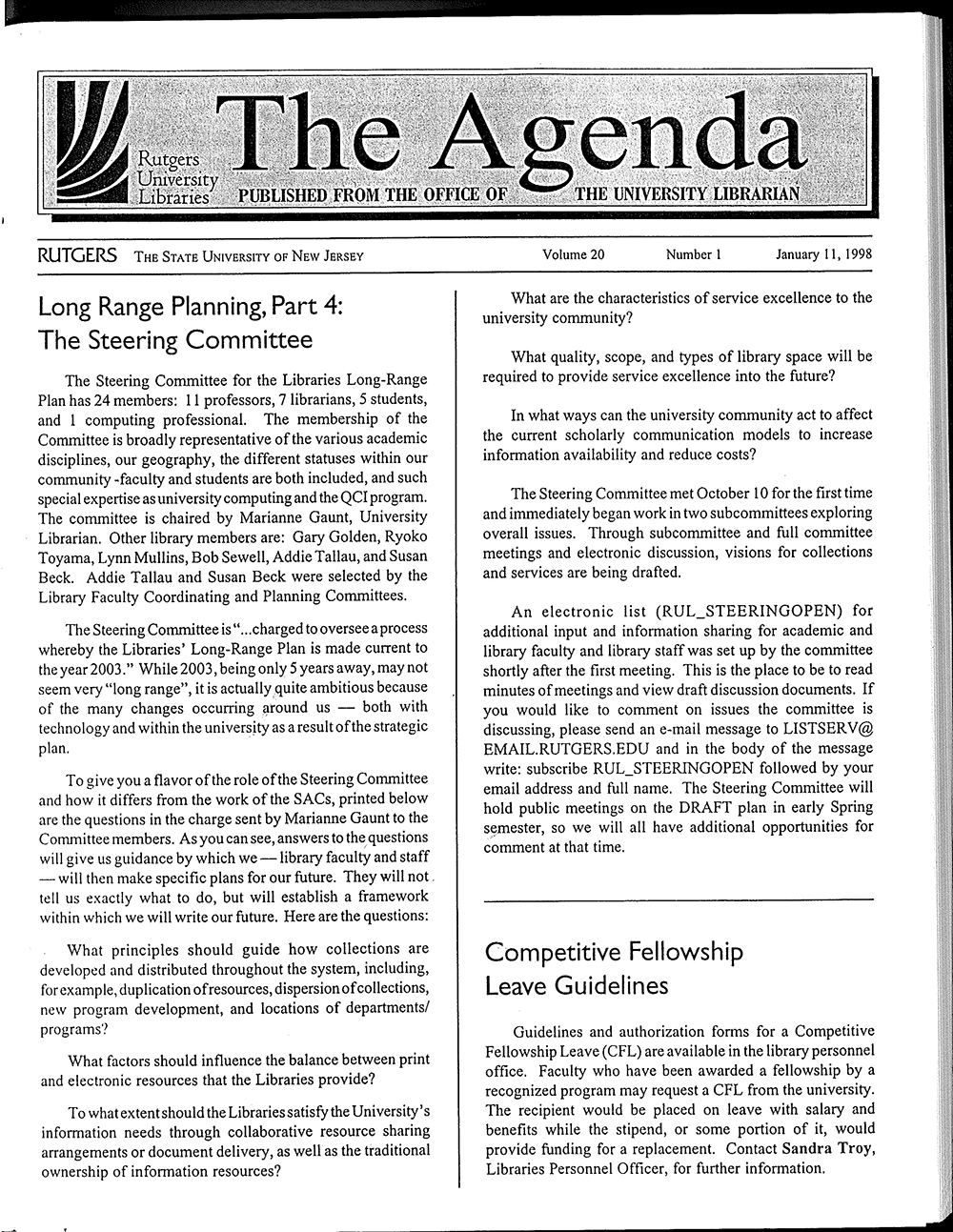
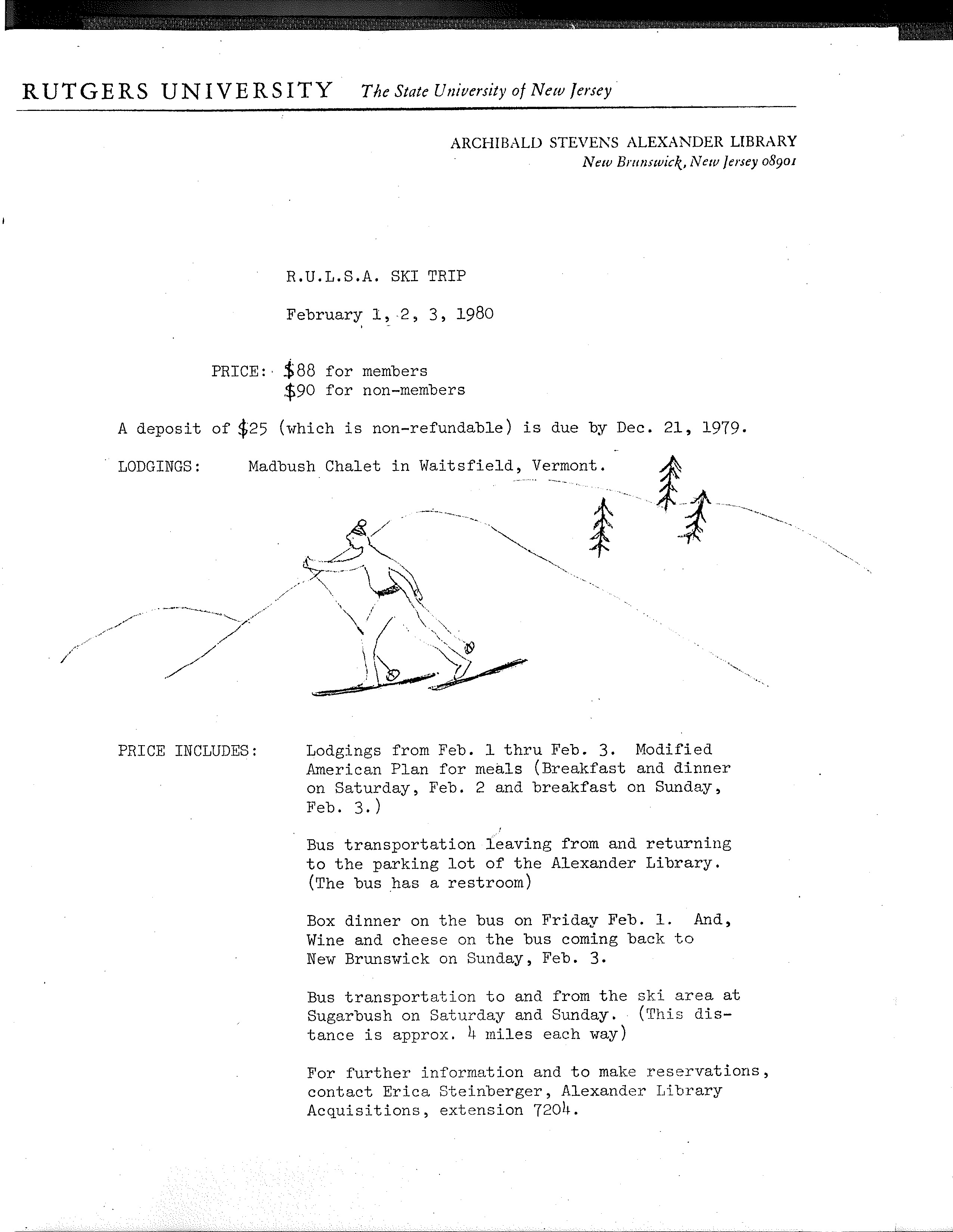
    Welcome to the newest regular feature of the Agenda. In “This Month in the Agenda,” we’ll explore highlights from this month in the history of Rutgers University Libraries. For the inaugural column, we’ll travel back in time 33 years to October 1984. What news was buzzing around the Libraries?

    My, How the Times Have Changed
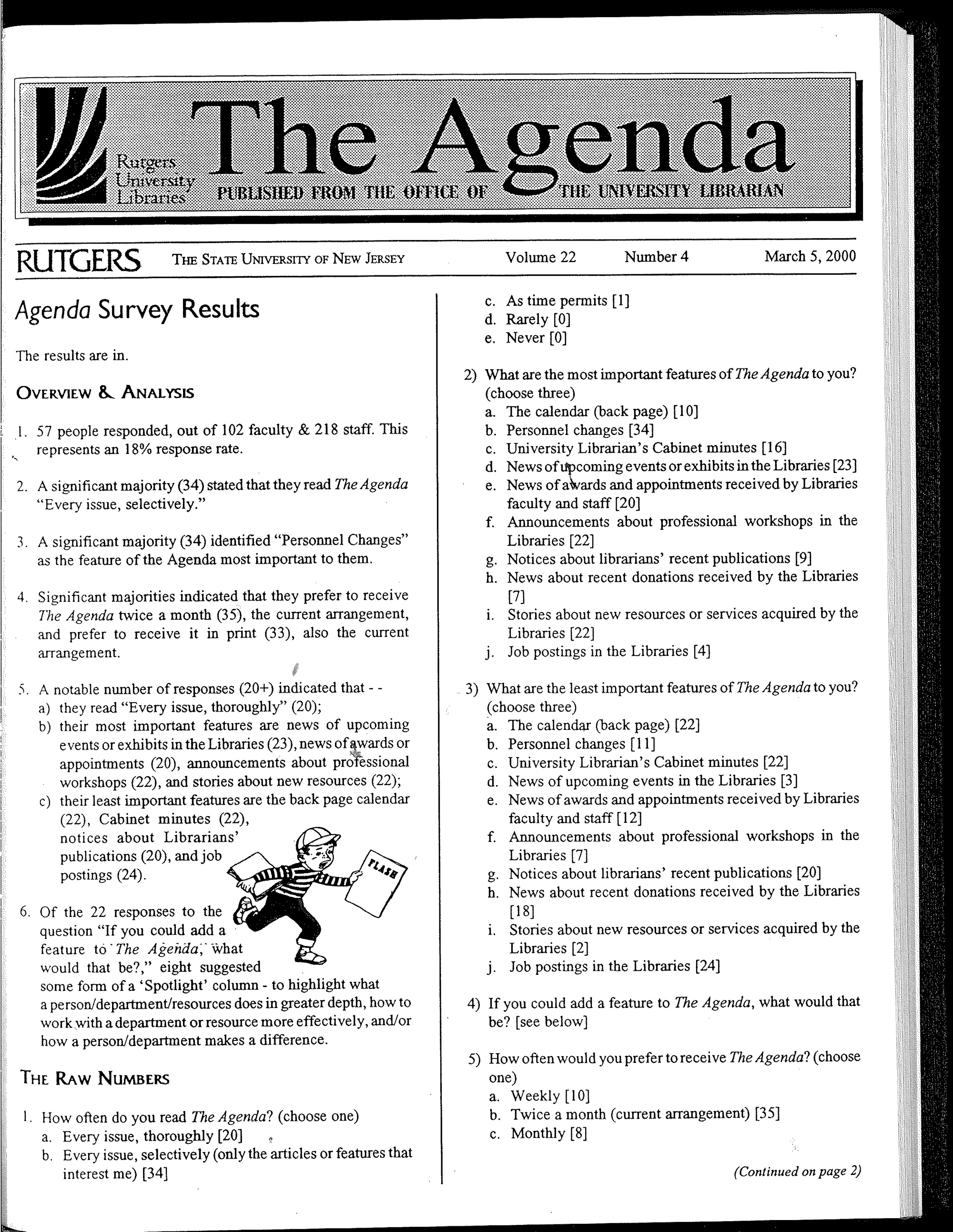
    A five year summary of library statistics spanning FY 79/80 to FY 83/84.
    East Asian Library Making Waves

    The East Asian Library and the International Center have received $14,000 from the New Jersey Department of Higher Education to establish an in-house automated information and delivery service to support East Asian research and curriculum development at Rutgers and within the New Jersey State Colleges System.

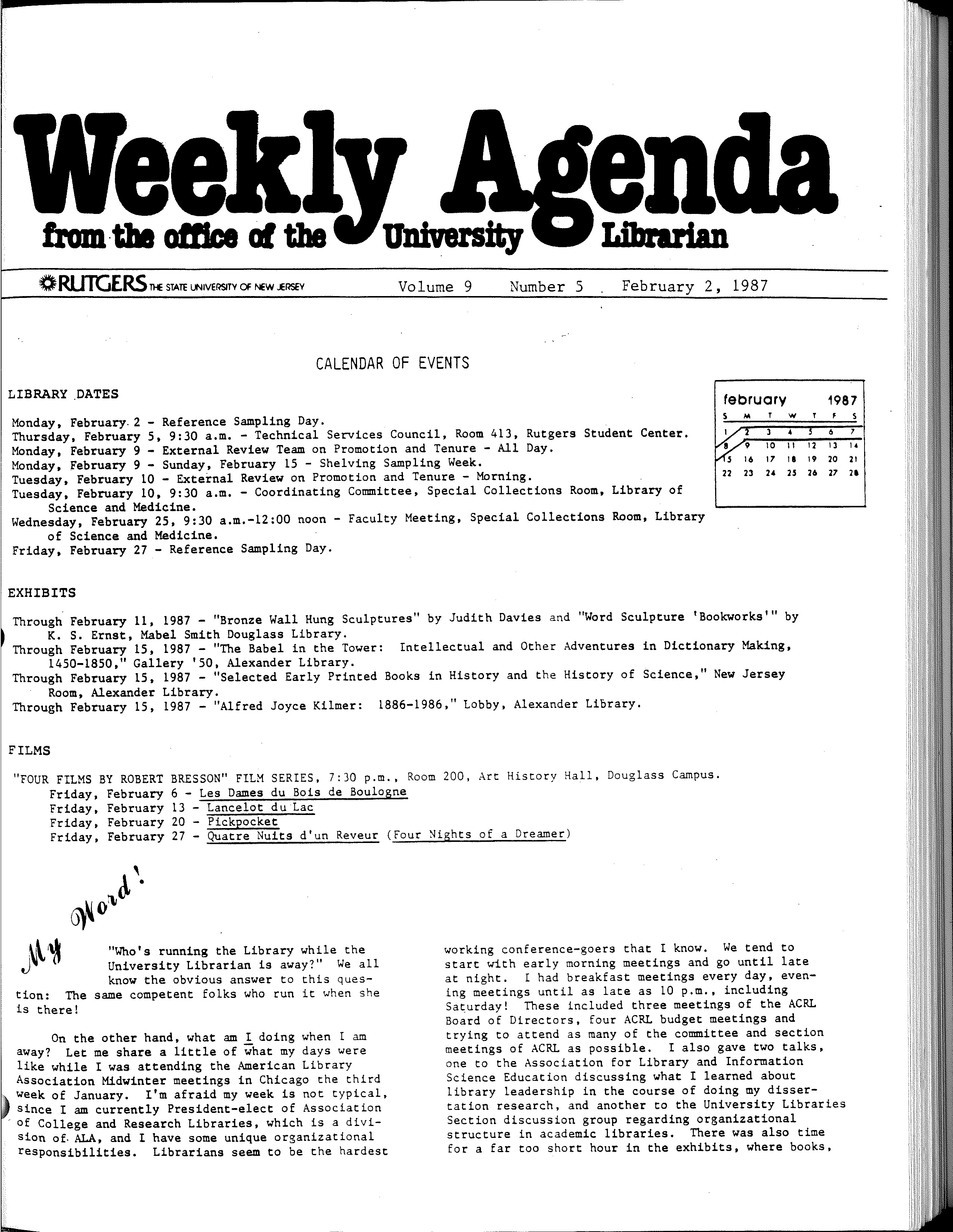
    Weekly Agenda 6, no. 40 (October 1, 1984).

    Dinner, Anyone?

    Name the Libraries’ integrated system, commonly known as Geac, and win a dinner at The Frog and the Peach in New Brunswick.

    The online system now includes cataloging and circulation elements, but the name should be flexible enough to cover all additional subsystems as well as the online catalog

    Submit names to Kamala Truscott, Library Administration by October 31.

    Weekly Agenda 6, no. 41 (October 8, 1984).

    The DeWitt Library Society of the Rutgers University Libraries invites you to share in the pleasure of an evening celebrating good books on Tuesday, November 13, 1984. The festivities celebrate the completion of a very successful year for our National Endowment for the Humanities Challenge Grant.

    Weekly Agenda 6, no. 43 (October 22, 1984).

    Movin’ On Up

    Changes in Position

    Timothy Corlis, Library Assistant II, Central Technical Services

    Weekly Agenda 6, no. 41 (October 8, 1984).

    Cabinet Report

    Edelman: Working on Title II-C proposals in Special Collections: Consumer Archive, Latin American Archive, Afro-American Archive. Proposal deadline is November 1. Reported on meeting to be held regarding Performance Appraisals. Discussed METRO: G. Neely will attend meeting on 10/25. Senator Case’s furniture to leave the Librarian’s office; to be placed in Special Collections Seminar Room.

    Weekly Agenda 6, no. 43 (October 22, 1984).

    Spam Filter Needed

    Campus mail is designed to be used for University business between departments of the University. Campus mail should not be used for transport of personal mail, chain letters or other unauthorized uses. Employees who make unauthorized use of campus mail may be subject to reprimand.

    Weekly Agenda 6, no. 43 (October 22, 1984).

    On Exhibit

    Elizabeth Cady Stanton Materials, Mabel Smith Douglass Library

    Through December 1 – “American Presidential Elections, 1904–1984,” Department of Special Collections, Archibald S. Alexander Library

    Through November 7 – Wood Sculpture and Drawings by Jane Teller, Mabel Smith Douglass Library

    Weekly Agenda 6, no. 43 (October 22, 1984).

    Hopefully you’ve enjoyed this glimpse into the Libraries’ past! Special thanks to Erica Parin for her idea to start this column.

    Please send comments or suggestions about “This Month in the Agenda” to Matt Badessa.

  • Mid-Atlantic Futures Conference Report

    • Irina Radeva (r) and SC&I scholarship recipients.

    Last week, I attended the Mid-Atlantic Futures Conference held in Atlantic City, NJ. Four other School of Communication and Information students and I attended this exciting two-day event thanks to a scholarship provided by the Library and Information Science Department and were accompanied by two SC&I instructors, Dr. Ross Todd and Dr. Joyce Valenza. The gathering was a great way to come together with like-minded library professionals and discover how libraries can thrive in a world full of ever-changing technology and vast information.

    The main question posed by the conference was, “How do we predict the future?” Among those trying to answer were keynote speakers Kevin Mitnick, the most elusive computer hacker in history; David Pescovitz, the research director at the Institute of the Future; Nicole Baker Rosa from the Future Schools; and Rutgers’ own Dr. James Hughes, University Professor and former dean of the Edward J. Bloustein School of Planning and Public Policy. Each speaker touched on the importance of knowing what libraries are and what they stand for, as well as keeping their eyes open not for trends, but for patterns that will point to the next big thing. There was a lot of discussion about artificial intelligence and virtual and augmented reality, and how they will affect both libraries and society. Acceleration strategist Phil Bowermaster proposed that the convergence of information and society is accelerating change, while communication specialist Rakia Reynolds shared a communication strategy that is both noticeable and disruptive.  Finally, Cindy Ball from Oculus Rift gave a demonstration of a virtual reality future that may be much closer than we think.

    So, how do we predict the future? We create it–with knowledge and imagination.

    I would like to thank Lilia Pavlovsky, director of the Master of Information program, who facilitated this opportunity for me, as well as Andy Martinez and Janet Croft for giving me approval to attend.

  • The Rutgers University Libraries Website Style Guide from Integrated Information Systems

    The Rutgers University Libraries Website style guide explains the rules and conventions that go into defining typography and the appearance of website elements on our website. Its goal is to provide a cohesive and coherent experience for website users and content creators. An internal style guide has been in existence since the redesign of the libraries’ website in June 2013. However, growing demand for custom content from colleagues and requests for mini-sites, established a need to make the style guide available to users across the libraries. Not everyone knows – or should be expected to know – how to create a webpage. The style guide provides a clear idea of what to expect when, for example, you want to display tabular data or, have an article on the website that uses pull quotes. Content creators amongst our library colleagues can use it when visualizing their pages. Developers can use it as a reference when coding new pages. It functions as a common reference for both.

    On a technical level, the style guide is structured such that it provides an example of the treatment of a website element, followed by the CSS code used to style the element, and the HTML code that displays it in the browser. On a general, stylistic level, it defines how pages are structured on the website, such as addressing questions regarding the appearance and location of navigational links within a mini-site. It also informs us about overarching style rules that users might be interested in knowing, such as the font family (Droid Sans) and generic typeface (sans-serif) that body copy defaults to throughout the site.

    The developers and designers in Integrated Information Systems are available to create webpages that use the style guide as a guideline, rather than a limitation, with possibilities for creativity and experimentation, to build the best experience for our users and our colleagues.

    Access the website style guide here: https://www.libraries.rutgers.edu/styleguide


  • Back to School Outreach to Our Users

    The fall semester officially begins in four days, and we are prepared. Matt Badessa made this wonderful welcome video for our students. We weren’t sure how it would turn out, so we kept the project relatively small and only interviewed faculty and staff in New Brunswick. We are happy with the video and would like to do more like this in the future. Let us know if you’d like to participate or if you have an idea for a short video about the Libraries or a service.

    We are also sending out a September newsletter to our email list, featuring current exhibits and upcoming events. You should receive a copy of this on the morning of September 5th. It includes the following events:

    John Haworth, senior executive emeritus of the National Museum of the American Indian, Smithsonian Institution, visits Alexander Library on September 19 to share his knowledge about cultural and arts issues impacting Native Americans, including key museum practices, repatriation, and social change.

    More

    Relive the rich history of student art and literary magazines at Rutgers with By Ourselves: Rutgers Student Literary Journals 1923–2017, a joint exhibition of the Robeson Library and the Rutgers–Camden Writers House from September 1 to October 31. Spanning nearly a century and two campuses, this exhibition highlights the creativity and initiative of Rutgers students through Quintessence, The Anthologist, and other publications.

    More

    The Libraries at Rutgers–New Brunswick will help new and returning students ease into the semester again this year with snack breaks during Welcome Days.

    • September 6 & 7, 2 p.m. Cookies and coffee at Douglass Library.
    • September 7, 1–2 p.m. Popcorn on the steps of the Art Library and Zimmerli Museum
    • September 7, 2–3 p.m. Snack break at Carr Library
    • September 12, 2–3 p.m. Snack break at Carr Library
    • September 26, 1:30–2:30 p.m. Snack break at Alexander Library

    More

    In celebration of the 100th anniversary of Douglass Residential College, the artwork of renowned feminist artist and Rutgers graduate Mimi Smith will be on display at Douglass Library from September 5 through December 15. Embodying the relationship between everyday life, intimacy, anxiety, and time, Smith’s works include clothing made from plastic and steel wool, traditionally rendered drawings, drawings made from knotted thread and tape measures, clocks, and knitted sculptures.
    More
    With support from a Freedom to Read Foundation grant, the Art Library will host a number of programs celebrating Banned Books Week from September 24 to September 30. The activities will provide students, faculty and staff, and community members the opportunity to explore the ideas of intellectual freedom, censorship, and banned books by creating and displaying original art.

    More

    The New Brunswick Music Scene Archive in Special Collections and University Archives will kick off Hub City Sounds’ ROCK New Brunswick music festival weekend on September 8 with a discussion panel featuring New Brunswick music insiders past and present: Dennis Diken of The Smithereens, Sharief Hobley of Sharief in Burgundy, Makin Waves columnist Bob Makin, Audrey Rose of The Wichts, and Spina Records’ Andrew Spina.

    More

    This fall, data librarian Ryan Womack will offer a series of workshops on statistical software and data at both Alexander Library and the Library of Science and Medicine. September’s topics include “Introduction to SPSS, Strata, and SAS”; “Introduction to R”; and “Data Visualization in R.”

    More

    Special Collections and University Archives’ exhibit “Heaven, Hell, or Hoboken!”: New Jersey in the Great War has been extended to September 22. Featuring one-of-a-kind documents, photographs, and artifacts reflecting the wartime experiences of New Jerseyans both at home and abroad, this display is a must-see for Garden State history buffs and World War I aficionados alike.

    More

    John Cotton Dana Library will commemorate its 50th anniversary with a host of free events and activities throughout the academic year. Exhibits showcasing the history of the library and its namesake as well as a birthday party during Rutgers–Newark’s Fall Fest will highlight the fall schedule. A number of guest speakers will visit the library to share their wisdom throughout the spring semester, and the year will culminate with a special event on Rutgers Day. Additional details are forthcoming, so stay tuned to our website for the latest on the #RutgersDana50 celebration.

    If you have an event coming up in September that is not mentioned here – there is still time to include it in our email newsletter. Send info to jessica.pellien@rutgers.edu.

  • Notes on 2017 WLIC, 83rd IFLA General Conference and Assembly

    Notes on 2017 WLIC, 83rd IFLA General Conference and Assembly

    • Printing press gnome . Wroclaw is famous for its small bronze gnomes scattered around the city. Each has a theme and it started representing a protest movement in the 1980s. There are 400 or so of them in the city. Credit: Kayo Denda.

    The 2017 IFLA WLIC took place in Wroclaw, a lovely city in the southwestern region of Poland from 19 to 25 August, 2017. With the theme Libraries. Solidarity. Society, the congress brought together thousands of representatives of the library field. IFLA’S Global Vision brainstorming that started earlier this year in Athens, Greece continued in Wroclaw, and as Donna Scheeder, IFLA President expressed, the delegates got together “to explore how a connected library field can meet the challenges of the future. Hopefully the final report will be released soon. Library staff around the world will be encouraged to vote supporting (or not) the document when the final draft is released.

    One of the highlights of the congress for me was the Social Science Libraries one-day workshop titled Understanding Your Library from the Inside Out: A Workshop in Library Ethnography for User Assessment. Our workshop leader was Celia Emmelhainz, Anthropology and Qualitative Research Librarian from UC Berkeley and our keynote speaker was Lynn Silipigny Connaway, Senior Research Scientist and Director of User Research at OCLC. We were very fortunate to hold the workshop in a brand new library facility at Wroclaw University Library. The workshop, capped at thirty participants, attracted participants from twelve countries affiliated with eleven IFLA units, and eight librarians from the host institution also joined the workshop. Through hands on exercises, we learned the importance of qualitative assessment of library services in capturing the behaviors of elusive library users. These rich and nuanced data provides important information to support decisions about resources and services. Despite her busy schedule during the congress, Dee Magnoni was able to join us at the workshop. So did Kay Cassell, faculty emerita from SC&I, LIS.

    Qualitative assessment was mentioned a few times during the congress. Jim Neal, the ALA President, stressed the importance for the libraries to depart from simple statistics collection and focus on the context and relationships beyond the numbers. The ethnography in libraries was also mentioned in Dona Scheeder’s remarks during the congress opening. Clearly the library leaders recognize the need to go beyond the numbers to gain access to rich and meaningful information in order to shape future direction of libraries.

    Organizing this workshop in Wroclaw while in New Jersey was extremely challenging. I was fortunate to work with Grażyna Piotrowicz, Director of Wroclaw University Libraries, who shared her local knowledge and invaluable insights with me. I was also assisted by Rutgers University Libraries/Rutgers University colleagues who put me in touch with key individuals and provided significant administrative assistance. It really took a village to make the ethnographic workshop successful!


    Kayo Denda
    Head, Margery Somers Foster Center & Women’s Studies Librarian
    Former Chair of IFLA, Social Science Libraries Section


  • Quick Takes on Events and News — September 2017

    Native Arts Expert Visits Alexander Library on September 19

    Join the Middlesex County Cultural and Heritage Commission and Rutgers University Libraries at Rutgers–New Brunswick in welcoming John Haworth, senior executive emeritus of the National Museum of the American Indian, Smithsonian Institution, as he shares his knowledge about cultural and arts issues impacting Native Americans, including key museum practices, repatriation, and social change. For more information, visit our events page.

    Welcome Days Events Return to Libraries in New Brunswick

    The Libraries at Rutgers–New Brunswick will host fun events for new and returning students during Welcome Days again this semester. A preliminary schedule is below—stay tuned for information on more activities!

    • September 6 & 7, 2 p.m. Cookies and coffee at Douglass Library.
    • September 7, 1–2 p.m. Popcorn on the steps of the Art Library and Zimmerli Museum
    • September 7, 2–3 p.m. Snack break at Carr Library
    • September 12, 2–3 p.m. Snack break at Carr Library
    • September 26, 1:30–2:30 p.m. Snack break at Alexander Library
    Student Publications on Display at Rutgers–Camden

    Relive the rich history of student art and literary magazines at Rutgers with By Ourselves: Rutgers Student Literary Journals 1923–2017, a joint exhibition of the Robeson Library and the Rutgers–Camden Writers House from September 1 through October 31Spanning nearly a century and two campuses, this exhibition highlights the creativity and initiative of Rutgers students through Quintessence, The Anthologist, and other publications. Are you a former student editor or do you remember your name in these pages? Share your memories on social media with the hashtag #ByOurselves.

    WWI Exhibit Extended through September 22

    Special Collections and University Archives’ exhibit “Heaven, Hell, or Hoboken!”: New Jersey in the Great War has been extended through September 22. Featuring one-of-a-kind documents, photographs, and artifacts reflecting the wartime experiences of New Jerseyans both at home and abroad, this display is a must-see for Garden State history buffs and WWI aficionados alike. Don’t miss out on your last chance to view it!

    Mimi Smith on Display at Douglass Library

    In celebration of the 100th anniversary of Douglass Residential College, the work of renowned feminist artist and Rutgers graduate Mimi Smith will be on display at Douglass Library from September 5 through December 15. Embodying the relationship between everyday life, intimacy, anxiety, and time, Smith’s works include clothing made from plastic and steel wool, traditionally rendered drawings, drawings made from knotted thread and tape measures, clocks, and knitted sculptures. Mark your calendars for Smith’s October 24 lecture and learn more about the exhibit on our website.

    Fall Data Workshop Series

    This fall, Data librarian Ryan Womack will offer a series of workshops on statistical software and data at both Alexander Library and the Library of Science and Medicine. The topics include “Introduction to SPSS, Strata, and SAS”; “Introduction to R”; “Data Visualization in R”; and “Reproducible Research.” For more information, visit the Research Data Management Services webpage.

    ROCK New Brunswick Weekend Kicks Off with New Brunswick Music Scene Archive Panel

    The New Brunswick Music Scene Archive in Special Collections and University Archives will kick off Hub City Sounds’ ROCK New Brunswick music festival weekend on September 8 with a discussion panel featuring Dennis Diken of The Smithereens, Sharief Hobley of Sharief in Burgundy, Makin Waves columnist Bob Makin, Audrey Rose of The Wichts, and Spina Records’ Andrew Spina. Interested in attending? RSVP on Facebook!

    Art Library Celebrates Banned Books Week

    With support from a Freedom to Read Foundation grant, the Art Library will host a number of programs celebrating Banned Books Week from September 24 to September 30. The activities will provide students, faculty and staff, and community members the opportunity to explore the ideas of intellectual freedom, censorship, and banned books by creating and displaying original art. To learn more or get involved, visit the Banned Books Week LibGuide or contact art librarian Megan Lotts.

    Dana Library Turns 50!

    John Cotton Dana Library will commemorate its 50th anniversary with a host of free events and activities throughout the academic year. Exhibits showcasing the history of the library and its namesake as well as a birthday party during Rutgers–Newark’s Fall Fest will highlight the fall schedule. A number of guest speakers will visit the library to share their wisdom throughout the spring semester, and the year will culminate with a special event on Rutgers Day. Additional details are forthcoming, so stay tuned to our website for the latest on the #RutgersDana50 celebration.

    Save

    Save

    Save

    Save

  • Fellows Learn Jazz and Archives in Institute Program

    • 2017 Institute of Jazz Studies Fellows, from left, Ana Niño, Jeannie Chen and Adam Berkowitz, tour an exhibit at the National Jazz Museum in Harlem. Leading them through Harlem jazz history is Ryan Maloney, a former employee of the Institute and director of education and programs at the Museum.

    Three archives students from across the country, each with strong musical backgrounds, undertook to learn jazz as a second language as they burnished their archival credentials from the classroom in an intensive two-week program at the Institute of Jazz Studies (IJS) this past June. They were the fifth class of Jazz Archival Fellows, a program underwritten by Jon Van Rens, a longtime IJS supporter and administered until earlier this year by the late Ed Berger, the previous IJS associate director.

    The selected candidates who came to Rutgers University-Newark were:

    • Ana Niño, a student at the University of North Texas who works in a Dallas-area library and plays guitar in an all-female rock band.
    • Jeannie Chen, a student at UCLA who has a background in classical piano that propelled her into international piano competition
    • Adam Berkowitz, a MLIS student at University of South Florida in Tampa who is also a professional percussionist interested in jazz and classical music and music educator with a special interest in Jewish musicians and composers.

    During their time at IJS, they arranged, described, and produced a finding aid for over 400 taped interviews with jazz musicians and other figures on the jazz scene designated as the Institute of Jazz Studies Collection of Jazz Oral Sound Recordings. Materials in the collection were made between 1956 and 2007 and include mostly audiocassettes and some reel-to-reel tapes.

    Field trips afforded the fellows a glimpse of how other area repositories and museums conduct their work. These trips have proven to be one of the more popular features of the fellowship experience, and this year was no exception. The fellows visited the Louis Armstrong House/Archive, the National Jazz Museum in Harlem, the New York Philharmonic Archives, the Carnegie Hall Archives, and the Thomas Edison National Park in West Orange.

    In addition, Niño, Chen, and Berkowitz received an overview of issues in managing oral history collections from Dana Library’s digital humanities librarian Krista White. Archivist Elizabeth Surles spoke on rudiments of Encoded Archival Description (EAD), a program utilized to post archival finding aids on the web. IJS archivist Angela Lawrence also worked closely with the students as they processed the interviews.

  • Librarians at the John Cotton Dana Library win a Research Award

    Roberta Tipton, Bonnie L. Fong, Krista White and Minglu Wang (l to r).

    Librarians Bonnie L. Fong, Minglu Wang, Krista White, and Roberta Tipton were presented the 2017 ACRL-NJ/NJLA CUS Research Award for their article, “Assessing and Serving the Workshop Needs of Graduate Students,” (The Journal of Academic Librarianship) during the NJLA Conference in April 2017.

    Each year, the Research Committee of the NJLA College and University Section (CUS) and the ACRL New Jersey Chapter selects the best published research completed by a New Jersey librarian during the past year for this honor. Fong, Wang, White, and Tipton’s journal article was one of two winners in 2017. Their research determined which workshop topics graduate students in the humanities, science, and social science disciplines are most interested in, and what their preferences are for workshop formats, times, and communication. What made their study unique was the comparison of student and graduate program director viewpoints on topic importance. In addition, they compared and contrasted Master’s and doctoral student training needs.

    The John Cotton Dana Library and other Rutgers University-Newark campus units are already using the research results as they develop workshops and other services to more fully support graduate students’ research, grant, career, teaching, and technology training requirements.

  • Tips for videography; promotional items inventory; new signage templates from the Communications Department

    Tips for videography; promotional items inventory; new signage templates from the Communications Department

    promotional item samplesThe communications department has made some more useful items available on our website.

    A promotional item visual inventory. This website lists all the promotional items we currently have in stock. Many of these items are available in limited quantities, for Libraries events. To place a request, please send Ken Kuehl an email with the quantities, item names, what they will be used for, and an address for shipping.

    Helpful Hints for Videotaping Interviews. This Microsoft Word document contains some tips and tricks for planning for and improving the visuals of taped interviews. We hope this is helpful to anyone planning to record video for the Libraries. It is listed on the Communications Department website.

    New signage templates. On our signage template web page, you can download Word files that you can update with your library’s information (name of library, URL, specific text, images) and print in black and white or color. We will work on converting them to Powerpoint over the next month. We’ve added the following to the Shared Sign Library:


    • Allow Us to Reshelve Your Books
    • Please Do Not Reshelve Your Books
    • Keep Your Belongings Safe
    • Please Bring Your Own Change

    sample policy sign imageWe’ve also added a Policy Signs and Toolkit. During our recent signage inventory, we saw lots of individual policy signs posted all over the libraries. These new Policy Signs and Toolkit will allow you to create signs that address multiple policies in a single page and hopefully eliminate the need for multiple single policy signs. The toolkit includes a vertical and horizontal version of this sign and a zip file of icons (hopefully live by the time this newsletter publishes) to use for signage.

    We have more signage templates on the way, including staff only and a replacement for the popular Can’t Find a Book signs. Stay tuned.


    Save

  • Deep Dive: JAMAevidence

    Deep Dive will give a bit more insider’s info on some of our resources. Here, Roberta Fitzpatrick gives us some more information about JAMAevidence.


    In 1990, Dr. Gordon Guyatt, Internal Medicine residency program director at McMaster University in Canada began to teach using a new method which he called “Scientific Medicine.” He felt that many clinical decisions were not necessarily rooted in scientific fact and taught his residents to make such decisions based in part on evidence found in the published literature. It eventually evolved into what is currently called Evidence-Based Medicine (EBM) or Evidence-Based Practice (EBP) or Evidence-Based Health Care (EBHC), combining a clinician’s experiences, well as information about the specific patient with the best evidence from journal articles.

    JAMAevidence, an information resource new to Rutgers and found at https://www.libraries.rutgers.edu/indexes/jamaevidence, is a natural extension from Gordon Guyatt’s original ideas and educational program. In order to assist health professionals in the practice of evidence-based health care, JAMAevidence provides guides to the systematic consideration of validity, importance, and applicability of problems and outcomes in health care. It consists of three textbooks, user tools, and forms useful to the critical appraisal process. Textbooks contained in JAMAevidence are:

    • Users’ Guides to the Medical Literature: A Manual for Evidence-Based Clinical Practice, 3rd ed.
    • The Rational Clinical Examination: Evidence-Based Clinical Diagnosis
    • Care at the Close of Life: Evidence and Experience

    Contents of the first two textbooks have been published as an article series in JAMA, the Journal of the American Medical Association. The User’s Guides are key to understanding the process of critically appraising an article. The Tational Clinical Exam series and subsequent textbook walks the reader through the process of conducting a physical exam of a patient.

    Tools in JAMAevidence include Education Guides, which consist of a library of PowerPoint slides useful in providing instruction on evidence-based medicine concepts; a glossary of over 900 EBM terms; calculators; and two types of worksheets, ones for critical appraisal of articles and those for charting an information cycle.

    JAMAevidnce is simple to use; a navigation bar is located at the top of each page and allows the users to review the contents through pointing and clicking. There is also a search box that allows for retrieval of searched key words. The resources is available on a monthly basis.

    Those who are interested in learning more about EBM may want to consider a review of an article titled “History of evidence-based medicine” by Roger L. Sur and Phillip Dahm from the Division of Urology, UC San Diego, published in the open-access Indian Journal of Urology, https://www.ncbi.nlm.nih.gov/pmc/articles/PMC3263217/.


    Save

    Save

    Save