Category: Feature

  • This Month in the Agenda: March 2000

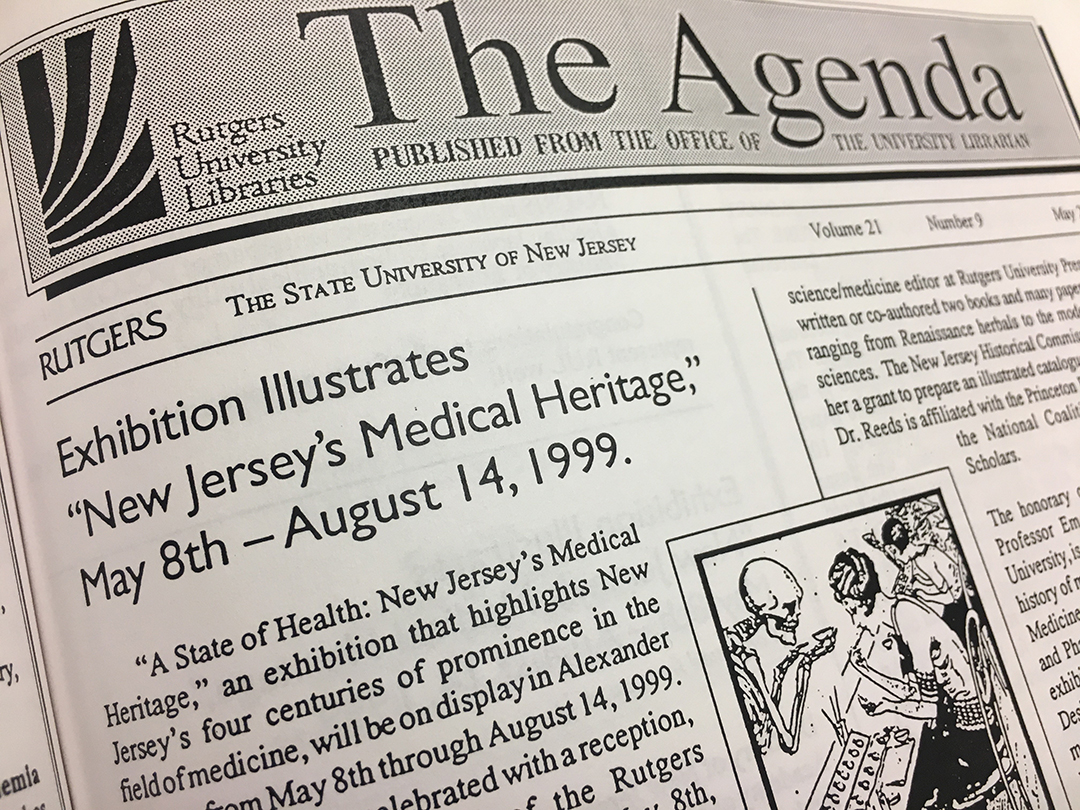
    This month we take a look at the Agenda in the aughts. Is it just me, or does 2000 not feel like almost two decades ago?

    Survey Says
    The Agenda 22, no. 4 (March 5, 2000)
    Reader survey from the Agenda 22, no. 4 (March 5, 2000).
    Systematic Thinking

    MESSAGE FROM THE UNIVERSITY LIBRARIAN

    At the last Cabinet meeting we discussed what it means to be a system. This might seem needless for an organization that has described itself as operating system-wide for many years, but it’s always useful to step back and take stock. This is especially important as we continue to develop our long-range plan, the Digital Library Initiative (DLI), and seek ways to be more effective.

    Typically, a system shares the same vision, philosophy, and goals. It shares common infrastructure and operates with system-wide policies and practices. There is considerable interdependency among units and a heightened need for communication. There’s also a shift to systems thinking, where operations are examined across the system rather than just locally. This helps to improve and expand the entire system’s capabilities to be effective. Each unit is each other unit’s best customer and best supporter. Information and expertise are shared readily, so that everyone in the organization benefits.

    As we implement the DLI we need to ensure that we are all working towards system-wide goals, using our resources effectively, thinking strategically, collaborating across units, and present a consistent, quality presence to our users. Communication and open discussion will be important as we gain new understandings in what it means to sustain and enhance a system in the digital environment.

    The Agenda 22, no. 5 (March 19, 2000)

    Getting Medieval

    The Medieval Studies Program and the Friends of the
    Rutgers University Libraries invite you to

    The Dedication of the
    Ernest McDonnell
    Medieval Culture Seminar Room
    in Alexander Library

    featuring a talk by
    Barbara Newman,
    Professor of English and Religion
    at Northwestern University

    “You Can’t Speak To Men
    Until You’ve Spoken With God:
    Medieval Women And The Church”

    Thursday, March 23, 2000
    4:00–6:00 p.m.
    Alexander Library

    The Agenda 22, no. 4 (March 5, 2000)

  • Library of Science and Medicine Update


    An architect’s rendering of what the new space in LSM.

    New Brunswick (NB) and Rutgers Biomedical and Health Sciences (RBHS) are collaborating to upgrade spaces and publicize library services to our users, in particular those from RBHS schools (Robert Wood Johnson Medical School (RWJMS), School of Public Health, Ernest Mario School of Pharmacy, Graduate School of Biomedical Sciences, the Physician Assistants program in the School of Health Professions), in Piscataway. One of the goals in recent draftsof the Libraries master plan for the Library of Science and Medicine (LSM) is to “create a science-focused atmosphere and establish a connection with RBHS.” In addition, the plan includes creating both “dedicated graduate study space,” and “dedicated RBHS study space” within the library.

    A plan is in place to encourage RBHS students to identify and use LSM and its resources. Survey data from RWJMS reveals that medical students do not currently identify with the library. The upcoming accreditation at RWJMS (March 5-7, 2018), spurred a feasibility study to upgrade study space and librarian support space at LSM to better serve the needs of graduate students in the health and life sciences on the Piscataway campus. Students from Pharmacy and Public Health are also in close proximity to LSM. Even though Pharmacy has recently opened their beautifully renovated building, LSM is still a very popular destination for Pharmacy students seeking serious study space.

    An open house for RWJMS students was held at LSM on Tuesday, February 13, to re-introduce students to LSM, view potential floor plans, the phased design for renovating space on the third floor, and view the location of the recently relocated MED-TEXT collection, approximately 1000 books recently relocated from the medical school to LSM. Approximately 100 medical students attended the event, which was positively received. Victoria Wagner and the librarians from Robert Wood Johnson Library of the Health Sciences (RWJ), along with faculty and staff from LSM, interacted with RWJMS students and faculty in attendance.

    The completed feasibility study, along with proposed floor plans, renderings, phasing plan and cost are nearing completion. Presenting and socializing the plan to stakeholders (RBHS schools and NB life sciences schools) and funders is a critical next step toward potential implementation. Mei Ling Lo has taken the lead on planning for the weeding of the bound journal collections on the north side of the LSM third floor. Journals are labeled for relocation to the Annex or discard, and a company will start moving items on April 2nd.

    An office, previously occupied by DTS on the LSM third floor, will provide the space for the RWJ librarians, who will begin providing services to students from that location in early March.

    A full meeting LSM and RWJ libraries took place on Friday, February 23rd at LSM. Plans were on display, updates were provided by Dee Magnoni and Judy Cohn, and then the 20 plus attendees broke into groups focused on space, access services, and deepening collaboration. One listserv for all LSM and RWJ librarians and staff was proposed to enhance communication. Other recorded recommendations are being transcribed to share back with the full group, which agreed to meet again in 2 months.

    These are exciting plans! We look forward to gaining momentum to fund this project.


    Save

  • This Month in the Agenda: February 1987

    The Agenda, February 2, 1987.
    The Agenda, February 2, 1987.

    It’s 1987: a Ford Escort costs just under $7,000, Full House debuts on TGIF prime-time, and the Dominion of Fiji is preparing to proclaim itself as a republic. What was happening at the Libraries?

    Cinephiles Rejoice!

    Media Services has announced a film series on works by director Robert Bresson. Bresson explores themes in his work which are similar to those Bergman addresses. The films focus on philosophical and human problems, dealing with issues of freedom and constraint, love or its lack, life and death, and affirmation or denial.

    ….

    The films will be shown on Fridays at 7:30 p.m. in Room 200 of Art History Hall on the Douglass Campus.

    February 6 Les Dames du Bois De Boulogne
    February 13 Lancelot du Lac
    February 20 Pickpocket
    February 27 Quatre Nuits d’un Reveur (Four Nights of a Dreamer)

    The Agenda 9, no. 5 (February 2, 1987)

    IRIS Insights

    IRIS Update for the week ending February 1, 1987.

    RLIN records produced on or before January 23, 1987 were added to IRIS.

    MRMS:

    New records added: 2,322

    Circulation:

    New records: 2,717
    Records updated: 6,033
    New items added: 3,138

    Circulation Notices produced and mailed: 3,138

    The Agenda 9, no. 6 (February 9, 1987)

    Just Say No… to Food

    The Rutgers University Libraries will begin an Anti-Food Campaign during March 1987. The purpose of the campaign is to draw the attention of both patrons and staff to the dangers that food and beverages present to the preservation of our library collections, the maintenance of our furnishings and equipment and the appearance of our buildings.

    ….

    Among items planned for the campaign are exhibits in each of the major libraries, and all campus mailing from the University Librarian’s office, articles in the campus newspapers, announcements on the campus radio station, bookmarks, posters, and notices. Each library will be holding a meeting to discuss the campaign and ways that library staff can help support it.

    The Agenda 9, no. 8 (February 23, 1987)

  • Disaster Planning and Recovery Workshop: Part 2

    • Tom Clareson demonstrates how to dry photos using fishing line. (All photos credit: Irina Radeva.)

    On November 30, Anthony Timek and I attended the final session of a two-part Disaster Planning and Recovery Workshop sponsored by the New Jersey Cultural Alliance for Response (NJCAR), of which Rutgers is a member institution. You can read my report on the first part of the workshop in the November issue of the Agenda.

    This session was held at the Wall Township Police Headquarters and focused on recovery. Presenter Tom Clareson, senior consultant for digital and preservation services at LYRASIS, covered the stages of disaster, with a particular focus on the last three:

    • Planning
    • Mitigation
    • Immediate Response
    • Recovery
    • Long-Term Recovery

    In the first part of the day, we learned about creating a comprehensive communication plan, appointing a recovery team, formulating salvage priorities, and assigning duties. The second part of the day consisted of an indoor demonstration by Clareson of how to treat waterlogged items. Afterwards, the group went outside and we plunged our hands into freezing water in an attempt to recover wet books, periodicals, microfilm, VHS tapes, DVDs, and more. At one point we even had an entire microfilm unspooled and drying in the cold November wind. Overall, the exercise was very valuable, especially for those who were lucky enough not to have experienced a water emergency in their facility.

    One significant takeaway from the workshop was for each institution to establish a relationship with first responders ahead of a disaster and familiarize them with the building and the disaster plan. Another was to create partnerships with similar institutions who may be able to assist each other during and after a disaster. In the spirit of the latter, Rutgers University Libraries shared our Water Emergency Presentation and Mold Identification Tutorial with the New Jersey State Library, who posted the materials on their website along with similar resources on disaster planning and preservation. Check out an article about this workshop on the NJ State Library’s website here.

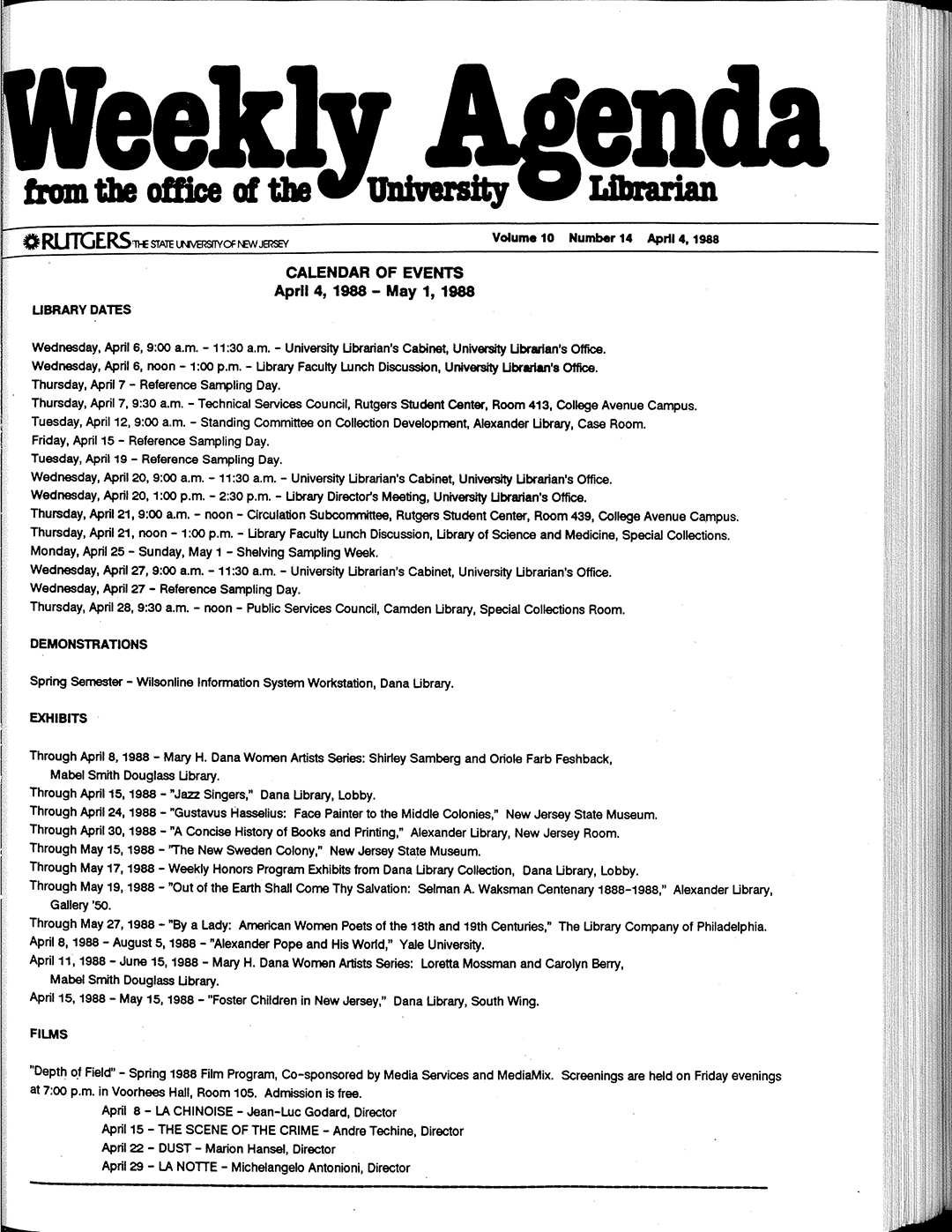
  • This month in the Agenda: January 1998

    The January 11, 1998 edition of the Agenda.
    The January 11, 1998 edition of the Agenda.

    This month, we go back two decades in the Agenda’s history to January 1998. The median household income was about $38,000; the world was ramping up for the Winter Olympics in Nagano, Japan; and we’d see blockbusters Armageddon, Titanic, and Saving Private Ryan all hit the box office over the course of the year. How did we ring in the New Year at the Libraries?

    Asking the Big Questions

    [P]rinted below are the questions in the charge [of the Steering Committee for the Libraries Long-Range Plan]…. As you can see, answers to the questions will give us guidance by which we—library faculty and staff—will then make specific plans for our future….

    What principles should guide how collections are developed and distributed throughout the system, including, for example, duplication of resources, dispersion of collections, new program development, and locations of departments/programs?

    What factors should influence the balance between print and electronic resources that the Libraries provide?

    To what extent should the Libraries satisfy the University’s information needs through collaborative resource sharing arrangements or document delivery, as well as the traditional ownership of information resources?

    What are the characteristics of service excellence to the university community?

    What quality, scope, and types of library space will be required to provide service excellence into the future?

    In what ways can the university community act to affect the current scholarly communication models to increase information availability and reduce costs?

    – The Agenda 20, no. 1 (January 11, 1998)

    Authority Is Constructed and Contextual

    At long last, the Rutgers library catalog will have full authority control for all name and series headings. The recently established LIS-Authority Committee is now investigating Sirsi policies for the implementation of authority functions and beginning a search for the vendor which will provide the best services. It will be writing an RFP (Request for Proposal) for authority control processing this spring, with an eye toward selecting a vendor in the early summer. The Committee, chaired by Rhonda Marker of TAS, welcomes all suggestions, wish-lists, and caveats from the library community regarding either vendors or online authority work.

    – The Agenda 20, no. 1 (January 11, 1998)

    Freshening Up

    The Libraries have recently received an allocation from University VP Joseph Seneca of $92,695 to upgrade academic facilities as part of the “Reinvesting in Rutgers” initiative the President announced in his state of the university message.

    The Libraries submitted a proposal as part of the academic facilities upgrade component of this initiative. The specific projects that were funded include upgrading the Mathematical Sciences library facilities (carpeting, draperies, acoustical buffers, etc.); replacing the telephone and wiring infrastructure at the Kilmer Library; and upgrading voice wiring at Douglass.

    In addition, Media Services was allocated $1.7 million to upgrade the smart classrooms on the New Brunswick campus and to improve the Kilmer Library media classrooms.

    Decisions regarding programs to be funded on the Newark and Camden campuses facilities are being handled through their respective provosts, who have not yet reported.

    – The Agenda 20, no. 2 (January 25, 1998)


  • This Month in the Agenda: December 1979

    This month, we go back to the Agenda’s inaugural year—1979. Jimmy Carter was President, Sony had just introduced the Walkman, and a gallon of gas costed $0.86. What was happening at the Libraries?

    Ski trip flyer
    Anyone up for a ski trip? (Hope it was better than that drawing…)
    Calling All Friends!

    An organizing party was held on November 20 to plan for the future of the Friends of the Library. Representatives  from the University Trustees’ Library Committee, University faculty and administration, Rutgers Foundation, and Library administration attended the early evening event in the Librarian’s office. They discussed various ways the Friends could raise support for the Library.

    – The Agenda 1, no. 42 (December 3, 1979)

    Movie Time

    FILM SHOWINGS
    Alexander Library, Wednesday, December 5 – Persona, New Jersey Room, 7:30
    Kilmer Area Library, Tuesday, December 4 – Italian Straw Hat, AV, 7:30
    Newark Dana Library, Monday, December 3 – Notorious, Listening/Viewing, 11:30

    –The Agenda 1, no. 42 (December 3, 1979)

    Need a Gig?

    RUL PROFESSIONAL VACANCIES
    Alexander Library: Information Services Librarian. $17,544 and up dependent upon qualifications.
    The Agenda 1, no. 43 (December 10, 1979)

    Archives Shaping Up

    The Board of Trustees has allocated $45,000 to fund an Archival Study Project to be conducted under the administration of the University Librarian.

    The project will survey current and non-current records and disposition practices throughout the University to develop recommendations for a coordinated records management/archives program. The program will enable the University to fulfill administrative needs, conserve space, meet legal requirements, and preserve historical records. From RUL’s perspective, the archives/records management program is part of a broader plan to develop research collections.
    Hendrik Edelman has appointed George Kanzler, William miller, Edward Pason, Ruth Simmons, Donald Sinclair, and Emma Warren to serve on the RUL Advisory Committee of the Archival Study Program. They will deal with the implications of the Archival Study Project for the Libraries.

    –The Agenda 1, no. 44 (December 17, 1979)

  • Retirement and YOU!

    Retirement and YOU!

    A new year is approaching! If you are thinking about retirement and what is involved in the process you should check out the important on-line links below that offer key information to help you prepare.

    ABP Retirement: Welcome to the Alternate Benefit Program Retirement Seminar Presentation [PDF].

    PERS Retirement: Welcome to the Public Employees’ Retirement System (PERS) Retirement Seminar Presentation [PDF].

    Additionally, UHR offers seminars to both ABP and PERS members contemplating retirement.  If you are interested in attending a seminar, please check the Learning and Development Course Registration System under Employee Benefit and Work-Life Programs managed by University Human Resources.

    Please note: Employees will need to submit an intent to retire letter to their supervisors to advise of the effective date of retirement once they have fully committed to retire.


    Save

    Save

    Save

    Save

  • Getting to Know Calvin Lai

    Many of you will have seen by now that this year’s State of the Libraries meeting on December 6 features special guest speaker Calvin K. Lai. (If you haven’t yet registered on Eventbrite, please take a moment to do so. Enter SOTL2017 when prompted for a password.) In advance of his visit to Rutgers, let’s learn a bit more about his research.

    As director of research for Project Implicit, Lai explores implicit biases, or the tensions between our conscious experience and unconscious mind and the resultant disconnect between our thoughts and actions. These biases are evident when, for instance, our attitudes about particular groups of people (based on their gender, race, religion, weight, ability, and so on) are at odds with our explicitly stated values about those groups.

    Lai’s research focuses on different approaches to changing our implicit biases and the question of whether changing these biases is actually the best approach for mitigating their effects on our behavior. He also offers lectures and workshops to organizations that discuss how unwanted influences can impair organizational performance.

    If you simply can’t wait to learn more, visit the Project Implicit website to complete an Implicit Association Test on your own or check out Who, Me? Biased?, a video series on implicit bias from the New York Times that features Lai (above).

  • What does the “Academic Library Impact” report mean for us?

    Stephanie Mikitish is co-author, along with Lynn Silipigni Connaway, William Harvey, and Vanessa Kitzie, of “Academic Library Impact: Improving Practice and Essential Areas to Research,” a new report from The Association of College and Research Libraries. We asked her to provide an overview of the findings and what might be most applicable to Rutgers University Libraries. Enjoy!


    Educational stakeholders are increasingly calling upon academic libraries to document their impact, especially in the areas of student learning and success. The Association of College and Research Libraries (ACRL) commissioned OCLC to investigate how librarians and other library employees can define, measure, and communicate their contributions to these areas. As Rutgers University Libraries continue to adapt to responsibility centered management (RCM) with the rest of the university, librarians and other employees can utilize the report and tools developed by the project team and add to research on library contributions to student learning and success.

    RCM has remapped stakeholder groups into more defined units. The deans of the university’s schools now control more of their budget, and they will likely be more willing to fund resources and services that clearly and directly benefit their faculty and students. Currently, library faculty and staff collect and report numbers for entire groups of users, such as the number of books checked out by undergraduate students for the entire university, or for library location, such as the number of exits at Alexander Library or the number of reference questions answered at the Robeson Library reference desk. Some data are more school- and even department-centered, such as the number of bibliographic instruction classes taught for the Newark College of Arts & Sciences. Studies of student learning and success conducted at other RCM institutions can suggest future directions for the Libraries’ research in these areas. However, the quality of data collected is an important factor that librarians and other library employees must address.

    To facilitate future studies and reporting, library faculty and staff may need to rethink strategies for collecting relevant data in a more consistent manner with concern to individual user privacy. While some data, such as the exit gate count, is consistently taken at each library, other data, such as reference statistics, may be recorded using different units of measurement (e.g., time required to answer a question), even at the same location. Standardizing data collection is a large task, but research that documents and informs other librarians on how to go about this and how to use the data may be eligible for funding from ACRL.

    In order to promote research, ACRL will be offering grants to conduct and/or present research in the following 6 areas.

    1. Communicate the library’s contributions
    2. Match library assessment to institution’s mission
    3. Include library data in institutional data collection
    4. Quantify the library’s impact on student success
    5. Enhance teaching and learning
    6. Collaborate with educational stakeholders

    The project team identified the above areas based on literature on academic library impact on student learning and success and from interviews with librarians and provosts. Given the scope of the Libraries’ collections, spaces, and services, any work done to demonstrate our contribution to student learning and success would fall into one or more of the categories above. The components of the ACRL/OCLC project, which include a research agenda to guide future work on the topic and a literature search/visualization, can suggest what aspects of the Libraries’ resources are most relevant to Rutgers stakeholders, ways to measure reach and impact, and how to effectively communicate the results of such work.

  • Humanism in Medicine: Teaching Poetry to Residents

    I serve as the clinical medical librarian for the Internal Medicine department at Rutgers New Jersey Medical School in Newark. This means I attend the residents’ morning reports every Thursday and Friday at 8 a.m. as they discuss patient cases to help them learn how to diagnose and treat the patients they serve. When a question comes up which can be answered by an article, I look up the answer in the medical literature and the chief residents share the results with the others via Sakai. I also train the residents in searching techniques in various databases such as PubMed, Scopus, or VisualDx.

    Dr. Mirela Feurdean, internal medicine residency program director at New Jersey Medical School, approached me in September 2017 about doing something a bit different with the residents. “I know you’re a poet,” she said to me. “Would you be interested in teaching a poetry workshop to the residents?” In my personal life, I’m a published poet who teaches a weekly workshop in Jersey City, and I just published my first chapbook this year. So of course, I said yes.

    The first workshop was held at noon on September 22, alongside free pizza for the residents. The residents were a bit shy, but 11 (out of 20 or so) ended up participating. I shared handouts with them that included a poem written by an award-winning internal medicine doctor, Rafael Campo, as well as a patient. I also shared a couple articles about how to use metaphors effectively when explaining science to patients. For example, research has shown that breast cancer patients who use battle or war metaphors to describe their experience with cancer have a higher incidence of depression than those who use positive words like “challenge” or “journey.” The words we use matter. The residents wrote poems employing medical metaphors, and some even submitted their finished poems to Ars Literarium, the literary journal of Rutgers New Jersey Medical School and other RBHS Schools.

    The chief residents asked me to return the following month, and on October 20, we focused on short poems, learning a bit about the form haiku. This time, virtually all 20 or so residents participated. Even if they weren’t writing themselves, they snapped their fingers or clapped their hands to celebrate each other’s work as they started to share their writing. Dr. Ahmad Al Turk was inspired to write a clever quatrain, Odgen Nash-style.

    NSAIDs work for all
    Conditions that end with –itis,
    Summer, spring, or fall,
    But don’t get fooled with gastritis!

    By Ahmad Al Turk, MD

    The medical “joke” of the poem, for those without the medical background, is that NSAIDs (non-steroidal anti-inflammatory drugs like aspirin or ibuprofen) can irritate the stomach and cause gastritis.

    However, not all the poems were strictly linked to medicine, and some of the doctors wrote about other aspects of their lives. One resident was inspired to share a rap he had previously written, and he nervously approached the front of the conference room. As he closed his rap, which shared a story about a patient who survived a dire medical situation, he encouraged his fellow doctors not to “go numb” as they continue their work as physicians. His fellow doctors cheered and clapped, and there were tears in the eyes of many.

    I look forward to continuing these workshops to my residents, as I hope to help them de-stress during a hectic time of their lives.

    Save