 Sixty years ago Hungary was in revolution against the one-party Communist state. Soviet armed forces entered Budapest to restore order, then withdrew in the face of stiff popular resistance. Prime Minister Imre Nagy announced a multi-party government and declared the country’s withdrawal from the Warsaw Pact alliance. This prompted a second Soviet intervention, the ouster of the Nagy government, and the flight of 200,000 Hungarians who feared the Communist crackdown and took advantage of an open border.
These many years later, post-Communist Hungary’s conservative government is inclined to celebrate the Revolution as a rejection of everything the Soviet regime represented. Meanwhile, the current government is confronting the European Union over the EU’s proposal that member countries be required to accept refugees according to a quota. On this issue, the government organized a national referendum for October 2 and is dominating the media with stories about the refugees entering Europe today and the need to reject the EU proposal. Scholars and opponents of the government are proposing different views of both the socialist character of the Revolution and the humane reception of refugees, then and now. I gave a paper (in Hungarian) at an exciting conference in Eger, Hungary on September 8-10: 1956 and Socialism: Crisis and Reconsideration.
My paper translates as The Culture of Welcome and the January, 1957 Austrian Refugee Quota Proposal. On the basis of research in the archives of the United Nations in New York and the Alexander Libraries’ excellent collection of UN and European documents, I traced the debate about the Hungarian refugees in the UN and the motives behind the decision of many Western countries to announce voluntary quotas for the number of Hungarians they would accept for resettlement. My paper and those of fellow panelists were reported in the main newspaper of the Hungarian opposition (this link is broken because the paper was recently purchased by a government-friendly owner and all content moved offline). Many of these papers, including mine, are forthcoming in Világtörténet, a journal of the Hungarian Academy of Sciences.
The Hungarian Academy is one of many organizations that encourage their scholars to make their research freely available. It is helped in this effort by the strong position of authors in the Hungarian publishing system: copyright transfers are not standard as in the US when publishing in a journal. Therefore, the editor of Világtörténet immediately assured me there was no obstacle to my posting the English original of my article—and the Hungarian translation when it is available—in the Rutgers institutional repository. Now the English version is available online in SOAR and accessible for readers in Hungary, with the Hungarian version soon to follow. SOAR’s ability to accommodate multiple versions of the same article is ideal for situations requiring prompt dissemination and different languages.
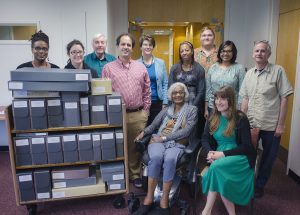

 Rutgers University Libraries faculty and staff had a busy summer preparing for the email and calendar migration to Rutgers Connect. The migration took place over three days between August 23 and August 25, 2016, but by the time we reached this milestone, over two months of work by Unit Computing Specialists (UCSs) and Integrated Information Systems (IIS) staff had already been invested into planning the process, preparing for the transition, and learning the new environment.
 On December 26, 2015, Izzy Stern tweeted: “Today is the day I found out that Rutgers doesn’t even have full ebrary access. So many sad faces.” As a graduate student in a major humanities department at Rutgers–New Brunswick, Izzy might have expected to use ebrary, one of the largest academic e-book resources, for her research in the winter break, but then had a rude awakening that day when she found out that it was not available at Rutgers, yet. So she went online and shared her frustration on Twitter with the entire world, which was totally understandable. As a matter of fact, the lack of access to e-books was a major source of complaint from our students and faculty about the library collections—hundreds of similar comments can be found in the results of the LibQual+ and previous Counting Opinions surveys. Here, I quoted only Izzy’s tweet because it is on the open web, but the problem she reported was a common one.
 Libraries operate on the premise of cooperation and support. Technical services, in particular, embodies this ideal, as evidenced by international union catalogs such as OCLC’s WorldCat and programs like the Program for Cooperative Cataloging (PCC), which contribute catalog records that are created to specific standards that are shared with other libraries, ensuring an efficient, accurate, and timely workflow.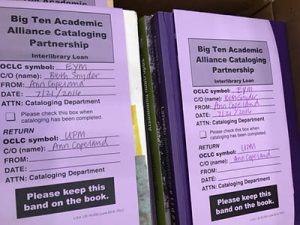
 Overnight library hours are among the most frequently requested service enhancements students would like to see in the New Brunswick Libraries. Popular during finals, students would like the option to work 24/7 during other parts of the academic year too. Twenty-four hour spaces are also standard in most of our peer libraries—in fact, only two of our Big Ten partner institutions do not provide this service.