Category: Units

  • It’s Official: Dana Marks 50th Anniversary as Federal Depository

    federal-depositoryWhere do you find population figures from a century ago? Health statistics over time in Newark, New Jersey or the U.S. as a whole? Business and economic or other information for those studying small business development or wanting to go into business for themselves?

    Valuable information such as this can be summed up in two words: government publications.

    In December, Dana Library celebrates 50 years since it obtained its status as a Federal Depository Library for the 10th Congressional District of the State of New Jersey. It has been a boon to faculty, students, the general public and the business community. It promises to continue to be a major resource at Dana even as most of the government publications are now available online. Dana also serves as a depository for many, but not all, publications of the State of New Jersey.

    One enhancement that accompanies their presence at the libraries are classes in which library faculty reaches out to faculty and students to educate them on the use of publications distributed by the Government Publishing Office (GPO) and online resources issued by the Federal Government.

    “The subjects covered by government publications go from the general to the specific, essential for researchers as well as the general public. Most importantly, government publications are available to all users regardless of affiliation or age,” said Wen-Hua Ren, the documents librarian who supervises government publication collections at Dana.

    New Jersey is home to as many as 25 federal depositories. Each of Rutgers University campuses, including New Brunswick and Camden, has a designated federal depository library. RU-Newark has two, the other being the Law Library which receives depository materials that support legal research and study.

    Programs in recognition of the fiftieth anniversary will be held in December and possibly also in January 2017. In addition to a display, there will community instruction programs offered to educate the public on the usefulness of the collections and service.

  • Exhibit and Tours to Emphasize Modernist Aspects of Dana Library and Rutgers-Newark Campus

    docomomo-005
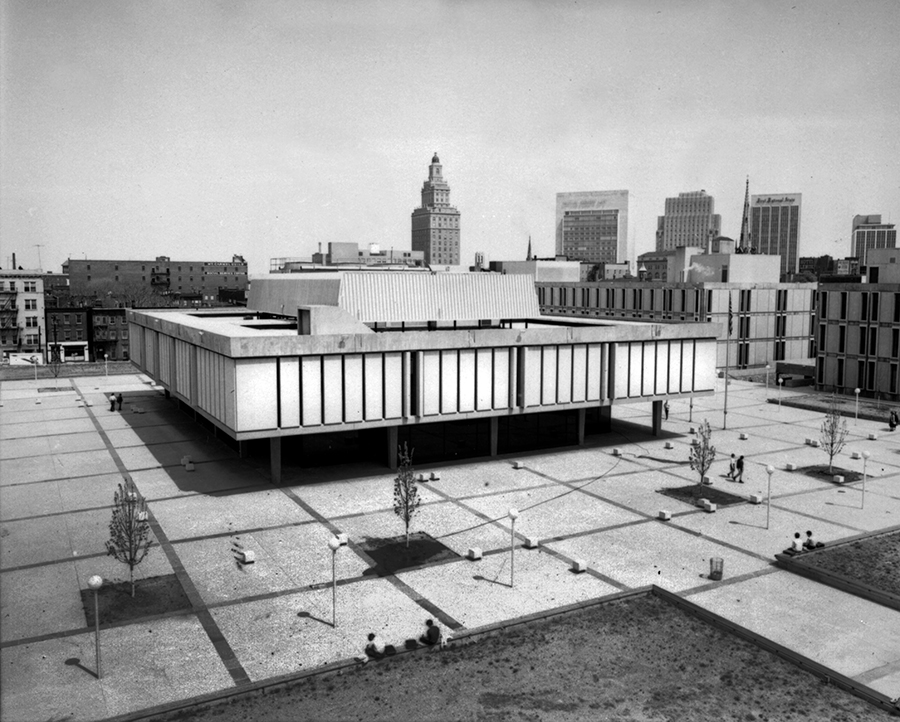
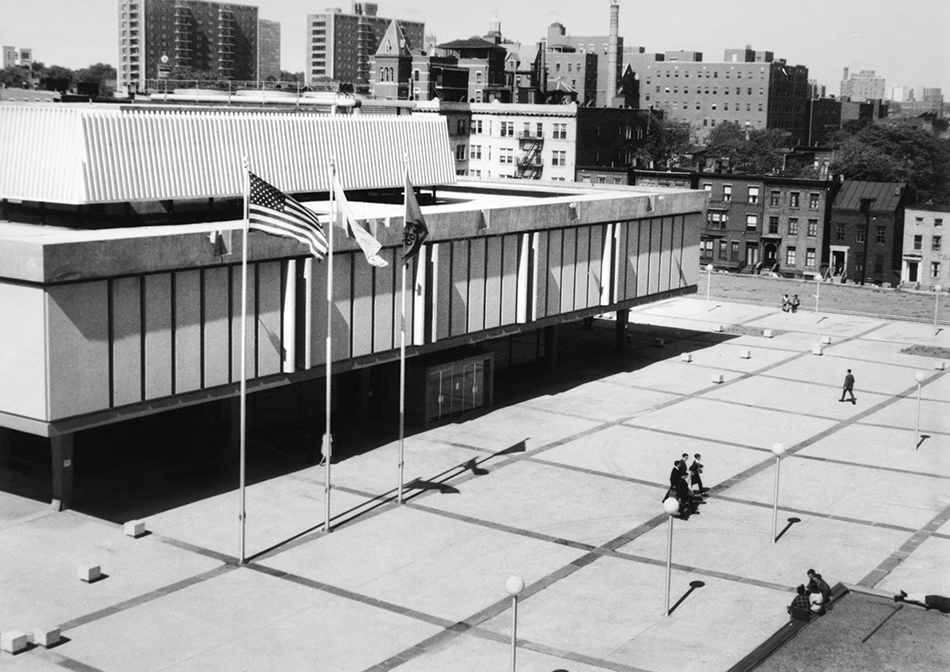
    Dana Library was the centerpiece for modernist buildings erected on the Rutgers University-Newark which are highlighted in an exhibit opening and tours at the library on October 15. Dana Library Archive.

    In 1959 Rutgers president Dr. Mason Gross fired a blunt shot across the bow in the pages of the New York Times in his quest to pass a $75 million bond issue. His plea was as much about expansion of the facilities as adding depth to the university’s core mission of education, culture, and social mobility for the burgeoning Baby Boom generation.

    Gross referred to New Jersey as educationally “impoverished” and culturally “almost bankrupt” in advocating Rutgers’ power to make a difference. The funding package passed and its impact on the Newark campus with construction of seven new buildings over the course of the 1960s was profound.

    Part of that legacy—the Newark campus’s inventory of significant modernist architecture and spatial concept—is the subject of an exhibit opening October 15 at the John Cotton Dana Library, Making a Place: Rutgers University-Newark as a Microcosm of 1960s America. Programming will also feature hour-long campus tours led by Newark-based architects, preservationists, and historians; in addition to tours of the world-renowned Institute of Jazz Studies, located on the fourth floor of the library. For additional details, see: http://docomomo-us.org/architecture_urbanism_rutgers_university_newark

    Cultural historian Dr. Eva Giloi, an associate professor of history at Rutgers University-Newark who is organizing the festivities, said Newark figured prominently in Gross’s plans.

    “Buildings here were designed and situated on the campus as part of a coherent vision of modernist mid-century architecture, with Dana Library the center of student life and community involvement,” said Giloi. “It was a humanistic concept in the way it used open space.”

    dana-plaza-001
    October 15, 2016 has been designated a DOCOMOMO US Tour Day. Dana Library Archive.

    The project’s supporters go way beyond the Rutgers community. The campus will enter the registry of DOCOMOMO, the world’s leading modernist preservation organization located in Barcelona, Spain.

    Giloi describes the exhibit as a “multisensory exhibit about the campus history and architecture in Dana Library,” using original architectural blueprints, photographs, yearbooks, and other artifacts bearing on the campus and student life during socially tumultuous times.

    Dr. Askew, director of Dana Library, said of Giloi’s research, “The campus plan from 50 years ago all started with a library building. Therefore, it is befitting that Dana Library, in addition to being a stop along the tour, also has a central role in this event.”

    The exhibit and programs are sponsored by the Dana Library, the Institute of Jazz Studies, Rutgers University-Newark Department of History, The Clement A. Price Institute, and DOCOMOMO, which has designated the events as an official U.S. Tour Day.

    Activities this month will be amplified when the fiftieth anniversary of Dana Library gets underway next year.


    Save

    Save

  • Dana Library Transformation into 21st-Century Knowledge Center Heading from the Drawing Board into Reality by 2018

    Dana Library Transformation into 21st-Century Knowledge Center Heading from the Drawing Board into Reality by 2018

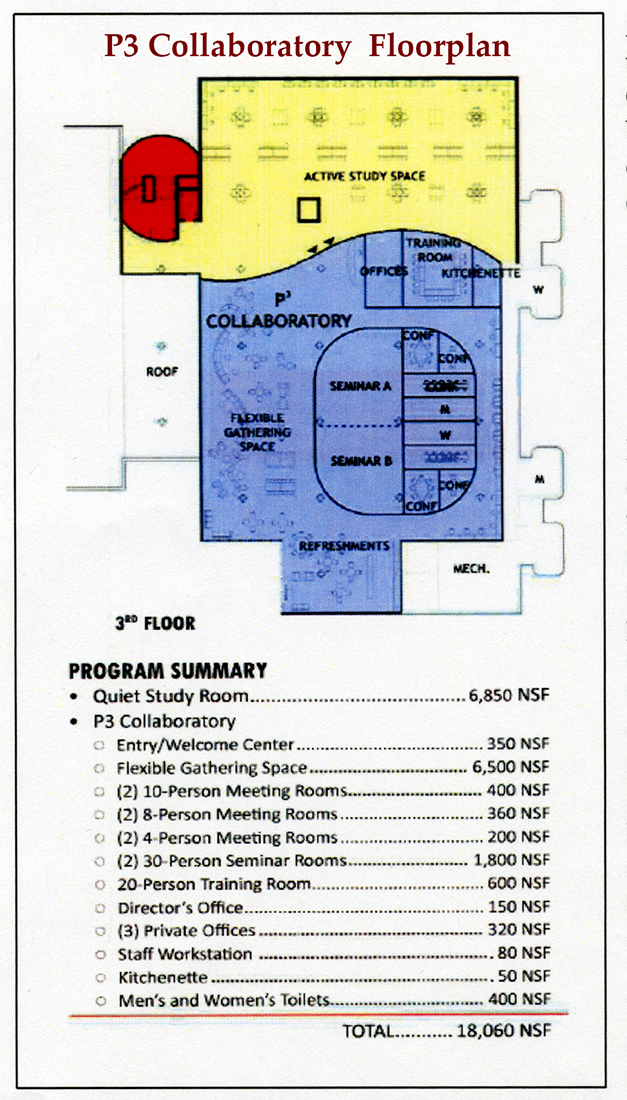
    Floor-plan of the P3 Collaboratory which is expected to be in operation on the third floor of Dana Library by 2018. Click to enlarge.
    Floor-plan of the P3 Collaboratory which is expected to be in operation on the third floor of Dana Library by 2018. Click to enlarge.

    Imminent plans to develop the third floor of the John Cotton Dana Library by 2018 are integrated with a farsighted and sweeping reconceptualization of the role of libraries at the juncture where 21st-century pedagogy and information delivery meet. These were among topics addressed in an initial report and recommendations released September 26 by the New Professoriate Study Group, co-chaired by Dr. Bonita Vesey, vice chancellor for planning and implementation, and Dr. Consuella Askew, director of Dana Library.

    The P3: A Collaboratory for Pedagogy, Professional Development and Publicly-Engaged Scholarship is designed to meet the needs of educators from preparation of graduate students for high impact, publicly engaged scholarship and leadership skills. Attracting promising scholars to a curriculum offering broad strategies for career-long activities in the world of academe and beyond holds the keys to success of the concept.

    Programming in support of the P3 Collaboratory is getting underway this fall with offices located on the second floor of the library. In addition, Rutgers-Newark chancellor Nancy Cantor is convening a two-day conference on the new professoriate October 28-29. The initiative is also the motivation behind $2 million in seed grants through the chancellor’s office to encourage creative cross-disciplinary, high impact, sustainable and innovative programs.

    Dr. Vesey said that while aspects of the P3 Collaboratory are not new, the combination and depth of the programs on the Rutgers-Newark campus is unusual and ideal for the diversity of students, faculty, and staff of Rutgers-Newark.

    “Under this plan, the library will be less of a repository of books, but the intellectual center of the campus, a role Dana Library already fulfills,” she said. “Consuella really understands and supports the mission of libraries in the 21st century.”

    Save

    Save

  • Welcome to the New Shared User Services Department

    Welcome to the New Shared User Services Department

    Krisellen Maloney, Vice President for Information Services and University Librarian

    I recently announced the formation of the Shared User Services Department, headed by Rhonda Marker as director of shared user services. This month, I want to provide a bit more context for this shift and how it fits into the priorities for the Libraries.

    To begin, it is best to look at the budgetary issues and priorities that we discussed at the State of Libraries in 2015, what we have learned, and how what we have learned is shaping our actions and the priorities for this year.

    A major priority—because it is at the heart of everything that we do—has been to clarify decision-making within the libraries. At the State of the Libraries, we talked about several ways in which we would do this, but the two that are most relevant to this discussion are the roles and decision-making authority of the AULs and directors and improving budget transparency.

    Throughout the year, as we began to define roles, it became apparent that having the coordinating function for shared public services and the leadership of the New Brunswick Libraries combined under one AUL was causing confusion. This is the same structural problem that the University addressed when they separated the executive vice president for academic affairs position into two positions: a senior vice president for academic affairs and the chancellor of Rutgers–New Brunswick. Following the university structure, we knew that we needed to separate the coordinating function and the leadership of New Brunswick Libraries.

    Budget transparency is also a driver for clearly defining central and university functions. We are now in the thick of the RCM budget process, and we know that the four chief financial officers expect us to accurately report expenses. A clearly defined central unit would bring more clarity to our accounting. The RCM budget model and our funding levels brought in another factor. With no funds available to create a new unit, the function of an existing unit would need to be modified.

    Two more priorities from the State of the Libraries provided us with ideas of how we could redefine our central units to support the changing university environment: the need to better understand and imporove our collections and the need to clearly articulate our vision for advanced research support, including scholarly communication.

    This year, we have begun to address collection management and development. We’ve used central and New Brunswick reserves to make large purchases that fill some holes in our collection. However, the results from our recent LibQUAL+ survey indicate that the negative perceptions of our collections are linked to discovery issues and problems with the website. Based on these findings, we have set a new priority for this year to improve information control which we will discuss more fully at the 2016 State of the Libraries.

    We are pioneers in the areas of advanced research support and scholarly communication, but internally we lack the infrastructure—organizational structure, connection to Cabinet, clear sources of funding—to support a path forward. This is something that we will study over the next year.

    With a need for improved information control and a lack of direction for scholarly communication priorities, we looked at the Scholarly Communications Center to see if there was an opportunity to restructure. Over many weeks this summer, I worked with a team to tease out the various functions of the Scholarly Communications Center, assessing each responsibility and aligning it with the appropriate unit or department. These were not easy decisions because advanced research support and discovery are complex aspects of what we do as a library system.

    Our goal was to create a department that could play a central coordinating role and be a single point of entry to access ongoing scholarly communications projects and to bring new projects into the fold.  The Shared User Services Department will also coordinate discovery, the website, and the shared components of reference. The Libraries have put a great emphasis on transparency and accountability over the previous year and SUS will work closely with University Library Directors and Cabinet to prioritize projects and communicate with infrastructure units to make sure that resources are available and requirements are clear. In essence, they will be the one-stop shop for project management on these larger initiatives.

    I noted this in my earlier announcement, but it is worth reiterating that this transition also involves significant changes in the role of the directors, IIS and RIS.  I will explore each of these in upcoming issues of the Agenda.

    These are exciting changes for the Libraries and I anticipate the work of the SUS department will further shift and mold our priorities over the coming year. During this period of transition and change, I encourage you to speak with the directors and AULs if you have concerns, suggestions, and ideas that will help us move forward in a smart, efficient way.


    Save

  • Hungary’s Anniversary and Its Refugees

    hungary2Sixty years ago Hungary was in revolution against the one-party Communist state. Soviet armed forces entered Budapest to restore order, then withdrew in the face of stiff popular resistance. Prime Minister Imre Nagy announced a multi-party government and declared the country’s withdrawal from the Warsaw Pact alliance. This prompted a second Soviet intervention, the ouster of the Nagy government, and the flight of 200,000 Hungarians who feared the Communist crackdown and took advantage of an open border.

    These many years later, post-Communist Hungary’s conservative government is inclined to celebrate the Revolution as a rejection of everything the Soviet regime represented. Meanwhile, the current government is confronting the European Union over the EU’s proposal that member countries be required to accept refugees according to a quota. On this issue, the government organized a national referendum for October 2 and is dominating the media with stories about the refugees entering Europe today and the need to reject the EU proposal. Scholars and opponents of the government are proposing different views of both the socialist character of the Revolution and the humane reception of refugees, then and now. I gave a paper (in Hungarian) at an exciting conference in Eger, Hungary on September 8-10: 1956 and Socialism: Crisis and Reconsideration.

    My paper translates as The Culture of Welcome and the January, 1957 Austrian Refugee Quota Proposal. On the basis of research in the archives of the United Nations in New York and the Alexander Libraries’ excellent collection of UN and European documents, I traced the debate about the Hungarian refugees in the UN and the motives behind the decision of many Western countries to announce voluntary quotas for the number of Hungarians they would accept for resettlement. My paper and those of fellow panelists were reported in the main newspaper of the Hungarian opposition (this link is broken because the paper was recently purchased by a government-friendly owner and all content moved offline). Many of these papers, including mine, are forthcoming in Világtörténet, a journal of the Hungarian Academy of Sciences.

    The Hungarian Academy is one of many organizations that encourage their scholars to make their research freely available. It is helped in this effort by the strong position of authors in the Hungarian publishing system: copyright transfers are not standard as in the US when publishing in a journal. Therefore, the editor of Világtörténet immediately assured me there was no obstacle to my posting the English original of my article—and the Hungarian translation when it is available—in the Rutgers institutional repository. Now the English version is available online in SOAR and accessible for readers in Hungary, with the Hungarian version soon to follow. SOAR’s ability to accommodate multiple versions of the same article is ideal for situations requiring prompt dissemination and different languages.

    Save

  • RSVP for the Faculty and Staff Appreciation Picnic

    The Rutgers University Libraries Faculty and Staff Appreciation Picnic will be held on Friday, October 21 from noon–4 p.m. at the Log Cabin and Pavilion in Rutgers Gardens (140 Log Cabin Road, North Brunswick). There will be food, music, games, and other surprises.

    Please let us know if you plan to attend by filling out the form below. We can’t wait to see you there!

  • Now Open for Research: The Andrew Hill Papers, Music, and Audiovisual Recordings

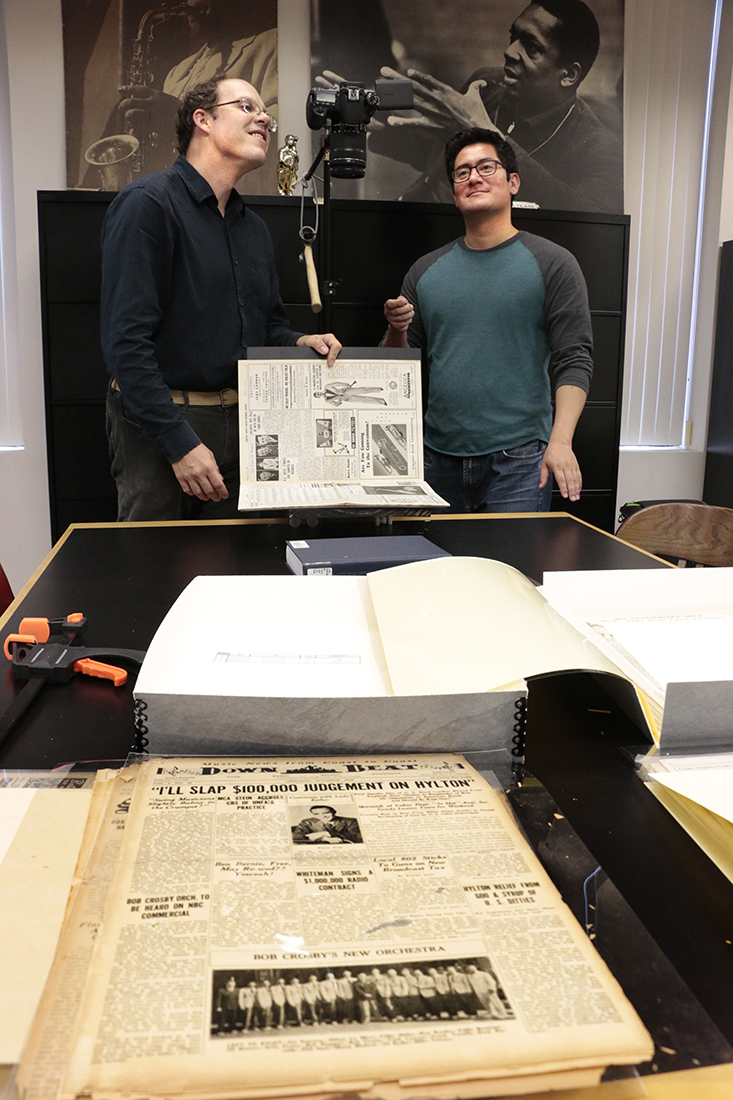
    2016 Jazz Archives Fellows and Institute of Jazz Studies and Dana Library faculty and staff pose with Joanne Robinson Hill and the processed Andrew Hill collection.  Pictured (L-R) Angela Lawrence, Adriana Cuervo, Bob Nahory, Brad San Martin, Krista White, Joanne Robinson Hill, Veronica Johnson, Max Dienemann, Treshani Perera, Elizabeth Surles, and Tad Hershorn.  Photo by Ed Berger, some rights reserved.
    2016 Jazz Archives Fellows and Institute of Jazz Studies and Dana Library faculty and staff pose with Joanne Robinson Hill and the processed Andrew Hill collection. Pictured (L-R) Angela Lawrence, Adriana Cuervo, Bob Nahory, Brad San Martin, Krista White, Joanne Robinson Hill, Veronica Johnson, Max Dienemann, Treshani Perera, Elizabeth Surles, and Tad Hershorn. Photo by Ed Berger, some rights reserved.

    The Institute of Jazz Studies (IJS) is pleased to announce the availability of the Andrew Hill papers, music and audiovisual recordings, 1956–2011. Hill (1931–2007) was an influential and acclaimed jazz pianist, composer, band leader, educator, and winner of numerous prestigious jazz accolades, including the National Endowment for the Arts Jazz Master award in 2008, among the highest honors in jazz in the United States. The extensive collection, generously donated in 2015 by Hill’s widow, Joanne Robinson Hill, includes materials ranging from his musical compositions, sound recordings, correspondence, and awards, to press kits and even one of his favorite hats.

    The collection was processed as part of the 2016 Jazz Archives Fellows residency, with IJS archivists Angela Lawrence, Tad Hershorn, and Elizabeth Surles working in tandem with jazz fellows Veronica Johnson, Brad San Martin, and Treshani Perera and intern Max Dienemann to arrange, describe, and rehouse the collection and create an EAD finding aid for the materials. The (IJS) started the Jazz Archives Fellows program in 2012 with two purposes in mind: to improve diversity in the archives profession and to provide a meaningful professional development opportunity for early career archivists and for students in graduate programs who intend to become archivists. In addition, the IJS benefits directly from the fellows’ work to process a collection. To see firsthand the fellows’ work and learn more about the collection and Andrew Hill, please explore the online finding aid at http://www2.scc.rutgers.edu/ead/ijs/hillf.html.

    The processing of the collection is timely. While it has only been open to researchers for a couple of months (before being announced publicly), the collection has already been used to produce a series of Andrew Hill legacy concerts at the Jazz Standard in New York City to celebrate what would have been Hill’s 85th birthday, as well as supported research by scholars visiting the Institute.

  • Rutgers Connect Migration Postmortem

    Rutgers Connect Migration Postmortem

    Office_365_logoRutgers University Libraries faculty and staff had a busy summer preparing for the email and calendar migration to Rutgers Connect. The migration took place over three days between August 23 and August 25, 2016, but by the time we reached this milestone, over two months of work by Unit Computing Specialists (UCSs) and Integrated Information Systems (IIS) staff had already been invested into planning the process, preparing for the transition, and learning the new environment.

    Here are some of the highlights:

    • 261 users responded successfully to the pre-migration questionnaire
    • 151 RUL members attended one of seven Information Sessions before the migration
    Please fill out a brief survey by Friday, October 14, and let us know how we did and what you are looking for, in terms of Rutgers Connect training and support, in the future.
    • 277 user accounts, 61 distribution lists, and 59 shared (resource) accounts were migrated
    • 146 RUL member participated in 9 hands-on training sessions conducted by Comparex and IIS (and paid for by the Rutgers Office of Information Technology)
    • 227 support requests have been completed since August 1
    • RUL retirees are also getting help migrating to ScarletMail, but that is a slower process and we respect their schedules
    • IIS was successful in arguing for reduced University requirements related to central management of personal mobile devices when accessing Rutgers Connect mail

    The migration went relatively smoothly, without any significant data loss, but there were inevitable glitches given the complex nature of the system and the four-way handling of the process: Microsoft as the owner of the platform, Rutgers as the customer (represented by OIT), Comparex as the University’s partner performing the actual migration, and, in RUL’s case, IIS as the local IT support unit, together with our UCS colleagues.

    We want to thank everyone for your patience and understanding as we have worked, and still keep working, to make the new tools perform efficiently for all. The Rutgers Connect environment is new to all of us, and there is still a lot to learn. IIS will transform the Rutgers Connect Migration Support website into an ongoing support site in the next couple of weeks. We will also try to prepare advanced training classes in the coming months.

    Since the Rutgers Connect/Office 365 platform lives in the Microsoft cloud, several features are difficult or impossible to adjust to our exact requirements. Rutgers is still working with the vendor to make changes, including the ability to set the default Sender address.

    All IIS members and UCSs added supporting the migration to their regular responsibilities, and they deserve our thanks. Tracey Meyer has been, and remains, our lead support person, and Kalaivani Anathan coordinated the migration process. We hope we have been able to help you all, and look forward to respond to any future question or support request.

    Please fill out a brief survey by Friday, October 14, and let us know how we did and what you are looking for, in terms of Rutgers Connect training and support, in the future.


    Save

    Save

    Save

    Save

    Save

  • Rutgers Joins the E-book Revolution

    vivaOn December 26, 2015, Izzy Stern tweeted: “Today is the day I found out that Rutgers doesn’t even have full ebrary access. So many sad faces.” As a graduate student in a major humanities department at Rutgers–New Brunswick, Izzy might have expected to use ebrary, one of the largest academic e-book resources, for her research in the winter break, but then had a rude awakening that day when she found out that it was not available at Rutgers, yet. So she went online and shared her frustration on Twitter with the entire world, which was totally understandable. As a matter of fact, the lack of access to e-books was a major source of complaint from our students and faculty about the library collections—hundreds of similar comments can be found in the results of the LibQual+ and previous Counting Opinions surveys. Here, I quoted only Izzy’s tweet because it is on the open web, but the problem she reported was a common one.

    What a difference a few months have made! Izzy and her fellow students may be glad to hear that the Libraries have made great strides to improve their access to e-books. Here are the major e-book resources that became available at Rutgers in the last several months:

    • Ebrary Academic Complete: a subscription-based collection of about 140 thousand e-books on all academic subjects.
    • Springer Nature frontlist e-book collections: 7,175 purchased e-books published in 2016 in STM (Science, Technology, and Medicine) and Social Sciences.
    • PALCI/EBSCO Demand-Driven Acquisitions Program: about 1,000 new e-books expected to be purchased during the academic year.

    In addition, we are evaluating a new PALCI/JSTOR e-book program. The program will purchase several hundred high-use titles and also provide academic year-round access to all the JSTOR e-books, a collection of over 40,000 high quality scholarly monographs from many of the major university presses.

    Over a decade ago, the Libraries began to acquire small, subject-based e-book collections. In 2014 we joined HathiTrust, which gives us access to several million out-of-copyright works. However, the availability of large, comprehensive collections of current e-books today represents a quantum leap or a sea change. Since the Rutgers community is celebrating the 250th anniversary of the University this year with a revolutionary spirit, it may be befitting to call this significant change a revolution, an e-book revolution.

    Stepping outside Rutgers, we will find that the e-book revolution is sweeping through the academic and research libraries in the region and the country. Actually, all of our major e-book acquisitions I mentioned earlier were made or will be made together with our partners in BTAA, PALCI, and VALE. This shows that Rutgers is adopting e-books at about the same pace as the majority of academic libraries. Being in the majority does not seem as glorious as playing the role of innovator or early adopter, but it is still an advantageous position, especially from a user perspective. Of course, if we moved any slower, we would have been left behind or characterized as reactionary by our peers.

    Peer pressure is not why we are joining the e-book revolution. It is for the good of our own community. Within our organizational context, there are many reasons why the large-scale shift to e-books is happening now:

    • The arrival of Krisellen as our University Librarian last year set a new direction for the Libraries.
    • E-books provide convenient, equal, and equitable access to the entire Rutgers community, which happens to be a mandate under the University’s RCM budgeting model as well as a core value of librarianship.
    • The loss of $1 million purchasing power in the collections budget in FY15, combined with the ongoing inflationary pressures, forces us to rethink our collection development priorities and strategies.
    • When adopted by instructors as textbooks, e-books can generate substantial savings for students struggling with high textbook costs (see one reported example at Rutgers), which is important in the context of a large public university.
    • The adoption of e-books can be part of the solution to our space shortage problem. As the Library Annex is full, our largest library locations are experiencing the stacks overflow problem at the same time that the universities want the Libraries to create more study space for a growing student population.

    Relating to the last point, I distinctly remember a scene from the Library Town Hall meeting in the spring—a brave staff member stood up and asked everyone: “Since there is really no space in the Libraries, why do we keep buying print books?” Does this remind you of that fabled child who cried “The emperor has no clothes!” or what? I believe that print books are not obsolete and probably won’t be for a long time. There are also situations when only print is available. But we do have to be mindful of our space constraints when making book purchase decisions.

    The e-book revolution is giving our community unprecedented access, but what it cannot do is bring a paradise to libraryland, not at Rutgers nor anywhere else. On the contrary, profound changes are always messy, chaotic, and uncomfortable and this one will be no exception. We have already started to face a new set of problems: how to make print available to the users who need it, in spite of our space and financial constraints; how to minimize the inevitable duplication between different e-book providers; and how to improve the discoverability of e-books, just to name a few. As we navigate these complex and difficult issues and find solutions, we will continuously improve our collections for the benefit of students like Izzy Stern.

    Save

    Save

  • Central Technical Services Participates in Big Ten Academic Alliance Cataloging Partnership

    A translation from one language to another graphicLibraries operate on the premise of cooperation and support. Technical services, in particular, embodies this ideal, as evidenced by international union catalogs such as OCLC’s WorldCat and programs like the Program for Cooperative Cataloging (PCC), which contribute catalog records that are created to specific standards that are shared with other libraries, ensuring an efficient, accurate, and timely workflow.

    One of the most challenging aspects of cataloging is handling foreign languages, especially when in-house expertise is lacking. Outsourcing materials is costly and a challenge when funding isn’t available. Hiring someone short-term to handle a gift isn’t always feasible or productive. The Big Ten Academic Alliance (BTAA) recently instituted a partnership to solve this problem in a collaborative and cost effective way.

    Catalogers from Central Technical Services (CTS) are participating in the BTAA Cataloging Partnership, a collaboration between 12 of the 14 BTAA institutions’ libraries to cooperatively share cataloging expertise for languages and formats. The partnership, coordinated by The University of Chicago, enables participants to leverage expertise across their libraries and is effective for the next two years (July 1, 2016–June 3, 2018).

    Here’s a broad overview of how the partnership works and the benefits to Rutgers:

    Step One – take inventory, create a work plan

    The first step was to conduct an inventory of language expertise and needs, plus format expertise and needs. A spreadsheet with this information was compiled that includes a proposed work plan that details which institutions will handle what work. Rutgers will contribute expertise in Hungarian, Polish, and Hindi, as well as music scores.

    A photo of books packaged for translation.
    Source: https://sites.psu.edu/librarynews/2016/08/01/big-ten-academic-alliance-cataloging-partnership-formed/

    Step Two – develop a work flow

    Materials cataloged for the partnership are sent via the BTAA’s Uborrow interlibrary loan program to hold down costs. All resources are marked by a purple band that stays on them until they are cataloged and returned to the owning institution. Cataloging can be done either using Resource Description and Access (RDA), the prevailing cataloging standard, or AACR2 (RDA’s predecessor). Materials will receive copy cataloging or original cataloging treatment, and all work is done using OCLC’s Connexion cataloging client. Catalogers will follow the BIBCO* Standard Record (BSR), which emphasizes access points over description. Participating libraries are required to commit to a minimum of ten hours of cataloging per month (ten hours per institution, not ten hours per cataloger).

    Step Three – stay in touch and assess

    A discussion list has been established for the heads of technical services at each participating institution, and there is a monthly conference call to discuss progress, concerns, etc. Statistics are submitted online monthly via a Google documents form and include language, format, number of titles cataloged (titles, not volumes, are counted), and any anomalies encountered while cataloging.

    Outcomes

    Thanks to this collaborative program, we will be able to catalog dozens of foreign language publications, exposing these valuable resources and making them discoverable. We have already sent Persian and Hebrew books to Maryland, Belarussian books to Northwestern, and Greek books to the University of Minnesota. Michigan will catalog 130 Arabic books and 72 serials for Rutgers later in 2016.

    We are also providing cataloging for many of our peer libraries. To date, Rutgers is cataloging 32 music scores for the University of Chicago and 25 Hungarian books from the University of Illinois. Rutgers will also receive 100 Polish books to catalog from Michigan and Hindi books from Northwestern.

    Roman Frackowski, Bela Gupta, Julianna (Kati) Ritter, and Catherine Sauceda are providing cataloging for Rutgers and Mary Beth Weber is Rutgers’ point person for the partnership. If you have questions about this program or the materials that are being processed, please contact Mary Beth.


    *BIBCO is a program within the PCC that contributes high quality bibliographic records for books.

    Save