Category: Department

  • Announcing Archival Description of Notated Music and the Guidelines for Archival Description of Notated Music

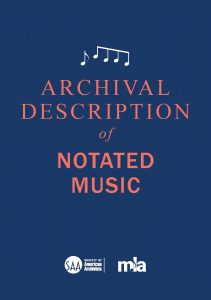
    In early October the Society of American Archivists (SAA) and the Music Library Association (MLA) co-published a new open-access ebook, Archival Description of Notated Music (ADNM), co-authored by the MLA Working Group for Archival Description of Music Materials, which I had the pleasure of co-chairing with Dr. John Bewley, a Rutgers alumnus and the retired associate librarian/archivist at the University at Buffalo Music Library.  Working Group members also included Sofía Becerra-Licha, lead archivist at the John F. Kennedy Center for the Performing Arts; Maristella Feustle, music special collections librarian at the University of North Texas; Vincent J. Novara, head of the Acquisitions and Processing Section in the Music Division at the Library of Congress; Matthew Snyder, archivist at the New York Public Library; and Karen Spicher, manuscript cataloger and processing archivist at the Beinecke Rare Book and Manuscript Library at Yale University.
    ADNM provides guidance intended for a wide readership and is helpful for experienced archivists with limited knowledge of music, music librarians with limited knowledge of archival practice, students in MLIS and archival studies programs, and others with responsibility for archival collections with notated music. The book includes discussion of fundamental archival principles as applied to collections with notated music, recommendations for descriptive approaches based on the musical and non-musical content of a collection, a glossary, and an annotated resource list. In addition, included as an appendix are the Guidelines for Archival Description of Notated Music, which provide a standard for archival description of notated music and represent the first subject-specific supplement to Describing Archives: A Content Standard (DACS). The Guidelines were endorsed by the SAA Council as an external standard at the end of 2019. Both the Guidelines and ADNM are available via MLA’s Humanities Commons repository. ADNM may also be downloaded free-of-charge from the SAA Bookstore.

    The Working Group started the project in 2016, and none of us expected it to become a full-length book and professionally-endorsed standard, much less require four years and countless hours of meetings to complete. We took a collective approach to authorship: one or two group members drafted each section of the book, which we then revised and edited as a group. Although this approach was time-consuming, the final publications represent our consensus agreement on standardized archival practice and the full range of group members’ considerable expertise. We also solicited and incorporated feedback from colleagues in other music libraries and archives and collaborated closely with SAA’s Technical Subcommittee on DACS, which contributed to SAA’s endorsement of the Guidelines. This cross-organizational collaboration was essential to the successful outcome and will hopefully serve as a model for future DACS supplements.

  • Ann D. Gordon to Give Presentation on Women’s Suffrage in New Jersey

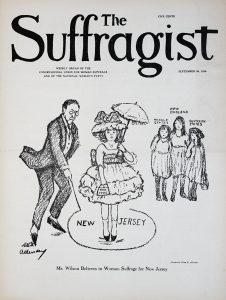
    2020 marks the 100th anniversary of the Nineteenth Amendment (1920) granting women the right to vote. In celebration of this milestone, Rutgers Research Professor Emerita of History Ann D. Gordon will give a presentation, “Bringing the Story Home: Agitating for Woman Suffrage in New Jersey,” on Thursday, September 24, 2020 at 4 p.m.
    Activists organizing for women to gain voting rights were everywhere across the United States, island territories included.  The struggle to win the right to vote is a national story chock full of local details, highlights of which will be explored in this presentation.

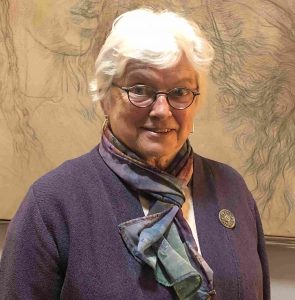
    Ann D. Gordon is Research Professor Emerita of History at Rutgers University. She has studied the movement for woman suffrage for nearly four decades as an author, editor, and lecturer. Her six-volume edition of the Selected Papers of Elizabeth Cady Stanton and Susan B. Anthony was published from 1997 to 2013. Toward celebrating woman suffrage at this centennial, her essay on the 19th Amendment appears in the National Park Service’s website publication, 19th Amendment and Women’s Access to the Vote Across America; she served as a historical advisor to the National Archives in preparing its suffrage centennial exhibit, Rightfully Hers; and, until the pandemic, she lectured often on the history of voting rights.

    This program marks the opening of the Special Collections and University Archives online exhibition, On Account of Sex: The Struggle for Women’s Suffrage in Middlesex County, New Jersey. More details about the exhibition will be forthcoming.

  • New Content for Library Tutorials!

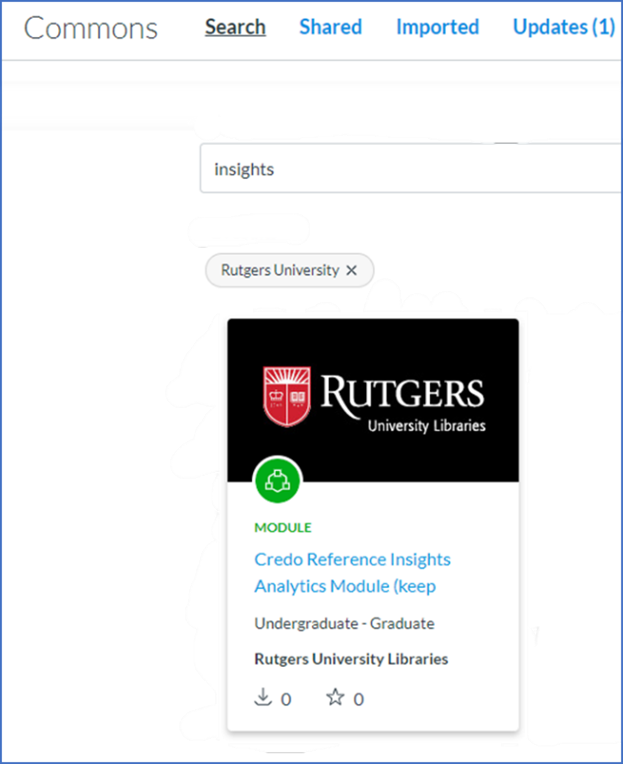
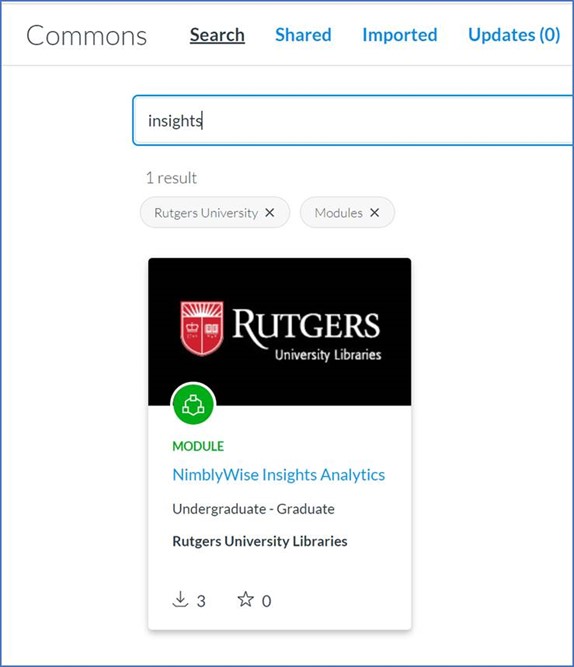
    The NimblyWise and Credo Reference Library instruction tutorials have undergone some changes and enhancements for the fall.

    For Credo Reference:

    • The addition of APA Citations 7th edition tutorial.
    • The addition of AMA Citations – A tutorial, which includes a video and checkpoint assessments for practice, on American Medical Association (AMA) style has been added to the Understanding and Using Research Sources section.
    • The addition of Gray Literature – The Health Science Resources section has a new tutorial, which includes a video and checkpoint assessments for practice, on gray literature (information from non-commercially published sources that can have use in research, such as conference proceedings and dissertations).
    • The Revisions of PubMed Material – the PubMed tutorial, including the screencasts, has been refreshed where relevant to reflect PubMed’s redesign.

    Quiz questions on the new topics of AMA and gray literature have been added to appropriate assessment libraries.

    For NimblyWise:

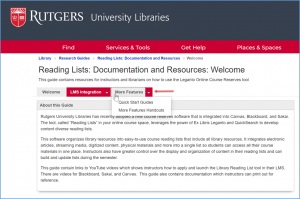
    For the Library Tutorials web page:

    • Citation Styles – New tutorial on APA Citations 7th
    • New quiz on Chicago Manual of Style 17th
    • Getting Started with Research
    • New video on “Framing a Problem” and a new quiz on “Research Strategies”.
    • Presenting Research and Data -The previous video, tutorial, and quiz on Synthesizing Information have been replaced by a video on “Synthesis” and a tutorial and quiz on “Synthesizing Information for Academic Writing”.
    • Using Critical Thinking and Logic – New video on “Why Thinking Matters” and new tutorials on “Logical Reasoning” and “Analyzing Information”.

    Evaluating Information – The video “How to Identify and Debunk Fake News” and the quiz on “Fake News” have been retired by the vendor.

    For questions about Library tutorials, contact Maria Breger at maria.breger@rutgers.edu

    View the complete list of the Libraries Teaching & Learning topics.

  • Communications Department Site Overhaul

    One of my projects for the summer was transferring the Communications Department site off the old apps.libraries platform and over to the new Staff Resources site. It is now located here: staff.libraries.rutgers.edu/communications.

    On the site you will find a variety of useful resources, from logo files and presentation templates, to flyers and signage, to style guidelines, to helpful tips and tricks. You may be particularly interested in the new Event Planning Guide (updated with a section on best practices for online events!) and the downloadable Zoom/WebEx backgrounds.

    Please have a look around and let me know what you think. I’m always looking for feedback on improvements and suggestions for new content. Thanks!

  • Rutgers Connect: Recent Changes and Enhancements

    Some recent changes and enhancements in Rutgers Connect have been announced by OIT. Several are highlighted and described here. Please do not hesitate to contact IIS at support@rulhelp.rutgers.edu if you have questions or comments about these enhanced or new features, or anything related to Rutgers Connect. 

    Login Upgrade:

    Rutgers Connect now allows you to log in with any of your aliases. You are no longer limited to logging in with NetID@libraries.rutgers.edu, and can now use any of the email addresses connected to your account including NetID@libraries.rutgers.eduNetID@rutgers.edu, or firstname.lastname@rutgers.edu 

    Send Later Option in OWA:

    Microsoft has added a new “Send later” feature for Outlook on the web (OWA) that allows you to schedule your messages to be sent later. This feature was previously only available in the Outlook Desktop Client. To access this feature while composing a message, navigate to the dropdown arrow beside the Send button, click on the ‘Send later’ option, and you will see a pop-up that will allow you to choose the date and time for scheduling the email. Until the message is sent, it will appear in your Drafts folder where you may change or cancel the message.

    End Meetings and Appointments Early in OWA:

    Already available in the Desktop Client, Microsoft is now adding the “end appointments and meetings earlier” setting to Outlook on the web. This setting allows you to end all the events you schedule earlier, with a pre-determined time for events that are under or over 60 minutes. This buffer helps you take breaks in back-to-back meetings. This can be enabled in calendar settings, under the “Events and Invitations” tab.

    OneDrive File Size Increase:

    Microsoft has increased the maximum size from 15GB to 100GB for files uploaded to OneDrive. For uploading very large files, Microsoft recommends using its OneDrive Desktop client. 

    Microsoft Teams New Meeting Experience:

    Several new features have been implemented in the new Teams experience. To enable them, select your profile picture at the top of the Teams app, then Settings > General. Select “Turn on new meeting experience” and restart Teams. The new experience includes features such as pop-out meetings by default, meeting control changes, user interface changes, large gallery view (up to 49 streams), and Together mode. Detailed information about these changes can be found here.

    Screen Recording Now Available in Stream:

    Directly from Microsoft Stream, you can now create short screen recordings of up to 15 minutes, including your camera and microphone, without additional software. To utilize this feature, Select Create > Record screen in Microsoft Stream. More details can be found here.

    View Sign-ins:

    Microsoft now lets you view your sign-ins via https://mysignins.microsoft.com/. Though this information has always been logged, you can now view your own recent activity.


  • Notes from Libraries HR

    Past Workshops

    Returning to Rutgers Safely:  Wear Your Mask, Watch Your Distance & Wash Your Hands

    Information Sessions on COVID-19 Health and Safety Precautions were held earlier this month hosted in partnership with Rutgers Environmental Health and Safety (REHS).  Subject experts and instructors Peter Skeels, REHS, Manager of Health and Safety Services and Christine D’Angelo, MPH, Health and Safety Specialist II, spoke about safety precautions intended to mitigate the risks of the spread of COVID-19 as staff, faculty, and certain students begin to return to work on campus and offered knowledgeable tips.

    The sessions were intended for employees returning to buildings onsite.   Attendees had the opportunity to choose among various sessions and ask questions.   All staff and faculty are expected to follow university policies and guidelines in order to sustain a healthy campus.  It is important that we all diligently adhere to these health precautions. If you have any questions or need more information, please contact REHS at 848-445-2550.

    As a reminder, the state is requiring additional compliance training regardless of any previous medical, health, or professional training you may have taken. The specific module can be accessed through your compliance training page under “Safety Short: Coronaviruses and COVID-19”:  https://rutgersu.percipio.com

    Additional University-wide COVID-19 Information can be found in the Returning to Rutgers guide and here for health and safety.


    Understanding the Manager’s Role Under FFCRA

    Earlier this month, essential training on understanding the manager’s role in employee leave options under the Families First Coronavirus Response Act (“FFCRA”) and understanding the manager’s role in Accommodations, was provided in a recorded presentation to supervisors.  The session was intended to explain university policy as it relates to leaves of absence to ensure supervisors are giving the correct information and support to employees.

    Employees who are expected to return to the workplace and who wish to seek a reasonable accommodation, should contact Office of Employment Equity (for Staff) or Academic Labor Relations (for Faculty).

    Supervisors had the opportunity to choose to attend various virtual drop-in sessions and ask questions hosted by Libraries HR.

    Employees with specific questions should make appointments by contacting Libraries HR:

    Michele Petosa, Coordinator of Human Resources at (848)-932-5949 or email rulhr@rutgers.edu

    Erica Parin, Administrative Assistant at (848)-932-5947 or email rulhr@rutgers.edu

    Additional information from the NJDOL, DOL, and University Human Resources is below:


    A message from Occupational Health on Influenza Vaccinations:

    “Occupational Health remains committed to keeping our faculty and staff safe during this global COVID-19 pandemic.  We strongly encourage all Rutgers employees to receive a flu shot this year.  Those employees who have not returned to campus should receive their vaccine at their local pharmacy which is provided at no cost with most medical insurances.  For those currently on campus, we will have 3 curbside outdoor flu clinics at the Hurtado Health Center located in New Brunswick.  We will partner again with Walgreens to assist with providing vaccinations at these clinics, so employees should bring their medical insurance cards at the time of the visit.  Occupational Health will provide any uninsured employee with the vaccine free of charge.  As parking and hours are limited, on campus employees may also consider receiving the vaccine at a local pharmacy.  Due to COVID-19 infection control concerns, this year we will not be able to schedule any off site vaccination clinics.  All graduate students should contact Student Health for their flu shot.”

    The curbside outdoor flu clinics will be located in New Brunswick, at this time no clinics are currently scheduled for Newark or Camden.    Additional information will be shared as we learn more, including dates and times—Be on the lookout for announcements from Libraries HR!

    Rutgers Occupational Health offices by location:

    • Rutgers–New Brunswick, Rutgers–Newark, and Rutgers–Camden: 848-932-8254
    • Rutgers Biomedical and Health Sciences (RBHS) Newark: 973-972-2900
    • RBHS New Brunswick/Piscataway and University Correctional Health Care: 848-445-0123 ext. 2
    • Robert Wood Johnson Medical School faculty and staff: 732-235-6559 

    Stay safe!


    Upcoming Reminders from Libraries HR

    As you prepare to embrace the Fall semester, reminders for employees can be found below as a new academic year is upon us!

    • Rutgers Employee First Initiative—University Human Resources is pleased to announce the Rutgers Employees First initiative. This initiative is intended to provide employees with tools and resources to support and promote employee wellness and build communities of interest around topics relevant to your needs and interests. To explore resources, please visit
    • Online Harassment Prevention Annual Training—All employees should receive an email from “Skillsoft”, a third party vendor, requesting you to complete online training regarding mandatory Harassment Prevention Education. The university uses a third party vendor, “Skillsoft”, as a provider of cloud-based learning and online training for it’s annual harassment prevention education.   Employees must complete this annual mandatory training no later than November 6, 2020.   If you have not yet received your personalized training link, employees may complete the training by logging in with their NetID This training is done on annual basis and is mandatory.
    • COVID-19 Compliance Training: The state is requiring mandatory compliance training regardless of any previous medical, health, or professional training you may have taken. Employees must complete this mandatory training by logging in with their NetID here.  The specific module can be accessed through your compliance training page under “Safety Short: Coronaviruses and COVID-19”:  https://rutgersu.percipio.com
    • Ethics Armor system-Outside Activity Questionnaire (OAQ)–As a reminder, all University faculty and staff members must complete an Outside Activity Questionnaire (OAQ) in the Ethics Armor system in accordance with University Policy.
    • Rutgers University employees (including legacy UMDNJ employees) should update their emergency contact information, home address, phone number(s), and or legal name changes with the Human Resources & Payroll system in your myRutgers Portal as follows:
    • Voluntary Self ID – Ethnicity/Race–We encourage you to take a moment to update your Race/Ethnicity demographic information. Although this two-item questionnaire is voluntary, we hope that you choose to complete it. The data from this survey helps us to build a modern and diverse workforce. Having the ability to benchmark our success in our hiring practices aids us in many ways. It helps us plan for our future state, as well as ensures federal and state affirmative action requirements are being met.
      • Please visit the myRutgers Portal at https://my.rutgers.edu/. Upon login, go to the Employee Self Service tab and click on Ethnic Groups under Personal Information to complete this short questionnaire.

    Any questions or concerns, please contact Libraries HR.

    Best wishes for good health and a safe year!


  • Collections Budget Statement for Fiscal Year 2021

    The public-facing document on the FY21 collections budget has now been posted to our website.

    You can view it here or by navigating to About > Mission, Vision, & Strategic Plan from the homepage.

  • Dorothy Gillespie Papers Digitization Project

    Dorothy Gillespie papers, box 13 folder 12 (Site Specific, City Wall, Roanoke, 8 x 10″, 1979) https://doi.org/doi:10.7282/t3-kpk6-n764

    We are delighted to announce that the first phase of the Dorothy Gillespie Papers digitization project is now completed and ready to be used by researchers at https://collections.libraries.rutgers.edu/dorothy-gillespie-papers

    Dorothy Gillespie (1920-2012) was an abstract sculptor and painter whose archives are part of the Miriam Schapiro Archives on Women Artists at Special Collections and University Archives. Born in Roanoke, Virginia on June 29, she attended the Maryland Institute College of Art in Baltimore. Moving to New York City in 1943, she continued her studies at the Art Students League and at Atelier 17, a printmaking studio that emphasized experimentation. In 1946 she married Bernard Israel, and subsequently had three children. Soon afterwards, she began painting in a completely gestural style influenced by Abstract Expressionism. In the 1950s, she and her family moved to Miami, Florida, where she secured group exhibitions and a solo exhibition at the Miami Museum of Art in 1962. As a young married woman, Gillespie encountered discrimination in the art world, finding herself labeled a “housewife painter.” These early experiences helped raise her consciousness as a feminist.

    In the mid-1960s, Gillespie and her family moved back to New York City. Gillespie’s use of oil paint began to diminish as she experimented with paper, pastels, and acrylic. The Gillespies owned Gallery Champagne, a champagne nightclub located in Greenwich Village, which provided a space for Gillespie to display her art. In the 1970s, Gillespie became involved in the feminist art movement. She organized exhibitions, created a collection of women’s art, compiled statistics, and took part in protests against galleries. The bright and whimsical style of her sculptures created various public art opportunities for her in the 1980s. In the 1980s and 1990s, she donated many pieces from her own art collection, as well as her own artwork, to various universities in order to create university art collections.

    Since her death in 2012, her son Gary Israel has been dedicated to preserving her legacy. This digital project, which foregrounds a selection of images of Gillespie’s work, was made possible by a generous gift from the Dorothy M. Gillespie Foundation. The donation funded two students from the Douglass Residential College, Talia Lang and Ana Couto Barbosa, to scan and create metadata for the images in Summer 2019.

    Couto was inspired by the project to pursue a degree in library science: she will begin the Master of Information program at Rutgers in September. “During this experience, I learned about digitization, metadata, archival standards, and the importance of information organization. The internship opened my eyes to the vastness of library science and its career opportunities,” she said.

    The Dorothy Gillespie digitization project will resume next summer. We would like to express special thanks to Isaiah Beard, Geoffrey Wood, Marty Barnett, and Sam McDonald for helping make this project a reality.

  • In Conversation with Diane Biunno

    Diane Biunno is metadata archivist for the Institute of Jazz Studies.

    Diane Biunno joined the Libraries as metadata archivist for the Institute of Jazz Studies back in February. Here, we catch up with her to learn more about her experience and what she has been working on since the shift to online-only service.

    Tell us a bit about your background prior to coming to Rutgers.

    Prior to joining the team at the Institute of Jazz Studies in February 2020, I served as a project archivist at the Historical Society of Pennsylvania (HSP) in Philadelphia. At HSP I worked on several projects including the Hidden Collections Initiative which was a grant funded project to improve the accessibility and discoverability of archival collections housed at Philadelphia-area small repositories. As part of the initiative, I helped staff and volunteers at local historical societies, ethnic organizations, and religious institutions better arrange, describe, and care for their collections. I enjoyed working on this project because it gave me an opportunity to get to know members of the local archival community and their amazing collections.

    Before coming to Rutgers, I also worked on several innovative digital projects that were focused on improving the discoverability of archival and special collections materials. For example, I served as a digital project assistant at Penn Libraries for the Bibliotheca Philadelphiensis
    project, an initiative to digitize and make freely available all the known medieval manuscripts in the Philadelphia region. In addition, I was a digital project associate for the Historical Images, New Technologies Project, which explored how to better describe archival visual materials using TEI (Text Encoding Initiative) markup. Through working on these projects, I learned a great deal about metadata standards and formats, as well as, digital preservation and digital project management best practices.

    I received my B.A and Ph.D. in Italian from Rutgers University and my Master’s in Library & Information Science from Drexel University in Philadelphia, Pennsylvania.

    What have you been working on during the quarantine?

    I’ve been working with my colleagues at IJS to copyedit and publish the approximately 200 finding aids that the IJS created last year. A finding aid is document that describes an archival collection and helps guide researchers in using the collection. The IJS finding aids will be published online and made accessible to the general public and researchers, with the goal of helping our patrons better understand our collections and how our materials can meet their research needs.

    What does the process look like?

    Before beginning the process of copyediting the finding aids, we quickly realized that we needed a style guide to ensure that all finding aids would be edited according to the same capitalization, punctuation, and grammatical guidelines. Unfortunately, there isn’t a standard style guide for archivists, so we decided to create our own and base it on the Chicago Manual of Style, a style guide widely used in academic publishing.

    Next, we created project workflows, as well as spreadsheets for keeping track of the project’s progress. We made sure to keep the project style guide, spreadsheets, and other documentation in a shared folder that was easily accessible to everyone working on the project. Most importantly, used software tools that allow us to easily track changes to documents and to view the edits of our coworkers in real time.

    How far along are you and what are the next steps?

    At this point, we are halfway through the project and have published approximately 110 finding aids. We’re moving at a steady pace and hope to wrap up the project in a few weeks.

    While working on the project, I began thinking about how the IJS might use Wikipedia to help guide researchers and the general public to our collections. Because patrons use Wikipedia as a starting point to find general information on a topic, as well as, additional resources, I’ve begun adding links to the institute’s finding aids in the “External Link” section located at the bottom of Wikipedia entries. For example, at the bottom of the Benny Goodman Wikipedia entry, I’ve added a link to the IJS finding aid for the D. Russell Connor collection of Benny Goodman audio recordings. Moving forward, I hope to add additional links to our collections and explore other ways to make our finding aids and collections more broadly accessible to the public.

    Where can people learn more?

    People can visit the repository page for Institute of Jazz Studies to view the finding aids that we’ve already published. https://archivesspace.libraries.rutgers.edu/repositories/6

    People can also check out the IJS Facebook page for more information about events and other news: https://www.facebook.com/InstituteJazzStudies as well as the institute’s page: https://www.libraries.rutgers.edu/jazz

  • Rutgers Meets Japan

    The planned exhibit was converted to a digital exhibit, which will be mounted on the course website.

    In 1867, Kusakabe Tarō (1844-1870), a samurai from Fukui in the remote west of the country, left Japan to study at Rutgers. After his untimely death in 1870, his mentor and friend, William E. Griffis (1843-1928) of the Rutgers Class of 1869, was invited to teach Western-style education in rapidly modernizing Japan. Griffis would spend his life writing and speaking about Japan and collecting books and archival material. His collection came to Rutgers Special Collections and University Archives (SC/UA) after his death. This spring, Haruko Wakabayashi of the Department of Asian Languages and Cultures, is teaching “Rutgers Meets Japan: Revisiting Early U.S.-Japan Encounters,” an interdisciplinary honors seminar based on the Griffis Collection. This seminar examines this crucial moment of early U.S.-Japan relationship and cultural exchange as we commemorate the 150th year since William E. Griffis left for Japan. As curator of the William Elliot Griffis Collection at SC/UA, I am supporting the class through helping them access books, documents, and images from the collection. Assignments are based on primary sources and prints from the Griffis Collection and the Zimmerli Art Museum, which are posted on the course website. For the final project, students planned to curate an exhibition at the Alexander Library using materials from the Griffis Collection. The culmination of the course was meant to be a two-week field trip, “The Japan that Griffis Saw,” where the students along with Professor Wakabayashi and myself would visit in Fukui, Yokohama, and Tokyo.

    On March 10, the class visited SC/UA to use maps and city directories to try to envision what New Brunswick was like at the time Griffis and Kusakabe were students. When we learned the next day that all Rutgers courses were going online after spring break, we had to adapt quickly. The planned exhibit was converted to a digital exhibit, which will be mounted on the course website (https://sites.rutgers.edu/rutgers-meets-japan). The trip to Japan was postponed until January.

    Access to the Griffis Collection was an even more difficult problem. In 2000, the Griffis Collection was microfilmed through an agreement with Adam Matthew, a company in the U.K. In 2017, Rutgers contracted with Adam Matthew to digitize this material, with a stipulation that Rutgers would get free access. When it became apparent that we would have no physical access to the Libraries for the rest of the semester, I followed up with Adam Matthew Digital regarding the status of the project. Thanks to Jeff Carroll, Elizabeth York, and their teams, the digital version of the Griffis Collection is now available through the database Area Studies: Japan, enabling students to access digitized primary source documents from the collection. Class discussion now takes place on the Canvas site. According to student Raj Malhotra, SAS ’22, “The transition to this digital classroom environment has come with its expected difficulties, but has shown us how to stay connected through the vast digital libraries and resources available for class meetings and teachings.” All are looking forward to the trip, which we hope will still take place.