Category: Department

  • Maggie Harris-Clark Retires after 50 Years of Service

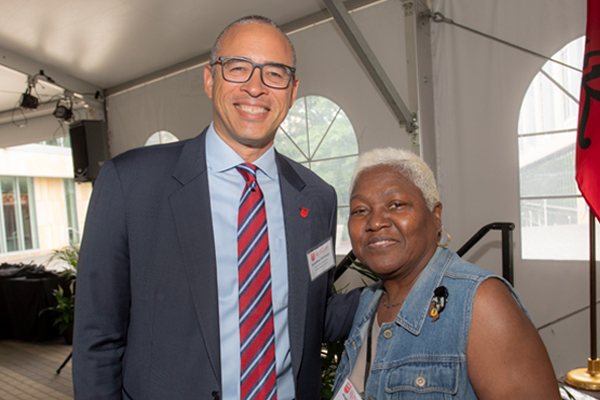
    Maggie Harris-Clark with Rutgers President Jonathan Holloway
    Rutgers President Jonathan Holloway with Maggie Harris-Clark at the 2022 Rutgers Staff Service Recognition Reception in the President’s Tent on Bishop Place (photo by Nick Romanenko/Rutgers University)

    After an extraordinary 50 years of service to the John Cotton Dana Library, Maggie Harris-Clark retired on July 1, 2022.

    Maggie began working at Rutgers University in January 1972. It was a cold and clear day. The temperature eventually climbed to 34 degrees, from a low of 10 degrees. William T. Cahill was governor of New Jersey, and Kenneth A. Gibson was Mayor of Newark, the first African American Mayor of Newark. Edward Bloustein was president of Rutgers University, and Horace Depodwin was Acting Provost, succeeded by James Young, the first Provost of Rutgers-Newark. Thomas Shaughnessy was the director of Dana Library. Maggie would work with several more directors: Eugene Neely (1981), Lynn Mullins (1987), Mark Winston (2008), and Consuella Askew (2015), as well as several interim directors (most recently, Jeanne Boyle and Rhonda Marker). Maggie also served under 10 University Librarians/Interim University Librarians.

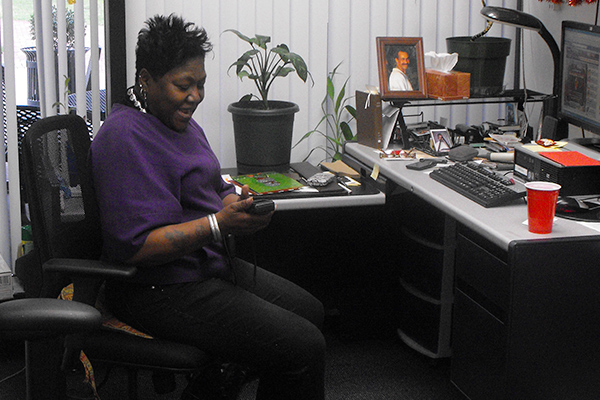
    Maggie Harris-Clark in her Dana Library office, ca. 1980s
    Maggie in her Dana Library office, ca. 2009

    Initially, Maggie worked at the Rutgers Law Library (Newark) in the Government Documents Department in a grant-funded position for six months. She then spent another six months at Dana Library in the Technical Services Department before Dr. Shaughnessy hired Maggie full time. Maggie worked for another long-time Dana Library employee, Madeline DeSantis, to maintain the card catalog and the shelf list. At that time, the library was using physical library cards to charge out books, but progress took over and advanced to using keypunch cards. Maggie transferred to the Circulation Department to work in course reserves for almost 10 years under the supervision of Mrs. Mann. About 20 years ago, Maggie was promoted to a Library Supervisor position in Circulation. Maggie is retiring as the head of Access Services at Dana Library. She has successfully navigated many changes from implementing the first automated circulation system through our current Ex Libris products. She has represented Dana Library on many cross-campus groups, including the Fulfillment Working Group.

    Although Maggie spent all her years at Rutgers on the Newark campus, she could be counted on to participate in Libraries-wide events. She has many friends throughout the Libraries who will miss her irrepressible optimism and kindness.

    Reflecting on her five decades at the university, Maggie fondly said, “Rutgers was my home away from home. I enjoyed working with my colleagues to advance the Libraries’ mission and to ensure our faculty and students received excellent service.”

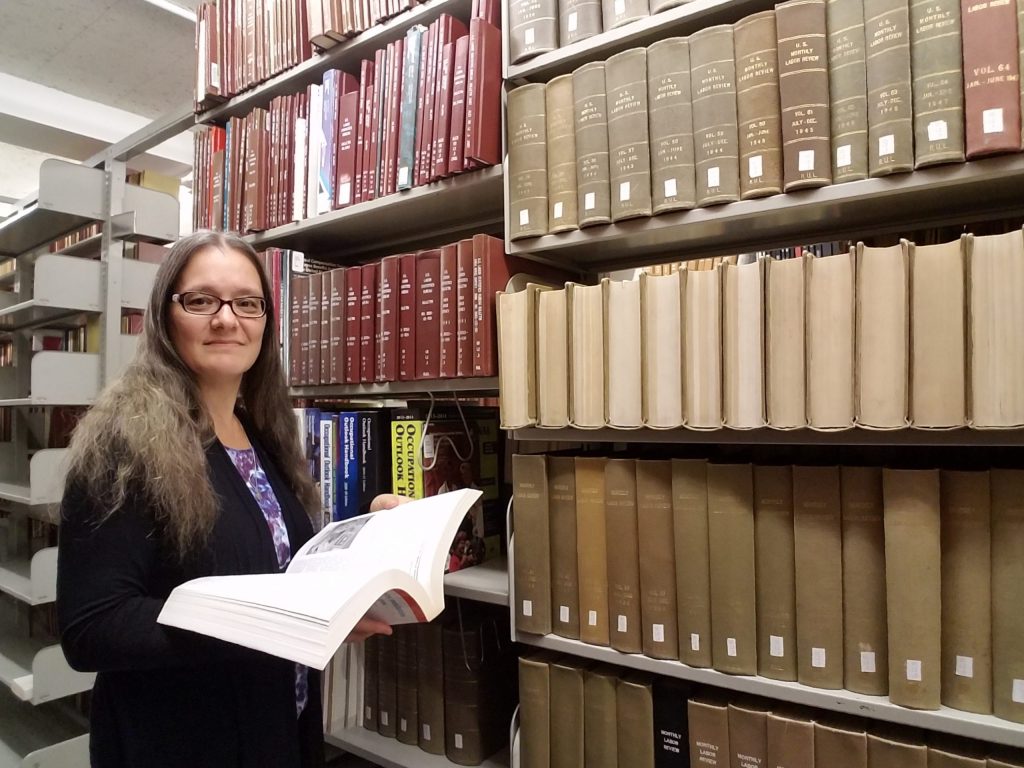
    Maggie Harris-Clark at Dana Library
    Maggie in the Dana Library’s new third-floor open study space, June 2022 (photo by Dennis Mark/Rutgers University Libraries)

    This past June, President Jonathan Holloway and the university honored Maggie at the Rutgers Staff Service Recognition Reception. “I very much appreciated the recognition and respect,” Maggie remarked. “It’s wonderful knowing that I made a difference in the Rutgers community.”

    In retirement, Maggie plans to continue being active in her church and the Eastern Star. Her pastor has already announced her expanded role to the congregation. She has many plans for volunteer work and is looking forward to doing more at home. She is especially looking forward to the birth of her first great-grandchild in August. As busy as she will be, Maggie promises to keep up with her friends at Rutgers.

    We wish Maggie a long and happy retirement and express our warmest appreciation for her many years of steadfast service to Dana Library and Rutgers University.

  • RUL Acquires Volumes I and II of National Theatre Collection Database

    National Theatre Collection, Volumes I and II.
    Photo courtesy of Alexander Street

    Rutgers University Libraries are pleased to announce their acquisition of Volumes I and II of the National Theatre Collection. This collection contains 50 high-definition streaming videos of live theatre productions by the U.K.’s National Theatre, accompanied by archival materials such as prompt scripts and costume designs. It includes both productions of new works by contemporary playwrights and new productions of classic plays, including Greek theatre, works by Shakespeare, and 20th-century classics. These new productions feature contemporary settings, diverse casts and production staff, and modern applications of enduring social issues. Productions feature major directors and actors as well as emerging talent. Rutgers permanently owns the entire contents of Volumes I and II of this collection.

  • Stephanie Bartz Retires after More than 30 Years of Service

    Stephanie Bartz

    Stephanie Bartz, Government Resources and Information Services Librarian at Rutgers University–New Brunswick Libraries, retired after more than 30 years of service to the university.

    Stephanie started at Alexander Library as a Reference Assistant in 1983 while a student at the School of Communication, Information, and Library Studies (SCILS) and continued in various capacities until 1989 (when she resigned). Her responsibilities included working at the reference desk and helping to maintain the print reference collection (much larger and more heavily used in those days).

    Stephanie was asked to return in a part-time capacity in 1994 and began working full-time in 1996 to assume responsibility for government resources while another librarian was on leave. When that same librarian retired in June 2015, Stephanie took over the bulk of the government documents duties for Alexander Library. In January 2016, she also assumed responsibilities for the government documents and maps collections at the Library of Science and Medicine and began splitting her time between the two locations.

    Stephanie quickly became an indispensable member of the reference department at Alexander and then of the larger New Brunswick Libraries (NBL). She often helped to preserve the sanity of more technologically challenged colleagues by fixing minor and not-so-minor computer problems. While Stephanie frequently disclaimed being a tech person, she provided a high level of computer support for Alexander Library colleagues and served as an informal interpreter between librarians and staff in the Systems Office. Her willingness to take on additional responsibilities during leaves or job vacancies played a key role in sustaining the library’s support for faculty and students. One measure of her readiness to pitch in was her participation in LibGuides. She created and/or maintained more than 30 reference, government publications, and general interest guides. Moreover, she became the local LibGuides expert providing assistance and training, coordinating the transfer of guides caused by personnel changes, and updating/babysitting orphaned guides. Beyond that, she was a silent partner on other guides, helping librarians design and maintain their subject guides.

    Stephanie also contributed enormously to a dizzying array of committees, task forces, working groups, and councils. She served on the Rutgers University Libraries (RUL) PC Working Group from 1997 until 2016 and as the NBL PC Coordination Team leader from 2001 until 2014. She provided tech support, allocated computers, coordinated computer and related equipment purchases, and maintained the NBL website, among other tasks.

    She served on the Library Catalog Committee from 1999 to 2018 and chaired the group from 2005 until 2018. From 2016 to 2019, she was a member of the Discovery Working Group, which essentially replaced the Library Catalog Committee.

    Stephanie served multiple terms on the Rules of Procedure Committee, co-chairing the group for several years. She created the first RUL electronic ballot, became the local expert on bylaws, and maintained an archive of bylaws editions and drafts.

    She assumed responsibility for NBL chat coordination in 2020 and handled the complicated process of scheduling as many as 34 librarian and graduate student chatters.

    Stephanie joined the NBL Web Content Team when preparations for the new RUL website were being finalized in 2021 and assumed responsibility for creating and maintaining NBL’s content. She also managed NBL’s pages on the staff website.

    She maintained many mailing lists/groups, including the retirees list that we hope will be continued after her retirement.

    Stephanie helped coordinate the Digital Learning Commons, Hatchery, Google Books, and Alexander bound periodicals weeding projects for NBL. Simply listing this coordinator role can give no sense of the tireless and scrupulously careful detail work involved, one of Stephanie’s many strengths, and her remarkable ability to work collaboratively across departmental and unit boundaries.

    Stephanie’s life outside the libraries manifests a similarly high level of participation and willingness to take on both leadership roles and the often unsung, behind-the-scenes work that sustains organizations. For example, she served more than 40 years as a volunteer for the Middlesex County Fair.

    For more than 20 years, Stephanie has been deeply involved in the South River Historical & Preservation Society in capacities ranging from secretary, newsletter editor, webmaster, and archivist. One result of that work was the Images of America book on South River.

    No listing of tasks and accomplishments can adequately capture Stephanie’s contributions to NBL and RUL as a whole. She has been an invaluable librarian and a highly respected colleague. Judit Ward captures many of our sentiments: “Stephanie Bartz is an exceptional colleague. Stephanie is my friend. How many of us think of her just like that? Always there for us with answers and solutions, the much-needed gentle reminders—that’s the Stephanie I know. She has always held herself to the highest professional standards at RUL. Because she cares. Competent and fair, authentic and trustworthy—these are precious and rare qualities. That’s Stephanie. I am honored to call her my friend. Hope I can still call her my friend in the future.”

    For many of us, it is hard to imagine the Libraries without her. I have turned to Stephanie for guidance, wisdom, and help across a range of initiatives and projects. I appreciate her sense of humor and her dedication to the community. Whether the community is our own faculty and staff, our retirees and alumni, the larger Rutgers landscape, the citizens of NJ, or other states who could benefit from our government documents, Stephanie is there.

    Stephanie, you have brought humanity and dedication to your role. Thank you for your service, and may your next chapter be fulfilling with just the right amount of peace. You will be deeply missed.

  • Update on the Basie Collection

    The Institute of Jazz Studies has been working diligently to inventory the Basie family papers as part of the project funded by a $433,500 Save America’s Treasures Grant, awarded to the Institute in late 2020.  Ben Houtman started in his position as Project Coordinator in January 2021 and quickly facilitated the safe transport of the collection to Dana Library for the inventory.  After the inventory is complete, the Institute will send unstable and damaged artifacts and archival materials from the collection to a team of conservators for treatment.  Finally, with support from a $23,500 New Jersey Historical Commission grant, the Institute will arrange and describe the archival materials in the collection to open it for use in 2022.

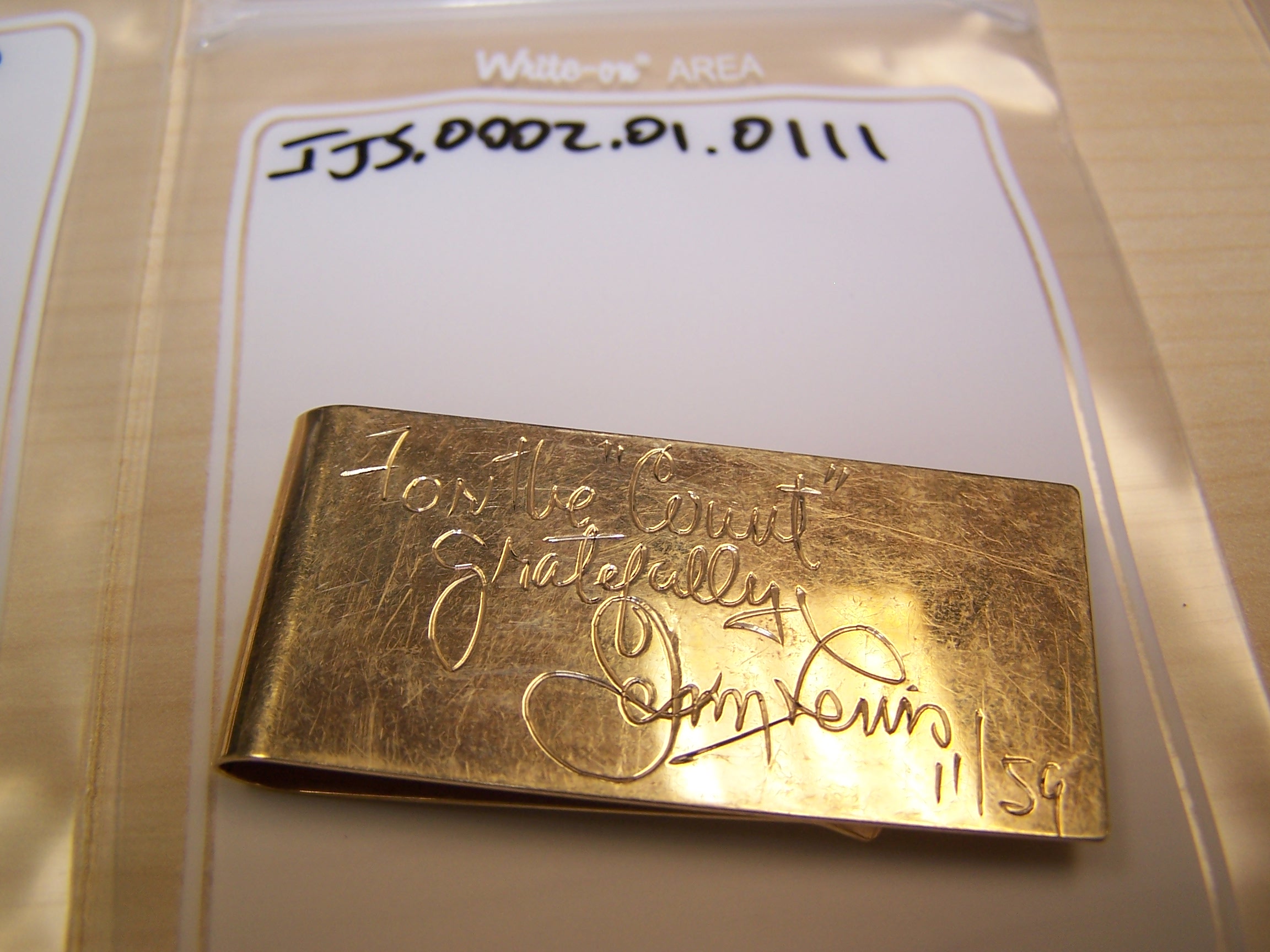
    14k gold money clip, inscribed from Jerry Lewis to the “Count”
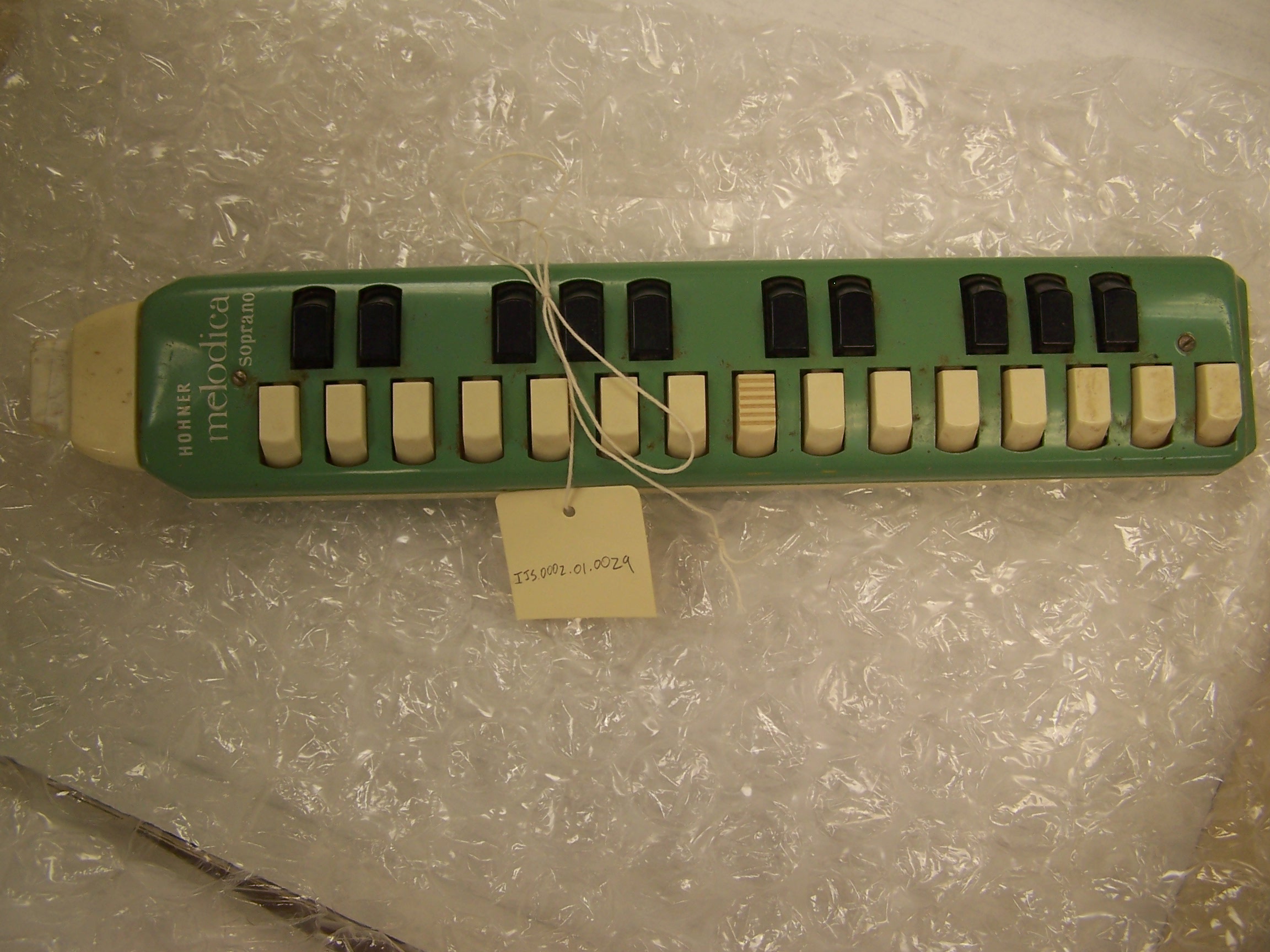
    Hohner soprano melodica
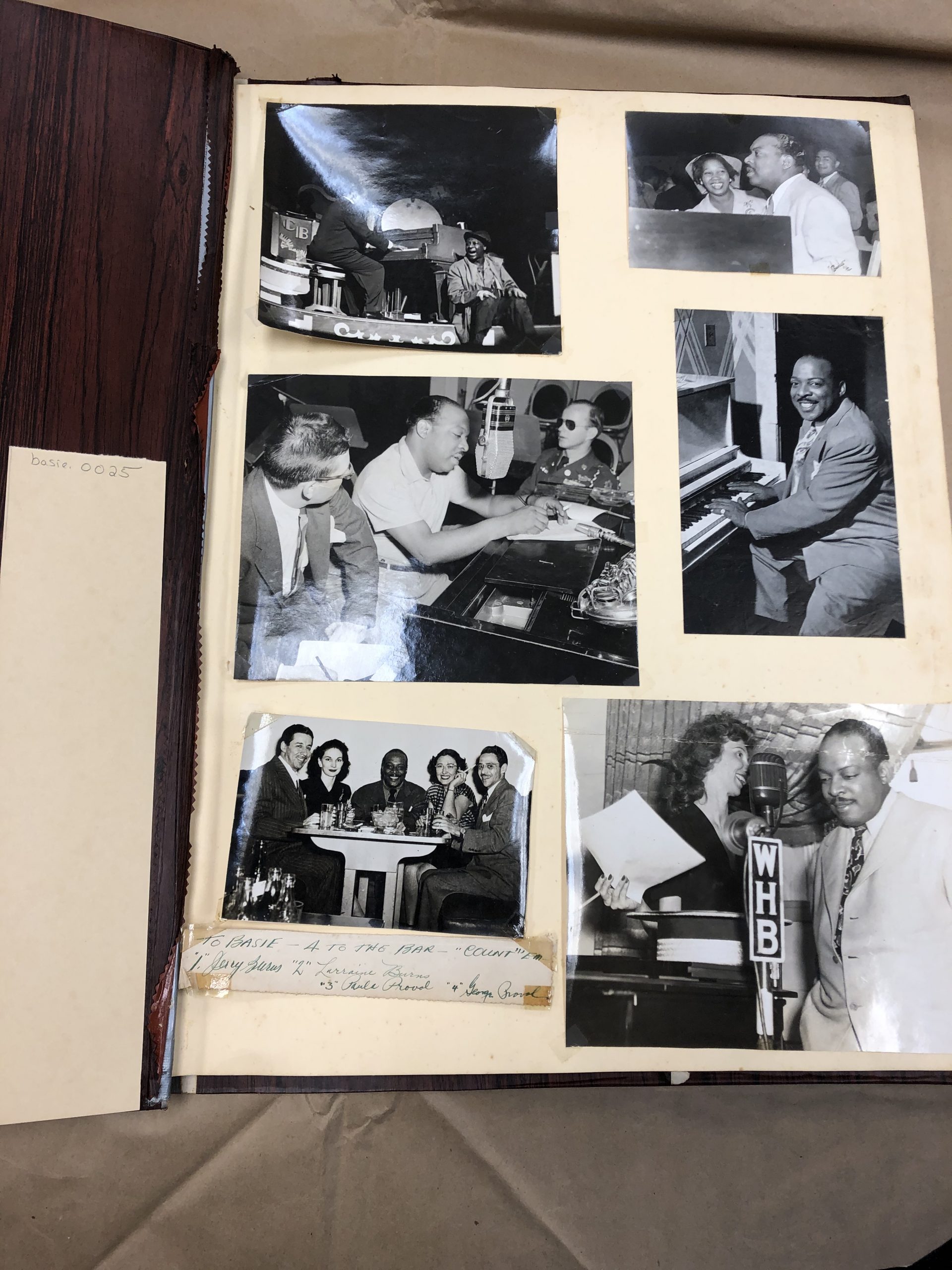
    Photo album page
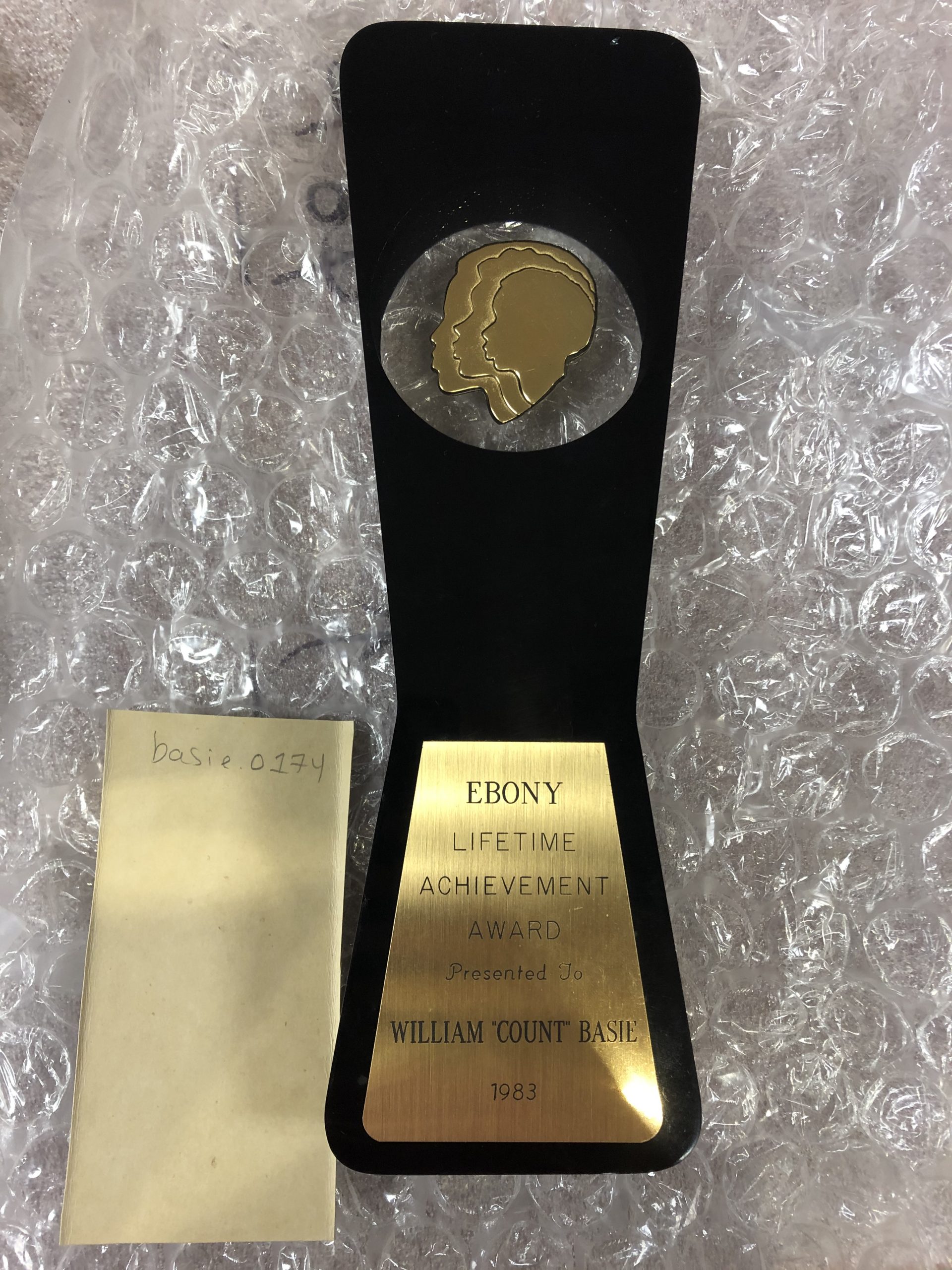
    Ebony Lifetime Achievement Award to Count Basie
  • Insights Analytics Tool Now Available in Canvas

    Library Tutorial Insights assessment and reporting provides a view of assessment and usage data for the tutorials that are used in a course. The detailed interface allows the course instructor to analyze learner performance on specific assessment questions, gauge students’ information literacy skills, and respond to problem areas more quickly and efficiently.

    NimblyWise and Credo Reference Insights Analytics tool is now integrated in the Canvas master courses:

    • Communication
    • Critical Thinking
    • Information Literacy
    • Health Sciences
    • Core Information Literacy and Critical Thinking

    Instructors who download any of these resources from Canvas Commons will have the option to use the Insights tool from within their Canvas course:

    Instructors who already have the library lessons in their course can download just the Insights tool from Canvas Commons:

    For questions about Library tutorials, contact Maria Breger at maria.breger@rutgers.edu

    View the complete list of the Libraries Teaching & Learning topics.

  • Reading List: Documentation and Resources Update

    The Reading Lists: Documentation and Resources LibGuide has been updated to include another page that describes additional functionality.  New content includes a quick start guide as well as printable handouts.  Liaisons can share this information with course instructors whether their courses are in Canvas, Blackboard, or Sakai.

    • Manage Sections (Edit/Add/Move/Set Dates):
    • Add Your Own Resource
    • Set Complete
    • Publish the Reading List
    • View the Reading List as a Student

    View the Reading List: Documentation and Resources.

    For questions about Library tutorials, contact Maria Breger at maria.breger@rutgers.edu

    View the complete list of the Libraries Teaching & Learning topics.

  • Special Collections and University Archives Primary Source Highlights

    Special Collections and University Archives is excited to share a new digital resource, “Special Collections and University Archives Primary Source Highlights,” a site that makes accessible a trove of images we have scanned for researchers over the years. The site also features images from an ongoing project to scan the Sinclair New Jersey Postcard Collection.

    Like all of Rutgers Libraries, SC/UA faculty and staff had to quickly find ways to continue to support research and instruction as the university shifted to a remote environment last year. And like most of our colleagues in archives and special collections around the country, and indeed around the world, we spent much of summer and early fall 2020 planning ways to enhance access to digital materials, offer Zoom research consultations, and provide remote classroom instruction, all while working (primarily) remotely.

    Faced with the challenge to increase digital resources with very limited access physical access to our collections materials, we decided to look to existing resources that we could leverage and work with from home. In SC/UA we make hundreds of high-resolution scans for patrons every year, typically for publication in books, journals, magazines, television and film productions, and for a variety of online projects. These images are stored on an internal server for potential future internal and external use. It was almost as if all of these images were waiting for their moment to shine.

    Dave Kuzma and I collaborated on planning the site during fall 2020. Dave undertook the nuts and bolts work of the site, spending much of the fall semester polishing his Omeka skills, identifying images, cleaning them up for optimal display, and creating metadata, and will do more of this work moving forward. Tara Maharjan, Isaiah Beard, and Sam McDonald have provided technical expertise. Thanks to Sonia Yaco and Rhonda Marker for their support of this project.

    While “Primary Source Highlights” is still in its infancy, we are adding images regularly, so we encourage you to check back frequently. This site is also now part of our Digital Resources Guide, which continues to serve as a one-stop-shop for centralized, easy access to all of SC/UA’s digitized resources, from manuscripts to maps to instructional videos. This guide also includes digitized material related to the work and mission of SC/UA, including Rutgers sites that feature digital content from SC/UA, and New Jersey history-related digital collections and resources. We welcome and encourage you to share “Primary Source Highlights,” as well as SC/UA’s other digitized resources, with the students, faculty, staff, and community members with whom you engage.

  • Responsibility Grows in the Garden State

    A new Marijuana Research Guide from Rutgers librarians is ready to help researchers, students, and the public after legalization.

    A new Marijuana Research Guide from Rutgers librarians is ready to help researchers, students, and the public after legalization.

    The moment the news came in that New Jersey voters opted for the legalization of recreational marijuana, a new research guide seemed reasonable and necessary. Based on my previous experience and information collected earlier for a potential guide, I invited two colleagues to create a Rutgers Libraries guide to resources on marijuana-related issues. The guide is intended for Rutgers faculty, staff, and students, as well as for the public.

    Government resources librarian Stephanie Bartz selected relevant sources from the federal and state governments, complementing the collection with international resources. Becky Diamond, New Brunswick Libraries business librarian, added business resources, such as industry and company information, market research, and related databases. They both also contributed to other tabs such as data and statistics, New Jersey resources and services, and Rutgers resources. The legal resources tab benefits from the expertise of the Newark Law Library, with law librarian Rebecca Kunkel as partner. Book recommendations also came from Nicholas Allred, Graduate Specialist for the Chang Library’s Books We Read.

    The Marijuana Research Guide will remain a work in progress for a while, as the State of New Jersey works out the nuts and bolts of the complex procedure post-legalization. Updates will be included in several areas as we go.

    Read more in the blog post from Books We Read. Comments and suggestions are welcome.

  • An Evening with LIS Students

    As the editor of a peer-reviewed scholarly journal, I interact with many people. I work closely with potential authors during the review and publication process, and often keep in touch with some of them after their papers have been published. This was the case with Dr. Keren Dali, whose paper I accepted for publication (see Keren Dali and Leah K. Brochu, “The Right to Listen: A Not So Simple Matter of Audiobooks,” Library Resources and Technical Services volume 64, no. 3 [2020]). Keren and I bonded over some mutual interests. She recently invited me to speak to the students in her Collection Management Course, which is offered by the Research Methods and Information Science Department of the Morgridge College of Education at the University of Denver. In her email invitation to me, Keren wrote, “This is a class on the selection and weeding of library materials, as well as related policies and HR procedures. It would be great if students could hear from a high-level manager in one of the top research academic libraries in the country.” Resource description and technical services work, particularly weeding and transfer projects, are important aspects of collection development and management and I was flattered to have been asked to discuss my work. When I was in graduate school, I found it beneficial to hear firsthand from practitioners about their work and experiences.

    I’ve spoken to LIS classes before, and this was the first time I did it via Zoom. Pre-pandemic, I would’ve still needed to use videconferencing to speak to a class in Denver. The difference this time is that everyone participated via Zoom. I’ve become used to participating in meetings, conferences and webinars remotely. Keren’s class was small (14 students) and was a good size for discussion.

    The evening was an informal, freely flowing discussion instead of a lecture. I was asked about my personal trajectory into librarianship, specifically academic librarianship. I discussed how I chose technical services librarianship (which actually wasn’t my first choice) and my experience managing a busy department in a large academic library. I truly enjoy the complexities of resource description and like that my work provides the infrastructure to enable my public services colleagues to successfully deliver reference service and to teach courses. It also gives our users the ability to find and select the resources they need.

    Not surprisingly, the conversation touched on how our normal operations have changed due to COVID-19 and what implications it has had for collections and organizational processes. I described the challenges and successes of transitioning our cataloging operation to function remotely. That included making sure everyone had the equipment and access to the necessary technology to do their work. Fortunately, the cataloging resources we use (Classification Web, RDA Toolkit, Connexion) are all available remotely, and Alma is cloud based. Using WebEx for meetings was new for some of my staff, as was accessing files via Box. We developed a work plan before we began working remotely that specified who would do what work, which helped immensely with the transition to remote. Additionally, I noted that Rutgers, like many other research libraries, is using HathiTrust’s Emergency Temporary Access Services (ETAS), and also offering services like Click and Collect and home delivery to meet the needs of our users.

    Questions that I was asked included how my work at Rutgers informs my work as the editor of Library Resources and Technical Services (great question!). The two are closely related, and my professional experience and knowledge come into play when I provide authors with feedback on their manuscripts. I’m aware of trends, past and present, that have a bearing on technical services work.

    The importance of belonging to a professional organization (very important) was another question posed to me. I emphasized the benefits of sharing your expertise, as well as acquiring new expertise and gaining professional contacts. Although many conferences this year were virtual and a trend that may likely continue due to the benefits such as holding down costs and reducing time out of the office, I encouraged the students to attend them to find an organization that aligns with their interests and needs.

    Librarianship has evolved so much since I was in graduate school. Remote classes weren’t even offered then. Technology is now such an important part of technical services work. Shared databases make it easier to obtain copy for the resources we catalog. Discussion lists and Facebook communities allow us to share information and resolve our problems. Speaking to a class of future library professionals was an uplifting experience. I was impressed by their enthusiasm and perceptive questions.

  • Banned Books Week in New Brunswick

    By Judit H. Ward and Nicholas Allred

    New Brunswick Libraries partnered with the Student College, Academic, and Research Libraries Association (SCARLA), the Library and Information Science Student Association (LISSA), and the SC&I Alumni Association to host an online Banned Books Week event on October 1, 2020. The engaging event called Banned: a virtual read-out and discussion on the freedom to read featured read-outs of banned books from students and faculty, flash talks from SC&I and NBL faculty, a zine workshop, and trivia from LISSA. The 90-minute student-hosted event was extremely well received. It managed to connect a variety of audiences across Rutgers fostering a greater sense of community through sharing personal narratives and experiences. See a sample list of Banned Books we read at the event.

    The Books We Read team at Chang also documented the event with a page dedicated to Banned Books Week 2020, complemented with a collection of short essays inspired by the flash talks. In the Introduction to Banned Books Graduate Specialist Nicholas Allred poses the ultimate question “Why study censorship?” His perspective, based on his main interest in British literature, suggests that censorship can often provide a window into the anxieties of the censoring authorities. As an example, he mentions George Orwell’s Animal Farm, banned in the Soviet bloc, “because the allegory of a barnyard revolution hijacked by a regime of self-serving pigs who hollow out its utopian promises hit too close to home.”

    Censorship has also shaped publishing and literary history, lending a thrill of the forbidden to challenged works and spurring DIY publication tactics like zines, the topic of Art Librarian Megan Lotts’ presentation entitled What is a Zine? In her definition, zines represent a unique subculture which has emerged around making and collecting as a powerful tool representing creative, low-cost, DIY means of self-expression and idea sharing. She recommended exploring zines in libraries not only as a creative way to learn about visual culture, open-access, visual literacy, and information but also as an engaging and non-threatening way to talk about issues around cultural appropriation, cultural sensitivity, and inclusivity.

    The Banned Books Week event also reminds us of what we have to lose. A flash talk by science librarian Judit Ward What is Samizdat? highlighted this term from the Cold War, referring to the underground publication and circulation of articles or books with political views in stark contrast to the party line. Samizdat editions were books that covered current political topics, written by foreign authors with political content, or new publications of blacklisted authors. Forbidden to publish, read, and circulate, these titles taught generations to reflect and read between lines for ever.

    “Censorship succeeds when no one talks about it”––NBL Special Projects Librarian and SC&I lecturer Nancy Kranich emphasized the importance of celebrating Banned Books Week in her flash talk entitled Ban No More. Focusing on the role of libraries and librarians, she also suggested that more banning would occur without librarians, teachers, journalists and others speaking out to defend the freedom to read. Although books in libraries are constantly challenged, i.e., someone tries to remove or restrict them based on their content, library policies and practices can ensure that (unlike during the Cold War in the Eastern Bloc) the freedom to read will prevail as one of the most basic freedoms of democracy.

    A large portion of challenged titles belongs to a genre called Young Adult (YA) literature. Challenged for their difficult topics related to gender, mental health, violence, or racism to protect the readers dealing with these problems in their everyday lives, many of these Banned Bestsellers can actually function conversely and assist processing the issue at hand instead, as suggested by Julie Rossano, Books We Read team member and graduate student in the course taught by Marc Aronson at SC&I.

    Banning books has been a long practice as a form of censorship for a great variety of reasons. Spearheaded by the American Library Association, Banned Books Week (September 27 – October 3, 2020) is an annual event celebrating the freedom to read. The Office for Intellectual Freedom (OIF) compiles lists of challenged books based on reports received from libraries, schools, and the media on attempts to ban books in the United States.