Category: Feature

  • Alma Analytics Tips: Lifecycle and Status

    When creating reports in Alma Analytics, there are a couple of filters or dimensions that you should be using frequently to help you refine the figures you are reporting. Two such dimensions are Lifecycle and Status. Dimensions containing the term Lifecycle filter for records that are active or deleted and dimensions containing the term Status filter for records or transactions that are active, inactive, or contain a specific status. You should search for these terms when creating reports to determine which dimensions are available in each Analytics subject area and then use them regularly to make better reports.

    Lifecycle – The Lifecycle dimensions can be found in Analytics subject areas that provide selections on bibliographic records, such as E-Inventory, Physical Items, and Titles. For example, if you search for Lifecycle in, the Physical Items subject area, you will see Lifecycle at three levels indicating you can filter for active or deleted records at the title, holding, or item level.

    Screenshot of alma analytics showing lifecycle

    Lifecycle options typically are:

    1. Deleted – record has been deleted
    2. In Repository – record has not been deleted

    Status – The Status dimensions are found in almost any Analytics subject area and store the status of the record or transaction such as Item in place or Item not in place, active or inactive, active or completed. There are a variety of statuses related to each subject area and Analytics users should examine them, review the options, and determine whether selections are needed in these dimensions. Some of the more frequently used statuses are:

    1. Loan Status – use this to filter on items actively on loan or not. This dimension is found in the Fulfillment and Fines and Fees subject area and the options are:
      1. Active – loan is current
      2. Inactive – loan is not current
    2. Fines Fees Status – use this to filter on items with active/outstanding fines. This dimension is found in the Fines and Fees subject area and the options are:
      1. Active – fine still outstanding
      2. Closed – fine has been paid or waived
    3. User – Status – use this to filter on users who are active or not. This dimension is found in the Fulfillment, Requests, Fines and Fees, and the Users subject area and the options are:
      1. Active – user record is in Alma and is currently active
      2. Inactive – user record is in Alma but not active
      3. Deleted – user record has been deleted from Alma
    4. Request – Status – use this to filter requests by current status. This dimension is found in Requests and the options are:
      1. Active – request is active and there is an available item to fulfill it
      2. Completed – request is completed
      3. Failed – request has failed.
      4. Ready – request is active but there is no available item to fulfill it
      5. Rejected – Alma staff member canceled an active request
      6. Rejected by Library – request cancelled. The cancellation reason is Canceled at patron’s request.
      7. Rejected by Patron – request cancelled. The cancellation reason is Patron no longer interested.

    More information about dimensions like Lifecycle and Status and others that can be used in each Analytics subject area can be found here. If you have follow-up questions related to this article or need assistance creating a report in Alma Analytics please send a message to exlibris@rulhelp.rutgers.edu.

  • In Conversation with Diane Biunno

    Diane Biunno is metadata archivist for the Institute of Jazz Studies.

    Diane Biunno joined the Libraries as metadata archivist for the Institute of Jazz Studies back in February. Here, we catch up with her to learn more about her experience and what she has been working on since the shift to online-only service.

    Tell us a bit about your background prior to coming to Rutgers.

    Prior to joining the team at the Institute of Jazz Studies in February 2020, I served as a project archivist at the Historical Society of Pennsylvania (HSP) in Philadelphia. At HSP I worked on several projects including the Hidden Collections Initiative which was a grant funded project to improve the accessibility and discoverability of archival collections housed at Philadelphia-area small repositories. As part of the initiative, I helped staff and volunteers at local historical societies, ethnic organizations, and religious institutions better arrange, describe, and care for their collections. I enjoyed working on this project because it gave me an opportunity to get to know members of the local archival community and their amazing collections.

    Before coming to Rutgers, I also worked on several innovative digital projects that were focused on improving the discoverability of archival and special collections materials. For example, I served as a digital project assistant at Penn Libraries for the Bibliotheca Philadelphiensis
    project, an initiative to digitize and make freely available all the known medieval manuscripts in the Philadelphia region. In addition, I was a digital project associate for the Historical Images, New Technologies Project, which explored how to better describe archival visual materials using TEI (Text Encoding Initiative) markup. Through working on these projects, I learned a great deal about metadata standards and formats, as well as, digital preservation and digital project management best practices.

    I received my B.A and Ph.D. in Italian from Rutgers University and my Master’s in Library & Information Science from Drexel University in Philadelphia, Pennsylvania.

    What have you been working on during the quarantine?

    I’ve been working with my colleagues at IJS to copyedit and publish the approximately 200 finding aids that the IJS created last year. A finding aid is document that describes an archival collection and helps guide researchers in using the collection. The IJS finding aids will be published online and made accessible to the general public and researchers, with the goal of helping our patrons better understand our collections and how our materials can meet their research needs.

    What does the process look like?

    Before beginning the process of copyediting the finding aids, we quickly realized that we needed a style guide to ensure that all finding aids would be edited according to the same capitalization, punctuation, and grammatical guidelines. Unfortunately, there isn’t a standard style guide for archivists, so we decided to create our own and base it on the Chicago Manual of Style, a style guide widely used in academic publishing.

    Next, we created project workflows, as well as spreadsheets for keeping track of the project’s progress. We made sure to keep the project style guide, spreadsheets, and other documentation in a shared folder that was easily accessible to everyone working on the project. Most importantly, used software tools that allow us to easily track changes to documents and to view the edits of our coworkers in real time.

    How far along are you and what are the next steps?

    At this point, we are halfway through the project and have published approximately 110 finding aids. We’re moving at a steady pace and hope to wrap up the project in a few weeks.

    While working on the project, I began thinking about how the IJS might use Wikipedia to help guide researchers and the general public to our collections. Because patrons use Wikipedia as a starting point to find general information on a topic, as well as, additional resources, I’ve begun adding links to the institute’s finding aids in the “External Link” section located at the bottom of Wikipedia entries. For example, at the bottom of the Benny Goodman Wikipedia entry, I’ve added a link to the IJS finding aid for the D. Russell Connor collection of Benny Goodman audio recordings. Moving forward, I hope to add additional links to our collections and explore other ways to make our finding aids and collections more broadly accessible to the public.

    Where can people learn more?

    People can visit the repository page for Institute of Jazz Studies to view the finding aids that we’ve already published. https://archivesspace.libraries.rutgers.edu/repositories/6

    People can also check out the IJS Facebook page for more information about events and other news: https://www.facebook.com/InstituteJazzStudies as well as the institute’s page: https://www.libraries.rutgers.edu/jazz

  • Uncovering Masks: Ritual, Fun, Transformation, and Protection

    A decorative mask crafted for the exhibit out of foam and beads.

    The Carr Library exhibit on masks was developed as a supplement to the Mid-Winter Mask Making student engagement event held on February 7, 2020 in partnership with the Friendship Fridays program organized by Rutgers Global. In the initial stages of development, masks were interpreted as objects from a more distant point of view. As the COVID-19 pandemic became a global health issue by March 2020 and began to impact day to day activities, masks quickly turned into a necessary and sought after object. The demand for masks as personal protective equipment skyrocketed and vendors continue to be overwhelmed with requests, and are unable to fulfill orders, or require an extended period of time for processing and shipping. This has also led to more creative and innovative outlets with people completing DIY masks and recycling different fabric materials to do so.  Masks are being made for personal use, as well as to donate to others in need to share this precautionary measure.

    The center case of the exhibit featured masks from India and Korea as well as books from the Libraries’ collection that revolved around the ritual and cultural uses of masks by different groups around the world.

    Requirements made by states throughout the U.S. for people to wear masks while out in public have also altered the way we prepare ourselves to leave our homes. There are new rituals of putting on gloves and a mask to help flatten the curve and prevent the spread of the virus. The way we see other people has changed, as eyes are the only facial features left exposed, and proper distance must be kept from others. Masks have now taken on a new meaning and significance, and will be enveloped into our attire and lifestyle for the foreseeable future.

    The exhibit explores the ways masks are constructed and how these objects serve larger purposes. Like the personal protective equipment masks made at home, masks can be made from nearby materials on hand. Whether these items are found in the natural environment such as wood, bone, and clay, or man-made products like plastic and beads. These materials are combined together to develop the structure of the mask and enhance the imagery of the object through design and decoration. Regardless of material type, masks are constructed with a use and purpose in mind.

    The right-side case of the exhibit featured the book Masks by Jamie Shalleck–a captivating visual portrayal of the different ways masks are involved in our lives and throughout history.

    Widespread uses for masks were identified in the exhibit as relating to qualities of fun, ritual/culture, identity and protection. Most commonly, people associate masks with a form of costume or disguise. These celebrations make masks a fun accessory for Halloween or a masquerade and can allow the wearer to be creative with their appearance. The process of decorating the mask itself is entertaining and can be elaborately done to mimic something in nature, feature bold colors, or glisten with jewels and beads. The masks used in Mardi Gras parades and Venetian carnivals depict this celebratory nature of the objects and how they can be combined with an ensemble to develop a whole new appearance and costume.

    Masks have also been a prominent part of cultural and social rituals. These objects exist as ritual devices of transformation and storytelling. Whether it be part of an ensemble for a ritual dance, a way to connect religiously, or to initiate members into a group. The masks are made to follow a pattern set over time through ritualized experience. Masks not only add to the sense of excitement and theatrics, but also create a sense of solidarity and belonging through the group experience. The repetition of these rituals causes the masks to become a part of one’s identity as it relates to a culture’s way of life.

    A protective mask modified with associated words and expressions.

    In another sense, people can portray themselves a certain way to mask their identity and inner self from the outside world. Virtually, individuals can devise new identities and ways of representing themselves externally that differ from what lies behind their public profile. What kind of masks do we put on around others and how does this impact the way we view ourselves and others?

    Masks can serve people in these intangible ways, but also are physically important when implemented as tools of protection. Constructed of materials such as bone or metal, masks have been brought into warfare as a form of armor. Often-times masks feature important cultural symbols or meanings in the design and construction, which can act as social or political protection and power as well. Or in the case of recent events, masks are tools to fight against the spread of disease and illnesses by creating barriers between people and prevent contact. Giving the wearer protection from the external environment and a sense of security and safety.

    To expand on the ideas of the Masks exhibit, a libguide was created to offer a list of resources and other examples of how masks are present in society and used for various reasons. Books, articles, and images/videos related to the themes of fun, ritual/culture, identity, and protection are present on the page. Additionally, links to other exhibits on masks and how masks have been used in social movements and literary works are available. Discover more information about this topic in the libguide https://libguides.rutgers.edu/masks.

    Lauren Rossi and Triveni Kuchi


  • Rutgers Meets Japan

    The planned exhibit was converted to a digital exhibit, which will be mounted on the course website.

    In 1867, Kusakabe Tarō (1844-1870), a samurai from Fukui in the remote west of the country, left Japan to study at Rutgers. After his untimely death in 1870, his mentor and friend, William E. Griffis (1843-1928) of the Rutgers Class of 1869, was invited to teach Western-style education in rapidly modernizing Japan. Griffis would spend his life writing and speaking about Japan and collecting books and archival material. His collection came to Rutgers Special Collections and University Archives (SC/UA) after his death. This spring, Haruko Wakabayashi of the Department of Asian Languages and Cultures, is teaching “Rutgers Meets Japan: Revisiting Early U.S.-Japan Encounters,” an interdisciplinary honors seminar based on the Griffis Collection. This seminar examines this crucial moment of early U.S.-Japan relationship and cultural exchange as we commemorate the 150th year since William E. Griffis left for Japan. As curator of the William Elliot Griffis Collection at SC/UA, I am supporting the class through helping them access books, documents, and images from the collection. Assignments are based on primary sources and prints from the Griffis Collection and the Zimmerli Art Museum, which are posted on the course website. For the final project, students planned to curate an exhibition at the Alexander Library using materials from the Griffis Collection. The culmination of the course was meant to be a two-week field trip, “The Japan that Griffis Saw,” where the students along with Professor Wakabayashi and myself would visit in Fukui, Yokohama, and Tokyo.

    On March 10, the class visited SC/UA to use maps and city directories to try to envision what New Brunswick was like at the time Griffis and Kusakabe were students. When we learned the next day that all Rutgers courses were going online after spring break, we had to adapt quickly. The planned exhibit was converted to a digital exhibit, which will be mounted on the course website (https://sites.rutgers.edu/rutgers-meets-japan). The trip to Japan was postponed until January.

    Access to the Griffis Collection was an even more difficult problem. In 2000, the Griffis Collection was microfilmed through an agreement with Adam Matthew, a company in the U.K. In 2017, Rutgers contracted with Adam Matthew to digitize this material, with a stipulation that Rutgers would get free access. When it became apparent that we would have no physical access to the Libraries for the rest of the semester, I followed up with Adam Matthew Digital regarding the status of the project. Thanks to Jeff Carroll, Elizabeth York, and their teams, the digital version of the Griffis Collection is now available through the database Area Studies: Japan, enabling students to access digitized primary source documents from the collection. Class discussion now takes place on the Canvas site. According to student Raj Malhotra, SAS ’22, “The transition to this digital classroom environment has come with its expected difficulties, but has shown us how to stay connected through the vast digital libraries and resources available for class meetings and teachings.” All are looking forward to the trip, which we hope will still take place.

  • Creating Homemade PPE

    I would like to share my experience during these difficult days of our quarantine to fight against COVID-19.

    While all of us are working from home, the medical staff are on the front line fighting the virus while lacking the PPEs. This became a great concern in my family, when my daughter called me three weeks ago, and asked if I could make some masks and head covers for her husband, who is a doctor, and also her doctor friends who are taking care of COVID-19 patients.

    She did some research how to make safe cloth masks for medical staff to place over the N95 masks to make them last longer. Pretty quickly, we figured out how to make them out of cotton fabric and flannel while using different filters. I used any item possible at home: T-shirts, cotton sheets, cotton tablecloths, bags, baby wipes, laundry softeners, vacuum cleaner filters. I also made head covers out of shower curtains while sending her all transparent plastic available at home so she could use it to make face shields, helped by her friend who made parts of them by 3D printing. She was able to make 30 face shields.

    My daughter and I also started a campaign on social media, asking people to make masks and sharing the instructions, suggesting they donate them to the community. The social media network in New York, Connecticut, and New Jersey was able to make 350 masks and donated them to hospitals and friends. My daughter, who is also a doctor, for about a month never stopped raising awareness on social media that everyone needs to wear a mask when we go out.

    I shared my experience with the Smith Library access services staff and shared guidelines about how to make masks. I will continue to make cloth masks and head covers until the pandemic is over. Doing something good for the community helps me release the stress and be happy that I can do my little part to fight the pandemic.

    How to Sew a Medical Face Mask

    Materials

    • 2 pieces of 100% cotton fabric that measure about 7 inches by 9 inches—cotton T-shirts, dish towels and pillowcases are good options (make sure all fabric is washed and dry)
    • 2 pieces of cotton fabric that measure about 1.5 inches by 40 inches for the mask’s strap (in a pinch, you can use something like shoelaces, elastic 6 inch long or ribbon)
    • A ruler, sewing pins, a pair of scissors, thread, an iron and a sewing machine.

    Video Tutorials

    Instructions

    Step 1: Sew the two main rectangle pieces together with the “right” sides of the fabric—the side you want to see—facing each other. Sew almost all the way around the rectangles, leaving a small gap (a few inches) open on the long side.

    Step 2: Turn the rectangle right-side-out by reaching into the gap you left open and pulling the fabric through. Now your edges are on the inside and you have a neatly sewn two-sided rectangle. At the gap you left open, just tuck the edges inside for now; you’ll sew it closed later.

    Step 3: Make three evenly spaced pleats along both 7-inch sides of the fabric, making sure to keep all of your tucks facing in the same direction, and pin in place. One way to do this is by marking the spacing with pins: place one about 1.5 inches down the short side of the fabric; add the next 1 inch down from that, then the third ½ inch down from that, and keep alternating between 1 and ½ inches until you’ve used all six pins. To create the pleats, just bring the first pin down to meet the second, the third to meet the fourth, and the fifth to meet the sixth. Repeat on the other side.

    Step 4: Once the pleats are pinned, stitch all the way around the perimeter of the rectangle. This will sew the pleats into place and also close the gap you had left open in Step 1.

    Step 5: If you’re using a strip of fabric for your strap, fold and iron it in half lengthwise and then fold and iron the raw edges in. Find the centers of your straps and the centers of the long sides of your mask, and match them. Pin the straps in place along the long edges of the mask, so there is a strap on the top of the mask and one on the bottom, with equally long pieces coming out to the sides. If you’re using a strip of fabric, pin it so it’s wrapped around the edge of the rectangle.

    Step 6: Sew the strap to the mask by stitching all the way down each strap, catching the edges of the mask as you pass. (If you are using a strap that did not require folding, you can opt instead to stitch around the perimeter of the rectangle one more time.)


  • United We Stand against COVID-19

    Photo credit: New York Times.

    Since March 17, a few residents in Warren, Watchung, Green Brook, and Long Hills and I have organized a donation campaign and raised a total of $31,214.60 from the local Chinese American community to donate PPEs to Robert Wood Johnson Hospital and St. Peter’s Hospital in New Brunswick, Overlook Hospital in Summit, Somerset Medical Group in Somerset, and Morristown Medical Center in Morristown, as well as local EMT, police, and fire fighter units.

    I have worked many nights trying to allocate PPE resources in the United States. I used my online search skills and technical background to perform the due diligence process and verified all PPE sources for quality and safety based on ASTM standards and CDC/FDA guidelines. Up to April 6, the following PPEs have been purchased and sent to the above organizations:

    • 1,200 N95 masks
    • 1,400 KN95 masks
    • 8,800 surgical masks
    • 1,014 DuPont protection gowns
    • 472 3M safety googles
    • 6,400 gloves
    • 20 big boxes of wipes
    • 8 big bottles of hand sanitizer

    A few news media including the New York Times, Echoes-Sentinel, Bitpush News, and other local community newspapers have interviewed me and published articles about the effort.

    Editor’s note: Kudos to Connie on this amazing and inspiring work!!


  • New Brunswick Libraries and the Google Book Project

    Google carts will arrive at Rutgers on March 2 for loading, with three quarters of them going to NBL.  Of the ca. 194,000 volumes listed on the Google candidates spreadsheet, roughly 86% were in the New Brunswick Libraries.

    Nearly 29% of the NBL Google candidates are in the Annex, and we’re beginning the process there.  The NBL Google Team made the decision to use the 1900 publication date as the cutoff for anticipating whether scanned material might eventually become freely available and would not need to return to RUL.  This date is a compromise and approximation; copyright findings are a complex process with later or earlier dates for American and non-American publications.  Stephanie Bartz arranged the Annex Google candidates in call number and (for the journals) title order, and I gave NBL selectors two months to decide for materials in their subjects whether to accept the “send–do not return” option for pre-1900 publications, or “opt out” and require materials be returned.  RUL will have search-only access in HathiTrust to scanned in-copyright publications, and we will retain the hard copy of these volumes after scanning.

    Many NBL subject specialists weighed in with their preferences by initialing the spreadsheets or expressing them in meetings and online.  The Annex candidates include many books and journals that saw the bulk of their circulation many decades ago and are now in poor condition, but available digitally or via interlibrary loan.  As we finalized the Annex spreadsheets, I made decisions where selectors had not based on their expressed preferences and a conservative interpretation of RUL’s Print Retention and Withdrawal Guidelines that permit withdrawal of last copies if we have perpetual digital access to the content or at least five copies in North American libraries.  Our current estimate is that of 54,115 volumes on the Google spreadsheet, 88% will be sent but returned, and 12% (mostly journals) will be sent but not returned with the prospect of both digital access and continued interlibrary loan access to the hard copies.  I believe we found a good procedure that observes RUL policy and values the expertise of our subject specialists while eventually gaining badly needed shelf space for our Annex.

  • Camden Area Libraries

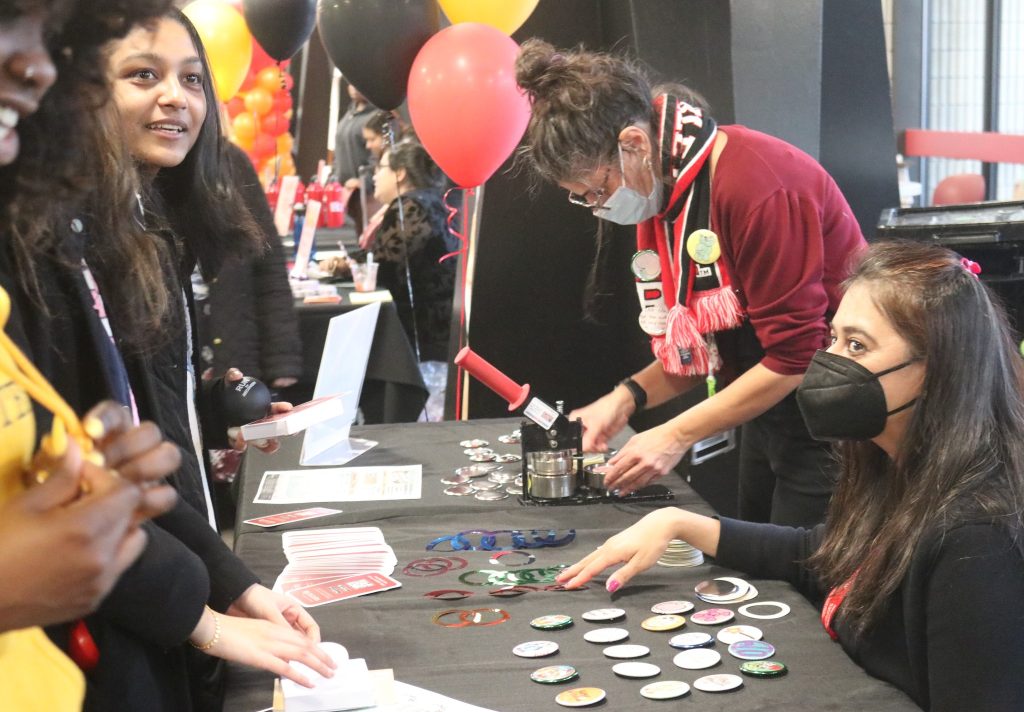
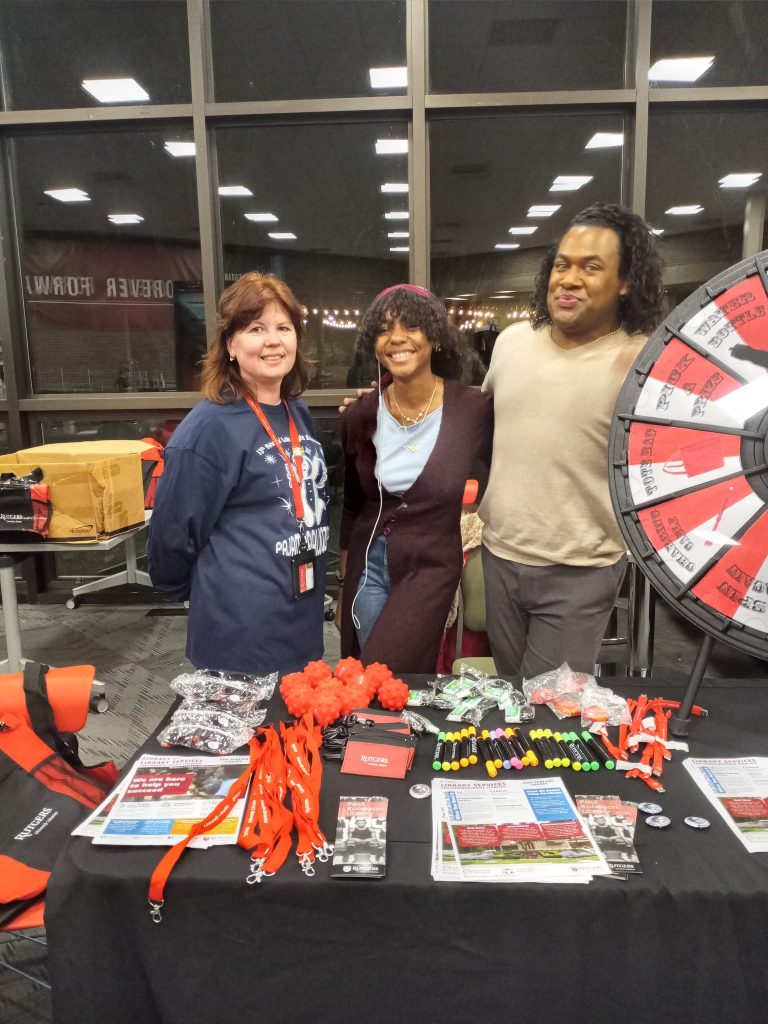
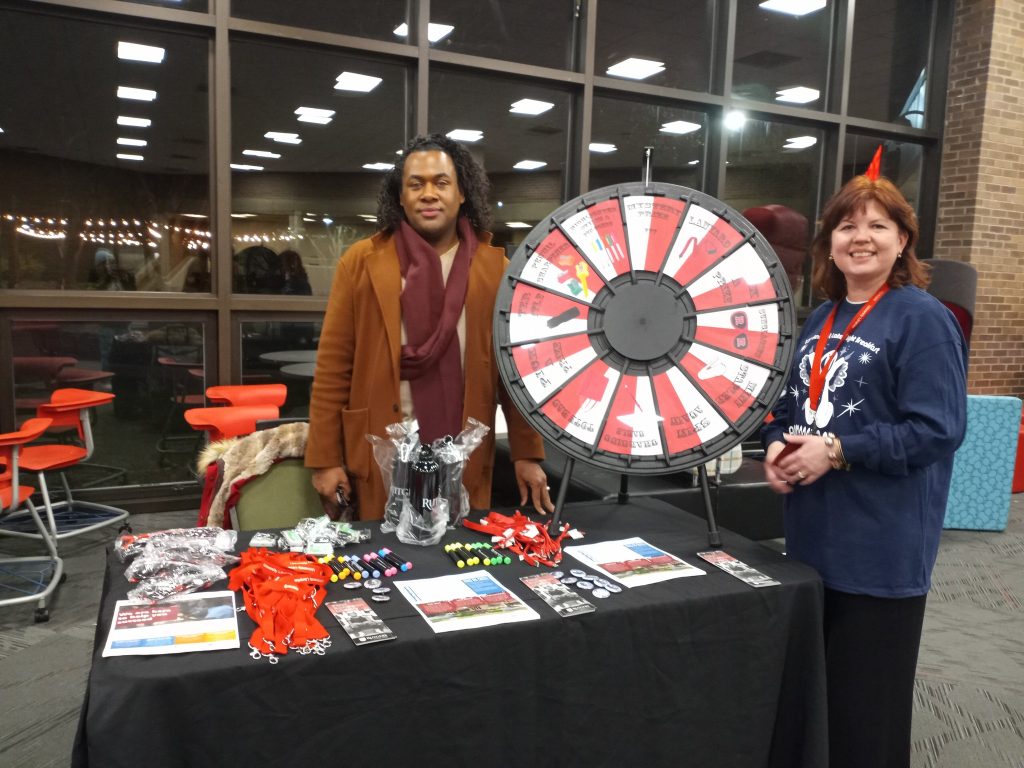
    The Paul Robeson Library in Camden hosted an Oreo tasting and cookie exchange for libraries in the Camden area, on Tuesday, December 10.  We worked with the Rutgers–Camden Law Library and Nilsa Cruz-Perez branch of the Camden Public Library. About 20 people from four different library systems attended. We tasted Oreos, talked about Alma as well as current and upcoming outreach efforts, and how we might work together on various projects. Julie Still and John Powell developed a logo (CAL for Camden Area Libraries) and made buttons for the event. All in attendance, and some who were unable to attend, indicated an interest in similar future events.

  • This Month in the Agenda – September 2002

    Rubbing Shoulders with the Pres’

    In August, President George W. Bush asked Paul Robeson Library’s Julie Still to join him in Waco, Texas for a national economic forum.

    Julie is a member of an investment club and participated in July in a town meeting in Philadelphia organized by the United States Secretary of Commerce that focused on small investors’ reactions to corporate misdeeds. Julie spoke up and was quoted by an AP reporter and then in a Philadelphia Inquirer story. One or both stories apparently caught the eye of the President’s people, and she got invited to Waco.

    Getting Hi-Tech

    Congratulations to Paul Robeson Library’s Vibiana Bowman, whose article “Reading Between the Lines: An Evaluation of WindowEyes Screen Reader as a Reference Tool for Teaching and Learning” was published in the latest issue of Library Hi Tech. This is a special issue of Library Hi Tech devoted to accessibility of Web information resources for people with disabilities.

    Gifts from Taipei

    Colleagues or students visiting the undergraduate reading room on the first floor of Alexander Library may notice a large new artwork, taking up much of the wall space near the windows overlooking the entry walkway.

    “A City of Cathay” was donated in June by the Taipei Cultural Center in New York City. The Taipei Cultural Center also donated a significant collection of Chinese language books and journals to the East Asian Library in May.

    Power to the People

    After a regular August maintenance downtime was completed, IRIS returned to regular use with two significant modifications. The Rutgers Request Service (RRS) changed its name to the Rutgers Delivery Service (RDS), and a major new feature, user-initiated holds, became available.

    The name change to the Rutgers Delivery Service reflects the Rutgers University Libraries growing use of technology to save time, enhance services, and offer increased options to Libraries users.

    The Agenda 24, no. 14 (September 8, 2002)

  • On the Impact of a Casual Conversation

    Kayo and student
    Noah Mac and I during New Student Orientation at Carr Library.

    One never thinks that a casual conversation with a librarian at Rutgers Day might impact a student’s decision to come to Rutgers University, but this is one such example.

    Noah Mac, RU ’21 and I met for the first time during the cool morning of 2017 Rutgers Day. Noah and his father were among the many visitors to the Rutgers University Libraries table in front of the Art Library. I engaged in a conversation with them and learned that they were visiting from Michigan. The visit was important for Noah, a high school senior, as he was in the process of selecting the college where he was to spend the next four years. After a friendly conversation that included information on the 250-year history of Rutgers and library services available for undergraduate students, I often wondered which college Noah ended up attending, especially because Michigan has so many options of state universities with great academic standings.

    It was a great pleasure for me to meet Noah for the second time in August 2018, when he was attending the New Student Orientation at Carr Library. He mentioned that the Rutgers Day conversation in 2017 had made a very positive impact on his decision in coming to Rutgers. Unexpectedly, Noah and I met for the third time during the 2019 New Student Orientation at Carr Library. This time, Noah was an orientation leader with the New Student Orientation and Family Programs guiding the incoming student groups from one event to another. After talking about his successful first year at Rutgers, Noah mentioned to me that the story he tells his group of incoming students, My Rutgers Story, includes “a librarian whom he met on Rutgers Day” who made him feel “not just another number,” impacting his decision!

    Noah will be majoring in microbiology and in addition to his academic endeavors has other talents, including that of being a trumpet performer in the Rutgers Marching Band. He is certainly very talented, as he was one of the five trumpet performers (among 35 or so) to be selected to travel with the band to a football game in Ann Arbor, MI against University of Michigan in fall 2019. He is delighted to go back to his home state as a member of Rutgers Marching Band representing the university.