Category: Universitywide

  • Alma Analytics Tips: Lifecycle and Status

    When creating reports in Alma Analytics, there are a couple of filters or dimensions that you should be using frequently to help you refine the figures you are reporting. Two such dimensions are Lifecycle and Status. Dimensions containing the term Lifecycle filter for records that are active or deleted and dimensions containing the term Status filter for records or transactions that are active, inactive, or contain a specific status. You should search for these terms when creating reports to determine which dimensions are available in each Analytics subject area and then use them regularly to make better reports.

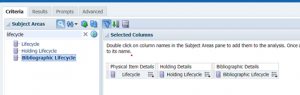
    Lifecycle – The Lifecycle dimensions can be found in Analytics subject areas that provide selections on bibliographic records, such as E-Inventory, Physical Items, and Titles. For example, if you search for Lifecycle in, the Physical Items subject area, you will see Lifecycle at three levels indicating you can filter for active or deleted records at the title, holding, or item level.

    Screenshot of alma analytics showing lifecycle

    Lifecycle options typically are:

    1. Deleted – record has been deleted
    2. In Repository – record has not been deleted

    Status – The Status dimensions are found in almost any Analytics subject area and store the status of the record or transaction such as Item in place or Item not in place, active or inactive, active or completed. There are a variety of statuses related to each subject area and Analytics users should examine them, review the options, and determine whether selections are needed in these dimensions. Some of the more frequently used statuses are:

    1. Loan Status – use this to filter on items actively on loan or not. This dimension is found in the Fulfillment and Fines and Fees subject area and the options are:
      1. Active – loan is current
      2. Inactive – loan is not current
    2. Fines Fees Status – use this to filter on items with active/outstanding fines. This dimension is found in the Fines and Fees subject area and the options are:
      1. Active – fine still outstanding
      2. Closed – fine has been paid or waived
    3. User – Status – use this to filter on users who are active or not. This dimension is found in the Fulfillment, Requests, Fines and Fees, and the Users subject area and the options are:
      1. Active – user record is in Alma and is currently active
      2. Inactive – user record is in Alma but not active
      3. Deleted – user record has been deleted from Alma
    4. Request – Status – use this to filter requests by current status. This dimension is found in Requests and the options are:
      1. Active – request is active and there is an available item to fulfill it
      2. Completed – request is completed
      3. Failed – request has failed.
      4. Ready – request is active but there is no available item to fulfill it
      5. Rejected – Alma staff member canceled an active request
      6. Rejected by Library – request cancelled. The cancellation reason is Canceled at patron’s request.
      7. Rejected by Patron – request cancelled. The cancellation reason is Patron no longer interested.

    More information about dimensions like Lifecycle and Status and others that can be used in each Analytics subject area can be found here. If you have follow-up questions related to this article or need assistance creating a report in Alma Analytics please send a message to exlibris@rulhelp.rutgers.edu.

  • Website Redesign Project Update – November 2020

    The website redesign project team has completed baseline usability testing and analysis, and we’ve combined that with other research from the discovery process and are now moving into wireframing. Using the ideas generated during prototyping sessions last month with each of the local library groups, we’re developing an architecture for the site that will balance each unit’s desire for flexibility with the need for a sustainable infrastructure that provides our users with streamlined, easy access to our most popular resources.

    Over the coming weeks and months, our team will be busy reviewing wireframes and revisions from the team at NewCity. Once the wireframes are approved, we’ll go through the same process with mockups, which will incorporate more of the look and feel of the pages along with example content. The new site will be built out of components, rather than templated pages – this is a different way to think about building web pages that puts greater power in the hands of content creators and managers. It will allow for greater flexibility and easier updates than our current setup, and each unit will be able to create and maintain beautiful, useful, up-to-date pages that reflect their users’ needs. The project team will be learning about how to work with a component library during the wireframing/mockup phase, and more people will be brought in for training once the component library is fully developed and we’re building out the actual site content.

    As always, you’re welcome to reach out anytime with questions or comments. Send us an email: webservices@libraries.rutgers.edu.

  • Ex Libris Implementation Team Update – November 2020

    Alma Analytics Upgrade

    Alma Analytics will be upgraded the week of November 1. Users who want to retain their personal reports in My Folders after the upgrade will need to save a copy in the Analytics shared folder’s Migration directory by October 31. Instructions to save your reports for the upgrade can be found here.

    New Alma Layout

    Ex Libris has introduced a new layout for Alma and items such as the main menu and persistent search box have moved to new locations on the screen. The new layout is currently in a testing phase. Users who want to familiarize themselves with the new layout can toggle it on themselves by following the instructions found here. The new layout becomes the default on November 1.

    Esploro Update

    The Esploro implementation is proceeding apace. All of our research assets have now been migrated from RUcore to Esploro. Next steps will include data cleanup, system and UI configuration, staff and user training, and integration with the library website. The Esploro research portal is scheduled to be released in January 2021. The rollout will be accompanied by the creation of a new support channel in LibAnswers to answer inquiries related to using the repository, depositing works, and the open access policy.

    Chapter Delivery Button

    The Chapter Delivery button is now available on many monograph collections in QuickSearch. At a time when access is limited, the addition of button raises awareness of this service and provides our patrons with expedient access to our monograph collection. These requests are being brokered by ILLiad and filled electronically via Document Delivery.  Patrons can also continue to access the Book Chapter Request form via their ILLiad account to place requests.

    Click and Collect Statistics

    Click and Collect usage rose from an average of 211 items per week during the summer to an average of 320 items per week during the semester. The week with the most requests so far was the first week of the semester (August 31-September 6) with 368 requests completed. Graduate students are the most frequent users of Click and Collect at 48% followed by faculty and staff at 36% and undergraduates at 17%. Thanks to the work of our onsite fulfillment teams we have circulated over 3,000 items to users via Click and Collect since the program began on August 3rd.

    Fulfillment Workflow Review and Redesign

    Efforts to review and redesign workflows supporting Course Reserves, Chapter and Article Delivery, ILL, etc. have begun. High level process mapping is being completed along with preparation for the impending switch to Leganto. Meetings with each campus will be scheduled to discuss the efforts and potential new workflows in more detail. Be on the lookout for more info!

  • Serving the Post-Pandemic University

    It has been eight months since the university moved online and it is still difficult to believe that it is real. The sudden change that we experienced is gradually transitioning to a new normal, along with the insight that it is unlikely that we will ever return to the operations that we left in April. We are beginning to understand that we have the opportunity to build a future that combines the best of the past with the elements of our current environment that work well.

    In a blog post related to the pandemic, Lorcan Dempsey writes about the ways in which the pandemic is accelerating changes in library collections that previously had been slowly evolving. Dempsey discusses three pandemic effects that have contributed to this acceleration and will shape our environment going forward:

    • Budget reductions and the possibility that recovery will not come quickly
    • The rapid shift to online learning and research that most likely will only be partially reversed
    • The need for libraries to visibly and proactively align their services with the mission of the university

    As we develop strategies, it is imperative that we continue to look closely at how these pandemic effects are changing both higher education in general and Rutgers in particular, to try to discern how we use our strengths in the new environment. Some collection-related trends that I believe will be most relevant for us include:

    • The need to advance undergraduate student success. Student success is a critical element for the future of Rutgers. We have seen that—perhaps surprisingly—certain courses like traditionally large lectures can actually work better in an online format, creating more opportunities for participation and engagement than would previously be possible. We also know that students and their families are facing unprecedented financial struggles because of the pandemic, and the economic ramifications of the virus are still not even fully understood. I expect that these factors will cause the delivery of some of the undergraduate curriculum to change, even after it is safe to return to classroom settings. Accordingly, we should expand our efforts to replace traditional textbooks with open and affordable information resources. We have been successful in this area with OAT and Leganto, but we should be asking ourselves what this could mean for how we develop our collections, offer instruction, and participate in shared activities moving forward.
    • The continued erosion of the scholarly communication system. Academic libraries have worked on multiple fronts to develop new models of scholarly communication that center the researcher and the scholarship rather than the publisher. Fueled by the success of the University of California system in breaking the Big Deal, for the first time libraries are seriously considering large-scale cancellation of packages as viable option. Publishers, in collaboration with libraries, have responded with transformative license agreements that may simply shift who pays for publications without solving the underlying problem of unsustainable costs. Library budgets have also supported other forms of academic publishing. Over the past few decades, libraries have systematically reduced the number of monographs purchased from university presses, creating—for all but a few large presses—the need for substantial university subsidies. Now scholarly associations are facing a similar future. Together, these changes represent substantial shifts in the scholarly communication environment and will require responses much broader than a single library. As such, we should join our institutional partners in continuing to advocate for a sustainable and open ecosystem of publication, one that recognizes and rebalances the contributions that authors, institutions, and publishers make.
    • The rise of multiple formats. Libraries have always dealt with multiple formats, and this trend only continues to grow. In addition to print and online journals and books, we also provide access to multiple forms of audio, video, data, and other media. Print continues to be an essential part of our collections; however, the rapid shift online has exposed the costs of acquiring and managing print collections and has changed the calculations that determine what format is optimal. Moving forward, we should look carefully at how we optimize the Libraries’ collection budget to provide access to content, balancing the diverse needs of the various disciplines with overall trends and preferences toward the use of digital media.

    Taken together, I see these trends pushing us further in the direction of interdependence and collaboration among libraries. For instance, the cancellation of “Big Deals” requires unprecedented levels of collaboration and reliance on borrowing networks. Strong and established partnerships with PALCI, BTAA, and VALE position us well in this environment, as do our membership with HathiTrust and leadership in the BTAA Collective Collection initiative. As we invest in these efforts, we will be forced to navigate the tradeoffs between local control versus participating in shared activities at the consortial level to achieve efficiencies of scale in purchasing, licensing, and sharing resources.

    At this moment, we have the opportunity to look more holistically at our collections, to ask important questions about our priorities and approach, and to begin charting a course forward that will help us address not only the difficulties we are facing in the immediate present, but also the shifting landscape of scholarly communication and higher education more broadly moving into the future. We have an informed and engaged library faculty who can share their insights and expertise with discipline-specific perspectives on these issues, as well as a faculty planning committee who are tasked with helping the Libraries develop a more focused long-term vision that will allow us to flourish in the face of the many challenges before us. It may be difficult, but with the willingness and flexibility to adapt to a rapidly changing environment, the courage to make bold decisions, and a genuine commitment to deep collaboration (both within the Libraries and across our many external partnerships), I am confident that we can position ourselves to provide excellent service to the post-pandemic university.

  • New Content for Library Tutorials!

    The NimblyWise and Credo Reference Library instruction tutorials have undergone some changes and enhancements for the fall.

    For Credo Reference:

    • The addition of APA Citations 7th edition tutorial.
    • The addition of AMA Citations – A tutorial, which includes a video and checkpoint assessments for practice, on American Medical Association (AMA) style has been added to the Understanding and Using Research Sources section.
    • The addition of Gray Literature – The Health Science Resources section has a new tutorial, which includes a video and checkpoint assessments for practice, on gray literature (information from non-commercially published sources that can have use in research, such as conference proceedings and dissertations).
    • The Revisions of PubMed Material – the PubMed tutorial, including the screencasts, has been refreshed where relevant to reflect PubMed’s redesign.

    Quiz questions on the new topics of AMA and gray literature have been added to appropriate assessment libraries.

    For NimblyWise:

    For the Library Tutorials web page:

    • Citation Styles – New tutorial on APA Citations 7th
    • New quiz on Chicago Manual of Style 17th
    • Getting Started with Research
    • New video on “Framing a Problem” and a new quiz on “Research Strategies”.
    • Presenting Research and Data -The previous video, tutorial, and quiz on Synthesizing Information have been replaced by a video on “Synthesis” and a tutorial and quiz on “Synthesizing Information for Academic Writing”.
    • Using Critical Thinking and Logic – New video on “Why Thinking Matters” and new tutorials on “Logical Reasoning” and “Analyzing Information”.

    Evaluating Information – The video “How to Identify and Debunk Fake News” and the quiz on “Fake News” have been retired by the vendor.

    For questions about Library tutorials, contact Maria Breger at maria.breger@rutgers.edu

    View the complete list of the Libraries Teaching & Learning topics.

  • Communications Department Site Overhaul

    One of my projects for the summer was transferring the Communications Department site off the old apps.libraries platform and over to the new Staff Resources site. It is now located here: staff.libraries.rutgers.edu/communications.

    On the site you will find a variety of useful resources, from logo files and presentation templates, to flyers and signage, to style guidelines, to helpful tips and tricks. You may be particularly interested in the new Event Planning Guide (updated with a section on best practices for online events!) and the downloadable Zoom/WebEx backgrounds.

    Please have a look around and let me know what you think. I’m always looking for feedback on improvements and suggestions for new content. Thanks!

  • Recapping Summer SAPAC

    In a year of many firsts, this summer saw RUL’s first Summer SAPAC talk series. After a discussion in the Spring Central Forum, SAPAC co-chairs Janet Croft and Bart Everts decided to send out a call for summer talks. SAPAC talks are a way for library faculty and staff to discuss research, programming, innovations, and more with a friendly audience of colleagues, and Summer SAPAC turnout was high. Bart Everts from the Robeson Library hosted the talks.

    6/9: A Modest Proposal: Trusted Pick-Up Points for Interlibrary Loan for Distant Users
    Janet Brennan Croft

    6/23 An Environmental Scan of Artists’ Book Collections: An Ontology for Visualization
    Sonia Yaco

    7/22 Digital Badging
    Grace Agnew, Mei Ling Lo, Ryan Womack

    8/11 The Library Freedom Institute: Becoming a Privacy Advocate
    Katie Anderson

    8/14 Closing the Transactional Distance in an Online Graduate Course through the Practice of Embedded Librarianship
    Leslin H. Charles

    8/18 “Agitation of the Question”: James McCune Smith’s Nomination for Fellowship to the New York Academy of Medicine, 1847
    Robert Vietrogoski

    8/25 From Digital to Computational: The Current and Near-Future State of Technology and Data Storage and How We Manage our Virtual Lives
    Isaiah Beard


  • Rutgers Connect: Recent Changes and Enhancements

    Some recent changes and enhancements in Rutgers Connect have been announced by OIT. Several are highlighted and described here. Please do not hesitate to contact IIS at support@rulhelp.rutgers.edu if you have questions or comments about these enhanced or new features, or anything related to Rutgers Connect. 

    Login Upgrade:

    Rutgers Connect now allows you to log in with any of your aliases. You are no longer limited to logging in with NetID@libraries.rutgers.edu, and can now use any of the email addresses connected to your account including NetID@libraries.rutgers.eduNetID@rutgers.edu, or firstname.lastname@rutgers.edu 

    Send Later Option in OWA:

    Microsoft has added a new “Send later” feature for Outlook on the web (OWA) that allows you to schedule your messages to be sent later. This feature was previously only available in the Outlook Desktop Client. To access this feature while composing a message, navigate to the dropdown arrow beside the Send button, click on the ‘Send later’ option, and you will see a pop-up that will allow you to choose the date and time for scheduling the email. Until the message is sent, it will appear in your Drafts folder where you may change or cancel the message.

    End Meetings and Appointments Early in OWA:

    Already available in the Desktop Client, Microsoft is now adding the “end appointments and meetings earlier” setting to Outlook on the web. This setting allows you to end all the events you schedule earlier, with a pre-determined time for events that are under or over 60 minutes. This buffer helps you take breaks in back-to-back meetings. This can be enabled in calendar settings, under the “Events and Invitations” tab.

    OneDrive File Size Increase:

    Microsoft has increased the maximum size from 15GB to 100GB for files uploaded to OneDrive. For uploading very large files, Microsoft recommends using its OneDrive Desktop client. 

    Microsoft Teams New Meeting Experience:

    Several new features have been implemented in the new Teams experience. To enable them, select your profile picture at the top of the Teams app, then Settings > General. Select “Turn on new meeting experience” and restart Teams. The new experience includes features such as pop-out meetings by default, meeting control changes, user interface changes, large gallery view (up to 49 streams), and Together mode. Detailed information about these changes can be found here.

    Screen Recording Now Available in Stream:

    Directly from Microsoft Stream, you can now create short screen recordings of up to 15 minutes, including your camera and microphone, without additional software. To utilize this feature, Select Create > Record screen in Microsoft Stream. More details can be found here.

    View Sign-ins:

    Microsoft now lets you view your sign-ins via https://mysignins.microsoft.com/. Though this information has always been logged, you can now view your own recent activity.


  • Notes from Libraries HR

    Past Workshops

    Returning to Rutgers Safely:  Wear Your Mask, Watch Your Distance & Wash Your Hands

    Information Sessions on COVID-19 Health and Safety Precautions were held earlier this month hosted in partnership with Rutgers Environmental Health and Safety (REHS).  Subject experts and instructors Peter Skeels, REHS, Manager of Health and Safety Services and Christine D’Angelo, MPH, Health and Safety Specialist II, spoke about safety precautions intended to mitigate the risks of the spread of COVID-19 as staff, faculty, and certain students begin to return to work on campus and offered knowledgeable tips.

    The sessions were intended for employees returning to buildings onsite.   Attendees had the opportunity to choose among various sessions and ask questions.   All staff and faculty are expected to follow university policies and guidelines in order to sustain a healthy campus.  It is important that we all diligently adhere to these health precautions. If you have any questions or need more information, please contact REHS at 848-445-2550.

    As a reminder, the state is requiring additional compliance training regardless of any previous medical, health, or professional training you may have taken. The specific module can be accessed through your compliance training page under “Safety Short: Coronaviruses and COVID-19”:  https://rutgersu.percipio.com

    Additional University-wide COVID-19 Information can be found in the Returning to Rutgers guide and here for health and safety.


    Understanding the Manager’s Role Under FFCRA

    Earlier this month, essential training on understanding the manager’s role in employee leave options under the Families First Coronavirus Response Act (“FFCRA”) and understanding the manager’s role in Accommodations, was provided in a recorded presentation to supervisors.  The session was intended to explain university policy as it relates to leaves of absence to ensure supervisors are giving the correct information and support to employees.

    Employees who are expected to return to the workplace and who wish to seek a reasonable accommodation, should contact Office of Employment Equity (for Staff) or Academic Labor Relations (for Faculty).

    Supervisors had the opportunity to choose to attend various virtual drop-in sessions and ask questions hosted by Libraries HR.

    Employees with specific questions should make appointments by contacting Libraries HR:

    Michele Petosa, Coordinator of Human Resources at (848)-932-5949 or email rulhr@rutgers.edu

    Erica Parin, Administrative Assistant at (848)-932-5947 or email rulhr@rutgers.edu

    Additional information from the NJDOL, DOL, and University Human Resources is below:


    A message from Occupational Health on Influenza Vaccinations:

    “Occupational Health remains committed to keeping our faculty and staff safe during this global COVID-19 pandemic.  We strongly encourage all Rutgers employees to receive a flu shot this year.  Those employees who have not returned to campus should receive their vaccine at their local pharmacy which is provided at no cost with most medical insurances.  For those currently on campus, we will have 3 curbside outdoor flu clinics at the Hurtado Health Center located in New Brunswick.  We will partner again with Walgreens to assist with providing vaccinations at these clinics, so employees should bring their medical insurance cards at the time of the visit.  Occupational Health will provide any uninsured employee with the vaccine free of charge.  As parking and hours are limited, on campus employees may also consider receiving the vaccine at a local pharmacy.  Due to COVID-19 infection control concerns, this year we will not be able to schedule any off site vaccination clinics.  All graduate students should contact Student Health for their flu shot.”

    The curbside outdoor flu clinics will be located in New Brunswick, at this time no clinics are currently scheduled for Newark or Camden.    Additional information will be shared as we learn more, including dates and times—Be on the lookout for announcements from Libraries HR!

    Rutgers Occupational Health offices by location:

    • Rutgers–New Brunswick, Rutgers–Newark, and Rutgers–Camden: 848-932-8254
    • Rutgers Biomedical and Health Sciences (RBHS) Newark: 973-972-2900
    • RBHS New Brunswick/Piscataway and University Correctional Health Care: 848-445-0123 ext. 2
    • Robert Wood Johnson Medical School faculty and staff: 732-235-6559 

    Stay safe!


    Upcoming Reminders from Libraries HR

    As you prepare to embrace the Fall semester, reminders for employees can be found below as a new academic year is upon us!

    • Rutgers Employee First Initiative—University Human Resources is pleased to announce the Rutgers Employees First initiative. This initiative is intended to provide employees with tools and resources to support and promote employee wellness and build communities of interest around topics relevant to your needs and interests. To explore resources, please visit
    • Online Harassment Prevention Annual Training—All employees should receive an email from “Skillsoft”, a third party vendor, requesting you to complete online training regarding mandatory Harassment Prevention Education. The university uses a third party vendor, “Skillsoft”, as a provider of cloud-based learning and online training for it’s annual harassment prevention education.   Employees must complete this annual mandatory training no later than November 6, 2020.   If you have not yet received your personalized training link, employees may complete the training by logging in with their NetID This training is done on annual basis and is mandatory.
    • COVID-19 Compliance Training: The state is requiring mandatory compliance training regardless of any previous medical, health, or professional training you may have taken. Employees must complete this mandatory training by logging in with their NetID here.  The specific module can be accessed through your compliance training page under “Safety Short: Coronaviruses and COVID-19”:  https://rutgersu.percipio.com
    • Ethics Armor system-Outside Activity Questionnaire (OAQ)–As a reminder, all University faculty and staff members must complete an Outside Activity Questionnaire (OAQ) in the Ethics Armor system in accordance with University Policy.
    • Rutgers University employees (including legacy UMDNJ employees) should update their emergency contact information, home address, phone number(s), and or legal name changes with the Human Resources & Payroll system in your myRutgers Portal as follows:
    • Voluntary Self ID – Ethnicity/Race–We encourage you to take a moment to update your Race/Ethnicity demographic information. Although this two-item questionnaire is voluntary, we hope that you choose to complete it. The data from this survey helps us to build a modern and diverse workforce. Having the ability to benchmark our success in our hiring practices aids us in many ways. It helps us plan for our future state, as well as ensures federal and state affirmative action requirements are being met.
      • Please visit the myRutgers Portal at https://my.rutgers.edu/. Upon login, go to the Employee Self Service tab and click on Ethnic Groups under Personal Information to complete this short questionnaire.

    Any questions or concerns, please contact Libraries HR.

    Best wishes for good health and a safe year!


  • Website Redesign Project Update – September 2020

    The website redesign project team is close to completing baseline usability testing, examining how student and faculty users complete common tasks on our site. Through this study, we’re gaining a better understanding of where usability problems lie and how we should prioritize and present various pieces of content on the site. Listening to users speak their thought process aloud is very enlightening, allowing us to learn a lot about their site usage and perceptions even beyond the steps they take to complete the assigned tasks. We’ve even learned a bit about what we’re doing right!

    As with the brand and messaging survey, we were happy to see a huge amount of interest in usability testing across units and user communities, and we’ve gathered a lot of valuable data that is steering how we move forward with the design of each site. We’ve also gathered a pool of people who were unable to participate in this study but are interested in being involved in future studies, which will make our next outreach efforts more streamlined.

    Local Library Owner groups are currently meeting with NewCity to workshop some prototype ideas, informed by analyses of all the discovery and audience research data gathered to date: stakeholder interviews, analytics, brand and messaging workshops and surveys, and usability/perception testing. These prototypes are just pen-and-paper outlines so far; NewCity will take a lot of inspiration and ideas from them, then will develop some more detailed and concrete options for us to explore. Over the course of the fall semester, we’ll get a real sense of how the sites are going to look and function, and content development will begin.

    We’ll be presenting at a central forum sometime early in the fall semester, so look out for an announcement about a date and time for that presentation.

    As always, you’re welcome to reach out anytime with questions or comments. Send us an email: webservices@libraries.rutgers.edu.