Category: Universitywide

  • Website Redesign Project Update – May 2021

    The redesign project reached a real milestone late last week, with the official handoff of the website from NewCity to the Rutgers team. This follows an intense period of testing, during which we worked closely with NewCity to ensure that the site was built and working as planned. We’re really pleased with what they’ve delivered and think it will suit our needs well. We’ll continue to have NewCity’s support over the next few months, both for development work and to consult about content. Amy has been working with subject matter experts and content teams from across the libraries and is excited that the real work of content building is finally underway.

    The team have targeted Wednesday, July 7 for a launch date. This is a huge project with a lot of dependencies, but we’re feeling fairly confident that we’ll hit this target. Several weeks prior to launch, Amy and the project team will be working with front-line staff and faculty to do site walk-throughs and answer any questions about where to find various pieces of information and how to perform common tasks. We’ll also be reaching out to external stakeholders to announce the new site in mid-June. The project team will be developing plans for that outreach over the next few weeks.

    In related news, planning for the libraries-wide adoption of LibCal Events is underway, and the project to develop a new subject vocabulary is wrapped up, thanks to a lot of thoughtful librarian involvement. Subject specialists are in the process of assigning updated lists of subject-specific resources and choosing top recommendations for our users. That project will also set us up to effectively connect users with the appropriate librarian for their subject.

    As always, you’re welcome to reach out anytime with questions or comments. Send us an email: webservices@libraries.rutgers.edu.

  • Ex Libris Implementation Team Update – May 2021

    Ex Libris Datacenter Migration and Outage

    During Memorial Day weekend Ex Libris will migrate our cloud platform which includes Alma, QuickSearch(Primo VE), Leganto, and Esploro to a new datacenter.  From 9:00 PM on Saturday, May 29th until 09:00 PM Sunday, May 30th we expect the entire platform to be unavailable due to this migration activity.  The Ex Libris Implementation Team will be updating the libraries as the date approaches with more details.

    Rialto

    The technical implementation of Rialto is progressing well. The firm order buying cycle configuration is complete and work on transitioning the DDA from Oasis to Rialto will finalize soon. We hope to train Selectors on the use of Rialto over this coming summer.

    Transition to ReShare

    User request history in EzBorrow will not be migrated to ReShare. Instructions are being developed for users who wish to export this data in advance of the transition and will be shared in the near future.

  • Leading the Way into the Future

    It’s hard to believe that this is my last article for the Agenda. When I look back at all that we have accomplished since I arrived at Rutgers in 2015—from the implementation of our new library system and QuickSearch, to the repeated successes of our Open and Affordable Textbooks program, to our pivot to an online-centric model of service delivery in the face of COVID-19, to our redesigned website, to the countless other achievements that I don’t have space to mention here—I cannot help but feel an overwhelming sense of pride. Looking back at the work that we have been able to accomplish to advance teaching and learning at Rutgers in these six years leaves me feeling incredibly grateful and fortunate to have had the pleasure of leading such a hardworking, intelligent, and creative group of colleagues.

    But all things must come to an end, and before I leave you in the capable hands of Consuella, I thought I would take one last opportunity to orient us toward the future and encourage you all to continue down the path we’ve begun charting during my tenure as university librarian.

    As a new article in The Chronicle of Higher Education illustrates, libraries are well-situated to lead their universities into the new era of higher education—not only because of the expertise we developed as we nimbly pivoted our services online with the outbreak of the pandemic, but also because of the community-building, “front porch” role our physical spaces will serve as students and faculty begin to repopulate our campuses. Over time, we’ve gained the experience and developed the tools to be leaders in this moment, but it’s up to us to make sure we are ready to answer the call.

    Put simply, now is the time for libraries to shine. If the past year has taught us anything, it’s that libraries have the ability to be impressively flexible and inventive in the face of unforeseen challenges, with a sharp focus on meeting our users’ needs and maximizing the impact of our limited resources. With disruptive changes ongoing in the scholarly communication and higher education landscapes—from new transformative agreements to the emergence of the hybrid classroom—we will need to continue demonstrating such ingenuity for the foreseeable future.

    While I am stepping down from my position, I am not leaving Rutgers. I know the Libraries will do well under Consuella’s leadership, and I am certain that the next university librarian, whoever they may be, will be able to build on the significant momentum we’ve gained over the last six years. I look forward to the next chapter of the Libraries’ history, and I feel confident that we will realize our place, in the words of President Holloway, as the “heart of the university.”

    One last time, on behalf of all the Rutgers students and faculty that we serve: thank you for everything that you do.

  • Storing Files in Box – Personal Folder vs Group Folder

    Box is a cloud-based file storage application where students, faculty and staff can securely store, manage, and share files. With an unlimited storage capacity, Box offers a great way to store lots of data and share it with colleagues. However, there are some important distinctions between using a ‘personal share’ and a ‘managed group share.’

    What is the difference between a personal folder and a group folder?

    When you activate your Rutgers Box account, you can begin storing and sharing data right away. When you share a folder from within your Box account with a colleague, that is considered a personal share, because you are the owner of the share.

    When you open a ticket and request a Box folder, that is a managed group share. In this case, users are assigned to have access to the folder, but no user owns the share. If you want users added or removed from the share, you must open a ticket.

    This is an important distinction because if you are sharing data that is part of a personal share, and the owner leaves the University, the data will no longer be accessible. However, with a managed group share, that data will continue to live perpetually, regardless of the status of its members.

    How can I tell if my folder is a personal folder or a group folder?

    Managed group shares are typically enclosed in parentheses. However, you can also verify by doing the following:

    1. Login to your box account (box.rutgers.edu).
    2. Right click on a folder.
    3. Select “More actions.”
    4. Select “Manage collaborators.” If the owner is “Share-RUL,” then it is a managed group share.

    How do I request a group folder?

    Send an email to support@rulhelp.rutgers.edu. We will need you to suggest a folder name and tell us who should have access to the folder, and what permissions you want them to have.

    For more information, visit Rutgers Box Storage Service page in Staff Resources.

  • Reading List: Documentation and Resources Update

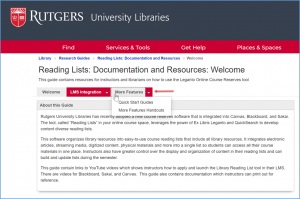
    The Reading Lists: Documentation and Resources LibGuide has been updated to include another page that describes additional functionality.  New content includes a quick start guide as well as printable handouts.  Liaisons can share this information with course instructors whether their courses are in Canvas, Blackboard, or Sakai.
    • Manage Sections (Edit/Add/Move/Set Dates):
    • Add Your Own Resource
    • Set Complete
    • Publish the Reading List
    • View the Reading List as a Student

    View the Reading List: Documentation and Resources.

    For questions about Library tutorials, contact Maria Breger at maria.breger@rutgers.edu

    View the complete list of the Libraries Teaching & Learning topics.

  • Update on LibCal Events

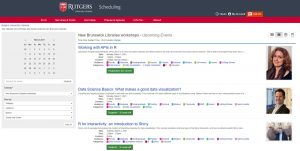
    NBL libcalIn the September 2020 issue of “The Agenda,” we wrote about the numerous modules of Springshare’s LibCal software that are in use at RUL.  This month, we’ll give you an overview and update on one of those modules, LibCal Events, and how it can be used.

    LibCal Events and associated event calendars are already used for scheduling workshops by NBL. Soon, we will be adopting LibCal Events across the Libraries as a replacement for our current event scheduler.  This switch will coincide with the launch of our new website in June.

    Creating events on calendars, displaying events, and registering for events is easily done through the LibCal Events module.  Waiting lists and automated reminders are helpful features for both end users and library personnel. Collection of usage statistics and follow-up survey comments will aid us in improving our future events and their scheduling. In addition, users will be able to search the calendars displayed on the website and filter by location and category to find events that are of interest.

    The next steps include forming a team of representatives from all library divisions to establish vocabularies for filters like category. That standardization will aid users in their searches, provide a basis for statistics collection, and enable the module to be useful across all libraries. Some of you will be contacted soon for this short task.

    For more information about LibCal Events and calendars, contact the LibCal Admin, Marty Barnett (martyb@rutgers.edu).  If you have questions about the website redesign, you can send email to the Website Redesign Team (webservices@libraries.rutgers.edu).

  • Website Redesign Update: March 2021

    The redesign project has moved into development, an exciting phase when we’re starting to see all our hard work turn into an actual website. This follows a few months of wireframe and design approvals, during which we met with each unit to talk through how they can use the new library of building blocks (“components” in website-ese) to put together pages that will best suit their users’ needs. It’s a very flexible system that will allow us to easily keep things fresh, eye-catching, and well-suited to the content we need to present – above all, making sure the site provides easy access to what our users need most. We’ve been testing this component library out with different types of pages (landing pages, informational pages, news items, profiles, etc.) and are confident that it will provide us with what we need.

    A few notable features in development: the database portal will be searchable by title and keyword, with easy one-click access to each resource, short-cutting the “connect” pages that force users through an extra step. A redesigned subject browse will make it easy to locate well-curated, usable lists of subject-specific databases, and database descriptions will be streamlined. We’re also finding ways to surface our librarians and staff in various places around the site. This will help connect users to people who can help, and showcase the expertise we have here at the Libraries.

    A content plan is beginning to take shape, as well as a governance plan that will ensure the long-term integrity of the site and its content. It will be great on launch day, and keeping it that way will require regular attention and maintenance, coordinated around a long-term strategy.

    Related to the redesign, we’re planning to move to LibCal as the Librarieswide means of scheduling events. You can read more about the transition in this issue of the Agenda.

    As always, you’re welcome to reach out anytime with questions or comments. Send us an email: webservices@libraries.rutgers.edu.

  • Ex Libris Implementation Team Update: March 2021

    As we approach the anniversary of the COVID-19 pandemic and our move to online instruction, we are taking a moment to reflect on the past year in reserves. Throughout this year, we have made the leap from primarily physical reserves to a fully digital workflow that is solidly grounded in Alma processes and provided to users through Leganto. This effort included almost everyone in the libraries and was possible only through the hard work of our reserves units, public-facing staff and librarians, directors, and nearly every central unit.

    Over the summer, Cabinet approved the Redesigning Reserves proposal to begin this transition. A few highlights from the completed work on this proposal include:

    • Modifying reserves workflows to make use of new metadata fields in Alma to manage evolving reading list and citation statuses added through Leganto
    • Moving and suppressing physical reserves items and the implementation of a chapter scanning workflow in QuickSearch to provide access to portions of these materials to users
    • Adding the Reading Lists tool to the default course shell in Canvas and integrating a Canvas course load into Alma to facilitate the connection between these two systems
    • Developing a focus group centered on improving fulfillment workflow processes, which reviewed the course reserves workflows and suggested modifications to improve efficiency and user experience
    • Forming a copyright queue to address internal course reserves copyright approvals
    • Changing the reserve workflow to center user communications in the local units and include liaisons and selectors at the correct points in the process
    • Sunsetting the course reserves scope, which was centered around print reserves discovery, in favor of the reading lists tool and the Leganto Search, which includes reserves materials in all formats

    While we are now successfully providing fully digital reserves for instructors and students, there are still ongoing changes. Some projects in process include:

    • The Fulfillment Working Group and volunteer reserves units from Camden, Newark, and New Brunswick Douglass are testing a new reports strategy in Alma to help reserves units manage reading list and citation statuses.
    • The Instructional Support Group is working on developing new documentation to help instructors create and populate their own reading lists and roll over their existing reading lists each semester to new courses.
    • The Alma Digital Steering Group is creating an outline for how we might implement Alma Digital. This tool would change the reserves process in several important ways including integrated digitization processes, a move away from local server storage for reserves materials, the opportunity to review our reserves content for accessibility, and the potential to provide controlled digital lending.
    • Cabinet will be reviewing a proposal focusing on student usage data collection in Leganto.

    Thanks to all the work across the organization on reserves this year, we have not only successfully transitioned the course reserves process to digital instruction, but have improved on it in many significant ways. Though this was a year full of uncertainty and change, we have been able to build new connections across Rutgers and continue our mission to support teaching and learning through course reserves.

  • Registration Now Open: BIG Collection Convenings for the Libraries of the BTAA

    Registration is now open for the Big Ten Academic Alliance monthly series of keynotes, panels, and conversations centered on the BIG Collection. All staff from across BTAA libraries are warmly invited to this “Sequence of Convenings,” which will focus on generating broad community engagement with the vision, themes, and practical direction for the BIG Collection. 

    Convening the 2nd Monday of each month throughout 2021, the program will include large plenary sessions about the strategic themes of the BIG Collection, alternating with focused conversations about how we reimagine our work as a community to collectively design and build the future we want to see. You can register for as many sessions as you like, and registration will remain open and editable throughout the year. Selected content will be recorded and made available following each session.

    The series launches on March 8th (10am CT / 11am ET) with “Envisioning the BIG Collection: Building a Knowledge Commons for the Big Ten” and an opening keynote from Maurice York, Director of Library Initiatives for BTAA. Panelists include the three library deans who sit on the BIG Collection Steering Committee.

    Featured plenary sessions will include:

    • April 12: “Collective Action and the Common Good: The Cornerstone of the Knowledge Commons” with Kathleen Fitzpatrick (Professor of English, Michigan State University) 
    • June 14: “Interdependence: The Pillars of the Knowledge Commons” with Greg Eow (President, Center for Research Libraries) 
    • September 13: “Open Knowledge: The Dome of the Knowledge Commons” with Evviva Weinraub (Vice Provost for Libraries, University at Buffalo)
    • November 8: “Equity and Inclusion: The Light and Air of the Knowledge Commons” 

    Conversation sessions with your peers will include:

    • May 10: Community Action in Practice: Networks of Trust in BTAA Library Initiatives
    • July 12: Shared Services, Shared Infrastructure, & Shared Strategy: Coherence of Activity in BTAA Library Initiatives
    • October 11: Open Content & Open Infrastructure: Alignment of Purpose in BTAA Library Initiatives

    For further background reading on the BIG Collection, this recent article in Library Journal contains an excellent overview.

    Register today for these sessions, and please share this announcement widely with colleagues at your library. All events are free, but registration is required. The hashtag for the sequence of events is #BIGconvenings.

  • The BIG Convenings: Why Now?

    As you may already have seen elsewhere in this issue of the Agenda, the BTAA has scheduled a series of BIG Collection Convenings for all faculty and staff of member libraries. This series of keynotes will focus on generating broad community engagement with the vision, themes, and practical direction for the BIG Collection.

    As a member of the BIG Collection Steering Committee, I invite you all to register to attend. But further, I thought I’d use this month’s column to give a bit of additional context about these events and discuss why now is a great time for us to be engaging in these conversations as a community.

    In a recent presentation, BTAA’s director of library initiatives Maurice York described our current operating environment as a sort of “Pangea,” with each of the self-contained land masses representing a distinct element of the member libraries’ collections and operations—our purchased collections versus our licensed collections, for instance, or the material we digitize from our physical holdings versus that which we make available as part of our various publishing initiatives.

    From my perspective as a member of the Steering Committee, the issue with the way this landscape has developed over time is that each area has grown in isolation from the others. Until very recently, no one had taken a step back to survey the environment holistically, to consider these elements as interconnected and interdependent, and to imagine the possibilities that can emerge when treating our Pangea not as a loosely related set of activities, but as a single entity with a unified purpose.

    The Convenings are our first step toward getting the people on all these separate land masses to see a common future—of moving us closer toward that unified purpose. They are also a way for us to hear from representatives of all these different groups, to understand them better and learn both what they can offer the BIG Collection and what they might need from the BIG Collection to be successful.

    As I have written several times over the last number of months, the scholarly communication landscape is evolving, precipitated in part by changes brought about by the pandemic and the shift to an online-centric model of teaching and research. At the same time as our users’ expectations shift to demanding access to materials “at the speed of now,” pressure is being put on academic libraries across the country to maximize their budgets and achieve efficiencies of scale. Set against this backdrop, how do we align resources and activities across BTAA libraries to work toward a “knowledge commons” and maximize our impact? How can we work together—leveraging shared services, infrastructure, and strategy—to better serve all our communities? These are the questions that we will begin to explore throughout the BIG Convenings. I hope you will plan to join us!