Category: Universitywide

  • Recapping State of the Libraries 2020

    Thanks to everyone who attended State of the Libraries on Wednesday. We had over 200 folks join the meeting, and I’m so glad you all found the time to be there even with the competing demands of work and home. It was no replacement for our traditional in-person gathering, but it was nice to feel a sense of togetherness despite the circumstances and our physical distance.

    If you haven’t had a chance to yet, I encourage you to view the poster presentations prepared by our colleagues from across the Libraries:

    It is so inspiring to view these and reflect on all the good work that has been done over the last year, as well as how we are preparing for the work that lies ahead. There will be no shortage of challenges in the year to come, but with all the creativity and dedication on display through these presentations, I know we are well-equipped to handle whatever comes our way.

    If you’d like to review them, you can view the slides from all the presentations on our staff resources site or a recording of the entire event on YouTube.

    As you might imagine, a lot of activity happened behind the scenes to make sure everything went smoothly. Special thanks to Kalaivani Ananthan, Matt Badessa, Tracey Meyer, Joann Parrone, Ed Smith, and the Major Events Committee—Elsa Alves, Matt Bridgeman, Ann Marie Latini, Erica Parin, Tonie Perkins, Jennifer Reiber, and Daphne Roberts—for their support.

    We also received some great actionable feedback that we will incorporate into our future virtual gatherings, so thanks to everyone who provided thoughtful comments via the feedback form.

    A theme that emerged from all of yesterday’s presentations was collaboration, and State of the Libraries was just another example of what we can accomplish when we all work together with a common goal and sense of purpose. I hope we can carry forth some of those lessons and apply them to our work moving forward. In the coming months, it’ll be more important than ever to identify the areas where we can leverage our shared interests and maximize our impact on the university community.

  • This Month in the Agenda – March 1982

    That’s Special

    Anticipating the physical and programmatic merger of the Department of Special Collections, University Archives, and the Records Management Program later this spring, University Librarian Hendrik Edelman has asked Ruth Simmons to serve as coordinator.

    Funds for the renovation of the New Jersey Room, staff offices on the B Floor and stack space on the BB Floor of Alexander Library have been received from the Board of Trustees and the University Administration. It is expected that all physical changes will be completed by this summer.

    The Agenda 4, no. 9 (March 1, 1982)

    Brenda in Charge

    Brenda Johnson has been named Head, Document Delivery Services/New Jersey Reference Services effect March 15. In this new position, Brenda will manage the interlibrary loan borrowing and lending service, provide assistance in bibliographic verification and location, and maintain liaison with unit reference librarians at RGL libraries and at other state, national, and international institutions.

    The Agenda 4, no. 11 (March 15, 1982)

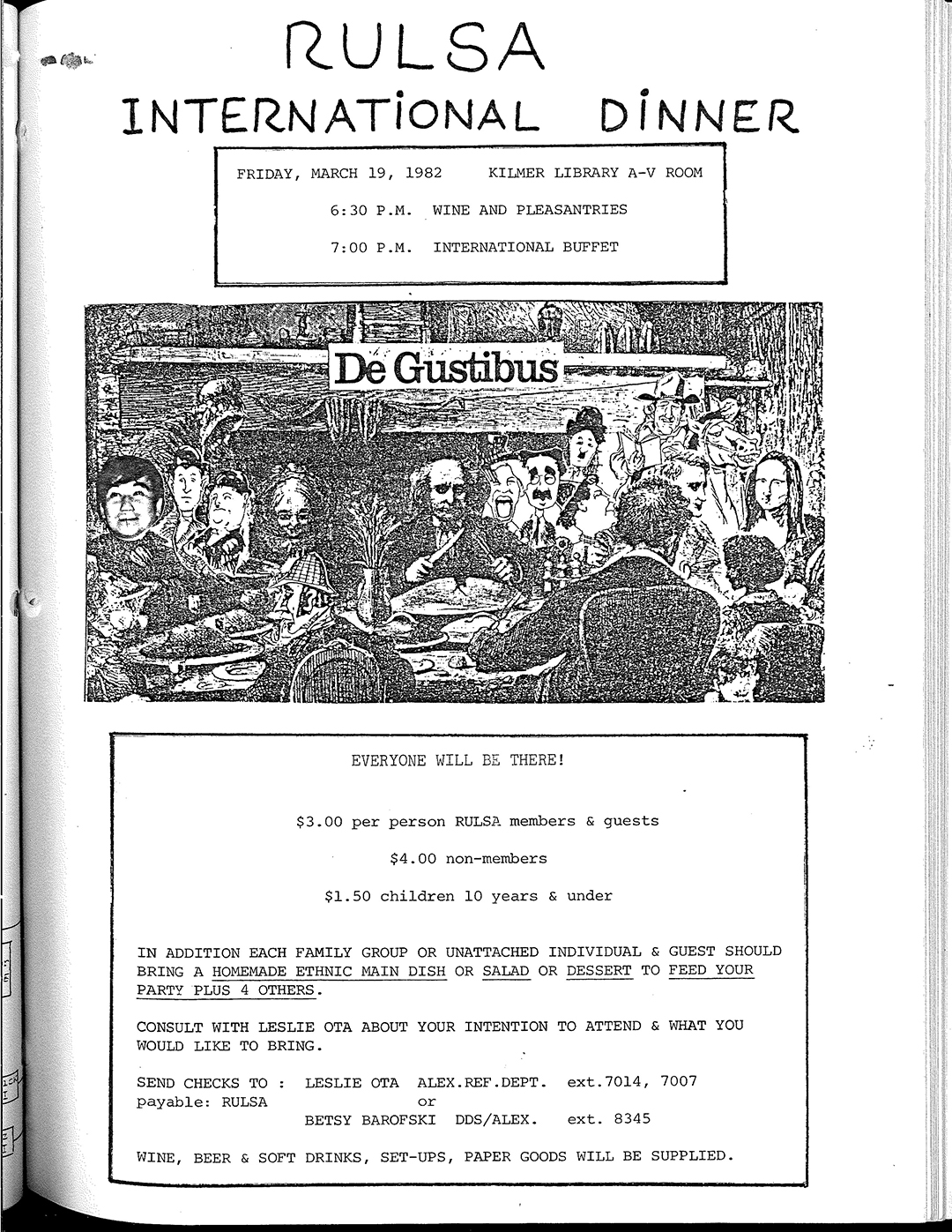
    Wine and Dine


    Camden Gets the News

    IN/FORM is a group of databases which include items published in the Philadelphia Inquirer and the Philadelphia Daily News; the major Philadelphia daily newspapers. IN/FORM provides full text access to these papers and permits searching on words/phrases in the complete text, and searching on fields such as headlines, bylines, and a limited set of descriptors and delimiters.

    The Agenda 4, no. 12 (March 22, 1982)

    Hey, Watch It!

    FROM THE PRESERVATION OFFICE

    No Scotch tape should be used under any circumstances to attach notes to the covers of books. Please place your memo concerning the book inside the front cover.

    The Agenda 4, no. 13 (March 29, 1982)

  • Quick Takes on Events and News – March 2020

    Bishop Lecture Returns

    The 34th annual Bishop Lecture will feature photographer and author Barbara Mensch, who will speak about how she was inspired by Special Collections and University Archives’ Roebling Collection to create her recent book In the Shadow of Genius: The Brooklyn Bridge and Its Creators (Fordham University Press, 2018). Mensch, who has lived alongside the Brooklyn Bridge for over 30 years, will illustrate her talk with striking photographs, including some taken deep inside. During the reception following the talks, guests will have the opportunity to purchase signed copies of the book.

    Free and open to the public. Refreshments will be served. RSVP here
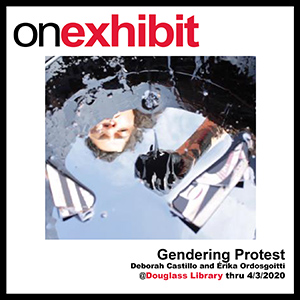
    Gendering Protest on Display at Douglass

    The Center for Women in the Arts and Humanities is pleased to announce the two-person exhibition, Gendering Protest: Deborah Castillo and Érika Ordosgoitti, which features the work of exiled Venezuelan artists whose art responds to the country’s political turmoil of the last decade.

    Gendering Protest will be on view from January 21 to April 3, 2020, in the Mary H. Dana Women Artists Series Galleries, Douglass Library. The exhibit is curated by art historian and curator Tatiana Flores, associate professor in the Departments of Latino & Caribbean Studies and Art History, Rutgers University. To accompany the exhibition, CWAH will publish a comprehensive online catalog.

    On Wednesday, March 25 at 5 p.m. in the Mabel Smith Douglass Room, Douglass Library, there will be a reception in honor of the artists followed by an artist’s lecture from 5:30 to 6:45 p.m.
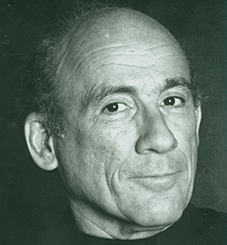
    Virgilio Papers Now Online

    Nicholas Virgilio was instrumental in popularizing haiku poetry in the United States and his own poetry received international acclaim. Except for a brief stay in Texas and service in the Navy, he lived in Camden his entire life. In 1962 he discovered a collection of haiku poems in the library at Rutgers University in Camden. A year later, his own first haiku works were published; he continued writing up until his death in 1989.

    This collection contains some of his haiku, including multiple versions of some of his better known poems, showing the development of his work. There are also drafts of correspondence, primarily concerning arrangements and publicity for his work and appearances. The collection includes thousands of unpublished and therefore never before seen haiku.

    Latino Oral History

    Krista White’s Digital Scholarship as Modular Pedagogy (DSMP) initiative is co-sponsoring an event with Newark Public Library about their Latino Oral History collection, which has been a featured collection used by students in the DSMP courses.

    Working Title: Latino Oral Histories: From Start to Finish.  With panelists:

    • Yesenia Lopez – managing an oral history project
    • Vanessa Castaldo – after the interview (transcribing, indexing, editing, etc.)
    • Juber Ayala – accessibility/ promoting the collection
    • Interviewee (tbd) – experience of being interviewed
    • Potential moderator: Dr. Katie Singer

    The program will be accompanied with a digital tour of our oral history collections and audio clips from some of our interviews.

    Date and location: Wednesday, April 1, Newark Public Library, 6:00–8:00 p.m. in Centennial Hall. 6:00–6:30 reception (light refreshments served), 6:30–8:00 p.m. program, community question and answers. Free and open to the public.

    More Published Poetry

    Congratulations to Ermira Mitre, whose English poetry was recently published in the literary magazine Mediterranean Poetry in Sweden.

    LOVE FOR MY HOMELAND

    I love your playful style, Albania,
    since I was a baby; still a gentle child,
    plunged myself blissfully, on your gusty roads,
    where my dream altered into a butterfly,
    chasing my shadow toward avant-garde.

    I love your prodigious Adriatic Sea coasts,
    the belly laugh of love, coiling on roses,
    melodious sounds, dance steps, moccasins,
    the echo, the zest of the flattering dances,
    the capricious sorceress of the wild tribes,
    unfolding the vivacity of the artifice.

    Read the full poem here.

    Vote for Adriana

    Adriana Cuervo is running as a 2020 candidate for Council of the Society of American Archivists. “We are at a critical juncture where different constituencies within the profession are championing diverging views on the future of the Society, and this is the time where SAA’s values will provide the grounding to move into what our profession will look like in the years to come,” she said. Learn more here.

  • Web Redesign Project Team Update – March 2020

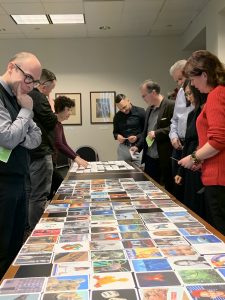
    Participants sort cards during NewCity’s on-site visit in February.

    The website redesign project has gotten underway. We are currently in the discovery phase, which has several objectives: to identify stakeholders and learn about their goals for the project; to uncover our needs as local communities delivering shared resources; to understand our technical infrastructure and plan for the future; and to strategize future engagement with our internal and external audiences.

    The project is being managed as a joint venture between Rutgers University Libraries and NewCity, a website design company experienced with higher education, large non-profits, and commercial companies.  The project team, which is co-led by Antonio Barrera (Library Applications and Development) and Amy Kimura (SUS), includes members from across RUL: Doug Allen, Matt Badessa, Megan Lotts, John Powell, Jonathan Torres, and Yini Zhu.

    On February 11 and 12, 2020, three members of the team from NewCity came for an on-site visit. They met with the project team, Cabinet, and additional faculty and staff representatives from across the campuses to lead a number of activities designed to explore the needs of our stakeholders, communities, and to reflect on each unit’s similarities and differences, while considering success measures for this project. One of the main goals was for NewCity to get to know us so they can be sure they’re capturing the authentic voices of the libraries.

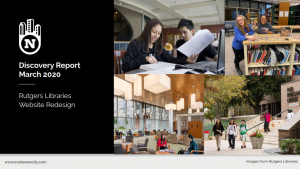
    NewCity will use these conversations and stakeholder interviews, together with a wealth of other qualitative and quantitative data, to build a comprehensive Discovery Report that they will deliver in the coming weeks. This report will help inform our site’s design and content strategy. We’ll make it available on the project team’s website, where you can also find other key documents related to the project.

    We plan to launch the new sites in June 2021 in order to minimize mid-year disruption. That gives us ample time to build the sites, provide training, and populate the new spaces with helpful, up-to-date content that best fits the need of each location and supports streamlined delivery of our shared resources. We will continue to update our project team site as we make progress, so check back frequently.

  • Digital Exhibits Page

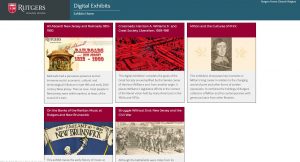
    Continuing the work of presenting our digital projects in a consistent arrangement, the Digital Exhibits page is available with its first five digital exhibitions. The page summarizes the completed projects and links to each online exhibition and its exhibit catalog. While the panels and web pages reflect the distinctiveness of the subjects, they share unified theming. They have consistent links back to the main Digital Exhibits page as well as the Libraries home page. Be sure to check back from time to time, as more are on the way in the months to come.

  • Digital Projects Status Page

    Over the past couple of years, the digital projects team in Shared User Services has been actively assisting campus libraries in organizing their work on digital collections, and making them available online. Thirty-one such projects are now publicly accessible through our digital collections page and span a variety of topics, from Inclusion and Diversity, to showcasing the research articles and presentations of our undergraduates. This list continues to grow, as new collections are proposed and some of our ongoing projects continue to be renewed and expanded upon.
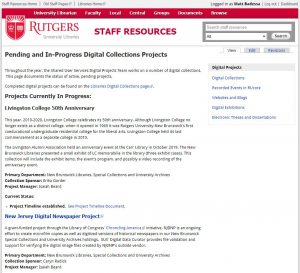
    But everyone wants to know what’s in the pipeline. In order to keep the RUL community up to date on the projects we’re working on, we’ve created a page for Pending and In-Progress Digital Projects that lists most of the digital collections and exhibits that are upcoming, along with their status and proposed work timelines. We hope you’ll visit our status page and keep abreast of our ever-growing digital collections work!

  • Teaching and Learning: LibGuides in Canvas

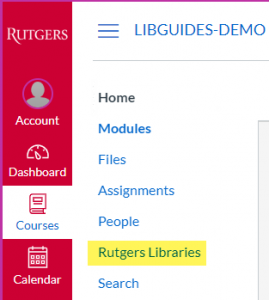
    A link to library content in the Canvas shell.

    Did you know that links to LibGuides and Library information are already included in all Canvas shells?

    Clicking on the Rutgers Libraries link in Canvas course navigation will display a page with a link to a LibGuide(s) and also Library information.

    By adding Canvas course metadata to a LibGuide, Librarians can connect students to LibGuides that are directly related to their course.

    There is no limit as to how many courses can be connected to one guide, and there is no limit as to how many Libguides can be connected to a course.

    View this document to see how to connect your LibGuide to a Canvas course.

    LibGuide authors who have questions about LibGuides may contact Maria Breger at maria.breger@rutgers.edu

    View the complete list of the Libraries Teaching & Learning topics.

  • Ex Libris Implementation Team Update – March 2020

    New Central Index Coming to QuickSearch

    In Spring 2020, Ex Libris will release its new Central Discovery Index (CDI), an expanded search index with an upgraded infrastructure that will replace the current Primo Central Index (PCI). The central index is a collection of records describing hundreds of millions of scholarly resources, including articles, books, conference papers, and audiovisual recordings harvested from publishers, aggregators, and open-access repositories. The new index will offer several improvements, including:

    • Expanded content coverage
    • Faster content updates
    • Merged records instead of record groups
    • New and more granular resource types
    • Streamlined activation process

    Although the transition to CDI is expected to be seamless, users may notice the following changes:

    • More search results
    • CDI leverages the combined assets of Primo and Summon, which means users will have access to more content than before
    • Changes to retrieval and ranking
    • CDI uses a different search algorithm impacting the way results are retrieved and ranked
    • Merged records
    • Duplicate results within the central index are merged into a single record instead of grouped together
    • New and more granular resource types
    • CDI will offer new resource types (e.g., archival material, market research, dataset, standard) and more granular categorization (audiovisual will be separated into audio and video)
    • Broken permalinks
    • The majority of permalinks will continue to work but Ex Libris estimates that ~10% could not be mapped and will break

    To minimize disruption, the new index will be activated after the spring semester ends on May 18th, 2020. If you have any questions, please contact exlibris@rutgers.libanswers.com.

    Law Libraries – By the Numbers

    The Law Libraries Append Project added a large number of physical and electronic resources to Alma and QuickSearch in January 2020. For physical, 188,572 titles and 463,395 items were added. For electronic, 95,216 titles representing 117,237 electronic resources were added. Also, 3,042 user records were loaded containing 1,451 new user records and 1,591 updated records and 3,583 checkout records attached to these users were loaded.

    Leganto in Action – Spring 2020

    Sixty-two unique course sections are actively using Leganto for Spring 2020. This includes at least one course from every campus and courses that span eight Rutgers schools and colleges. The School of Social Work in New Brunswick’s online and hybrid courses have continued to make active use of the Reading List tool, but there are also notable numbers from the College of Arts and Sciences in Camden and the School of Nursing at RBHS.

    Introducing Esploro

    Rutgers University Libraries have contracted with Ex Libris to integrate Esploro, an institutional repository platform for collecting, managing, and showcasing the university’s research output. Esploro offers a variety of useful features including:

    • Support for over 50 asset types including pre-prints, publications, data sets, audiovisual media, and creative works
    • Direct and mediated deposit as well as automatic capture of assets from external sources such as indexes, national repositories, and disciplinary repositories
    • Researcher profiles allowing for easier identification of domain experts and potential research collaborators
    • Integration with Pivot, a global funding database that helps match researchers with potential funding opportunities
    • Robust analytics for measuring research performance and impact

    Integration of Esploro into our Alma environment begins March 2020 and will be carried out in two phases. The first phase will focus on data migration and system configuration and is expected to be completed by the end of summer. The second phase will focus on education, promotion, and campus engagement. Stay tuned for further updates as the project unfolds.


  • Ex Libris Implementation Team Update – January 2020

    As you know, the Ex Libris Implementation Team has been working with the Law Libraries since May on a project to migrate their data to Alma and merge their library catalog with ours. During the week of January 6, we will begin the final steps of this migration. To help you navigate this transition, below are answers to some frequently asked questions about the project. If you have additional questions, please send them to the Ex Libris Implementation Team at exlibris@rutgers.libanswers.com.

    Q: When are the Law libraries expected to migrate to Alma?

    A: The migration is expected to be completed on January 10, 2020.

    Q: Will any services be disrupted or temporarily unavailable during the migration?

    A: No, Alma and Primo are expected to remain fully operational during the migration.

    Q: Will the collections of the Law libraries be discoverable in QuickSearch?

    A: Once migration is complete, all materials currently represented in Law’s library catalog will be discoverable in QuickSearch. Law patrons will also be able to access these resources through a separate custom view designed specifically for the Law School. Additional work is required to create and configure Law’s electronic resources. It will take up to 24 hours after go-live for all of Law’s electronic resources begin appearing in QuickSearch. Because this configuration must be done in our live production environment, users may experience intermittent access issues during this time.

    Q: Can Law’s circulating collections be borrowed or requested by non-Law School patrons? Are the loan policies the same?

    A: Yes, circulating materials can be borrowed or requested by any Rutgers user. To make borrowing between the libraries easier, loan polices have been made uniform.

    Q: Are there any resources that are restricted to Law patrons only?

    A: Yes, certain electronic resources (such as Westlaw, Lexis, and Bloomberg) are restricted to Law patrons only. Access to these resources is only available from a Law School IP address, via the Law School proxy, or with an assigned username and password. These resources will be visible to all QuickSearch users with a note indicating that access is restricted to Rutgers Law School students, faculty, and staff [view example]. To maximize visibility of this note, direct linking will be deactivated for all Law-restricted resources.

    Q: Will the Law migration result in duplicate records?

    A: Yes, you may see some duplicate records initially. There are plans to identify and remove duplicate records post go-live.

    Q: Where should I refer Law-specific reference and borrowing inquiries?

    A: Please direct patrons to contact the appropriate Law library:

    Camden Law
    Reference (856) 225-6173
    Circulation (856) 225-6172
    lawlib@camden.rutgers.edu
    Newark Law
    Reference (973) 353-5676
    Circulation (973) 353-5677
    refdesk@law.rutgers.edu
    Q: Who should I contact if I have additional questions?

    A: Please send questions or comments to the Ex Libris Implementation Team at exlibris@rutgers.libanswers.com.


  • SAPAC Schedule 2020

    Join the Scholarly and Professional Activities Committee for these upcoming talks.

    Lies, Damned lies, and…What LibQual+ 2019 and other statistics mean to me

    Thursday, January 16, Noon-1:00 pm, Pane Room, Alexander Library, New Brunswick
    Grace Agnew, Special Advisor for Strategic Initiatives and Analytics

    So we did this survey in April, 2019.  But what does it mean for me?  Will anything change?  Does anything need to change?  Why do we collect numbers, anyway?  Grace Agnew will highlight the findings of the 2019 LibQual+ statistics, with specific emphasis on individual user groups and libraries, as well as other statistics we are collecting to get a handle on how we are doing with services and collections.  Much of the time will be discussion, as attendees share what they think the statistics mean, based on their observations when working with users.

    Learning from the Smithsonian: Reflections of a Museum Studies Fellow

    Thursday, February 13, Noon-1:00 pm, Pane Room, Alexander Library, New Brunswick
    Kayo Denda, Librarian for Women’s, Gender and Sexuality Studies, Douglass Library

    The presentation will be based on my 4 week-stay in Washington D.C., during summer ’19 as a museum studies fellow affiliated with the Smithsonian, Center for Learning and Digital Access. I will provide an insider’s view of the nation’s leading historical institution, its uniqueness and its challenges as they forge their future. The presentation will highlight select Smithsonian projects and tools, such as the Learning Lab platform, with great potential for the library community.

    Ithaka S+R Research study

    Wednesday, March 26, Noon-1:00 pm, Pane Room, Alexander Library, New Brunswick
    Triveni Kuchi, Social Sciences/Instructional Services Librarian and Faculty & Graduate Services Coordinator, NBL
    Jim Niessen, World History librarian, NBL
    Jon Sauceda, Music/Performing Arts librarian and interim liaison to Spanish, Portuguese, Latinx, Latin American and Caribbean Studies, NBL

    We examine the research practices of faculty in a particular field, namely language and literatures, to identify what resources and services scholars currently use and wish they had access to at Rutgers University – New Brunswick. This research was part of a study coordinated by Ithaka S+R, a not-for-profit research and consulting organization, working in conjunction with the Modern Language Association (MLA). In this presentation we would like to share our findings and recommendations.

    The Nick Virgilio Papers

    Monday, April 20, Noon-1:00 pm, Conference Room 290, Robeson Library, Camden (with Webex to remote locations)
    Julie Still, Reference Librarian/Collection Development Coordinator, Robeson Library

    The Nick Virgilio Haiku Archives arrived at Rutgers (and later at the Robeson Library) in several copier paper boxes over a decade ago. In January the Rutgers University Libraries released the fully searchable database of these poems. The process of getting from Point A to Point B is long and convoluted, full of fits and starts. This presentation will focus not just on the technical nuts and bolts, but also on the human element involved, and what consideration might be due those whose name is invoked in someone else’s work.

    Understanding Open Access Trends in Business Schools: A Bibliometric Analysis of Open Access Faculty Publications in Accounting Departments at Three Universities

    Monday, May 11, location TBA
    Jonathan Torres, Business Librarian, Dana Library

    Open access publications and journals continue to be an emerging trend in a variety of academic areas. Studies have indicated that open access journals offer a citation benefit. (Salisbury et.al, 2017) One of the many benefits of OA mentioned in previous studies states that, “advocates argue that OA will increase research efficacy as measured by citation counts and/or citation impact factor” (Atchison and Bull, 2015, p.133). Further research highlights the fact that free access to literature has the potential to increase authorship and readership (Philip and Walter, 2011). Nonetheless, studies have indicated that a top priority for faculty is having their publications viewed by peers within the same field because that impacts their career. As a result, providing articles for open access to the public is secondary. Faculty perceptions of article and journal accessibility tends to vary based on disciplines.

    This presentation will examine the outcome using bibliometric analysis between (OA) open access and non-OA publications from the accounting departments of three business schools (University of Arkansas-Fayetteville, University of Tennessee-Knoxville, and Auburn University). These schools were selected based on the comparable sizes of the departments. The research will demonstrate faculty OA compared to non-OA publications and their relative scholarly impact and merits for the period 2013-2018.

    SAPAC 2019-2020 Committee Members:
    Janet Brennan Croft, Co-Chair
    Bart Howard Everts, Co-Chair
    Amy Kimura
    Laura Costello
    Fobazi Ettarh