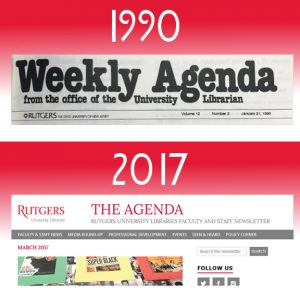
During one of my visits to Smith Library, Mina Ghajar mentioned that she knows two people who used to write this very same internal newsletter when it was in the print form of The Weekly Agenda. Jan Leavitt (retired and presently a part-time Librarian at Franklin Township Public Library) and Ann Smith (Head of Adult Services, Franklin Township Public Library) offered to write a short recollection about the origins and content of the earlier version of The Weekly Agenda upon which our new web-based publication is based.
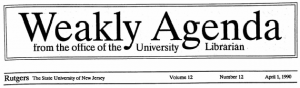

From Jan Leavitt and Ann Smith:
The Weekly Agenda was first printed in April of 1979. Instituted by the university librarian as a form of communication to faculty and staff in the libraries on the various Rutgers campuses, it became the newsletter announcing the many happenings in the Libraries.
The faculty and staff news items included professional development announcements of various conferences, along with grant and publication opportunities and reports to the library community from those attending meetings outside of Rutgers. The Agenda also included fundraising updates from the University Foundation regarding the Parents and Friends donations to the Library budget, which supported the Libraries. Library employment vacancies were listed in The Agenda, and the library calendar of events for the month was printed on the back page. Also included on the back of The Agenda were the various exhibits on the three library campuses.
Occasionally we would put out an April Fool’s type of publication which everyone seemed to get a laugh out of and enjoyed. One that comes to mind was the April 1, 1990 issue.
Happily, thanks to Janie Fultz’s archival tendencies, we have bound copies of earlier issues of The Agenda. Enjoy this PDF of the April 1, 1990 issue of “The Weakly Agenda” which features a tongue-in-cheek obituary for Ken Kuehl (death by axe – one heck of a way to go); the introduction of a new policy to install “grease trucks” outside of the libraries (which as we now know was remarkably prescient); and the formation of the Acronymiacs Anonymous to combat our tendency to speak in acronyms.
It’s Performance Appraisal time again! The program has two components: performance evaluation and merit increases.
In anticipation of an announcement from University Human Resources regarding the performance appraisal program for URA-AFT employees, managers and supervisors should remind their URA-AFT employees to begin a self-appraisal. To be eligible for the Staff Compensation Program (SCP), URA-AFT employees must be in a program-eligible title on or before January 1, 2017 and remain employed in a URA position through the payment date of the merit increase. The SCP runs from May 1, 2016 through April 30, 2017. Self-appraisals should be completed by April 15, 2017. Managers and supervisors must complete performance evaluations and notify eligible employees of the appraisal by April 30, 2017 and provide the employee an opportunity to comment in writing by June 1. Any employee comments are attached to the appraisal.
Staff are evaluated against performance standards that were established during the previous evaluation process and include any additions or modifications that have been communicated to the employee during the year. The two rating categories are Meets Standards and Does Not Meet Standards. At the completion of the evaluation, supervisors establish standards for the next year’s evaluation process and discuss with each employee.
Please note: For RBHS staff, evaluations for CWA Local 1031 are due in November. HPAE Local 5094 and Teamsters Local 97 evaluations are due in the anniversary month.
Additional information will be forwarded when the official appraisal and merit programs are announced.
Below are links to the UHR webpage to assist you in the process.
Yes! The Rutgers 250 celebration was a lot of fun, so we are planning to hold another staff appreciation event this fall. We’ll circulate a date for this as soon as we can. We have something pretty fun planned for the event and hope to have more to share soon.
State of the Libraries (12/6/17)
The 2017 State of the Libraries will be held at the College Avenue Student Center and will, once again, have a poster presentation. More information will be available soon, but we encourage everyone to discuss possible poster ideas with their supervisors and director/AUL.
We are also happy to announce that the video from our 2016 State of the Libraries is now available here.
From the western front to the home front, the experiences of New Jerseyans will be on display at Special Collections and University Archives through one-of-a-kind documents, photographs, and artifacts. The exhibit, curated by Flora Boros, opens March 9 with a reception and a Bishop Lecture by Dr. Virginia A. Dilkes on her father’s combat experiences. Everyone is invited to attend, but please RSVP to events@libraries.rutgers.edu.
About the exhibit:
New Jersey played an important role in World War I. Not only did the Garden State make significant financial, industrial, military, and psychological contributions from the outset of the bloody conflict, but it would ultimately provide 72,946 recruits and 46,960 volunteers, with an additional over 20,000 serving by the War’s end. In total, 3,836 New Jerseyans were lost to combat, accident, or disease.
“Heaven, Hell, or Hoboken!”: The Great War in New Jersey (on display March 9 – September 2017, Alexander Library, 169 College Avenue, New Brunswick, NJ) focuses on the individual experiences of these Jersey doughboys and servicewomen who bravely went “Over There,” and the families and neighbors who remained behind, “Over Here.”
The exhibit takes its name from Commander in Chief John J. Pershing who—predicting a swift resolution to the deadlocked western front—promised his men that they would be home by Christmas of 1917. His patented promise of “Heaven, Hell, or Hoboken!” became a national rallying cry for the nearly 1.8 million Americans that passed through Hoboken on their way to the European battlefront.
Split into two parts, the exhibit begins with “Over There,” featuring rare watercolors by Swiss artist Gustave A. Wendt, artist Lute Pease’s political cartoons for the Newark Evening News, soldiers’ frontline diaries, letters from the Rutgers College War Service Bureau, trench newspapers, albums and scrapbooks from servicemen and servicewomen, and a complete French gas mask kit. Continuing with “Over Here,” the exhibit features a homemade service flag hung in a Branchburg family’s window, volunteer armbands, the John A. Roebling’s Sons’ patented torpedo nets, memorabilia from Camp Merritt, and posters from our Liberty Bond Poster Collection.
The exhibit includes loans of 29th “Blue and Gray” Division artifacts and souvenirs from the National Guard Militia Museum of New Jersey, wartime medical supplies from the Johnson & Johnson Archives, and postcards from the Special Collections of the George F. Smith Library of the Health Sciences at Rutgers Biomedical and Health Sciences.
On March 9, Special Collections and University Archives will open the exhibit with a reception and lecture by Dr. Virginia A. Dilkes who will present “Through the Eyes of a WWI Combat Engineer,” based on her father’s experiences during the war. This event is open to the public and begins at 6:00 p.m. at Alexander Library (169 College Avenue, New Brunswick, NJ).
This exhibit is part of a series of events around New Jersey to commemorate this anniversary. For a complete list, check here. Additional events will take place at the Libraries throughout the year including a WWI poetry reading during National Poetry month on April 18 and an additional exhibit in Paul Robeson Library at Rutgers University–Camden.
Believe it or not, the 2018-2019 planning process is beginning. This will be our third planning cycle under the RCM model, so we are gaining an understanding of the flow of things. Over the last few weeks, Cabinet has developed a planning calendar to guide our strategic discussions and budget requests.
Based on what we have learned in past years, our planning process can be thought of in three phases. In each of the three phases, we have to address library planning for the upcoming fiscal year (2018) and future year (2019) budget requests. (I know, this is where everyone’s eyes glaze over, but it isn’t as bad as it sounds!)
Why three phases? Rutgers Libraries serves the needs of three distinct campuses and a health system. We need to support the unique needs of each of the communities with a single shared infrastructure. In the first phase of the process, we address the feasibility of initiatives and look for ways to optimize our infrastructure. By doing this together, we have a transparent process with many voices at the table. The second and third phases address two necessary parts of planning – creating a plan and creating a budget.
Phase 1: Environmental scan. During this part of the process, the library directors will assess the needs of their local communities, identify gaps, and develop a list of local priorities for their collections, services, and spaces. It will be up to each library director to determine how they conduct their local process, so if you have questions, be sure to ask your director.
At the same time, infrastructure units will be assessing their capacity. What projects are starting and ending, are there projects waiting to start? Are elements of the infrastructure outdated or at capacity? This analysis will result in a better understanding of the capacity of our infrastructure and whether we can take on new services.
In late March, Cabinet will meet in an all-day retreat to review priorities and activities and to identify themes and overlap. We will look at the capacity of our infrastructure and determine which priorities we can accomplish with our existing infrastructure, which will need additional funding, and which should be tabled until the next planning process. This meeting will result in list of priorities that have been vetted for feasibility for further consideration.
One of the challenges we face is that because we have yet to receive our working budget for 2018, we can’t be certain which priorities will be covered by our 2018 plan and which may have to become part of a future budget request. So, for the time being, we will include all priorities in a master list so we don’t miss anything important. In April, we expect to receive our working budget for 2018, which will give us essential information into the staging of the priorities.
Phase 2: Develop a 2018 plan. At this point of the process, we will have all the information we need to establish our plan for 2018, which we will do at a late May retreat. We will use the working budget to separate the master list of priorities into two categories: priorities that have 2018 funding and are therefore part of the 2018 plan, priorities for which we do not have capacity.Before finalizing, the 2018 plan will be returned again to the units giving directors a chance to discuss these activities more broadly on campus. Since many items on this plan will take more than a year to accomplish, the 2018 plan is then incorporated into the Library Priorities spanning 2017-2019 that will be announced at the State of the Libraries meeting in December 2017.
Once we have made our plan for 2018, we are left with a list of priorities for which we do not have capacity. This is where things become more difficult as we have limited resources and must decide which priorities will be included in the 2019 budget request and which will be postponed. I have learned in my time at Rutgers that it is difficult for us to say that we are not going to do something. We have a talented, capable group and I have seen amazing things accomplished; but it is important for us to be clear about what is possible. Which brings us to developing our 2019 budget request.
Phase 3: Develop a 2019 budget request. In this phase, we take the list of priorities that do not have funding and determine what we should do. Are the priorities important enough to develop budget requests? We have learned that the most successful budget requests are based on data. For example, we received funding for new information resources because we could provide evidence of use of similar resources. If the priority is not well suited for an external budget request, is it something that we might internally fund through the reallocation of resources? Or is it something that has to be put on hold? At a Cabinet retreat in August we will finalize the budget requests.
After a few months, the entire process will commence again with the plan for 2018 and budget request for 2019 quickly seguing into the plan for 2019 and the budget request for 2020. The planning calendar that cabinet has developed will help us stay on top of this process and ensure that we are doing the right things to make Rutgers better. The process takes months and is continuous, but this has hidden benefits – there are breaks throughout the process that give Cabinet members time to communicate and seek feedback about the progress and because the process is thorough and transparent, we will end up with a cohesive and targeted plan that we can all support.
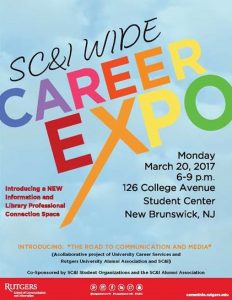
We just received an invitation to participate in the SC&I Wide Career Expo on Monday, March 20 from 6-9 p.m. The Expo will be located in the College Avenue Student Center and refreshments will be provided. There is no fee for participating in the Expo.
This year they will feature two unique spaces for library, company and organizational representatives.
One space will feature Archival, Academic, Information Technology, Informatics, Data Analytics, School and Public Library representatives to network and discuss careers with our students and alums.
The second adjacent space for representatives in the industries related to Communication, Journalism and Media Studies.
This event will also kick-off a new collaboration between SC&I, Rutgers University Career Services, and the Rutgers University Alumni Association called, “The Road to Communication and Media”. The goal of the program is to connect students with alumni in their desired communication and media career fields.
Spam and phishing messages are pouring into our inboxes almost every day. Some of these messages cleverly mimic the look and feel, and in some cases naming conventions, of trusted sites, leading people to accept the legitimacy of the messages.
Rutgers Connect email administrators in the Office of Information Technology have put powerful filters in place to keep the number of incoming malicious messages low, but it is impossible to completely eliminate them. The messages sneaking in past the filters entice you to click on links/attachments or to reveal confidential information about yourself (NetID and password, date of birth, SSN, etc.). Clicking on a link or opening an attachment may install malicious software on your computer, or steal the data entered in good faith to use it later for criminal gain, like illegal downloading research content the Libraries are paying for – or worse.
Recognizing and avoiding spam/phishing messages minimizes your chances of becoming a victim. The following are some tips that will help you identify such attempts:
Look for spelling and grammatical errors
Look for suspicious links and/or the sender’s email address
Do not click on links in an email to connect to a website unless you are sure that the link is authentic.
Hover with your mouse to reveal the actual URL.
Do not reply.
Look for unusual/generic-looking requests
Fraudulent emails are often not personalized.
Be wary of emails asking for confidential information. Do not disclose sensitive information in response to an email you don’t know where it is coming from. Phishers like to use scare tactics and may threaten to disable your account or delay services until you “update certain information.”
Do not open attachments in any suspicious email messages.
Make sure you are keeping your computer’s security software up to date.
IIS sends out a reminder on last Wednesday of each month to download and install Windows security updates. Please be sure to install them immediately.
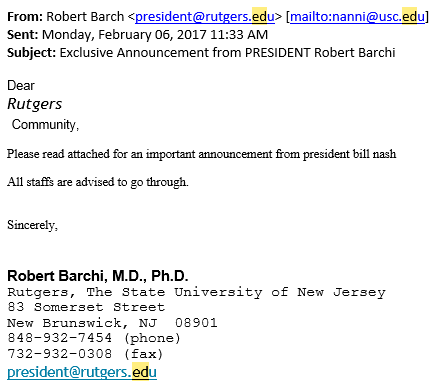
Here is an example of a recent phishing attempt. Can you spot a few clues?
“i” is missing from President Barchi’s last name in the “From” address
Suspicious “mailto” email address
Unusual formatting of the greetings line
Poorly written message body: “president bill nash” indicates lack of attention to detail. Not capitalizing title and name gives away sloppy authoring skills.
Poor English: “All staffs are advised to go through.”
If you are uncertain about the legitimacy of an email, ask your local UCS or IIS to confirm the authenticity. If you have clicked on a suspicious link, or have provided your confidential information, call IIS immediately at 848-445-5896 #7.
Rutgers Day will take place on Saturday, April 29 from 10 a.m. to 4 p.m. Just like last year, events will take place on all campuses and the Libraries will be well represented. This year, the Libraries have formed local Rutgers Day committees who have been busily planning for the day.
How you can help:
Sign up to help at the booths/tables for a shift (usually 2 hours, but you’re welcome to stay for longer!).**
Donate good condition children’s books—check with organizers who have wish lists to fit their themes.
Donate or loan other items as needed (electrical cords and tablecloths were mentioned at our most recent meeting, but there may be other items. Check with your organizers).
Sign up to help with set up and break down of the booth/displays.**
Check in with your local Rutgers Day organizer.
RBHS– Peggy Dreker, Pam Hargwood
Camden: Monique Whittle, Zara Wilkinson
Newark: Tad Hershorn
New Brunswick: Stacey Carton, Tara Kelley
Post Rutgers Day flyers and card booklets at work or in other locations.
Join the fun – plan to attend Rutgers Day and stop by the booths/tables to say “hi.”
**IMPORTANT: This is not unpaid volunteer time. Time worked at Rutgers Day must be approved by your supervisor.
Here’s what is planned for the day!
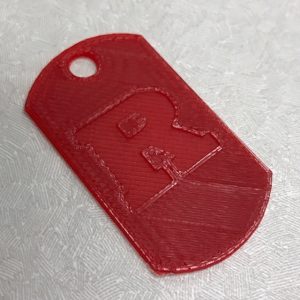
New Brunswick Libraries is 3D printing Rutgers dog tags to promote the WWI Anniversary and Exhibit. Weather permitting, the 3D printer will be on-hand for demos, too.
Rutgers Biomedical and Health Sciences Libraries @ Busch Campus
Fishing for Quality Health Information
Cast your line for tips on staying healthy, answer wellness trivia, or learn where to catch dependable health information on the web.
Rutgers-Camden, Robeson Library
Lights, Camera… Read!
Whether you’re learning your ABCs or getting your PhD, the library can help make you a star. Create a button or get your face painted, then take a walk by our red carpet selfie station and smile for the paparazzi.
Rutgers-Newark, Dana Library
Staying Informed in the 21st Century
Get tips on identifying fake news, test your knowledge of current events, or learn how to get involved in public affairs with help from the Dana Library.
Rutgers-Newark, Institute of Jazz Studies
Swing into the Institute of Jazz Studies
Tour the world’s largest jazz archive, listen to a jazz oral history, or learn about our 50th anniversary exhibition.
Rutgers-New Brunswick Libraries @ Math department
Fun Facts about the Libraries
Sharpen your mind with a brain game or take an instant “shelfie” while learning about the libraries at Rutgers.
Rutgers-New Brunswick Libraries @ Voorhees Mall
What’s “Special” about the Libraries? NJ and the Great War
Calling all doughboys and doughgirls! Learn about the centennial of World War I through Rutgers’ Special Collections and University Archives, then 3D print your own souvenir dog tag.
Records at Play: The Institute of Jazz Studies @50
A new exhibit of materials from IJS titled Records at Play: The Institute of Jazz Studies @50 is the inaugural exhibit in the Paul Robeson Galleries at Express Newark ( 54 Halsey Street, Newark, NJ 07102). On display through the end of the calendar year, this will be the first time the IJS has exhibited so many of its treasures at once. Although they represent only a small fraction of the Institute’s collections, the artifacts, documents, and sound recordings in this exhibit provide a record of IJS history and the music at its core.
From the Boarding House to the Board Room: 250 Years of Women at Rutgers
The Libraries collaborated with multiple university partners on the documentary “From the Boarding House to Board Room: 250 years of Women at Rutgers” by award winning filmmaker June Cross which was shown last October. Kayo Denda just received notice that the YouTube video for the panel discussion following the film screening is now available.
About “From the Boarding House to Board Room”: Rutgers was founded in 1766 to educate young men, and so it remained for the first 152 years. Yet from the beginning women played vital but unrecognized roles. This film, directed by award-winning filmmaker June Cross and produced by the Institute for Women’s Leadership consortium, highlights the multiple layers of Rutgers’ ongoing transformation – from the campaign to create a separate, co-ordinate women’s college to the first female students to enter Rutgers College. While Rutgers’ story is distinctive, it is also universal. The film considers the radical transformation of higher education and how this revolution continues to meet the needs of 21st century students.
Tara Kelley trains NJDNP staff in operation of the equipment.
New Jersey Digital Newspaper Project February Update
The latest blog from the New Jersey Digital Newspaper Project introduces us to the new dedicated office space that has been prepared for the project at Alexander Library. It is replete with all the equipment needed for analyzing the papers on microfilm: “film reel arms, a light box, densitometer, jeweler’s loupe, a 100x handheld microscope, static-free cloths and (of course) white gloves,” writes project director Caryn Radick. Reach out to Peter Konin if you are interested in seeing the space.
Perhaps even more exciting, the advisory board has selected the newspapers that they hope to digitize and submitted them for approval to the Library of Congress. Once the titles are approved an announcement will follow shortly, so stay tuned for more from the NJDNP!
Tim Corlis and Erika Gorder teamed up in January to teach the NJLA workshop, “Archival Basics for Librarians: A workshop for new archivists and special collections librarians.” This workshop is geared toward public libraries who may encounter historical materials or have archival issues come up. It provides practical advice on immediate issues of preservation, writing a finding aid, archival materials, etc. This year, around 25 people participated and they had to turn additional registrations away. The need for this type of course is increasing. Winnowing library budgets mean there aren’t funds to hire archivists, though there continues to be a real need for archiving and conservation skills.
The Pony Wilson exhibit at Robeson Library. Credit: John Powell.
Exhibit at Robeson Library Remembers Longtime Athletic Director
Remembering Coach Wilbur “Pony” Wilson is on display now through March 8 at Paul Robeson Library. Wilson was the athletic director at Rutgers–Camden for over 28 years and coached the Pioneers basketball team to the first 20-win season in Rutgers–Camden athletics history. Under his leadership, the university expanded its varsity sports program from five to 14 teams, and his was the first name enshrined in the Rutgers–Camden Circle of Honor in February 2000.
The Kalmyks originated in Dzhungaria (today’s northern Xinjiang, China) in the 16th century. They proceeded via Russia and western Europe and, during the 1950s, established unique diasporic communities in Philadelphia as well as in Paterson and Howell. hrough illustrations, photographs, artifacts, and music recordings drawn from the Kalmyk Diaspora Archives Project, this exhibition showcases the Kalmyk journey from pastoral nomadism to post-WWII urban and suburban America.
NLM Director Appointed Interim NIH Associate Director for Data Science
The National Institutes of Health (NIH) announced that National Library of Medicine director Patricia Flatley Brennan, RN, PhD will assume an additional role as NIH interim associate director for data science.
The associate director for data science and team provide input to the overall NIH vision and actions undertaken by each of the 27 institutes and centers in support of biomedical research as a digital enterprise. Among other duties, the office oversees the Big Data to Knowledge (BD2K) initiative, stimulating the best developments in the data science community.
“I believe the future of health and health care rests on data—genomic data, environmental sensor-generated data, electronic health records data, patient-generated data, research collected data,” Dr. Brennan observed. “The data originating from research projects is becoming as important as the answers those research projects are providing.”
On April 20th through the 22nd, the Mid-Atlantic Regional Archives Conference (MARAC) will hold its spring meeting in Newark at the Robert Treat Hotel. The meeting’s theme, “Adaptable Archives: Redefine, Repurpose and Renew,” is a fitting reflection of Newark’s continued renaissance. As a tri-chair for the meeting’s Local Arrangements Committee, I’m incredibly excited to welcome the expected 300-350 attendees and support their professional development while making an impact in Newark and showcasing the city and its transformation. MARAC serves archivists in New York, New Jersey, Pennsylvania, Delaware, Maryland, Virginia, West Virginia, and Washington, D.C., locations rich with a diverse array of archives. The meeting’s program is jam-packed with tours of area historic sites, attractions, and repositories; sessions on topics ranging from Hurricane Sandy recovery to digital preservation of faculty and student research; workshops about using APIs in archives, identification of photographic formats, and more; and lots of opportunities for professional networking.
Numerous Rutgers divisions have been instrumental in supporting the meeting, including Rutgers University Libraries, the School of Communication and Information, Rutgers University—Newark, and the Clement A. Price Institute on Ethnicity, Culture, and the Modern Experience. RUL deserves special recognition because of its role as sponsor and host of the all-conference reception via the Institute of Jazz Studies; for underwriting the cost of transportation for one of the tours to a local historic site; for its encouragement of library faculty, staff, and librarians to serve on the Local Arrangements and Program Committees, including Natalie Borisovets, Tim Corlis, Angela Lawrence, Tara Maharjan, and Bob Vietrogoski; and for providing space for Local Arrangement Committee meetings at Dana Library. RUL is also well represented in the program, with presenters including Christie Lutz, Sheridan Sayles, Krista White, and Ron Becker, and a tour of the Institute of Jazz Studies and its new exhibit Records at Play: The Institute of Jazz Studies @50. Clearly, Rutgers will be in the spotlight at the meeting!
Many of the meeting programs should be of interest not only to archivists and special collections professionals, but also to librarians, so I encourage all RUL faculty, staff, and librarians to peruse the conference program and consider attending. Early bird registration ends March 22nd, and more information is available on the conference blog, created by RUL’s own Tara Maharjan.
In closing, I would like to express my deep gratitude for RUL’s support and for the efforts of all RUL faculty, staff, and librarians involved in the meeting. Hope to see you in Newark this April!