Category: Rutgers University–Camden

Faculty and staff news from the Paul Robeson Library at Rutgers University-Camden.

  • In Memoriam – Ed Berger

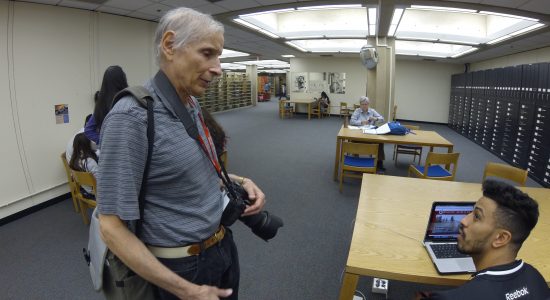
    • Ed captured this self-portrait last year.

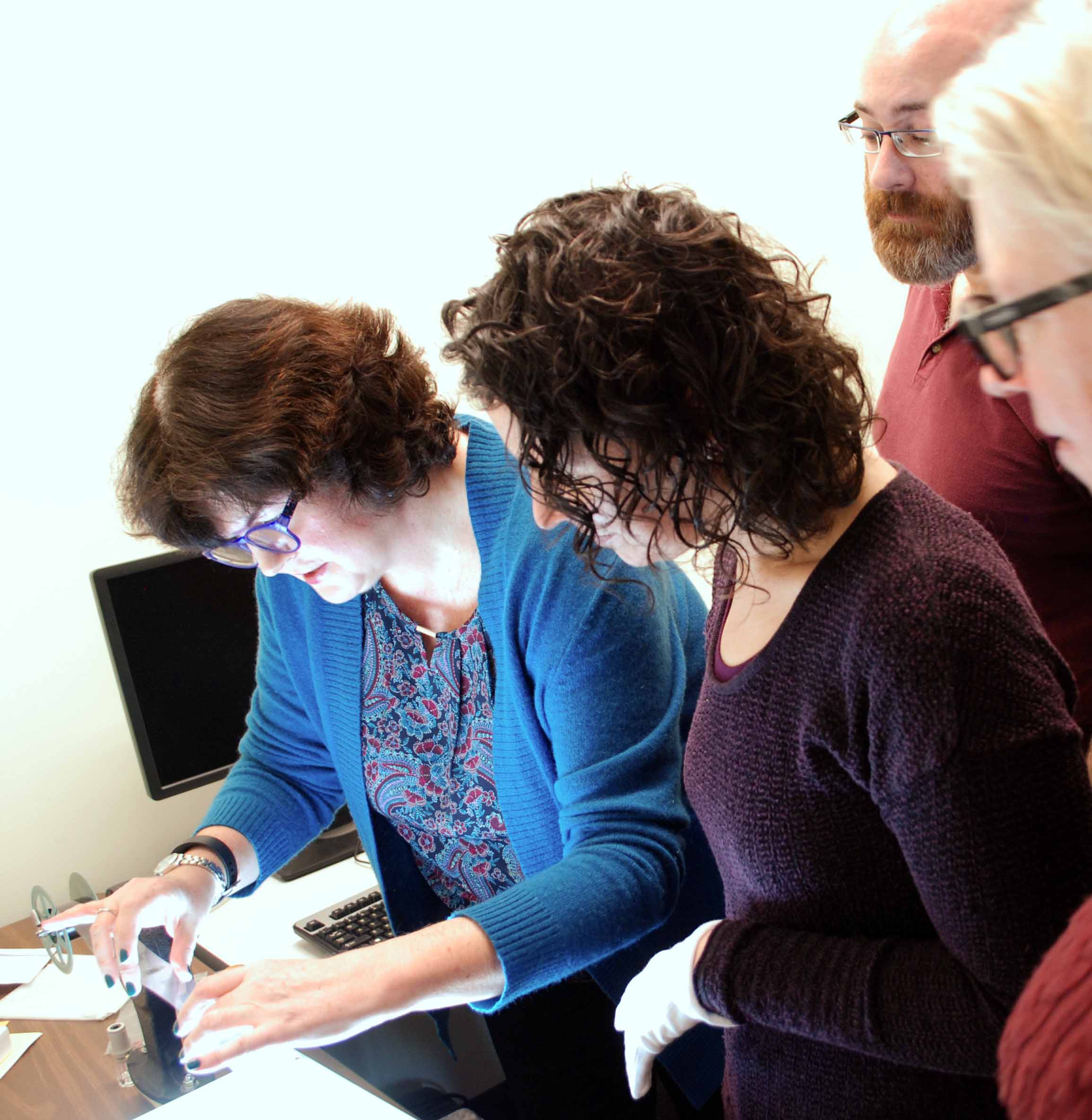
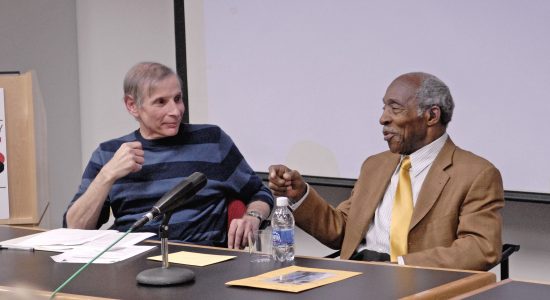
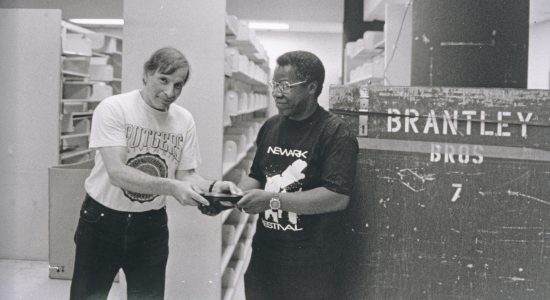
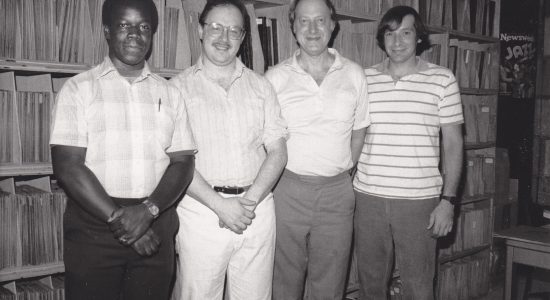
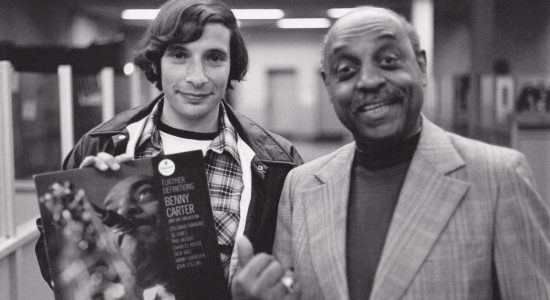
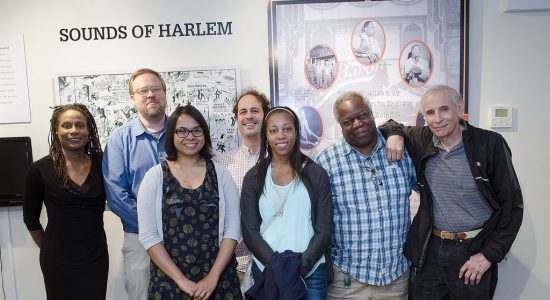
    Recently Consuella Askew and Wayne Winborne sent around a note announcing that our colleague Ed Berger passed away suddenly and quite unexpectedly in January. Ed was a wonderful photographer and spent many hours documenting the spaces and faces of Dana Library and the Institute of Jazz Studies. Many of his photographs are posted on his Flickr site. Here, we take a moment to turn the camera back toward the photographer and offer a glimpse into his time and the people who he called colleagues and friends at the Institute of Jazz Studies.


    Ed played a vital role in the growth and development of the Rutgers Institute of Jazz Studies where he filled a number of positions for nearly four decades.  He was also an award-winning jazz writer and accomplished photographer, teacher, producer, and road manager.

    A graduate of Indiana University with an M.L.S. from Rutgers, his most recent book was Softly, With Feeling: Joe Wilder and the Breaking of Barriers in American Music (Temple University Press, 2014), which received the Association for Recorded Sound Collections’ Award for Best Historical Research in Recorded Jazz in 2015.  He was a frequent contributor to Jazz Times as writer and photographer and for many years served as co-editor of the Journal of Jazz Studies.

    Berger taught at Jazz at Lincoln Center’s Swing University, and from 1979 to 2014 was co-host of Jazz from the Archives on WBGO-FM. He enjoyed a long association with jazz master Benny Carter, serving as Carter’s road manager for nearly two decades, as well as producing two Grammy-winning recordings for the saxophonist.  Berger’s other publications include Free Verse and Photos in the Key of Jazz (2015, with Gloria Krolak); Benny Carter: A Life in American Music (2002, with Morroe Berger and James Patrick); Basically Speaking: An Oral History of George Duvivier (1993); and Reminiscing in Tempo: The Life and Times of a Jazz Hustler (1990, with Teddy Reig).

    He was a beloved friend, colleague, mentor, raconteur, and a true lover of jazz and jazz musicians. His loss is devastating to all of us at the IJS and to the broader jazz community across the globe.

    A public celebration of Ed’s life is being planned and will be announced at a later date.


    Save

    Save

    Save

    Save

    Save

    Save

    Save

  • You never know who is listening

    Our librarians are out there every year, making presentations, leading panels, writing articles – and it really does make a difference. Sometimes it’s a contribution to the field and sometimes the impact is much more personal.

    In 2010, Connie Wu gave a talk in titled: “From a Patent Examiner to an Academic Librarian,” at Life Beyond Patent Information Session of International Patent Information User Group 2010 Annual Conference in Washington, DC.  Six years have now passed, but she received the following letter in January:

    Hi Connie,

    I am a fellow PIUG member.   I just wanted to let you know how much you inspired me when you gave a talk at a PIUG meeting about being a librarian.   I think that was in 2009 or 2010.   I was so inspired that I enrolled in Kent State University’s program in 2010.   Since I work full-time at LexisNexis, it took me 6 years to complete the program plus an additional program in Information Architecture.   I graduated from Kent State on December 16, 2016 with a dual MLIS and M.Sc. in Information Architecture degree.

    Thanks very much!   I hope to thank you in person someday.

    The un-named Sender is a Global Content and Project Specialist for Copyright,  E-Commerce,  Patent,  Trademark, Trade Secret at LexisNexis.

    Way to go, Connie!

  • Changes in Committees Reporting Structures

    Changes in Committees Reporting Structures

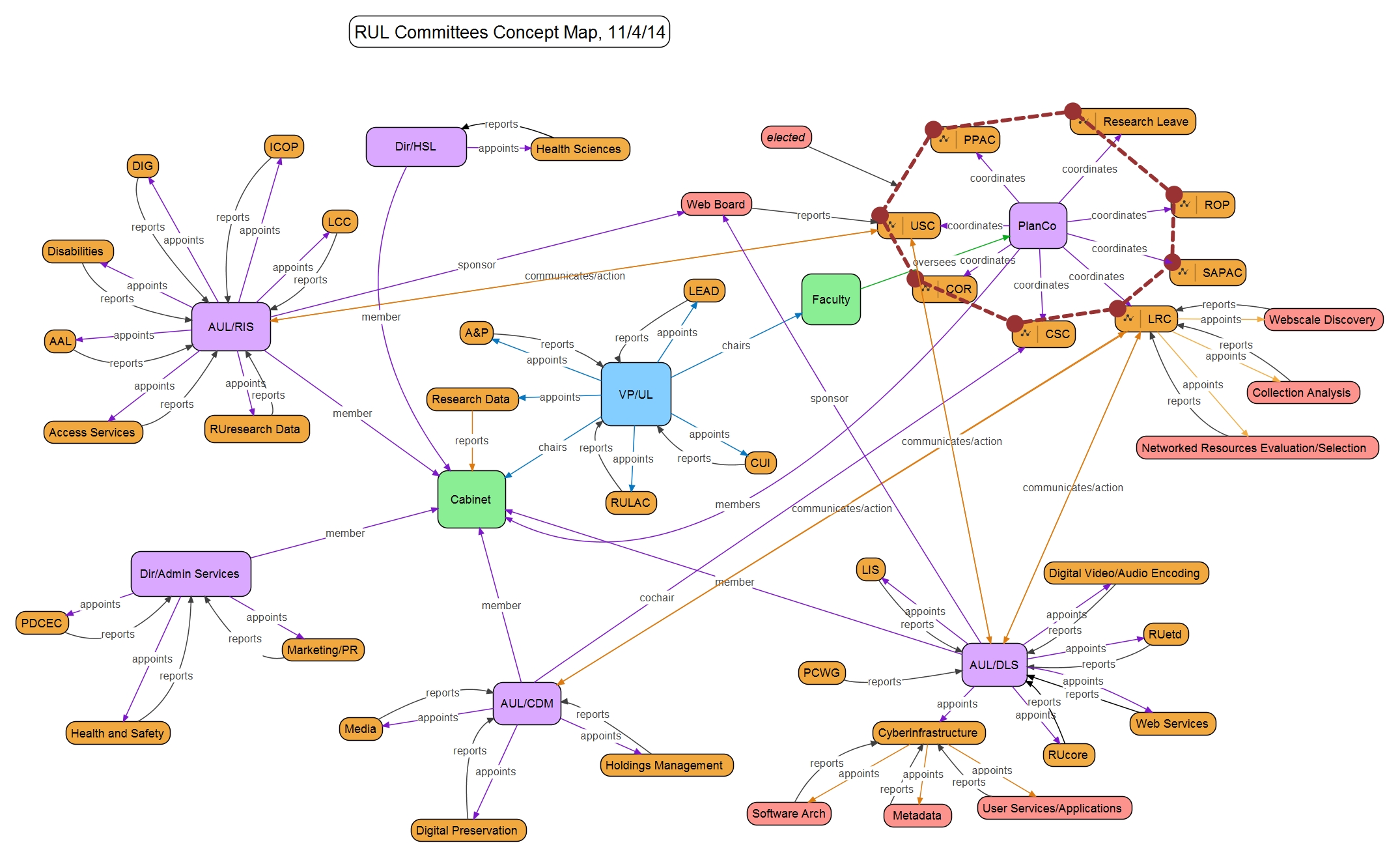
    The original Committee Concept Map from 2014.

    When I arrived at Rutgers, I was charged with clarifying central vs. local functions. In the October and November issues of The Agenda, I talked about changes in the organizational structure that (among other things) moved central and shared librarieswide functions from purview of the AUL for Research and Instruction to central units.

    In December, Cabinet reviewed the Committee Concept Map—a now historical document developed in late 2014 to better understand decision-making responsibilities and flows in the libraries. The diagram showed many different types of groups, including committees, working groups, taskforces, etc. and their reporting relationships. During the review process, we discussed each group—what work it was assigned, whether that work was complete, where it falls within the current organization’s footprint, and who ultimately is responsible for the output of the group. As a result of this work, some groups were sunsetted or moved to new reporting structures. These outcomes were already communicated via the cabinet minutes.

    Finalizing the review of the Committee Concept Map enabled us (among other things) to clarify a few more areas where the lines between central and local responsibility were not clear—especially in the area of public services. Coordination of shared public services—LCC, Ask a Librarian, and Webscale Discovery—were all moved to Shared User Services (SUS). An additional 3 groups on the Committee Concept Map—Access Services, Disabilities, and ICOP—did not fit under the SUS umbrella. Instead, the work of these groups needs some level of central coordination even though their functions are local and the responsibility of the library director.

    Access Services, for example, used to report to the AUL for research and instruction in her central coordinating role, even though they were addressing local policies (e.g., bulletin boards). While the committee itself has representatives from many locations, this reporting structure essentially meant that central was creating policies to govern local services and spaces (a perception further complicated by the former structure where the AUL for research and instruction was also the director of New Brunswick Libraries).

    Under the new system, Access Services, along with Disabilities and ICOP, will report to a newly formed Directors Group that is composed of the library directors—Consuella Askew, Katie Anderson (in her role as interim director of Robeson Library), Judy Cohn, and Jeanne Boyle (in her role as interim director of New Brunswick Libraries)—and Rhonda Marker, the director of shared user services. This will align the important work of these committees more closely with their local units and clarify the director’s role in decision-making, while ensuring two-way flow of information about the needs and resources required for the work.

    Since I know there have been a lot of questions, it is worth spending a little more time talking about the purpose and goals of the Directors Group. The directors convene to address local concerns, discuss shared issues and how they can work together to establish best practices and avoid duplicating effort. This group does not extend the responsibility or authority of the Library directors. Instead, it provides a means for Library directors to work together collectively to solve problems and to benefit from each other’s experience. Ultimately, each Library director is responsible for providing the vision, leadership, and management necessary to deliver collections, services, and spaces that are tailored for their local community.

    Some of the comments that I heard noted that the Directors Group seemed to have taken on many of the responsibilities that USC used to have. As I think about the changes that are occurring at the University-level, and of my charge to clarify local vs. central function, I realize that the comments accurately reflect the changes in the libraries. In the past, decisions related to public services occurred centrally with a goal of developing the most cost-effective library system possible. Rutgers Libraries had a long history of successful internal collaboration. Now, each campus expects services that are tailored to meet local needs. Directors are being held accountable on their campuses for ensuring that the library system provides services (and collections) that directly support local initiatives and programs. The shift from a large, representative decision-making body to a more federated model that favors local decision-making is necessary to support the changes within the broader University context.

    Before ending, I do want to acknowledge the hard work that went into finalizing the Committee Concept Map. We originally worked from a single-page document with over 40 administrative and faculty groups. On the administrative side, we now have a structured list 17 active committees, taskforces, and working groups with clearly defined “homes” in the Libraries. The faculty have also made substantial progress refining their committee structure. This project required a lot of heavy lifting and input from our colleagues, so please accept my thanks for your efforts.

    If you have additional questions about these changes, please speak with your AUL or Director.


    Save

    Save

    Save

  • 2016-2018 Priorities Handout now available

    2016-2018 Priorities Handout now available

    Right click this image to download a PDF of the Priorities Handout.

    Following the example of University of Maryland Libraries and other academic peers, we have designed a visually appealing handout for our 2016-2018 Priorities. The handout is available to the public as a PDF on our Mission, Vision, and Strategic Plan page.


    Save

    Save

    Save

  • Quick Takes on Events & News – December 2016

    Quick Takes on Events & News – December 2016

    ccdc-social-media-card

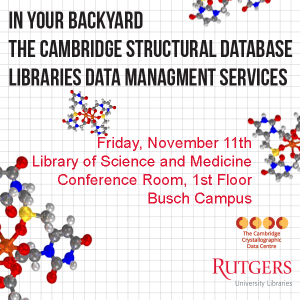
    Cambridge Structural Database Workshop Summary

    The New Brunswick Libraries Data Outreach Team held a successful workshop for students and faculty on Data Management Services available through the Libraries, and introduced users to the Cambridge Structural Database, a database of crystal structures curated by the Cambridge Crystallographic Data Centre (CCDC). The workshop took place at the Library of Science and Medicine, and was attended by students and faculty from the Chemistry and Chemical Biology department, the Center for Integrative Proteomics Research, several Engineering departments, and the School of Pharmacy. Presentations were given by Dr. Amy Sarjeant, a crystallographer and Education and Outreach Manager for the CCDC, and Laura Palumbo, who represented the NBL Data Outreach Team. The workshop was a collaboration between the New Brunswick Libraries and the CCDC, who generously provided lunch for the attendees. Feedback from the session was positive, with attendees citing new knowledge of the Libraries data services and resources.

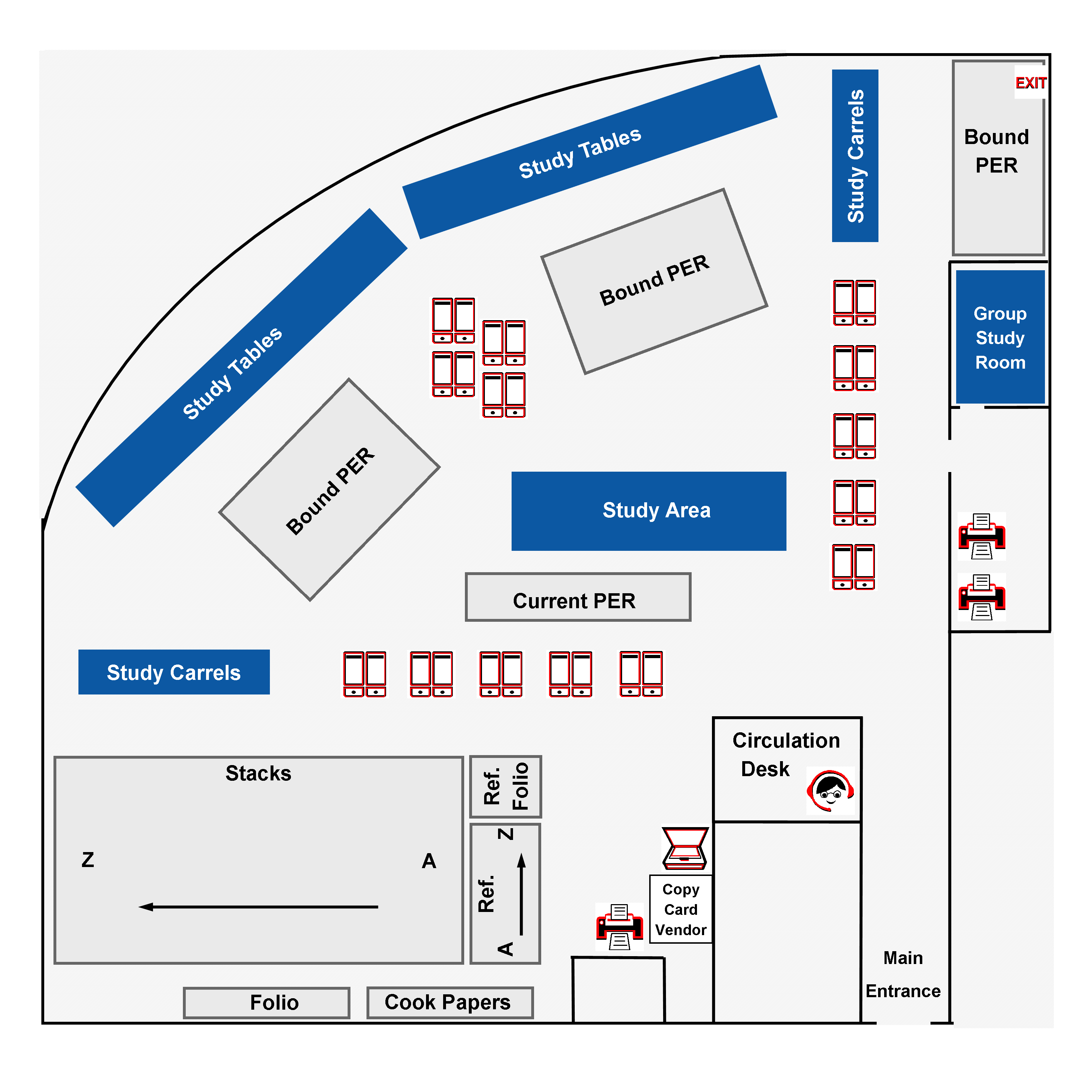
    library map
    What Library is this?

    New Up-to-date Maps for Every Library

    Thanks to some incredible teamwork led by Robert Krack, designer Mary Ann Koruth, Devin Gingery, Soo Lee, and Sam McDonald,  we now have online maps for every Rutgers library available on both our main website and our mobile site. Access these maps at http://www.libraries.rutgers.edu/maps_directions.


    In Case You Missed It…

    What an exciting and energizing time to be a librarian with the swearing-in of Dr. Patty Brennan as Director of the National Library of Medicine and the subsequent swearing-in of Dr. Carla Hayden as the Librarian of Congress earlier this fall.  If you weren’t able to view the ceremonies live, the archived versions of the webcasts are available here.

    Dr. Patty Brennan – https://videocast.nih.gov/Summary.asp?File=19851&bhcp=1

    Dr. Carla Hayden – https://www.youtube.com/watch?v=lvNuPcftWYE

  • Happy Holidays

    Happy Holidays

    captureHello all –

    My message this month is simple. I wish you all the happiest of holidays and the joy of the New Year as we enter this festive season.

    As you all know, 2016 has been an incredibly productive and busy year and I am grateful for all of your efforts in moving the Libraries plans and priorities forward. In a few weeks, we will circulate our annual report which paints a vibrant picture of our accomplishments of the last 12 months. The theme of the annual report is “Transform,” which is a nod to the internal changes the Libraries have undertaken in 2016, as well as a reflection of the transformative effect our activities have on our students, faculty, and the university at large. We have truly made a difference this year and our good work will continue in the coming months.

    I hope you enjoy time with your family and friends this month and look forward to seeing all the good things 2017 brings our way.

    Thank you so very much,

    Krisellen


    Save

  • Thank You for a Terrific #RutgersGivingDay

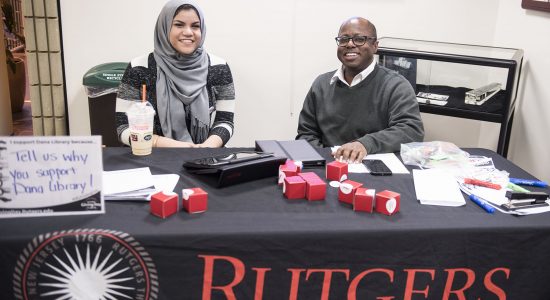
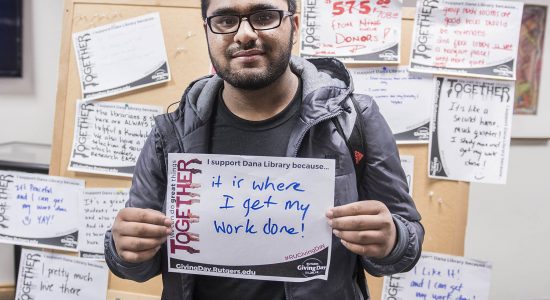
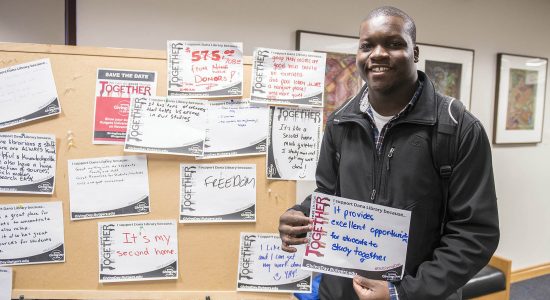
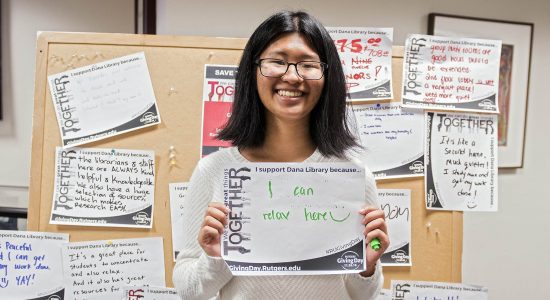
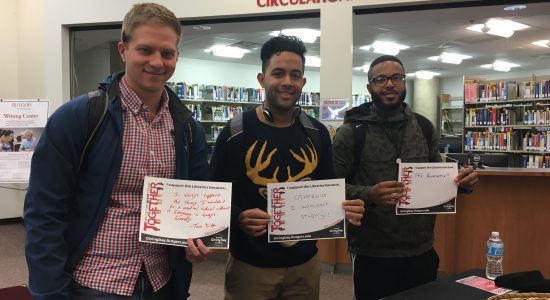
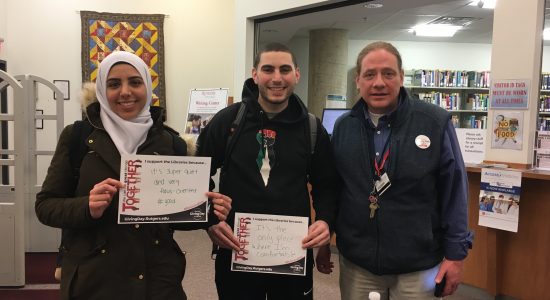
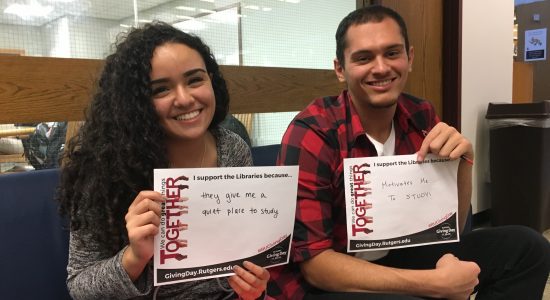
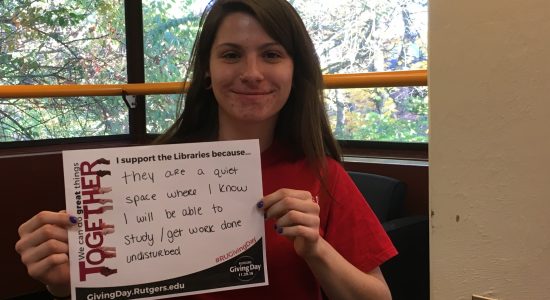
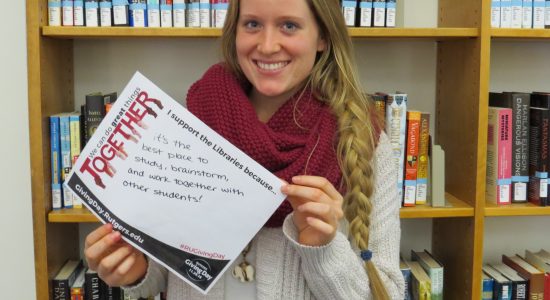
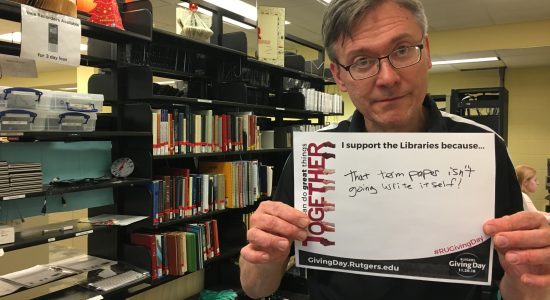
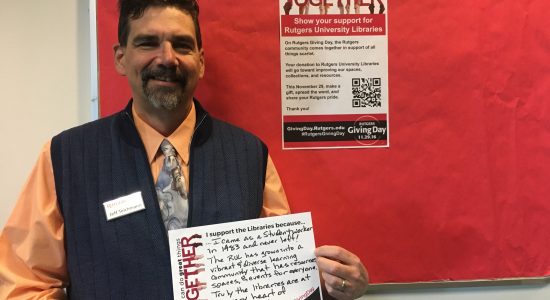
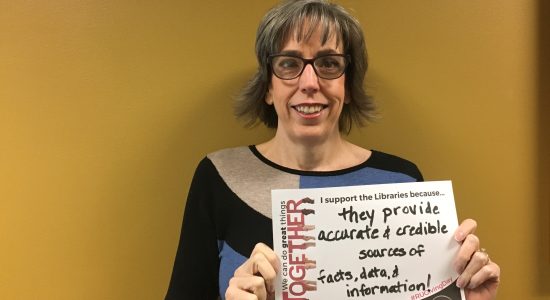
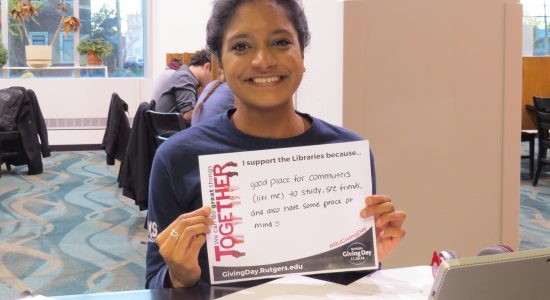
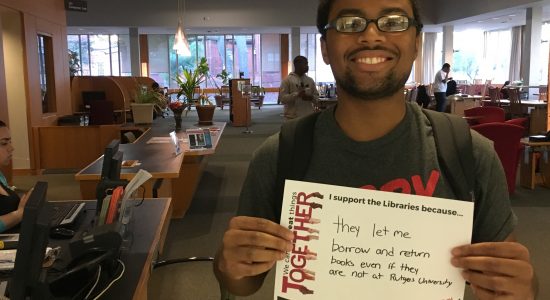
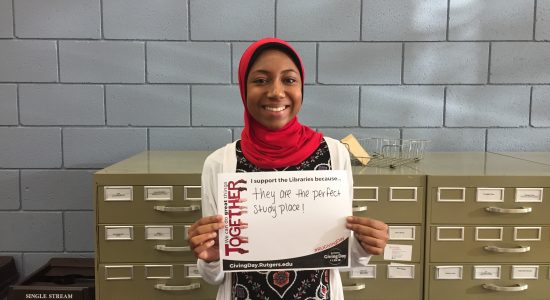
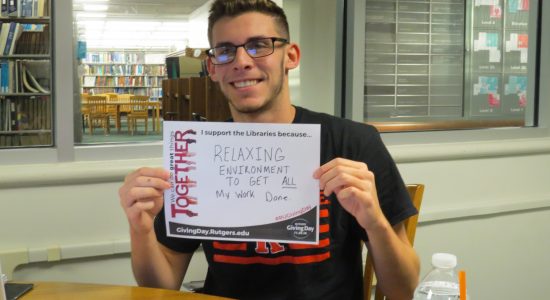
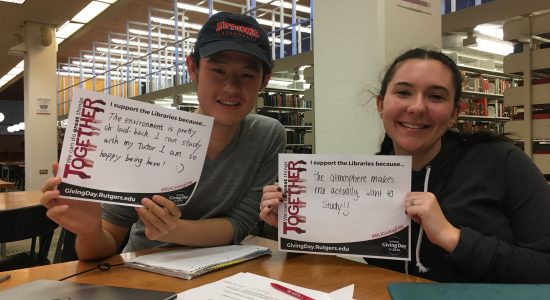
    Thanks to all of your efforts and support, the Libraries greatly exceeded our goals for Giving Day this year. Last year, we had 22 donors and our goal this year was to slightly more than double this with 50 donors. We blew our goal out of the water with 134 donors and the Libraries are on the Top Ten leaderboards for both Rutgers-Newark and Rutgers-New Brunswick. We raised a total of $13,375.00. Here are the specifics for each location:

    #11 – RBHS Libraries, 6 donations, $300.00

    #12 – Camden Libraries, 10 donations, $170.00

    #7 – Newark Libraries, 18 donations, $1433.00

    #9 – New Brunswick Libraries, 100 donations, $11,472.00

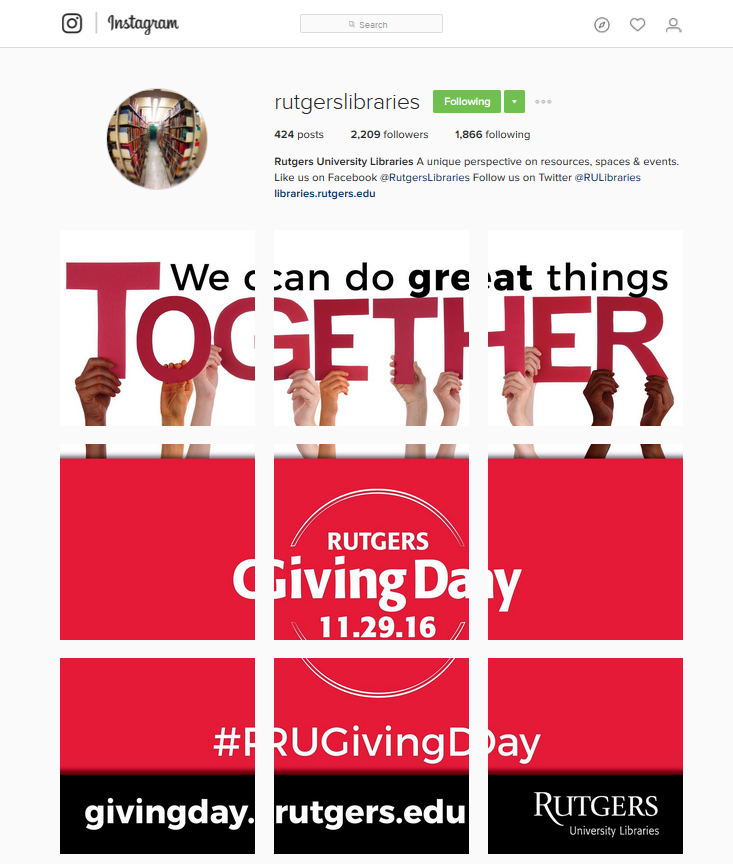
    instagram
    This banner ran on Instagram on Giving Day.

    The figures above may shift slightly as the Foundation does their final accounting, but clearly, we did a great job!

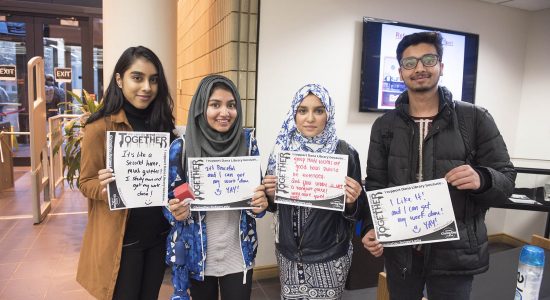
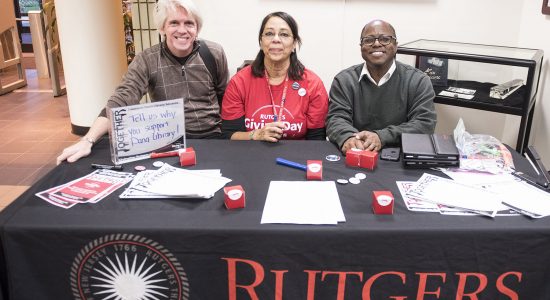
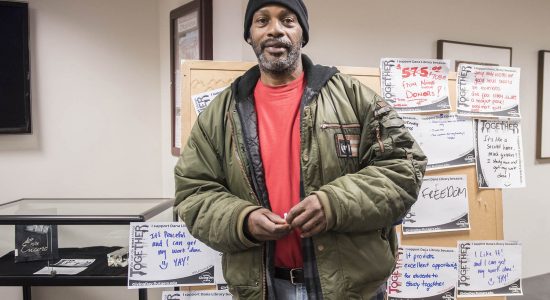
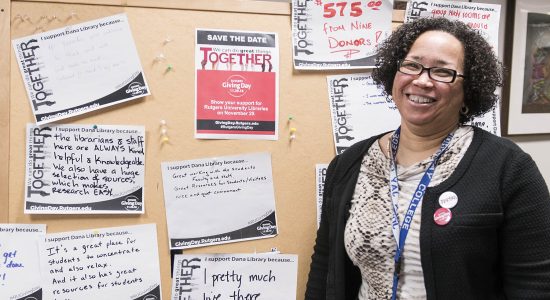
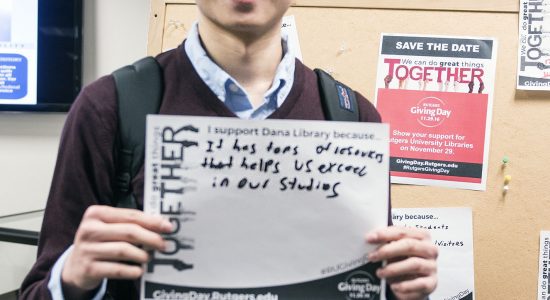
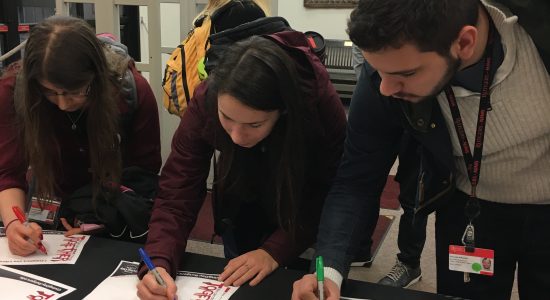
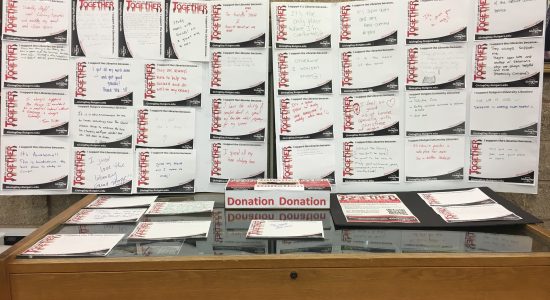
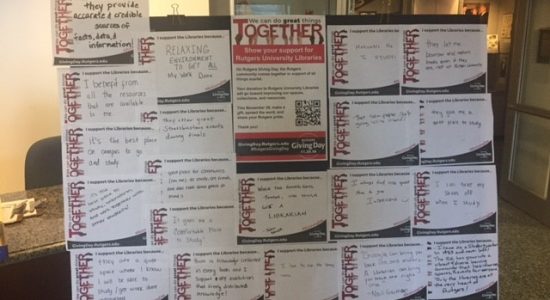
    Thank you to everyone who took time to set up donation computer stations or to sit at tables and solicit support sheets and donations in their libraries. I hope you all had a chance to see the fantastic social media campaign we ran on Twitter, using many photos of our real students and colleagues sounding off on matters most to them. Matt Badessa also created our first Instagram banner/photo grid.

    If you have photos of Giving Day at your location, send them to jessica.pellien@rutgers.edu and I’ll add them to the slideshow!

    Save

  • Interview with Grace Agnew about NSF Grant-Supported Virtual Data Collaboratory

    Grace Agnew, associate university librarian for digital library systems , photo credit: Isaiah Beard.
    Grace Agnew, associate university librarian for digital library systems , photo credit: Isaiah Beard.

    Rutgers University Libraries is a key part of a team that won a $4 million grant to establish a regional data-sharing network called the Virtual Data Collaboratory. This is a huge grant that involves other departments at Rutgers University, as well as several regional university partners. We shared a press release about this initiative on our website in October, but I recently sat down with Grace Agnew who is coordinating the Libraries’ participation, to get a better sense of what it means for the Libraries and for Rutgers.


    Jessica Pellien: You are part of a team that has won a multimillion dollar grant from the National Science Foundation. What is the grant for?

    Grace Agnew: The grant will build an infrastructure where research data created at Rutgers and other collaborating universities can be stored, discovered, and reused. Rutgers is among the nation’s top 20 public universities in terms of obtaining research grants and number 7 among Big Ten universities, yet the university lacks a cohesive strategy for efficiently managing research data. Research data often ends up silo-ed in individual departments where it is not easily discovered and reused. Also, because we do not have a shared infrastructure that can be easily repurposed, financial and personnel resources that could be dedicated to the research itself are instead expended on duplicating infrastructure that exists in silos around Rutgers. A large scale research data infrastructure is critical for Rutgers to continue to advance as a research institution, which is part of the university’s three-fold mission.


    JP: This grant involves many units at Rutgers and other regional universities. What role will Rutgers University Libraries play?

    GA: The Libraries are uniquely positioned because we engage with and support Rutgers users across the spectrum, from incoming first year students to faculty members engaged in groundbreaking research. What we bring to the table is understanding and representing user needs. We are tasked with designing the data services layer which is the user-facing part of the project. Our design encompasses adding, discovering, and reusing data. We took a unique approach to ensuring the discoverability and reuse of data by designing an interface that links data with the person who created it, the tools used to analyze it, and the intermediate research products–analyses, reports, etc.–that are created around the data before the peer-reviewed publications begin. In other words, we designed a strategy that not only supports the workflow of the researcher but helps other researchers, perhaps in other disciplines, understand the context of the data and how it is used, as part of the discovery process. We will work with the lead department, Rutgers Discovery Informatics Institute (RDI2) to implement the data services layer according to our design.  In addition to myself, Ron Jantz is helping to design the architecture for the data services layer and Ryan Womack will be working closely with the two use cases, the Protein Data Bank with Helen Berman, Center for Integrative Proteomics Research at Rutgers and Vasant Honavar of Penn State and with Jie Gong. Civil and Environmental Engineering at Rutgers, to ensure that the design of the data services layer meets their research and workflow needs.  Other librarians involved in the data services design are Karen Estlund at Penn State and Joe Lucia at Temple University.


    JP: So, what is the Virtual Data Collaboratory?

    GA: The Virtual Data Collaboratory is intended, ultimately, as a “one stop shop” for the storage, discovery and reuse of data. It is immediately collaborative because we are building parallel facilities at Rutgers and Penn State. Other participating universities in Pennsylvania, include Drexel and Temple. The VDC will ultimately be available to other universities in both states through the Internet2 high speed networking facilities, KINBER in Pennsylvania and NJEdge in New Jersey. The term collaboratory references both the universities involved in the design, as well as the opportunities for collaboration that the data services layer will promote. The VDC is also designed to bridge to existing collaboratories, such as the Protein Data Bank, so much of the data in the VDC will be “virtual” because they exist in other collaboratories but are accessible via the VDC.


    JP: There are existing places to store data. What will distinguish our effort from others?

    GA: Other universities have collaboratories. We believe the VDC has a unique focus on both robust storage and preservation of data and a user focus on multidisciplinary discovery and reuse of data. Also, the existing places are largely single university initiatives or single discipline initiatives. They are very well designed and very supportive of their users, particularly those with a disciplinary focus. The VDC will work with existing facilities and will bring new users and increased impact from other disciplines through bridges to those facilities.


    JP: You note that the VDC will integrate with other regional and national efforts. Can you paint a picture of what this actually means for your average researcher? If I am a scientist doing research on X, how would VDC help me?

    GA: VDC is leveraging the technologies already funded in the NSF DIBBS initiative, so the design is inherently collaborative with other large scale data facilities. What the VDC will provide is an infrastructure that the researcher can use to ensure her data is preserved, is accessible, and can be analyzed and reused by the researcher and by others. Currently, researchers at Rutgers have to build an infrastructure according to granting agency requirements to ensure that data is preserved and made openly available to others or they can deposit in disciplinary repositories. Once deposited in a disciplinary repository, the researcher generally cannot continue to work with the data, unless the data is downloaded for use. VDC is envisioned as a workflow-oriented repository with a suite of tools for reusing data and the ability to store and link data products, such as analyses, which otherwise reside on the researcher’s local server or desktop. So the VDC is somewhat unique in designing full integration in merging storage and working space for the active scientist.


    JP: Will faculty and researchers at non-participating universities have access to the VDC?

    GA: It is open to everyone for discovery of data. I don’t think policies for membership in the collaboratory have been developed yet. Membership enables you to upload your data, use tools, etc. The Advisory Board will assist with the development of policies for membership.


    JP: When will the VDC be available?

    GA: This is a four year grant that began in September 2016.  The goal is to use agile methodologies to build a prototype and layer on functionality, so hopefully there will be something real to show early in 2018.


    So there you have it, the team behind the VDC is already hard at work. Currently, their focus is on designing a collaboratory for sciences, though Grace was quick to point out that social sciences and humanities wouldn’t be turned away if they were interested.

    When it is completed, the VDC will meet or exceed requirements for open access data management by granting agencies and will be a tremendous accomplishment for Rutgers.


    Save

  • Video Conferencing Best Practices

    We’re all attending lots of videoconferences and there are ways to make the experience better for both the host and remote sites. Here are some tips to insure everyone can see, hear, and participate regardless of where they are.

    Courtesy and empathy are the key factors of a successful video conference. Hosts and participants at the host site are responsible for removing all barriers to participation for remote attendees. Remote attendees need to be engaged and inform the host if they encounter any difficulties in their abilities to participate.

    Host:

    • Please share any documents remotely at least one day before the scheduled meeting. All participants need to have all documents that will be discussed and it can disenfranchise participants at a remote location to hand out and discuss materials only to those physically present in the room.
    • A few minutes before the meeting starts do an audio-visual check with participants at the remote sites.
    • Check the placement of the furniture and positions of the participants at the host site. Everyone should be facing the screen and should be able to be seen and heard by the Video conferencing attendees.
    • Host should begin the meeting by going around the table and clearly identifying the people in the room of the host location. Host should also greet teleconferencing participants.
    • Check with the remote attendees throughout the meeting to see if they have questions or comments.
    • If “pushing screens” make sure to return to room view ASAP so that remote attendees can once again see their colleagues and join the discussion. If during a presentation a lengthy discussion ensues switch back to room view to bring the remote attendees back into the conversation.

    Attendees at Host Sites:

    • Speak clearly and audibly. Be aware of the position of the microphones in the room.
    • Be aware of the line of sight of remote colleagues.
    • Refrain from noise near the microphones such as tapping and paper shuffling.

    Attendees at Remote Sites:

    • Arrive several minutes early for an audio-visual check and to confirm connection.
    • Alert the host ASAP to any audio-visual problems.
    • Mute the microphone when not speaking to diminish distracting noise.
    • Upon leaving take leave of the host and the other participants.
    • If unable to attend, let the host know ASAP so as the meeting is not broadcast into an empty room.

    Sources:

    Lifesize “Video Conferencing Best Practices.” 2016. Available: https://www.lifesize.com/~/media/Documents/Related%20Resources/Briefs/Video%20Conferencing%20Best%20Practices.ashx.

    Richardson, Nicole Marie. Inc. “11 Dos & Don’ts of Video Conferencing Etiquette.” January 13, 2011. Available http://www.inc.com/ss/video-conferencing-best-practices.


  • Retirement & You

    Gary Golden's retirement cake
    Gary Golden’s retirement cake!

    Retirement is defined as “withdrawal from one’s position or occupation or from active working life”.  Retirement is the goal most employees look forward too.  Others not so much.  There are a lot of decisions to make and for many the process can be daunting! Educating yourself on this important process is extremely important.  To help explain the vital steps, please take note of the following info below:

    1.) Attend a retirement seminar here at Rutgers

    • Retirement seminars are offered through UHR: You can register for a session through the UHR Learning and Development Course Registration System under the Human Resources Development tab:   https://hrservices.rutgers.edu/crs/ then Employee Benefit and Work Life Programs drop down
    • PERS members – Tuesday, December 6, 2016 -10-NOON
    • ABP members – Wednesday, January 25, 2017 – 10-11:30

    2.) Review accumulated leave balances (must take all accumulated leave prior to retirement date) with supervisor or Libraries HR to figure out last physical day at work

    3.) Choose a retirement date (must be 1st of the Month)

    4.) Write a brief letter to advise your supervisor of your retirement plans, making sure the letter includes your retirement date (i.e. 3/1/2017) and last physical day at work

    5.) Complete and submit PERS or ABP pension paperwork to UHR

    6.) Libraries HR finalizes retirement and confirms pension paperwork completed