Category: Rutgers University–Camden

Faculty and staff news from the Paul Robeson Library at Rutgers University-Camden.

  • Ex Libris Implementation Project Update – November 2017

    Ex Libris Implementation Project Update – November 2017

    In spring 2017, the Libraries decided to adopt the new library service platform (Alma and Primo) from Ex Libris. The decision was made in support of two major librarywide priorities: improving information control and optimizing collection development and management. What this means to the Libraries is that Alma will replace the current SirsiDynix system and Primo will replace both the EBSCO Discovery Service and VuFind catalog. Unlike our current configurations, Alma and Primo are fully integrated with each other. They also provide other important benefits: a unified interface to manage our entire collections of electronic and print resources, rich analytics for making better decisions about collections, the potential of improving the discovery experience of library users, and the opportunities to collaborate with other Alma/Primo libraries.


    The Ex Libris Implementation Project officially began at Rutgers in late September, when the Implementation Team was formed and met for the first time. The team includes seven members from the Libraries’ infrastructure units – Tao Yang, Abbey DiPaolo, Joseph Deodato, Chad Mills, Gracemary Smulewitz, Chris Sterback, and Mary Beth Weber, with Tao and Abbey as the co-leads. The team has had a busy and productive month: we completed and submitted to Ex Libris the Alma Implementation Form, which is the first step of the implementation process. We have also begun to work on the validation of SIRSI Symphony data extracts, creation of the project website, and development of internal goals, among other things. As a happy coincidence, the Ex Libris Northeast User Group held its annual meeting in Jersey City in mid-October, so all the team members and several other colleagues had an outing to Jersey City and learned the experiences of many libraries who have adopted Alma and Primo.

    Currently, the project is still at the pre-implementation phase, which is when the library team works with an Ex Libris consultant to get ready for the implementation. The project will kick into high gear in early December, when the implementation phase officially begins. The new system is expected to go live on June 1, 2018. Between early December and June, there will be many opportunities for library colleagues to get involved in the project and become familiar with the new system. Please stay tuned. Thank you!

    Tao Yang & Abbey DiPaolo


    Save

  • How Do We Handle New Requests in the Planning Process?

    How Do We Handle New Requests in the Planning Process?

    As busy as we all are, sometimes it can be difficult to see the tremendous progress we’ve made in the last couple of years—particularly with something as diffuse as the priorities planning process. Our most recent cabinet meeting provides a snapshot of how far we’ve come.

    As indicated in cabinet minutes, earlier this year cabinet produced a set of priorities to guide our activities over the next 18 months or so. These priorities have specific projects in mind and reflect the capacity of our central units. This planning document is intended to be the scaffolding for our collective work and, by definition, we must work within its bounds. While this may sound limiting—“We only do what’s on the list!”—when it is working well, the opposite is true. A good plan enables us to take advantage of unexpected opportunities as they arise. And in recent weeks, four such opportunities have been brought to the Libraries.

    These requests are for activities that are not currently part of our plan and must be weighed against our existing commitments. Our recent discussion at Cabinet illustrates the give and take negotiations that must take place when we consider new projects or services.

    Our shared list of priorities forms the foundation of purposeful discussions about tradeoffs and how best to shift priorities to new opportunities. For example, we have been asked to create space for a new OIT Lab in Alexander Library and to provide dedicated health sciences library services at LSM. Both of these requests stem from strategic initiatives within the university. We have also been approached about integrating ORCID into our journal platform and providing ETD support for honors undergraduate theses. Each of these is a reasonable request, but they require time and effort from the same central units that support our existing weeding projects, the implementation of ExLibris, and the development of digital projects templates, among other items identified through the planning process.

    Cabinet considered the source of the requests; the anticipated benefit to local users; staffing and capacity in the central Libraries units; the amount of development vs. coordination required; and more, before deciding which opportunities to pursue. The outcomes, communicated in the minutes, are to move forward with adding ORCID iDs to the Open Journal System workflow and to shift weeding priorities to accommodate the deadlines for the Alexander OIT Lab and the LSM renovations. We also decided to hold off on the development of honors ETDs process.

    This is not because including honors theses in RUCore is a bad idea—we simply don’t have capacity this year and we have other priorities to complete. But this is where the planning process kicks in. A local need has been identified, and while we don’t have capacity to follow through this year, the proposal will be moved forward to next year’s planning process for consideration.

    No doubt, there will be additional requests from the university and additional local needs identified throughout the year. In fact, I would argue that the level of attention we are receiving from the university is an indicator of the important role of the Libraries on campus. We are viewed as strong partners and collaborators, our spaces are appreciated student resources, and our services are recognized as key to student success.

    Thankfully, we now have a planning model that allows us to assess these opportunities in objective, realistic, and equitable ways that balance the needs of Camden, Newark, New Brunswick, and RBHS. We must continue to take on high priority projects for the university, but we must also make sure we have the capacity, technology, and resources to succeed. The only thing worse than saying “not now,” is saying “yes,” and not completing the task. These types of discussions are much easier to have when we have a shared understanding of priorities and capacity.

  • The Budget Process and Library Impact on Student Outcomes

    With the last of the Welcome Days events now completed and the start of the fall semester fully complete, it is time to turn our attention to another annual tradition: the preparation of our annual budget request.

    Each year, we are asked to put together a budget request for the following fiscal year, so this October we are in the process of requesting budgets for 2018–2019. The budget process has changed quite a bit in the last few years. Historically, budgets were distributed through the ‘all funds’ budget process in which the ‘administration’ made decisions about how best to allocate resources. The process was not transparent, and in the last few years of the all funds process, the Libraries did not fare well.

    The shift to the RCM model may have been turbulent, but the result is a much more transparent budget process and a way for us to request needed funds. In fact, anyone can view a lot of detail related to the sources of allocations to cost centers (including the Libraries) at budget.rutgers.edu. In addition to being more transparent, RCM has moved decision-making from ‘administration’ to the chancellors and the chancellors are now in the process of engaging the deans.  This means that more of the budget decisions are being made by people who use our resources and services.

    I have now participated in two budget requests through the RCM process with some success (see reports on FY2017 and FY2018 requests). It is clear that the chancellors face difficult decisions in allocating funds because of competing factors, including other cost centers such as Student Affairs and Facilities and internal needs such as new faculty and startup packages.

    During this process, the Libraries are asked to provide a description of our services. We routinely include figures that demonstrate our impact on students or the use of our resources (such as the estimated savings of the OAT Program, the use of resources, or the cost per use for journal articles), so we know it is helpful to have strong evidence that Libraries make a difference. However, because of the complexity of the educational environment, it has been difficult to measure the impact that libraries have on student success.

    That is what makes this news out of the University of Minnesota so exciting.

    The Impact of Academic Library Resources on Undergraduates’ Degree Completion: https://doi.org/10.5860/crl.78.6.812

    A large, rigorous study by the University of Minnesota—“The Impact of Academic Library Resources on Undergraduates’ Degree Completion”—assessed whether first-year students who used the library at least once during their first year were more likely to graduate or continue to be enrolled in four years (indicating progress towards degree completion).

    The survey followed the 2011 entering class of 5,368 students, controlling for factors related to differences in students, including first-generation, socioeconomic status, participation in support programs for underrepresented students, on-campus vs. off-campus housing, SAT scores, AP courses taken, and enrolled college.

    They analyzed the students’ records to determine if they had used at least one of five major library services—borrowing books (including interlibrary loan and ebooks), using electronic resources, using a computer workstation, enrolling in library instruction, or asking a reference question—in their first academic year

    The results indicate that, overall, first-year students who used any of the library services at least once during their first year of enrollment were nearly 40% more likely to be enrolled in four years or 44% more likely to have graduated in four years than peers who did not use any library resources.

    Further analysis of the individual services showed that first-year students who used:

    • electronic resources at least once in their first year, were 45% more likely to continue to be enrolled and nearly twice as likely to graduate;
    • books at least once in their first year, were 34% more likely to graduate in four years; or,
    • instruction, either by enrolling for a class or having library instruction embedded in classes, were 40% more likely to continue to be enrolled after four years.

    There was no significant relationship with the use of workstations, reinforcing the fact that workstations are simply a tool. There was also no significant relationship with the use of reference services (including chat), perhaps because a very low number of students—only 5%—used this service.

    This survey is a tremendous accomplishment and is directly relevant to our work, in part because of the parallels between Rutgers and the University of Minnesota.  Like us, UMN is a large public land-grant institution and member of the Big10. I hope you will take time to read the report and think about how its findings might be useful to what we do and how we do it. I’d love to hear your thoughts on this.

    These findings couldn’t arrive at a better time! Although I have never been asked to prove the value of the Libraries during the budget request process, evidence of library impact on student outcomes will be very useful in our budget request and I hope to have good news for the Libraries later this year when we receive our budget allocation.

  • The Rutgers University Libraries Website Style Guide from Integrated Information Systems

    The Rutgers University Libraries Website style guide explains the rules and conventions that go into defining typography and the appearance of website elements on our website. Its goal is to provide a cohesive and coherent experience for website users and content creators. An internal style guide has been in existence since the redesign of the libraries’ website in June 2013. However, growing demand for custom content from colleagues and requests for mini-sites, established a need to make the style guide available to users across the libraries. Not everyone knows – or should be expected to know – how to create a webpage. The style guide provides a clear idea of what to expect when, for example, you want to display tabular data or, have an article on the website that uses pull quotes. Content creators amongst our library colleagues can use it when visualizing their pages. Developers can use it as a reference when coding new pages. It functions as a common reference for both.

    On a technical level, the style guide is structured such that it provides an example of the treatment of a website element, followed by the CSS code used to style the element, and the HTML code that displays it in the browser. On a general, stylistic level, it defines how pages are structured on the website, such as addressing questions regarding the appearance and location of navigational links within a mini-site. It also informs us about overarching style rules that users might be interested in knowing, such as the font family (Droid Sans) and generic typeface (sans-serif) that body copy defaults to throughout the site.

    The developers and designers in Integrated Information Systems are available to create webpages that use the style guide as a guideline, rather than a limitation, with possibilities for creativity and experimentation, to build the best experience for our users and our colleagues.

    Access the website style guide here: https://www.libraries.rutgers.edu/styleguide


  • Report from Social Media Summit 2017


    Video: Rutgers communications professionals discuss social media planning and how to best reach users.


    The Libraries held our second Social Media Summit on July 20, 2017. The full-day event, hosted by the Social Media Task Force, was broken into several sessions and attended by over 25 of our colleagues.

    During the introductory session, director of communications Jessica Pellien presented the work of the social media task force and reviewed the new social media guidelines, manual, and process for requesting a new social media account. This PowerPoint presentation is available below. Following this presentation, round-table discussions (15 minutes per topic – like speed dating but for social media topics) allowed the group to share ideas and experiences. Notes were taken at each table and are available below.

    Following lunch, there were two more sessions:

    • A workshop/training on HootSuite presented by Dory Devlin of University Communications and Marketing
    • A panel of Rutgers University communicators, including Stefanie Charles, social media manager for all of Rutgers–Camden; Brice Hammack, marketing professional from Rutgers University Press; and Jennifer Valera,  marketing manager of  Rutgers University-New Brunswick, Division of Continuing Studies.

    If you have any questions about the materials below or the Social Media Summit, please reach out to a member of the Social Media Task Force.

    Social Media Summit Documents:

    Social Media Documents

  • Back to School Outreach to Our Users

    The fall semester officially begins in four days, and we are prepared. Matt Badessa made this wonderful welcome video for our students. We weren’t sure how it would turn out, so we kept the project relatively small and only interviewed faculty and staff in New Brunswick. We are happy with the video and would like to do more like this in the future. Let us know if you’d like to participate or if you have an idea for a short video about the Libraries or a service.

    We are also sending out a September newsletter to our email list, featuring current exhibits and upcoming events. You should receive a copy of this on the morning of September 5th. It includes the following events:

    John Haworth, senior executive emeritus of the National Museum of the American Indian, Smithsonian Institution, visits Alexander Library on September 19 to share his knowledge about cultural and arts issues impacting Native Americans, including key museum practices, repatriation, and social change.

    More

    Relive the rich history of student art and literary magazines at Rutgers with By Ourselves: Rutgers Student Literary Journals 1923–2017, a joint exhibition of the Robeson Library and the Rutgers–Camden Writers House from September 1 to October 31. Spanning nearly a century and two campuses, this exhibition highlights the creativity and initiative of Rutgers students through Quintessence, The Anthologist, and other publications.

    More

    The Libraries at Rutgers–New Brunswick will help new and returning students ease into the semester again this year with snack breaks during Welcome Days.

    • September 6 & 7, 2 p.m. Cookies and coffee at Douglass Library.
    • September 7, 1–2 p.m. Popcorn on the steps of the Art Library and Zimmerli Museum
    • September 7, 2–3 p.m. Snack break at Carr Library
    • September 12, 2–3 p.m. Snack break at Carr Library
    • September 26, 1:30–2:30 p.m. Snack break at Alexander Library

    More

    In celebration of the 100th anniversary of Douglass Residential College, the artwork of renowned feminist artist and Rutgers graduate Mimi Smith will be on display at Douglass Library from September 5 through December 15. Embodying the relationship between everyday life, intimacy, anxiety, and time, Smith’s works include clothing made from plastic and steel wool, traditionally rendered drawings, drawings made from knotted thread and tape measures, clocks, and knitted sculptures.
    More
    With support from a Freedom to Read Foundation grant, the Art Library will host a number of programs celebrating Banned Books Week from September 24 to September 30. The activities will provide students, faculty and staff, and community members the opportunity to explore the ideas of intellectual freedom, censorship, and banned books by creating and displaying original art.

    More

    The New Brunswick Music Scene Archive in Special Collections and University Archives will kick off Hub City Sounds’ ROCK New Brunswick music festival weekend on September 8 with a discussion panel featuring New Brunswick music insiders past and present: Dennis Diken of The Smithereens, Sharief Hobley of Sharief in Burgundy, Makin Waves columnist Bob Makin, Audrey Rose of The Wichts, and Spina Records’ Andrew Spina.

    More

    This fall, data librarian Ryan Womack will offer a series of workshops on statistical software and data at both Alexander Library and the Library of Science and Medicine. September’s topics include “Introduction to SPSS, Strata, and SAS”; “Introduction to R”; and “Data Visualization in R.”

    More

    Special Collections and University Archives’ exhibit “Heaven, Hell, or Hoboken!”: New Jersey in the Great War has been extended to September 22. Featuring one-of-a-kind documents, photographs, and artifacts reflecting the wartime experiences of New Jerseyans both at home and abroad, this display is a must-see for Garden State history buffs and World War I aficionados alike.

    More

    John Cotton Dana Library will commemorate its 50th anniversary with a host of free events and activities throughout the academic year. Exhibits showcasing the history of the library and its namesake as well as a birthday party during Rutgers–Newark’s Fall Fest will highlight the fall schedule. A number of guest speakers will visit the library to share their wisdom throughout the spring semester, and the year will culminate with a special event on Rutgers Day. Additional details are forthcoming, so stay tuned to our website for the latest on the #RutgersDana50 celebration.

    If you have an event coming up in September that is not mentioned here – there is still time to include it in our email newsletter. Send info to jessica.pellien@rutgers.edu.

  • Human Resources – Dates to Remember for Open Enrollment & Flu Shots

    Two bits of news from the Rutgers University Libraries Human Resources Department:

    • There will be a clinic for annual flu shots on October 4, 2017 at 11:00 in the Pane Room at Alexander Library.
    • University Human Resources (UHR) will host a series of Open Enrollment Benefits Fairs throughout the month of October to educate employees about their SHBP benefits options, as well as other benefits and services that are available and may be of interest. Save the date and plan to attend the Open Enrollment Benefit Fair that is most convenient for you:

    October 10, 2017 10 a.m. – 4 p.m. – Rutgers University – Newark Campus, Robeson Campus Center, Multipurpose Room, 350 Martin Luther King Blvd, Newark, New Jersey 07102

    October 12, 2017 10 a.m. – 4 p.m.– Rutgers University – New Brunswick, College Avenue Campus, Student Center Multipurpose Room, 126 College Ave, New Brunswick, NJ 08901

    October 17, 2017 10 a.m. – 3 p.m. – Rutgers University – Camden Campus, Camden Campus Center, 326 Penn St, Camden, New Jersey 08102

    DETAILS TO BE DETERMINED– RBHS Piscataway/New Brunswick

    October 24, 2017 10 a.m. – 4 p.m. – RBHS Newark, Medical Science Building, Grand Foyer Lobby, 185 South Orange Ave, Newark, New Jersey 07101

    October 25, 2017 10 a.m. – 4 p.m. – Rutgers University – Piscataway, Busch Student Campus, Student Center Multipurpose Room, 604 Bartholomew Rd, Piscataway, New Jersey 08854

    As always, if you have any questions about your employee benefits, please contact the Benefits Administration staff at 848-932-3990 or via email at benefits@hr.rutgers.edu.

    Save

    Save

  • New Resources from the Communications Department

    The following resources are now available on the communications department website. We hope you find them useful. We’re trying to actively identified shared resources that we can supply to save our colleagues time and to create a cohesive visual identity for our libraries. If you have suggestions of new projects, please let me know.

    New signage templates:

    During our last signage inventory, we tried to identify signs that appear in multiple libraries, and we’ve added a bunch of new templates to the signage library. We now have some templates for quiet and collaborative study areas, guest and Net ID computers, reshelving books and shelving carts, and keep your belongings safe.
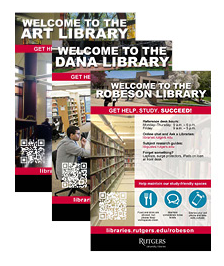
    We also have Welcome to the Library signs prepared for all public library spaces (except for the Annex, which we will get to soon). These are available in two sizes – 24” x 36” large posters, and 8.5” x 11” in landscape and portrait orientation.

    In the signage section, you will also find our policy sign toolkit, including icons for policy signs and welcome signs, and build your own signage templates. If you make a sign that might be useful for other libraries, please send it to us and we’ll post it in the sign library so others can access it.

    link: https://apps.libraries.rutgers.edu/communications/signage-templates

    Powerpoint templates:

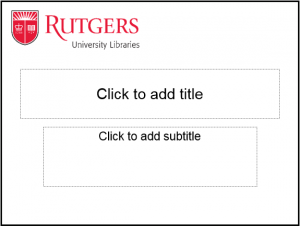
    Complete Powerpoint templates, featuring the new shield logo, are now available. Please do not use the older Powerpoint templates with the Rutgers seal. The Rutgers informal seal is no longer part of the university’s visual identity and we should be using the shield wherever possible. There are two versions of the template – an all-white version, and one with a scarlet band. These templates include title pages and sub-pages and also have a color theme that includes Rutgers colors.

    To edit the Optional Presentation Title area on the slide, go to “View,” select “Master,” and then choose “Slide Master.” You will then be able to double click on the Optional Presentation Title text and edit the area. The template must be resaved before creating a presentation.

    To select the Rutgers color theme, go to “View,” select “Master,” and then choose “Slide Master.” Select Colors and scroll down to select Rutgers University Libraries under the Custom subheading.

    link: https://apps.libraries.rutgers.edu/communications/visual-identity-resources

    Video branding elements:

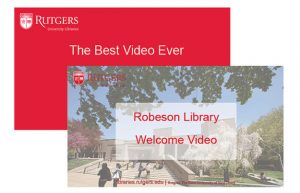
    Video branding elements are also now available for you to use. These should be used in any video you make that promotes Library services, spaces, or resources. It is very important that the branding is used because it will make us compliant with the university visual identity policy for video standards, create greater visibility for the Libraries, and acknowledge our ownership of this material (very important when videos are being repurposed, embedded, or linked to from other users).

    The visual identity policy for video standards is:

    The Rutgers logotype, with or without a signature, must appear prominently at or near the opening or closing of a Rutgers video. In addition, the appropriate Rutgers name (i.e., Rutgers, The State University of New Jersey; Rutgers University–New Brunswick; Rutgers University–Newark; Rutgers University–Camden; Rutgers Biomedical and Health Sciences) must appear somewhere in the course of the video.”

    **Please note: we should use the full university name, “Rutgers, The State University of New Jersey,” and not a local university name since the libraries are a central unit.

    The Communications Department is supplying four branding elements that can be personalized to some extent, depending on your project:

    These branding elements can be mixed and matched, appear at the beginning or the end of your video – just so long as you are compliant with the visual identity policy quoted above. If you have a special video project or series and would like a tailor-made branding element, please let us know. We’re happy to work with you to accommodate these requests.

    link: https://apps.libraries.rutgers.edu/communications/visual-identity-resources

    Revised Rutgers University Libraries editorial style guide:

    The Libraries’ style guide has been updated to address issues particular to the Libraries that are not covered in the university’s guidelines and to offer quick tips for remaining consistent with the established Rutgers style. Our goal is to foster clear, consistent messaging in all of the Libraries’ official communication channels, including our website, blogs, social media, print and electronic newsletters, brochures, flyers, and so on. It is not intended to supplant the style guidelines of any academic journal or news outlet to which you may be contributing material.

    link: https://www.libraries.rutgers.edu/rul/staff/pub_serv/procedures/stylesheet.shtml

    Save

    Save

    Save

    Save

    Save

    Save

    Save

    Save

    Save

  • Notes on 2017 WLIC, 83rd IFLA General Conference and Assembly

    Notes on 2017 WLIC, 83rd IFLA General Conference and Assembly

    • Printing press gnome . Wroclaw is famous for its small bronze gnomes scattered around the city. Each has a theme and it started representing a protest movement in the 1980s. There are 400 or so of them in the city. Credit: Kayo Denda.

    The 2017 IFLA WLIC took place in Wroclaw, a lovely city in the southwestern region of Poland from 19 to 25 August, 2017. With the theme Libraries. Solidarity. Society, the congress brought together thousands of representatives of the library field. IFLA’S Global Vision brainstorming that started earlier this year in Athens, Greece continued in Wroclaw, and as Donna Scheeder, IFLA President expressed, the delegates got together “to explore how a connected library field can meet the challenges of the future. Hopefully the final report will be released soon. Library staff around the world will be encouraged to vote supporting (or not) the document when the final draft is released.

    One of the highlights of the congress for me was the Social Science Libraries one-day workshop titled Understanding Your Library from the Inside Out: A Workshop in Library Ethnography for User Assessment. Our workshop leader was Celia Emmelhainz, Anthropology and Qualitative Research Librarian from UC Berkeley and our keynote speaker was Lynn Silipigny Connaway, Senior Research Scientist and Director of User Research at OCLC. We were very fortunate to hold the workshop in a brand new library facility at Wroclaw University Library. The workshop, capped at thirty participants, attracted participants from twelve countries affiliated with eleven IFLA units, and eight librarians from the host institution also joined the workshop. Through hands on exercises, we learned the importance of qualitative assessment of library services in capturing the behaviors of elusive library users. These rich and nuanced data provides important information to support decisions about resources and services. Despite her busy schedule during the congress, Dee Magnoni was able to join us at the workshop. So did Kay Cassell, faculty emerita from SC&I, LIS.

    Qualitative assessment was mentioned a few times during the congress. Jim Neal, the ALA President, stressed the importance for the libraries to depart from simple statistics collection and focus on the context and relationships beyond the numbers. The ethnography in libraries was also mentioned in Dona Scheeder’s remarks during the congress opening. Clearly the library leaders recognize the need to go beyond the numbers to gain access to rich and meaningful information in order to shape future direction of libraries.

    Organizing this workshop in Wroclaw while in New Jersey was extremely challenging. I was fortunate to work with Grażyna Piotrowicz, Director of Wroclaw University Libraries, who shared her local knowledge and invaluable insights with me. I was also assisted by Rutgers University Libraries/Rutgers University colleagues who put me in touch with key individuals and provided significant administrative assistance. It really took a village to make the ethnographic workshop successful!


    Kayo Denda
    Head, Margery Somers Foster Center & Women’s Studies Librarian
    Former Chair of IFLA, Social Science Libraries Section


  • Where in the World is Shared User Services?

    Where in the World is Shared User Services?

    Nearly a year ago, the Libraries reorganized to form a central user services unit, Shared User Services. While we are still building, major structures are coming together. Here’s a progress report to let you know who we are, where you can find us, and some of the things we are up to.

    SUS began with several people in the former Scholarly Communication Center department: Isaiah Beard (Digital Data Curator), Ron Jantz (Digital Library Architect), Peter Konin (Digital Project Coordinator), and Rhonda Marker (Director of Shared User Services). Marty Barnett (Digital Library Applications Specialist) moved from IIS to join us. This summer, Joseph Deodado (Digital User Services Librarian) and Amy Kimura (Web Services Librarian) came on board. We are currently recruiting for a new Virtual Reference Services Librarian.

    Our physical work home is in Alexander Library on the 4th floor. Our online home is on the Staff Resources pages of the Libraries website. We have an up to date SUS Contacts list where you can see who to contact, from digital curation and digital file questions (Isaiah Beard) to virtual reference services (currently, Joseph Deodato and Natalie Borisovets). No, Natalie has not moved to SUS. She is still at Dana Library, where she has been the glue holding together the chat reference schedule across all of RUL. When we hire the new Virtual Reference Services Librarian, we’ll update our contacts list.

    SUS coordinates discovery, the shared components of reference (chat, email), and the public-facing libraries website. We also have a coordinating role for digital projects – but that story will have to wait for a future issue of The Agenda. Two working groups that support improvements to discovery of library resources, the Discovery Working Group and the Library Catalog Committee, report to the Head of Shared User Services. Their minutes and other useful information are now located on the SUS web pages of Staff Resources. Cabinet recently charged the Web Improvement Team, which is ambitiously meeting on the first day of the fall semester. We are all looking forward to seeing the fruits of their labors – and you will be able to read all about it on the SUS web pages.

    From time to time, the Libraries identify other services that call for a central user services role. This was the case for the modernization of our library hours information. Staff in SUS and IIS collaborated on configuring the information in LibCal (from SpringShare) and worked with many people in all our library locations to assemble the details of buildings, service points, and shifting calendars. We could not have done it without you. We are still adding details and features so that this new way of presenting our library hours gives our users the information they need. Ongoing support for library hours resides in SUS (Marty Barnett).

    There is a lot more that we are doing, and we are excited about the work ahead of us. Most of all we look forward to working with all of you in the Libraries. If you ever want to chat, now you know where to find us!

    Save