Last month, I attended a panel discussion hosted by the Rutgers Communicators Network titled Social Media – Industry and Platform Trends for Owned and Paid Content. You can check out a recording of the event below:
While some of the discussion may not be directly applicable for units with limited or nonexistent budgets for social media advertising, here are some of my broader takeaways for social media at the Libraries:
Developing a voice and building relationships. Ultimately, social media needs to be social. Developing a friendly and authentic voice can help us seem more approachable and available, and allow us to cultivate a sense of community around our accounts. Attending to this may, in the long run, prove more effective for our strategy than the successful implementation of any given campaign. We might even get a research question or two out of it!
Leveraging influencers. While there may not be many opportunities for us to develop formalized, paid partnerships with influencers such as those discussed in the panel (see here for an example of one of Mary Chayko’s students advertising for a hair product), we should still think about creatively leveraging user-generated content in our approach to social media. We also have a unique resource—namely, expertise—at our disposal. Is there a way for us to position our librarians and their research as influencers in the broader academic community on social media?
Understanding your audience and goals. As with any form of communication, understanding your audience is a key to success. Who are you trying to reach, and where are they likely to hang out online? What are the actions you ultimately want them to take? What would return on social media investment look like for your unit? Identifying the answers to these questions can help make your effort worthwhile.
Benchmarking. You may be interested in reading RivalIQ’s 2018 Social Media Industry Benchmark Report, which was discussed during the event. It has some useful information on best practices and trends in social media for higher education.
Do you have your own ideas for how we can improve social media at the Libraries? Feel free to reach out and let me know.
Rutgers Day was last weekend and, by all accounts, it was another tremendous success. Thank you to all the volunteers who helped pull these great activities off! If you missed out on the fun, enjoy this collection of sights from our different locations.
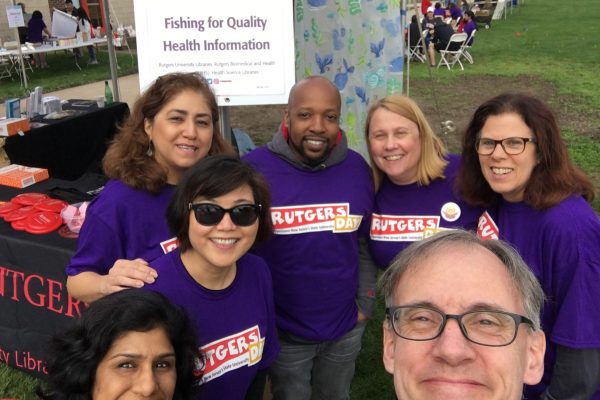
The theme of the RBHS booth this year was “Fishing for Quality Health Information.” Credit: Yingting Zhang.
Yingting Zhang marshals the prize wheel. Credit: Yingting Zhang.
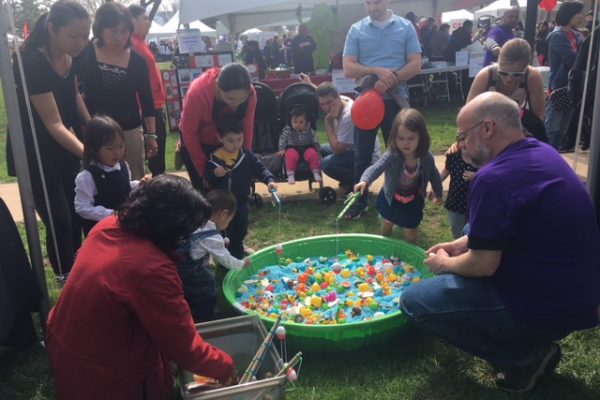
Bob Vietrogoski oversees the young anglers. Credit: Judy Cohn.
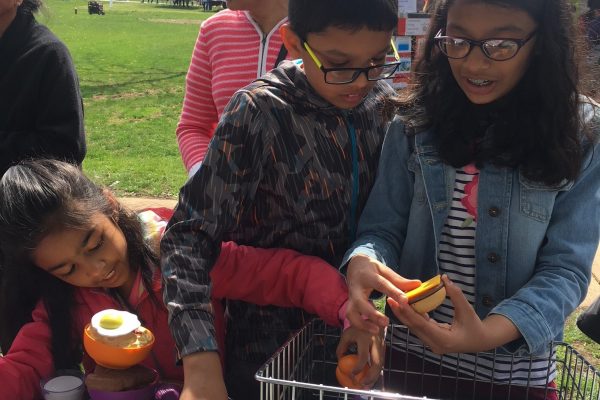
Building healthy plates! Credit: Yini Zhu.
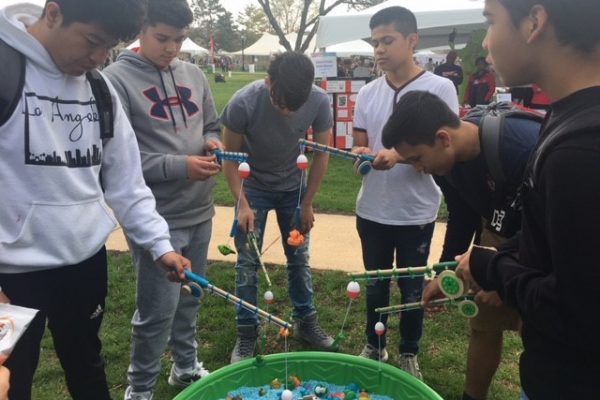
A group of information fishermen hard at work. Credit: Mary Ann Koruth
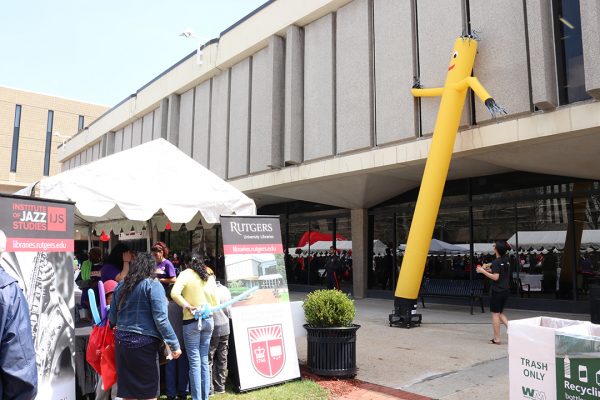
The wacky waving arm inflatable guy was an attraction at the Dana Library tent. Credit: Mark Papianni.
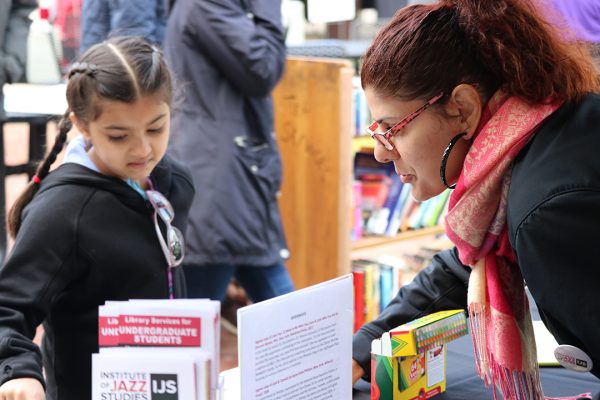
Elsa Alves assists a young visitor. Credit: Mark Papianni.
Ayesha Salim and Fatima Cunha pose with the new IJS banner. Credit: Mark Papianni.
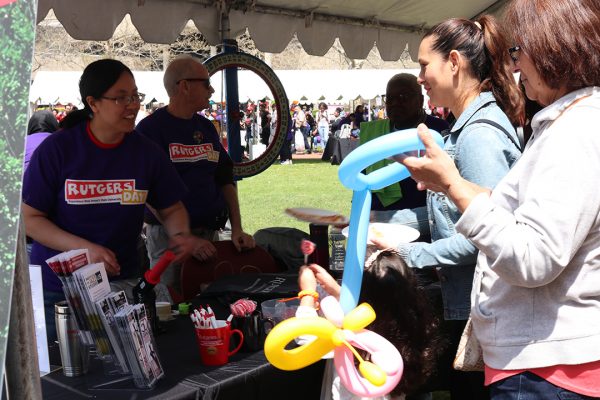
Buttons, candy, prizes, and information–Steph Mikitish and Tad Hershorn had it all under control. Credit: Mark Papianni.
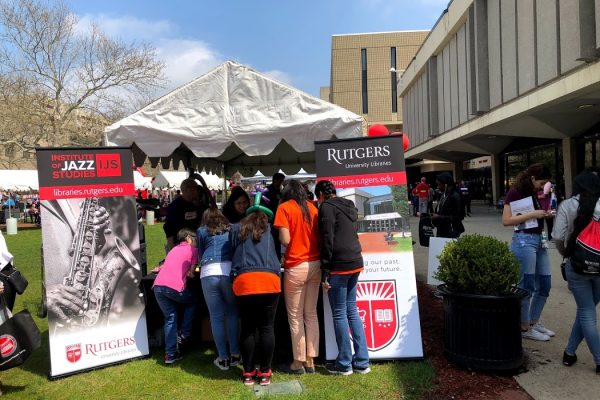
Quite the crowd at the Dana tent! Credit: Elsa Alves.
The Wheel of Knowledge was a primary attraction at the Voorhees Mall location in New Brunswick. Credit: Jim Niessen.
Button making was also a hit in New Brunswick. Credit: Janet Croft.
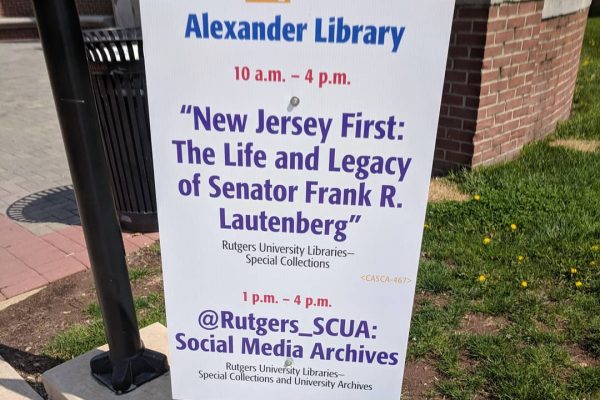
The Lautenberg exhibit was open for visitors! Credit: Tara Maharjan.
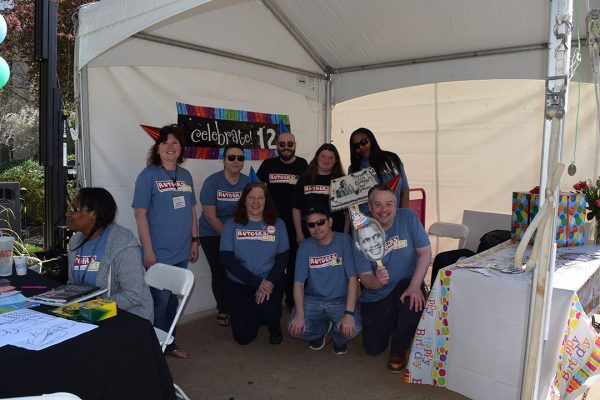
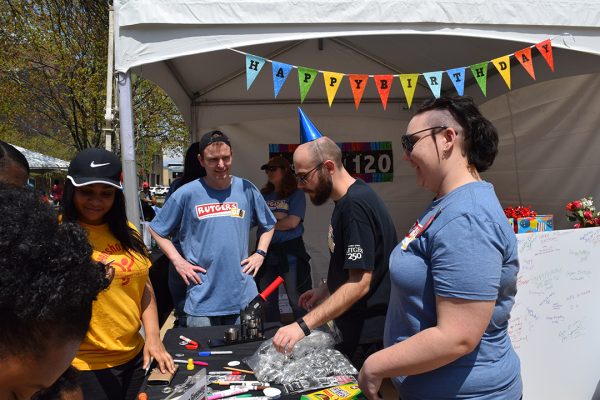
At Rutgers–Camden, the theme was a celebration of Paul Robeson’s 120th birthday. Credit: Regina Koury.
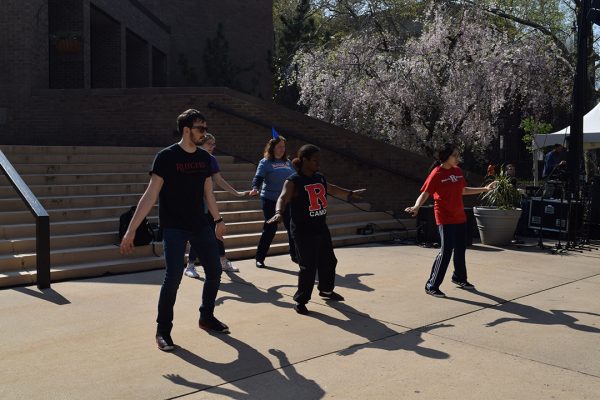
Jessica Pellien spotted doing tai chi in front of Robeson Library. Credit: Regina Koury.
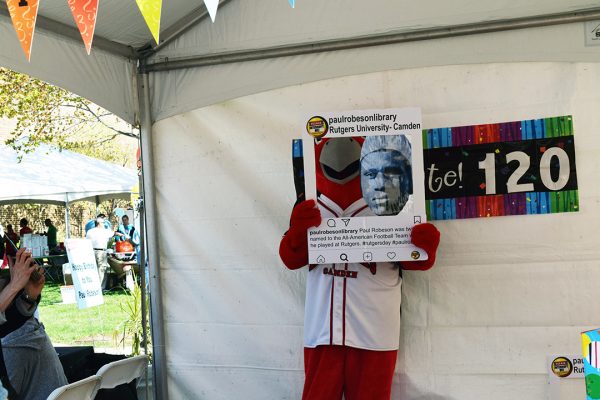
The Scarlet Raptor takes advantage of the Paul Robeson selfie station. Credit: Regina Koury.
Button making was a crowd-pleaser in Camden. Credit: Regina Koury.
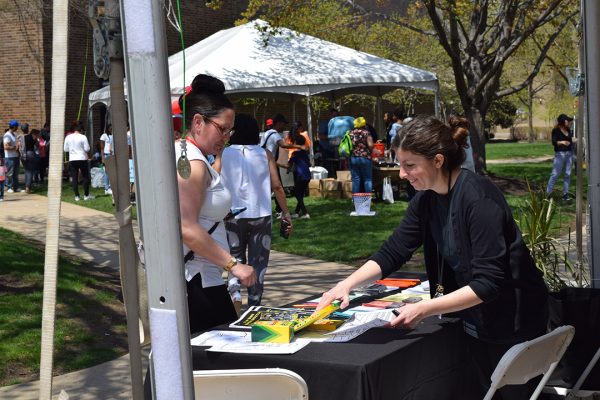
Julie Tozer represents the Camden County library. Credit: Regina Koury.
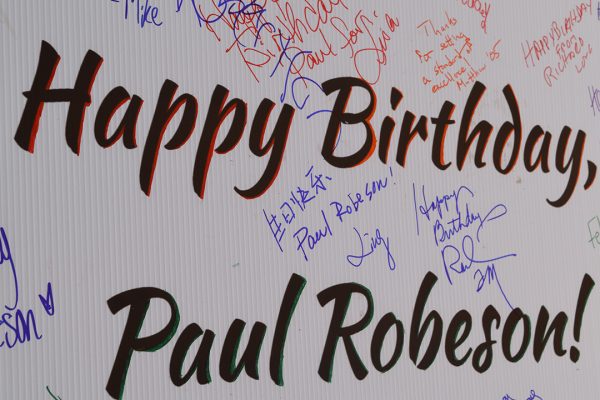
Paul Robeson’s birthday card received signatures in several different languages. Credit: Regina Koury.
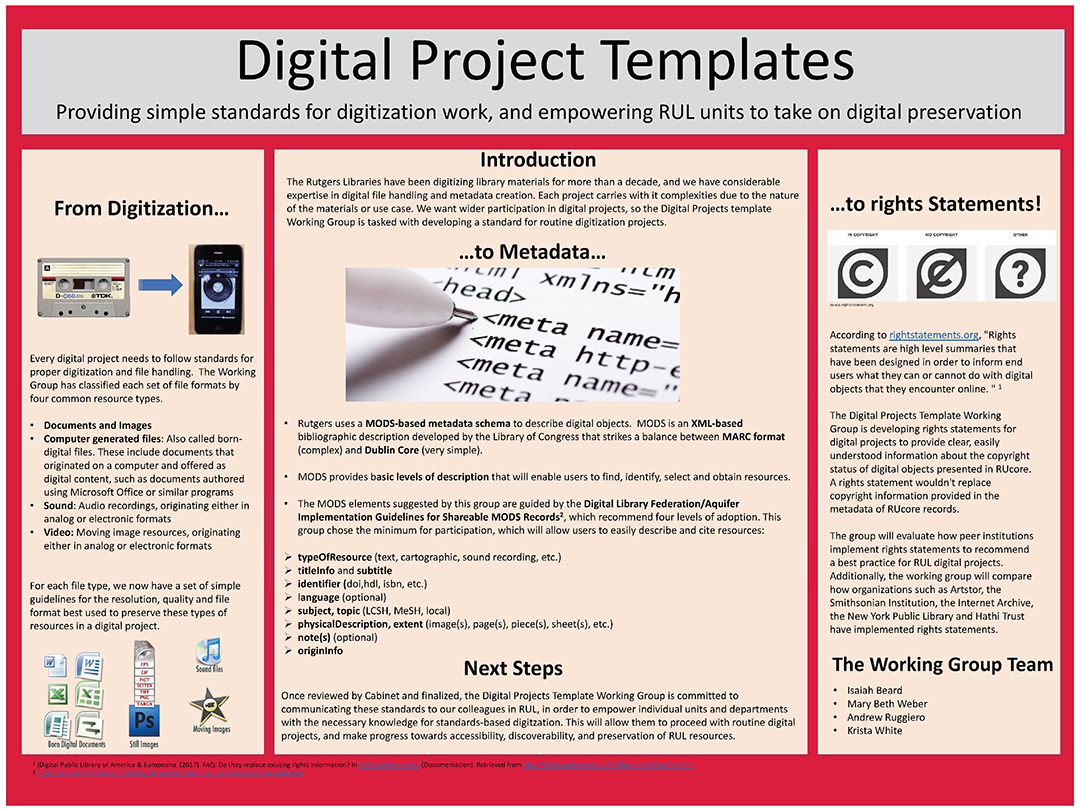
The Digital Projects Template Working Group presented an interim report poster at the last State of the Libraries.
Digital projects have been an integral part of the services that Rutgers University Libraries have provided over the past decade. Making some of our resources available online adds to the discovery and accessibility of those holdings, providing a valuable service to our patrons. The digitization of physical items also provides an additional layer of preservation, protecting the original item from additional wear, while ensuring the content lives on.
In light of this, the Digital Projects Template Working Group was formed in September 2017 to streamline and simplify the process for individual units, empowering them with the knowledge to embark on their own routine digital projects as their resources permit. We’ve worked hard during this time to document what types of items and collections make up a potential “routine” project; provide technical information on file formats and digitization standards; offer up minimum required descriptive metadata; and provide recommendations on rights statements. With this simplification documentation, we hope that there will be less of a bottleneck for routine digitization projects.
While the Digital Projects Template Working Group has completed their work, we realize that libraries also need guidance about the process to begin carrying out this work. Cabinet determined that a group will develop a workflow for routine digital projects. That effort is already under discussion.
Central units will provide support for these routine digital projects in the areas of digital preservation assessment, accessibility, and search portal and website creation. Shared User Services can consult with directors and project managers to answer questions about whether a digital project is routine, or perhaps more complex. We encourage everyone to visit our website and review the recommended guidelines for digital projects.
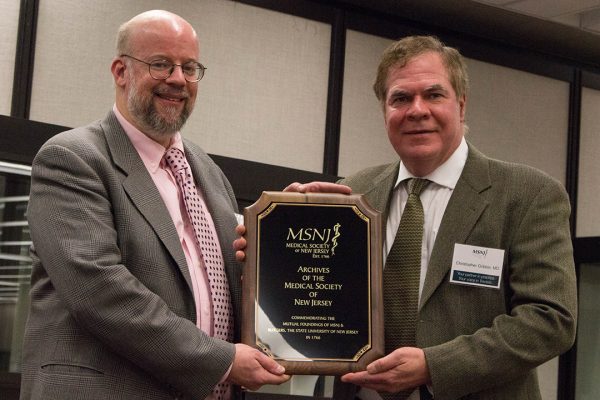
Bob Vietrogoski receives a plaque commemorating the donation from MSNJ president Christopher Gribbin.
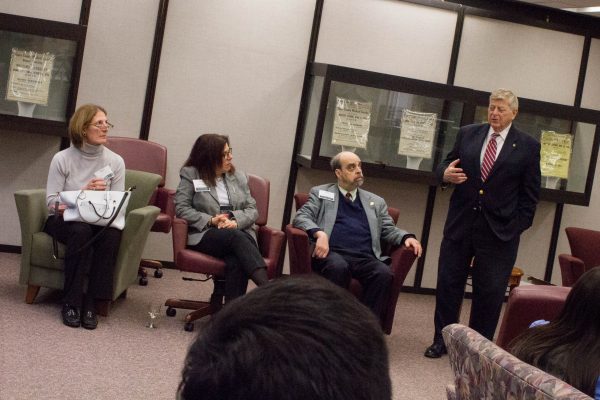
Peter Carmel, president of the Medical History Society of New Jersey, addresses attendees of the reception at Smith Library.
In 2016, Rutgers University was not the only major New Jersey institution celebrating its 250th anniversary. On July 23, 1766, at Duff’s Tavern in New Brunswick, a group of physicians met and formed the Medical Society of New Jersey (MSNJ). The MSNJ is America’s oldest state medical society, and indeed, is America’s oldest professional society.
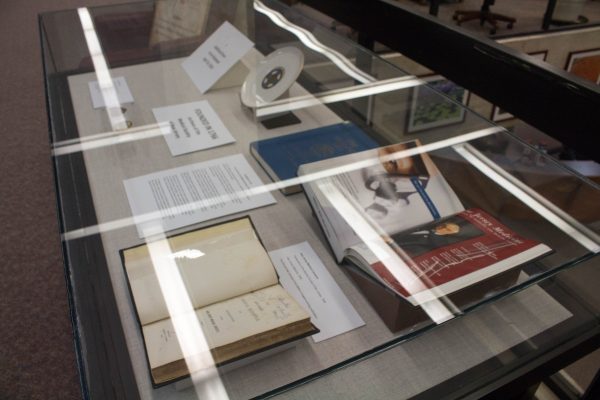
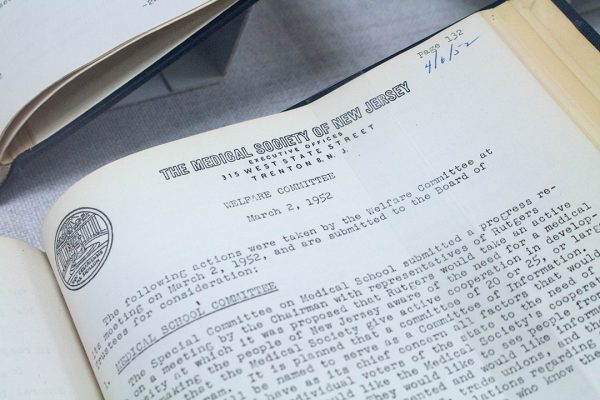
The George F. Smith Library of the Health Sciences, Rutgers University Libraries, is pleased to announce that the MSNJ has donated its 20th- and early 21st-century records to Smith Library’s Special Collections in the History of Medicine. The donation consists of 52 archival boxes of records, and 85 volumes of MSNJ Board of Trustees minutes from 1931 to 2005. These valuable historical records will be preserved and made available to MSNJ administrators, members, and officers; Rutgers University students and faculty; historians of medicine; and local and family historians.
Special Collections already holds a nearly complete run of MSNJ journal publications from 1848 to 2005, as well as substantial archival holdings of its constituent Bergen, Burlington, Essex, Hudson, Monmouth, Passaic, and Warren County Medical Societies, and the records of the Medical Society of New Jersey Alliance (formerly the Women’s Auxiliary).
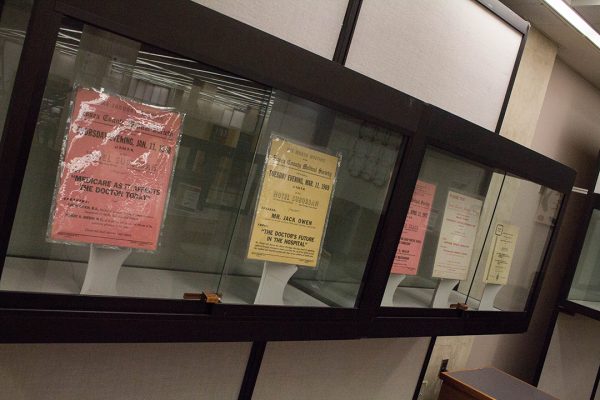
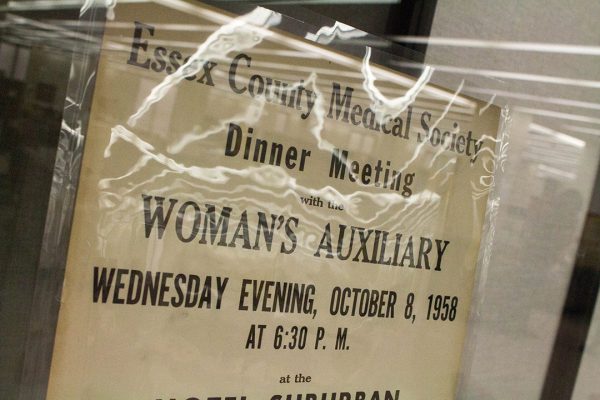
An exhibit of materials from this accession was curated by Bob Vietrogoski, with the help of Nancy Blankenhorn, medical student Stephanie Yuen, and Tim Corlis and his preservation team. On display are a selection of artifacts related to the 200th and 250th anniversaries of the MSNJ; Board of Trustees minutes discussing physicians joining the military during World War II, plans for a New Jersey medical school in 1952, the introduction of the polio vaccine in 1955, and the discouragement of smoking in hospitals in 1967; photographs from two issues of New Jersey Medicine on the history of New Jersey’s pioneering women physicians; and meeting posters from the Essex County Medical Society from 1954 to 1979 concerning the perpetual topic of “New Legislation Affecting the Medical Profession.”
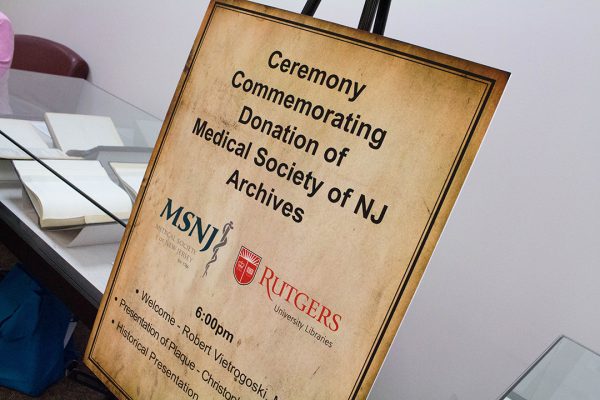
The exhibit opening on April 19 was attended by MSNJ administrators including its past, present, and future presidents; members of the Medical History Society of New Jersey; Rutgers New Jersey Medical School faculty and students; and Rutgers librarians. At this reception, MSNJ President Christopher Gribbin presented Special Collections librarian Bob Vietrogoski with a plaque commemorating the MSNJ archival donation. This donation brings together Rutgers and the MSNJ, two New Jersey institutions founded in 1766.
For the last two months, I have used the Agenda to provide updates about a framework we are developing to provide us with a common vocabulary and a shared understanding of the relationships and dependencies between local and central services. Last month I focused on the local aspects of the framework, with the intent of talking about the central aspects this month.
However, two weeks ago Cabinet had a retreat to discuss local priorities and to begin developing realistic expectations of what would be possible for the Libraries to accomplish with our shared infrastructure. Before continuing the framework discussion, I think it will be useful to review the outcomes of the retreat, including the overarching themes that emerged from our discussions.
Now that we have filled the Library Director positions, our planning processes are in full swing. The Library Directors came to the retreat prepared to discuss their most pressing needs and how best to use the shared infrastructure. The conversations were good because they were based on the needs of the campuses and communicated with a strong sense of collaboration and common purpose.
By the end of the day, several themes emerged that describe opportunities and constraints that are common to all units.
Access to Collections: It is clear that the Alma/Primo implementation will be a catalyst for organizational change. The new systems will provide a platform to strengthen foundation services and will help us to better assess our effectiveness. They will also drive changes in workflows in every unit of the Libraries. It is easy to see how this implementation will result in changes for people working directly with the system (e.g., cataloging, acquisition, circulation), but what may be less obvious are the effects for those with less direct daily interaction with the system. Discovery will change, driving changes in the broader website. Links to our resources will change, meaning that every research guide and instructional object that directs users to a specific resource will need to be updated. Needless to say, the Alma/Primo implementation will be a big part of all of our lives in the coming year.
Library Instruction: There is a need for us to build course-related infrastructure to support student success and to improve access to open and affordable resources within courses. We have begun this process with the implementation of PressBooks, but it appears that changes on the horizon may also include Leganto, an advanced Alma module related to course reserves, and Credo Education, customizable information literacy modules. We will have to determine the balance between central coordination and local autonomy in the coming year. Student success is such an important part of the library mission that we have to take the time to invest in shared infrastructure.
Discovery and Website modifications: There were many requests for new features related to discovery and the website. In the coming year, most of the attention of the Discovery Working Group and Web Improvement Team will be focused on integrating new features related to the Alma/Primo implementation and to integrating the emerging course-related infrastructure. It will be necessary to focus our attention on foundation services this year; however, the strong platform that we are establishing will allow us to continue to develop boutique services in the coming years.
I started this article with a mention of the effective discussions we had at this year’s retreat which is in and of itself a strong indicator of the final theme that emerged. The Libraries have succeeded for many years in an environment of grassroots endeavors that eventually coalesced into larger themes. The environment in which we find ourselves is moving far too quickly for this approach. In the coming year, it will be necessary to acknowledge and support the roles of managers in prioritizing and effectively advancing the missions of the Libraries. Over the past few years, we have focused on the importance of Library Directors in setting priorities for their libraries that meet the needs of and support the unique priorities of the campus environments in which they operate. For an example of how that is happening, take a look at the Framework for Change established for Dana Library and the Institute of Jazz Studies in response to Rutgers-Newark priorities. In order to support robust local plans and Librarieswide priorities, we need to focus on infrastructure and strengthen the role of the manager in understanding the priorities of the Libraries and prioritizing work accordingly. The Alma/Primo implementation is the perfect catalyst for this change.
This is an exciting time for the Libraries. We are recognized as a unit that provides leadership at Rutgers and is focused on the mission(s) of the University. I can see the progress we are making. Although we have a lot to do, this will be a productive year and will result in a stronger and more flexible organizational structure. Next month, we are back to frameworks!
From March 13 to 15, an Ex Libris consultant came to the Libraries and facilitated a three-day workshop on Alma workflows. The first one and half days of the workshop were devoted to technical services topics, from ordering to receiving/activating to invoicing to cataloging. The second half of the workshop covered fulfillment issues, such as user management, circulation, requests, resource sharing, and course reserves. The participants of the workshop included the Implementation Team members, the working group members, and staff from technical, collection, and access services. The university librarian also attended most of the sessions. The feedback on the workshop was generally positive: The Ex Libris facilitator was very knowledgeable and well prepared. The demonstrations went smoothly. The discussions were both lively and calm, perhaps thanks to the puppy pictures the facilitator included throughout her presentation.
An important takeaway for everyone at the workshop is that we need to think about changing our workflows and sometimes policies to maximize the benefits of Alma, instead of simply trying to transfer our current practices in the Sirsi environment to Alma. This will guide the work of the team and working groups in the coming months.
Other Developments
Preparing for and participating in the Alma workshop was the main activity for the Implementation Team and working groups in March. All the working groups were also busy with both internal training and testing. The Implementation Team had four weekly training sessions with Ex Libris, two on Alma and two on Primo VE. On the migration front, the Data Migration and System Integration Group is currently working hard on third-party integration issues.
Congratulations to Consuella Askew for being named a 2018 Senior Library Fellow!
California-Bound!
Congratulations are in order for Consuella Askew, who was recently announced as one of the 17 library leaders who have been selected to participate in this year’s Library Senior Fellows program at UCLA.
Consuella will join an international cohort of fellows at UCLA in August for a three-week residential program combining management perspectives, strategic thinking, and practical and theoretical approaches to the issues confronting academic institutions and their libraries. We can’t wait to hear all about it!
Where Literature and Medicine Meet
Kayo Denda and Victoria Wagner are at the heart of a new partnership with Robert Wood Johnson Medical School that will expand the dialogue surrounding issues of gender, sexuality, and identity in campus hospitals. The Literature and Medicine series brings free film screenings and discussions to the Robert Wood Johnson University Hospital one Monday each month. Next up: A presentation on transgenderism and the military on April 16. Learn more.
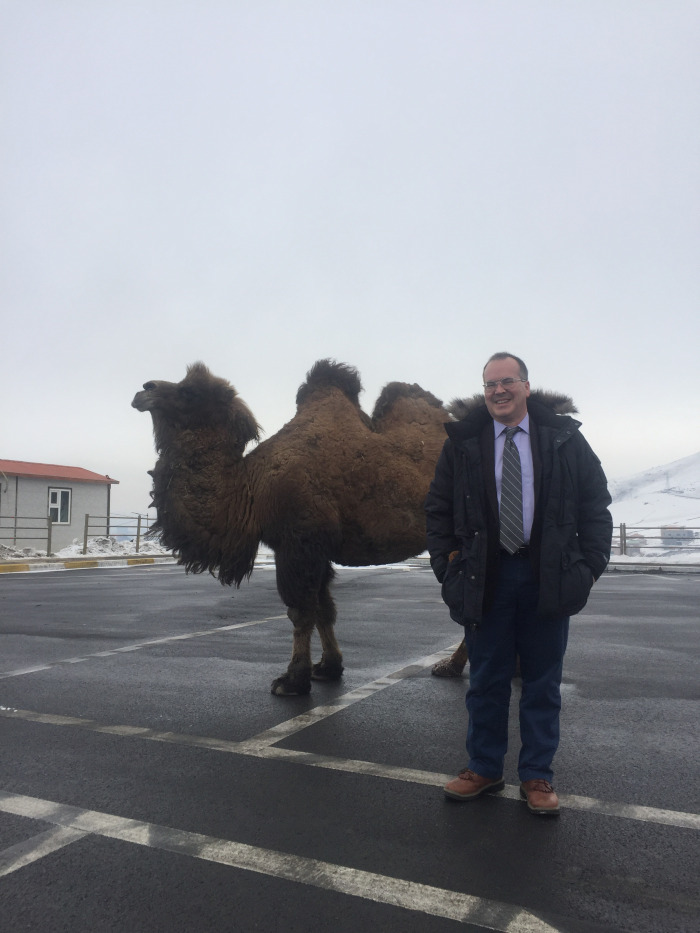
Ryan Womack meets a parking lot attendant in the Mongolian airport.
Teaching Data in Mongolia
Ryan Womack was recently invited to the Mongolian University of Life Sciences’ School of Economics and Business, where he taught a weeklong seminar on applied multivariate statistical methods using R. The seminar drew participants from schools across the university as well as Mongolian governmental offices. He also participated in meetings to discuss improvements to the academic and data infrastructure of the university and talked with undergraduate statistics majors about trends in data science. Read more on our website or the RyanData blog (which has a ton of great photos from the trip!).
Happy Birthday Paul Robeson!
April 9, 2018 marks the 120th birthday of Rutgers alum, actor, artist, and activist Paul Robeson. In honor of this milestone, Paul Robeson Library is hosting events throughout the month of April including an exhibit about his life, a documentary film screening and panel discussion, and a birthday party on Rutgers Day. Learn more about the planned festivities.
The 32nd annual Bishop Lecture comes to Alexander Library on April 25.
Who Spoke Up?
The 32nd Annual Louis Faugères III Bishop Lecture will be held at Alexander Library on April 25. Join us as we welcome David Greenberg, professor of history and journalism and media studies at Rutgers University–New Brunswick and author of Republic of Spin: The Inside History of the American Presidency. Greenberg’s lecture, titled “Who Spoke Up?: Liberals, the Left, and the ‘Great Debate’ over Entering World War II,” will paint a vivid portrait of the personalities and debates surrounding America’s entrance into World War II, illustrating the importance of political papers projects for this type of original historical and political research.
As a scholar of political history, Greenberg frequently uses political papers in his research. For his most recent book, he visited no less than six presidential libraries and used political collections at the Library of Congress and Princeton University.
Last month I introduced the idea of using Frameworks to describe our increasingly complex environment. As a reminder, Frameworks provide a way to divide complex processes into manageable chunks while retaining information about relationships and dependencies between the components. Developing a Service and Project Framework will give us a common vocabulary and a better understanding of the relationships and dependencies between local and central services.
Over the past two Cabinet meetings, we have worked to establish a Framework by using a matrix to describe components of a range of our services, including items like instruction, reference, or access to collections, and projects like ExLibris and OAT implementation. With each pass, we identified areas for improving the Framework and developed better ways to describe the work we do within our unique environment.
This matrix expands on the service categories outlined in the OCLC Research Library Partnership Reports on the Realities of Research Data Management—education, expertise, curation—to accommodate the full range of work done at Rutgers University Libraries. The matrix continues to evolve, but the important thing to note is that it breaks down our work into components related to Service Category or Project and Type of Support.
The best way to read this draft of the matrix is to start with a Service category and read down the column. Each of the cells describes one component of a service or project, with the lower cells describing the infrastructure required to deliver the service or complete the project.
Click this image to download and view a PDF version of the matrix.
About Service Categories
There are many different ways that we could describe the categories of service that we provide, but based on our discussions, we found it most useful to group our services based roughly on the breadth of the audience; whether it serves mostly Rutgers faculty and students or external scholars and the public; and the number of stakeholders we work with to design of the service or resource. The Service Categories include:
Foundation:Services directly related to finding, evaluating, and using information in all forms. Typically, we design these services for a wide range of faculty and students. These are sometimes referred to as “core” library services.
Boutique: Focused services and resources that are designed by a small number of stakeholders (often outside of the Libraries) and that primarily serve a targeted audience within Rutgers, the needs of scholars outside of Rutgers, or the community.
Education: Providing information about aspects of scholarly communication (beyond Foundation instruction like information literacy) designed for a wide range of faculty and students.
Consulting:Providing specialized recommendations and information to an individual or group based on their specific scholarly communication need.
About Projects:
These projects are planned, intentional activities that span local and central units and expertise to change our infrastructure, create new services, or generate new information resources. Our central infrastructure has to support four unique missions, so we need to ensure that changes to our services and resources work to advance all of these goals.
Innovating: Projects that lead to the design and development of new Foundation services, including improvements to existing Foundation services. Upon completion, the long-term operation and maintenance of these projects shifts to the Foundation service category.
Creating:Projects that require extensive expertise and central and local infrastructure to develop Boutigue services and knowledge products. These are usually collaborative projects with non-library units and involve a small number of stakeholders. Upon completion, the long-term operation and maintenance of these projects shifts to the Boutique service category.
Local: Direct support to faculty and students. Examples include library instruction, material selection, and reference support.
Local Infrastructure: Services that support the work of others in the library and that are provided by local faculty and staff. Examples include gathering local statistics, scheduling classes, and the repair and preservation of materials.
So how does this impact the Planning Process?
The Framework will need refinement, but even the process of creating this matrix has resulted in important conversations and clarification of the work we do, the locus of responsibility for processes, and how we identify and distinguish between local-level and Libraries-wide priorities. Although I am asking library directors to provide a comprehensive list of priorities for the coming years, the central planning process will only focus on priorities that need central coordination or changes in the central infrastructure.
Foundation services represent the bulk of what we do. Ongoing work and even some improvements in these services can be completed at the local level, but changes that need support from central infrastructure—for example coding, non-routine digital projects, changes to a website, or programming—require coordination to ensure that they do not cause unexpected problems. Modifications that may seem small on the surface can have a big impact on the workflows in the central units. During the planning process we will distinguish between priorities that can be completed on the local level and those that require new Innovating projects to ensure that services are coordinated and effectively use the shared infrastructure.
Boutique services also come with their own quirks. Because these projects are expensive—they use a lot of expertise and library infrastructure to complete and to maintain—the bar is particularly high for new priorities. The consideration here will be how significant is the impact of this proposal? What audiences or needs does it address? During the planning process we will prioritize projects and assign resources to Creating projects to develop new services and resources.
There is a circular movement between Foundation services and Innovating projects—significant changes to Foundation services are accomplished via Innovating projects; and once complete, Innovating projects shift to Foundation services. This flow is also present in the movement between Boutique services and Creating projects.
By definition, Education and Consulting services are local and should only use existing shared infrastructure. There are many ideas for improvement—workshops for graduate students or consultations on data management—that are worthy initiatives and can be coordinated within the local units.
Next month, I will include the portions of the matrix that describe how central infrastructure, coordination, and expertise interacts with the other parts of the matrix. In the meantime, please explore the matrix (the best way, as I mentioned earlier is to read down the columns). Think about how your work would fit into these columns–which of our services would fit into each category? How are services delivered to our users at the local level? How are they supported by local infrastructure? Are there services that don’t fit into this matrix?
This is an evolving document and I encourage you to talk to your library director or AUL and to send in feedback and suggestions.
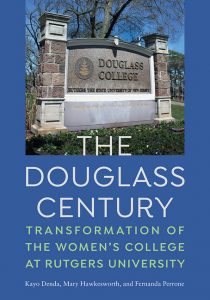
Kayo Denda and Fernanda Perrone have coauthored, with Mary Hawkesworth, The Douglass Century: Transformation of the Women’s College at Rutgers University. This book is part of the centennial celebrations planned at the University and is published by Rutgers University Press. Read a nice article from NJ.com about the book.






 Alma Workshop

 Compiled by the Collection Analysis Group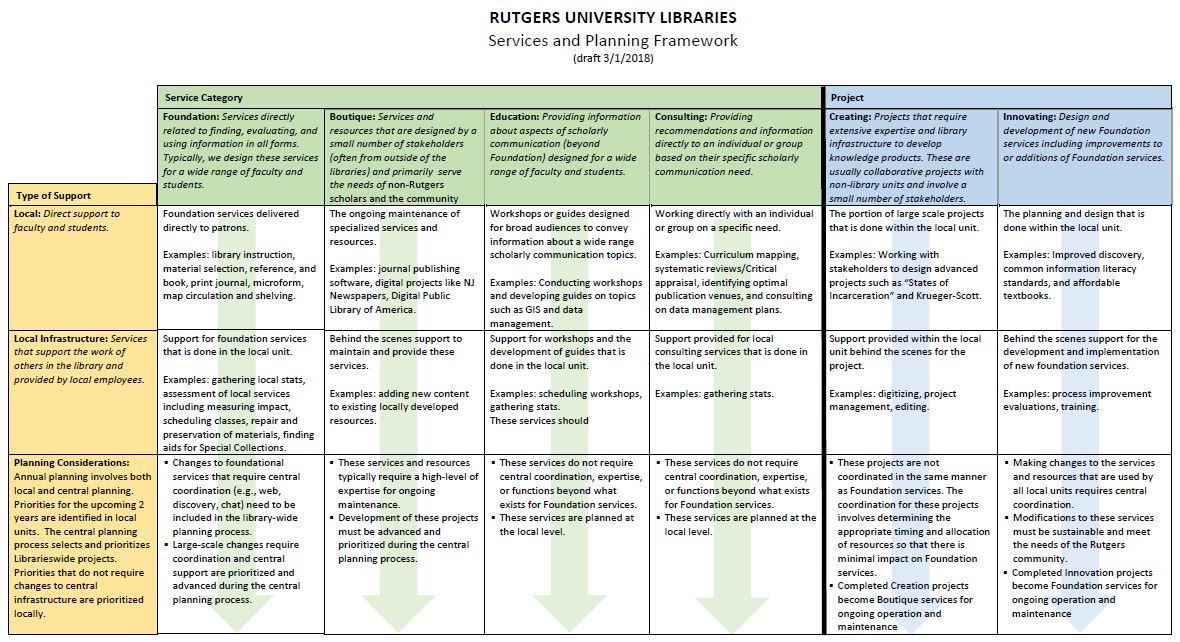
 Kayo Denda and Fernanda Perrone have coauthored, with Mary Hawkesworth, The Douglass Century: Transformation of the Women’s College at Rutgers University. This book is part of the centennial celebrations planned at the University and is published by Rutgers University Press.