Category: Rutgers Biomedical and Health Sciences

Faculty and staff news from the libraries at Rutgers Biomedical and Health Sciences.

  • Self-Appraisal Reminder

    In anticipation of an announcement from University Human Resources regarding the performance appraisal program, managers and supervisors should remind URA-AFT staff to begin a self-appraisal. Managers and supervisors should also ensure that employees have a self-appraisal form that includes an accurate list of key duties. Self-appraisals should be completed and returned to supervisors by April 5, 2019. Managers and supervisors must complete performance evaluations and notify eligible employees of the appraisal by April 30, 2019.

    Here is a link to the UHR webpage to assist you in the appraisal process.

    If you have any questions, please do not hesitate to contact Libraries HR.

  • Ex Libris Implementation Project Update – March 2019

    quicksearch logoThis month, the Ex Libris Implementation Team welcomed back Megan Drake from Ex Libris for our follow up to the six-month health check. Following two days of meeting with representatives from various Ex Libris working groups, Megan provided some very actionable suggestions for improving our processes and making our workflow more efficient in Alma. The team is working hard to integrate her suggestions into our processes.

    Leganto Implementation

    This month also marked the kickoff of the Ex Libris Leganto project. Leganto is a course reserves platform that is integrated with both Alma and the course management systems we support at Rutgers, like Canvas, Sakai, Moodle, and Blackboard. This product will give instructors more control over developing their course reserves lists and put the power of the library directly in their course space to help them provide electronic resources and streaming video from our subscriptions, and realtime catalog information for physical reserves.

    Because faculty members are able to create their own course reading lists, Leganto will enable us to increase our course reserves services without creating additional work for reserves management in access services. Students will be able to access course reserves directly from their course management system on any device and Leganto will help faculty select clean pdfs from our subscription databases rather than scans of readings. The system also provides robust analytics and encourages faculty to use materials from within our subscription databases for course reserves, providing us with a more accurate understanding of usage. Ex Libris provides a good overview of the product in this video demo.

    Ex Libris expects that our implementation process will take 12 weeks and the team plans to conduct a pilot with several courses during the summer with an official launch in Fall 2019. Faculty engagement is important for the success of Leganto, so expect to hear soon from your campus Leganto Team representative about communication strategies and training.

  • University Librarian’s Report – March 2019

    As we learned in Lorcan Dempsey’s presentation in January, collections are one area where academic libraries face strategic choices along a continuum that ranges from cooperation (weakest) to consolidation (strongest), with collaboration in the middle. When does it make sense to consolidate infrastructure? What are the advantages of offering access collaboratively versus locally? And what are the tradeoffs that come with these decisions?

    It was somehow reassuring to see that libraries in general are grappling with these issues, since asking these questions is something we do every day at Rutgers. When Cabinet developed our Services and Planning Framework, we thought about what aspects of our work it would be beneficial to consolidate centrally, where our efforts would require shared coordination, and which services were best left to local discretion.

    At this point, the majority of our Foundational services are consolidated. These include activities related to acquisitions, cataloging, and discovery, for example, which are all handled centrally. Services that benefit from having a consolidated infrastructure are typically large-scale and have substantial startup and operation costs—especially in terms of faculty and staff time, with the recent Alma/Primo implementation being a prime example. Once implemented, changes to these services have wide ranging impact and need to be carefully planned and communicated.

    Of course, there are pros and cons to consolidation. On the plus side, it increases operational efficiency and lowers the long-term cost of providing the core services that reach the most faculty and students. The biggest drawback is that in order to gain efficiencies, some local features and specializations can be lost.

    In other areas, like reference and instruction, our activities are coordinated. We decide collectively on a tool or service like Credo or Leganto, but how it is deployed locally is up to the individual unit. Then there are the truly local activities. Education and consulting services, from workshops to systematic reviews, can be tailored to meet the specific needs of our local communities. There is a lot of freedom and flexibility in this area to use the available infrastructure in your own unique way.

    Whether in the BTAA or OCLC, the trending discussion is about these tradeoffs between efficiency and autonomy. At Rutgers, we’re fortunate to have experience navigating these same issues. As the larger academic library environment continues to evolve, we will be well-positioned to contribute meaningfully to these discussions.

  • Introducing Libraries HR’s New Website

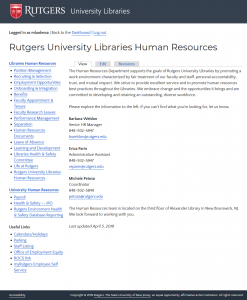
    I’m happy to announce the launch of Libraries HR’s new staff resources website at https://apps.libraries.rutgers.edu/hr.

    The goal of this page is to be your new one-stop shop for all things related to human resources at the Libraries. It contains need-to-know information for managers, from position management to onboarding and integration; guides to tenure, benefits, and applying for research leave; and a library of useful forms and other documents including CARFs and APPs. There is also a collection of links to resources available via UHR, such as the REHS reporting portal and the university’s holiday closing schedule.

    I hope you’ll have a look and let us know what you think. And don’t forget to update your bookmarks!

  • University Librarian’s Report – January 2019

    Happy New Year, everyone! I hope you’ve had a restful winter break and are ready to tackle all the challenges of the upcoming semester.

    Though we are between terms and the activity on campus may have slowed a bit, this is actually a busy time in the Libraries’ planning cycle. The library directors have just completed progress reports on their 2018-2019 plans, adjusting them to reflect progress as well as any changes in their goals for the rest of the year. In addition, the Discovery Working Group, Web Improvement Team, and Virtual Reference Group have updated their annual plans. We have now received news about our 2020 budget, so we will have solid information as we move into the 2019-2021 planning cycle.

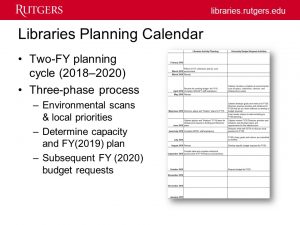
    We are also in Town Hall season. Last month the central units had a Town Hall, yesterday was Camden’s, later this week will be New Brunswick’s, and RBHS will hold theirs in February. This year, my Town Hall presentation has focused on our planning cycle. Although some of you have already seen the presentations, and others will soon, it is worth seeing a few times. Like all things Rutgers, the process is a bit complicated but the results are worth the effort. Here are the slides that I’ve been presenting:

    As you can see, the Libraries operate on a two-year planning cycle that is tied closely to the budget activities of the university overall. It’s a three-phase, iterative process that includes establishing local priorities, taking stock of central capacities to support those priorities, and looking ahead to solidify a plan and develop related budget requests. This helps us stay focused on our core services while maintaining the flexibility to respond to important new requests as they come in.

    Our priorities document for 2018-2020 has been added to our mission page and I invite you to read through to get a sense of where we’re headed in the months to come. And, if they haven’t already, your library director will soon be updating you on the local implications of the 2020 budget.

    I know that it seems like a lot to juggle all at once, but sound planning ensures that we continue to build on the momentum we’ve gained and can make the best choices on behalf of all our users. I look forward to seeing all we will accomplish together in 2019.

  • Planner and Teams in Connect

    The Office of Information Technology has enabled two new Office 365 apps, Planner and Teams, for all Rutgers Connect users. These tools will appear in your Outlook app launcher, aka “waffle.” They work best for users who are members of Office 365 Groups.

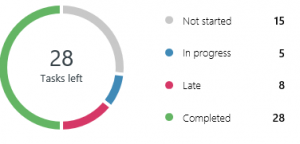
    Planner is an application for creating, assigning, and managing tasks. It is useful for collaborating among small groups.

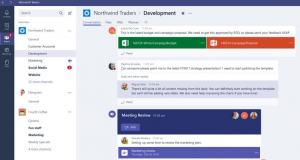
    Teams is a chat-based workspace that integrates all the people, content, and tools that the team needs to be more engaged and effective. It is useful for communicating with team members through messages that require an instant response.

    Every group has its own needs and workstyle, so selecting the best tool is important. This article highlights some of the features available in Planner and Teams.

    plannerPlanner

    • Organize your work
    • Manage tasks
      • Assign user(s)
      • Set due dates
    • Collaborate
      • Communicate with group members
      • Attach project related files
    • Monitor progress
      • Use charts to view progress
      • Get email updates

    Teams

    • Communicate with your team
      • Email
      • Chat
    • Share files
      • Store all your files and docs in one place
    • Team OneNote
    • Audio/Video Meetings
      • On-demand
      • Scheduled
    • Integrate other apps

    Still not clear what is suitable for your group? Please submit a ticket in RULhelp and help will be on the way!

  • Ex Libris Implementation Project Update – January 2019

    quicksearch logoAs we move into spring semester, the Ex Libris Implementation Team is working towards optimizing our workflows and resolving remaining issues in the systems. We passed a major milestone in December with the end of our subscription to Symphony. Integrated Information Systems (IIS) has archived our data and will make it available on request. The Ex Libris Fulfillment Team has also transformed in the New Year and will continue in a new form as the Fulfillment Working Group, addressing central coordination for systems and processes for access services. The Ex Libris Implementation Team moved to a new schedule and will be meeting every other week during spring semester as we address the remaining implementation issues. Some other updates from our work include:

    Updates to QuickSearch

    We made several updates to QuickSearch in early January based on feedback from user testing and from system enhancements provided by Ex Libris. These updates include direct linking through Get it @ R, increased clarity in the display of some menus and options, and search improvements.

    Six-Month Health Check

    Megan Drake, a representative from Ex Libris, visited onsite in January to review workflows and address system issues. Representatives from each working group brought lingering problems for review and Megan suggested alternative strategies and optimizations that will help improve efficiency in Alma.

    Analytics Training for Selectors

    We held our first analytics training session for selectors on January 7. This active training session focused on learning the analytics platform and testing queries related to circulation and fund information. Future sessions are planned for 1–3 p.m. on January 17 and January 22 in New Brunswick and via WebEx and 9–11 a.m. on January 18 in Newark. Prior registration is not necessary, but if you have questions, please contact Laura Costello.

    Ex Libris Identity Service

    At the end of January, Ex Libris will debut an identity management service that will improve security for our barcode and password users. New security standards will ensure better privacy protection and users will be able to change their own password and retrieve a lost password via “My Account.” This update will not impact our users that authenticate via NetID.

  • Introducing Browzine

    Rutgers University Libraries are pleased to introduce BrowZine, a current awareness tool that allows users to find, read, and monitor the top scholarly journals in their field from almost any device.

    BrowZine improves discovery of current issues of academic journals and provides streamlined access to full-text via PC, tablet, or smartphone. It also offers useful personalization features so users can keep current with their favorite publications.

    BrowZine users can:

    • Browse thousands of top academic journals by subject, title or ISSN; review current tables of contents, and download full-text articles published since 2005
    • Follow and receive new article notifications for their favorite journals by creating a personal bookshelf
    • Save and export articles to services such as DropBox, Mendeley, RefWorks, EndNote, and Zotero

    Although it provides access to thousands of titles from major academic publishers, BrowZine does not include every journal available at Rutgers or cover issues published before 2005. It also does not include non-scholarly periodicals such as newspapers, magazines, and trade publications. Access to the Libraries’ complete periodical holdings is available via QuickSearch.

    For more information, see What is BrowZine?

  • Help Us Help You Better!

    New technology and better solutions keep coming, as we all know. By joining the University’s central Rutgers Active Directory as the Libraries’ Windows domain, we are expanding the ability to log in anywhere with a single username. But it obviously comes with new issues as many have noticed.

    IIS is inviting everyone in the Libraries to submit such issues and any other computing concerns and requests using the RULhelp trouble ticket system. It is the best way to keep track of issues, make sure that every one of them is addressed in a timely manner, and develop our knowledge base to speed up resolution. Instead of emailing or calling UCSs or other IIS staff, please use this address to submit a ticket: support@rulhelp.rutgers.edu It will be automatically channeled to the IT support closest to you.

    IIS is working on transforming the RULhelp database to use NetIDs (instead of old Windows usernames) just like most other platforms. Soon, you will be able to log into the trouble ticket system with your NetID to check the status of your issue.

  • Ex Libris Implementation Project Update – September 2018

    quicksearch logoThe fall semester has started, and September 5 marks the third month of Alma and QuickSearch implementation. We have focused on rectifying known problems in preparation for the new school year, and have made many improvements to the system and the services it provides. Thanks to feedback from users and library staff, we are continually making improvements to the system. We encourage and welcome your input and questions—submit them by visiting https://apps.libraries.rutgers.edu/ex-libris/contact.

    As reported in the July update, the Implementation Team visited all four campuses in August. During those meetings, the team reported on the respective working groups and held discussions with library personnel. We appreciate the fact that people took the time to participate in these sessions and provided thoughtful feedback and questions. The discussions were lively and productive.

    The Implementation Team would like to take this opportunity to share the following updates:

    • A QuickSearch tutorial has been created and will be available this fall. An announcement is forthcoming.
    • The library names facet in Primo has been revised to reflect abbreviated and more commonly known library names, making it more usable for patrons. For example, Archibald S. Alexander Library will now display as “Alexander Library”.
    • 856 links to finding aids and other materials are now available in the “Links” section of QuickSearch records.
    • Sign in has been improved to allow users to sign in with fewer actions and to more easily access account options such as loans, requests, and favorites.
    • Database lookup has been enabled so that users who enter database names (PubMed, JSTOR, Factiva) in the search box get a direct link to that resource at the top of their search results.
    • An open access filter is now available in QuickSearch, enabling users to limit results to content published in open access publications.
    • A number of fields are now available in QuickSearch record displays, including uniform title, language, identifier, related work, and several local note fields (e.g., general, bound with, performer, production credits, donor, and finding aid). Additionally, the donor note is now searchable, making it easier to identify specific gift collections and to retrieve records for items in those collections.
    • Harvard has been added to the list of citation options and MLA has been updated to the 8th edition.
    • Users can now save records to Zotero.
    • Users are now able to pick up materials from off-site delivery locations, such as the law libraries.
    • A new marketing campaign for QuickSearch will be unveiled this fall.

    The Implementation Team’s website is available at https://apps.libraries.rutgers.edu/ex-libris. It includes the various teams and working groups associated with the implementation, a timeline for the project, resources, an FAQ, and a list of known issues for Alma and QuickSearch (alias Primo). The team is working through both lists of issues, and the lists are updated as progress is made and issues are resolved.

    We are fully aware that our experience with QuickSearch and Alma is one of learning and trial and error. The Implementation Team values input and collaboration from the Libraries as well as our user community to continually refine and improve this service.