As recently announced, University Human Resources (UHR) will host a series of Open Enrollment Benefits Fairs throughout the month of October to educate employees about their SHBP benefits options, as well as other benefits and services that are available and may be of interest.
Save the date and plan to attend the Open Enrollment Benefit Fair that is most convenient for you:
Rutgers University/ Rutgers Biomedical and Health Sciences (RBHS) New Brunswick
Oct. 10, 2016, 10 a.m. – 4 p.m.
Medical Education Building, 1 Robert Wood Johnson Pl.
Rutgers University – New Brunswick/Piscataway
Oct. 11, 2016, 10 a.m. – 4 p.m.
Rutgers Student Center, College Avenue Campus
Oct. 20, 2016, 10 a.m. – 4 p.m.
Busch Student Center, Busch Campus
Rutgers University – Camden
Oct. 13, 2016, 10 a.m. – 2:30 p.m.
Athletic and Fitness Center, 301 Linden St.
Rutgers University – Newark
Oct. 19, 2016, 10 a.m. – 4 p.m.
Paul Robeson Campus Center, 350 Martin Luther King Jr. Blvd.
Rutgers University – Rutgers Biomedical and Health Sciences (RBHS) Newark
Oct. 25, 2016, 10 a.m. – 4 p.m.
Medical Science Building, 185 South Orange Ave.
Contact the Benefits Administration staff with questions regarding benefits at (848) 932-3990 or via email at benefits@hr.rutgers.edu.
Save the date for State of the Libraries – December 7, 2016
Many more details will follow, but please save the date of December 7 for the 2016 State of the Libraries. The program will begin with poster presentations at 10:30 a.m., lunch will be served around noon, and presentations by Krisellen Maloney and others at 1 p.m. The event will take place at the Busch Campus Center, so hopefully this schedule will allow many of our colleagues from Camden and Newark to avoid the brunt of rush hour traffic.
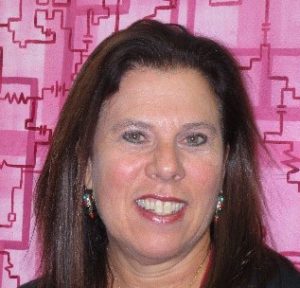
Judy Cohn to be a mentor in the 2016-2017 NLM/AAHSL Leadership Fellows Program
Congratulations to Judy Cohn who has been selected as a mentor in the 2016-2017 NLM/AAHSL Leadership Fellows Program, sponsored by the National Library of Medicine and the Association of Academic Health Sciences Libraries. The Program prepares emerging leaders for director positions in academic health sciences libraries through a year-long mentoring relationship with a director of another library and a curriculum focused on developing leadership knowledge critical to enhancing the value of libraries in their institutions.
In this highly competitive program, Judy will be one of ten fellows and mentors from academic health sciences libraries across the U.S. who will begin their work together in November. Since the program began in 2002, 42% of all fellow graduates have assumed director positions.
President Barchi mentions Libraries’ capital construction projects in Report to the University Senate
Excerpt: “University Libraries: The University has also launched an in-depth master plan for the university libraries. Libraries have changed their mission; we are looking to align them with what students want and need today, including better computing resources, collaborative areas, and other amenities. Individual projects have been identified and designs are under way for a new OIT computer center at Alexander Library in New Brunswick and a Professional Development and Scholarship Center in Dana Library in Newark.”
“The centipede party,” 40 inches by 42 inches, oil painting by BFA student Audrey Meehan. This will be on view at the Mason Gross Galleries.
Art Library participating in The Co-Cureate Show
Undergraduate and graduate visual arts students are teaming up to conceptualize and install a collection of eight student exhibits at three locations across the New Brunswick campus: the Mason Gross Galleries, Rutgers Art Library, and Douglass Student Center. The co-cureate shows (the title is a mash-up of what the initiative has prompted teams to engage in: conceive, curate and create exhibits) are set to run from Thursday, September 29 through Monday, October 17, 2016. The shows will feature student performances, paintings, photographs, sculptures, media, and prints. Admission is free.
The Art Library will host In Search of Punchline is curated by Johanna Boyce, Audrey Meehan, and Ed Weisgerber and features the work of Johanna Boyce, Erin Keane, Audrey Meehan, Carlyn Perlow, Delfina Picchio, and Ed Weisgerber.
New Brunswick Music Scene Symposium Planned for October 27, 2016
Save the date. Special Collections and University Archives will hold the next New Brunswick Music Scene Archive symposium on October 27, 6 p.m. in the Teleconference Lecture Hall at Alexander Library. Stay tuned for more information, including the participants. In the meantime, here’s a look back at the 2015 symposium, featuring a who’s who of New Jersey music (http://www.libraries.rutgers.edu/news/symposium-local-notables-inaugurate-new-brunswick-music-scene-archive).
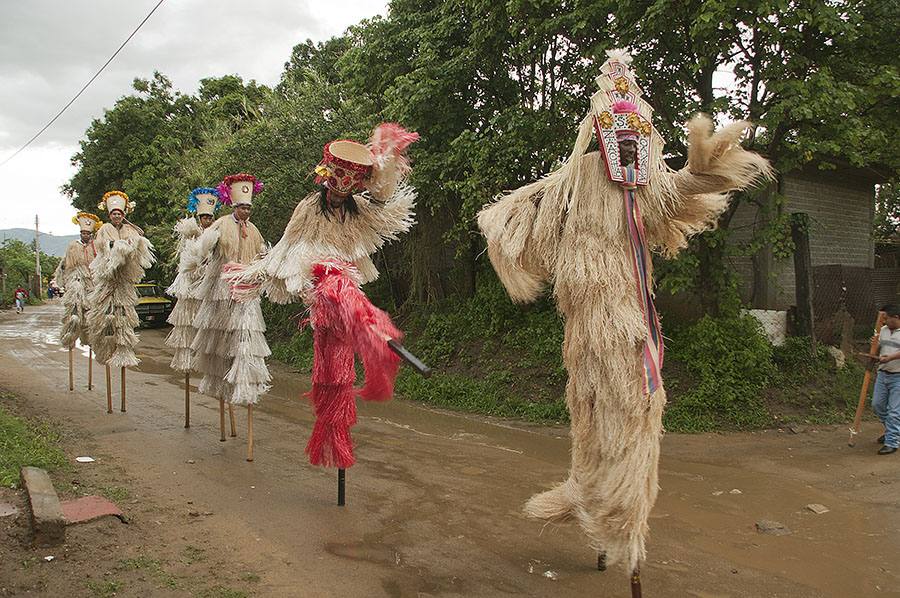
Credit: Laura Anderson Barbata.
Mary H. Dana Women Artists Series Galleries Welcomes “Laura Anderson Barbata: Collaborations beyond Borders”
This fall, the Mary H. Dana Women Artists Series Galleries in the Mabel Smith Douglass Library will welcome the 2016-17 Estelle Lebowitz Endowed Visiting Artist Exhibition, Laura Anderson Barbata: Collaborations Beyond Borders. The exhibit contains selected highlights of textile, sculptural, 2-dimensional, and video works from the traveling exhibition Transcommunality.
In the July staff news, you may have noticed this announcement: “A poem of Michael Joseph‘s will be part of the Vispo Art Exhibition of poetry and art sponsored by the German state of Northrhine-Westphalia (NRW). The exhibition, scheduled for Spring 2017, will conclude in Burgau…” His brilliantly and beautifully conceived books are now a reality.
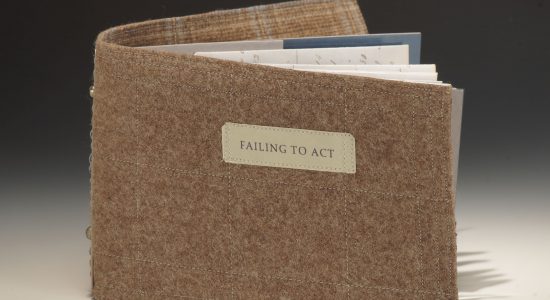
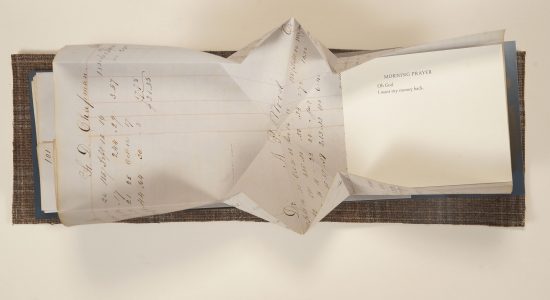
Shown above in the slideshow are SPICA, a poem by Michael Joseph, Failing to Act, a collaborative artists’ book, and Dream Dirt, a book unlike any other. All three books were conceived and fabricated by Sarah Stengle.
Details:
SPICA
Poem by Michael Joseph 2016
Art by Sarah Stengle 2016
Silkscreen on etched and drilled found glass autoclave windows with steel brass and neoprene rubber fittings.
Edition of 2
14 x 12 x 26 centimeters (height x depth x width)
Failing to Act
Collaborative artists’ book
Four Poems: Michael Joseph 2016
Book Art: Sarah Stengle 2016
Twelve pages as follows: six turkish map-folded spreads, each containing text on one side.
This book was typeset in Aldus and Aldus SC by Hermann Zapf, and printed on Crane Crest Natural White Cotton Wove. The endpapers are Rives Smoke Cover with Western Blot antibody test result films mounted with 3M 568 adhesive. The text appears inside mid-nineteenth century pale blue ledger-paper folded with a Turkish map-fold. The outer covers are sewn wool with printed pale celadon colored silk title labels applied. The covers are attached with waxed blue linen thread and vintage Erector Set hardware from the 1950’s.
Edition of 8.
Dream Dirt
Text by Michael Joseph 2016
Art by Sarah Stengle 2016
A wooden train carrying two vials of dirt, 30 vials containing paper scrolls (28 short stories, 2 signatures).
The text is available in a trade edition, titled Juvenile Fantasies and Innocent Dreams. The vials contain short stories about childhood and dirt, each one sentence in length, as well as an equivalent number of single-sentences critiques and responses to the stories. Two of the vials contain sterilized dirt from the past of the author and artist.
Making Rowan University and Camden County College Students Feel Welcome
Through a partnership agreement, Paul Robeson Library is now the campus library for Rowan University and Camden County College students. Bart Everts is the library liaison for these students and has started a new Facebook page to share information about their library privileges and resources. The agreement allows students to access the library, use library databases, and check out books using their student ID cards. Robeson also has computers reserved for their use.
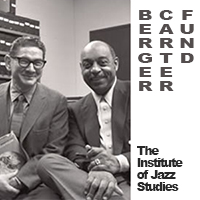
Morroe Berger–Benny Carter Jazz Research Fund
Each year the Institute of Jazz Studies (IJS) awards up to ten grants of $1,000 each to assist jazz researchers. Half of the awards are designated for students in the Rutgers University-Newark Master’s Program in Jazz History and Research and half are awarded to scholars from other institutions or unaffiliated researchers to enable them to visit IJS in conjunction with their projects. To date, we have given more than 70 awards to scholars and students worldwide working in a variety of disciplines, including jazz history, musicology, bibliography, and discography.
Applications for the 2017 grants are due October 21, 2016. Awards will be announced by November 14.
“Homecoming! Some Highlights from the Library of J. Milton French” at Alexander Library
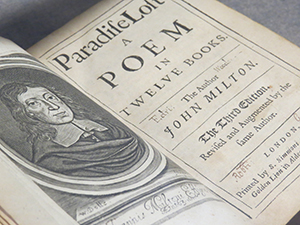
Homecoming! Some Highlights from the Library of J. Milton French is on display now in the Scholarly Communication Center at Alexander Library. This case exhibit features a selection of volumes recently donated to Rutgers by the family of J. Milton French (1895–1962), a Milton scholar and professor of English at the university from 1940 to 1960.
The books on display include rare first and early editions of works by John Harington, Richard Barckley, Michael Drayton, Ben Jonson, John Suckling, George Wither, William Wollaston, and John Milton.
New Brunswick Music Scene Symposium Planned for October 27, 2016
Save the date. Special Collections and University Archives will hold the next New Brunswick Music Scene Archive symposium on October 27, 6 p.m. in the Teleconference Lecture Hall at Alexander Library. Stay tuned for more information, including the participants. In the meantime, here’s a look back at the 2015 symposium, featuring a who’s who of New Jersey music (http://www.libraries.rutgers.edu/news/symposium-local-notables-inaugurate-new-brunswick-music-scene-archive).
Credit: Laura Anderson Barbata.
Mary H. Dana Women Artists Series Galleries Welcomes “Laura Anderson Barbata: Collaborations beyond Borders”
This fall, the Mary H. Dana Women Artists Series Galleries in the Mabel Smith Douglass Library will welcome the 2016-17 Estelle Lebowitz Endowed Visiting Artist Exhibition, Laura Anderson Barbata: Collaborations Beyond Borders. The exhibit contains selected highlights of textile, sculptural, 2-dimensional, and video works from the traveling exhibition Transcommunality.
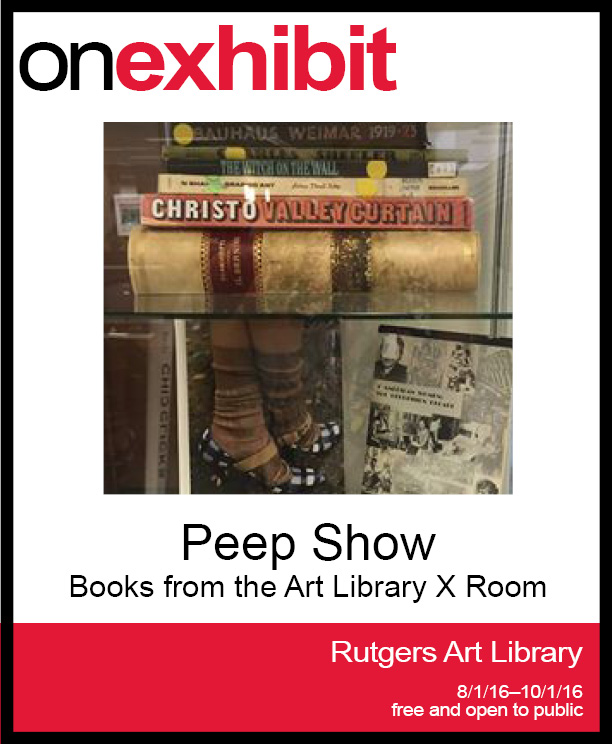
“Peep Show: Books from the Art Library X Room” Exhibit at Rutgers Art Library
Megan Lotts has raided the X Room to put on a case display of beautiful, surprising, amusing, and impressive books.
Stop by to get a taste of the treasures that reside in the Rutgers Art Library’s archives.
Latino Americans: 500 Years of History was made possible through a grant from the National Endowment for the Humanities and the American Library Association.
Rutgers University Libraries recently concluded the ALA-funded program Latino Americans: 500 Years of History. Over the course of a year, Rutgers and other scholars led 17 PBS film screening discussions about the experience of Latinos in New Jersey in collaboration with Rutgers University Libraries, the Nilsa L. Cruz-Perez Branch of the Camden County Library, New Brunswick Free Public Library, and the Newark Public Library.
Beyond the film showings in Spanish and English, project partners offered exhibits, book talks, lectures, and special celebrations. Highlights include A Day of the Dead Celebration and Cinco de Mayo festivities in New Brunswick showcasing a variety of performances and children’s activities; a Cuban musical concert by renowned singer Gema Corredera; the exhibit “Beyond Exile: Cubans in New Jersey” at the Newark Public Library, including a keynote address by Lisando Pérez; and two separate exhibitions at the Rutgers Art Library, Ilya Genin’s “Photographs of Cuban Revolution 50 Years Later,” and “From Island to Ocean: Caribbean and Pacific Dialogues by Fidalis Buehler and Juana Valdes.”
As project director Nancy Kranich notes in the final report on this initiative, this program allowed Rutgers University Libraries to become “a catalyst for bringing together scholars and organizations involved with the New Jersey Latino American experience and encouraging more attention to documenting it. The grant enabled us to take a more assertive role in building and strengthening relationships with local Latino communities and the scholars, organizations, and public libraries that interact with them.”
Kranich also lists several other outcomes that may be of interest to our colleagues:
Several new items were added to Special Collections, including several leaflets of unpublished poetry by Newark poet Pablo Le Riverend, clippings of anti-Castro activities in Hudson County, Sarah Hirschman’s papers covering People & Stories/Gente y Cuentos.
The publisher and owner of Impacto, published in the 1960s, donated 99 issues of the publication to Rutgers University.
15 Latino clubs are Rutgers are planning to learn how to organize and preserve their own records in conjunction with Rutgers University Libraries’ archivists.
Two possible books are in discussion: a history of Latinos in NJ and an anthology of unpublished documents about Latino migrant workers in NJ and the United States.
The New Brunswick Free Public Library and Rutgers University Libraries are discussing partnering again on another ALA public programming grant proposal.
A deeper understanding of the Latino collections in the state and increased participation in depositing scholarly works into our Rutgers Inclusion and Diversity Research Portal.
Mary Beth Weber won the ALCTS Slogal Contest for her slogan, “Creating the future, preserving the past.” This slogan will be used during the 60th anniversary celebration of ALCTS in 2017. In addition to bragging rights, Mary Beth also received a prize of registration for CE webinars valued at $350. Congratulations Mary Beth!
“Peep Show: Books from the Art Library X Room” Exhibit at Rutgers Art Library
Megan Lotts has raided the X Room to put on a case display of beautiful, surprising, amusing, and impressive books.
Stop by to get a taste of the treasures that reside in the Rutgers Art Library’s archives.
Location: Rutgers Art Library
It’s Getting Hot in Here
Late in July, America faced record temperatures outside and Smith Library in Newark was no exception. With the A/C out for several days, the librarians and staff had to come up with new ways to keep their cool. Here, a short haiku on the experience:
The books are burning!
Librarians are weeping…
The heat is too much.
– Sarah Jewell
Communications Tip – Using Rutgers Go to Shorten URLs
Want a short, trackable URL to use in an email or social media post? There are many URL shorteners on the market including goo.gl, bitly, and ow.ly, but go.rutgers.edu offers something the others can’t–an actual Rutgers URL to make your link appear official and trustworthy. This service allows Rutgers users to quickly and easily shorten a URL and track how many times that URL is viewed.
While I used the same shortened URL on both Facebook and Twitter, I could have created separate shortened URLs for each social media site to track the relative traffic. I did this for an earlier post about the New Brunswick Music Scene Archive, which allowed me to see the number of views on each platform (162 for Twitter, 7 for Facebook).
I highly recommend you try out go.rutgers.edu if you have not already done so.
–Jessica Pellien
New Brunswick Music Scene Symposium Planned for October 27, 2016
Save the date. Special Collections and University Archives will hold the next New Brunswick Music Scene Archive symposium on October 27, 6 p.m. in the Teleconference Lecture Hall at Alexander Library. Stay tuned for more information, including the participants. In the meantime, here’s a look back at the 2015 symposium, featuring a who’s who of New Jersey music (http://www.libraries.rutgers.edu/news/symposium-local-notables-inaugurate-new-brunswick-music-scene-archive).
Full Text Finder Training
This fall the Rutgers Libraries will be migrating to Full Text Finder, EBSCO’s newest holdings and link management tool designed to replace its A-to-Z and LinkSource services, which are being phased out. A-to-Z is the product that powers the Libraries’ electronic journals search. LinkSource is the product that powers its link resolver service (locally known as “Get it @ R”). Although the basic functionality of these tools has not changed much, we have taken the opportunity to introduce a few custom modifications that we hope will simplify the process of finding full-text articles and improve the overall user experience. If you’d like to learn more about Full Text Finder and the upcoming changes, feel free to attend one of the 30 minute drop-in sessions scheduled in August. Videoconferencing to Dana, Robeson, and Smith is available upon request.
Full Text Finder Information Sessions
August 4 @ 2 p.m. — LSM Conference Room, Library of Science & Medicine
August 8 @ 2 p.m. — Pane Room, Alexander Library
August 11 @ 2 p.m. — Pane Room, Alexander Library
Buttons! Buttons for Everyone!
Custom buttons are now available from the Communications Department.
The buttons we mentioned in the July issue of The Agenda proved a popular giveaway at the New Student Orientations in New Brunswick. This is a relatively low-cost and fun way to run a promotion or to market something at the Libraries. If you are interested in borrowing our machine for a project, please make sure to purchase the supplies that are available here. We’re happy to train you or your student workers on how to create buttons.
You’ve Got People, Now What?
August 3, 2016
9 a.m. – 1 p.m.NEW DATE!
This course is ideal for new and experienced managers, supervisors, and administrators who have direct reports and would like to apply their knowledge of personal styles to flexibly manage their staff.
Location: Pane Room, 1st floor, Alexander Library
RSVP: Erica Parin on behalf of the Professional Development Committee
Manager as Leader – Developing Staff
August 30, 2016
9 a.m. – 12 p.m.
This course is ideal for managers, supervisors, and administrators who would like to sharpen their situational leadership skills and discover how flexible and effective they are in a variety of situations with staff.
Location: Pane Room, 1st floor, Alexander Library
RSVP: Erica Parin on behalf of the Professional Development Committee
Image credit: Ingfbruno – Own work, CC BY-SA 3.0, https://commons.wikimedia.org/w/index.php?curid=27955753
The Libraries now have a Central drive (T:\CENTRAL) where shared items of interest to all areas of the Libraries can be stored. The plan is to eventually store shared resources, information, procedures, and manuals in this location. Currently, it contains folders for Assessments, Collection Development and Management, Communications and Marketing, Photos and Media, Procedures and Resources, and Visual Identity, but more folders will be added as needed. Some of the folders are read-only, while others like Photos and Media are available to all for adding materials.
Please take some time to peruse the folders:
Jeanne Boyle recently sent an invitation to view the LibQUAL+ survey results now stored in the Assessments folder.
Under Visual Identity, you will find resources that are useful if you are making flyers, advertisements, or website graphics, such as the colors, fonts, logos, and letterheads that are approved by University Communications and Marketing.
Photos and Media is a one-stop place to find images of our spaces, our events, and faculty & staff.
The communications department has also moved their folders from the ALEX drive to Central location Communications and Marketing.
Procedures and Resources currently holds the recent communications policies for photography and fielding requests to photograph in the Libraries, but will be populated with other materials, procedures, and FAQs in the future.
These changes are partly philosophical–these are resources we all share and shouldn’t be housed on one of the unit server locations–but they are also intended to surface important materials and provide a single authoritative place to look for procedural information and guidance. If you have feedback, suggestions for how to further improve this shared drive, or materials you would like added to this drive, please speak with your unit director or supervisor.
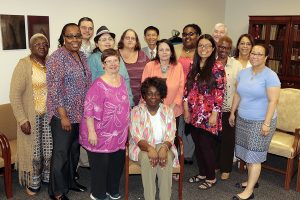
Dana Library colleagues of longtime Circulation Desk supervisor Joyce Watson joined her in celebrating her retirement after 15 years with Rutgers University Libraries, effective June 30. From left: Maggie Harris-Clark, Alex and Doris Arencibia, Natalie Borisovetz (foreground), Andrea Lakios, Ka-Nang Au, Linda Becker, Joyce Watson (foreground, seated), Amber Judkins, Bonnie Fong, Robert Nahory, Dorothy Grauer, Janet Giorgio, and Library Director Consuella Askew. Photograph by Mark Papianni.
The apple will not fall far from the tree after Joyce Watson retires from Dana Library on June 30 after 15 years of service. The longtime circulation desk supervisor expects to continue sharing her knowledge of libraries and information technology as a volunteer with the public libraries in Asbury Park and nearby Neptune, in addition to spending more time with family and church work.
“For me, retirement means continuing to expand my level of knowledge and ability to encourage students’ desires to learn beyond their wildest dreams in libraries,” Watson said recently.
Her first position with Rutgers University Libraries, in 2001, was with the Library of Science and Medicine in Piscataway before transferring to Dana. Passionate about working with students and technology–putting a world of knowledge at patrons’ fingertips–Joyce dug in as an adult learner to earn an MLIS at Rutgers between 2005 and 2009.
Watson, a native of New Smyrna in central Florida, arrived in New Jersey in 1966 and spent nearly a decade and a half doing factory work in the pharmaceutical industry in New Brunswick. Along the way, she earned a journalism degree from Rutgers University. “I liked writing and wanted to tell stories,” she said. “Then I wanted to roam.”
Her cross-country travels with daughter Tynyetta in tow over the next several years began in Florida and made their way to Atlanta, Houston, Denver, and Los Angeles, where she found work at colleges and universities. Her daughter made the trip as far as Los Angeles, where she has a long and successful career as a hair stylist and now resides with her family, including husband Joe, four sons, and two step-children. All combined, Joyce has nine grandchildren upon whom she can lavish her attention.
Combining her backgrounds in storytelling, libraries, and archives, Joyce was the onetime historian for Mount Zion A.M.E Church in New Brunswick and currently is archivist for St. Stephen’s A.M.E. Church in Asbury Park.
She cites former Dana Library director Lynn Mullins and current director Consuella Askew as “gems who encouraged me in all my endeavors.”
Join us as we wish Joyce happiness and further intellectual “endeavors” in her retirement!
Authors: Margaret Rush Dreker, Roberta Bronson Fitzpatrick
Authors: Roberta Bronson Fitzpatrick, Leslin Charles, Ann Watkins, Zara Wilkinson, Megan Lotts
Author: Pamela Hargwood
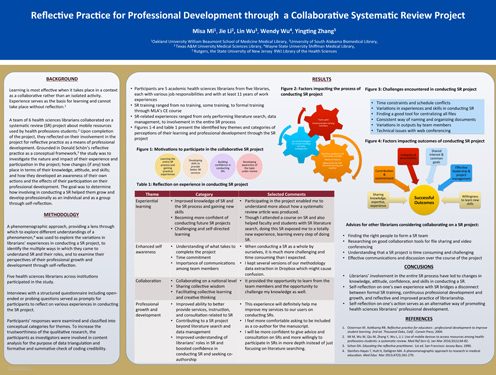
Authors: Misa Mi, Yingting Zhang
Authors: Roberta Bronson Fitzpatrick, Margaret Rush Dreker
Authors: Misa Mi, Jie Li, Lin Wu, Wendy Wu, Yingting Zhang
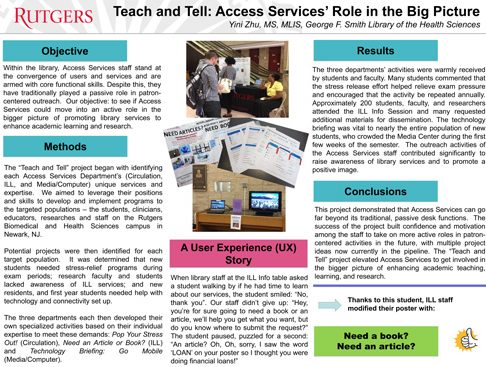
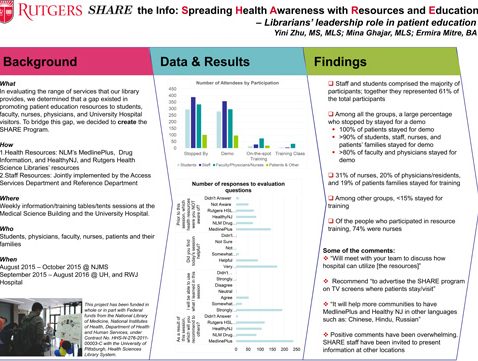
Authors: Yini Zhu, Mina Ghajar, Ermira Mitre
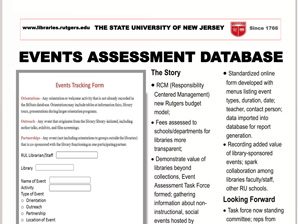
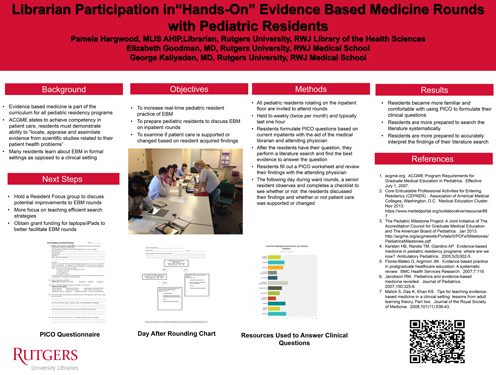
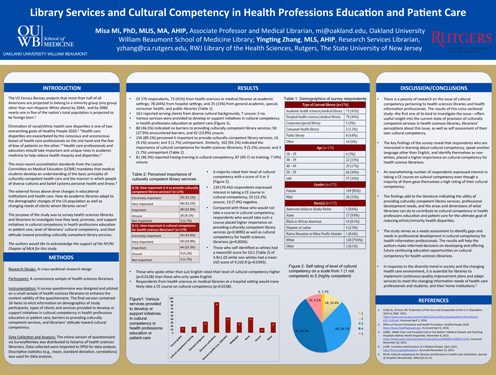
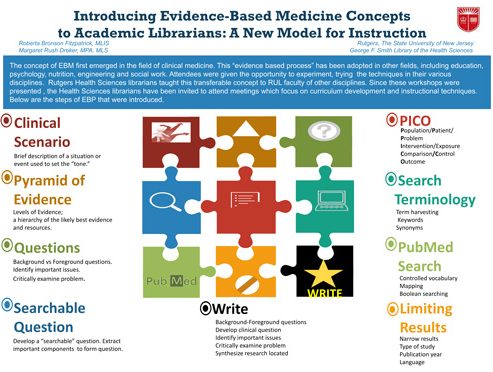
Rutgers University Libraries were well represented at the poster session for the annual meeting of the Medical Library Association (MLA). A total of eight posters were presented by librarians from RWJ and Smith Libraries that capture a range of activities from access services and event assessment to systematic review and participation in medicine rounds. The posters were selected by juries comprised of association members and RBHS bears the distinction of having the most posters from a single library system in the show.
Held from May 13 – 18, 2016, In Toronto, this year the meeting was a collaboration by MLA, the Canadian Health Libraries Association/Association des bibliotheques de la santé du Canada (CHLA/ABSC), and the Clinical Librarians Conference (CLC).
Peruse the posters in the slideshow at the top of this page (click on the images to see PDFs). You can also view the posters & abstracts at the links below, on the meeting app, or in the official online program.
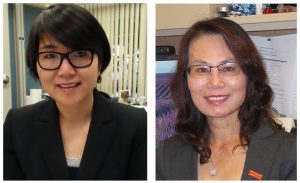
Yingting Zhang from RWJ Library (l) and Yini Zhu from Smith Library (r) were both named to the prestigious Medicine Medical Informatics Fellowship.
Yini Zhu (Smith Library) and Yingting Zhang (RWJ Library) were both named to the National Library of Medicine’s (NLM) Biomedical Informatics Fellow program through a competitive application process. Yini attended a week-long medical informatics workshop held at Augusta University, Augusta, GA, in April 2016. Yingting will attend the same program in fall 2016.
This program introduces participants to the fundamental concepts and application areas of biomedical informatics with components including principles of controlled terminology/vocabulary, standards, mathematical modeling, bioinformatics, natural language processing, and more.
NLM’s program recruits from health sciences educators, librarians, administrators, clinical practitioners, and faculty who can become agents of change in their respective institutions by becoming a “field force” to train other on these concepts.
The benefits of attendance at the fellowship program were immediate. Following her participation in the NLM program, Yini Zhu joined Minglu Wang and Bonnie L. Fong to present a Data Management Plan workshop to a group of Rutgers Newark and RBHS faculty, researchers, and staff on May 3, 2016. Yini covered the fundamentals and best practices of data sharing plans required by the National Institutes of Health (NIH) while Minglu and Bonnie addressed data management plans.
Click here to learn more about the Biomedical Informatics program.