In a year of many firsts, this summer saw RUL’s first Summer SAPAC talk series. After a discussion in the Spring Central Forum, SAPAC co-chairs Janet Croft and Bart Everts decided to send out a call for summer talks. SAPAC talks are a way for library faculty and staff to discuss research, programming, innovations, and more with a friendly audience of colleagues, and Summer SAPAC turnout was high. Bart Everts from the Robeson Library hosted the talks.
6/9: A Modest Proposal: Trusted Pick-Up Points for Interlibrary Loan for Distant Users
Janet Brennan Croft
6/23 An Environmental Scan of Artists’ Book Collections: An Ontology for Visualization
Sonia Yaco
7/22 Digital Badging
Grace Agnew, Mei Ling Lo, Ryan Womack
8/11 The Library Freedom Institute: Becoming a Privacy Advocate
Katie Anderson
8/14 Closing the Transactional Distance in an Online Graduate Course through the Practice of Embedded Librarianship
Leslin H. Charles
8/18 “Agitation of the Question”: James McCune Smith’s Nomination for Fellowship to the New York Academy of Medicine, 1847
Robert Vietrogoski
8/25 From Digital to Computational: The Current and Near-Future State of Technology and Data Storage and How We Manage our Virtual Lives
Isaiah Beard
Returning to Rutgers Safely: Wear Your Mask, Watch Your Distance & Wash Your Hands
Information Sessions on COVID-19 Health and Safety Precautions were held earlier this month hosted in partnership with Rutgers Environmental Health and Safety (REHS). Subject experts and instructors Peter Skeels, REHS, Manager of Health and Safety Services and Christine D’Angelo, MPH, Health and Safety Specialist II, spoke about safety precautions intended to mitigate the risks of the spread of COVID-19 as staff, faculty, and certain students begin to return to work on campus and offered knowledgeable tips.
The sessions were intended for employees returning to buildings onsite. Attendees had the opportunity to choose among various sessions and ask questions. All staff and faculty are expected to follow university policies and guidelines in order to sustain a healthy campus. It is important that we all diligently adhere to these health precautions. If you have any questions or need more information, please contact REHS at 848-445-2550.
As a reminder, the state is requiring additional compliance training regardless of any previous medical, health, or professional training you may have taken. The specific module can be accessed through your compliance training page under “Safety Short: Coronaviruses and COVID-19”: https://rutgersu.percipio.com
Additional University-wide COVID-19 Information can be found in the Returning to Rutgers guide and here for health and safety.
Understanding the Manager’s Role Under FFCRA
Earlier this month, essential training on understanding the manager’s role in employee leave options under the Families First Coronavirus Response Act (“FFCRA”) and understanding the manager’s role in Accommodations, was provided in a recorded presentation to supervisors. The session was intended to explain university policy as it relates to leaves of absence to ensure supervisors are giving the correct information and support to employees.
Employees who are expected to return to the workplace and who wish to seek a reasonable accommodation, should contact Office of Employment Equity (for Staff) or Academic Labor Relations (for Faculty).
Supervisors had the opportunity to choose to attend various virtual drop-in sessions and ask questions hosted by Libraries HR.
Employees with specific questions should make appointments by contacting Libraries HR:
Michele Petosa, Coordinator of Human Resources at (848)-932-5949 or email rulhr@rutgers.edu
Erica Parin, Administrative Assistant at (848)-932-5947 or email rulhr@rutgers.edu
Additional information from the NJDOL, DOL, and University Human Resources is below:
A message from Occupational Health on Influenza Vaccinations:
“Occupational Health remains committed to keeping our faculty and staff safe during this global COVID-19 pandemic. We strongly encourage all Rutgers employees to receive a flu shot this year. Those employees who have not returned to campus should receive their vaccine at their local pharmacy which is provided at no cost with most medical insurances. For those currently on campus, we will have 3 curbside outdoor flu clinics at the Hurtado Health Center located in New Brunswick. We will partner again with Walgreens to assist with providing vaccinations at these clinics, so employees should bring their medical insurance cards at the time of the visit. Occupational Health will provide any uninsured employee with the vaccine free of charge. As parking and hours are limited, on campus employees may also consider receiving the vaccine at a local pharmacy. Due to COVID-19 infection control concerns, this year we will not be able to schedule any off site vaccination clinics. All graduate students should contact Student Health for their flu shot.”
The curbside outdoor flu clinics will be located in New Brunswick, at this time no clinics are currently scheduled for Newark or Camden. Additional information will be shared as we learn more, including dates and times—Be on the lookout for announcements from Libraries HR!
Rutgers Occupational Health offices by location:
Rutgers–New Brunswick, Rutgers–Newark, and Rutgers–Camden: 848-932-8254
Rutgers Biomedical and Health Sciences (RBHS) Newark: 973-972-2900
RBHS New Brunswick/Piscataway and University Correctional Health Care: 848-445-0123 ext. 2
Robert Wood Johnson Medical School faculty and staff: 732-235-6559
Stay safe!
Upcoming Reminders from Libraries HR
As you prepare to embrace the Fall semester, reminders for employees can be found below as a new academic year is upon us!
Rutgers Employee First Initiative—University Human Resources is pleased to announce the Rutgers Employees First initiative. This initiative is intended to provide employees with tools and resources to support and promote employee wellness and build communities of interest around topics relevant to your needs and interests. To explore resources, please visit
Online Harassment Prevention Annual Training—All employees should receive an email from “Skillsoft”, a third party vendor, requesting you to complete online training regarding mandatory Harassment Prevention Education. The university uses a third party vendor, “Skillsoft”, as a provider of cloud-based learning and online training for it’s annual harassment prevention education. Employees must complete this annual mandatory training no later than November 6, 2020. If you have not yet received your personalized training link, employees may complete the training by logging in with their NetID This training is done on annual basis and is mandatory.
COVID-19 Compliance Training: The state is requiring mandatory compliance training regardless of any previous medical, health, or professional training you may have taken. Employees must complete this mandatory training by logging in with their NetID here. The specific module can be accessed through your compliance training page under “Safety Short: Coronaviruses and COVID-19”: https://rutgersu.percipio.com
Ethics Armor system-Outside Activity Questionnaire (OAQ)–As a reminder, all University faculty and staff members must complete an Outside Activity Questionnaire (OAQ) in the Ethics Armor system in accordance with University Policy.
Rutgers University employees (including legacy UMDNJ employees) should update their emergency contact information, home address, phone number(s), and or legal name changes with the Human Resources & Payroll system in your myRutgers Portal as follows:
Voluntary Self ID – Ethnicity/Race–We encourage you to take a moment to update your Race/Ethnicity demographic information. Although this two-item questionnaire is voluntary, we hope that you choose to complete it. The data from this survey helps us to build a modern and diverse workforce. Having the ability to benchmark our success in our hiring practices aids us in many ways. It helps us plan for our future state, as well as ensures federal and state affirmative action requirements are being met.
Please visit the myRutgers Portal at https://my.rutgers.edu/. Upon login, go to the Employee Self Service tab and click on Ethnic Groups under Personal Information to complete this short questionnaire.
Any questions or concerns, please contact Libraries HR.
Diane Biunno is metadata archivist for the Institute of Jazz Studies.
Diane Biunno joined the Libraries as metadata archivist for the Institute of Jazz Studies back in February. Here, we catch up with her to learn more about her experience and what she has been working on since the shift to online-only service.
Tell us a bit about your background prior to coming to Rutgers.
Prior to joining the team at the Institute of Jazz Studies in February 2020, I served as a project archivist at the Historical Society of Pennsylvania (HSP) in Philadelphia. At HSP I worked on several projects including the Hidden Collections Initiative which was a grant funded project to improve the accessibility and discoverability of archival collections housed at Philadelphia-area small repositories. As part of the initiative, I helped staff and volunteers at local historical societies, ethnic organizations, and religious institutions better arrange, describe, and care for their collections. I enjoyed working on this project because it gave me an opportunity to get to know members of the local archival community and their amazing collections.
Before coming to Rutgers, I also worked on several innovative digital projects that were focused on improving the discoverability of archival and special collections materials. For example, I served as a digital project assistant at Penn Libraries for the Bibliotheca Philadelphiensis project, an initiative to digitize and make freely available all the known medieval manuscripts in the Philadelphia region. In addition, I was a digital project associate for the Historical Images, New Technologies Project, which explored how to better describe archival visual materials using TEI (Text Encoding Initiative) markup. Through working on these projects, I learned a great deal about metadata standards and formats, as well as, digital preservation and digital project management best practices.
I received my B.A and Ph.D. in Italian from Rutgers University and my Master’s in Library & Information Science from Drexel University in Philadelphia, Pennsylvania.
What have you been working on during the quarantine?
I’ve been working with my colleagues at IJS to copyedit and publish the approximately 200 finding aids that the IJS created last year. A finding aid is document that describes an archival collection and helps guide researchers in using the collection. The IJS finding aids will be published online and made accessible to the general public and researchers, with the goal of helping our patrons better understand our collections and how our materials can meet their research needs.
What does the process look like?
Before beginning the process of copyediting the finding aids, we quickly realized that we needed a style guide to ensure that all finding aids would be edited according to the same capitalization, punctuation, and grammatical guidelines. Unfortunately, there isn’t a standard style guide for archivists, so we decided to create our own and base it on the Chicago Manual of Style, a style guide widely used in academic publishing.
Next, we created project workflows, as well as spreadsheets for keeping track of the project’s progress. We made sure to keep the project style guide, spreadsheets, and other documentation in a shared folder that was easily accessible to everyone working on the project. Most importantly, used software tools that allow us to easily track changes to documents and to view the edits of our coworkers in real time.
How far along are you and what are the next steps?
At this point, we are halfway through the project and have published approximately 110 finding aids. We’re moving at a steady pace and hope to wrap up the project in a few weeks.
While working on the project, I began thinking about how the IJS might use Wikipedia to help guide researchers and the general public to our collections. Because patrons use Wikipedia as a starting point to find general information on a topic, as well as, additional resources, I’ve begun adding links to the institute’s finding aids in the “External Link” section located at the bottom of Wikipedia entries. For example, at the bottom of the Benny Goodman Wikipedia entry, I’ve added a link to the IJS finding aid for the D. Russell Connor collection of Benny Goodman audio recordings. Moving forward, I hope to add additional links to our collections and explore other ways to make our finding aids and collections more broadly accessible to the public.
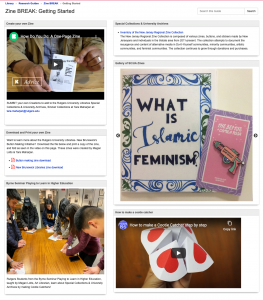
In lieu of physical events this finals season, New Brunswick Libraries have developed a virtual stressbusters LibGuide. Visit it to check out their virtual escape rooms, puzzles, tours, crafting activities and much more! Kudos to Rose Barbalace for her work organizing this resource for our students during what is surely an extra stressful time.
NBMSA Takes the Scene Online
On their Facebook page, the New Brunswick Music Scene Archive will be featuring a series that invites donors and other supporters to share what music they’re listening to and/or performing during this time, what their favorite NBMSA item is, and if they wish, share a related photo. This is a way for us to stay connected with our community while SC/UA is closed and we can’t accept physical donations. Kicking off the series this week will be former SC/UA public history intern Rachel Ferrante, who as part of her internship helped maintain the NBMSA social media presence and solicited donations via her work at 90.3 The Core and involvement in the New Brunswick basement scene. She also designed the NBMSA Facebook page logo!
Congrats Ying!
Congratulations are in order for Yingting Zhang, who has been asked to serve on the Medical Library Association’s 2022 National Program Committee. Her three-year term begins June 1.
Introducing New Jersey’s Historical Newspapers
A round of applause to Jacob Paul for his work editing the New Jersey Digital Newspaper Project’s latest promotional video. Way to go, Jacob!
The planned exhibit was converted to a digital exhibit, which will be mounted on the course website.
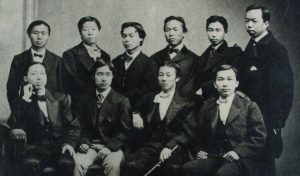
In 1867, Kusakabe Tarō (1844-1870), a samurai from Fukui in the remote west of the country, left Japan to study at Rutgers. After his untimely death in 1870, his mentor and friend, William E. Griffis (1843-1928) of the Rutgers Class of 1869, was invited to teach Western-style education in rapidly modernizing Japan. Griffis would spend his life writing and speaking about Japan and collecting books and archival material. His collection came to Rutgers Special Collections and University Archives (SC/UA) after his death. This spring, Haruko Wakabayashi of the Department of Asian Languages and Cultures, is teaching “Rutgers Meets Japan: Revisiting Early U.S.-Japan Encounters,” an interdisciplinary honors seminar based on the Griffis Collection. This seminar examines this crucial moment of early U.S.-Japan relationship and cultural exchange as we commemorate the 150th year since William E. Griffis left for Japan. As curator of the William Elliot Griffis Collection at SC/UA, I am supporting the class through helping them access books, documents, and images from the collection. Assignments are based on primary sources and prints from the Griffis Collection and the Zimmerli Art Museum, which are posted on the course website. For the final project, students planned to curate an exhibition at the Alexander Library using materials from the Griffis Collection. The culmination of the course was meant to be a two-week field trip, “The Japan that Griffis Saw,” where the students along with Professor Wakabayashi and myself would visit in Fukui, Yokohama, and Tokyo.
On March 10, the class visited SC/UA to use maps and city directories to try to envision what New Brunswick was like at the time Griffis and Kusakabe were students. When we learned the next day that all Rutgers courses were going online after spring break, we had to adapt quickly. The planned exhibit was converted to a digital exhibit, which will be mounted on the course website (https://sites.rutgers.edu/rutgers-meets-japan). The trip to Japan was postponed until January.
Access to the Griffis Collection was an even more difficult problem. In 2000, the Griffis Collection was microfilmed through an agreement with Adam Matthew, a company in the U.K. In 2017, Rutgers contracted with Adam Matthew to digitize this material, with a stipulation that Rutgers would get free access. When it became apparent that we would have no physical access to the Libraries for the rest of the semester, I followed up with Adam Matthew Digital regarding the status of the project. Thanks to Jeff Carroll, Elizabeth York, and their teams, the digital version of the Griffis Collection is now available through the database Area Studies: Japan, enabling students to access digitized primary source documents from the collection. Class discussion now takes place on the Canvas site. According to student Raj Malhotra, SAS ’22, “The transition to this digital classroom environment has come with its expected difficulties, but has shown us how to stay connected through the vast digital libraries and resources available for class meetings and teachings.” All are looking forward to the trip, which we hope will still take place.
I would like to share my experience during these difficult days of our quarantine to fight against COVID-19.
While all of us are working from home, the medical staff are on the front line fighting the virus while lacking the PPEs. This became a great concern in my family, when my daughter called me three weeks ago, and asked if I could make some masks and head covers for her husband, who is a doctor, and also her doctor friends who are taking care of COVID-19 patients.
She did some research how to make safe cloth masks for medical staff to place over the N95 masks to make them last longer. Pretty quickly, we figured out how to make them out of cotton fabric and flannel while using different filters. I used any item possible at home: T-shirts, cotton sheets, cotton tablecloths, bags, baby wipes, laundry softeners, vacuum cleaner filters. I also made head covers out of shower curtains while sending her all transparent plastic available at home so she could use it to make face shields, helped by her friend who made parts of them by 3D printing. She was able to make 30 face shields.
My daughter and I also started a campaign on social media, asking people to make masks and sharing the instructions, suggesting they donate them to the community. The social media network in New York, Connecticut, and New Jersey was able to make 350 masks and donated them to hospitals and friends. My daughter, who is also a doctor, for about a month never stopped raising awareness on social media that everyone needs to wear a mask when we go out.
I shared my experience with the Smith Library access services staff and shared guidelines about how to make masks. I will continue to make cloth masks and head covers until the pandemic is over. Doing something good for the community helps me release the stress and be happy that I can do my little part to fight the pandemic.
How to Sew a Medical Face Mask
Materials
2 pieces of 100% cotton fabric that measure about 7 inches by 9 inches—cotton T-shirts, dish towels and pillowcases are good options (make sure all fabric is washed and dry)
2 pieces of cotton fabric that measure about 1.5 inches by 40 inches for the mask’s strap (in a pinch, you can use something like shoelaces, elastic 6 inch long or ribbon)
A ruler, sewing pins, a pair of scissors, thread, an iron and a sewing machine.
Step 1: Sew the two main rectangle pieces together with the “right” sides of the fabric—the side you want to see—facing each other. Sew almost all the way around the rectangles, leaving a small gap (a few inches) open on the long side.
Step 2: Turn the rectangle right-side-out by reaching into the gap you left open and pulling the fabric through. Now your edges are on the inside and you have a neatly sewn two-sided rectangle. At the gap you left open, just tuck the edges inside for now; you’ll sew it closed later.
Step 3: Make three evenly spaced pleats along both 7-inch sides of the fabric, making sure to keep all of your tucks facing in the same direction, and pin in place. One way to do this is by marking the spacing with pins: place one about 1.5 inches down the short side of the fabric; add the next 1 inch down from that, then the third ½ inch down from that, and keep alternating between 1 and ½ inches until you’ve used all six pins. To create the pleats, just bring the first pin down to meet the second, the third to meet the fourth, and the fifth to meet the sixth. Repeat on the other side.
Step 4: Once the pleats are pinned, stitch all the way around the perimeter of the rectangle. This will sew the pleats into place and also close the gap you had left open in Step 1.
Step 5: If you’re using a strip of fabric for your strap, fold and iron it in half lengthwise and then fold and iron the raw edges in. Find the centers of your straps and the centers of the long sides of your mask, and match them. Pin the straps in place along the long edges of the mask, so there is a strap on the top of the mask and one on the bottom, with equally long pieces coming out to the sides. If you’re using a strip of fabric, pin it so it’s wrapped around the edge of the rectangle.
Step 6: Sew the strap to the mask by stitching all the way down each strap, catching the edges of the mask as you pass. (If you are using a strap that did not require folding, you can opt instead to stitch around the perimeter of the rectangle one more time.)
Since March 17, a few residents in Warren, Watchung, Green Brook, and Long Hills and I have organized a donation campaign and raised a total of $31,214.60 from the local Chinese American community to donate PPEs to Robert Wood Johnson Hospital and St. Peter’s Hospital in New Brunswick, Overlook Hospital in Summit, Somerset Medical Group in Somerset, and Morristown Medical Center in Morristown, as well as local EMT, police, and fire fighter units.
I have worked many nights trying to allocate PPE resources in the United States. I used my online search skills and technical background to perform the due diligence process and verified all PPE sources for quality and safety based on ASTM standards and CDC/FDA guidelines. Up to April 6, the following PPEs have been purchased and sent to the above organizations:
1,200 N95 masks
1,400 KN95 masks
8,800 surgical masks
1,014 DuPont protection gowns
472 3M safety googles
6,400 gloves
20 big boxes of wipes
8 big bottles of hand sanitizer
A few news media including the New York Times, Echoes-Sentinel, Bitpush News, and other local community newspapers have interviewed me and published articles about the effort.
Editor’s note: Kudos to Connie on this amazing and inspiring work!!
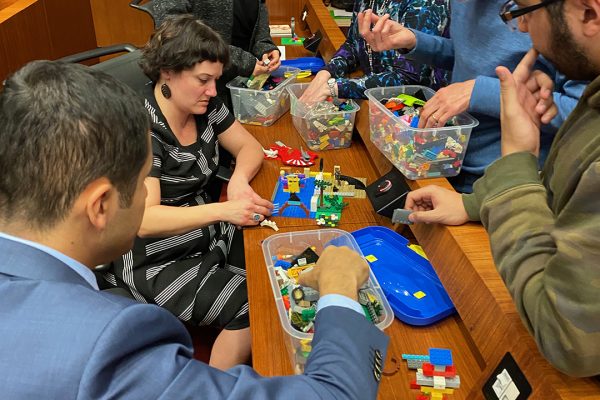
Megan Lotts (r.) and her Carnegie Mellon collaborators.
The LEGO workshop at Carnegie Mellon-Qatar.
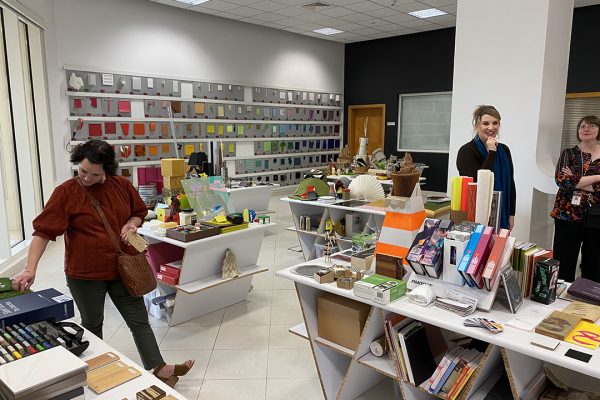
The Materials Library at Virginia Commonwealth University-Qatar.
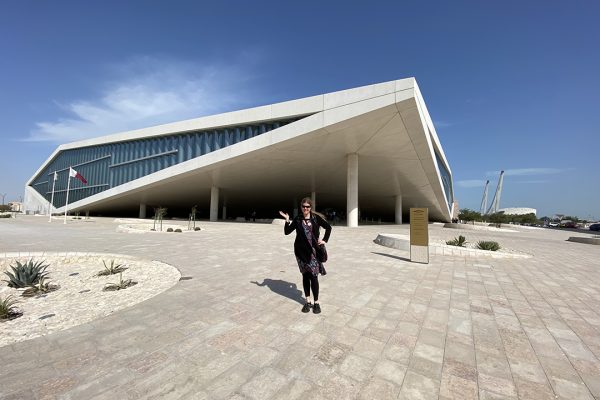
Megan Lotts at the Qatar National Library.
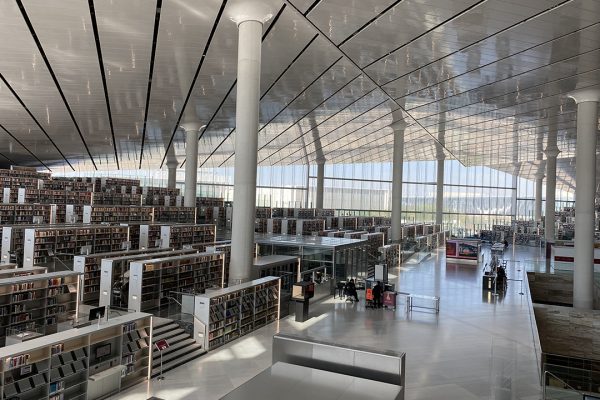
The Qatar National Library designed by Rem Koolhaus.
“The Pearl” in Doha, Qatar.
On February 1, 2020, I boarded a plane with bags full of LEGO as well as Rutgers University Libraries coloring books, zines, and library swag. My final destination was Doha, Qatar to visit one of Carnegie Mellon’s satellite campuses. I was invited to Doha as the Carnegie Mellon-Qatar (CM-Q) Glorianna St Clair Distinguished Lecture in 21st Century Librarianship and gave a presentation titled “The Engaged Librarian: Fostering a Culture of Creativity and Play in Libraries.” This presentation was based off my previous work on makerspaces, active learning, and play in libraries, as well as new research from my latest book project on creativity for the American Libraries Association, forthcoming in 2021.
While in Doha, I had the opportunity to collaborate on a zine and LEGO workshop for the CM-Q campus with Jill Chisnell, Dom Jebbia (both from Carnegie Mellon-Pittsburgh), and director of the CM-Q Library Teresa MacGregor. These events were attended by students, faculty, and staff members of the CM-Q campus as well as a few members from the Georgetown University-Qatar community.
Another exciting part of my trip was the opportunity to present my research on LEGO and active learning at the Qatar National Library (QNL). This library, recently built by architect Rem Koolhaus, is jaw dropping. Having a soft spot for Koolhaus since reading his well-known text Delirious New York, I immediately fell in love with this elegant sculpture which houses unusual furniture, futuristic technology, and an elevator known as the “people mover,” which is similar to a ride one might find at Disney World in the 1980s. Beyond the stunning architecture was a variety of unique spaces and resources that cater to the needs of the local Qatar communities, including a large children’s space, a music room, makerspaces, a beautiful café, an impressive auditorium, and more.
Although there were many interesting cultural experiences while visiting Qatar, including buying goods at the Souq, the Materials Library at Virginia Commonwealth University-Qatar, and trying beef bacon, I was awestruck by the architecture including the QNL (Rem Koolhaus) and the Museum of Islamic Art, designed by world-renowned architect IM Pei. But perhaps most interesting was the architecture of “the Pearl,” an artificial island built on one of Qatar’s former major pearl diving sites. It’s not surprising that this stunning, futuristic, almost unreal structure houses some of the most modern neighborhoods in town. Fortunately, I was able to experience this space in person at a monthly community-building party hosted by Mike Trick, dean of CM-Q.
Founded in 1992, the New Jersey Studies Academic Alliance (NJSAA) is a 501c3 educational organization promoting research and teaching in the multidisciplinary field of New Jersey studies. The NJSAA’s approximately 100 members include teachers (primary school through college), historians, geographers, museum and historical organization personnel, archivists, and librarians. Membership is open to anyone interested in the study of New Jersey, and membership dues are $5 annually. (Yes, $5.)
The NJSAA regularly meets four times a year in Alexander Library’s Pane Room to hold business meetings, present awards, and hear presentations in New Jersey studies. Meetings are open to all.
Among its central activities, the NJSAA recognizes notable work in New Jersey studies by presenting awards in the following categories:
Starting on September 1, 2018, three Rutgers University special collections librarians will be assuming leadership roles in NJSAA for three-year terms. The incoming chair is Bob Vietrogoski, the special collections librarian for the history of medicine at George F. Smith Library in Newark. He currently serves as chair of the NJSAA’s Roger McDonough Librarianship Award. As chair, he is succeeding Maxine Lurie, professor emerita of history at Seton Hall University. Dr. Lurie is a co-founder of NJSAA and has served as chair or co-chair since NJSAA’s founding 26 years ago. She is the author and editor of several award-winning works in New Jersey studies, including New Jersey: A History of the Garden State (2012), and the Encyclopedia of New Jersey (2004).
The incoming secretary is Christie Lutz, New Jersey regional studies librarian and head of public services for Special Collections and University Archives at Alexander Library in New Brunswick. She has been acting secretary for the past year, and is succeeding Marc Mappen, the former executive director of the New Jersey Historical Commission and a historian whose books include There’s More to New Jersey Than the Sopranos (2009) and Prohibition Gangsters: The Rise and Fall of a Bad Generation (2013).
The incoming membership chair is Tara Maharjan, processing archivist for Special Collections and University Archives at Alexander Library. She currently serves as the NJSAA’s webmaster. As membership chair, she is succeeding Karl Niederer, the former director, state archivist, and chief records administrator in the former state Division of Archives and Records Management, and current coordinator of outreach and strategic partnerships at the New Jersey Historic Preservation Office.
The next NJSAA meeting will be held on Tuesday, October 16, 2018 in the Pane Room. The business meeting will begin at 3pm, and at 4:15pm, William Kroth, president of the Sterling Hill Mine Museum in Sussex County, will speak on the “Great Zinc Mines of Sussex County” and will have samples on hand to view.
For more information about the NJSAA, see its website here, along with News of NJSAA’s recent activities and its Calendar of Events. The NJSAA is also on Facebook, and “likes” are strongly encouraged.
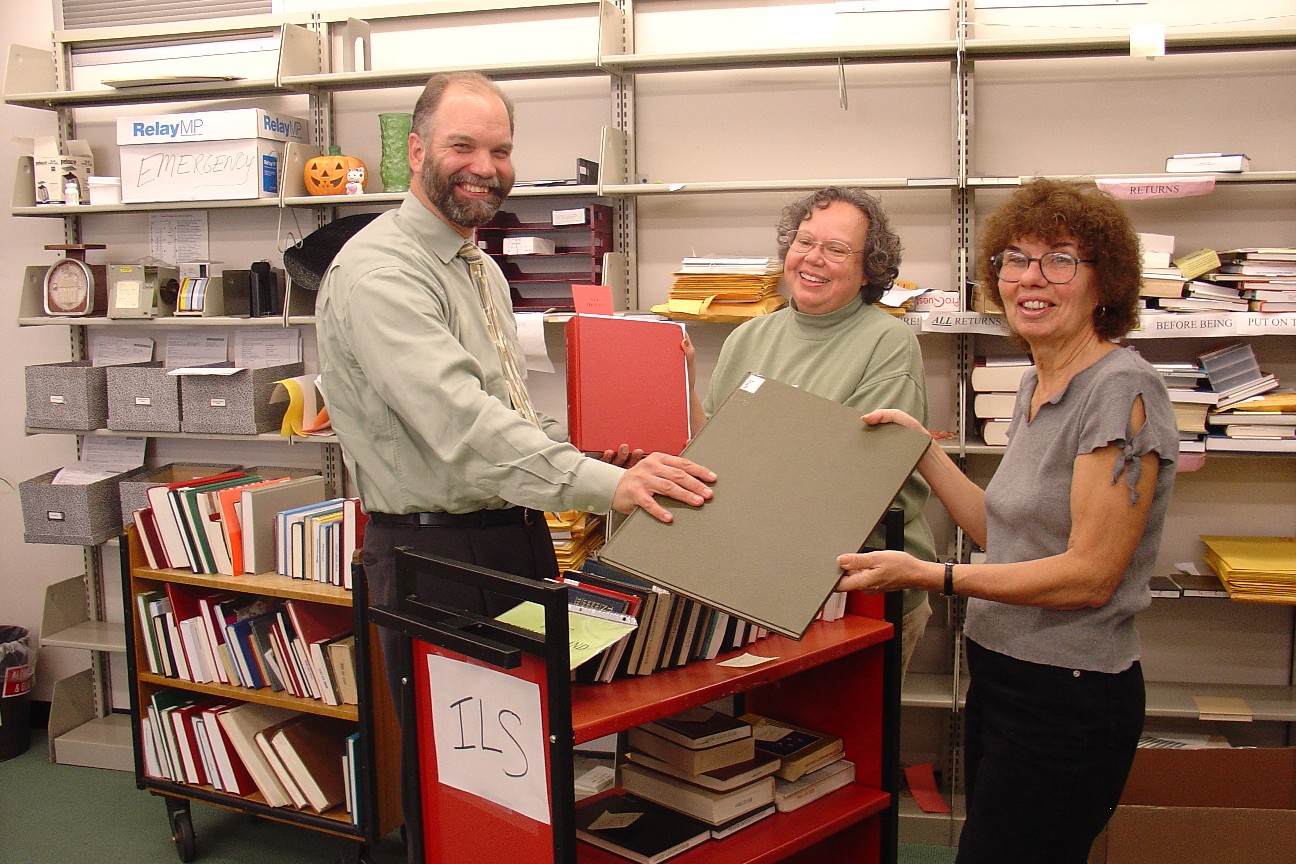
Glenn with ILL staffers Mary Belasco (l.) and Lilly Miller (r.) in 2005.
Glenn Sandberg will retire on August 1, 2018, after 30 years of service to the university. His last day in the office is June 1.
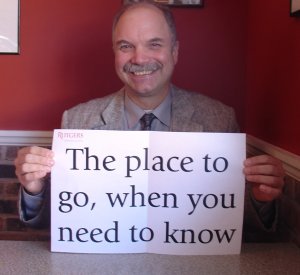
Glenn’s career at the Libraries began in 1988, when he was hired as the supervisor of the Media Department within the Laurie Music Library (now part of the Douglass Library) in New Brunswick. He became the supervisor of Access Services at the Library of Science and Medicine in Piscataway in 1999. Among his many contributions to the Libraries, Glenn has the distinction of having created “The place to go, when you need to know!”—a slogan for the Libraries he developed as a member of the Marketing/PR Team.
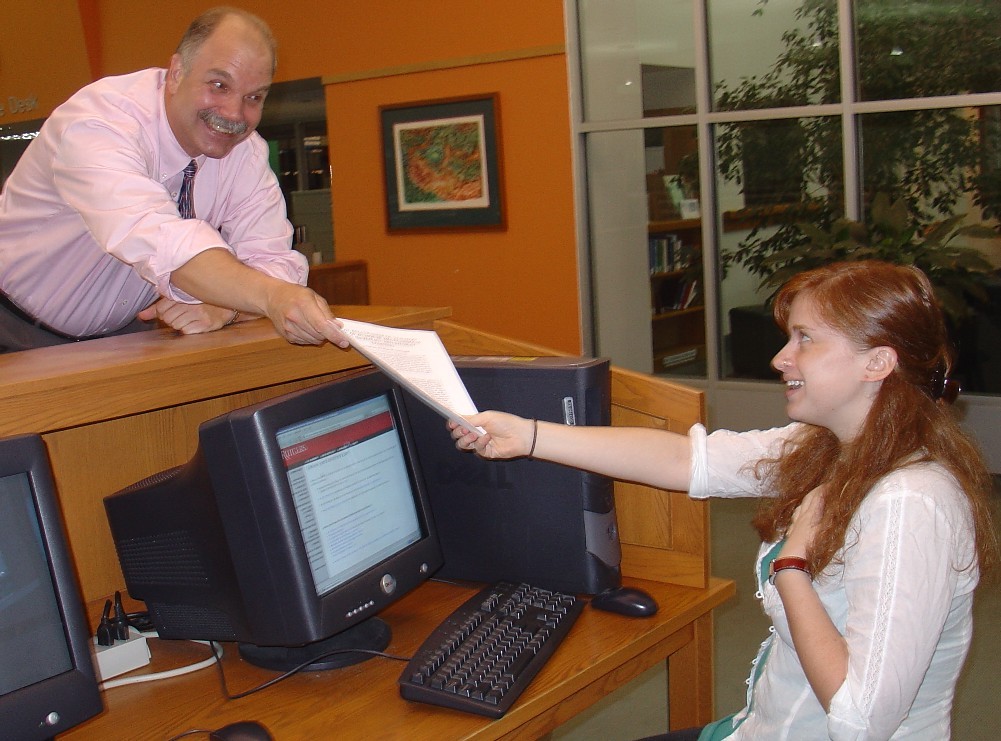
Glenn poses for a promotional photo in 2007.
Since 2004, Glenn has been the supervisor of Interlibrary Loan Services. Beginning his tenure in ILL at about the same time as the start of the E-ZBorrow service, Glenn is proud of the role he has played in bolstering Rutgers’ standing within the E-ZBorrow community. After Rutgers joined the CIC (now BTAA) in 2013, Glenn contributed to the adoption of the UBorrow service. In the last three years, Glenn has helped ensure the successful implementation of several major improvements to ILL services, including removal of copyright fees charged to ILL users, adoption of ReprintsDesk as an alternative article delivery service, and further integration into the Get it @ R service. Glenn also contributed his knowledge of ILL services to the ongoing implementation of Alma and Primo.
Glenn shows off the Libraries slogan he coined in 2008.
Glenn has deep ties with the university. He graduated from Rutgers College in 1980 with a bachelor’s degree in German and music and received his doctoral degree in German from Rutgers University in 1995. He taught in the German Department as an adjunct faculty in New Brunswick from 1994 to 1997 and worked as a manager at the Rutgers University Foundation from 2001 to 2004.
Glenn served in the U.S. Army from 1984 to 1988 and received a certificate in Czech from the Defense Language Institute in 1985. Last, but not least, Glenn is a talented musician—he received a master’s degree in trumpet from the Julliard School in 1983.
Please join us in thanking Glenn for his decades-long service to the Libraries and wishing him all the best in his new adventure!