Category: Articles

  • Kicking off Annual Planning and Budget Process with LibQUAL+ Results

    Kicking off Annual Planning and Budget Process with LibQUAL+ Results

    Welcome to July!

    For me, summer has always been a time to catch up, tidy loose ends, reflect, and prepare for the upcoming academic year. As with so many other things, I am learning that at Rutgers things are different.

    As a cost-center, the summer is a time of planning. Our budgets and plans for the following fiscal year have to be ready by October. That means that our plans for 2018 have to be in place this summer. This month, there will be two Cabinet retreats to begin to establish priorities, look at potential projects, and consider budget requests. There will be many conversations in the coming months.

    As we move into planning, one of the most important issues that we will address is the LibQUAL+ results. I talked about these a bit at the Spring Town Hall, but since these will be at the heart of our planning efforts, it is worth spending more time studying these.

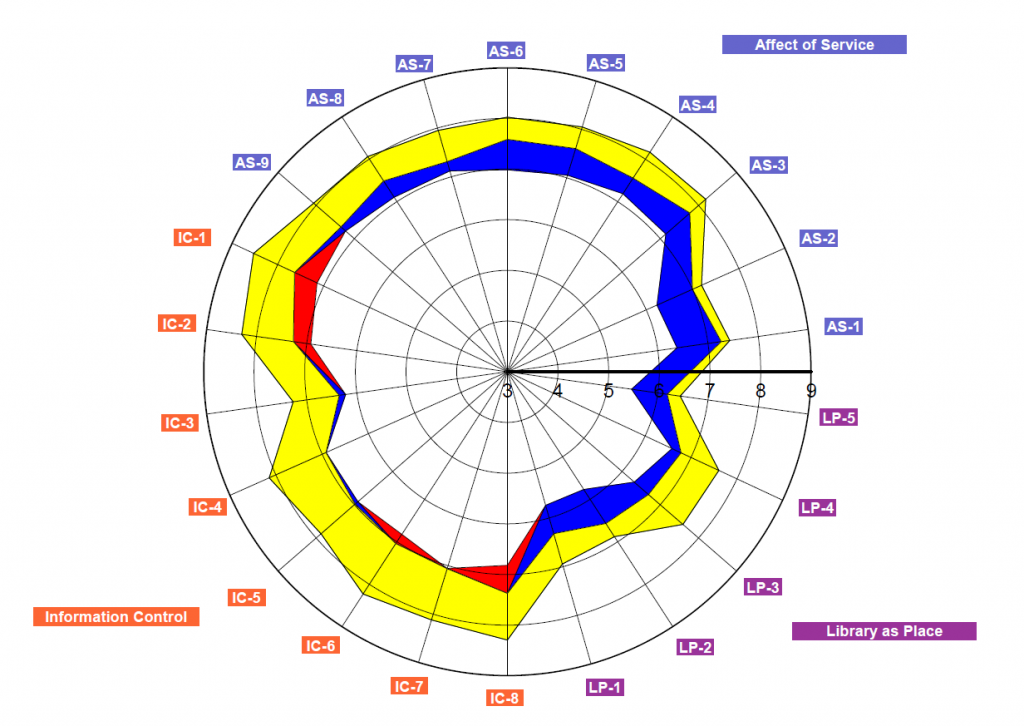
    Overall, our results were good. However, there was a consistent finding, across libraries and universities, that the Information Control dimension did not meet faculty expectations. This graph from the LibQUAL+ results shows the combined results for all 1,200 faculty respondents:
    lib qual survey graph
    This graph is from section 6.2 – Core Questions Summary for Faculty (page 73 of 13501-2 Rutgers University Libraries.pdf available on T:\CENTRAL\Assessments\LibQUAL 2016 Reports).

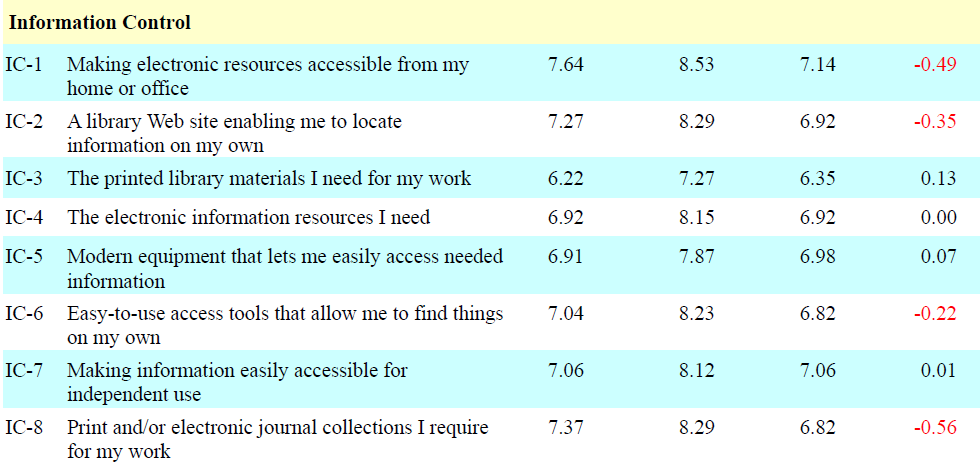
    Here is a table form of the same information:
    lib qual chart
    The first column represents the minimum mean, the second is the desired mean, the third is the perceived mean, and the fourth is the adequacy mean.

    But what does this mean? LibQUAL+ does a good job of showing us where we are doing well and where we might improve. However, LibQUAL+ doesn’t tell us why and understanding why is the first step in solving the problems.

    When we look at IC-1 and IC-8 together, it is not clear if the problem is lack of collections or difficulty finding the collections. How do the website (IC-2) and access tools (IC-6) contribute to the perception that our collections are below expectations? These are not problems that are simply solved by purchasing more collections or by making improvements to the search functions of our website. They require a multi-pronged approach that balance collections needs and ease of discovery.

    This year, using both one-time funding and new funding from the chancellors, we have made some substantial additions to our collections. These additions include:

    • SWANK Digital Campus subscription: 250 feature films selected by instructors
    • UpToDate: an evidence-based clinical resource
    • Sage Journals: Approximately 180 additional Social Sciences, Health Sciences and Science Journals
    • Wiley Journals: Approximately 880 Science, Technology, Medicine, Social Sciences and Humanities Journal
    • EBSCO e-books: 850 e-book titles selected by faculty and students
    • Springer e-books: Approximately 2300 Biomedical/Life Sciences, Engineering, and Medicine
    • American Institute of Physics (AIP) Digital Archive: Digital backfiles of 12 journals and conference proceedings
    • Oxford Journal Archive: Backfiles of about 150 Science and Medicine Journals
    • Wiley Journal: Digital backfiles of about 800 Science, Technology, Medicine, Social Sciences and Humanities Journals

    In addition, we eliminated the fees charged for requesting articles through ILL.

    In the coming year, we need to continue to make smart decisions about new collections and resources and I am confident that the Collection Analysis Group and the Selectors are moving in the right direction. But we must also look more deeply into our access infrastructure, making it easier for faculty to find the information they need. Moving in this direction will take a large amount of coordination, an effort kicked off by the new discovery working group charge.

    The LibQUAL+ results provide us with a tremendous amount of information and highlight opportunities for improvement. I expect that looking deeper at these issues will be a priority in the upcoming year and look forward to seeing what we can accomplish together.
    Save

  • Joyce Watson Retires from Dana Library

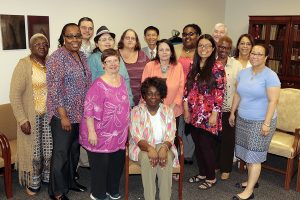
    Dana Library colleagues of longtime Circulation Desk supervisor Joyce Watson joined her in celebrating her retirement after 15 years with Rutgers University Libraries, effective June 30. From left: Maggie Harris-Clark, Alex and Doris Arencibia, Natalie Borisovetz (foreground), Andrea Lakios, Ka-Nang Au, Linda Becker, Joyce Watson (foreground, seated), Amber Judkins, Bonnie Fong, Robert Nahory, Dorothy Grauer, Janet Giorgio, and Library Director Consuella Askew. Photograph by Mark Papianni.
    Dana Library colleagues of longtime Circulation Desk supervisor Joyce Watson joined her in celebrating her retirement after 15 years with Rutgers University Libraries, effective June 30. From left: Maggie Harris-Clark, Alex and Doris Arencibia, Natalie Borisovetz (foreground), Andrea Lakios, Ka-Nang Au, Linda Becker, Joyce Watson (foreground, seated), Amber Judkins, Bonnie Fong, Robert Nahory, Dorothy Grauer, Janet Giorgio, and Library Director Consuella Askew. Photograph by Mark Papianni.

    The apple will not fall far from the tree after Joyce Watson retires from Dana Library on June 30 after 15 years of service. The longtime circulation desk supervisor expects to continue sharing her knowledge of libraries and information technology as a volunteer with the public libraries in Asbury Park and nearby Neptune, in addition to spending more time with family and church work.

    “For me, retirement means continuing to expand my level of knowledge and ability to encourage students’ desires to learn beyond their wildest dreams in libraries,” Watson said recently.

    Her first position with Rutgers University Libraries, in 2001, was with the Library of Science and Medicine in Piscataway before transferring to Dana. Passionate about working with students and technology–putting a world of knowledge at patrons’ fingertips–Joyce dug in as an adult learner to earn an MLIS at Rutgers between 2005 and 2009.

    Watson, a native of New Smyrna in central Florida, arrived in New Jersey in 1966 and spent nearly a decade and a half doing factory work in the pharmaceutical industry in New Brunswick. Along the way, she earned a journalism degree from Rutgers University. “I liked writing and wanted to tell stories,” she said. “Then I wanted to roam.”

    Her cross-country travels with daughter Tynyetta in tow over the next several years began in Florida and made their way to Atlanta, Houston, Denver, and Los Angeles, where she found work at colleges and universities. Her daughter made the trip as far as Los Angeles, where she has a long and successful career as a hair stylist and now resides with her family, including husband Joe, four sons, and two step-children. All combined, Joyce has nine grandchildren upon whom she can lavish her attention.

    Combining her backgrounds in storytelling, libraries, and archives, Joyce was the onetime historian for Mount Zion A.M.E Church in New Brunswick and currently is archivist for St. Stephen’s A.M.E. Church in Asbury Park.

    She cites former Dana Library director Lynn Mullins and current director Consuella Askew as “gems who encouraged me in all my endeavors.”

    Join us as we wish Joyce happiness and further intellectual “endeavors” in her retirement!

  • Middle School Art on Display at Rutgers Art Library

    Middle School Art on Display at Rutgers Art Library

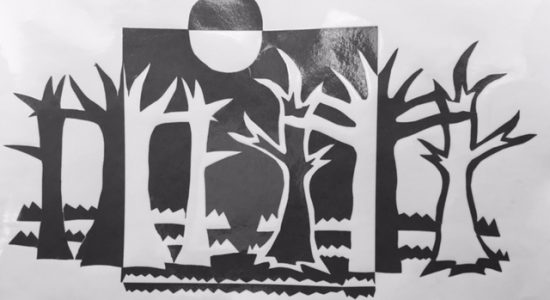
    • “Winter Night” by Carson He (6th Grade Art Cycle, teacher Antonia Germanos)

    This summer, Rutgers Art Library will host a free public exhibit of artwork by the sixth and seventh grade students at Hammarskjold Middle School in East Brunswick, NJ. Art teachers Anna Deacon, Antonia N. Germanos and Lisa Gombas hope the exhibit—on display from June 1 to August 31, 2016—will open students’ eyes to the world of artistic and educational possibilities outside their school classroom.

    Antonia N. Germanos, sixth grade art teacher at Hammarskjold Middle School, describes the motivation behind the exhibit saying, “I hope that placing Hammarskjold Middle Schools students’ work on exhibit at the collegiate level will help our students realize their talent and creativity. I want them to understand that art is part of life and that it can, and should, be taken outside the classroom walls.”

    For Megan Lotts, working with community partners to bring local artists of all ages to her exhibit space serves multiple purposes. “For many of these students, this will be their first and perhaps only art exhibition, but by inviting students and parents to visit Rutgers Art Library, we are giving them insight into what life and research is like at a leading university,” explains Lotts.

    “These very well could be future Rutgers students and many students this age have no idea that art libraries even exist. It can be empowering at a young age to see a space of this nature, as well as have your art work shown in a gallery space.”

    A Mason Gross alumna, Germanos is no stranger to the artistic scene at Rutgers University. She credits strong bonds between the East Brunswick community and Rutgers University with the decision to bring the exhibit to Rutgers Art Library.

    “As a neighboring community, East Brunswick embraces and supports Rutgers University activities and many of our graduates have attended the university,” says Germanos. “Displaying our students work at Rutgers Art Library will hopefully strengthen the bonds between primary, secondary, and collegiate education; honor our students’ hard work and dedication to the fine arts; and create opportunities for students to explore grander aspects of the fine arts.”

    The Hammarskjold Middle School art exhibit will feature a variety of pieces in different mediums, including:

    • Hand cut collages inspired by the Japanese term notan, used to describe the concept of dark versus light. Students embrace contrast through the use of symmetry, asymmetry, color, and shape to create balance. Don’t miss “Winter Night” by Carson He (6th Grade Art Cycle, teacher Antonia Germanos) which draws on associations of winter and white alongside black and night to conjure the feeling of a cold evening.
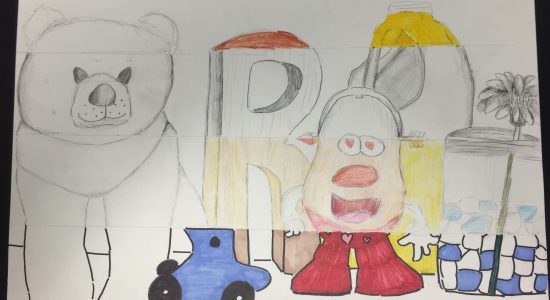
    • Drawings of objects from life, divided into four sections that use different art materials to create layers of color and value. Don’t miss “Deconstructed Still Life” by Amanda Lee (7th Grade Art Elective, teacher Anna Deacon) featuring playroom and household objects in oil pastels, graphite pencil, colored pencil, and Sharpie pens.
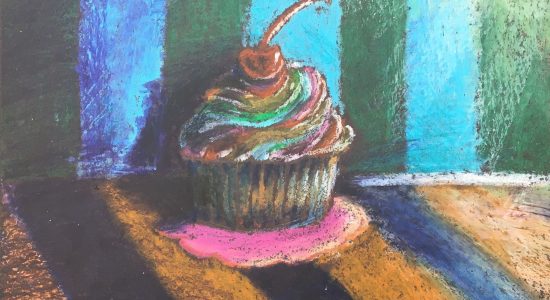
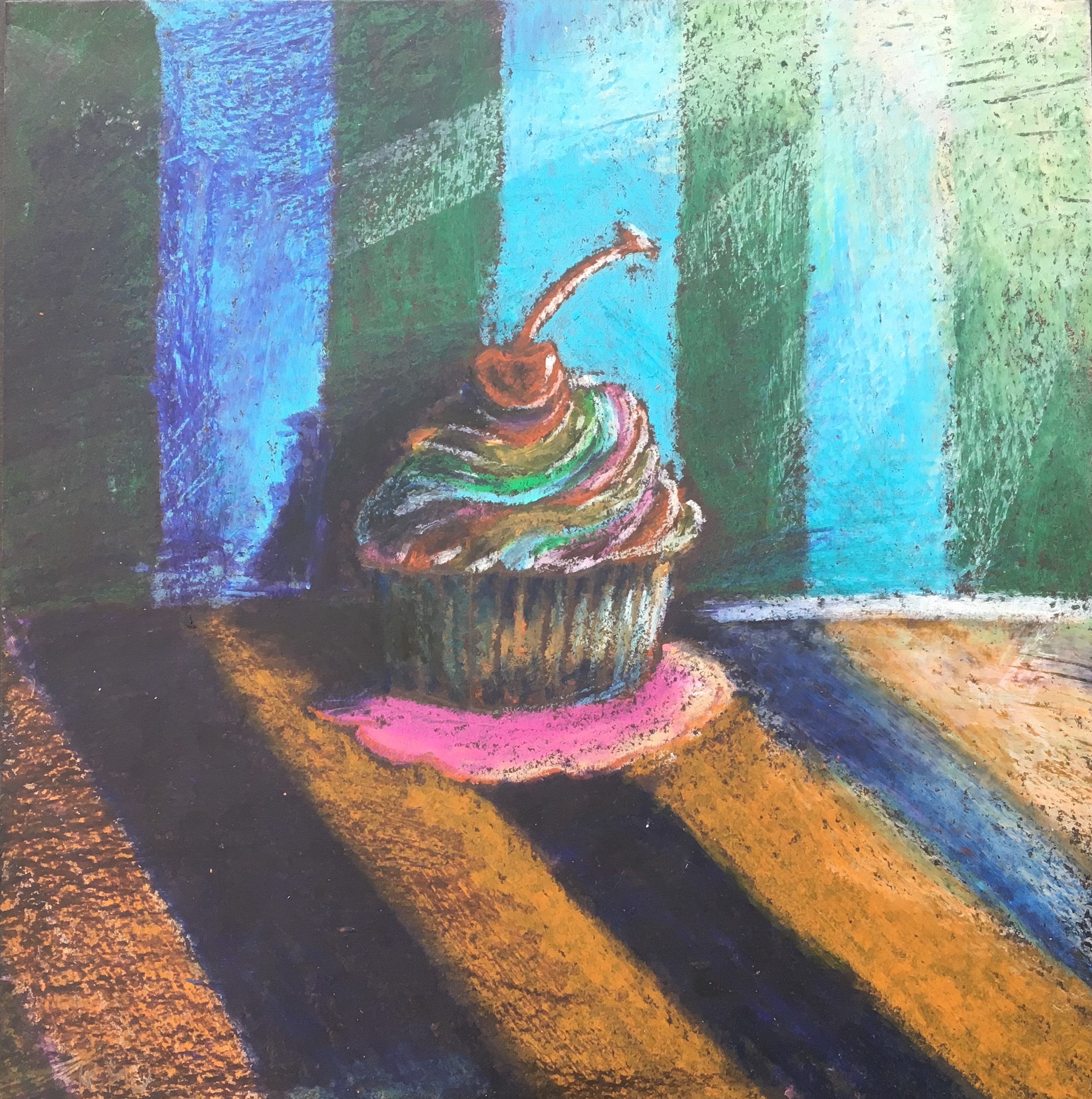
    • A series of Pop Art-inspired oil pastel drawings in which students pay close attention to their chosen light source and the effects of highlights and shadows to pay homage to the confectionery creations of painter Wayne Thiebaud and the bright patterns and thick lines of Andy Warhol and Keith Haring. Don’t miss “Rainbow Cupcake” by Katherine Mu (7th Grade Art Cycle, teacher Lisa Gombas) which depicts a realistic cupcake set off by a dramatic background and lighting.
  • Quick takes on events & news – June 2016

    Top 10 Skills for Professional Success

    June 23. 2016
    9 a.m. – 12 p.m.
    This course is ideal for staff, managers, supervisors, and administrators who recognize the need to improve their overall confidence and competence in critical skills and apply positive strategies for transferring ideas learned to the workplace.

    Location: Pane Room, 1st floor, Alexander Library with teleconference to Smith Library, Dana Library and Robeson Library

    RSVP: Erica Parin on behalf of the Professional Development Committee

    Digital Humanities Lab Open Houses

    June 2. 2016
    10 a.m.June 8. 2016
    12 p.m.
    We’re hosting a couple of DH Lab Open House events in early summer session as a way to acquaint faculty and students with this research space. If you are curious about how to use this space, or what is available there, please feel free to join us. At each event, there’ll be a short presentation followed by an open discussion on digital humanities work and research at Rutgers.

    Location: Digital Humanities Lab, Room 406-407, Alexander Library

    Refreshments will be provided. RSVP with preferred date to Francesca Giannetti.

    Open and Affordable Textbooks at Rutgers

    The Libraries have recently formed a taskforce to plan and implement the President’s Affordable Textbook grant initiative. This taskforce has representation from RBHS, Newark, Camden, and New Brunswick and will be charged, among other things, with creating criteria for judging course redesign grants. We are excited to have the support of the Open Textbook Network in these efforts, as we have recently joined this nation-wide system of partners, with a wealth of experience in promoting access, affordability, and student success through the use of open and affordable textbooks. In the next few months, we will be actively working with all of our colleagues at the Libraries to shape this program and educate students and faculty about the importance (and learning benefits) of open texts. Stay tuned for much more to come, including a website describing the grant process, application guidelines to share with interested faculty, as well as workshops organized by the Open Textbook Network in the fall semester. Please feel free to email the chair of the taskforce, Lily Todorinova, with any thoughts or suggestions. We look forward to working with you!

    -Lily Todorinova

    Dana Library Loans Portable DVD Players

    film-145099_960_720 175As part of the growing TechnologyLending @Dana Library program, four portable DVD players will be available for short-term loan to Rutgers University students, faculty, and staff, beginning May 31, 2016. The players may be borrowed for up to four hours, with the option of one in-person, four-hour renewal, if there is at least one other DVD player available. They may be used in or out of the library, and must be returned exclusively to the Dana Library circulation desk at least 30 minutes before library closing. Students are also asked to report any problems with the DVD players to library staff upon return.For more complete information, please read Portable DVD Player Borrowing: Policy and Procedures, issued on May 25.

    -Tad Hershorn

    Watch “Preserving Your Digital Life” with Krista White and Isaiah Beard

    webinarOur stories as individuals and as members of a community are preserved in each of our homes, in our family histories, and in life stories—not just in libraries, archives, and museums. Today, many of us record and keep these stories in digital formats, often on our smartphones. The ability to easily create audio and video recordings leads to deep and rich documentation of events that may be personally important but may also have regional or national significance. Preserving these narratives for our families and for future generations means considering how we create the files and how we store them. As part of ALA Preservation Week, Krista White and Isaiah Beard presented a Webinar Titled “Preserving Your Digital Life” that touched on these issues, and provided a high-level primer on how best to make sure your digital memories stay in focus for years to come. Watch their presentation on YouTube.

    -Isaiah Beard

  • Rutgers University Libraries at the American Library Association Meeting

    ALA logo

    The American Library Association Meeting will take place later this month in Orlando, Florida. Here are highlights from the program that feature our colleagues:

    Research, Writing, and Publishing Fair

    June 25. 2016
    10:30 a.m. – 11:30 a.m.
    Are you interested in publishing? Would you like to learn about a variety of opportunities to publish, resources to help you get started with writing an article or a book, and tools that will make research and writing for publication better and easier? Please join us for the Research, Writing, and Publishing Fair, where you’ll have the opportunity to meet with ALCTS editors, the Library Research Round Table, learn about publishing mentoring opportunities in ALA, and more. Sponsored by ALCTS Leadership Development Committee. Co-Sponsored by ALA Library Research Round Table (LRRT), ALCTS New Members Interest Group (ANMIG), and ALA New Members Round Table (NMRT).

    Speaker: Mary Beth Weber (Rutgers University Libraries)

    ACRL Arts Publications and Research Committee Annual Discussion Forum

    June 25. 2016
    3:30 p.m. – 4:30 p.m.
    Join ACRL Arts Publications and Research Committee for their Annual Discussion Forum! This year’s forum will feature the following presentations:

    • “Artists as Scholars: The Research Behavior of Dance Faculty” by Shannon Marie Robinson (Drexel University)
    • “Building Bridges, Creating Partnerships and Elevating the Arts: the Rutgers University Art Library Exhibition Spaces” by Megan Lotts (Rutgers University Libraries)
    • “You Say Tomato, I Say Tomato: Collection Format Preference of Music Faculty” by A. Carey Huddlestun (Kennesaw State University)


    If there are additional Rutgers University Libraries highlights I should include here, leave a comment below or let me know.

  • “Spring Sutras” Exhibit at Dana Library

    spring sutras on exhibitSpring Sutras, a work of renewal and hope by installation and book artist Karen Guancione, took shape while she was caring for Mary Guancione, her elderly mother who was suffering from dementia.

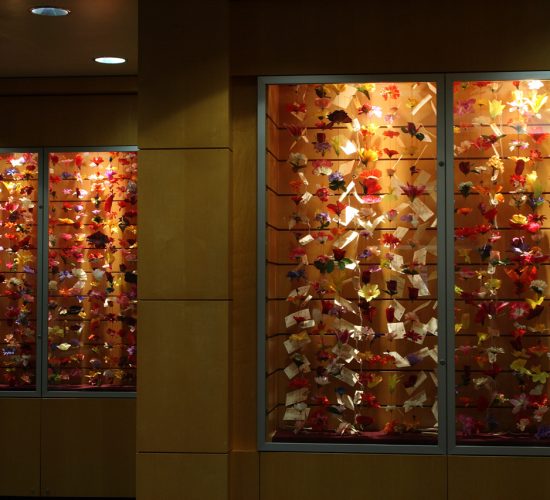
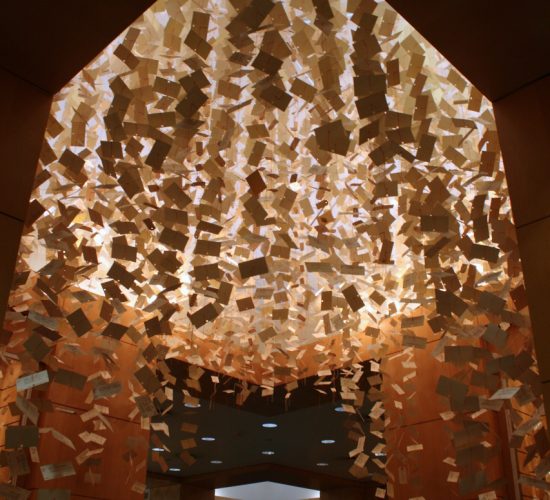
    On display now on the fourth floor of the John Cotton Dana Library at Rutgers University–Newark, Spring Sutras features thousands of recycled catalog cards that cascade in hand-sewn, brilliantly translucent strands from a two-story-high skylight, surrounding and touching viewers as they move through the space.  Hundreds of faux flowers suspended in the accompanying display cases fill the gallery with swaths of vibrant color.

    In stark contrast to the environment in which it was created—what Guancione described as “an endless, exhausting, all-consuming caregiving hell”—Spring Sutras exudes a sense of tranquility and solace. “While caregiving around the clock in the house where my mother had lived for 65 years, I was able to work near her and string together the thousands of pieces of paper—a repetitive, meditative act that enabled me to continue making art,” said Guancione, who was recently awarded a 2016 Individual Artist Fellowship from the New Jersey State Council on the Arts for Works on Paper.

    Funded by a Rutgers–Newark cultural programming grant, the exhibition is one of several projects commemorating the city’s 350th anniversary by drawing inspiration from the nation’s largest and most varied collection of Japanese cherry trees in Newark’s Branch Brook Park. Spring Sutras accompanies a display in the library’s lobby, on loan from the Essex County Parks Department, that details Branch Brook Park’s first planted trees; it is also a fitting prelude to Cherry Blossoms in Winter, a forthcoming multimedia public art project spearheaded by the Rutgers–Newark College of Arts and Sciences that will invite amateur and professional artists from throughout the region to install works in the bare branches of the park’s cherry trees.

    More than just a product of the artist’s personal struggles, the installation also celebrates bringing new life to things we discard or forget. Drawing upon the literal Sanskrit meaning of sutra, or a thread of knowledge sewn over time, Guancione chose to work with hand-typed catalog cards—a tool long since abandoned by libraries as a means of indexing their collections. “In an age of digital information, I have relished holding in hand the many singular pieces of paper that once spoke of a vast and impressive array of accumulated knowledge,” she said. “The strung flower garlands celebrate new life and honor the old and departed.”

    For Michael Joseph, rare book librarian at Rutgers University Libraries, Guancione’s installation celebrates the way in which libraries as institutions are able to constantly reinvent themselves. “Spring Sutras reaches toward a vision of ecstatic renewal,” explained Joseph. “Intriguingly, the catalog cards suspended like leaves or stars have been assembled in roughly alphabetical order, preserving and transforming not only the librarian’s tools of organization, but the original library vision: it, too, changes and becomes part of what is renewed and endures.”

    Spring Sutras runs through the fall. The exhibition is free and open to the public, and an opening reception will be held on Thursday, June 2, from 7-9 p.m. in the Dana Gallery on the fourth floor of the library.

  • RBHS Librarians Present Eight Posters at Medical Library Association

    • Author: Yini Zhu

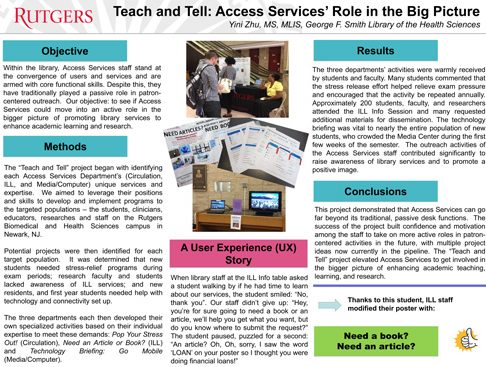
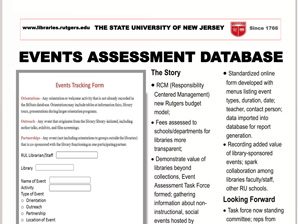
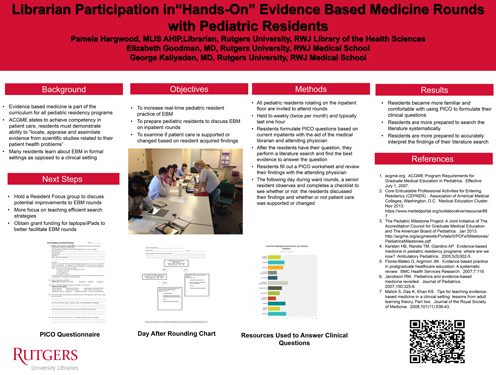
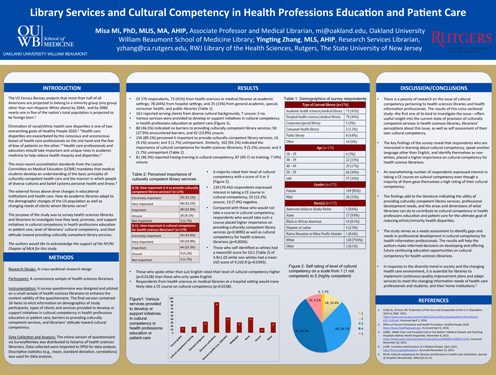
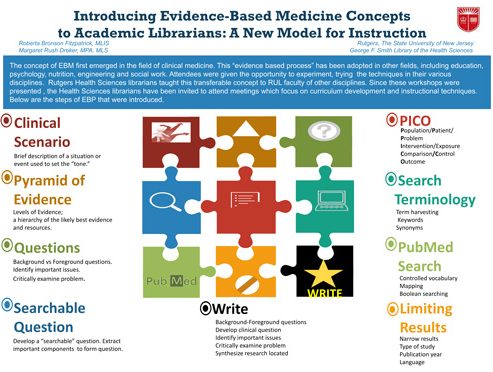
    Rutgers University Libraries were well represented at the poster session for the annual meeting of the Medical Library Association (MLA). A total of eight posters were presented by librarians from RWJ and Smith Libraries that capture a range of activities from access services and event assessment to systematic review and participation in medicine rounds. The posters were selected by juries comprised of association members and RBHS bears the distinction of having the most posters from a single library system in the show.

    Held from May 13 – 18, 2016, In Toronto, this year the meeting was a collaboration by MLA, the Canadian Health Libraries Association/Association des bibliotheques de la santé du Canada (CHLA/ABSC), and the Clinical Librarians Conference (CLC).

    Peruse the posters in the slideshow at the top of this page (click on the images to see PDFs). You can also view the posters & abstracts at the links below, on the meeting app, or in the official online program.


    RBHS Posters from MLA

    Title Author(s)
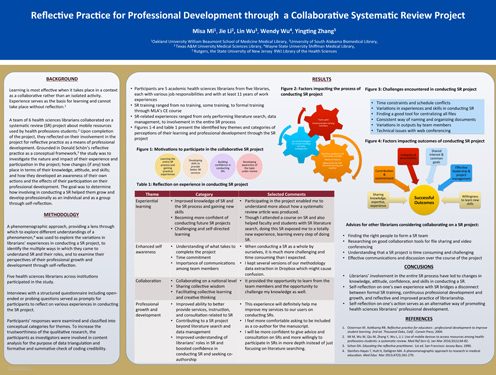
    Reflective Practice for Professional Development through a Collaborative Systematic Review Project Misa Mi, Jie Li, Lin Wu, Wendy Wu, Yingting Zhang
    Librarian Participation in “Hands-On” Evidence-Based Medicine Rounds with Pediatric Residents Pamela Hargwood
    Introducing EBM Concepts to Academic Librarians: A New Model for Instruction Roberta Bronson Fitzpatrick, Margaret Rush Dreker
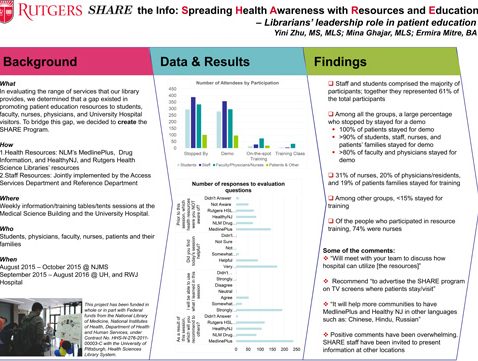
    SHARE the Info: Spreading Health Awareness with Resources and Education: A National Network of Libraries of Medicine-Funded Program Yini Zhu, Mina Ghajar, Ermira Mitre
    Library Services and Cultural Competency in Health Professions Education and Patient Care Misa Mi, Yingting Zhang
    Counting the Colorful: The Events Assessment Task Force Roberta Bronson Fitzpatrick, Leslin Charles, Ann Watkins, Zara Wilkinson, Megan Lotts
    Adding More Tiles to the Mosaic: The Library and EBM in a Time of Curriculum Revision Margaret Rush Dreker, Roberta Bronson Fitzpatrick
    Teach and Tell: Access Services’ Role in the Big Picture Yini Zhu


  • Smith Library Stressbusters: Anatomy Rare Book Show and Tell

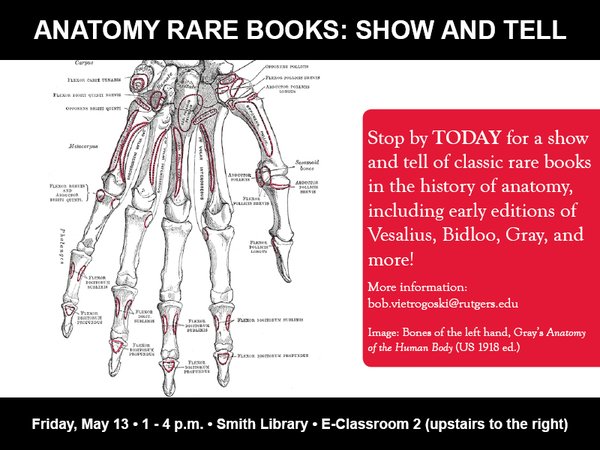
    anatomy inviteIn addition to bubble-popping and “make your own squeeze ball” stressbuster activities, the George F. Smith Library of the Health Sciences hosted its first “Anatomy Rare Book Show and Tell” on Friday, May 13. Over the afternoon, 18 attendees (15 students, 2 librarians, and a regular library visitor) dropped by to see, touch (supervised!), and learn about:

    • Andreas Vesalius, De Humani Corporis Fabrica (2nd edition, 1555 – a gorgeous book with renowned illustrations, with our copy featuring a magnificent 1572 binding)
    • G. Bidloo, Anatomia Humani Corporis (1st edition, 1685 – folio size with awesome and gruesome giant plates)
    • Henry Gray, Anatomy: Descriptive and Surgical (1st British edition, 1858, and 1st American edition, 1859 – fantastic pedagogical illustrations, and thanks to television, probably the best-known textbook title)

    Librarian lessons learned:

    Patron serendipity: A first-year medical student recently visited Special Collections and expressed interest in the rare books. She was concluding gross anatomy studies, and really liked the idea of a show and tell of classic anatomical works. She was happy to post news of the event on the private Facebook page of the first year students.  So if one patron is interested, it’s reasonable to conclude that maybe more than one will be interested!

    Location location location: Instead of using the Special Collections reading room, the books were displayed in E-Classroom 2, a recently renovated room closer to where students congregate on Smith Library’s upper floor.  A sign taped to a chair and an open door worked to draw some second-year students temporarily away from their USMLE Step 1 studies. Prompted by a Vesalian illustration, some even recalled which bone in the human body is the only bone not connected to another.

    If it works, do it again:  Attendees showed interest and stayed longer than originally anticipated. (By the end, my voice was shot.) So I intend to make similar rare book, manuscript, or even historical object show and tell events a regular end of semester activity.


  • Behind the Scenes of the Historic Commencement of 2016

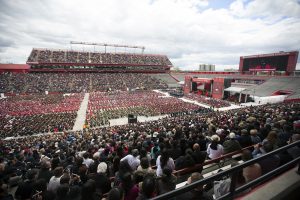
    The view on commencement day. Photo credit: Nick Romanenko, University Photographer, Creative Services
    The view on commencement day. Photo credit: Nick Romanenko, University Photographer, Creative Services

    On September 27, 2005 at the opening of the exhibition of the newly purchased East Jersey materials held at Morven Museum and Gardens in Princeton, Richard P. McCormick, distinguished professor of history at Rutgers, presented remarks on the extraordinary acquisition of colonial New Jersey documents from Christie’s. “What a glorious day!” McCormick stated at the beginning of his address. I’m sure that, as a Rutgers University historian, he would have felt the same way about Commencement in 2016.

    Indeed, it was a “glorious day” for the entire university community. To have the first sitting President of United States present the Commencement address was perhaps the signature event in the year-long celebration of Rutgers’ 250th anniversary.

    As a member of the Executive Planning Committee for Rutgers 250, I was involved in early discussions and was delighted to hear Matt Weismantel, Senior Director of Rutgers 250, was considering extending an invitation to President Barack Obama. We knew it was likely a far-fetched idea, given the complexity of scheduling and the number of invitations a president receives for such occasions, but there were numerous factors that weighed in favor of Rutgers, particularly its celebration as the eighth oldest college in the nation and its distinctly diverse student population. A three-year campaign, as highlighted in President Obama’s commencement remarks, resulted in a last-minute acceptance and dramatic preparations for a presidential visit to the Banks of the Old Raritan.

    I was fortunate to contribute to the events of this remarkable day. On the Friday preceding commencement, I received a call from Greg Trevor, director of media relations, asking if I would do an interview with WNYC (NPR) about Rutgers history. I told Greg that I would be more than willing to participate and that evening I participated in a five-minute conversation for a segment of “All Things Considered” that aired the following day at 5:30 p.m.

    During our preparations for the “All Things Considered” interview, I mentioned to Greg that I did not have a ticket for Sunday’s ceremony. If anything, I thought he might be able to get me a ticket as a professional courtesy, so I could observe this historic moment in my capacity as the university archivist. But Greg went one step further and added me to the Media Relations team that assembled in the press box at High Point Solutions Stadium.

    So, in addition to being a spectator, I also contributed to the event by informing the media about Rutgers past. During commencement, I was interviewed by both print media (the Star Ledger, Home News, Bergen Record, among others) as well as broadcast media (WCTC and WRSU).

    As I sat in the box at the 50-yard line looking at the crowd and listening to a wonderful commencement address, I kept thinking about Richard P. McCormick and wondering what his reaction would have been. To me, it was one of the most significant days in Rutgers history and I’m sure Richard McCormick would have agreed!

    “What a glorious day!” indeed.

  • National Library of Medicine Biomedical Informatics Fellows Named from Rutgers

    NLM
    Yingting Zhang from RWJ Library (l) and Yini Zhu from Smith Library (r) were both named to the prestigious Medicine Medical Informatics Fellowship.

    Yini Zhu (Smith Library) and Yingting Zhang (RWJ Library) were both named to the National Library of Medicine’s (NLM) Biomedical Informatics Fellow program through a competitive application process. Yini attended a week-long medical informatics workshop held at Augusta University, Augusta, GA, in April 2016. Yingting will attend the same program in fall 2016.

    This program introduces participants to the fundamental concepts and application areas of biomedical informatics with components including principles of controlled terminology/vocabulary, standards, mathematical modeling, bioinformatics, natural language processing, and more.

    NLM’s program recruits from health sciences educators, librarians, administrators, clinical practitioners, and faculty who can become agents of change in their respective institutions by becoming a “field force” to train other on these concepts.

    The benefits of attendance at the fellowship program were immediate. Following her participation in the NLM program, Yini Zhu joined Minglu Wang and Bonnie L. Fong to present a Data Management Plan workshop to a group of Rutgers Newark and RBHS faculty, researchers, and staff on May 3, 2016. Yini covered the fundamentals and best practices of data sharing plans required by the National Institutes of Health (NIH) while Minglu and Bonnie addressed data management plans.

    Click here to learn more about the Biomedical Informatics program.