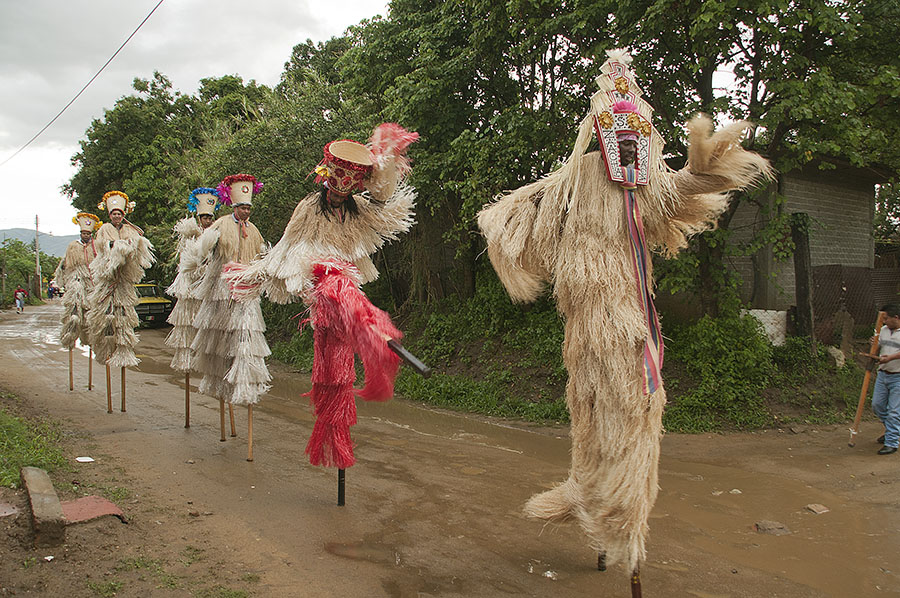
Credit Line: Laura Anderson Barbata, Performance for San Pedro Festivities, 2011, Zaachila, Oaxaca. Photo: Marco Pacheco / Image courtesy of the artist.
This fall, the Mary H. Dana Women Artists Series Galleries in the Mabel Smith Douglass Library will welcome the 2016-17 Estelle Lebowitz Endowed Visiting Artist Exhibition, Laura Anderson Barbata: Collaborations Beyond Borders. The exhibit contains selected highlights of textile, sculptural, 2-dimensional, and video works from the traveling exhibition Transcommunality.
Save the Dates: Tuesday, November 1st, 5:30 p.m. – 6:30 p.m Join us for a reception in honor of the artist at 5 p.m. and a free public artist lecture on in the Mabel Smith Douglass Room at Douglass Library.
Wednesday, November 2nd, 10:30 a.m. – 12 p.m.
Barbata will presentLa Extraordinaria Historia de Julia Pastrana, a performance work in progress at Alexander Library in the Scholarly Communications Center.
Background: Born in Mexico City and based in New York, Laura Anderson Barbata’s work focuses on participatory art initiatives that document communities and traditions, using storied art forms as platforms for social change, contemporary performance, group participation, and protest. Her collaborative and ongoing transdisciplinary works have been initiated in places such as the Amazon of Venezuela, Trinidad and Tobago, Norway, the United States., and Mexico. Her practice intertwines traditional and contemporary mediums, so-called “fine art” and popular art, and craft and folk customs forging links between the past and the present, as well as the individual and the community.
Among her most well-known projects are: Transcommunality, a decade-long project with communities in Trinidad and Tobago, Mexico, and Brooklyn highlighting the moko jumbie stilt walking tradition; Intervention: Wall Street, a collaborative performance with the Brooklyn Jumbies that took place during 2011’s Occupy Wall Street protests; and The Repatriation of Julia Pastrana, a project involving the return of Ms. Pastrana (a woman who was exhibited in the 19th century as the ugliest woman in the world) for burial in her homeland of Mexico.
Barbata’s work is included in numerous private and public collections, among them, the Metropolitan Museum of Art, New York; the Museo de Arte Moderno, Mexico City; and Landesbank Baden-Wϋrttemberg, Stuttgart, Germany. She is a member of the Sistema Nacional de Creadores de Arte, FONCA-CONACULTA, México; and the Julia Pastrana project is supported by the Sistema Nacional de Creadores de Arte, FONCA-CONACULTA, México.
Rutgers is not the only major New Jersey institution celebrating its 250th anniversary this year!
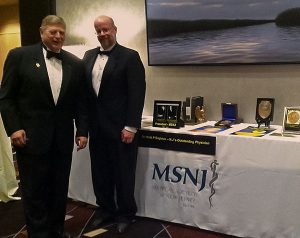
On Saturday May 23, I attended the Medical Society of New Jersey’s 250th Anniversary Celebration and Inaugural Gala. The celebration was held at the Heldrich Hotel in New Brunswick, on the actual 250th anniversary of the Medical Society of New Jersey’s first ever meeting, also held in New Brunswick (at Duff’s Tavern!). The Medical Society of New Jersey (MSNJ) is America’s oldest state medical society, and has over 5000 members. RBHS–Special Collections holds a nearly complete run of MSNJ journal publications from 1848 to 2005, as well as substantial archival holdings of its constituent Burlington, Essex, Hudson, Monmouth, Passaic, and Warren County Medical Societies. We also hold the records of the Medical Alliance of the Medical Society of New Jersey (formerly the Women’s Auxiliary).
Credit: Robert Vietrogoski
At the gala, I joined Dr. Peter Carmel, the emeritus chair of the Department of Neurological Surgery at New Jersey Medical School. Dr. Carmel is also the current president of the Medical History Society of New Jersey and a recent past president of the American Medical Association! During the program, Dr. Carmel presented a well-received illustrated historical retrospective on the MSNJ’s founding and its centennial and bicentennial celebrations. Some of the images used by Dr. Carmel were drawn from RBHS–Special Collections materials.
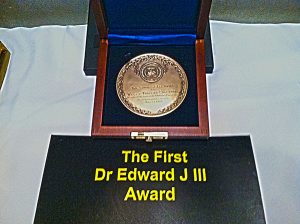
For the gala, Dr. Carmel also organized an exhibit on Dr. Wells P. Eagleton, the first New Jersey neurosurgeon, and a medical luminary who received the first Edward J. Ill award from the Academy of Medicine of New Jersey in 1939. Thanks to Dr. Carmel’s generous restoration efforts, Eagleton’s actual Edward J. Ill medal was on display. This artifact was rediscovered last summer in storage at Robert Wood Johnson Medical School and is now part of the holdings of RBHS–Special Collections. Dr. Carmel’s exhibit and the Eagleton artifacts will soon be on display in the lobby of Smith Library.
Credit: Robert Vietrogoski
If the Eagleton name seems familiar at Rutgers, Dr. Eagleton’s wife Florence Peshine Eagleton was a founding member of the board of managers of the New Jersey College for Women (now Douglass College) and a Rutgers trustee from 1932 to 1946. She made the bequest in 1956 that established Rutgers University’s Eagleton Institute of Politics, which itself is celebrating its 60th anniversary this year.
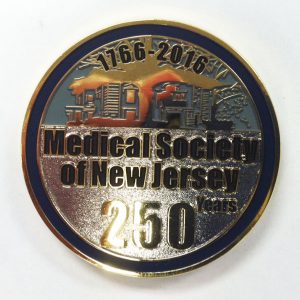
The newest addition to the RBHS–Special Collections artifact collection is the commemorative 250th anniversary “challenge coin” given to gala attendees by Captain Joseph P. Costabile, the incoming MSNJ president. The gala was a most enjoyable event and I hope to extend the relationship between the Medical Society of New Jersey and RBHS–Special Collections. (And for those familiar with my normal mode of dress, here is photographic proof of me in a tuxedo!)
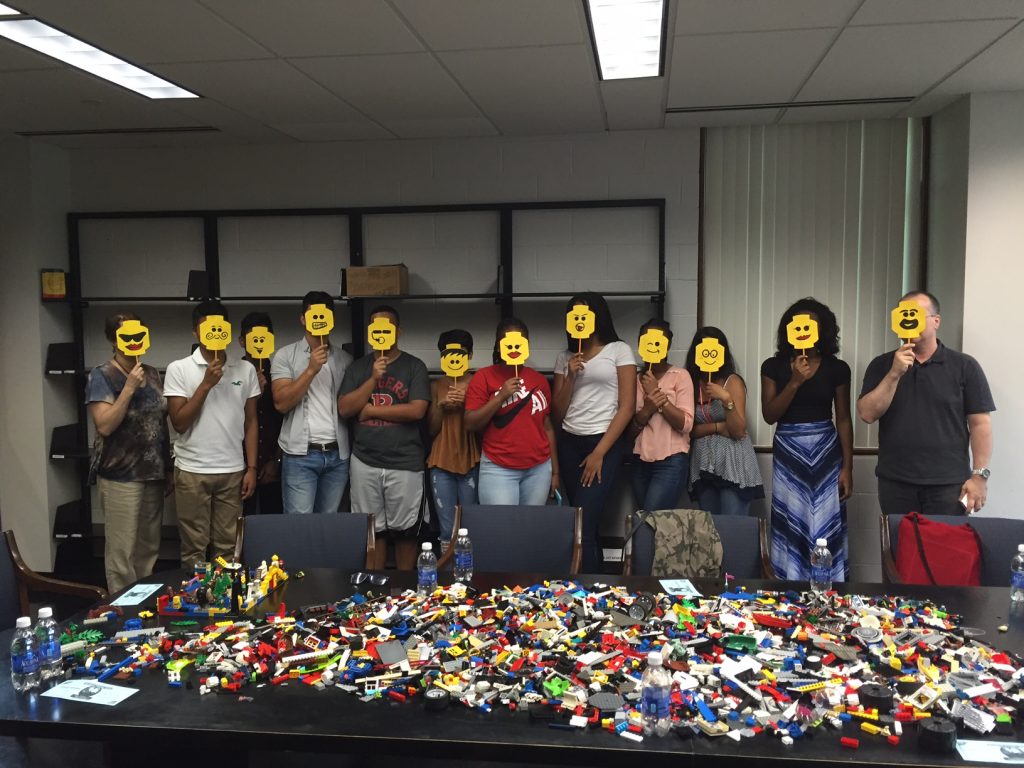
Rutgers Future Scholars use Legos at the Art Library to learn about teamwork and libraries. Photo credit: Megan Lotts.
The Rutgers Future Scholars program places rising High School juniors in an internship for one week during the summer. This summer, the New Brunswick Libraries hosted two internships. Ryan Womack hosted 5 students and worked with them on Big Data, and Jill Nathanson hosted 5 students working on gamification.
For those unfamiliar with the Rutgers Future Scholars Program, here is the description from its website:
The goal of the Rutgers Future Scholars program is to increase the numbers of academically ambitious high school graduates who come from less-advantaged communities, inspire and prepare them meet the standards to be admitted to colleges and universities, and then provide tuition funding to those who are admitted and choose to attend Rutgers University.
In addition to working on their respective projects, the interns were provided an overview of the Libraries and had an opportunity to meet a variety of faculty and staff. Snack breaks were hosted each day by librarians, access services staff, and the communications team. The interns also traveled to the Art Library one day to participate in using Legos to learn about teamwork and libraries.
The students working with Jill Nathanson created an event for transfer students. The challenge was to create an event that reinforced the library instruction transfer students received in their library sessions while also making it fun and giving them an opportunity to interact with other transfer students. The students worked together to create a team based activity that will be used this fall at the Alexander Library.
The students working with Ryan Womack explored data science with R, working through exercises on data wrangling, data analysis, and data visualization using the R open source statistical software environment. By working with real-world College Scorecard data, the students gained understanding of the challenges and possibilities of working with live, raw data sources.
On July 25, the office of research and economic development announced the impending launch of the Research Administration and Proposal Submission System (RAPSS) Phase II on August 8. The text below is taken directly from that announcement. As this system is implemented, our ability to work in an informal manner will be eliminated. In order to successfully submit a grant, we must follow the correct RAPSS process. If you have any questions about RAPSS and how it applies to your work at the Libraries, please bring those questions to your director or AUL.
What you need to know:
Faculty and staff need to complete training on the new system before it goes live.
On August 8, RAPSS will become mandatory for all new submissions of research proposals, corporate contracts, and associated items. Paper submissions will no longer be possible.
Information about RAPSS user training and the schedule of training sessions are posted here.
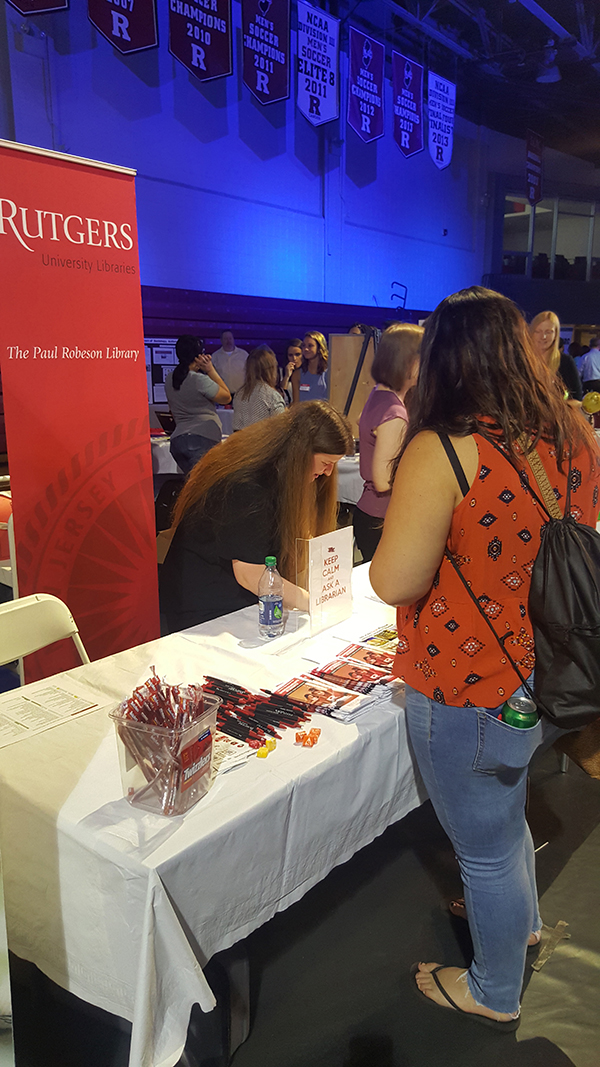
Zara Wilkinson provides information about the Libraries to new students at Raptor Welcome.
Faculty and staff across the entire system of libraries at Rutgers University participated in numerous events over the summer to welcome students to the campus.
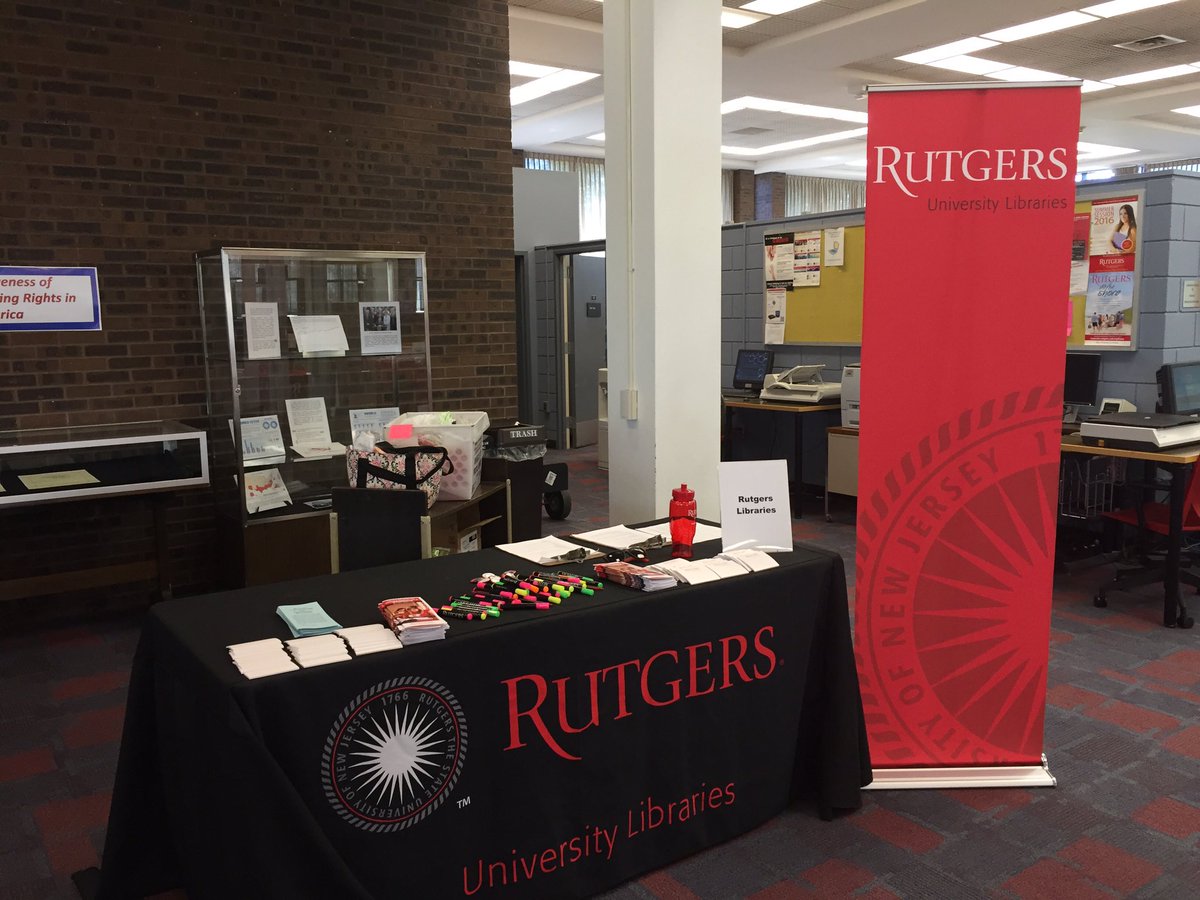
The Paul Robeson Library is a longtime participant in Raptor Welcome, a fun and interactive orientation program for first-year and transfer students at Rutgers University-Camden. Raptor Welcome includes a full day of programming and a campus information fair with over 80 tables representing university departments, student support services, and student organizations. Robeson will host a table at the event, welcoming over 700 new students with information, candy, and giveaways. As a result of the Bridging the Gap financial aid program, Rutgers-Camden is expecting the biggest incoming class it has ever had!
In addition to Raptor Welcome, Robeson participates in orientation programs for graduate students, teaching assistants, international students, and resident assistants. This year, library faculty and staff are also looking forward to being part of Rutgers-Camden’s brand new Raptor Passport Program, which is designed as an extra-curricular first-year experience with helpful workshops, social events, and the potential to earn prizes.
As hosts of the fair, the New Brunswick libraries get a prime spot at the front of the space. Giveaways include pens, highlighters, post-it pads, water bottles, and sunglasses. We also distribute informational flyers on undergraduate services and special collections.
Over the summer, the New Brunswick Libraries hosted the resource table fair for new and transfer students for the second year at Kilmer Library. There were 22 sessions, which were attended by around 4000 or so students and families. The libraries engaged participants with interesting facts about library services and facilities, as well as popular giveaways, such as sunglasses and water bottles.
This event was staffed by library faculty and staff who provide students information about printing, library hours and facilities, technology, and getting research help.
This fall, the New Brunswick Libraries is distributing a special mystery gift to new students who visit Alexander Library or Kilmer Library on the first day of classes, September 6. To promote this giveaway, flyers will be posted in first-year dorm common areas and the communications department will run a social media campaign. Hopefully this encourages more students to stop in and say “hi.”
While we don’t have specifics just yet, Dana Library also participated in numerous student welcome days at Rutgers University-Newark. They distributed goodies and had a special brochure with information about Dana Library to distribute.
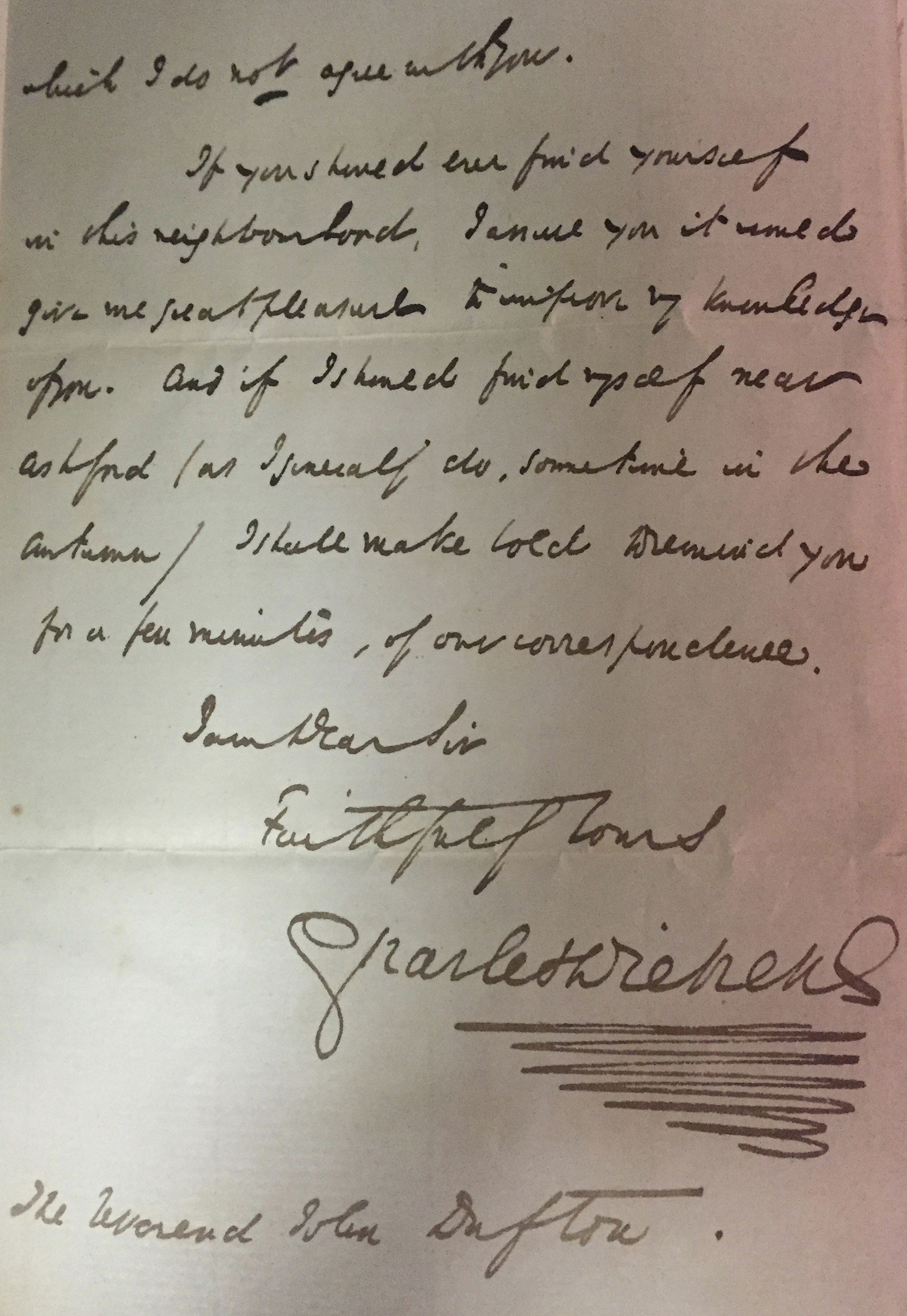
Click to enlarge. Photo credit: Michael Joseph, Rutgers University Libraries.
In preparing a pop-up exhibition for the Northeast Victorian Studies Conference in April, we turned up a previously unknown and unrecorded letter from Charles Dickens bound into one of the Libraries’ books. Written by Dickens on 24 November 1849 to the Reverend John Dufton, the 3 p. letter responds to Dufton’s pamphlet, The Prison and the School: a Letter to Lord John Russell, M.P. (London: John W. Parker, 1848). Dickens writes warmly in support of the pamphlet, though he registers a disagreement with Dufton’s apparent enthusiasm for the “reformatory influences” of the new “model prisons,” noting, with a Dickensian touch, that the reformatory spirit cannot “[survive] the unnatural air of the solitary cell.”
Penal reform was a complex and pressing topic, then as now. The skepticism of the reforming capacities of prison Dickens shared with Dufton anticipates his 1850 essay “Pet Prisoners,” as well as David’s cynical views of the “model prison” in chapter 61 of David Copperfield, which Dickens would begin writing in 1849. Despite their disagreement on what Dickens calls a “momentous”—and Phillip Collins in Dickens and Crime (1968) a “blood-heating”—issue, Dickens concludes his letter on amiable terms by inviting Dufton to visit him in London. Quite familiarly, he invites himself to visit Dufton: “if I should find myself near Ashford as I generally do, sometime in the autumn I shall make bold to remind you for a few minutes, of our correspondence.” No such visit has been recorded.
Dickens thought well enough of Dufton’s pamphlet to keep and annotate it, and it has survived into our time. Regrettably, however, it is currently unavailable to scholars. In 2010, it was sold by Henry Sothern Limited to a private collector in Switzerland (see Piccadilly Notes 56 [2010] item 100, no. 11). [i]
Click to enlarge. Photo credit: Michael Joseph, Rutgers University Libraries.
Dickens and Dufton were not strangers. Elsewhere in the volume housing the Dickens letter (noted below) is a manuscript note, dated 1846, from George Cruikshank to Dufton, written on behalf of Dickens and the Committee of the Ashford Mechanics’ Institution, thanking Dufton for sending a lecture, as requested.
The letter is captioned “Devonshire Terrace.” Dickens lived at 1 Devonshire Terrace (now 15-17 Marylebone Road, Marylebone), near Regent’s Park, from December 1939–1851.
John Dufton was rector of Warehorne, in the Ashford Borough of Kent and the author of other ephemeral publications including National Education, What it is and What it Should be (1848).
The letter has escaped detection because it was all but buried within an extra-illustrated copy of Blanchard Jerrold’s Life of George Cruikshank (1882). As Ron Becker discovered in a search of the archives of the Journal of the Rutgers University Libraries, Don Sinclair recorded the acquisition of the volume in 1956:
Click to enlarge. Photo credit: Michael Joseph, Rutgers University Libraries.
Without doubt the most striking single gift is that of the Class of 1933, which had presented earlier an extra-illustrated set of Benjamin West material. The present gift, preserved in the same form, is the Jesse Metcalf collection of George Cruikshank prints and manuscripts. It is interleaved in a first edition of Blanchard Jerrold’s Life of George Cruikshank (1882), published originally in two octavo volumes, here expanded to seven gilt-edged, large folio volumes
bound in scarlet crushed Levant morocco. The items have not been counted, but a careful estimate places the number of prints at nearly a thousand, with perhaps six dozen manuscript letters. Virtually all types of Cruikshank’s artistic work are represented (oil paintings excluded): etchings, some in color, woodcuts, at least one original watercolor, etc.; caricatures, book illustrations for Dickens and others. His well-known Temperance series, The Bottle (1847) and The Drunkard’s Children (1848), are present. The first volume also contains his famous Specimen of a Bank Note—not to be imitated (1818), a bitter, effective caricature inspired by the hanging of several women convicted of passing counterfeit notes. Engraved in banknote style, it shows eleven hooded figures hanging by the neck, and other macabre decorations. (19:2)
George Cruikshank (1792–1878) was an important caricaturist, illustrator, and print-maker, perhaps best known now for his illustrations of Sketches by Boz (1836) and Oliver Twist (1838). In George Cruikshank, Life, Times and Art: Volume 1, 1792–1835, Robert E. Patton notes that Ruskin thought him second only to Rembrandt in etching (8). “He infused his pictures with a humor at times bawdy, crude, sentimental, inconsequent, grotesque, bathetic, or pathetic. Like Dickens, to whom he was frequently compared, he was both a ‘special correspondent to posterity,’ focusing a journalist’s eye on the rapidly changing world around him, and a visionary humanist, outraged by injustice, greed, and folly, sympathetic to the defenseless and neglected,moralistic toward those who abused their power, their prerogatives, their neighbors, or their bodies.” (8)
Michael Joseph
Kevin Mulcahy
[i] Andrew McGeachin, e-mail message to M. Joseph, March 31, 2016.
Most of you have, by now, visited the Rutgers Connection Migration Support website. I hope you are finding a lot of useful information there, but if anything is missing, please let us know using the Submit Your Questions form. This story is meant to update everyone on the newest pieces of the migration plan. Most importantly, to let you know that everyone’s email in Rutgers University Libraries will be migrated August 23–25, 2016. The exact grouping will be worked out in collaboration with AULs and library directors.
Kickoff meeting:
A successful kickoff meeting was held on Friday, July 22, with four representatives of OIT, all UCSs; and all IIS staff, joined by a special Migration Representative from the Health Sciences Libraries. A four-hour recording of that discussion is available with RUL NetID authentication–but you are hereby warned: It is heavy on technical jargon! Unless you want to delve into every detail, you would be better off perusing the support site and attending the upcoming information sessions and subsequent training.
Prepping for the migration:
But first, as the most important part of preparations, we must collect information about all existing accounts, as only one account per Rutgers employee can be migrated automatically. Content from other accounts should be first transferred to the primary account, or migrated later.
For this purpose, IIS has developed an instrument with half a dozen questions and a lot of help on how to respond to them. Please use your NetID to log in (each RUL member needs to fill it out personally or with the help of their UCSs) and provide the required information about the Rutgers email accounts you currently hold. The more accurate the data we receive, the more efficient and more painless the migration will be.
Since the new email and calendaring tools will appear quite different from what Zimbra users are used to, IIS will offer a series of 90-minute information sessions August 8–19 in several libraries covering all three geographic regions. The schedule for these sessions will soon follow via RUL_Everyone messages, and will be available on the support site’s calendar by August 5.
The plan for the migration:
All three hundred email users at RUL will be migrated over a three-day period August 23–25. Groups of account holders will be scheduled for each day based on organizational, geographic, and logical criteria. When you come to work on your assigned day of the migration, all your email and calendar appointments will be ready for you in the new system. You can immediately access them and continue working with them in the new interface called OWA (Outlook Web Access) by logging in through any browser using the link connect.rutgers.edu and your new email address [NetID]@libraries.rutgers.edu. (Please see details about account names in the Questionnaire and at the support site.)
Throughout the days of the migration, IIS staff and UCSs will be “roaming the halls” in the libraries to help users access their mailboxes using the client of their choice: The desktop version of Microsoft Outlook, available on every RUL workstation, is the preferred client for work in the office, while any browser may be used to log into OWA away from your desk.
Training opportunities:
Two-hour-long introductory, instructor-led, classroom-based, hands-on training will be offered in several sessions over two days of the migration. If you cannot make it during those days, the training sessions will come back after Labor Day, including more advanced training later on. Individual introductory sessions will also be available for those who learn best that way. Please check back to the support site’s calendar around August 15 for the exact schedule and to sign up.
In the first wave of training sessions we will focus on the communication tools included with Rutgers Connect (which is, as you know, a customized version of Microsoft’s Office 365 running in the Microsoft cloud): OWA (and Outlook on the desktop), Calendar, People, Tasks, OneDrive for Business (cloud-based file storage), and Skype for Business. But the rest of the Office 365 tools will also be immediately available to everyone from the same online interface: Word, Excel, PowerPoint, and OneNote. At the same time, the respective applications can be downloaded and installed on your home computer and mobile devices, while you will have them installed on your RUL desktops in the Office 2016 version that is fully interchangeable with the cloud-based apps.
Questions or concerns:
Much more information will continue to become available as we approach the migration week. In the meantime, please let IIS know of any concerns or questions you might have by writing to support@rulhelp.rutgers.edu or using the support site’s Submit Your Questions form.
Like most other people, I cringe at the very thought that the fall semester is only a month away. Didn’t the summer just start? Where did all the time go? Why couldn’t we have a summer that is all year long? Oh well, such is life. But here is the good news, if there is good news in contemplating that the summer days are numbered: in September when tens of thousands of students return to or come to Rutgers for the first time, the Libraries will have a better collection of information resources waiting for them.
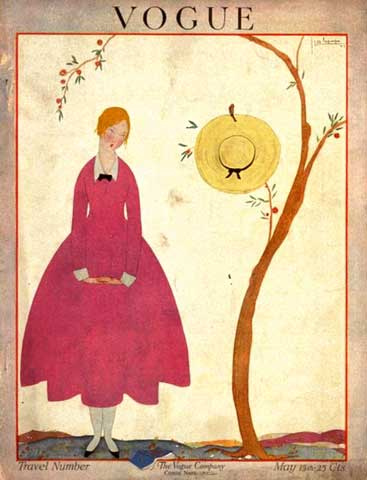
Cover of the May 1917 issue. (American Vogue) https://commons.wikimedia.org/wiki/File:Vogue,_portada_de_mayo_de_1917.jpg
Fiscal Year 2016 that ended on June 30 started off as a very challenging year for collection development, due to the loss of about $1 million of purchasing power in the collections budget in the previous year. Thanks to the strong support and guidance from the new Libraries administration and the tireless work of all the colleagues involved in collection development, we have more or less turned a corner. The University Librarian’s Report from the July issue of the newsletter includes a summary of major acquisitions that the Libraries made in FY16. Additionally, at the end of FY16 we purchased the British Periodicals collections and Vogue archive, two valuable humanities resources that have been on our wish list for a very long time. It is fair to say that, since last year, the Libraries have been making considerable progress to improve access to all kinds of scholarly resources (online journals, e-books, and primary sources) that the entire Rutgers community can benefit from.
Our collection development program is continuing the upward trend that began last year. Since July 1, which is when the new fiscal year started, we have been focusing on acquiring and upgrading resources essential to the education mission of the University, in anticipation of the beginning of the new academic year. These new resources include:
ProQuest ebrary Academic Complete: a collection of about 140,000 current scholarly e-books on all academic subjects.
Springer Nature STM (Science, Technology, and Medicine) and social sciences frontlist e-books: over 7000 newly published titles from the largest STM e-book publisher, paid for with a funding increase from the universities.
Academic Video Online: Premium (AVON): over 50,000 videos on Social Sciences, Arts & Humanities, Science & Engineering, and Health Sciences topics from many reputable producers such as BBC and PBS.
ProQuest Dissertations and Theses (PQDT) Global: 1.7 million full-text dissertations and theses from both American and international institutions.
Clinical resources: In the spring, the Libraries received a funding increase from the universities for five new clinical resources. UpToDate and Bates’ Visual Guide are already available. VisualDx, DynaMed Plus, and JAMA Evidence will be added soon.
Some of the resources are available now and others will be available later in the fiscal year. We are confident that these new resources will greatly enhance the Libraries’ support for undergraduate, graduate, and medical education at Rutgers. Yes, even when summer is ending, there will be a lot to look forward to in the fall!
We are at a strange point of the year where, like time travelers, we must work and plan in three different fiscal years. The close of FY16 necessitates the activities of closure and assessment; FY17 is already galloping along with its own demands; and in some circles, we are already planning for the priorities FY18 in anticipation of State of the Libraries meeting in November.
In order to get a handle on that last item, I invited members of cabinet to join me for a two-day retreat to discuss where we see our priorities in the future. Over the course of two days, we reviewed SWOT analyses, LibQUAL+ survey results, budgets, previous State of the Unions, and on. We considered the impact of changes in the Libraries’ environment ranging from the master space plan to the needs of the Giddings collection. And we assessed the priorities we established at State of the Libraries in November 2015, asking what have we accomplished this year? And how do these accomplishments provide opportunity for further refinement and, in some cases, expansion of these priorities?
While I don’t have a finalized list of priorities to share at this time, I want to give you a sense of the tone and the focus of these discussions. Much of our discussion centered on the priorities established at the last State of the Libraries:
Enhance undergraduate support
Conduct a holistic review of special collections
Optimize Collection development and management
Clarify communication and decision-making
Define the Libraries role in and identify resources for advanced research support
We have made tremendous strides in each of these areas, but what became clear through our discussion was that each “accomplishment,” was also a new beginning. For example, we considered the report of the completed special collections holistic review (an executive summary is available here), but this brought up questions about strategy, resources, and next steps.
So, I suspect when all is said and done, our priorities will fall into similar areas as last year, but with shifts in focus or additional avenues to explore. The one exception is that we will undoubtedly add a priority related to strengthening information control. Additional threads running through our conversations included the impact of the RCM budget model and the use of assessment in decision-making and planning.
I anticipate sharing the outcome of this retreat with you all in the coming weeks. We will all benefit from a set of clearly articulated, aspirational, and achievable priorities to guide our activities in the following year. The discussions initiated during the retreat will continue in cabinet and within units before the priorities are finalized. I thank you in advance for your participation and support during this process.
This course is ideal for staff, managers, supervisors, and administrators who recognize the need to improve their ability to generate ideas, see old ideas in new light, and make decisions that are innovative yet founded on strong grounds.
Location: Pane Room, 1st floor, Alexander Library with teleconference to Smith Library, Dana Library and Robeson Library
RSVP: Erica Parin on behalf of the Professional Development Committee
Leading Staff through Change & Transition
July 21. 2016
9 a.m. – 12 p.m.
This course is ideal for managers, supervisors, and administrators who are experiencing departmental change and would like insight, guidance, models, and tools to assist them in moving their departments forward.
Location: Pane Room, 1st floor, Alexander Library
RSVP: Erica Parin on behalf of the Professional Development Committee
Digital Humanities Summer Institute
Bart Everts attended the Digital Humanities Summer Institute at the University of Victoria in Victoria, BC June 12-16th and participated in a week-long workshop titled Critical Pedagogy and Digital Praxis in the Humanities. The workshop “built an open course as a playground, letting participants experiment with critical digital pedagogy in a class-created online course that [they] co-designed, built, deployed, promoted, and assessed.” Learn more at the website they designed: http://www.digitalpedagogylab.com/dhsi2016/.
Dana Library Media Services Department Restructure
Photograph by Ed Berger.
The fourth floor Dana Library Media Services Department is being restructured in recognition of how the library’s patrons access sound and video for education and entertainment. The transition will be completed by August 1 well in advance of the fall semester.
Patrons will find a selection of some 1,700 DVDs, VHS tapes, and audio CDs currently available from Media Services publicly accessible on the lower level of the library, where the journals and bound periodicals are housed. Faculty requests to purchase new titles to support their teaching will continue to come through Dana’s department liaison librarians.
Congratulations to Our Colleagues Who Worked on an Award-Winning Book!
Rutgers: A 250th Anniversary Portrait received the Gold Award in the Circle of Excellence Awards given by the Council for Advancement and Support of Education (CASE).Many of our Libraries’ colleagues contributed to the success of this book: University archivist Tom Frusciano served as one of the primary authors, co-authoring the opening chapter on “History and Politics,” with GSE professor Benjamin Justice, constructing the extensive historical “Timeline” that appears in the back of the book, and writing—in partnership with archival associate Erika Gorder—many, many photo captions. This was a true group effort with dozens of contributors, including Gorder on musical concerts at Rutgers, archivist Fernanda Perrone on the activities of visiting Japanese students at Rutgers in the 1870s, David Fowler, an independent researcher with close ties to Special Collections and University Archives, on the life and impact of Henry Rutgers, and former university librarian Marianne Gaunt on, of course, the libraries themselves! Lastly, former associate director of the Institute of Jazz Studies Ed Berger contributed many photographs.
Custom Buttons Now Available from the Communications Department
Custom buttons are now available from the Communications Department.
The Communications Department recently purchased a custom button maker and we are happy to now make buttons available to all of our colleagues for events or outreach activities. These 1.5 inch buttons feature a glossy, professional-quality finish and the designs can be customized to suit your needs. We are currently piloting a small “See You @ the Library” campaign for New Student Orientations in New Brunswick and welcome ideas for other ways to take advantage of this new equipment. Please contact us with project ideas or to request a sample.