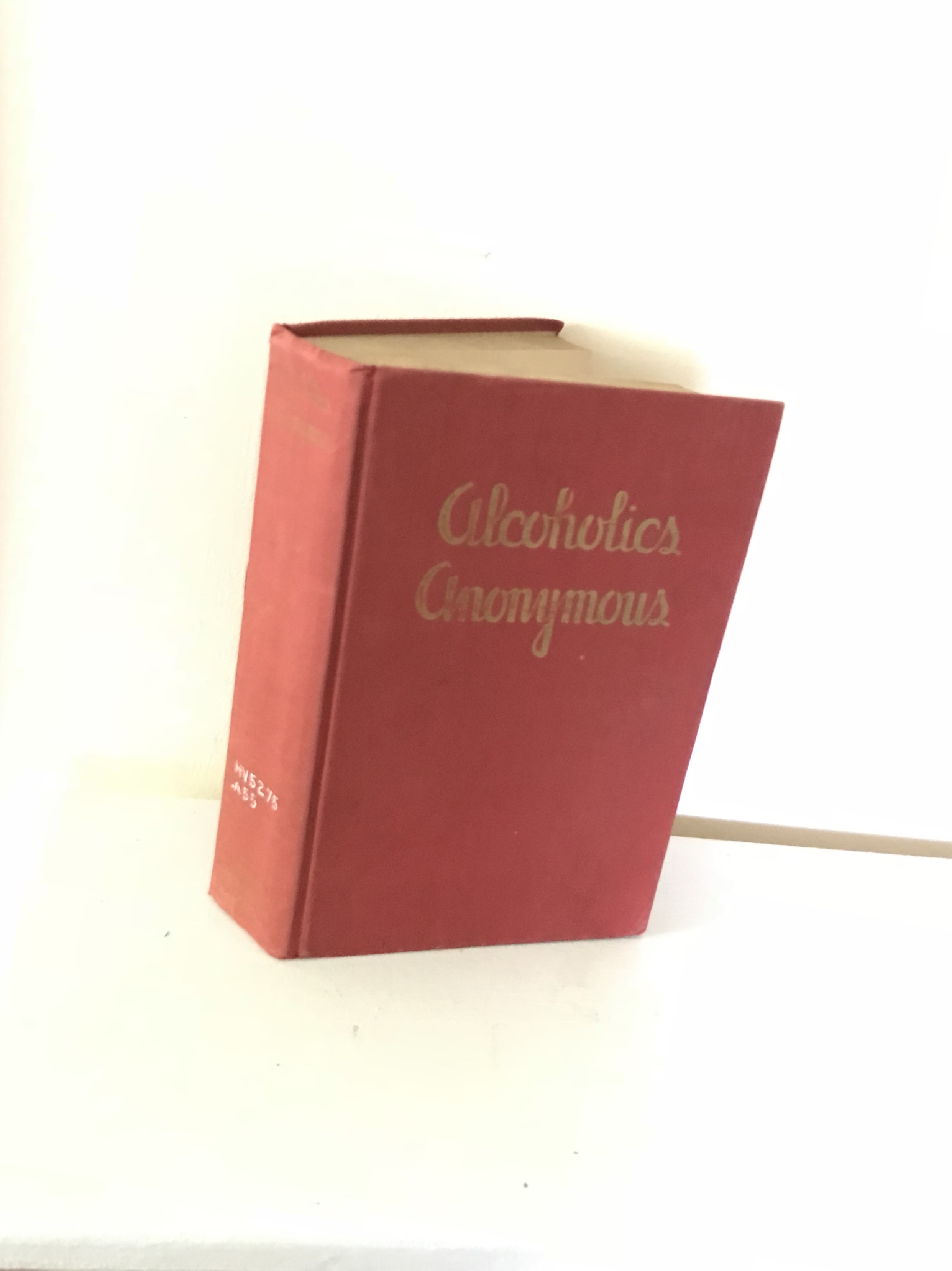
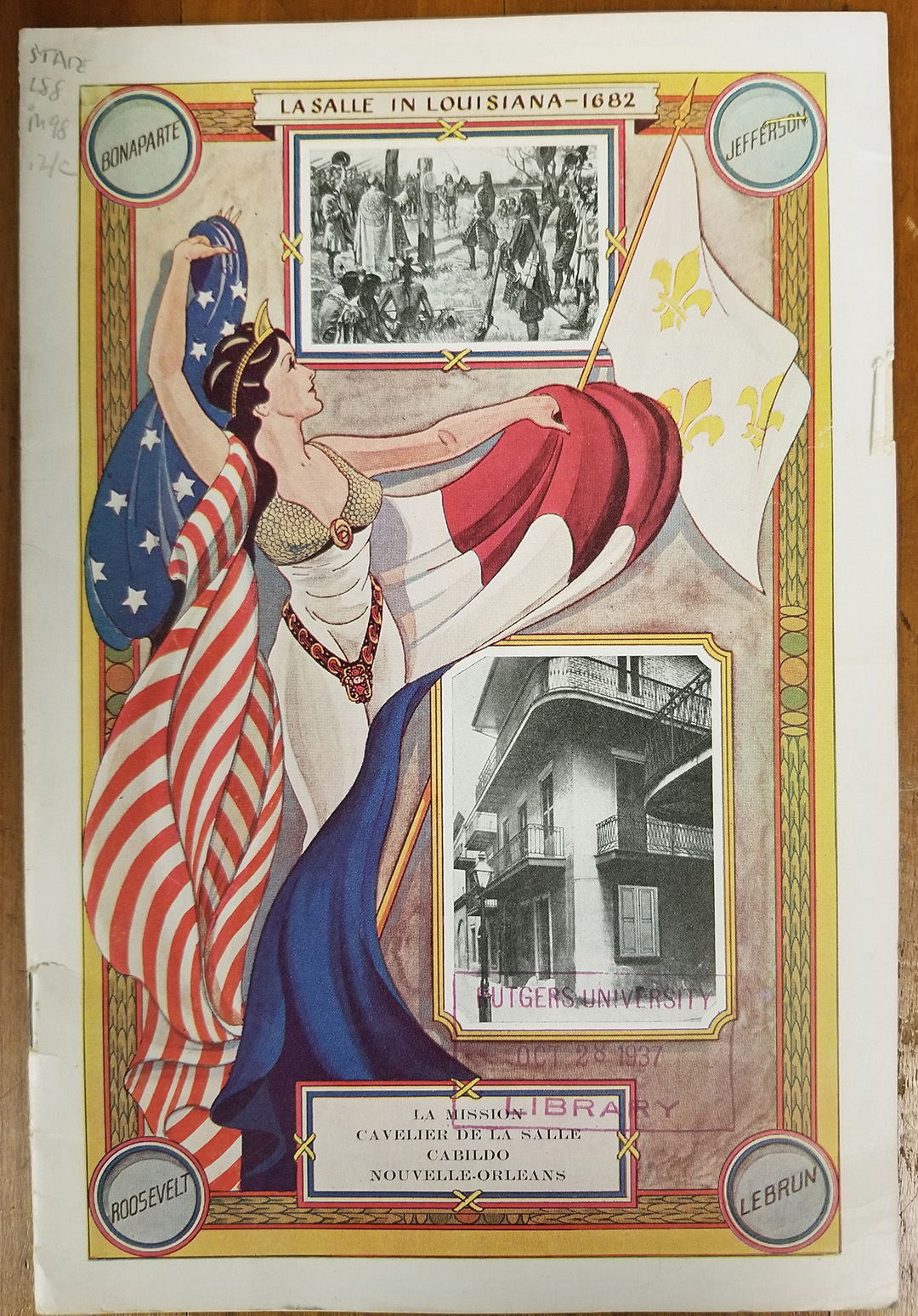
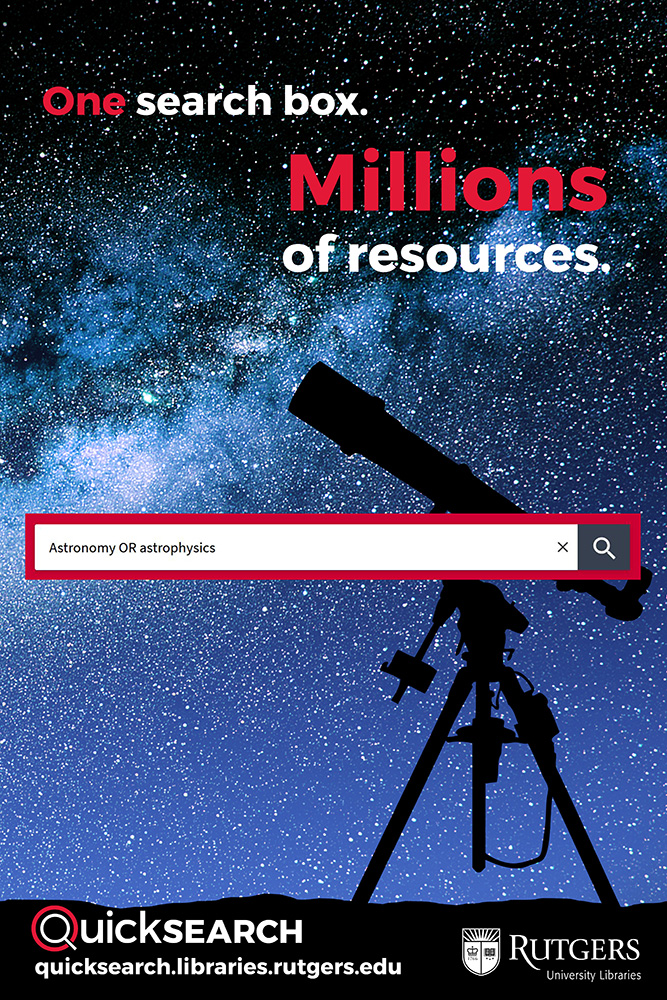
For Fall 2018, we will have new marketing materials for QuickSearch. While our summer campaign was designed to raise awareness of the name of our search engine, this campaign will highlight the breadth of our collection and what QuickSearch enables users to do.
The tag line is One Search Box, Millions of Resources. The images suggest the breadth of our resources and how they can be used for discovery and research. The search box terms also incorporate a soft approach to introducing advanced search technique using Boolean terms.
This campaign is designed to be flexible — it will be used on posters, postcards, bookmarks, and social media. It also allows us to tailor the messaging to different disciplines. In addition to these materials, we will also have some new promotional items to distribute — pens, highlighters, and maybe even flashlights.
We also hope you will send along additional suggestions for imagery that we should use for different disciplines. Matt Badessa and Mary Ann Koruth have contributed to this design and we owe a big thank you to Sarah Jewell for recommending the astronomy/universe image which helped us to conceptualize this campaign.
It has been more than a year (March 2017) since I wrote an Agenda post about one of my favorite books on organizational success, Creativity Inc.: Overcoming the Unseen Forces that Stand in the Way of True Inspiration by Ed Catmull and Amy Wallace. What impressed me most about the success of Pixar was the approach to planning and problem solving that they used. The animated movies didn’t begin with a script; they started with an idea, which I think maps well in our environment for the purpose of an initiative.
It isn’t the release of The Incredibles 2 that has me thinking again about Pixar. (Although these hot, humid days of summer would be a perfect time to go to the movies.) What has me thinking about Pixar, and the creative process they use, is the release of our new library services platform.
I watched the implementation process unfold and realized that it had a lot in common with the way Pixar made films. The Ex Libris Implementation Team was not given a script for the implementation. They had a list of deliverables but were never given quite enough of the plot to decide what exactly to do. Primo/Alma is a platform, and configuration decisions vary depending on factors such as your current environment and the workflows you are trying to establish.
We had an idea of what we wanted: integrated workflows for staff, improved ability to generate statistics and assess our collection, and the reduction of silos for our users. The problem is that there is no single right way to implement Primo/Alma. The decisions that the Ex Libris Implementation Team made along the way depended on the workflows and functions we were trying to support. We had some idea of what those would be but were not quite sure how they would fit together. To make matters more complicated, the timeline for implementation was only six months (by comparison, The Incredibles 2 was 12 years in the making!). Finally, the implementation team brought together people from different backgrounds. Although each person has an area of specialty, no one person had the expertise to solve the problem alone.
The group worked together to develop the plot and the script. I will say that, from the sidelines, there were times when it was stressful for the group members as they struggled to determine how best to move forward. Like the folks at Pixar, they worked together and solved problems quickly. In the words of Catmull, “…if you put your faith in slow, deliberative planning in the hopes it will spare you failure down the line—well, you’re deluding yourself.” The group planned, but at some point (perhaps much earlier than any of them wanted) they had to test their plans. There were definitely mistakes along the way but again, as Catmull says, “Mistakes aren’t a necessary evil. They aren’t evil at all. They are an inevitable consequence of doing something new.”
The original group consisted of:
Tao Yang (co-lead)
Interim AUL for Collection Development and Management
Resource Sharing
Chad Mills
Digital Library Architect
Digital Collections, Data Migration & Systems Integration
Abbey DiPaolo (co-lead)
Director of Financial Planning and Business Operations
Acquisitions
Gracemary Smulewitz
Head of Collection Services and Resources Sharing
Electronic Resources
Chris Sterback
Integrated Information System Administrator
Data Migration & Systems Integration
Joseph Deodato
Discovery Services Librarian
Discovery
Mary Beth Weber
Head of Central Technical Services
Resource Management
Because of identified gaps, several other people were later added to the group.
Laura Costello
Virtual Reference Services Librarian
Fulfillment
Amy Kimura
Web Services Librarian
Website Design and Updates
Jessica Pellien
Director of Communications and Web
Communications & Marketing
I have to say that I am completely impressed by the team. The breadth and depth of knowledge in the group will provide the Libraries with a strong foundation for the future. They all know how the pieces fit together and how they can continue to make the system better. And each member of the team has worked with other groups to implement aspects of the platform, drawing on a broader range of expertise while exponentially increasing the reach of this knowledge. As an organization, we are not reliant on a few gurus with all of the answers.
This is only the beginning. There are plenty of issues to address, some we know about and more that will be uncovered. Borrowing one last time from Catmull’s insights on Pixar, I like to think that what makes the Libraries special “is that we acknowledge we will always have problems, many of them hidden from our view; that we work hard to uncover these problems, even if doing so means making ourselves uncomfortable; and that, when we come across a problem, we marshal all of our energies to solve it.” This is the new world in which we live, and—thanks to the work of the Ex Libris Implementation Team and the lessons we’ve learned along the way—we are now better prepared to thrive in it.
As I’m sure you’re all aware, the annual American Library Association conference was held last month in New Orleans, Louisiana. Rutgers was well represented, with plenty of posters and presentations being delivered by folks from the Libraries (check out our Faculty & Staff News page for more details). I reached out to our colleagues for their takeaways from the conference—here’s what they had to say.
Tara Maharjan (l.) and Megan Lotts (r.) presented on using a button maker for outreach to students. Credit: Megan Lotts.
Jordan Nielsen’s poster was titled “Mapping the Undergraduate Business School Curriculum: A Targeted Approach to Library Outreach & Instruction.” Credit: Megan Lotts.
Bonnie Fong and her poster on equity, diversity, and inclusion in a science librarian organization. Credit: Bonnie Fong.
Bonnie was busy! Here she is with her poster on boot camps for graduate students.
As the section’s incoming chair, Lily Todorinova had the honor of presenting the Emerging Technologies Section Achievement Award to the Library of Congress’s Donna Brearcliffe. Credit: Lily Todorinova.
Katie Anderson: I had the opportunity to learn more about ACRL’s Signature Initiative on Equity, Diversity, and Inclusion (EDI) during the ACRL Leadership meeting. Everyone is encouraged to take this quick poll (open until July 13, 2018) for feedback on priorities. Along with the many business meetings for my section (Anthropology and Sociology Section), a highlight of the conference was a program addressing equity, diversity, and inclusion in academic libraries. Three panelists presented an engaging and thought-provoking program to a packed room entitled “When to Speak Up, When to Listen: Allyship, Race, and Communication in the Academic Library”.
Megan Lotts: What I enjoyed most about our poster session was learning more about what’s happening at other libraries, as well as sharing what we are up to at Rutgers. I also met a woman who is on a design team in Newark, I think within the libraries, and she was excited to take home a Rutgers button, so she could wear it to her next meeting. Kind of warmed my heart, total cheese, but true story. It was also great presenting at the same time as Jordan. I learned more about my RU colleague’s work, and we got to take pictures of each other!
Christie Lutz: It’s tough to beat the food and architecture (and heat) in New Orleans, but at the Rare Books and Manuscripts Section (RBMS) conference I had a great experience presenting on the New Brunswick Music Scene Archive and chatting with people about music scenes and special collections. And I conducted some inadvertent collection development—I met a conference attendee from the University of Delaware who is married to a former Court Tavern bouncer, and she texted him right away about my presentation and it looks like he’ll be donating! I attended some thought-provoking sessions as well, in particular on challenges and new ways of thinking in archival collection management, and challenges and opportunities in working with underrepresented communities in developing their own archives.
Tara Maharjan: What I took away from the conference was that a lot of people stopped by and mentioned that their institutions already had a button maker, but were not really using it. People were surprised that we were using it to promote collections, talk about copyright, collaborate with departments, as well as a fun tool to engage with students. I also learned that I apparently talk with my hands in a lot of photos!
Lily Todorinova: I am the incoming chair of the Emerging Technologies Section (ETS), which is part of the ALA Reference & User Services Association. As part of my section, I attended an interesting session regarding formal vs. informal project management, how to make a decision matrix, as well as “rightsizing” projects. It was super useful.
Zara Wilkinson: My co-authors and I presented at the Library Research Round Table (LRRT) Research Forum. The forum had a total of four presentations, so we got to hear about a group of diverse research projects, from first generation college students’ experiences using the library to the resources and repertoire knowledge catalogers rely on in their day-to-day work. I enjoyed the breadth of topics and methodologies, especially in the context of our own project, which examined academic librarians’ experiences with research and their successful development of research skills and confidence.
Matthew Bridgeman and Sarah Jewell are leading the teams behind the new Facebook and Instagram pages representing the Rutgers Health Sciences Libraries. Matthew Bridgeman, an information and education librarian at Robert Wood Johnson, has both professional and personal experiences with Instagram. He began the Instagram account at Middlesex County College. In two years he grew the library’s presence and even had a post shared by the New York Public Library. The NYPL also has a great article on creating Instagram posts to be engaging called 20 Ways to Make People Fall in Love with your Instagram. He sees Instagram as a way to begin a discussion with students and faculty with creative photography.
Sarah Jewell, an information and education librarian at the George F. Smith Library of the Health Sciences, primarily has experience doing social media for organizations outside the professional sphere. In the past, she has volunteered to do Facebook, Instagram, and WordPress work with writing and meditation-based organizations. “I see social media as a great vehicle for expressing passion about important work,” Sarah says. “When you express enthusiasm through this media, it is contagious, and it gets others excited about the work to be done.”
The @RutgersHSL Instagram page.
Some resources that Sarah uses to guide her social media efforts include the Rutgers Libraries Social Media Resources (which she helped create) and Young and Rossmann’s book titled Using Social Media to Build Library Communities. As the Rutgers Health Sciences Libraries staff is just getting the Facebook and Instagram accounts off the ground, she has been reaching out to her regular contacts to spread the word about the new way to communicate with the libraries. She was thrilled to see the Rutgers School of Public Health post on both Facebook and Instagram a promotion of the Rutgers Health Sciences Libraries pages.
The primary goals of the Facebook and Instagram accounts are to promote library resources, services, and events to the Rutgers University community and to engage with the students, faculty, and staff of the seven schools under RBHS. The new Rutgers Health Sciences Libraries Facebook and Instagram accounts are off to a running start. The accounts’ plans are to keep a constant scheduled flow of content celebrating the students, faculty, and libraries from the schools of Rutgers Biomedical and Health Sciences. If you have not already followed them, connect with them now as they begin this adventure.
The New Brunswick Music Scene Archive has been awarded MARAC NJ’s Innovative Archives Award for 2018. Photo credit: NBMSA on Facebook.
The New Brunswick Music Scene Archive has been awarded the 2018 Innovative Archives Award from the MARAC NJ Caucus.
The award is given to an organization that has provided exemplary leadership or service to the archival community and residents of the state. It may also honor a local, county, or regional organization, either for long-term leadership or service, or for outstanding effort demonstrated in a given year. Nominees may have developed innovative educational or outreach models utilizing archival sources, provided leadership during a time of emergency or crisis, demonstrated new thinking in finding a solution to an issue or problem, or exhibited creativity in increasing awareness of local history resources among New Jersey residents and visitors.
The official presentation of the award will take place at Monmouth County Archives and History Day on October 13. Congratulations to Christie Lutz and Tara Maharjan in Special Collections and University Archives for this recognition of their tremendous work!
BTAA Cooperative Cataloging Partnership Receives ALCTS Outstanding Collaboration Award
Rutgers was among the institutions recognized by the ALCTS’s 2018 Outstanding Collaboration Citation.
The Big Ten Academic Alliance’s Cooperative Cataloging Partnership was awarded the Association for Library Collections & Technical Services’ (ALCTS) Outstanding Collaboration Citation for 2018.
This award recognizes and encourages collaborative problem-solving efforts in the areas of acquisition, access, management, preservation, or archiving of library materials. It recognizes a demonstrated benefit from actions, services or products that improve and benefit providing and managing library collections. It was presented at the ALCTS Awards Ceremony at the ALA conference in June.
Congratulations are in order for our colleagues from Central Technical Services who comprised the Rutgers team: Colin Bitter, Roman Frackowski, Kati Ritter, Catherine Sauceda, and Mary Beth Weber. Rutgers both provided cataloging (Roman and Kati for foreign languages and Catherine for musical scores) and took advantage of the program to eliminate a backlog of titles in Arabic and other foreign languages.
NJEDL Spotlights Outdoorsy Summer Getaways
Whitesbog Village. Photo credit: Peter Miller on flickr.
Looking for the perfect summer day trip? Look no farther than the New Jersey Environmental Digital Library’s spotlights column. This area highlights activities around the state mostly having to do with the outdoors or the environment. Forthcoming events include:
100th Annual Mercer County 4-H Fair, July 28–29
Bio Blitz at Whitesbog Village, July 28–29
Making Bark Collection Containers and Berry Harvesting, August 8
Star Gazing with Morris Museum Astronomical Society, August 18
Join Connect the Lots for free fitness classes in Camden all summer long.
As part of their #HealthyCamden series of weekly fitness classes, Connect the Lots offers free outdoor yoga classes at Johnson Park on Tuesdays from June through August. Classes begin at 6 p.m. For cancellations due to inclement weather, visit Connect the Lots on Facebook or Twitter after noon on the day of the class. Other weekly offerings include Zumba, House Party Fitness, Bootcamp, and Aqua Aerobics classes.
Connect the Lots is a community-driven initiative to activate Camden, New Jersey’s vacant and underutilized spaces through the identification and implementation of artistic, cultural, and recreational projects and activities. The goals of the initiative are to engage Camden residents in neighborhood transformation, create safe nodes of activity, and to bring vibrancy to Camden’s corridors and public spaces. Learn more at the Connect the Lots website.
kite+key Summer Tech Promotion
kite+key’s summer tech promotion offers special deals for faculty and staff.
Take advantage of our promotion and spread your interest free payments using Employee Payroll Deduction! Purchase a Mac and receive $100 off + $100 kite+key Gift Card! Purchase an iPad Pro receive $50 off and $50 kite+key gift card! Purchase a Dell computer $499 and above, receive $100 eGift card + $50 kite+key gift card! Purchase Safeware Protection Plan and we double your theft coverage free! Visit our website here. Located in the Plaza at Livingston Campus 55 Rockafeller Road, Piscataway and the Hahne & Co. Building at 625 Broad Street, Newark. Prices and promotions are subject to change, some restrictions may apply.
Rutgers Cinema
See first run movies at discounted prices at Rutgers Cinema.
See first run movies at Rutgers Cinema while enjoying a special from our concession! Open to the public with free parking available in lot 112A. Ticket prices with ANY valid school ID are $5 before 6pm and $7 after, no ID still a bargain at $7 before 6pm and $9.50 after. Rutgers Cinema is located in the Plaza at Livingston Campus, 105 Joyce Kilmer Avenue, Piscataway, NJ. Get tickets here, showtimes here.
The Plaza at Livingston Campus
The Plaza at Livingston is home to nine retailers.
The Plaza at Livingston Campus is home to nine retailers: Henry’s Diner; Hoja Asian Fusion; Kilmer’s Market; kite+key, Rutgers Tech Store & TeKCheK, Rutgers Computer Repair; The Wright Cut; Qdoba; Starbucks; 16 Handles; Rutgers Cinema. The Plaza at Livingston Campus offers free visitor parking in Lot 112A. Click here for retail hours of operation.
AfroBeat Fest comes to Newark’s Military Park on July 14.
AfroBeat Fest
African Soul Festival will be the largest celebration of culture and heritage of Africans on the continent and in the diaspora in the state of New Jersey. This free family friendly celebration on Saturday, July 14 at Military Park will bring out over 200 vendors featuring food, music, clothing, artifacts as well as entertainment from the diaspora.
Experience the African cultural scene in Newark with a day full of entertainment, dancers, drummers, children’s village and the best vendors in NJ. Visit the Newark Happening website for more information or mark your calendar on Facebook.
The 13th Annual Lincoln Park Music Festival expands to a second weekend for the first time this year.
Lincoln Park Music Festival
The 13th Annual Lincoln Park Music Festival will take place from July 27 to August 4 at Lincoln Park, 450 Washington Street in Newark. For the first time ever, the Lincoln Park Music Festival expands to two weekends of music, arts, culture, and humanities.
“Doin’ it in the Park” opening weekend features Family Day blues and jazz, a youth talent showcase, Gospel in the Park, Hip Hop Day, Health and Wellness/Sustainability Village, Senior Village, Kids Zone Village, and more.
Weekend two focuses on the humanities, with “Unplugged” style conversations with creatives, free outdoor film screenings, a music-and-dance-party meets maker faire, and closing concert performances.
The team is planning to visit each campus where we will hold open Q&A sessions. This will be an open forum where you can bring any questions or concerns you have about QuickSearch, Alma, or related processes.
After much planning and preparation from all of the Libraries, QuickSearch and Alma went live on June 5. It’s so hard to believe that we are already almost four weeks past go live! The implementation team would like to thank everyone for your hard work in making go live a success. Each and every person in the Libraries has helped move us forward, be it by serving on a working group, attending a training, or by submitting a help ticket to point out a concern. We couldn’t have done it without you!
Of course, we also continue to experience bumps along the way, but this is expected with an implementation this large. The team has spent much of the time since our last post focused on those bumps… addressing critical post-go live activities, implementing fixes, and responding to help tickets. In addition, we are reviewing our lists of known issues and possible future improvements in order to prioritize items for completion. The website will be updated with this information as soon as the process is complete.
The team is also planning to visit each campus where we will hold open Q&A sessions. This will be an open forum where you can bring any questions or concerns you have about QuickSearch, Alma, or related processes. Be on the lookout for an announcement about dates in the very near future. Your feedback is critical and we really hope that you will join us.
Lastly, as Tao steps away from the team, I would like to thank him for his contributions to the group and to the project. I know that we will all miss working with him as we continue to forge ahead.
Twenty-one years ago, all hands were on deck as the Libraries were gearing up for the implementation of a new library system. Sound familiar? Here’s a snapshot of the Agenda from July 1997.
With a Little Love from Our Friends
Merit awards for 1997. See any names you recognize?
Below are some notes we recently received from members of the Friends of the Rutgers University Libraries. We thought you might like to see them too!
Letter #1
Yesterday (Sunday, May 25th) I walked in the rain to the Alexander Library. Absolutely everything was closed – the caravans at the bus stop, the food shop further up, clearly all the teaching buildings. I met not one person on College Avenue.
But the library was open, and there were people going in and out, using it.
We get a publication from the Library of the University of Michigan, which announces the library to be the center of the university. Truly, I believe yours is, and truly I thank you for acting as though it is!
Letter #2
I have been a Friend of the Library for several years….
I continue to actively use several branches of the Library on a regular basis. I have been particularly impressed with the caliber of the reference librarians at the Dana Library. It has been a satisfying association for me.
Thank you for your assistance.
The Agenda 19, no. 13 (July 6, 1997)
LIS Teams, Assemble!
We have had a wonderful response to the several calls for people to become involved with the training program for the new LIS coming later this summer. Nearly seventy people from all over the library system have volunteered to participate in some aspect of the training program.
We have compiled all the information from the completed “LIS Training Committee Questionnaires” returned to us by the volunteers and have worked with each of the LIS Implementation Chairs to place volunteers into the training teams for the Circulation/Reserves, Cataloging and OPAC modules. The remaining teams, Acquisitions/Fiscal Control and Serials Control, will be announced shortly.
Based on volunteer’s questionnaire responses, each team will be divided into smaller working groups to write documentation, develop scripts, test scenarios, conduct sessions and assist trainees at the computers.
The Agenda 19, no. 13 (July 6, 1997)
Connie Abroad
Partially funded by “Chun Hui Plan,” a government grant from China, Connie Wu at LSM went to China for a lecture tour in June. She and four presenters from other universities and information companies visited three top ranking universities in China: Fudan University, Zhejiang University and Hangzhou University. Connie presented three topics: (1) Internet Overview and Its Applications and Resources; (2) Electronic Publishing and Its Impacts; and (3) Challenges to Librarianship. More than 400 academic and public library directors and librarians from several provinces attended these workshops. Since her presentations interested the audience Connie has already received several invitations for next year’s lectures after she came back.
The LCC began as the Public Access Committee when the Libraries were planning to implement the new Unicorn library information system from Sirsi in 1997.
With the implementation of Alma and Primo, the Rutgers University Libraries bid a fond farewell to the Library Catalog Committee. Recent LCC “emeriti” are: Stephanie Bartz (New Brunswick Libraries, chair), Natalie Borisovets (Rutgers–Newark/Dana), Melissa De Fino (Central Technical Services), Joseph Deodato (Shared User Services), John Maxymuk (Rutgers–Camden/Robeson), Bob Warwick (Integrated Information Systems, retired), and Yini Zhu (Rutgers Biomedical and Health Sciences/Smith).
The committee began as the Public Access Committee (shortened to PAC) when the Libraries were planning to implement the new Unicorn library information system (LIS) from Sirsi in 1997, which replaced an aging Geac catalog and Innovative (III) acquisitions system. At that time, “PAC” was one of several subcommittees of the LIS Committee tasked with implementing the new system.
The first meeting of the Public Access Committee was held in April 1997. Although the name of the chair was not recorded in the meeting minutes, in attendance were the following.
Emily Fabiano, Alexander Library
Harriet Hemmasi, Cataloging
Rhonda Marker, Cataloging
Tracey Meyer, Database Management
Pat Piermatti, Library of Science & Medicine
Bob Warwick, Systems Department
Mark Witteman, Systems Department (Unicorn systems administrator)
By fall 1998, Ann Scholz-Crane (Robeson Library) was chair of the group and it was Ann who asked Sam McDonald to place PAC meeting notes on the web. Minutes from October 1998 through the final meeting in July 2017 were made available in Staff Resources.
In 2000, the committee was revitalized and reconstituted under Harriet Hemmasi, then acting associate university librarian for Technical & Automated Services. It became the IRIS Public Access Committee (IPAC). A new charge was issued and new members were added. Just two years later, in 2002, the charge was once again revised as the committee was moved from technical services to public services under the aegis of Jeanne Boyle, associate university librarian for Public Services & Communications.
The final major transition for the committee took place in 2011, when the Libraries discontinued the name “IRIS” for the library catalog. The committee, which had been under the leadership of Stephanie Bartz since 2005, received a revised charge and changed its name to Library Catalog Committee.
During its long tenure and multiple transitions, there have been many, many others who have served on this committee. Thank you, each one!
Our new library system Alma and Primo (a.k.a QuickSearch) are expected to go live next week. It is incredibly exciting to be in the home stretch after more than a year of hard work. We truly appreciate what library colleagues, especially those on the Implementation Team and working groups, have done to get us to this point. We anticipate that the last few days before launch will be full of questions and new developments, so we have started to send daily emails to RUL everyone with updates and additional information. Please follow these daily messages for up-to-date information. In this report, we will summarize the progress made in the previous month.
Migration Update
The Libraries began technical services freeze to extract Sirsi data for the migration to Alma in early May. The Implementation Team submitted the data on May 11 and received the migrated data in the Alma implementation environment from Ex Libris on May 25, both on schedule. Over the Memorial Day weekend, we discovered some errors in the migrated data and had a conference call with Ex Libris. Ex Libris assured us that they would work with us to correct the errors but several additional days would be required to complete the necessary work. Therefore, we determined the launch of the new system would be delayed until Tuesday, June 5. The delay has ramifications for workflows, work schedules, and more, but there are also benefits to the change. Going live early in the work week is much better and the extra time can be used for additional preparations. We thank everyone for their patience and support as we work through these unexpected hiccups.
The Access Services staff started to use Alma offline client for circulation activities on May 26. On May 28, we delivered to Ex Libris the Sirsi circulation (or fulfillment) data for migration to Alma. The offline client will be in use until go-live on June 5.
In anticipation of the launch of the new system, the Implementation Team and working groups made significant progress on many issues related to the new system, including the access for barcode and PIN users, simplification of location codes, digitization and ILL workflows, and Alma permissions and roles. The content on the library website has been updated to reflect the adoption of Primo, and further changes will be planned and implemented after go-live. Our communications activities were strengthened by the expert advice and support from the Communications Department. In the meantime, we are continuing to investigate some outstanding issues, such as book delivery to offsite locations.
Primo Training and Important Links
Earlier in May, a total of over 150 library faculty and staff attended nine Primo (QuickSearch) training sessions across all four campuses. We thank everyone who participated in the training. Here are some additional resources about Primo features and functionalities:
We have finalized what the search box and website will look like at go-live. We are happy to share with you this sneak peek (see below). The decision was made to use a full-width single search box and you can see the QuickSearch logo in place.