Category: Articles

  • Rutgers Day 2018

    Rutgers Day was last weekend and, by all accounts, it was another tremendous success. Thank you to all the volunteers who helped pull these great activities off! If you missed out on the fun, enjoy this collection of sights from our different locations.

    • group photo
      The theme of the RBHS booth this year was “Fishing for Quality Health Information.” Credit: Yingting Zhang.
  • Simplifying Routine Digital Projects

    poster
    The Digital Projects Template Working Group presented an interim report poster at the last State of the Libraries.

    Digital projects have been an integral part of the services that Rutgers University Libraries have provided over the past decade. Making some of our resources available online adds to the discovery and accessibility of those holdings, providing a valuable service to our patrons. The digitization of physical items also provides an additional layer of preservation, protecting the original item from additional wear, while ensuring the content lives on.

    In light of this, the Digital Projects Template Working Group was formed in September 2017 to streamline and simplify the process for individual units, empowering them with the knowledge to embark on their own routine digital projects as their resources permit.  We’ve worked hard during this time to document what types of items and collections make up a potential “routine” project; provide technical information on file formats and digitization standards; offer up minimum required descriptive metadata; and provide recommendations on rights statements. With this simplification documentation, we hope that there will be less of a bottleneck for routine digitization projects.

    While the Digital Projects Template Working Group has completed their work, we realize that libraries also need guidance about the process to begin carrying out this work. Cabinet determined that a group will develop a workflow for routine digital projects.  That effort is already under discussion.

    Central units will provide support for these routine digital projects in the areas of digital preservation assessment, accessibility, and search portal and website creation. Shared User Services can consult with directors and project managers to answer questions about whether a digital project is routine, or perhaps more complex. We encourage everyone to visit our website and review the recommended guidelines for digital projects.

  • Founded in 1766: An Exhibit and an Event Celebrating the Archives of the Medical Society of New Jersey

    • Bob Vietrogoski receives a plaque commemorating the donation from MSNJ president Christopher Gribbin.

    In 2016, Rutgers University was not the only major New Jersey institution celebrating its 250th anniversary. On July 23, 1766, at Duff’s Tavern in New Brunswick, a group of physicians met and formed the Medical Society of New Jersey (MSNJ). The MSNJ is America’s oldest state medical society, and indeed, is America’s oldest professional society.

    The George F. Smith Library of the Health Sciences, Rutgers University Libraries, is pleased to announce that the MSNJ has donated its 20th- and early 21st-century records to Smith Library’s Special Collections in the History of Medicine. The donation consists of 52 archival boxes of records, and 85 volumes of MSNJ Board of Trustees minutes from 1931 to 2005. These valuable historical records will be preserved and made available to MSNJ administrators, members, and officers; Rutgers University students and faculty; historians of medicine; and local and family historians.

    Special Collections already holds a nearly complete run of MSNJ journal publications from 1848 to 2005, as well as substantial archival holdings of its constituent Bergen, Burlington, Essex, Hudson, Monmouth, Passaic, and Warren County Medical Societies, and the records of the Medical Society of New Jersey Alliance (formerly the Women’s Auxiliary).

    An exhibit of materials from this accession was curated by Bob Vietrogoski, with the help of Nancy Blankenhorn, medical student Stephanie Yuen, and Tim Corlis and his preservation team. On display are a selection of artifacts related to the 200th and 250th anniversaries of the MSNJ; Board of Trustees minutes discussing physicians joining the military during World War II, plans for a New Jersey medical school in 1952, the introduction of the polio vaccine in 1955, and the discouragement of smoking in hospitals in 1967; photographs from two issues of New Jersey Medicine on the history of New Jersey’s pioneering women physicians; and meeting posters from the Essex County Medical Society from 1954 to 1979 concerning the perpetual topic of “New Legislation Affecting the Medical Profession.”

    The exhibit opening on April 19 was attended by MSNJ administrators including its past, present, and future presidents; members of the Medical History Society of New Jersey; Rutgers New Jersey Medical School faculty and students; and Rutgers librarians. At this reception, MSNJ President Christopher Gribbin presented Special Collections librarian Bob Vietrogoski with a plaque commemorating the MSNJ archival donation. This donation brings together Rutgers and the MSNJ, two New Jersey institutions founded in 1766.

  • Fighting Hate while Preserving Freedom: A Best Practices Forum

    panelists at table
    A recording of the President’s Symposium is available here.

    My research on social media and admitted overuse of Twitter has taken me on an interesting, and at times disturbing path in the past two years. While exploring the use of social media by the performance artists LaBeouf, Rönkkö & Turner (specifically their durational artwork HEWILLNOTDIVIDE.US, which has been attacked both physically and virtually by internet trolls and neo-Nazis), I came across some sinister corners of the internet where hate groups communicate, organize and work to harass those they hate. Social media apps such as Twitter and Facebook are in the news daily with stories involving free speech, harassment, “fake news” and the spread of propaganda. These problems with social media are not new, their anonymous nature has provided many with outlets to spread misinformation and vitriol and engage in harassing behavior in the past. What does seem to be newer is how the online hate is bubbling up and presenting itself in the real world in many forms from hate speech, marches, and graffiti to acts of physical violence. The President’s Symposium dedicated an entire day to discussions on both physical and virtual acts of hate with suggestions on how those of us in the Rutgers community might address them.

    The President’s Symposium featured a number of different speakers and panelists. These speakers included Jeh Johnson, former U.S. Secretary of Homeland Security, Deborah T. Porits, former Chief of the Supreme Court of New Jersey, law professors, law enforcement professionals, lawyers, criminal justice professors, criminal justice students, a representative from the ADL, and Gurbrir S. Grewal, the Attorney General of New Jersey (who announced that bias crimes can now be reported online here: http://www.nj.gov/oag/bias/). All of the speakers provided a wealth of expertise and information along with their valuable insight into the state of incidents of hate locally, nationally, and worldwide. A highlight was the talk by Rabbi Francine Roston who spoke of the attacks on herself, her family, and her congregation in Whitefish, Montana by that town’s infamous resident Richard Spencer, self-proclaimed founder of the alt-right, and Andrew Anglin, head of the Daily Stormer. Her detailed and emotionally charged description of the online harassment and intimidation is an excellent way to understand the more sinister side of social media and misinformation. The story of how quickly false information spread through the online hate groups is important in informing us in libraries just how crucial information literacy skills are in this present state of “fake news”, digital disinformation, and propaganda. Several speakers emphasized the importance of fighting hate with information, presenting facts to counter “fake news,” calling out misinformation when it is observed and being diligent in monitoring the marketplace of ideas. These of course are all things that library professionals have been doing for some time and will continue to do; however, the content of the symposium further emphasizes the importance of information sharing and instruction in the specifically targeted fight against hate. I highly recommend reviewing the agenda and watching some of the content, especially the talk by Rabbi Francine Roston to enhance an understanding of the nature of hate and bias and how it can be countered.

    Agenda: https://president.rutgers.edu/fighting-hate-while-preserving-freedom-best-practices-forum

    Livestream of the symposium: https://livestream.com/rutgersitv/FightingHate

    Rabbi Francine Roston’s talk: https://livestream.com/rutgersitv/FightingHate/videos/172404110


  • Themes from the March Cabinet Retreat

    Themes from the March Cabinet Retreat

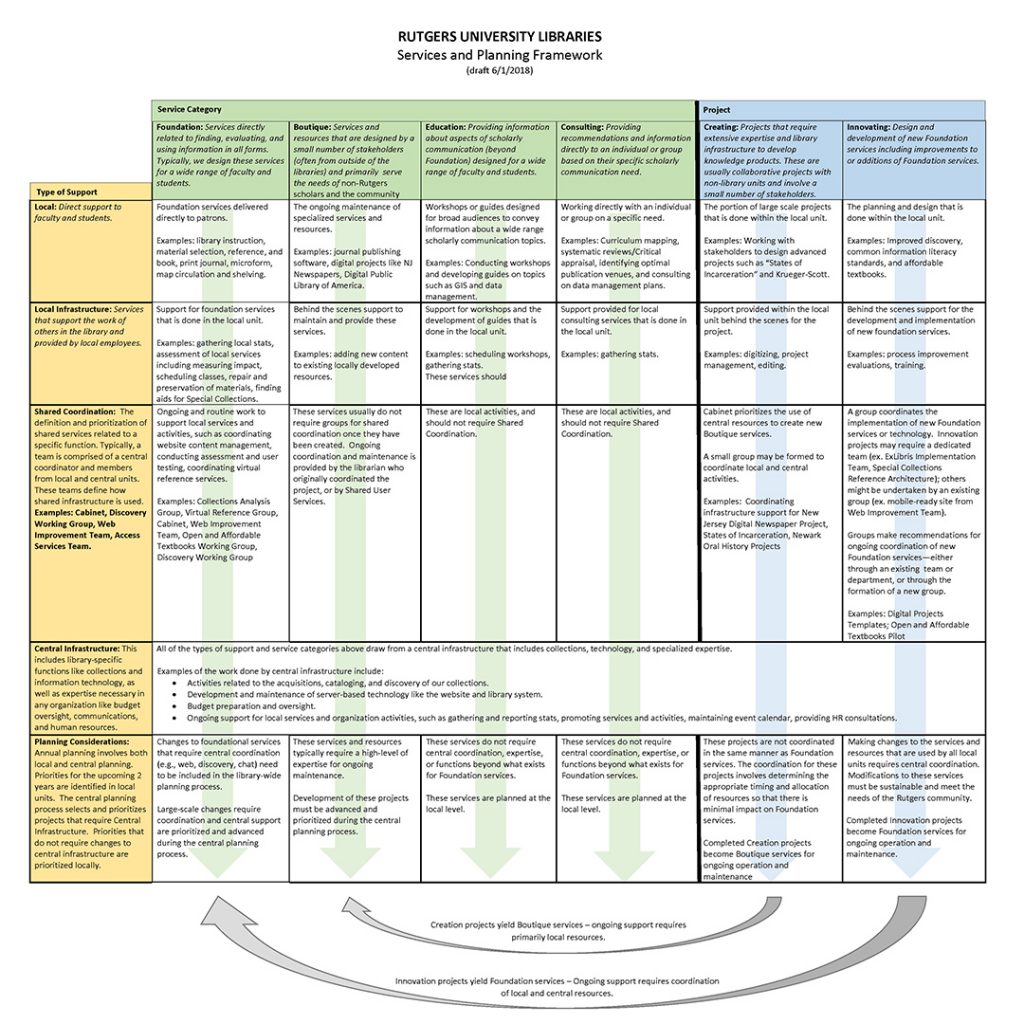
    For the last two months, I have used the Agenda to provide updates about a framework we are developing to provide us with a common vocabulary and a shared understanding of the relationships and dependencies between local and central services. Last month I focused on the local aspects of the framework, with the intent of talking about the central aspects this month.

    However, two weeks ago Cabinet had a retreat to discuss local priorities and to begin developing realistic expectations of what would be possible for the Libraries to accomplish with our shared infrastructure. Before continuing the framework discussion, I think it will be useful to review the outcomes of the retreat, including the overarching themes that emerged from our discussions.

    Now that we have filled the Library Director positions, our planning processes are in full swing. The Library Directors came to the retreat prepared to discuss their most pressing needs and how best to use the shared infrastructure. The conversations were good because they were based on the needs of the campuses and communicated with a strong sense of collaboration and common purpose.

    By the end of the day, several themes emerged that describe opportunities and constraints that are common to all units.

    • Access to Collections: It is clear that the Alma/Primo implementation will be a catalyst for organizational change. The new systems will provide a platform to strengthen foundation services and will help us to better assess our effectiveness. They will also drive changes in workflows in every unit of the Libraries. It is easy to see how this implementation will result in changes for people working directly with the system (e.g., cataloging, acquisition, circulation), but what may be less obvious are the effects for those with less direct daily interaction with the system. Discovery will change, driving changes in the broader website. Links to our resources will change, meaning that every research guide and instructional object that directs users to a specific resource will need to be updated. Needless to say, the Alma/Primo implementation will be a big part of all of our lives in the coming year.
    • Library Instruction: There is a need for us to build course-related infrastructure to support student success and to improve access to open and affordable resources within courses. We have begun this process with the implementation of PressBooks, but it appears that changes on the horizon may also include Leganto, an advanced Alma module related to course reserves, and Credo Education, customizable information literacy modules. We will have to determine the balance between central coordination and local autonomy in the coming year. Student success is such an important part of the library mission that we have to take the time to invest in shared infrastructure.
    • Discovery and Website modifications: There were many requests for new features related to discovery and the website. In the coming year, most of the attention of the Discovery Working Group and Web Improvement Team will be focused on integrating new features related to the Alma/Primo implementation and to integrating the emerging course-related infrastructure. It will be necessary to focus our attention on foundation services this year; however, the strong platform that we are establishing will allow us to continue to develop boutique services in the coming years.

    I started this article with a mention of the effective discussions we had at this year’s retreat which is in and of itself a strong indicator of the final theme that emerged. The Libraries have succeeded for many years in an environment of grassroots endeavors that eventually coalesced into larger themes. The environment in which we find ourselves is moving far too quickly for this approach. In the coming year, it will be necessary to acknowledge and support the roles of managers in prioritizing and effectively advancing the missions of the Libraries. Over the past few years, we have focused on the importance of Library Directors in setting priorities for their libraries that meet the needs of and support the unique priorities of the campus environments in which they operate. For an example of how that is happening, take a look at the Framework for Change established for Dana Library and the Institute of Jazz Studies in response to Rutgers-Newark priorities. In order to support robust local plans and Librarieswide priorities, we need to focus on infrastructure and strengthen the role of the manager in understanding the priorities of the Libraries and prioritizing work accordingly. The Alma/Primo implementation is the perfect catalyst for this change.

    This is an exciting time for the Libraries. We are recognized as a unit that provides leadership at Rutgers and is focused on the mission(s) of the University. I can see the progress we are making. Although we have a lot to do, this will be a productive year and will result in a stronger and more flexible organizational structure. Next month, we are back to frameworks!

  • Sharing Rare Books and Artists’ Books with the Blind and Visually Impaired

    On March 14, we hosted a visit from the Joseph Kohn Training Center for the Blind (130 Livingston Avenue, New Brunswick). The idea for the visit originated in a phone conversation initiated by Amo Musharraf, an instructor at the center, with Christie Lutz, the New Jersey regional studies librarian and head of public services. Since Amo expressed a desire for his class, consisting of 15 blind and visually impaired students and three sighted aids, to look at some of our rare books, Christie put him in touch with me. I remembered meeting Amo several years ago when he dropped by to look at copies of early editions of Paradise Lost, and I was delighted to be back in touch and to be included in what promised to be an adventure. In my 26 years at Rutgers, I had never addressed a class comprised of blind and visually impaired students. Seeing feels indispensable to me, and a lot of the pleasure I find in rare books and art derives from the visual. The question was, what would a blind class find pleasurable in our collection?

    Without sight, other senses—like touch and sound—would be more important. We started by gathering volumes that had interesting tactile elements, for example, a brace of bindings in various animal skins—goatskin, calf, sheep, and vellum. Snakeskin, cowhide, and velvet were suggestions from our rare book cataloger, Silvana Notarmaso, who agreed to speak about them. Not only is Silvana knowledgeable about these materials, but it seemed to us that the class might benefit from hearing different voices.

    It also seemed a good idea to refine the touch experience. Feeling the difference between rough sheep and smooth goatskin would be a nice introduction, because everyone would easily know what they were supposed to be feeling; but touching and analyzing differently finished grains of goatskin would be more challenging and rewarding. After a second or two, students were engrossed in contrasting the milky smoothness of a flat grain finish (which feels like the arm of a leather couch or car seat) with the grooves of a straight grain finish (resembling the surface of a vinyl record, only slightly softer). We told them that, like writers, bookmakers made an effort to appeal to all of the senses. Bookbinders wanted their customers to luxuriate in the sense of touch, and that historical bookbinding was a complex trade.

    To these books we added 15th-century wooden bindings, and 19th-century cloth. As well as helping the students to connect sensually with the objects, we wanted to engage them intellectually by sharing some of their history and contents. So, we talked a little bit about binding history, pointing out that the earliest printed books were bound simply in durable wooden boards with tough leather spines, or workaday vellum, and we shared notes about the texts themselves and our personal experiences with them. For example, we explained that the small octavo book with wooden boards (knuckles rapping for emphasis) and the remnants of a scallop shell clasp was a 1480 edition of the first cookbook ever printed (the same book the great French chef Julia Childs had handled when she came to Rutgers to accept her honorary doctorate); and we noted that the grooved finish of the clothbound first edition of Cooper’s The Song of Hiawatha represents the trade binder’s attempt to manufacture for a wider audience an imitation of the surface of the elegant bespoke goatskin bindings handmade for the wealthy collectors.

    This turn of the discussion led into an aside about book collecting in which we explained that historically, books finely-bound with gold decorations were prestige items acquired by the wealthy and powerful, generally male—a cultural phenomenon that went back to the great Renaissance libraries of collectors like the Medicis—and that the spines of these books were often lavishly tooled in gold because they would be showcased glittering on private library shelves. The boards were less often or more humbly adorned because the books would seldom be taken down and hardly ever read. One of the older students, an African American female whose eyes were almost completely white, commented insightfully, “Oh, that’s why there were so many power paintings of men holding books.”

    Other students made similarly perceptive comments, so that the class often resembled an extended conversation or symposium. And we were constantly reminded of the students’ range of experience: when Silvana talked about the snakeskin and crude cowhide bindings used on Argentine publications, and mentioned that SC/UA holds three copies of Martin Fierro (el Gaucho), a 2,316-line epic poem by the Argentine writer José Hernández, all bound in cowhide, one of the Latina students spoke briefly about Fierro’s popularity.

    We also selected books of unusual proportions and mass. Bodies respond in different ways to books of different size. The highlight of a group of large, tall, and chunky books was a massive early volume of musical notation hand-drawn on parchment sheets measuring approximately three feet in height bound in stiff, well-wormed leather over wooden boards decorated with metal bosses and the remnants of heavy, metal clasps. The students were taken by the sweep of the vellum pages, by the harsh, lumpy, pitted surface of the boards, and by the immense weight of the thing. They congregated around this book, and continually asked questions about it, such as what causes worming (one of the students was surprised and delighted to learn that bookworms were an actual thing), what purpose the clasps served, how such an immense book was used and by whom, and whether anyone who could read the musical notation ever came by. The commanding dimensions of the volume made it the focal point or perceptual center of the class, and I pointed out the obvious fact that it would have been so in a church or monastery. The auratic power of the book, realized in this particular volume, was a cultural reality, one we forget when we examine texts on computer screens.

    And we talked about how the authority of the book could be subverted for artistic purpose in a discussion of artists’ books. Most of the students had never heard of artists’ books and some expressed reservations about the concept (they laughed when I pointed out that they were frowning), but they regarded the objects with a great deal of intense interest and open-mindedness.

    Recently acquired glass books by Amanda Thackray were passed around gently, almost reverently. The students showed great respect for the integrity of the object and thoughtfully considered the artist’s statement that books are bodies and she wanted her artists’ books to be held. To contrast Amanda’s weighty, artistically rounded glass, I handed them a book by Anna Pinto consisting of calligraphy on light driftwood shaped by the sea. The diverse non-traditional materials used in Suellen Glashausser’s artists’ books (margarine wrappers, aluminum foil, pieces of metal from a Sprite soda can, cigar labels, cardboard collars, brown paper bags, etc.) provoked side conversations. The students were impressed by Suellen’s ability to find the voice in virtually any material, as well as her belief that every material has something valuable to say. One of the aids intensified our sense of communing with the artist by telling us she had studied with Suellen at Montclair State University and that she had been a fabulous teacher.

    The class responded thoughtfully to Buzz Spector’s elegant single sheet work Cage. Buzz deliberately printed Cage on a handmade paper that crackles when handled. (I passed the sheet around for the students to hear.) His intention seems to have been for beholders of the work to have an acoustic experience to facilitate a connection with John Cage’s famously silent 4’ 33”.

    The most popular artists’ book was Marcia Wilson’s provocative All the Men I Ever Slept With, a coffin-shaped wooden book with a metal screw through the bottom that serves as a binding agent. The joke of the screw poking through the images and becoming a three-dimensional extension of the imagery is immediately comprehensible (the students were eager to feel the book and explain the joke to each other as they passed it around). Having already handled driftwood and glass books, they grasped the idea that form is information, and laughed at the fresh ingenuity of the object; they responded to my reading a page of the author/artist’s text by pointing out that while it was amusing, it was also wistful—that the book wasn’t the cartoon (my word) it first appeared to be.

    Naturally, since Paradise Lost inspired Amo to arrange the visit, we featured it in a selection of iconic texts including our editio princeps of Homer (1488), the second folio of Shakespeare (1634), and The King James Bible (1611). It seemed important to say that according to legend, the great Homer was also blind, and we sought to emphasize its importance by processing around the room with the book in hand inviting everyone to touch the cover. The students asked us to open the book so they could feel the pages as well.

    The class was intensely responsive, engaging, inquisitive, and astute. Their visit to our library was clearly important to them, as it was to us, and midway through, the director of the program, Dell Bashar, drove over to be a part of it. One of the students, Dave, who was graduating at the end of the week, caught him up on some of what he’d missed, summarizing a good 40 minutes of our talk in about five minutes. Another student wanted us to discuss a book we had overlooked (a multivolume edition of Lawrence Sterne’s Tristram Shandy housed in a slipcase with a false front that resembled the curved spines of three substantial volumes side-by-side). She had found the object on her own and she couldn’t work out by touch what it could be. She wanted to know.

    Although we had arranged in advance to take photographs, the demands of the class made it impossible. The photographs here were taken by Amo and by one of his aids. When Amo texted the photos he jokingly captioned one of me looking surprised: “Your reaction when three vans full of blind people showed up looking for you :)”

    Amo deemed the visit successful, calling it “history,” and Dell said he would like to bring future classes to see our collections.

  • Annual Celebrations for Faculty of Rutgers University Libraries (2018)

    We tip our hats to the following colleagues who are celebrating milestone employment anniversaries this year. Join us in congratulating them all and thanking them for their service to Rutgers University and the Libraries!

    10 Stephanie Mikitish (Dana Library)

    Tao Yang (Collection Development and Management)

    20 Erika Gorder (Special Collections and University Archives)

    Ronald Jantz (Shared User Services)

    Laura Mullen (New Brunswick Libraries)

    30 Rebecca Gardner (New Brunswick Libraries)

    Connie Wu (New Brunswick Libraries)


    Save

    Save

  • Ex Libris Implementation Project Update – April 2018

    ExLibris graphicAlma Workshop 

    From March 13 to 15, an Ex Libris consultant came to the Libraries and facilitated a three-day workshop on Alma workflows. The first one and half days of the workshop were devoted to technical services topics, from ordering to receiving/activating to invoicing to cataloging. The second half of the workshop covered fulfillment issues, such as user management, circulation, requests, resource sharing, and course reserves. The participants of the workshop included the Implementation Team members, the working group members, and staff from technical, collection, and access services. The university librarian also attended most of the sessions. The feedback on the workshop was generally positive: The Ex Libris facilitator was very knowledgeable and well prepared. The demonstrations went smoothly. The discussions were both lively and calm, perhaps thanks to the puppy pictures the facilitator included throughout her presentation.  

    An important takeaway for everyone at the workshop is that we need to think about changing our workflows and sometimes policies to maximize the benefits of Alma, instead of simply trying to transfer our current practices in the Sirsi environment to Alma. This will guide the work of the team and working groups in the coming months. 

    Other Developments 

    Preparing for and participating in the Alma workshop was the main activity for the Implementation Team and working groups in March. All the working groups were also busy with both internal training and testing. The Implementation Team had four weekly training sessions with Ex Libris, two on Alma and two on Primo VE. On the migration front, the Data Migration and System Integration Group is currently working hard on third-party integration issues. 

    Submitted by Tao Yang and Abbey DiPaolo 

  • What’s Happening around Rutgers? April 2018

    Rutgers DayRutgers Day

    Saturday, April 28
    10 a.m.–4 p.m.
    Universitywide

    The biggest event of the year—Rutgers Day—is just around the corner, and the Libraries will have representation across the university, with activities in Camden, Newark, and New Brunswick (on both the College Avenue and Busch campuses). Plan to stop by our tents to see all we have in store—or check in with your local committee leader to ask if they need an extra hand. We’ll see you there!

    MI ColloquiumMI Colloquium

    Tuesday, April 3
    7–8:30 p.m.
    Alexander Library, Rutgers–New Brunswick 

    The Master of Information program at the School of Communication and Information has invited us all to their colloquium on Tuesday, April 3.   The speakers for the evening are ALA president-elect Loida Garcia-Febo and Reforma president Tess Tobin. The focus is how to help Puerto Rico’s libraries recover from Hurricane Maria. Presentations at 7 p.m. will be preceded by a reception. See the flyer for more information.

    Comic ConCamden Comic Con

    Saturday, April 14
    10 a.m.–6 p.m.
    Rutgers–Camden

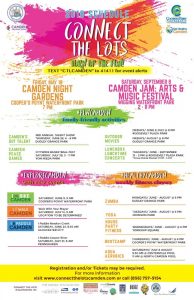
    Camden Comic Con is a free, all-ages comic convention. Guests for this year include Adam McGovern, Gail Simone, Kirsten Gudsnuk, Mark McKenna, and more. Tons of vendors, cosplayers, and programs are also in store. Learn more at CamdenComicCon.com.

    Alternative Solutions for Life Sciences

    Thursday, April 19
    8:30 a.m.
    Life Science Building, Busch Campus, Rutgers–New Brunswick

    This free event features industry experts and successful entrepreneurs who will provide key insights into the current life sciences funding landscape. As an attendee, you will learn strategies for attracting financing to support your venture’s next round of development, based on real-world examples from local entrepreneurs and c-suite executives. Mark your calendars for what is sure to be a memorable morning of stimulating conversation, helpful information… and a good breakfast. Reserve your seat at http://go.rutgers.edu/iexj7r1i.

    Lewis Porter-Phil Scarff Quartet Plays Jazz and Indian Ragas

    Wednesday, April 25
    2:30–4 p.m.
    Dana Library, Rutgers–Newark

    This is the last in the series with Music Professor Emeritus Lewis Porter (pianist) and guests. Boston-based saxophonist Phil Scarff (http://www.philscarff.com/) performs Indian classical music and jazz and leads the acclaimed world-jazz ensemble, Natraj, which has performed domestically and abroad. With John Funkhouser on bass, and Bertram Lehmann on drums, the group will perform standard jazz material by Monk, etc., as well as original pieces inspired by North Indian ragas. Visit the Rutgers–Newark website for more information.

    ZimmerliThis Month at the Zimmerli

    The Zimmerli Art Museum invites the campus community and general public to a broad range of free programs this April!

    • 3: Art After Hours: First Tuesdays features curator-led tours, an artist’s talk with photographer Bill Owens, and live music by New Brunswick’s own Noordzo.
    • 6: Enjoy your lunch at a Lunchtime Chamber Music Performance with a short program of works by Mozart, Faure, and Brahms.
    • 7: The museum hosts the second annual NOFLASH Video Show, a one-night event featuring avant-garde short films by emerging artists. Please RSVP here.
    • 8: Families are invited to get creative at Art Together, a drop-in interactive workshop.
    • 11: “Identity, Imagination and Science: Helen Lundeberg’s Surrealism” Lecture and Reception
    • 15: A curator’s talk explores the topic “Bursts of Color in Nineteenth-Century Lithography” in the exhibition Set in Stone: Lithography in Paris, 1815-1900.
    • 17: Celebration of Storytelling and Teacher Workshop is an annual offering for families and educators. Please register here.
    • 19: “East Meets West: Japonisme and European Art” Lecture and Reception
    • 24: Launch of Aperture magazine’s “Prison Nation” issue, accompanied by a panel discussion.
  • This Month in the Agenda: April 1988

    The AgendaAll Work and No Play… From the University Librarian

    I have a new personal computer at home, fully compatible with the office computers, and there is a busy traffic in diskettes with work begun in one place, completed in another, spell-checked, proofread and printed in yet a third location. It’s a wonderful productivity tool and an interesting toy as well.

    However, my new-found ability to mingle further my work and personal life leads me to speculate about how this sort of technology may in the future blur the distinction between work and home and between work time and leisure time. When I find myself contentedly bent over the terminal right into the middle of “Cagney and Lacey,” I know something different is going on.

    The Agenda 10, no. 14 (April 4, 1988)

    We’ll TSB-Seeing You Soon!

    After all the years of planning, we finally have definite news about the new Technical Services Building for the Libraries which is to be built on the Busch Campus next to the existing Annex…. [The] schedule has been considerably shortened in the contract as awarded, and now calls for building completion by October 29, 1988. Allowing a month for furniture installation in November, the schedule now provides for our moving into the new building in December. Though delays can always occur, it is now possible for TAS to begin thinking about being in the new building by the December holidays.

    The Agenda 10, no. 14 (April 4, 1988)

    In a Bind?

    On Friday, April 15, a field trip to the Library Binding Company, Horsham, PA is planned for SCILS students enrolled in the Preservation course. R.U.L. staff members are invited to join the group, especially those involved with commercial library binding. It is a good opportunity to view a binding operation and to ask questions about services. Library Binding Company handles a lot of Rutgers’ materials. If you want to go, please contact Susan Swartzburg, ext. 8573, as soon as possible.

    The Agenda 10, no. 14 (April 11, 1988)

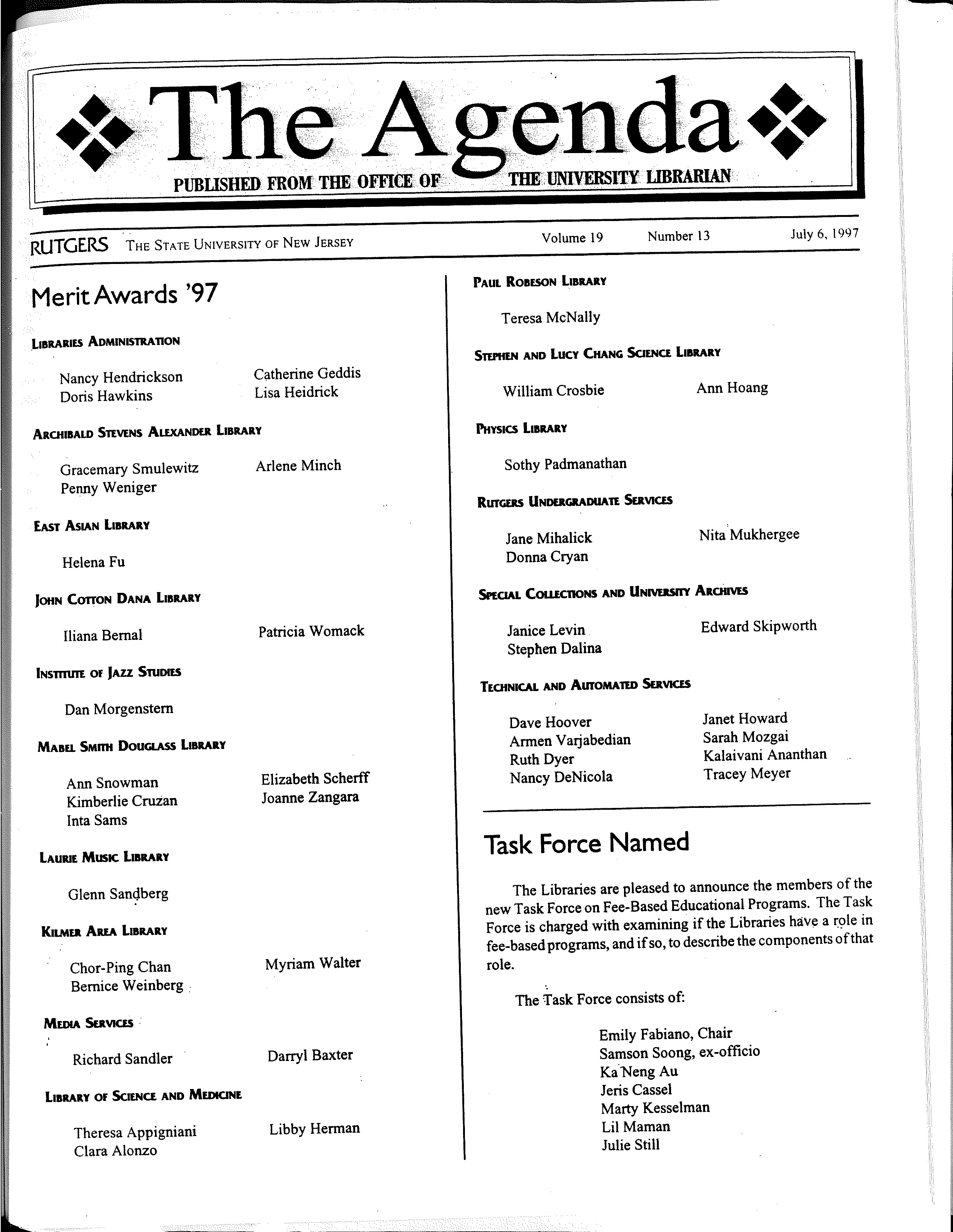
    The Honorable Natalie

    Congratulations to Natalie Borisovets who has been elected by the Library Faculty to serve as a member of the University Senate. Her term of office will begin July 1, 1988.

    The Agenda 10, no. 16 (April 18, 1988)