Category: Articles

  • Website Redesign Project Update – May 2020

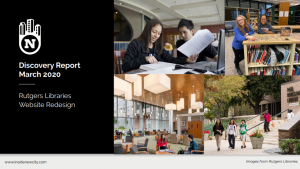
    Screenshot of NewCity discovery report
    The discovery report is available on the project team’s staff resources site.

    The Discovery phase of the website redesign project has officially concluded. Feel free to peruse NewCity’s Discovery Report, which outlines their findings from their onsite visit, one-on-one interviews with some key stakeholders, discussions with the core project team, an intercept survey, and analytics. They tease out some of the characteristics that make RUL’s different units unique, as well as what unites everyone, and what some of our biggest challenges will be as we move forward with this project.

    We’re excited to be starting audience research this month. Over the next ten weeks, NewCity and the RUL project team will be working with local teams and directors to survey and interview our user groups, define the brands and goals for each campus, and move toward a baseline understanding of what our users need and how they behave. While we’d love to be able to meet face-to-face with our users, we’re not letting COVID-19 slow our progress—we’re working with NewCity to develop a robust research plan that we can deploy entirely online.

    To help coordinate, conduct, and analyze this research, we’ve formed a Local Library Owners team, an augmented version of our core project team. We’re happy to welcome John Gibson, Samantha Kannegiser, Angela Lawrence, Amber Judkins, Christie Lutz, and Victoria Wagner to the project.

    Audience research doesn’t apply only to our external users; we’ll be working with the RUL audience as well. As we develop a web presence that has room for more “local flavor,” we need to be sure to empower local content editors to create and contribute content and design that works best for their units. Our new site will employ a component-based system that will allow local contributors flexibility and ease in creating and customizing local content while keeping the site sustainable for the central technical team.

    The project team continues to meet bi-weekly, with additional meetings now being added as we begin the next period of intense focus on audience research.

    You’re welcome to reach out anytime with questions or comments. Send us an email: webservices@rutgers.libanswers.com
  • Ex Libris Implementation Team Update – May 2020

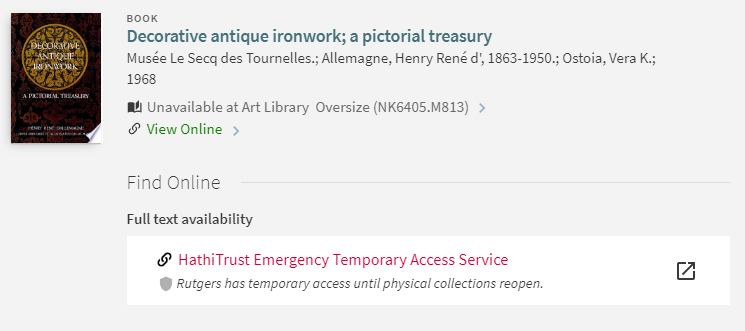
    Rutgers students, faculty, and staff can now access over a million digitized texts available through HathiTrust’s Emergency Temporary Access Service (ETAS). In response to the current public health crisis, HathiTrust is providing member libraries with temporary access to digital versions of print titles that would otherwise be inaccessible due to library closures. As a result, the Rutgers community now has online access to over 1.2 million volumes previously only available in print. This is in addition to the more than 6 million public domain and Creative Commons-licensed works already accessible through HathiTrust.

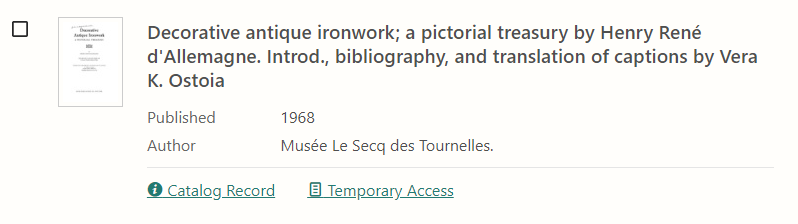
    Rutgers users can search for these titles in QuickSearch or the HathiTrust Digital Library. Books available through ETAS include a note indicating temporary access.

    View in QuickSearch.
    View in HathiTrust.

    Terms of service

    • “Temporary Access” books require NetID login and can only be accessed by Rutgers students, staff, and faculty.
    • “Temporary Access” books can be read online only. Unlike “Full View” books in HathiTrust, they cannot be downloaded for offline reading.
    • “Temporary Access” books can be checked out for one hour. The banner at the top of the browser informs you how long the book is checked out to you. Your access to the book will automatically renew as long as you are actively reading it.
    • If the book you want is currently checked out, a message will display letting you know that the book is in use. Check back later to see if the book has been returned. Unfortunately, it is not possible to request or place a hold on a book. Because access is limited, users are encouraged to return books as soon as they are done using them.
    • “Temporary Access” books will only be available online until access to the Libraries’ print collection is restored.

    For more information, including instructions for accessing ETAS books on your mobile device, see https://www.hathitrust.org/ETAS-How-To


  • Recapping State of the Libraries 2020

    Thanks to everyone who attended State of the Libraries on Wednesday. We had over 200 folks join the meeting, and I’m so glad you all found the time to be there even with the competing demands of work and home. It was no replacement for our traditional in-person gathering, but it was nice to feel a sense of togetherness despite the circumstances and our physical distance.

    If you haven’t had a chance to yet, I encourage you to view the poster presentations prepared by our colleagues from across the Libraries:

    It is so inspiring to view these and reflect on all the good work that has been done over the last year, as well as how we are preparing for the work that lies ahead. There will be no shortage of challenges in the year to come, but with all the creativity and dedication on display through these presentations, I know we are well-equipped to handle whatever comes our way.

    If you’d like to review them, you can view the slides from all the presentations on our staff resources site or a recording of the entire event on YouTube.

    As you might imagine, a lot of activity happened behind the scenes to make sure everything went smoothly. Special thanks to Kalaivani Ananthan, Matt Badessa, Tracey Meyer, Joann Parrone, Ed Smith, and the Major Events Committee—Elsa Alves, Matt Bridgeman, Ann Marie Latini, Erica Parin, Tonie Perkins, Jennifer Reiber, and Daphne Roberts—for their support.

    We also received some great actionable feedback that we will incorporate into our future virtual gatherings, so thanks to everyone who provided thoughtful comments via the feedback form.

    A theme that emerged from all of yesterday’s presentations was collaboration, and State of the Libraries was just another example of what we can accomplish when we all work together with a common goal and sense of purpose. I hope we can carry forth some of those lessons and apply them to our work moving forward. In the coming months, it’ll be more important than ever to identify the areas where we can leverage our shared interests and maximize our impact on the university community.

  • This Month in the Agenda – March 1982

    That’s Special

    Anticipating the physical and programmatic merger of the Department of Special Collections, University Archives, and the Records Management Program later this spring, University Librarian Hendrik Edelman has asked Ruth Simmons to serve as coordinator.

    Funds for the renovation of the New Jersey Room, staff offices on the B Floor and stack space on the BB Floor of Alexander Library have been received from the Board of Trustees and the University Administration. It is expected that all physical changes will be completed by this summer.

    The Agenda 4, no. 9 (March 1, 1982)

    Brenda in Charge

    Brenda Johnson has been named Head, Document Delivery Services/New Jersey Reference Services effect March 15. In this new position, Brenda will manage the interlibrary loan borrowing and lending service, provide assistance in bibliographic verification and location, and maintain liaison with unit reference librarians at RGL libraries and at other state, national, and international institutions.

    The Agenda 4, no. 11 (March 15, 1982)

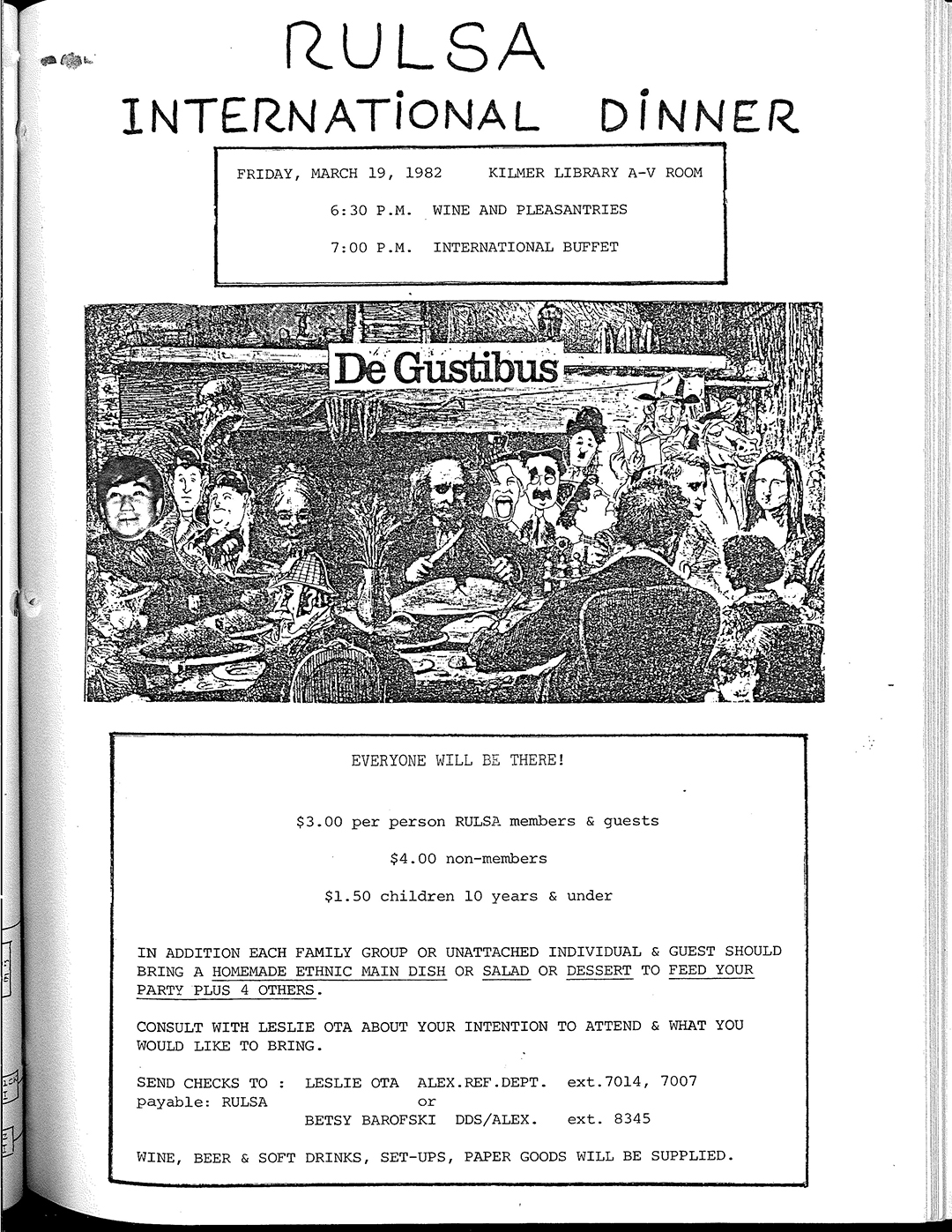
    Wine and Dine


    Camden Gets the News

    IN/FORM is a group of databases which include items published in the Philadelphia Inquirer and the Philadelphia Daily News; the major Philadelphia daily newspapers. IN/FORM provides full text access to these papers and permits searching on words/phrases in the complete text, and searching on fields such as headlines, bylines, and a limited set of descriptors and delimiters.

    The Agenda 4, no. 12 (March 22, 1982)

    Hey, Watch It!

    FROM THE PRESERVATION OFFICE

    No Scotch tape should be used under any circumstances to attach notes to the covers of books. Please place your memo concerning the book inside the front cover.

    The Agenda 4, no. 13 (March 29, 1982)

  • Web Redesign Project Team Update – March 2020

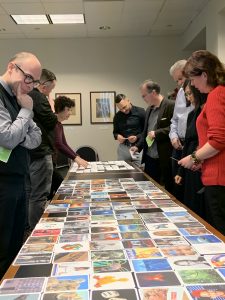
    Participants sort cards during NewCity’s on-site visit in February.

    The website redesign project has gotten underway. We are currently in the discovery phase, which has several objectives: to identify stakeholders and learn about their goals for the project; to uncover our needs as local communities delivering shared resources; to understand our technical infrastructure and plan for the future; and to strategize future engagement with our internal and external audiences.

    The project is being managed as a joint venture between Rutgers University Libraries and NewCity, a website design company experienced with higher education, large non-profits, and commercial companies.  The project team, which is co-led by Antonio Barrera (Library Applications and Development) and Amy Kimura (SUS), includes members from across RUL: Doug Allen, Matt Badessa, Megan Lotts, John Powell, Jonathan Torres, and Yini Zhu.

    On February 11 and 12, 2020, three members of the team from NewCity came for an on-site visit. They met with the project team, Cabinet, and additional faculty and staff representatives from across the campuses to lead a number of activities designed to explore the needs of our stakeholders, communities, and to reflect on each unit’s similarities and differences, while considering success measures for this project. One of the main goals was for NewCity to get to know us so they can be sure they’re capturing the authentic voices of the libraries.

    NewCity will use these conversations and stakeholder interviews, together with a wealth of other qualitative and quantitative data, to build a comprehensive Discovery Report that they will deliver in the coming weeks. This report will help inform our site’s design and content strategy. We’ll make it available on the project team’s website, where you can also find other key documents related to the project.

    We plan to launch the new sites in June 2021 in order to minimize mid-year disruption. That gives us ample time to build the sites, provide training, and populate the new spaces with helpful, up-to-date content that best fits the need of each location and supports streamlined delivery of our shared resources. We will continue to update our project team site as we make progress, so check back frequently.

  • Digital Exhibits Page

    Continuing the work of presenting our digital projects in a consistent arrangement, the Digital Exhibits page is available with its first five digital exhibitions. The page summarizes the completed projects and links to each online exhibition and its exhibit catalog. While the panels and web pages reflect the distinctiveness of the subjects, they share unified theming. They have consistent links back to the main Digital Exhibits page as well as the Libraries home page. Be sure to check back from time to time, as more are on the way in the months to come.

  • Digital Projects Status Page

    Over the past couple of years, the digital projects team in Shared User Services has been actively assisting campus libraries in organizing their work on digital collections, and making them available online. Thirty-one such projects are now publicly accessible through our digital collections page and span a variety of topics, from Inclusion and Diversity, to showcasing the research articles and presentations of our undergraduates. This list continues to grow, as new collections are proposed and some of our ongoing projects continue to be renewed and expanded upon.

    But everyone wants to know what’s in the pipeline. In order to keep the RUL community up to date on the projects we’re working on, we’ve created a page for Pending and In-Progress Digital Projects that lists most of the digital collections and exhibits that are upcoming, along with their status and proposed work timelines. We hope you’ll visit our status page and keep abreast of our ever-growing digital collections work!

  • New Brunswick Libraries and the Google Book Project

    Google carts will arrive at Rutgers on March 2 for loading, with three quarters of them going to NBL.  Of the ca. 194,000 volumes listed on the Google candidates spreadsheet, roughly 86% were in the New Brunswick Libraries.

    Nearly 29% of the NBL Google candidates are in the Annex, and we’re beginning the process there.  The NBL Google Team made the decision to use the 1900 publication date as the cutoff for anticipating whether scanned material might eventually become freely available and would not need to return to RUL.  This date is a compromise and approximation; copyright findings are a complex process with later or earlier dates for American and non-American publications.  Stephanie Bartz arranged the Annex Google candidates in call number and (for the journals) title order, and I gave NBL selectors two months to decide for materials in their subjects whether to accept the “send–do not return” option for pre-1900 publications, or “opt out” and require materials be returned.  RUL will have search-only access in HathiTrust to scanned in-copyright publications, and we will retain the hard copy of these volumes after scanning.

    Many NBL subject specialists weighed in with their preferences by initialing the spreadsheets or expressing them in meetings and online.  The Annex candidates include many books and journals that saw the bulk of their circulation many decades ago and are now in poor condition, but available digitally or via interlibrary loan.  As we finalized the Annex spreadsheets, I made decisions where selectors had not based on their expressed preferences and a conservative interpretation of RUL’s Print Retention and Withdrawal Guidelines that permit withdrawal of last copies if we have perpetual digital access to the content or at least five copies in North American libraries.  Our current estimate is that of 54,115 volumes on the Google spreadsheet, 88% will be sent but returned, and 12% (mostly journals) will be sent but not returned with the prospect of both digital access and continued interlibrary loan access to the hard copies.  I believe we found a good procedure that observes RUL policy and values the expertise of our subject specialists while eventually gaining badly needed shelf space for our Annex.

  • Schedule Meetings More Easily with FindTime

    FindTime is an Outlook add-in that allows you to easily identify and come to a consensus on meeting times. FindTime shows you the dates and times you and your attendees are available based on the free/busy data in Outlook calendars. A poll is created within an email message which is sent to invitees who can vote on their preferred times. Because FindTime is integrated into Office 365, you no longer need to use separate applications, such as Doodle, to poll colleagues for meeting times. Invitees do not need to install FindTime to vote on meeting times, and invitations can be sent to any email address including external addresses.

    FindTime works with Outlook on the Web (OWA), Outlook 2016 (desktop version), and Outlook for Mac. When using it for the first time, you will need to install the add-in and you will be prompted to sign in to authorize its use. More information on FindTime can be found here.

    If you have questions about FindTime, please do not hesitate to contact IIS by phone at 848-445-5896, option 7, or by email at support@rulhelp.rutgers.edu.

  • Teaching and Learning: LibGuides in Canvas

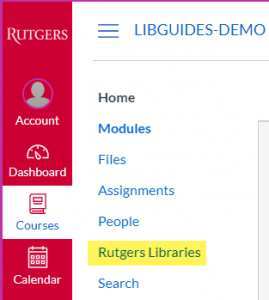
    A link to library content in the Canvas shell.

    Did you know that links to LibGuides and Library information are already included in all Canvas shells?

    Clicking on the Rutgers Libraries link in Canvas course navigation will display a page with a link to a LibGuide(s) and also Library information.

    By adding Canvas course metadata to a LibGuide, Librarians can connect students to LibGuides that are directly related to their course.

    There is no limit as to how many courses can be connected to one guide, and there is no limit as to how many Libguides can be connected to a course.

    View this document to see how to connect your LibGuide to a Canvas course.

    LibGuide authors who have questions about LibGuides may contact Maria Breger at maria.breger@rutgers.edu

    View the complete list of the Libraries Teaching & Learning topics.