Category: Articles

  • My Trip to Speak at Carnegie Mellon-Qatar

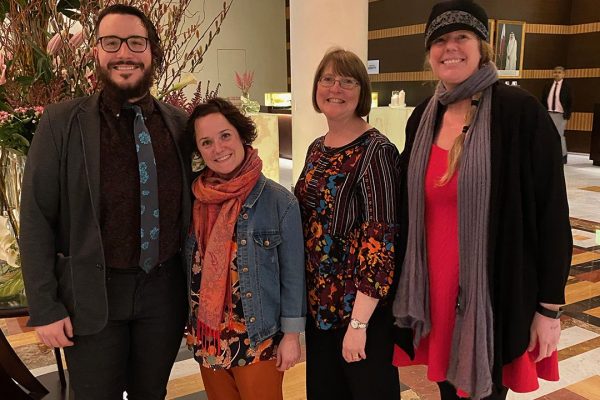
    • Megan Lotts (r.) and her Carnegie Mellon collaborators.

    On February 1, 2020, I boarded a plane with bags full of LEGO as well as Rutgers University Libraries coloring books, zines, and library swag.  My final destination was Doha, Qatar to visit one of Carnegie Mellon’s satellite campuses. I was invited to Doha as the Carnegie Mellon-Qatar (CM-Q) Glorianna St Clair Distinguished Lecture in 21st Century Librarianship and gave a presentation titled “The Engaged Librarian: Fostering a Culture of Creativity and Play in Libraries.” This presentation was based off my previous work on makerspaces, active learning, and play in libraries, as well as new research from my latest book project on creativity for the American Libraries Association, forthcoming in 2021.

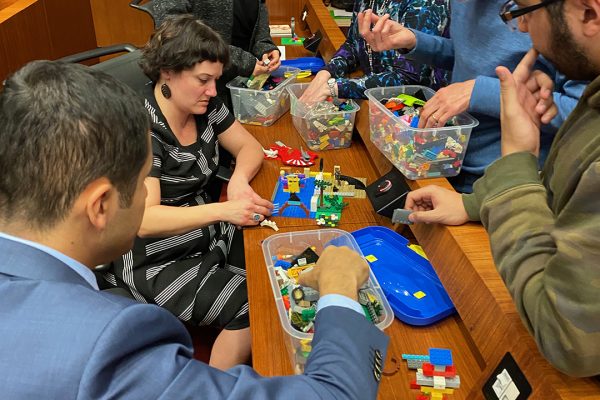
    While in Doha, I had the opportunity to collaborate on a zine and LEGO workshop for the CM-Q campus with Jill Chisnell, Dom Jebbia (both from Carnegie Mellon-Pittsburgh), and director of the CM-Q Library Teresa MacGregor. These events were attended by students, faculty, and staff members of the CM-Q campus as well as a few members from the Georgetown University-Qatar community.

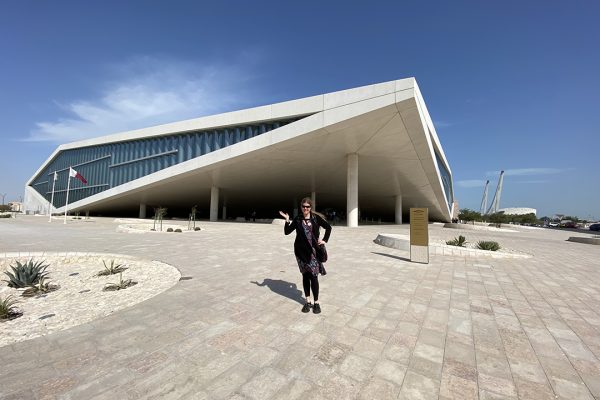
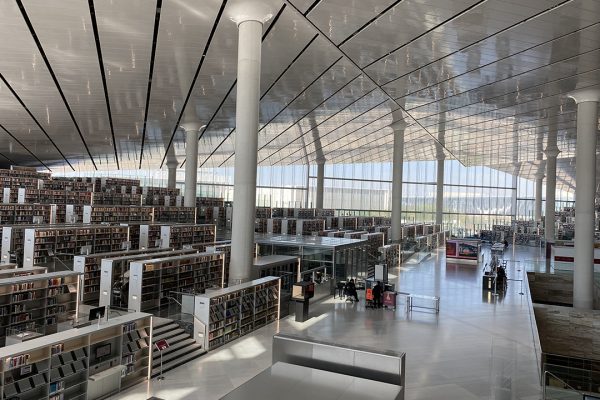
    Another exciting part of my trip was the opportunity to present my research on LEGO and active learning at the Qatar National Library (QNL).  This library, recently built by architect Rem Koolhaus, is jaw dropping. Having a soft spot for Koolhaus since reading his well-known text Delirious New York, I immediately fell in love with this elegant sculpture which houses unusual furniture, futuristic technology, and an elevator known as the “people mover,” which is similar to a ride one might find at Disney World in the 1980s.  Beyond the stunning architecture was a variety of unique spaces and resources that cater to the needs of the local Qatar communities, including a large children’s space, a music room, makerspaces, a beautiful café, an impressive auditorium, and more.

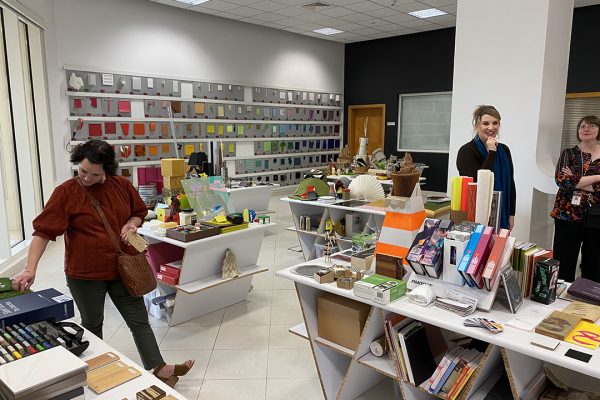
    Although there were many interesting cultural experiences while visiting Qatar, including buying goods at the Souq, the Materials Library at Virginia Commonwealth University-Qatar, and trying beef bacon, I was awestruck by the architecture including the QNL (Rem Koolhaus) and the Museum of Islamic Art, designed by world-renowned architect IM Pei. But perhaps most interesting was the architecture of “the Pearl,” an artificial island built on one of Qatar’s former major pearl diving sites. It’s not surprising that this stunning, futuristic, almost unreal structure houses some of the most modern neighborhoods in town. Fortunately, I was able to experience this space in person at a monthly community-building party hosted by Mike Trick, dean of CM-Q.

    If you have questions about this trip or my research, please contact me at megan.lotts@rutgers.edu or learn more about me at meganlotts.com.


  • Kicking Off another Planning Cycle

    It’s March, which means that another planning cycle is getting into full swing. At the Cabinet retreat tomorrow, we will begin discussing the 2020–2022 local priorities that have been developed by the directors. You can read them yourself on our Annual Planning and Priorities page: Camden, Newark, New Brunswick, RBHS.

    Over the past several planning cycles, information control has been among our top priorities as a system. This was based on feedback we received in the 2016 LibQUAL+ survey, which indicated we had room for improvement in this area in particular. As you know, this led to a whole suite of changes, not the least of which was the implementation of QuickSearch. We’ve also added extensive backfiles in recent years, working to address gaps in our collections so that they better meet the needs of Rutgers researchers. It has been a lot of hard work, but signs point to it paying off. The 2019 LibQUAL+ results, for instance, coupled with indicators like the drop in ILL numbers, give us reason to believe that we have made significant improvements when it comes to information control. This is a huge achievement for us, because it’s where our users indicate that they have the highest expectations for library service.

    That said, it isn’t entirely surprising to see that information control is becoming less of a focus area in some of the plans for this cycle. Of course, this doesn’t mean that this aspect of our work is any less important—it just means that we’ve laid an effective foundation and are ready to build toward new things.

    It is important that we take a moment to congratulate ourselves for this amazing accomplishment. Having a strong information control foundation allows us to build new services that will be both scalable and robust. These services fall into a category that we are calling in our priorities information management.

    Information management will be the organizing theme for many of our new initiatives in the coming years. One such area is our support for scholarly communication, and I wrote in my last post about Esploro and how it will strengthen our ability to provide open access to articles and data. We also see local initiatives in this cycle’s plans such as the Health Sciences Libraries’ pursuit of research information management services, Newark’s revitalization of the open access Journal of Jazz Studies, New Brunswick’s development of bibliometrics, or Camden’s creation of digital projects based on undergraduate and graduate student research. These are all encouraging signs that the work we’ve done is opening up new possibilities for how we serve the scholarly communities on our respective campuses, and I’m excited that we’re finally at the point where we can pursue these sorts of activities.

    My next Agenda post will be in May, and by then we’ll have had a chance to review the local plans and determine which priorities require central support. We’ll then begin finalizing the plans based on the capacity of our infrastructure and which priorities will move the most people forward. It’s an exciting time of year as the work on our horizons comes into sharper focus, and I look forward to exploring all the possibilities with Cabinet. But it’s also an occasion to reflect on how far we’ve come, and for that I have all of you to thank.

  • This Month in the Agenda – January 2000

    IRIS Offline

    Welcome to the new millennium! I hope everyone had a chance to enjoy the holiday and celebrate in style. The holiday break really flew by, and now we’re at the beginning of the new semester. As you all well know, this wasn’t a time for rest. Our systems staff were totally immersed in providing a critical upgrade of SIRSI software and loading our authority records. This was a massive undertaking that required a tremendous amount of work on the part of many in TAS. Because access to IRIS functions are an integral part of all our work, even those of you not directly involved with the upgrade and systems work were directly impacted by this project. The unavailability of IRIS meant a lot of work-arounds and the delay of many important front-line support activities. Our users, too, felt the absence of IRIS and the impact that had on their research and instructional plans.

    The Agenda 22, no. 2 (January 23, 2000)

    Talking Internet Ethics

    An article co-authored by Robeson Library’s Julie Still and Vib Kassabian, “The Mole’s Dilemma: Ethical Aspects of Public Internet Access in Academic Libraries,” has been published in v.4 #3 of Internet Reference Services Quarterly (pp. 7-22). The article discusses some of the ethical and legal aspects of allowing the general public free and unlimited Internet access. The authors note that denying the public access can be equally problematic, especially at publicly funded institutions.

    The Agenda 22, no. 2 (January 23, 2000)

    Happy Birthday NJEDL

    There’s a wealth of information “out there” on the environment in New Jersey, produced by a variety of agencies, organizations, scientists, and public individuals throughout the state. The challenge is finding, and bringing together, all the relevant sources when a comprehensive answer to a specific question is needed.

    A new project, led by two Rutgers librarians, will address that perplexing dilemma. The two librarians, Linda Langschied and Ronald Jantz of the New Brunswick Libraries of Rutgers University, will employ their professional expertise and the considerable computer resources of the Scholarly Communication Center in Alexander Library to build the New Jersey Environmental Digital Library. This project was recently endorsed by the NJ Department of Environmental Protection’s Geographic Information System (GIS) division which made a grant in support of the project – for a total of $92, 543.

    The Agenda 22, no. 2 (January 23, 2000)

    Welcome – and Congrats!

    Arrivals

    • Zohreh Bonianian, Library Assistant II, ALEX
    • Jessica Cintron, Library Assistant III, ROBESON

    Promotions

    • Anne Butman, Systems Programmer IV, TAS
    • Clark Sho Nakagama, Microcomputer Analyst, TAS
    • Jeffrey Teichmann, Library Supervisor II, LSM
    • Robert Terrio, Library Associate II, TAS

    The Agenda 22, no. 2 (January 23, 2000)

  • What’s Happening around Rutgers – January 2020

    Adverse Childhood Experiences, Social Determinants of Health, and the Road to Health Equity

    Tuesday January 21, 11 a.m.–12:30 p.m.
    Medical Science Building, RBHS Newark

    Luis Alzate-Duque, MD, Assistant Professor in the Department of Medicine at Rutgers NJMS, will present this important, socially-relevant talk addressing health inequity and the road to redress. All interested parties are encouraged to attend. Learn more.

    Outside the Wire: Speaking Out About Marginalized Experiences in the Military

    Wednesday January 22, 7–8:30pm
    Rutgers–Camden Campus Center, Multi-Purpose Room

    Outside the Wire is an annual programming series highlighting veterans’ narratives. This event pairs the lived experiences of veterans with speakers whose scholarly, journalistic, or creative work concerns veterans’ experiences. The panel will feature Samuel Black, curator of African American Programs at the Heinz History Center; Helen Benedict, author of The Lonely Soldier: The Private War of Women Serving in Iraq; and area veterans. Learn more and RSVP to attend.

    Hosted by the Writers House.

    Dogs and People and Dingoes

    Friday January 24, 3:30 p.m.
    Ruth Adams Building, Rutgers–New Brunswick

    As part of the 2019-20 Lecture Series of the Center for Human Evolutionary Studies (CHES), Dr. Patricia Shipman (Pennsylvania State University) will give a lecture, “Dogs and People and Dingoes.” Learn more.

  • Quick Takes on Events and News – January 2020

    Targum Documentary Spotlights NBMSA

    Islamic Art Wiki-a-Thon Returns to Dana Library 

    Dana Library hosted its second Islamic Art Wiki-a-Thon last semester. Professor Alex Seggerman’s Islamic Architecture course was one of a group of classes participating in the December 9 Islamic Art Wiki-a-Thon. Students spent the semester learning how to do research and edit Wikipedia pages. They prepared and wrote drafts, updating current Wikipedia articles on various Islamic architecture sites. During the event, they came together and made official changes to articles. They were joined asynchronously by students at Temple University and the University of Texas. 

    On Exhibit at Douglass Library 

    MARY H. DANA WOMEN ARTISTS SERIES GALLERIES
    Gendering Protest: Deborah Castillo and Érika Ordosgoitti
    Exhibition: January 21April 3, 2020
    Curator: Tatiana Flores, Associate Professor of Latino & Caribbean Studies and Art History
    Gallery Hours: M-F 9 a.m.–10 p.m.
    Public Event
    Reception and Artist’s Lecture: Wednesday, March 25 | 5:006:45 p.m.
    RSVP: womenart@cwah.rutgers.edu
    Galleries and event are free and open to the public.
    cwah.rutgers.edu @CWAHatRutgers #GenderingProtest 


  • Ex Libris Implementation Team Update – January 2020

    As you know, the Ex Libris Implementation Team has been working with the Law Libraries since May on a project to migrate their data to Alma and merge their library catalog with ours. During the week of January 6, we will begin the final steps of this migration. To help you navigate this transition, below are answers to some frequently asked questions about the project. If you have additional questions, please send them to the Ex Libris Implementation Team at exlibris@rutgers.libanswers.com.

    Q: When are the Law libraries expected to migrate to Alma?

    A: The migration is expected to be completed on January 10, 2020.

    Q: Will any services be disrupted or temporarily unavailable during the migration?

    A: No, Alma and Primo are expected to remain fully operational during the migration.

    Q: Will the collections of the Law libraries be discoverable in QuickSearch?

    A: Once migration is complete, all materials currently represented in Law’s library catalog will be discoverable in QuickSearch. Law patrons will also be able to access these resources through a separate custom view designed specifically for the Law School. Additional work is required to create and configure Law’s electronic resources. It will take up to 24 hours after go-live for all of Law’s electronic resources begin appearing in QuickSearch. Because this configuration must be done in our live production environment, users may experience intermittent access issues during this time.

    Q: Can Law’s circulating collections be borrowed or requested by non-Law School patrons? Are the loan policies the same?

    A: Yes, circulating materials can be borrowed or requested by any Rutgers user. To make borrowing between the libraries easier, loan polices have been made uniform.

    Q: Are there any resources that are restricted to Law patrons only?

    A: Yes, certain electronic resources (such as Westlaw, Lexis, and Bloomberg) are restricted to Law patrons only. Access to these resources is only available from a Law School IP address, via the Law School proxy, or with an assigned username and password. These resources will be visible to all QuickSearch users with a note indicating that access is restricted to Rutgers Law School students, faculty, and staff [view example]. To maximize visibility of this note, direct linking will be deactivated for all Law-restricted resources.

    Q: Will the Law migration result in duplicate records?

    A: Yes, you may see some duplicate records initially. There are plans to identify and remove duplicate records post go-live.

    Q: Where should I refer Law-specific reference and borrowing inquiries?

    A: Please direct patrons to contact the appropriate Law library:

    Camden Law
    Reference (856) 225-6173
    Circulation (856) 225-6172
    lawlib@camden.rutgers.edu
    Newark Law
    Reference (973) 353-5676
    Circulation (973) 353-5677
    refdesk@law.rutgers.edu
    Q: Who should I contact if I have additional questions?

    A: Please send questions or comments to the Ex Libris Implementation Team at exlibris@rutgers.libanswers.com.


  • Special Collections Open House

    You’re invited to an open house at

    Special Collections and University Archives

    Thursday, January 9

    1 – 4 PM

    Alexander Library

    Featuring snacks, demonstrations, and tours.

    RSVP

    Sign up for a tour of our galleries and vast storage areas

  • SAPAC Schedule 2020

    Join the Scholarly and Professional Activities Committee for these upcoming talks.

    Lies, Damned lies, and…What LibQual+ 2019 and other statistics mean to me

    Thursday, January 16, Noon-1:00 pm, Pane Room, Alexander Library, New Brunswick
    Grace Agnew, Special Advisor for Strategic Initiatives and Analytics

    So we did this survey in April, 2019.  But what does it mean for me?  Will anything change?  Does anything need to change?  Why do we collect numbers, anyway?  Grace Agnew will highlight the findings of the 2019 LibQual+ statistics, with specific emphasis on individual user groups and libraries, as well as other statistics we are collecting to get a handle on how we are doing with services and collections.  Much of the time will be discussion, as attendees share what they think the statistics mean, based on their observations when working with users.

    Learning from the Smithsonian: Reflections of a Museum Studies Fellow

    Thursday, February 13, Noon-1:00 pm, Pane Room, Alexander Library, New Brunswick
    Kayo Denda, Librarian for Women’s, Gender and Sexuality Studies, Douglass Library

    The presentation will be based on my 4 week-stay in Washington D.C., during summer ’19 as a museum studies fellow affiliated with the Smithsonian, Center for Learning and Digital Access. I will provide an insider’s view of the nation’s leading historical institution, its uniqueness and its challenges as they forge their future. The presentation will highlight select Smithsonian projects and tools, such as the Learning Lab platform, with great potential for the library community.

    Ithaka S+R Research study

    Wednesday, March 26, Noon-1:00 pm, Pane Room, Alexander Library, New Brunswick
    Triveni Kuchi, Social Sciences/Instructional Services Librarian and Faculty & Graduate Services Coordinator, NBL
    Jim Niessen, World History librarian, NBL
    Jon Sauceda, Music/Performing Arts librarian and interim liaison to Spanish, Portuguese, Latinx, Latin American and Caribbean Studies, NBL

    We examine the research practices of faculty in a particular field, namely language and literatures, to identify what resources and services scholars currently use and wish they had access to at Rutgers University – New Brunswick. This research was part of a study coordinated by Ithaka S+R, a not-for-profit research and consulting organization, working in conjunction with the Modern Language Association (MLA). In this presentation we would like to share our findings and recommendations.

    The Nick Virgilio Papers

    Monday, April 20, Noon-1:00 pm, Conference Room 290, Robeson Library, Camden (with Webex to remote locations)
    Julie Still, Reference Librarian/Collection Development Coordinator, Robeson Library

    The Nick Virgilio Haiku Archives arrived at Rutgers (and later at the Robeson Library) in several copier paper boxes over a decade ago. In January the Rutgers University Libraries released the fully searchable database of these poems. The process of getting from Point A to Point B is long and convoluted, full of fits and starts. This presentation will focus not just on the technical nuts and bolts, but also on the human element involved, and what consideration might be due those whose name is invoked in someone else’s work.

    Understanding Open Access Trends in Business Schools: A Bibliometric Analysis of Open Access Faculty Publications in Accounting Departments at Three Universities

    Monday, May 11, location TBA
    Jonathan Torres, Business Librarian, Dana Library

    Open access publications and journals continue to be an emerging trend in a variety of academic areas. Studies have indicated that open access journals offer a citation benefit. (Salisbury et.al, 2017) One of the many benefits of OA mentioned in previous studies states that, “advocates argue that OA will increase research efficacy as measured by citation counts and/or citation impact factor” (Atchison and Bull, 2015, p.133). Further research highlights the fact that free access to literature has the potential to increase authorship and readership (Philip and Walter, 2011). Nonetheless, studies have indicated that a top priority for faculty is having their publications viewed by peers within the same field because that impacts their career. As a result, providing articles for open access to the public is secondary. Faculty perceptions of article and journal accessibility tends to vary based on disciplines.

    This presentation will examine the outcome using bibliometric analysis between (OA) open access and non-OA publications from the accounting departments of three business schools (University of Arkansas-Fayetteville, University of Tennessee-Knoxville, and Auburn University). These schools were selected based on the comparable sizes of the departments. The research will demonstrate faculty OA compared to non-OA publications and their relative scholarly impact and merits for the period 2013-2018.

    SAPAC 2019-2020 Committee Members:
    Janet Brennan Croft, Co-Chair
    Bart Howard Everts, Co-Chair
    Amy Kimura
    Laura Costello
    Fobazi Ettarh

  • OneDrive External Sharing

    Beginning on January 13, Rutgers Connect users will be able to share OneDrive files with collaborators outside of the university. Up to this point, external sharing was possible only between authenticated Rutgers Connect users.

    This feature works like sharing with internal Rutgers Connect users. Anyone with access to the shared link will be able to view and edit shared files or folders based on permissions specified by the owner. More information on sharing OneDrive files and folders can be found here.

    If you have any questions about OneDrive file sharing, please do not hesitate to contact IIS by phone at 848-445-5896, option 7, or by email at support@rulhelp.rutgers.edu.

  • Camden Area Libraries

    The Paul Robeson Library in Camden hosted an Oreo tasting and cookie exchange for libraries in the Camden area, on Tuesday, December 10.  We worked with the Rutgers–Camden Law Library and Nilsa Cruz-Perez branch of the Camden Public Library. About 20 people from four different library systems attended. We tasted Oreos, talked about Alma as well as current and upcoming outreach efforts, and how we might work together on various projects. Julie Still and John Powell developed a logo (CAL for Camden Area Libraries) and made buttons for the event. All in attendance, and some who were unable to attend, indicated an interest in similar future events.