
Author: Jessica Pellien

  • “Spring Sutras” Exhibit at Dana Library

    spring sutras on exhibitSpring Sutras, a work of renewal and hope by installation and book artist Karen Guancione, took shape while she was caring for Mary Guancione, her elderly mother who was suffering from dementia.

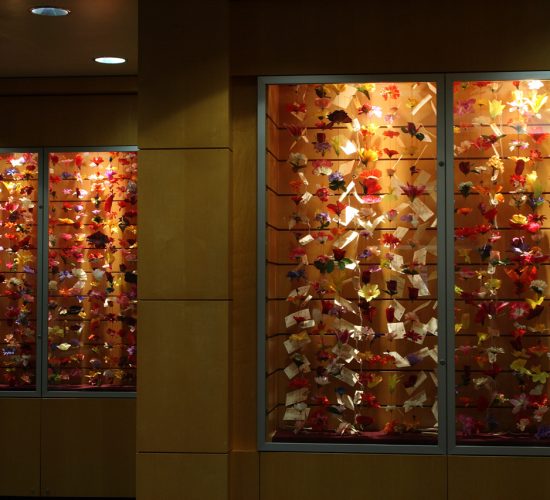
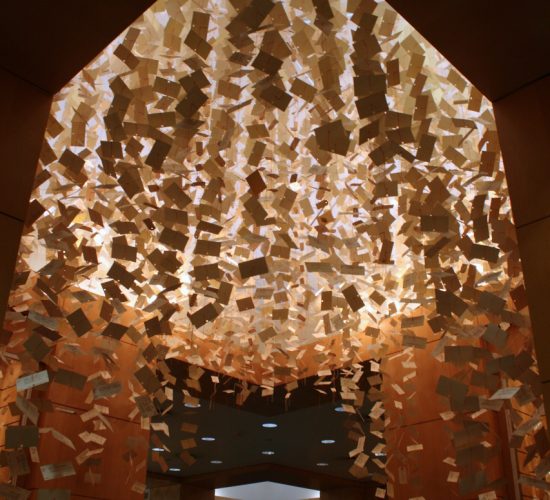
    On display now on the fourth floor of the John Cotton Dana Library at Rutgers University–Newark, Spring Sutras features thousands of recycled catalog cards that cascade in hand-sewn, brilliantly translucent strands from a two-story-high skylight, surrounding and touching viewers as they move through the space.  Hundreds of faux flowers suspended in the accompanying display cases fill the gallery with swaths of vibrant color.

    In stark contrast to the environment in which it was created—what Guancione described as “an endless, exhausting, all-consuming caregiving hell”—Spring Sutras exudes a sense of tranquility and solace. “While caregiving around the clock in the house where my mother had lived for 65 years, I was able to work near her and string together the thousands of pieces of paper—a repetitive, meditative act that enabled me to continue making art,” said Guancione, who was recently awarded a 2016 Individual Artist Fellowship from the New Jersey State Council on the Arts for Works on Paper.

    Funded by a Rutgers–Newark cultural programming grant, the exhibition is one of several projects commemorating the city’s 350th anniversary by drawing inspiration from the nation’s largest and most varied collection of Japanese cherry trees in Newark’s Branch Brook Park. Spring Sutras accompanies a display in the library’s lobby, on loan from the Essex County Parks Department, that details Branch Brook Park’s first planted trees; it is also a fitting prelude to Cherry Blossoms in Winter, a forthcoming multimedia public art project spearheaded by the Rutgers–Newark College of Arts and Sciences that will invite amateur and professional artists from throughout the region to install works in the bare branches of the park’s cherry trees.

    More than just a product of the artist’s personal struggles, the installation also celebrates bringing new life to things we discard or forget. Drawing upon the literal Sanskrit meaning of sutra, or a thread of knowledge sewn over time, Guancione chose to work with hand-typed catalog cards—a tool long since abandoned by libraries as a means of indexing their collections. “In an age of digital information, I have relished holding in hand the many singular pieces of paper that once spoke of a vast and impressive array of accumulated knowledge,” she said. “The strung flower garlands celebrate new life and honor the old and departed.”

    For Michael Joseph, rare book librarian at Rutgers University Libraries, Guancione’s installation celebrates the way in which libraries as institutions are able to constantly reinvent themselves. “Spring Sutras reaches toward a vision of ecstatic renewal,” explained Joseph. “Intriguingly, the catalog cards suspended like leaves or stars have been assembled in roughly alphabetical order, preserving and transforming not only the librarian’s tools of organization, but the original library vision: it, too, changes and becomes part of what is renewed and endures.”

    Spring Sutras runs through the fall. The exhibition is free and open to the public, and an opening reception will be held on Thursday, June 2, from 7-9 p.m. in the Dana Gallery on the fourth floor of the library.
  • News from The New Brunswick Libraries’ Undergraduate Experience Team

    Lily Todorinova and Rose Barbalace describe some of the activities the New Brunswick Libraries’ Undergraduate Experience Team have undertaken in recent months or have planned for the summer.

    #ClubAlex

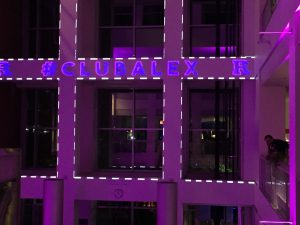
    IMG_7530The Libraries partnered with Student Affairs once again to bring Club Alex back to Alexander Library during Senior Days. This much-anticipated annual event, which sold out within minutes, saw hundreds of graduating seniors and their guests descend upon the library-turned-nightclub on the day following the conclusion of finals. Alexander was transformed with all the trappings one would expect of an actual club: mood lighting and pipe and drape walls helped set the tone in the reference room—which featured a DJ, dance floor, and bar—and an R&B lounge was installed on the ground floor for those who preferred a more intimate atmosphere. A photo booth allowed partygoers to capture the excitement of the evening, and a massive Pac-Man-themed light show was projected onto the atrium walls to the delight of all in attendance.  The buzz on social media was considerable, with many students expressing their gratitude and enthusiasm—and perhaps even more alumni wishing that they had had the chance to party at the library when they were still at Rutgers! Club Alex is a great opportunity for us to create an impression of the Libraries that will last in students’ minds well beyond graduation, and we are grateful to be a partner in this event each year.


    Aresty Undergraduate Research

    The Summer Science Program of the Aresty Research Center offers sophomores an intensive research experience with a dedicated faculty adviser, as well summer  housing and a $3000 stipend. This year, students are working on a diversity of fascinating topics, from cancer prevention, to wearable devices and impact on dietary behaviors, to cataloging emission lines from simulated galaxies. Recognizing the importance of information literacy to the success of these students, the Center has recently reached out to Lily Todorinova, Undergraduate Experience Librarian, to lead several research sessions for the students. With the help of Laura Palumbo, Chemistry & Physics Librarian and Science Data Specialist, we will hold several active learning-based workshops for the 60 or so students in the program, which will focus on finding, evaluating, and using scholarly sources. We are excited to support these students and help them navigate the wealth of academic research resources available to them.

    -Lily Todorinova

    Undergraduate Experience Team Exam Week Stressbuster Report

    IMG_7438
    Students relax with therapy dogs in the lobby of Douglass Library during Spring 2016 Stressbusters.

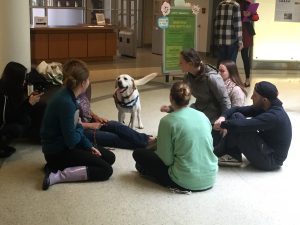
    During the spring semester exam period (May 2 – May 11) the New Brunswick libraries hosted over 22 stressbuster events and activities, engaging with hundreds of students. New this semester we expanded our stressbuster activities to the Art Library, Math/Physics Library, and Chang Science Library each offering snacks and bottled water. The students expressed their thanks and appreciation as they waited patiently in line for their cookie or coffee. The pet therapy sessions were also extremely popular with many students staying nearly the whole hour with their favorite dog.

    Here are some of the highlights of items distributed during finals week:

    • 1480 bottles of water
    • 1000 ear plugs
    • 768 cookies
    • 675 sandwiches
    • 500 cups of coffee
    • 480 granola bars
    • 388 bags of chips
    • 160 packs of fruit snacks
    • 126 packages of cookies
    • 20 gallons of iced tea
    • 20 gallons of lemonade
    • 7 pet therapy sessions
    • 5 lbs. of chocolate
    • brunch at the Library of Science and Medicine serving coffee, orange juice, bagels, croissants, muffins, and pound cake. (Tried something new, students loved it!)
    • hundreds of coloring pages, stickers, stamps, and other craft supplies offered at two de-stress stations.

    Special thanks to Bright and Beautiful Therapy Dogs, RU Seeing Eye Puppy Raising Club, Creature Comfort Pet Therapy, Jimmy John’s, New Brunswick Libraries Administration, and Rutgers Health, Outreach, Promotion and Education for sponsoring these events.

    -Rose Barbalace

  • Annual Celebrations for Staff and Faculty of Rutgers University Libraries (2016)

    Recently, the University convened two events to recognize faculty and staff who are celebrating a decade increment of employment at Rutgers. We are delighted to announce that more than 25 of our colleagues were included in the festivities and hope you join us in congratulating them on these accomplishments:


    10 Fay Austin (TAS)

    Ashwin Bijur (TAS)

    Kevin Conover (RIS)

    Eric Fizur (Robeson Library)

    Qun Luo (RIS)

    Holly Muller (RIS)

    Alfreda Richardson (RIS)

    Christopher Singh (Dana Library)

    Li Sun (TAS)

    William Torres (RIS)


    20 Stephanie Bartz (RIS)

    Barbara Grau (RIS)

    Charlene Houser (Central administration)

    Yoshiko Ishii (Dana Library)

    Mei Ling Lo (RIS)

    Andres Martinez (RIS)

    Fernanda Perrone (SC/UA)

    Julie Still (Robeson Library)


    30 Ka-Neng Au (Dana Library)

    Gary Golden (Robeson Library)

    David Hoover (TAS)

    Martin Kesselman (RIS)

    Kenneth Kuehl (Central administration)

    Linda Langschied (TAS)

    Julianna Ritter (TAS)

    James Robinson (RIS)


    40 Natalie Borisovets (Dana Library)


    Save

  • Teach and Tell: Access Services’ Role in the Big Picture [MLA Poster]

    Author: Yini Zhu
    Author: Yini Zhu

    Objectives

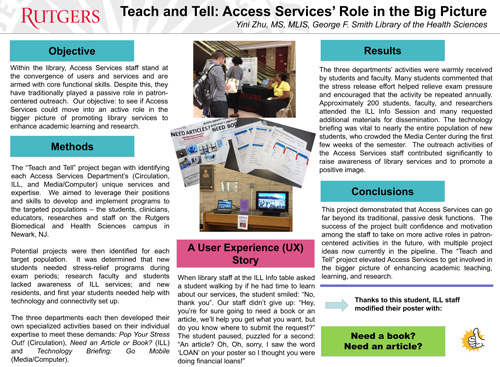
    Within the library, Access Services staff stand at the convergence of users and services and are armed with core functional skills. Despite this, they have traditionally played a passive role in patron-centered outreach. Our objective: to see if Access Services could move into an active role in the bigger picture of promoting library services to enhance academic learning and research.

    Methods

    The “Teach and Tell” project began with identifying each Access Services Department’s (Circulation, ILL, and Media/Computer) unique services and expertise. We aimed to leverage their positions and skills to develop and implement programs to the targeted populations – the faculty, students, clinicians, educators, and staff on the Rutgers Biomedical and Health Sciences campus in Newark, NJ.

    Potential projects were then identified for each target population. It was determined that new students needed stress-relief programs during exam periods; research faculty and students lacked awareness of ILL services; and new residents, and first year students needed help with technology and connectivity set up.

    The three departments each then developed their own specialized activities based on their individual expertise to meet these demands: Pop Your Stress Out! (Circulation), Need an Article or Book? (ILL) and Technology Briefing: Go Mobile (Media/Computer).

    Results

    The three departments’ activities were warmly received by students and faculty. Many students commented that the stress release effort helped relieve exam pressure and encouraged that the activity be repeated annually. Approximately 200 students, faculty, and researchers attended the ILL Info session and many requested additional materials for dissemination. The technology briefing was vital to nearly the entire population of new students and crowded the Media Center during the first few weeks of the semester. Via these outreach activities, the Access Services staff contributed significantly to raising awareness of library services and promoting a positive library image.

    Conclusions

    This project demonstrated that Access Services can go far beyond its traditional, passive desk functions. The success of the project built confidence and motivation among the staff to take on more active roles in patron-centered activities in the future, with multiple project ideas now currently in the pipeline. The “Teach and Tell” project elevated Access Services to get involved in the bigger picture of enhancing academic teaching, learning, and researching.

  • Adding More Tiles to the Mosaic: The Library and EBM in a Time of Curriculum Revision [MLA Poster]

    Authors: Margaret Rush Dreker, Roberta Bronson Fitzpatrick
    Authors: Margaret Rush Dreker, Roberta Bronson Fitzpatrick

    Objectives
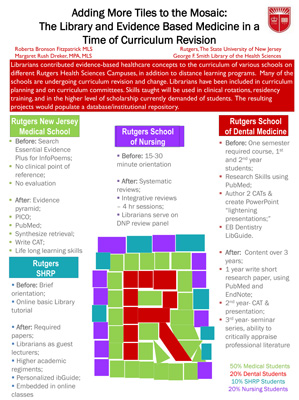
    Librarians contributed evidence-based medicine curriculum. The CATs project provides instruction on basic EBM concepts: the evidence pyramid and levels of evidence, formulating a searchable clinical question, using the PICO format, searching PubMEd. Articles were read, synthesized, and turned into a CAT. These skills will be used in clinical rotations and residency. The resulting CATs would populate a database/institutional repository.

    Methods
    Medical students enrolled in their “Foundations” course were simultaneously enrolled in an “Evidence Based Medicine” Moodle course. Module 2 covers developing searchable clinical questions, breaking them into a PICO format and selecting from among the available library resources when conducting a search. Librarians have embedded exercises within the course. Students are divided into small groups and paired with a partner. The small groups convene in the library for one hour for more focused training on searching PubMed, as well as a quick review of concepts covered in the Moodle course. Students work with their partner to write a focused clinical question, break it down into PICO, connect to PubMed, execute a search, identify at least four relevant articles. They obtain the articles, read and synthesize them, and write a CAT with a clinical bottom line.

    Results
    An online form was developed and is used to write the CATs, which are submitted directly to the library and to the course director. The completed CATs are presented by each pair to their small group and preceptor. Medical school faculty preceptors have commented on the quality of scholarship exhibited, students’ facility with PubMed, and their understanding of article types and the PICO format exhibited during small group discussions. The library developed a relational database to house the completed CATs but is in discussion to import them into RUCore, the institutional repository.

    Conclusions
    There is a high degree of interest in this project. Students feel that they are developing a skill that has application for the duration of their career. Faculty and administrators are enthusiastic about the fact that this is not EBM in a vacuum, but for lifelong learners.

  • Counting the Colorful: The Events Assessment Task Force [MLA Poster]

    Authors: Roberta Bronson Fitzpatrick, Leslin Charles, Ann Watkins, Zara Wilkinson, Megan Lotts
    Authors: Roberta Bronson Fitzpatrick, Leslin Charles, Ann Watkins, Zara Wilkinson, Megan Lotts

    Objectives
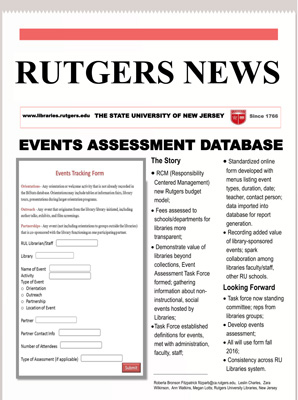
    With the advent of RCM, Responsibility Center Management, as a new financial/budgeting model, fees assessed to schools or departments are more transparent. To demonstrate the value of the libraries beyond collections, an Events Assessment Task Force was formed to gather information about the non-instructional, more social, events hosted by the university libraries.

    Methods
    The Task Force began by establishing definitions for what constituted an “event”. Members solicited suggestions for event types, such as art shows, Lego building contents, book clubs, exhibits, guest lectures, health information fairs, stress buster activities, and more. There was discussion about the information that was useful to capture for each event, such as number attending, co-sponsorship with another group, time/date/location. An online form was developed. It has drop-down menus which list event types, duration, and other common elements, which make recording easier. The data will be imported into a database capable of report generation. The database is modeled after one currently in use for collecting bibliographic instruction data and reflects both AAHSL and ARL needs At each step of the process, Task Force members solicited comments from library faculty and staff who were involved with various events.

    Results
    As of this writing, the Events Assessment Task Force presented both the data collection form and the events database to USC, the User Support Council. Both were approved. The next step is to conduct local training sessions to familiarize library faculty and staff with the form and the database in order to acquaint them with all involved procedures and to gain their participation in the data collection.

    Conclusions
    In the process of developing the online data collection form and the database, it was interesting to note the many types of events hosted by Rutgers University Libraries. By recording the added value that the libraries bring to the university, it may spark more collaborative ventures among members of the libraries staff and with other schools/departments within the university.


  • Library Services and Cultural Competency in Health Professions Education and Patient Care [MLA Poster]

    Authors: Misa Mi, Yingting Zhang
    Authors: Misa Mi, Yingting Zhang

    Objectives

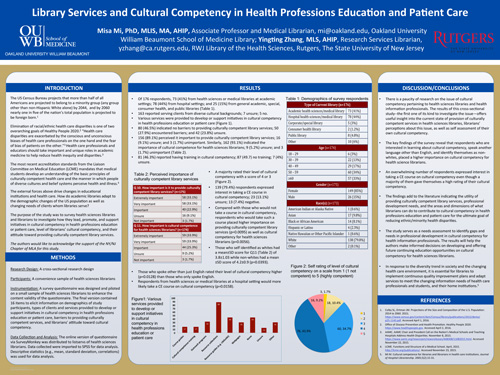
    This study investigated how health sciences libraries provide services to lead, promote, and support initiatives in cultural competence in health professions education or patient care and to examine health sciences librarians’ opinions on cultural competence in relation to library services and professional development. The study serves as needs assessment for our goal to develop a continuing education course on cultural competency for health sciences librarians.

    Methods

    This is a quantitative research design. Data has been collected with a survey questionnaire including eliciting demographic information, addressing health sciences libraries’ status in provision of culturally competent services and librarians’ perceptions of the importance of cultural competence. The questionnaire was pilot tested with a convenience sample of health sciences librarians to enhance the validity and then administered via SurveyMonkey to MEDLIB-L subscribers of the Medical Library Association. Descriptive statistics were used to analyze the collected data.

    Results

    The survey results revealed that most of respondents (156, 89.1%) indicated the importance of provision of culturally competent library services. The majority of respondents (162, 93.1%) perceived the importance of cultural competence for health sciences librarians. 81 (46.3%) respondents reported to have training and 87 (49.7) indicated no past training experience in cultural competence. When asked if they were interested to take a CE course in cultural competence, 139 (79.4%) expressed their interest.

    Conclusion

    The research findings contributed to our understanding what types of library services are provided to develop or support cultural competency initiatives and how health sciences librarians perceive cultural competence for librarians. The results are useful for developing future continuing education courses.

  • SHARE the Info: Spreading Health Awareness with Resources and Education: A National Network of Libraries of Medicine-Funded Program [MLA Poster]

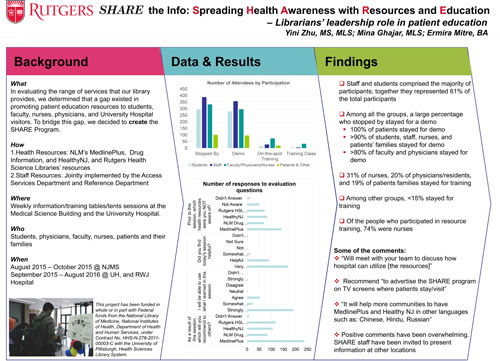
    Authors: Yini Zhu, Mina Ghajar, Ermira Mitre
    Authors: Yini Zhu, Mina Ghajar, Ermira Mitre

    Objective

    Despite the availability of various online patient education resources, the majority of physicians have not incorporated them into practice. The SHARE Program’s objective is to reach out to physicians, faculty, students, nurses, patients and their families to raise the awareness of consumer health information resources available through the National Library of Medicine and the Health Sciences Libraries at Rutgers University.

    Methods

    In evaluating our library services, we determined that a gap existed in promoting patient education resources. To bridge this, we decided to create the SHARE Program (Spreading Heath Awareness with Resources and Education).

    First, we determined that this program should be jointly implemented by the Access Services and Reference departments due to their respective strengths in knowledge of library services and research instruction. Next, we agreed that our efforts should focus on promoting NLM’s MedlinePlus health and Drug Information, and HealthyNJ due to their comprehensive and authoritative information.

    Finally we determined the format for SHARE would be weekly tables/tents at the Medical School and the University Hospital where we would conduct demonstrations and trainings and distribute specially designed SHARE Card, instructional and health literacy materials. Evaluation form and log sheet would be collected for program assessment and analysis.

    Results

    SHARE launched on August 26, 2015 and is slated to end on August 30, 2016. Evaluation forms and log sheets are being collected at each session to assess participant feedback and the resulting data are being analyzed and evaluated as they are collected. A detailed program report will be submitted to the NN/LM Grant Review Committee before May 14, 2016, and, if this topic is selected for MLA 2016, the results will also be submitted and included on the poster.

    Conclusion

    As this is an ongoing project, a conclusion is not available at this time. All collected data will be analyzed prior to MLA 2016, and a conclusion will be drawn by then.

  • Introducing EBM Concepts to Academic Librarians: A New Model for Instruction [MLA Poster]

    Authors: Roberta Bronson Fitzpatrick, Margaret Rush Dreker
    Authors: Roberta Bronson Fitzpatrick, Margaret Rush Dreker

    Objectives
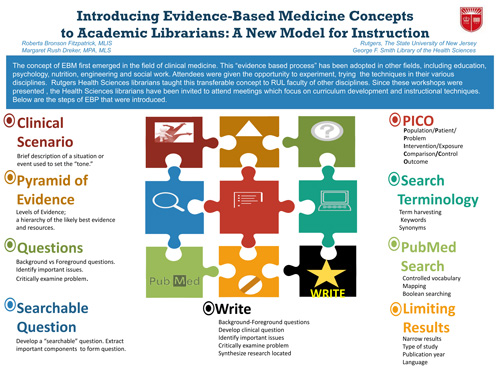
    A poster describing a CAT-writing project was presented at the Rutgers University “State of the Libraries” meeting in 2014. It gained the attention of the Chancellor. At the conclusion of the discussion, he urged that transferrable concepts be taught to other RU librarians and incorporated within their instructional programs. A workshop was designed and presented in June and November 2015.

    Methods
    Specific elements of the CATs sessions were deemed to be transferrable to those providing instruction to students in the sciences and social sciences, as well as education and other disciplines. These include: foreground/background questions; writing a focused question; breaking a search question into the PICO format to assist with term generation, and the evidence pyramid. The workshop covered the CATs project as an example of a type of complete assessment, in that students must use the component skills to write their own CAT (Critically-Appraised Topic). Each of the noted transferrable concepts was covered. Attendees had time to come up with an example which would fit their subject audience and there a general discussion portion where ideas were exchanged on how to best incorporate these new skills into instructional programs.

    Results
    The workshops resulted in offers to teach collaboratively outside of our home campus. All attendees identified concepts which could be used directly so slightly modified to fit various disciplines. For example, article types listed in the evidence pyramid did not fit every discipline but librarians considered other types of resources, such as dissertations/theses and web sites/pages were listed in this format.

    Conclusions
    Rutgers University had few health sciences programs prior to 2013. Teaching the workshops was a good vehicle for informing our new colleagues about how instructional sessions are approached in the health sciences. It also allowed us to become part of the cadre of instructors and to be invited to attend meetings which focus on curriculum development and instructional techniques.

  • Librarian Participation in “Hands-On” Evidence-Based Medicine Rounds with Pediatric Residents [MLA poster]

    Author: Pamela Hargwood
    Author: Pamela Hargwood

    Objectives:

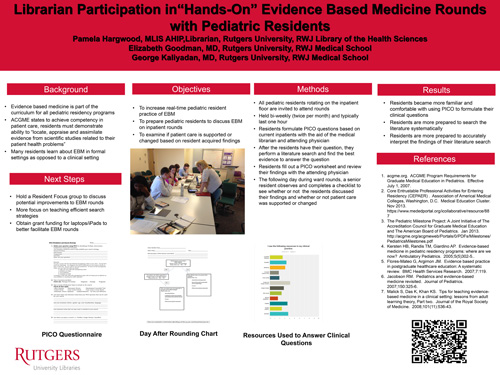
    To describe the successful implementation of a project to increase the ability of pediatric residents at a medical school to practice evidence based medicine (EBM) in real time; examine if patient care is supported or changed based on the resident’s findings; and discuss the role of the medical school librarian in this process.

    Methods:

    In July 2014, the Department of Pediatrics implemented “hands-on ” inpatient EBM rounds to help pediatric residents learn how to better formulate clinical questions, locate relevant literature, and apply their EBM findings to patient care in “real time”. These hour long rounds take place bi-weekly and are held on inpatient wards. All pediatric residents rotating on the inpatient team are invited to attend the EBM rounds. The medial librarian and two pediatric faculty members assist the residents with formulating clinical questions based on the inpatients they are currently following and searching for an answer to their question. The residents summarize their search and findings using a PICO worksheet. The following day the residents are evaluated on whether or not they presented their EBM findings on attending rounds and if patient care was supported or changed based on these findings.

    Results:

    The pediatric residents became more familiar and comfortable with using PICO to formulate their clinical questions. They also are more prepared to search the literature systematically and interpret the findings of their literature search.