For the second year in a row, the New Brunswick Libraries and the communications department have partnered with the Office of Summer and Winter Sessions on the AuthorTalks series. This year, the Libraries will host three Rutgers faculty author events during the summer session.The authors read or discuss their book, take questions from the audience, and sign copies. Rutgers’ Office of Summer & Winter Sessions sponsors a door drawing for 10 copies and Rutgers University Bookstore is on-hand to sell books, as well.
The first event with novelist Tisha Bender took place in June and was well attended. Her book, P.U.N.C.H., is a satirical take on online learning programs in academia. Though the novel is humorous, Bender writes from a position of authority, as she is also the author of two editions of Discussion-Based Online Teaching to Enhance Student Learning: Theory, Practice, and Assessment (Stylus 2003, 2012) and has trained instructors in online teaching at the SUNY Learning Network, NYU, Cornell, the New School, and in the Writing Program at Rutgers University. She also teaches hybrid courses in the Rutgers Writing Program, and has taught online for the New School and Cornell.
The next AuthorTalks event takes place at Alexander Library on July 6, 2016 at 4:00 p.m. and will feature history professor David Greenberg, reading and discussing his new, topical book Republic of Spin: An Inside History of the American Presidency. His book, arriving in time for the 2016 election, moves beyond cynicism to ask more probing questions about the convergence of politics and public relations in the Oval Office—how has spin affected the landscape of American democracy in the last century, and are we right to regard it as manipulative and deceitful?
Our final AuthorTalks event will be our very own Janet Brennan Croft discussing Perilous and Fair: Women in the Works and Life of J.R.R. Tolkien at Alexander Library on July 27 at 4 p.m. Croft takes on critics who claim the works of J. R. R. Tolkien seem either to ignore women or to place them on unattainable pedestals and focuses attention on views that interpret women in Tolkien’s works and life as enacting essential, rather than merely supportive roles.
We are delighted to partner with the Office of Summer and Winter Sessions on these events and hope you will join the fun if you are available. If you have suggestions for future AuthorTalks events, please let the communications department know.
Also, join us as we celebrate a milestone in the historical research at the Center of Alcohol Studies Library. One of the most important founders of alcohol and addiction studies, E. M. Jellinek, also laid down the foundations of the current CAS Library. The most recent issue of the Journal of Studies on Alcohol and Drugs, published at CAS, features three open-access articles with CAS Library’s contributions to the history of alcohol studies. CAS Library staff has compiled Jellinek’s most comprehensive bibliography to date based on their original research that discovered new biographical data and articles. His seminal articles have also become freely available on the JSAD website. See the reintroduction of Jellinek to current addiction science at: http://www.jsad.com/page/bunkybundle
Cabinet recently approved a new set of guidelines for the use of photography at the Libraries. These guidelines endorse and support the guidelines for the university as a whole, but also add a few tweaks specifically for the Libraries. If you are photographing events, people, or spaces of the Libraries, it is important that you familiarize yourself with thees guidelines and obtain all the necessary model releases. Three groups of subjects require special attention: children, Rutgers student athletes, and medical patients.
Also, if you are in the position of having your photograph regularly taken at Library events and wish to avoid having to sign a new release each time, we have made available an extended model release for library faculty and staff only. If you would like to complete this one-time form, please right click and download the Extended Model Release Template RUL Faculty and Staff only (also available on the new central drive: T:\CENTRAL\Procedures and Resources\Communications\model releases for photography), complete, sign, and return to the communications department.
The guidelines also cover how to handle videotaping and photographing events. If you are taking photos that might be useful to your colleagues or for publication on our website or in our print materials, please be sure to upload the photos and scanned copies of the signed model releases to the Photos and Media network location, too.
There is a lot of confusion about when model releases are necessary. Some situations are clear–as when you are taking a photo of a single person or a group of people–but other scenarios aren’t as obvious. A guiding mantra is that if you want to identify someone in the written caption for the photography, you will need a model release. Hopefully the examples below will help clarify how to deal with different types of situations.
Model Release Examples (arrows require model release, circles are optional depending on circumstance)
No photo release would be necessary for this type of group photo as everyone is facing away.
Before photographing this group, the photographer should announce that s/he is taking a photograph and provide time for people to move out of the frame if necessary.
You would not need a photo release for a photo like this of a subject looking away and not identifiable.
Even though you might be able to pick out and identify individuals because you know them, this scene would not require any photo releases as there is no “subject” per se.
However, there should be a notice in the program and a sign at the entrance indicating photography will take place and to notify the event staff if they don’t want to be included.
You would get a model release from the gentleman in the foreground of the photo, but not from the others in the room. You would also need a model release if you want to mention the teacher by name.
In a photo like this, you would need releases from the library staff behind the table, but not from the standing person. However, this is a case, where you would likely want the name of the person for the caption, in which case you would need a release.
The primary subject of the three is the man facing the camera. Even though the man in the back is blurred and facing sideways—a model release is required. The woman is facing away so a release is not required. If you planned to mention their names in the caption, then you would need model releases.
This is a scenario where you would want to identify all subjects in the caption. So, even though only two people are identifiable and require a model release, you would want to get model releases from all five.
A straightforward photograph that requires model releases even if these individuals work at the library or have given permission to use photographs on another occasion.
Image credit: Ingfbruno – Own work, CC BY-SA 3.0, https://commons.wikimedia.org/w/index.php?curid=27955753
The Libraries now have a Central drive (T:\CENTRAL) where shared items of interest to all areas of the Libraries can be stored. The plan is to eventually store shared resources, information, procedures, and manuals in this location. Currently, it contains folders for Assessments, Collection Development and Management, Communications and Marketing, Photos and Media, Procedures and Resources, and Visual Identity, but more folders will be added as needed. Some of the folders are read-only, while others like Photos and Media are available to all for adding materials.
Please take some time to peruse the folders:
Jeanne Boyle recently sent an invitation to view the LibQUAL+ survey results now stored in the Assessments folder.
Under Visual Identity, you will find resources that are useful if you are making flyers, advertisements, or website graphics, such as the colors, fonts, logos, and letterheads that are approved by University Communications and Marketing.
Photos and Media is a one-stop place to find images of our spaces, our events, and faculty & staff.
The communications department has also moved their folders from the ALEX drive to Central location Communications and Marketing.
Procedures and Resources currently holds the recent communications policies for photography and fielding requests to photograph in the Libraries, but will be populated with other materials, procedures, and FAQs in the future.
These changes are partly philosophical–these are resources we all share and shouldn’t be housed on one of the unit server locations–but they are also intended to surface important materials and provide a single authoritative place to look for procedural information and guidance. If you have feedback, suggestions for how to further improve this shared drive, or materials you would like added to this drive, please speak with your unit director or supervisor.
With Gabryel Smith, Assistant Archivist at NY Philharmonic Archive, Lincoln Center
With Gino Francesconi, Director of Archives and the Rose Museum at Carnegie Hall
The fellows and Angela Lawrence with Gino Francesconi, Carnegie Hall
The three Fellows with Duke Ellington’s piano at the Jazz Museum in Harlem
ith archivist Matt Snyder at the New York Public Library Services Center, Queens
Archivist Ricky Riccardi shares some treasures at the Louis Armstrong Archive, Queens College
Treshani, Brad, and Veronica holdi Louis’ horns as Ricky Riccardi and Satchmo himself look on.
With Kathy Kauhl, Archivist at the Essex County Parks Archive.
The fellows during Q&A with Rutgers University Library administrators
Brad, Veronica, and Treshani with Joanne Hill and the Andrew Hill Collection.
The Institute of Jazz Studies Archival Fellowship Program was established in 2011 to support archival career development, as well as to promote diversity in the archival field. Each year, three Fellows are selected from among dozens of applicants, who are either currently enrolled in, or recent graduates of, an MLIS program, have a special interest in jazz and or African American culture, and aspire to careers as archivists. Fellows receive a stipend to cover travel, hotel, and miscellaneous expenses. The Fellowship Program is funded by longtime IJS supporter John Van Rens.
The Fellows spend two weeks on campus working closely with IJS archivists and staff. Participants gain hands-on experience processing one of the Institute’s multi-faceted collections and preparing a related digital project that can be shared with colleagues and prospective employers. There are also seminars with RUL as well as Newark campus administrators, who provide an overview of Rutgers-Newark as the nation’s most diverse university, as well as role of an archive within an urban university library. The Program also involves two days of visits to other area archives and institutions, which have included the Schomburg Center for Research in Black Culture, The New York Public Library Archival Processing Center, the Louis Armstrong House Museum and Archive, the Jazz Museum in Harlem, the Carnegie Hall Archive, and the New York Philharmonic Archive at Lincoln Center. There are also several social gatherings with IJS staff and area librarians and archivists.
This year’s fellows were Veronica Johnson (MLIS student at Wayne State Univ.), Treshani Perera (MLIS student at Univ. of Wisconsin-Milwaukee), and Brad San Martin (MLIS student at Univ. of North Carolina-Chapel Hill), who were on campus from June 6 to June 17. In collaboration with IJS archivists Elizabeth Surles, Angela Lawrence, and Tad Hershorn, and Digital Humanities Librarian Krista White, they processed the collection of pianist/composer and NEA Jazz Master Andrew Hill (1931-2007). Hill as both player and composer was a unique figure, who forged an original style that was at once part of the jazz tradition while extending its boundaries. On the last day of the fellowship program, Hill’s widow, Joanne, and donor of the collection, visited IJS to meet with the Fellows and to examine the newly processed collection she had donated as well as to view digital presentations by the fellows covering selected aspects of her husband’s distinguished career.
Veronica Johnson, photo by Ed Berger.
VERONICA JOHNSON:
Completing the IJS fellowship at Rutgers was an amazing experience and one that I will forever be grateful for. I learned so much about processing and the steps it takes to make a collection available to users. Working on the Andrew Hill Collection was great, and it really gave me the opportunity to process a larger collection, which I had never done before. I learned a lot about Hill and quickly became a fan of his work, which was very innovative. My favorite part of the program was learning about EAD and being able to create a finding aid using Oxygen. EAD was an area I did not have much experience in outside of school, so having Elizabeth and Angela show me how to use the software and create this awesome finding aid for the collection was very enlightening. I also really enjoyed visiting the other archives like the Jazz Museum of Harlem and the New York Philharmonic in order to see how other archives both large and small operate. The IJS Fellows program really gives graduate students the opportunity to be archivists for two weeks and get a real sense of the day to day tasks of the profession. The IJS staff is awesome and really made me feel welcome and a part of the team. I also developed some great friendships with the other fellows and am so thankful that I was able to take advantage of this great opportunity.
Treshani Perera, photo by Ed Berger.
TRESHANI PERERA:
I’m really thankful that I was chosen as a 2016 IJS Fellow. Throughout my two-week experience, I was so impressed with the work ethic and collegiality of the IJS staff, and their willingness to make every moment a teachable one during and outside of processing the collection. I was thrilled for the opportunity to process jazz pianist Andrew Hill’s collection, and discover his genius and creative thought captured in his music. The icing on the cake was meeting Mrs. Hill at the end of the experience, and talking to her about Mr. Hill as a musician and spouse. My favorite part of the experience was visiting music archives in the Greater New York area, and learning about how each archives does things differently. Throughout the two week internship, I was able to put into practice what I had learned in the classroom, and process the collection as a group, which was a unique experience. I’m truly grateful for this opportunity, and can honestly say that it was a transformative experience!
Brad San Martin, photo by Ed Berger.
BRAD SAN MARTIN:
The greatest strength of the Institute of Jazz Studies Fellowship was in the way it provided well-rounded insight into nearly all facets of an archives’ operations. While processing a collection at a fairly granular level (as we did with Andrew Hill’s papers) gave us invaluable experience in the most fundamental archivist tasks, our meetings and discussions with administrators, directors, historians, and even a donor offered much-needed perspective into archives role in the larger arts community – and the associated challenges entailed with maintaining and evolving that presence. It didn’t hurt that the people we met were all passionate, thoughtful, accomplished professionals who were willing to both share their time and speak candidly about the pleasures and pressures of the field. The two weeks flew by, and I’m sure that, when I look back, I’ll find my time at the IJS to have been a perfect (and much-needed) enrichment to my formal library and archive science studies.
Gary Golden retired on June 30 after 30 years with Rutgers University Libraries.
1987 yearbook photo of the library staff.
1988 yearbook photo of the library staff.
1990 yearbook photo of the library staff.
1991 yearbook photo of the library staff.
The Camden Library receives a new name in 1990-1991.
1994 yearbook photo of the library staff.
The OIT space opened in 2011.
Undertaking big renovations and improvements is a hallmark of Gary’s time with Rutgers.
For over a decade, Paul Robeson Library has collected toys for local children during the holiday season.
The faculty and staff of the Robeson Library in 2014.
Krisellen Maloney fêtes Gary at his retirement party, held June 6.
Happy retirement, Gary!!
On June 30, Gary Golden retired from his long-time position as director of Paul Robeson Library. His colleagues at Rutgers University-Camden held a retirement party earlier in June and assembled these photos to document some highlights from his time with Rutgers. I hope you enjoy the photo slide show.
Here is the text Krisellen circulated earlier this year because it is a story that bears repeating.
Gary started working at Rutgers in June of 1986, shepherding the Camden Library through many transitions—new technology; new building; a new name as the Paul Robeson Library; and, most recently, a $3 million dollar, four-year renovation that completed in 2015. Throughout these changes, Gary has maintained a steadfast eye on the student user experience, made smart financial and technological decisions, and created links to the Camden community.
Starting in 1986, Gary strived to create a safe, comfortable, and functional space for students to study and research. Between an addition in 1995 and, more recently, the 2015 renovation, he has successfully met the demands of the students at Rutgers University—Camden. Gary tells me nearly every square foot of public and 80% of work space has been renovated during his tenure, and I believe it. You can see the results for yourself if you visit: the libraries look great, the furniture is comfortable, the computer labs are top notch. Because of Gary’s efforts, the Paul Robeson Library is truly a 21st-century institution that Rutgers University can be proud to call its own.
Under Gary’s guidance, the Paul Robeson Library has invested wisely in exciting partnerships like the ongoing one with Camden County Library and Rowan University that not only expand the service of the library, but have also yielded good financial results—money that that has been invested back into the Library to continue to improve and expand services. His efforts have kept the Library on the cutting edge of technology—from introducing the first computer labs of the late 1980s and phasing out the paper card catalog in 1992 to bringing wireless access to all areas of the library in 2000 and, just last year, creating a 10,000 square foot OIT computer lab.
Additionally, Gary has forged important connections with Rutgers University–Camden and the greater Camden community. He and his colleagues have collected toys and donations for the Camden Rescue Mission, organized conferences and events that span town and gown, and created Camdenbase, an online database of citations to newspapers and periodicals about Rutgers Camden and Camden City.
As if these accomplishments were not enough, Gary is also a wonderful colleague—smart, thoughtful, kind, and creative.We wish him all the best in this next chapter.
Dana Library colleagues of longtime Circulation Desk supervisor Joyce Watson joined her in celebrating her retirement after 15 years with Rutgers University Libraries, effective June 30. From left: Maggie Harris-Clark, Alex and Doris Arencibia, Natalie Borisovetz (foreground), Andrea Lakios, Ka-Nang Au, Linda Becker, Joyce Watson (foreground, seated), Amber Judkins, Bonnie Fong, Robert Nahory, Dorothy Grauer, Janet Giorgio, and Library Director Consuella Askew. Photograph by Mark Papianni.
The apple will not fall far from the tree after Joyce Watson retires from Dana Library on June 30 after 15 years of service. The longtime circulation desk supervisor expects to continue sharing her knowledge of libraries and information technology as a volunteer with the public libraries in Asbury Park and nearby Neptune, in addition to spending more time with family and church work.
“For me, retirement means continuing to expand my level of knowledge and ability to encourage students’ desires to learn beyond their wildest dreams in libraries,” Watson said recently.
Her first position with Rutgers University Libraries, in 2001, was with the Library of Science and Medicine in Piscataway before transferring to Dana. Passionate about working with students and technology–putting a world of knowledge at patrons’ fingertips–Joyce dug in as an adult learner to earn an MLIS at Rutgers between 2005 and 2009.
Watson, a native of New Smyrna in central Florida, arrived in New Jersey in 1966 and spent nearly a decade and a half doing factory work in the pharmaceutical industry in New Brunswick. Along the way, she earned a journalism degree from Rutgers University. “I liked writing and wanted to tell stories,” she said. “Then I wanted to roam.”
Her cross-country travels with daughter Tynyetta in tow over the next several years began in Florida and made their way to Atlanta, Houston, Denver, and Los Angeles, where she found work at colleges and universities. Her daughter made the trip as far as Los Angeles, where she has a long and successful career as a hair stylist and now resides with her family, including husband Joe, four sons, and two step-children. All combined, Joyce has nine grandchildren upon whom she can lavish her attention.
Combining her backgrounds in storytelling, libraries, and archives, Joyce was the onetime historian for Mount Zion A.M.E Church in New Brunswick and currently is archivist for St. Stephen’s A.M.E. Church in Asbury Park.
She cites former Dana Library director Lynn Mullins and current director Consuella Askew as “gems who encouraged me in all my endeavors.”
Join us as we wish Joyce happiness and further intellectual “endeavors” in her retirement!
“Winter Night” by Carson He (6th Grade Art Cycle, teacher Antonia Germanos)
“Deconstructed Still Life” by Amanda Lee (7th Grade Art Elective, teacher Anna Deacon)
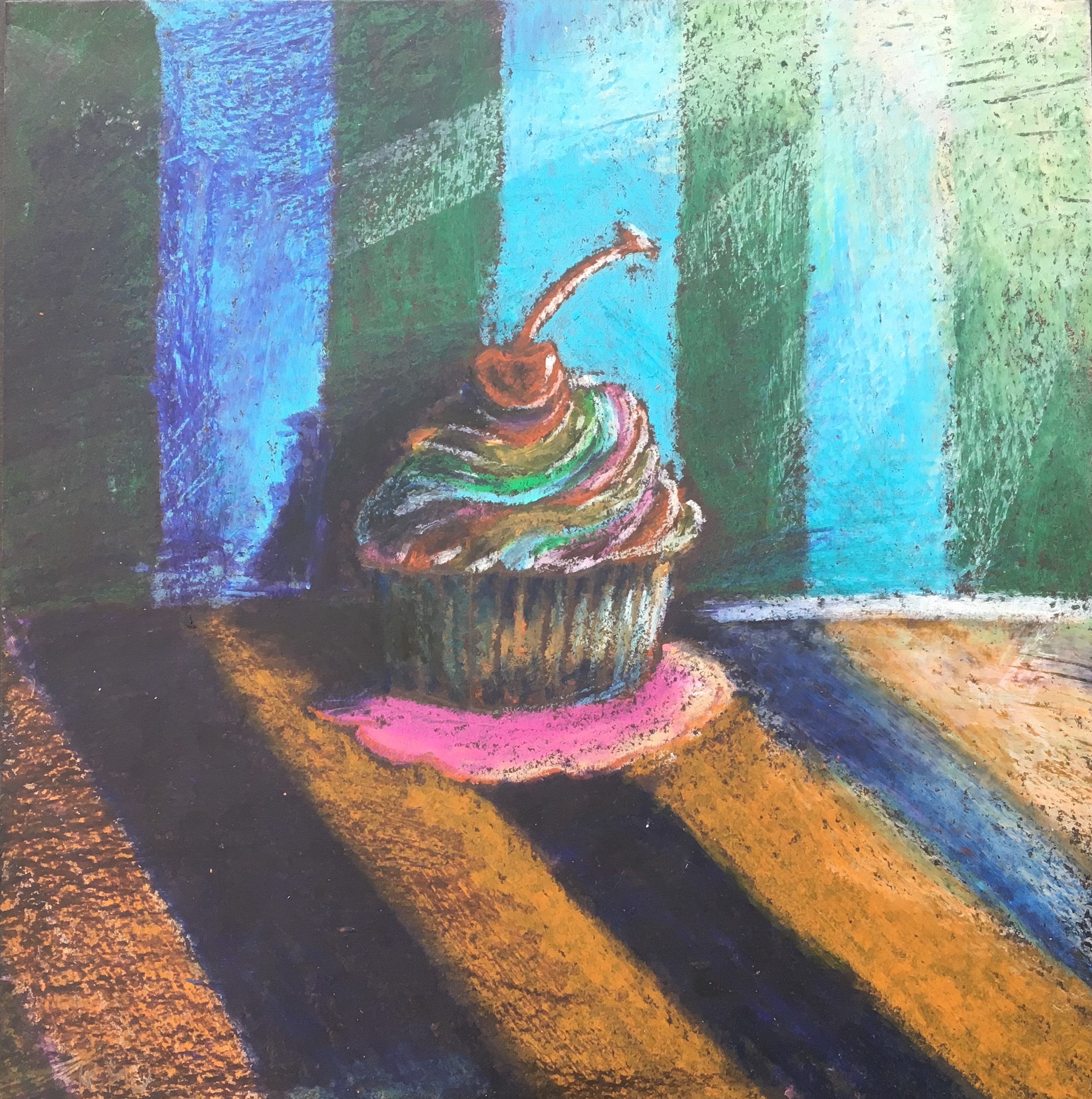
“Rainbow Cupcake” by Katherine Mu (7th Grade Art Cycle, teacher Lisa Gombas)
This summer, Rutgers Art Library will host a free public exhibit of artwork by the sixth and seventh grade students at Hammarskjold Middle School in East Brunswick, NJ. Art teachers Anna Deacon, Antonia N. Germanos and Lisa Gombas hope the exhibit—on display from June 1 to August 31, 2016—will open students’ eyes to the world of artistic and educational possibilities outside their school classroom.
Antonia N. Germanos, sixth grade art teacher at Hammarskjold Middle School, describes the motivation behind the exhibit saying, “I hope that placing Hammarskjold Middle Schools students’ work on exhibit at the collegiate level will help our students realize their talent and creativity. I want them to understand that art is part of life and that it can, and should, be taken outside the classroom walls.”
For Megan Lotts, working with community partners to bring local artists of all ages to her exhibit space serves multiple purposes. “For many of these students, this will be their first and perhaps only art exhibition, but by inviting students and parents to visit Rutgers Art Library, we are giving them insight into what life and research is like at a leading university,” explains Lotts.
“These very well could be future Rutgers students and many students this age have no idea that art libraries even exist. It can be empowering at a young age to see a space of this nature, as well as have your art work shown in a gallery space.”
A Mason Gross alumna, Germanos is no stranger to the artistic scene at Rutgers University. She credits strong bonds between the East Brunswick community and Rutgers University with the decision to bring the exhibit to Rutgers Art Library.
“As a neighboring community, East Brunswick embraces and supports Rutgers University activities and many of our graduates have attended the university,” says Germanos. “Displaying our students work at Rutgers Art Library will hopefully strengthen the bonds between primary, secondary, and collegiate education; honor our students’ hard work and dedication to the fine arts; and create opportunities for students to explore grander aspects of the fine arts.”
The Hammarskjold Middle School art exhibit will feature a variety of pieces in different mediums, including:
Hand cut collages inspired by the Japanese term notan, used to describe the concept of dark versus light. Students embrace contrast through the use of symmetry, asymmetry, color, and shape to create balance. Don’t miss “Winter Night” by Carson He (6th Grade Art Cycle, teacher Antonia Germanos) which draws on associations of winter and white alongside black and night to conjure the feeling of a cold evening.
Drawings of objects from life, divided into four sections that use different art materials to create layers of color and value. Don’t miss “Deconstructed Still Life” by Amanda Lee (7th Grade Art Elective, teacher Anna Deacon) featuring playroom and household objects in oil pastels, graphite pencil, colored pencil, and Sharpie pens.
A series of Pop Art-inspired oil pastel drawings in which students pay close attention to their chosen light source and the effects of highlights and shadows to pay homage to the confectionery creations of painter Wayne Thiebaud and the bright patterns and thick lines of Andy Warhol and Keith Haring. Don’t miss “Rainbow Cupcake” by Katherine Mu (7th Grade Art Cycle, teacher Lisa Gombas) which depicts a realistic cupcake set off by a dramatic background and lighting.
This course is ideal for staff, managers, supervisors, and administrators who recognize the need to improve their overall confidence and competence in critical skills and apply positive strategies for transferring ideas learned to the workplace.
Location: Pane Room, 1st floor, Alexander Library with teleconference to Smith Library, Dana Library and Robeson Library
RSVP: Erica Parin on behalf of the Professional Development Committee
Digital Humanities Lab Open Houses
June 2. 2016
10 a.m.June 8. 2016
12 p.m.
We’re hosting a couple of DH Lab Open House events in early summer session as a way to acquaint faculty and students with this research space. If you are curious about how to use this space, or what is available there, please feel free to join us. At each event, there’ll be a short presentation followed by an open discussion on digital humanities work and research at Rutgers.
Location: Digital Humanities Lab, Room 406-407, Alexander Library
Refreshments will be provided. RSVP with preferred date to Francesca Giannetti.
Open and Affordable Textbooks at Rutgers
The Libraries have recently formed a taskforce to plan and implement the President’s Affordable Textbook grant initiative. This taskforce has representation from RBHS, Newark, Camden, and New Brunswick and will be charged, among other things, with creating criteria for judging course redesign grants. We are excited to have the support of the Open Textbook Network in these efforts, as we have recently joined this nation-wide system of partners, with a wealth of experience in promoting access, affordability, and student success through the use of open and affordable textbooks. In the next few months, we will be actively working with all of our colleagues at the Libraries to shape this program and educate students and faculty about the importance (and learning benefits) of open texts. Stay tuned for much more to come, including a website describing the grant process, application guidelines to share with interested faculty, as well as workshops organized by the Open Textbook Network in the fall semester. Please feel free to email the chair of the taskforce, Lily Todorinova, with any thoughts or suggestions. We look forward to working with you!
-Lily Todorinova
Dana Library Loans Portable DVD Players
As part of the growing TechnologyLending @Dana Library program, four portable DVD players will be available for short-term loan to Rutgers University students, faculty, and staff, beginning May 31, 2016. The players may be borrowed for up to four hours, with the option of one in-person, four-hour renewal, if there is at least one other DVD player available. They may be used in or out of the library, and must be returned exclusively to the Dana Library circulation desk at least 30 minutes before library closing. Students are also asked to report any problems with the DVD players to library staff upon return.For more complete information, please read Portable DVD Player Borrowing: Policy and Procedures, issued on May 25.
-Tad Hershorn
Watch “Preserving Your Digital Life” with Krista White and Isaiah Beard
Our stories as individuals and as members of a community are preserved in each of our homes, in our family histories, and in life stories—not just in libraries, archives, and museums. Today, many of us record and keep these stories in digital formats, often on our smartphones. The ability to easily create audio and video recordings leads to deep and rich documentation of events that may be personally important but may also have regional or national significance. Preserving these narratives for our families and for future generations means considering how we create the files and how we store them. As part of ALA Preservation Week, Krista White and Isaiah Beard presented a Webinar Titled “Preserving Your Digital Life” that touched on these issues, and provided a high-level primer on how best to make sure your digital memories stay in focus for years to come. Watch their presentation on YouTube.
The American Library Association Meeting will take place later this month in Orlando, Florida. Here are highlights from the program that feature our colleagues:
Research, Writing, and Publishing Fair
June 25. 2016
10:30 a.m. – 11:30 a.m.
Are you interested in publishing? Would you like to learn about a variety of opportunities to publish, resources to help you get started with writing an article or a book, and tools that will make research and writing for publication better and easier? Please join us for the Research, Writing, and Publishing Fair, where you’ll have the opportunity to meet with ALCTS editors, the Library Research Round Table, learn about publishing mentoring opportunities in ALA, and more. Sponsored by ALCTS Leadership Development Committee. Co-Sponsored by ALA Library Research Round Table (LRRT), ALCTS New Members Interest Group (ANMIG), and ALA New Members Round Table (NMRT).
Speaker: Mary Beth Weber (Rutgers University Libraries)
ACRL Arts Publications and Research Committee Annual Discussion Forum
June 25. 2016
3:30 p.m. – 4:30 p.m.
Join ACRL Arts Publications and Research Committee for their Annual Discussion Forum! This year’s forum will feature the following presentations:
“Artists as Scholars: The Research Behavior of Dance Faculty” by Shannon Marie Robinson (Drexel University)
“Building Bridges, Creating Partnerships and Elevating the Arts: the Rutgers University Art Library Exhibition Spaces” by Megan Lotts (Rutgers University Libraries)
“You Say Tomato, I Say Tomato: Collection Format Preference of Music Faculty” by A. Carey Huddlestun (Kennesaw State University)
If there are additional Rutgers University Libraries highlights I should include here, leave a comment below or let me know.

 The first event with novelist Tisha Bender took place in June and was well attended. Her book, P.U.N.C.H., is a satirical take on online learning programs in academia. Though the novel is humorous, Bender writes from a position of authority, as she is also the author of two editions of Discussion-Based Online Teaching to Enhance Student Learning: Theory, Practice, and Assessment (Stylus 2003, 2012) and has trained instructors in online teaching at the SUNY Learning Network, NYU, Cornell, the New School, and in the Writing Program at Rutgers University. She also teaches hybrid courses in the Rutgers Writing Program, and has taught online for the New School and Cornell.




 As part of the growing TechnologyLending @Dana Library program, four portable DVD players will be available for short-term loan to Rutgers University students, faculty, and staff, beginning May 31, 2016. The players may be borrowed for up to four hours, with the option of one in-person, four-hour renewal, if there is at least one other DVD player available. They may be used in or out of the library, and must be returned exclusively to the Dana Library circulation desk at least 30 minutes before library closing. Students are also asked to report any problems with the DVD players to library staff upon return.For more complete information, please read
