Category: Universitywide

  • Library Reading Lists Created within Multiple LMSs

    Students in electronic classroomThe Ex Libris Leganto Reading List Management tool is now available for use in Blackboard, Canvas, and Sakai. The reading list tool can help instructors create impactful resource lists using library content and integrate a variety of materials into one, easy-to-use list. The tool is accessible from inside the learning management system, so students can access the reading list, along with other course resources. Instructors and librarians can collaboratively create and process reading lists for students from all types of resources.

    Because the reading lists tool is integrated in Blackboard, Canvas, and Sakai, access to materials is easy and streamlined for students.

    Here are some of the key features:

    • Instructors can create reading lists from books, articles, streaming media, and other resources held by the Libraries or add their own content. Reading lists integrate with the saved favorites feature on QuickSearch and lists can be used for multiple sections of a course or copied into new courses.
    • Reading lists can be divided into sections, by chronology, or by citation type.
    • Instructors and students can view information about each citation such as availability and status.
    • Instructors can collaborate with peers to enrich reading lists and keep them up to date.
    • Instructors can access usage data about their reading lists.

    The tool is now available in the external tools sections of the learning management systems. For more information, or if you have any questions, contact me at maria.breger@rutgers.edu.

  • Ex Libris Implementation Project Update – November 2019

    quicksearch logoThe project to append Rutgers Law Libraries’ Koha Catalog data to our instance of Alma and QuickSearch is picking up the pace. During the summer the Implementation Team and its working groups met with our counterparts at Law to review Alma configuration options and best practices for data cleanup and loading records. Then in September and October, Law supplied configuration and mapping forms and exported their full catalog of bibs and patrons to Ex Libris.



    Below is the tentative schedule for the remainder of the Law Append project:

    October 2019

    • Ex Libris performs test load and builds test system
    • Law starts using our ILLiad and redirects their users to our ILLiad form

    November 2019

    • Law and Libraries review results of test load
    • Libraries provide Alma training
    • Law stops lending under NJRLL (Law Camden) and RULAW (Law Newark) symbols in ILLiad
    • Law Exports Koha Catalog Titles to OCLC
    • OCLC attaches NjR symbol to Law titles in WorldCat

    December 2019

    • Continue Alma Training

    January 3, 2020

    • Law provides final version of configuration forms and extracts to Ex Libris

    January 4-8, 2020

    • Technical Services and Fulfillment Activities are frozen
    • Ex Libris appends Law data to our instance of Alma and QuickSearch

    January 9, 2020

    • Law Goes Live with Alma and QuickSearch

    January 10, 2020

    • Load Offline Circulation transactions

    January 2020

    • OCLC removes NJRLL and RULAW symbols from existing Law titles in WorldCat
  • What’s Happening around Rutgers – September 2019

    Painting
    Dimensionism: Modern Art in the Age of Einstein

    Tuesday, September 3, 2019 to Sunday, January 5, 2020
    Zimmerli Art Museum, New Brunswick

    Dimensionism: Modern Art in the Age of Einstein is a groundbreaking exhibition that explores how modern art was influenced by advances in science, from Einstein’s theory of relativity to newly powerful microscopic and telescopic lenses. A first-of-its-kind touring exhibition, Dimensionism is organized by the Mead Art Museum at Amherst College and opened at the Berkeley Art Museum and Pacific Film Archive.

    Learn more.

    Savage Feast book
    Writers House: “Savage Feast” with Boris Fishman

    Thursday, September 12 | 12:45 to 1:45 p.m.
    Rutgers–Camden Writers House

    Boris Fishman was born in Minsk, Belarus, and immigrated with his family to New York in 1988, at nine. He is the author of the novel A Replacement Life, a New York Times Notable Book of the Year that also won the VCU Cabell First Novelist Award and the American Library Association’s Sophie Brody Medal, and Don’t Let My Baby Do Rodeo, also a New York Times Notable Book of the Year. His new book is Savage Feast, a nonfiction family history told through recipes. He lives in New York City and teaches creative writing at Princeton University.

    Learn more.

    Gardens Party
    Rutgers Gardens party

    Thursday, September 26, 2019 | 6:00 to 9:00 p.m.
    Rutgers Gardens, New Brunswick

    At this year’s Gardens Party, we will celebrate the opening of Cook’s Market. Our weekly farm market, now housed in its permanent green-roof structure, features vendors of local and Jersey-fresh products, many of whom will be featured at the party.

    At the event, Dr. Dennis Werner will be presented with the 2019 Hamilton Award. Dr. Werner is a fellow of the American Society for Horticultural Science, and was recently named the Alumni Association Distinguished Undergraduate Professor by North Carolina State University.

    We will be joined by chef, grocer, and television personality “Produce Pete” Napolitano, for a book signing, who is well known across the state for his weekly fruit and vegetable segments on NBC affiliates in the greater New York and Philadelphia areas.

    Learn more and register.

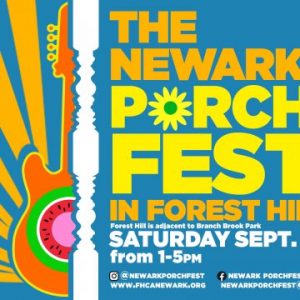
    Porch fest
    The Newark Porch Fest in Forest Hill

    Saturday, September 28 | 1:00 to 5:00 p.m.
    Forest Hill, Newark

    This inaugural celebration of community arts will take place in Newark’s Forest Hill historic district. Organized by the Forest Hill Community Association, our FREE family-friendly event will have amateur and professional artists (both performing and visual) volunteering to showcase their talents. Residents from Forest Hill will make their porches available to serve as community stages to accommodate the artists. Attendees will be invited to visit stages across the neighborhood to enjoy a full afternoon of entertainment, food, and fun. Visit us at Facebook: Newark Porchfest or Instagram: @newarkporchfest for updates and information.

    Learn more.

  • This Month in the Agenda – September 2002

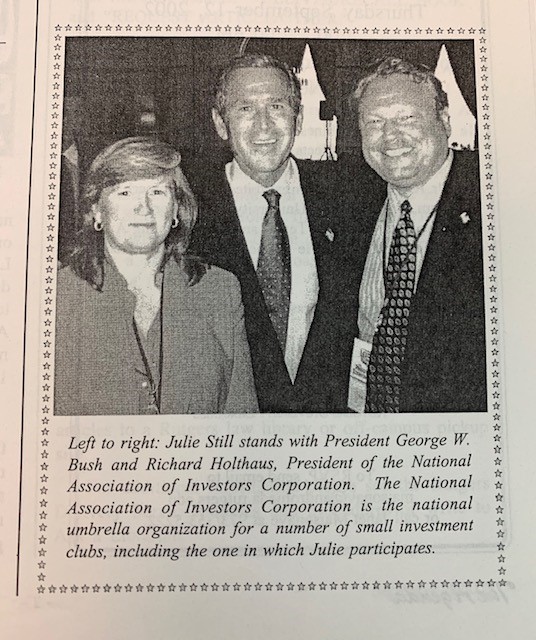
    Rubbing Shoulders with the Pres’

    In August, President George W. Bush asked Paul Robeson Library’s Julie Still to join him in Waco, Texas for a national economic forum.

    Julie is a member of an investment club and participated in July in a town meeting in Philadelphia organized by the United States Secretary of Commerce that focused on small investors’ reactions to corporate misdeeds. Julie spoke up and was quoted by an AP reporter and then in a Philadelphia Inquirer story. One or both stories apparently caught the eye of the President’s people, and she got invited to Waco.

    Getting Hi-Tech

    Congratulations to Paul Robeson Library’s Vibiana Bowman, whose article “Reading Between the Lines: An Evaluation of WindowEyes Screen Reader as a Reference Tool for Teaching and Learning” was published in the latest issue of Library Hi Tech. This is a special issue of Library Hi Tech devoted to accessibility of Web information resources for people with disabilities.

    Gifts from Taipei

    Colleagues or students visiting the undergraduate reading room on the first floor of Alexander Library may notice a large new artwork, taking up much of the wall space near the windows overlooking the entry walkway.

    “A City of Cathay” was donated in June by the Taipei Cultural Center in New York City. The Taipei Cultural Center also donated a significant collection of Chinese language books and journals to the East Asian Library in May.

    Power to the People

    After a regular August maintenance downtime was completed, IRIS returned to regular use with two significant modifications. The Rutgers Request Service (RRS) changed its name to the Rutgers Delivery Service (RDS), and a major new feature, user-initiated holds, became available.

    The name change to the Rutgers Delivery Service reflects the Rutgers University Libraries growing use of technology to save time, enhance services, and offer increased options to Libraries users.

    The Agenda 24, no. 14 (September 8, 2002)

  • Ex Libris Implementation Project Update – September 2019

    quicksearch logoAs we embark on a new academic year, we thought it would be a good time to let you know about some improvements coming to QuickSearch. Below is a summary of some of the major enhancements that Ex Libris plans to introduce in 2019-2020.

    Central index

    In Q1 2020, Ex Libris plans to release a new and improved central index. Leveraging the combined assets of its Primo and Summon indexes, Ex Libris’s new, unified Central Discovery Index (CDI) promises expanded content coverage, faster updates, improved deduplication, and better result filtering. In addition to providing an improved search experience for users, the new central index also offers better integration with Alma, making it easier to administer and maintain. 

    Related items

    As part of its effort to build a bigger and better central index, Ex Libris is also developing a graph database that will allow users to explore connections between related items. For example, a record for a book will soon have links to reviews of that book and the individual chapters contained within, creating additional opportunities for exploration and serendipitous discovery.     

    Browse journals by subject

    The Journal Search page will be enhanced to allow users the option to browse journals by subject. Subject categories will be based on Library of Congress Classification and offer researchers an easier way to identify and locate journals in their area of study. 

    Enhanced personalization

    Users will be given more control over their search experience with customizable preferences, including the ability to configure their preferred library, sort order, and number of results per page. 

    Bulk actions

    Currently, actions such as save, email, and export can only be applied to records individually. However, users will soon have the ability to perform these actions in bulk on a set of records. They will also have the option to export search results to Excel or CSV.

    Be on the lookout for more information about these enhancements as they are released. As always, if you have any questions or would like to report an issue with QuickSearch, please email the Ex Libris Implementation Team at exlibris@rutgers.libanswers.com. You can also use the “Report a problem” link in QuickSearch. For more information on how to use QuickSearch, visit QuickSearch Help or check out our QuickSearch tutorial videos.

  • Google Books, HathiTrust, and Our Contribution to the Collective Collection

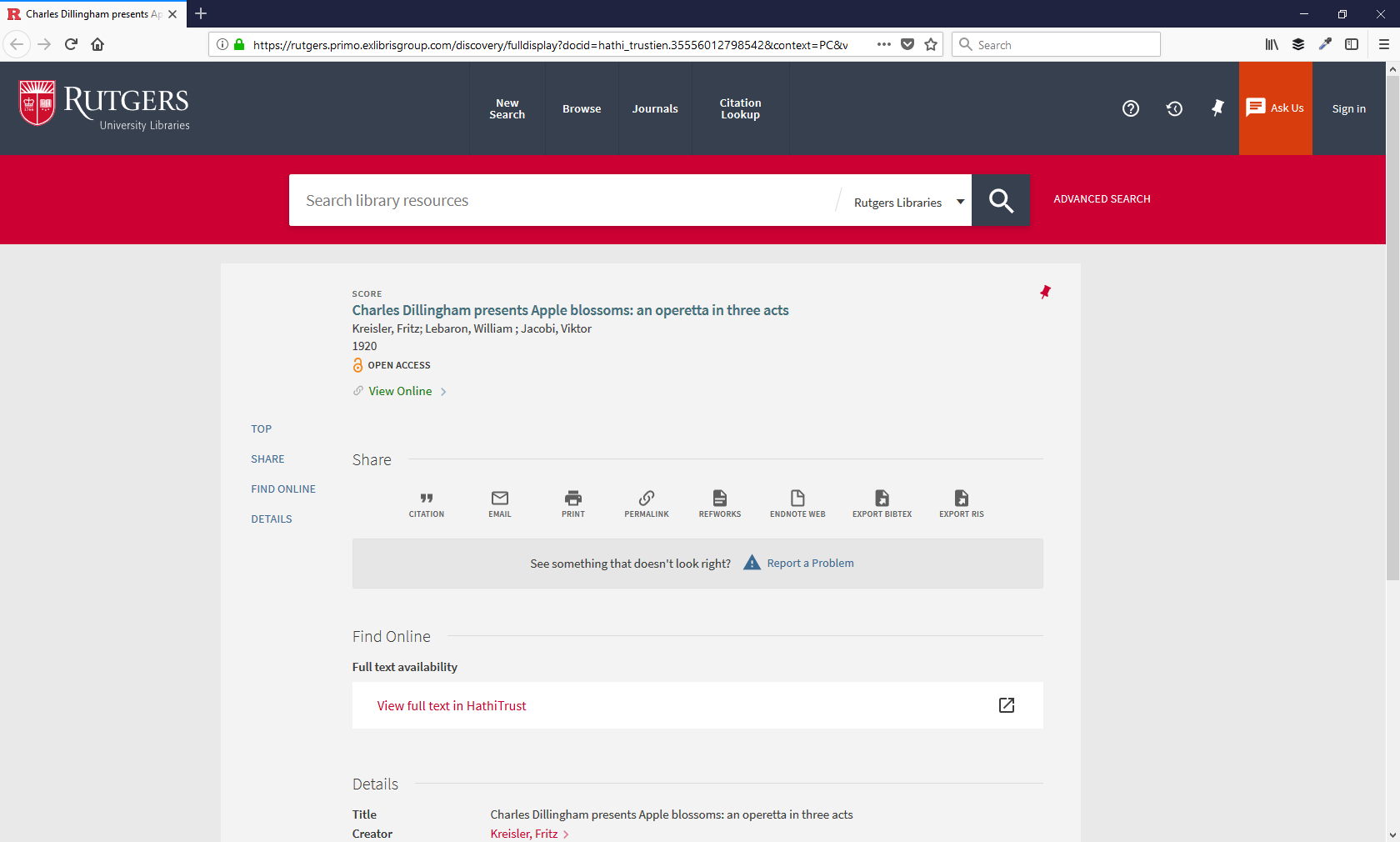
    The record for a HathiTrust text displayed in QuickSearch.

    As you may have read in the Cabinet minutes, the Libraries recently formalized our commitment to participate in the Google Books Library Project. With the goal “to create a comprehensive, searchable, virtual card catalog of all books in all languages,” this partnership between Google and dozens of libraries worldwide—including those of the BTAA, which signed an agreement to participate in 2007—has digitized millions of books and made them searchable through the Google Books platform.

    In addition to improving Google’s search, the books scanned through the Google Books Library Project are deposited into the HathiTrust Digital Library. The BTAA and University of California system were instrumental in setting up HathiTrust, a community-owned partnership developed to “be a vital catalyst for emerging forms of research, teaching, and learning that engage the scholarly and cultural record.” We already benefit greatly from the services of HathiTrust, which include preservation of the scanned versions of the content, access to research tools such as textual analysis, and books for people with print disabilities. Moreover, full-text content from HathiTrust is discoverable in QuickSearch, adding to the amount of resources our users have access to at the click of a button.

    Though our work on this project is really just beginning, it has already been months in the making. Last spring, we worked with Google to go through a test run of their digitization process, from the identification of books in our collection to the review of the final, scanned versions. Now that we’re moving forward, a Librarieswide team has been formed to carry out the project with Joann Parrone acting as the central coordinator. This group had its kick-off meeting last month and is already working to comb through the candidate list provided by Google, which amounts to nearly 170,000 unique items. Each needs to be reviewed for eligibility, taking into consideration size, condition, and a variety of other factors.

    And this is all just the tip of the iceberg. This project will call upon many of us throughout its lifecycle, from the selection of materials, to packing and staging, to coordinating checkout policies while the books are away being scanned. But this this is an important undertaking and a great opportunity for us to further our contribution to the collective collection, advancing the elements of our mission to accelerate discovery, illuminate understanding, and contribute to the public good.

    In their new report on operationalizing the BTAA collective collection, Lorcan Dempsey and his colleagues write that “effective collaboration, the provision of shared infrastructure, and operational sustainability are all now central issues for libraries and the institutions of which they are a part.” Contributing to initiatives like the Google Books Library Project and the HathiTrust Digital Library is one of the many ways we can embrace this spirit of collaboration and ensure that we maximize the impact of our collections—not just in the here and now, but around the world, and for generations to come.

  • Library Tutorials Made Available in Multiple LMSs

    The NimblyWise courses on Communication, Critical Thinking, and Information Literacy are now available for use in Blackboard, Canvas, and Sakai.  A new Credo Reference course – Health Science – is in the process of being set up and soon will be available in Canvas.  As an easy way to reference these courses while conveying the wide range of library instruction topics, we refer to them as Library Tutorials.

    The Library Tutorials are for use by Rutgers University instructors on all campuses.  Librarians will be interested to know that the lessons are mapped to instructional standards including the AAC&U (American Association of Colleges and Universities) VALUE Rubrics (Information Literacy and others), the ACRL Framework for Information Literacy, and the ACRL Visual Literacy Standards.

    Here are some of the ways that instructors may use these lessons:

    • In a first-year or transition class, to help students appreciate the overall importance of information literacy, strong research and evaluation, and communication skills.
    • As a flipped classroom, assigning students to view a video or work through a lesson before they attend a specialized library instruction class.
    • At various points during a scaffolded assignment, courses are broken down into individual lessons so that they may be deployed to students at various points in their process.
    • At the beginning of a class project, the multimedia lessons cover topics essential to success in research, from choosing a topic to evaluating sources.
    • At point of need, the lessons and videos provide just-in-time learning resources that are available to students throughout the semester.

    Instructors who have questions about the Library Tutorials content, or who want to supplement the online instruction with in-person or other modes of library instruction, are being directed to contact their library liaison.  Library liaisons can also help instructors select the most relevant lessons for their course.

    Librarian liaisons who need information about the tutorials may contact Maria Breger at maria.breger@rutgers.edu.

  • Making Room for (Space) Improvement

    Last month the Central unit completed a series of relocation projects within Alexander Library and the Libraries Technical Services Building in order to maximize the efficient use of space and prepare for future improvement projects.

    We were pleased to welcome Communications, Shared User Services and Digital Projects to the administrative offices on the third floor at Alexander: Matt Badessa, Rhonda Marker, Marty Barnett, and Isaiah Beard are now located at 169 College Avenue, and may be reached at their same telephone lines. Business Operations, including Abigail DiPaolo, Amanda Presler and Jodi Costeira, have relocated within the administrative suite, so their address and telephone lines will not change.

    We are also excited to welcome Gracemary Smulewitz to the SCC space on the fourth floor of Alexander. Web services librarian Amy Kimura and discovery services librarian Joseph Deodato have now relocated to TSB, near to their frequent collaborators in IIS and TAS, and can be reached at their same telephone lines at 47 Davidson Road.

    These new arrangements are partly the result of achieving certain goals and priorities for FY2019, namely, the addition of Jeffrey Carroll, our new AVP of scholarly communications and collections, who joins Rutgers on July 15. In the coming year, both Alexander Library and TSB will undergo limited renovation projects to include more collaborative space for staff and students, and to co-locate School of Communication and Information faculty in Alexander Library.

    The Libraries are accustomed to the strengths and challenges of working together across 16 buildings and three campuses, and effective workspace is always in demand. More news about ongoing space improvements will follow as we work on the functionality and use of the Technical Services Building. We look forward to the next phase of enhancements!

    Want more exciting news about spaces and places at RUL? Read about the Dana Library Transformation Project and track its progress on its dedicated blog.

  • This Month in the Agenda – July 1980

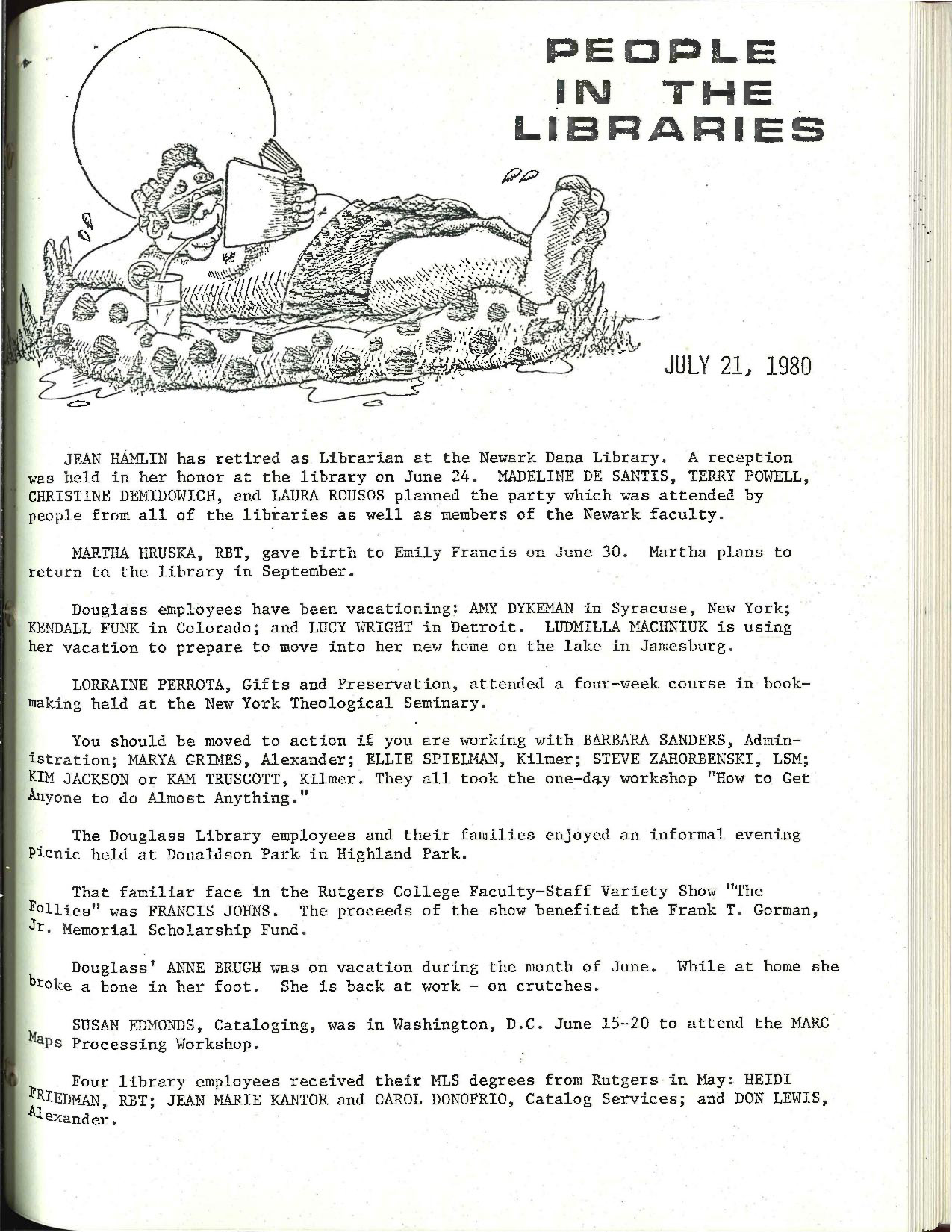
    Movers and shakers around the Libraries, July 1980.
    Play ball!

    RULSA is sponsoring a baseball trip on Sunday, July 20 for the Yankees vs. Kansas City game. The cost of the trip ($13.00 for RULSA members and their families, $13.50 for non-members and their families) will include the bus trip and box seats. The bus will leave the Alexander Library at 11:45 a.m. You may purchase your tickets form Eileen Barron, Douglass Library, extension 9411. The deadline for full payment is Thursday, July 10.

    The Agenda 2, no. 27 (July 7, 1980)

    Database Searching… Online!

    Upon the request of the University Librarian Hendrik Edelman, Pat Piermatti convened a meeting of the Ad Hoc Group for Online Database Searching to discuss the issues involved in providing system-wide online database searching, heretofore offered by LSM and the Camden Law
    Library alone….

    Evelyn Greenberg presented Alexander Library’s proposal for the provision of online services beginning September 2, 1980. Initially Lockheed Information Systems DIALOG will be accessed for its social sciences and humanities databases. The fee structure and publicity materials must still be decided upon. Debbie Ludwig reviewed the Dana Library Task Force Preliminary Report for the Provision of Online Searching. Dana anticipates the commencement of their online service sometime after January 1, 1981. Debbie will have responsibility for the science databases, while Christine Demidowich will be responsible for the social sciences and humanities databases. The Bibliographic Retrieval Service and DIALOG will be the first two systems accessed.

    The Agenda 2, no. 29 (July 21, 1980)