The new administrative information systems under Cornerstone are scheduled to go live over the next week. Cornerstone is the University’s strategic approach to unify, upgrade, and streamline its administrative information systems for Finance, Human Resources and Payroll, Procurement, etc. Upgrading and improving these systems will significantly improve how we work and collaborate across the university. These projects are also particularly exciting to the library because they will enable all of our units to finally utilize the same systems for administrative functions.
Be on the look-out for future announcements about process updates and training opportunities related to this implementation. If you have any questions about how the new systems may or may not impact you, please see your local business staff.
Faculty are inundated with email invitations to publish in scholarly journals or to serve on their editorial boards. Many of these solicitations are completely valid, but an increasing number of these journals are engaging in predatory publishing practices.
Predatory publishing, a term coined by Jeffrey Beall, a librarian and associate professor at the University of Colorado, Denver, is an unwanted and undesirable side effect of the open access movement and Beall has become widely known as the “go-to guy” when it comes to checking the validity, authenticity, or value of these invitations.
Beall maintains several resources that are great tools for promotion boards, hiring committees, and, as it turns out, librarians. The renowned Beall’s List of predatory publishers lists “potential, possible, or probable predatory scholarly Open-access publishers,” on his Scholarly Open access blog. Additionally, Beall maintains a list of standalone journals and a list of criteria—covering everything from editors, staff, and business management to transparency, integrity, journal standards, and publishing practices—for identifying predatory Open-access publishers.
The Rutgers Center of Alcohol Studies (CAS) has been a frequent users of Beall’s list, since nationally and internationally recognized researchers at the Center are primary targets of invitations to participate in scholarly communication in various ways. Addiction science has been experiencing an influx of new journals and conferences, akin to health sciences.
In the July issue of The Agenda, we invited you to read part one of this interview in the Center of Alcohol Studies Information Services Newsletter, in which Beall explains how he became involved in the growing area of predatory publishing, discusses the most vulnerable groups in academia, and gives an update of the current situation. Part two, focusing on topics of greater interest for librarians, is now available in SALIS News. Beall advocates for educating users about not only predatory publishing, but also the various forms of open access and publishing standards, so that they can avoid the traps of predatory publishers.
In the July staff news, you may have noticed this announcement: “A poem of Michael Joseph‘s will be part of the Vispo Art Exhibition of poetry and art sponsored by the German state of Northrhine-Westphalia (NRW). The exhibition, scheduled for Spring 2017, will conclude in Burgau…” His brilliantly and beautifully conceived books are now a reality.
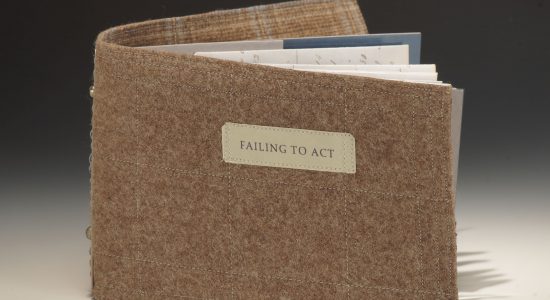
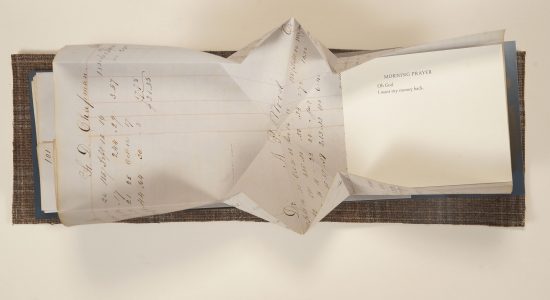
Shown above in the slideshow are SPICA, a poem by Michael Joseph, Failing to Act, a collaborative artists’ book, and Dream Dirt, a book unlike any other. All three books were conceived and fabricated by Sarah Stengle.
Details:
SPICA
Poem by Michael Joseph 2016
Art by Sarah Stengle 2016
Silkscreen on etched and drilled found glass autoclave windows with steel brass and neoprene rubber fittings.
Edition of 2
14 x 12 x 26 centimeters (height x depth x width)
Failing to Act
Collaborative artists’ book
Four Poems: Michael Joseph 2016
Book Art: Sarah Stengle 2016
Twelve pages as follows: six turkish map-folded spreads, each containing text on one side.
This book was typeset in Aldus and Aldus SC by Hermann Zapf, and printed on Crane Crest Natural White Cotton Wove. The endpapers are Rives Smoke Cover with Western Blot antibody test result films mounted with 3M 568 adhesive. The text appears inside mid-nineteenth century pale blue ledger-paper folded with a Turkish map-fold. The outer covers are sewn wool with printed pale celadon colored silk title labels applied. The covers are attached with waxed blue linen thread and vintage Erector Set hardware from the 1950’s.
Edition of 8.
Dream Dirt
Text by Michael Joseph 2016
Art by Sarah Stengle 2016
A wooden train carrying two vials of dirt, 30 vials containing paper scrolls (28 short stories, 2 signatures).
The text is available in a trade edition, titled Juvenile Fantasies and Innocent Dreams. The vials contain short stories about childhood and dirt, each one sentence in length, as well as an equivalent number of single-sentences critiques and responses to the stories. Two of the vials contain sterilized dirt from the past of the author and artist.
Making Rowan University and Camden County College Students Feel Welcome
Through a partnership agreement, Paul Robeson Library is now the campus library for Rowan University and Camden County College students. Bart Everts is the library liaison for these students and has started a new Facebook page to share information about their library privileges and resources. The agreement allows students to access the library, use library databases, and check out books using their student ID cards. Robeson also has computers reserved for their use.
Morroe Berger–Benny Carter Jazz Research Fund
Each year the Institute of Jazz Studies (IJS) awards up to ten grants of $1,000 each to assist jazz researchers. Half of the awards are designated for students in the Rutgers University-Newark Master’s Program in Jazz History and Research and half are awarded to scholars from other institutions or unaffiliated researchers to enable them to visit IJS in conjunction with their projects. To date, we have given more than 70 awards to scholars and students worldwide working in a variety of disciplines, including jazz history, musicology, bibliography, and discography.
Applications for the 2017 grants are due October 21, 2016. Awards will be announced by November 14.
“Homecoming! Some Highlights from the Library of J. Milton French” at Alexander Library
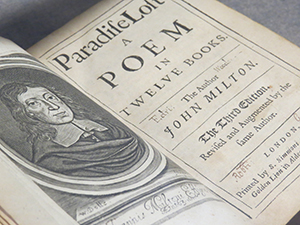
Homecoming! Some Highlights from the Library of J. Milton French is on display now in the Scholarly Communication Center at Alexander Library. This case exhibit features a selection of volumes recently donated to Rutgers by the family of J. Milton French (1895–1962), a Milton scholar and professor of English at the university from 1940 to 1960.
The books on display include rare first and early editions of works by John Harington, Richard Barckley, Michael Drayton, Ben Jonson, John Suckling, George Wither, William Wollaston, and John Milton.
New Brunswick Music Scene Symposium Planned for October 27, 2016
Save the date. Special Collections and University Archives will hold the next New Brunswick Music Scene Archive symposium on October 27, 6 p.m. in the Teleconference Lecture Hall at Alexander Library. Stay tuned for more information, including the participants. In the meantime, here’s a look back at the 2015 symposium, featuring a who’s who of New Jersey music (http://www.libraries.rutgers.edu/news/symposium-local-notables-inaugurate-new-brunswick-music-scene-archive).
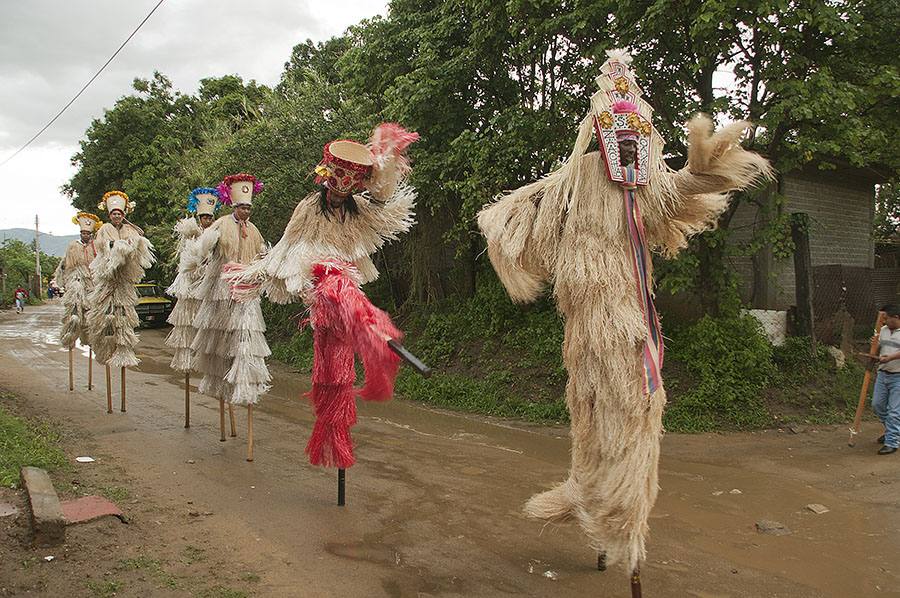
Credit: Laura Anderson Barbata.
Mary H. Dana Women Artists Series Galleries Welcomes “Laura Anderson Barbata: Collaborations beyond Borders”
This fall, the Mary H. Dana Women Artists Series Galleries in the Mabel Smith Douglass Library will welcome the 2016-17 Estelle Lebowitz Endowed Visiting Artist Exhibition, Laura Anderson Barbata: Collaborations Beyond Borders. The exhibit contains selected highlights of textile, sculptural, 2-dimensional, and video works from the traveling exhibition Transcommunality.
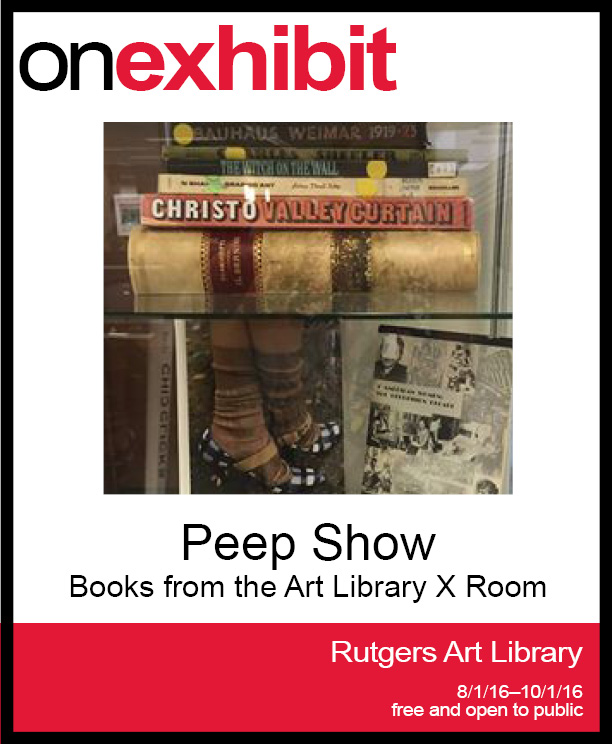
“Peep Show: Books from the Art Library X Room” Exhibit at Rutgers Art Library
Megan Lotts has raided the X Room to put on a case display of beautiful, surprising, amusing, and impressive books.
Stop by to get a taste of the treasures that reside in the Rutgers Art Library’s archives.
Latino Americans: 500 Years of History was made possible through a grant from the National Endowment for the Humanities and the American Library Association.
Rutgers University Libraries recently concluded the ALA-funded program Latino Americans: 500 Years of History. Over the course of a year, Rutgers and other scholars led 17 PBS film screening discussions about the experience of Latinos in New Jersey in collaboration with Rutgers University Libraries, the Nilsa L. Cruz-Perez Branch of the Camden County Library, New Brunswick Free Public Library, and the Newark Public Library.
Beyond the film showings in Spanish and English, project partners offered exhibits, book talks, lectures, and special celebrations. Highlights include A Day of the Dead Celebration and Cinco de Mayo festivities in New Brunswick showcasing a variety of performances and children’s activities; a Cuban musical concert by renowned singer Gema Corredera; the exhibit “Beyond Exile: Cubans in New Jersey” at the Newark Public Library, including a keynote address by Lisando Pérez; and two separate exhibitions at the Rutgers Art Library, Ilya Genin’s “Photographs of Cuban Revolution 50 Years Later,” and “From Island to Ocean: Caribbean and Pacific Dialogues by Fidalis Buehler and Juana Valdes.”
As project director Nancy Kranich notes in the final report on this initiative, this program allowed Rutgers University Libraries to become “a catalyst for bringing together scholars and organizations involved with the New Jersey Latino American experience and encouraging more attention to documenting it. The grant enabled us to take a more assertive role in building and strengthening relationships with local Latino communities and the scholars, organizations, and public libraries that interact with them.”
Kranich also lists several other outcomes that may be of interest to our colleagues:
Several new items were added to Special Collections, including several leaflets of unpublished poetry by Newark poet Pablo Le Riverend, clippings of anti-Castro activities in Hudson County, Sarah Hirschman’s papers covering People & Stories/Gente y Cuentos.
The publisher and owner of Impacto, published in the 1960s, donated 99 issues of the publication to Rutgers University.
15 Latino clubs are Rutgers are planning to learn how to organize and preserve their own records in conjunction with Rutgers University Libraries’ archivists.
Two possible books are in discussion: a history of Latinos in NJ and an anthology of unpublished documents about Latino migrant workers in NJ and the United States.
The New Brunswick Free Public Library and Rutgers University Libraries are discussing partnering again on another ALA public programming grant proposal.
A deeper understanding of the Latino collections in the state and increased participation in depositing scholarly works into our Rutgers Inclusion and Diversity Research Portal.
Mary Beth Weber won the ALCTS Slogal Contest for her slogan, “Creating the future, preserving the past.” This slogan will be used during the 60th anniversary celebration of ALCTS in 2017. In addition to bragging rights, Mary Beth also received a prize of registration for CE webinars valued at $350. Congratulations Mary Beth!
“Peep Show: Books from the Art Library X Room” Exhibit at Rutgers Art Library
Megan Lotts has raided the X Room to put on a case display of beautiful, surprising, amusing, and impressive books.
Stop by to get a taste of the treasures that reside in the Rutgers Art Library’s archives.
Location: Rutgers Art Library
It’s Getting Hot in Here
Late in July, America faced record temperatures outside and Smith Library in Newark was no exception. With the A/C out for several days, the librarians and staff had to come up with new ways to keep their cool. Here, a short haiku on the experience:
The books are burning!
Librarians are weeping…
The heat is too much.
– Sarah Jewell
Communications Tip – Using Rutgers Go to Shorten URLs
Want a short, trackable URL to use in an email or social media post? There are many URL shorteners on the market including goo.gl, bitly, and ow.ly, but go.rutgers.edu offers something the others can’t–an actual Rutgers URL to make your link appear official and trustworthy. This service allows Rutgers users to quickly and easily shorten a URL and track how many times that URL is viewed.
While I used the same shortened URL on both Facebook and Twitter, I could have created separate shortened URLs for each social media site to track the relative traffic. I did this for an earlier post about the New Brunswick Music Scene Archive, which allowed me to see the number of views on each platform (162 for Twitter, 7 for Facebook).
I highly recommend you try out go.rutgers.edu if you have not already done so.
–Jessica Pellien
New Brunswick Music Scene Symposium Planned for October 27, 2016
Save the date. Special Collections and University Archives will hold the next New Brunswick Music Scene Archive symposium on October 27, 6 p.m. in the Teleconference Lecture Hall at Alexander Library. Stay tuned for more information, including the participants. In the meantime, here’s a look back at the 2015 symposium, featuring a who’s who of New Jersey music (http://www.libraries.rutgers.edu/news/symposium-local-notables-inaugurate-new-brunswick-music-scene-archive).
Full Text Finder Training
This fall the Rutgers Libraries will be migrating to Full Text Finder, EBSCO’s newest holdings and link management tool designed to replace its A-to-Z and LinkSource services, which are being phased out. A-to-Z is the product that powers the Libraries’ electronic journals search. LinkSource is the product that powers its link resolver service (locally known as “Get it @ R”). Although the basic functionality of these tools has not changed much, we have taken the opportunity to introduce a few custom modifications that we hope will simplify the process of finding full-text articles and improve the overall user experience. If you’d like to learn more about Full Text Finder and the upcoming changes, feel free to attend one of the 30 minute drop-in sessions scheduled in August. Videoconferencing to Dana, Robeson, and Smith is available upon request.
Full Text Finder Information Sessions
August 4 @ 2 p.m. — LSM Conference Room, Library of Science & Medicine
August 8 @ 2 p.m. — Pane Room, Alexander Library
August 11 @ 2 p.m. — Pane Room, Alexander Library
Buttons! Buttons for Everyone!
Custom buttons are now available from the Communications Department.
The buttons we mentioned in the July issue of The Agenda proved a popular giveaway at the New Student Orientations in New Brunswick. This is a relatively low-cost and fun way to run a promotion or to market something at the Libraries. If you are interested in borrowing our machine for a project, please make sure to purchase the supplies that are available here. We’re happy to train you or your student workers on how to create buttons.
You’ve Got People, Now What?
August 3, 2016
9 a.m. – 1 p.m.NEW DATE!
This course is ideal for new and experienced managers, supervisors, and administrators who have direct reports and would like to apply their knowledge of personal styles to flexibly manage their staff.
Location: Pane Room, 1st floor, Alexander Library
RSVP: Erica Parin on behalf of the Professional Development Committee
Manager as Leader – Developing Staff
August 30, 2016
9 a.m. – 12 p.m.
This course is ideal for managers, supervisors, and administrators who would like to sharpen their situational leadership skills and discover how flexible and effective they are in a variety of situations with staff.
Location: Pane Room, 1st floor, Alexander Library
RSVP: Erica Parin on behalf of the Professional Development Committee
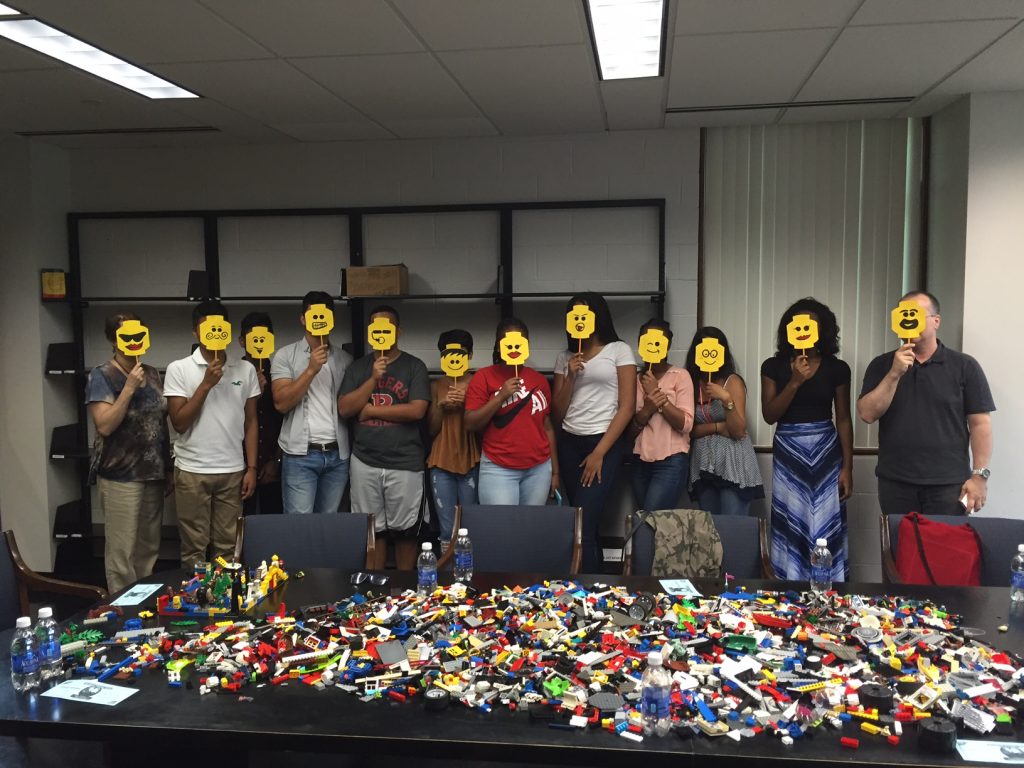
Rutgers Future Scholars use Legos at the Art Library to learn about teamwork and libraries. Photo credit: Megan Lotts.
The Rutgers Future Scholars program places rising High School juniors in an internship for one week during the summer. This summer, the New Brunswick Libraries hosted two internships. Ryan Womack hosted 5 students and worked with them on Big Data, and Jill Nathanson hosted 5 students working on gamification.
For those unfamiliar with the Rutgers Future Scholars Program, here is the description from its website:
The goal of the Rutgers Future Scholars program is to increase the numbers of academically ambitious high school graduates who come from less-advantaged communities, inspire and prepare them meet the standards to be admitted to colleges and universities, and then provide tuition funding to those who are admitted and choose to attend Rutgers University.
In addition to working on their respective projects, the interns were provided an overview of the Libraries and had an opportunity to meet a variety of faculty and staff. Snack breaks were hosted each day by librarians, access services staff, and the communications team. The interns also traveled to the Art Library one day to participate in using Legos to learn about teamwork and libraries.
The students working with Jill Nathanson created an event for transfer students. The challenge was to create an event that reinforced the library instruction transfer students received in their library sessions while also making it fun and giving them an opportunity to interact with other transfer students. The students worked together to create a team based activity that will be used this fall at the Alexander Library.
The students working with Ryan Womack explored data science with R, working through exercises on data wrangling, data analysis, and data visualization using the R open source statistical software environment. By working with real-world College Scorecard data, the students gained understanding of the challenges and possibilities of working with live, raw data sources.
On July 25, the office of research and economic development announced the impending launch of the Research Administration and Proposal Submission System (RAPSS) Phase II on August 8. The text below is taken directly from that announcement. As this system is implemented, our ability to work in an informal manner will be eliminated. In order to successfully submit a grant, we must follow the correct RAPSS process. If you have any questions about RAPSS and how it applies to your work at the Libraries, please bring those questions to your director or AUL.
What you need to know:
Faculty and staff need to complete training on the new system before it goes live.
On August 8, RAPSS will become mandatory for all new submissions of research proposals, corporate contracts, and associated items. Paper submissions will no longer be possible.
Information about RAPSS user training and the schedule of training sessions are posted here.
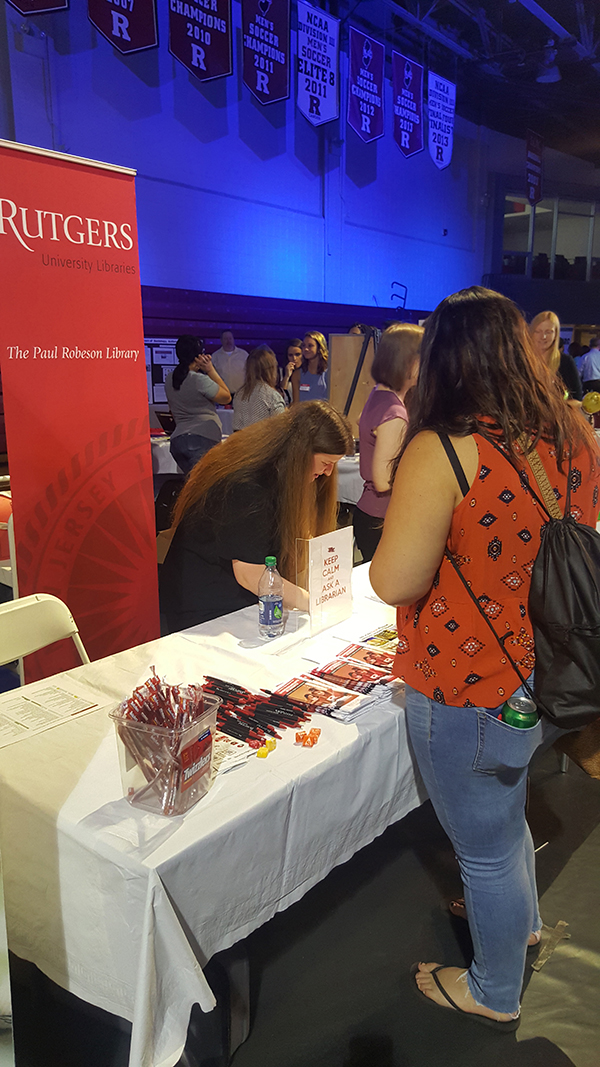
Zara Wilkinson provides information about the Libraries to new students at Raptor Welcome.
Faculty and staff across the entire system of libraries at Rutgers University participated in numerous events over the summer to welcome students to the campus.
The Paul Robeson Library is a longtime participant in Raptor Welcome, a fun and interactive orientation program for first-year and transfer students at Rutgers University-Camden. Raptor Welcome includes a full day of programming and a campus information fair with over 80 tables representing university departments, student support services, and student organizations. Robeson will host a table at the event, welcoming over 700 new students with information, candy, and giveaways. As a result of the Bridging the Gap financial aid program, Rutgers-Camden is expecting the biggest incoming class it has ever had!
In addition to Raptor Welcome, Robeson participates in orientation programs for graduate students, teaching assistants, international students, and resident assistants. This year, library faculty and staff are also looking forward to being part of Rutgers-Camden’s brand new Raptor Passport Program, which is designed as an extra-curricular first-year experience with helpful workshops, social events, and the potential to earn prizes.
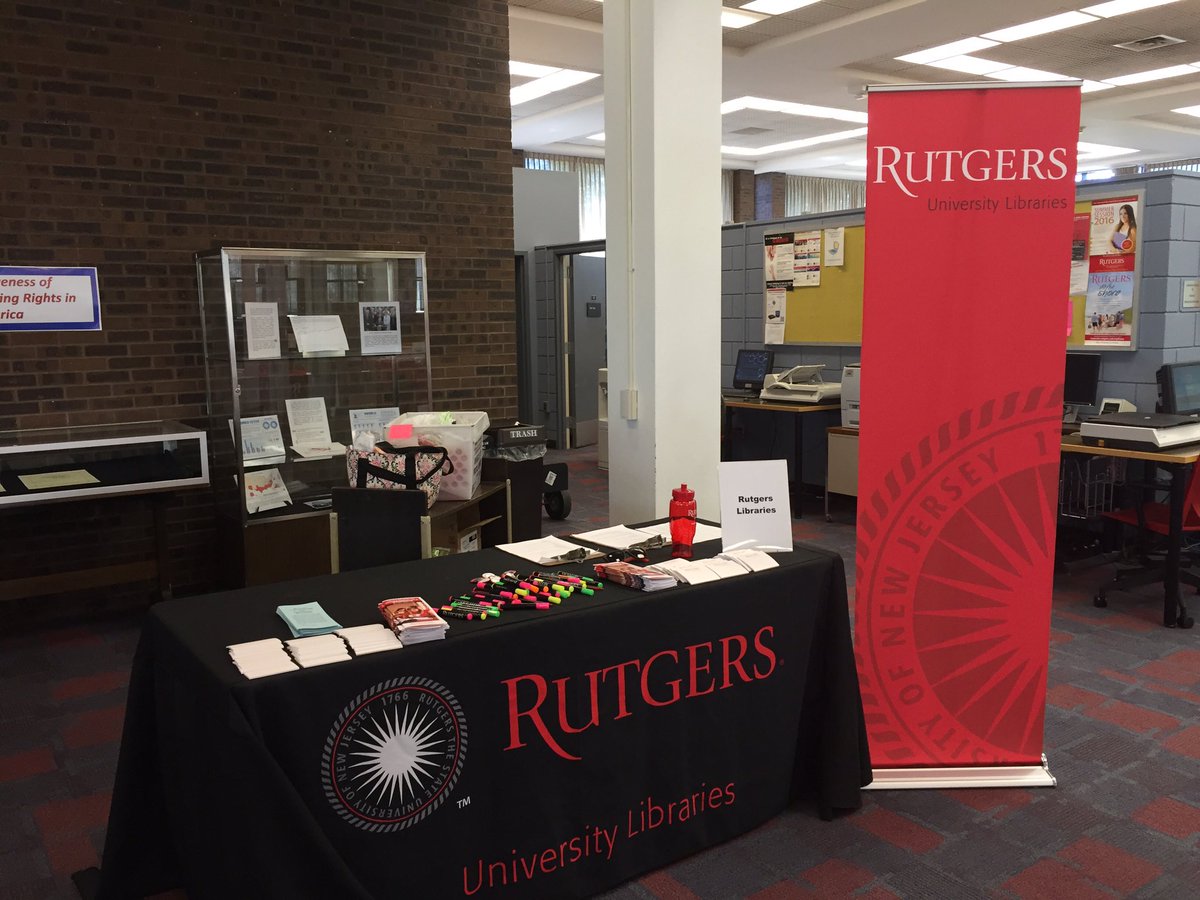
As hosts of the fair, the New Brunswick libraries get a prime spot at the front of the space. Giveaways include pens, highlighters, post-it pads, water bottles, and sunglasses. We also distribute informational flyers on undergraduate services and special collections.
Over the summer, the New Brunswick Libraries hosted the resource table fair for new and transfer students for the second year at Kilmer Library. There were 22 sessions, which were attended by around 4000 or so students and families. The libraries engaged participants with interesting facts about library services and facilities, as well as popular giveaways, such as sunglasses and water bottles.
This event was staffed by library faculty and staff who provide students information about printing, library hours and facilities, technology, and getting research help.
This fall, the New Brunswick Libraries is distributing a special mystery gift to new students who visit Alexander Library or Kilmer Library on the first day of classes, September 6. To promote this giveaway, flyers will be posted in first-year dorm common areas and the communications department will run a social media campaign. Hopefully this encourages more students to stop in and say “hi.”
While we don’t have specifics just yet, Dana Library also participated in numerous student welcome days at Rutgers University-Newark. They distributed goodies and had a special brochure with information about Dana Library to distribute.
Click to enlarge. Photo credit: Michael Joseph, Rutgers University Libraries.
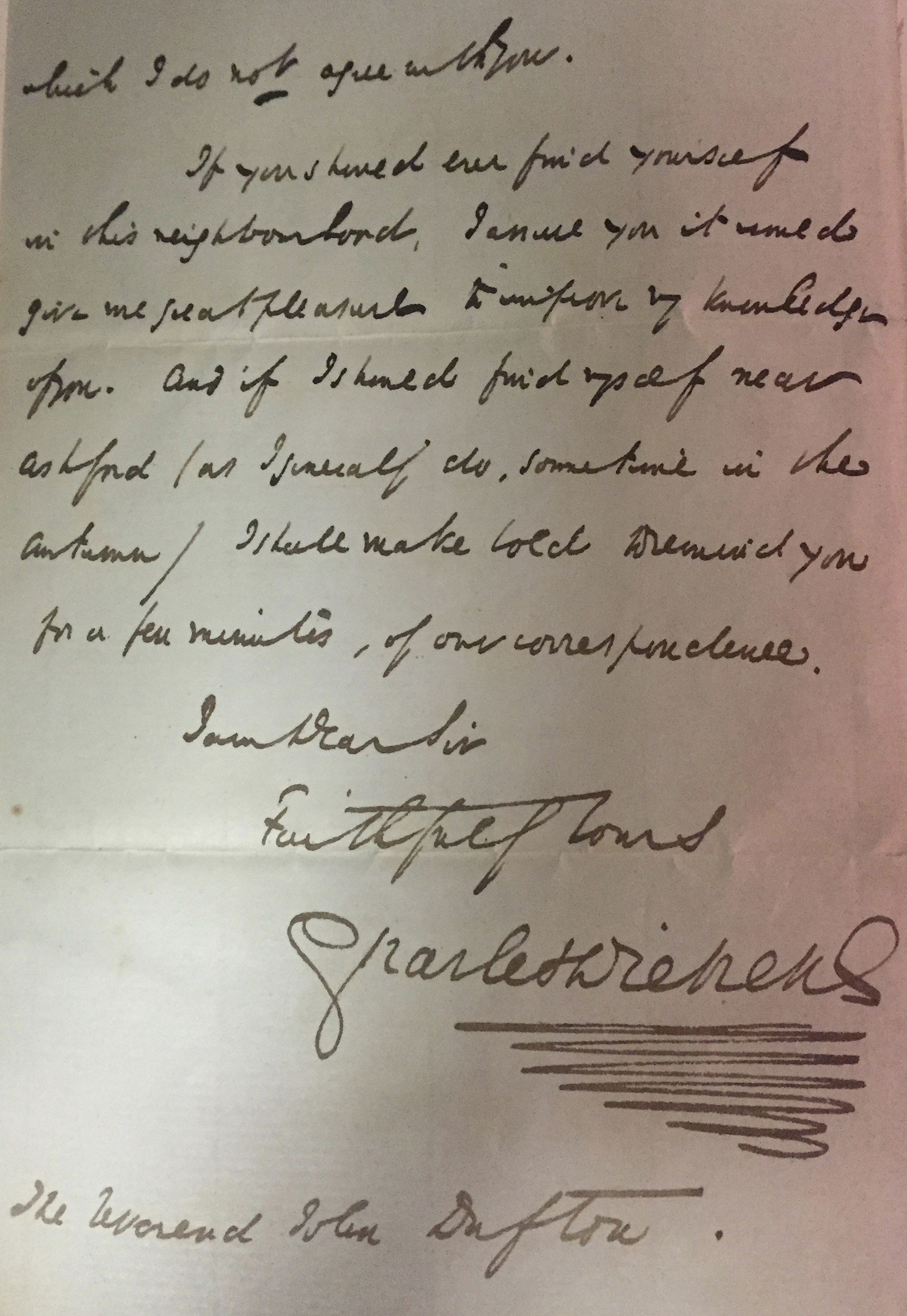
In preparing a pop-up exhibition for the Northeast Victorian Studies Conference in April, we turned up a previously unknown and unrecorded letter from Charles Dickens bound into one of the Libraries’ books. Written by Dickens on 24 November 1849 to the Reverend John Dufton, the 3 p. letter responds to Dufton’s pamphlet, The Prison and the School: a Letter to Lord John Russell, M.P. (London: John W. Parker, 1848). Dickens writes warmly in support of the pamphlet, though he registers a disagreement with Dufton’s apparent enthusiasm for the “reformatory influences” of the new “model prisons,” noting, with a Dickensian touch, that the reformatory spirit cannot “[survive] the unnatural air of the solitary cell.”
Penal reform was a complex and pressing topic, then as now. The skepticism of the reforming capacities of prison Dickens shared with Dufton anticipates his 1850 essay “Pet Prisoners,” as well as David’s cynical views of the “model prison” in chapter 61 of David Copperfield, which Dickens would begin writing in 1849. Despite their disagreement on what Dickens calls a “momentous”—and Phillip Collins in Dickens and Crime (1968) a “blood-heating”—issue, Dickens concludes his letter on amiable terms by inviting Dufton to visit him in London. Quite familiarly, he invites himself to visit Dufton: “if I should find myself near Ashford as I generally do, sometime in the autumn I shall make bold to remind you for a few minutes, of our correspondence.” No such visit has been recorded.
Dickens thought well enough of Dufton’s pamphlet to keep and annotate it, and it has survived into our time. Regrettably, however, it is currently unavailable to scholars. In 2010, it was sold by Henry Sothern Limited to a private collector in Switzerland (see Piccadilly Notes 56 [2010] item 100, no. 11). [i]
Click to enlarge. Photo credit: Michael Joseph, Rutgers University Libraries.
Dickens and Dufton were not strangers. Elsewhere in the volume housing the Dickens letter (noted below) is a manuscript note, dated 1846, from George Cruikshank to Dufton, written on behalf of Dickens and the Committee of the Ashford Mechanics’ Institution, thanking Dufton for sending a lecture, as requested.
The letter is captioned “Devonshire Terrace.” Dickens lived at 1 Devonshire Terrace (now 15-17 Marylebone Road, Marylebone), near Regent’s Park, from December 1939–1851.
John Dufton was rector of Warehorne, in the Ashford Borough of Kent and the author of other ephemeral publications including National Education, What it is and What it Should be (1848).
The letter has escaped detection because it was all but buried within an extra-illustrated copy of Blanchard Jerrold’s Life of George Cruikshank (1882). As Ron Becker discovered in a search of the archives of the Journal of the Rutgers University Libraries, Don Sinclair recorded the acquisition of the volume in 1956:
Click to enlarge. Photo credit: Michael Joseph, Rutgers University Libraries.
Without doubt the most striking single gift is that of the Class of 1933, which had presented earlier an extra-illustrated set of Benjamin West material. The present gift, preserved in the same form, is the Jesse Metcalf collection of George Cruikshank prints and manuscripts. It is interleaved in a first edition of Blanchard Jerrold’s Life of George Cruikshank (1882), published originally in two octavo volumes, here expanded to seven gilt-edged, large folio volumes
bound in scarlet crushed Levant morocco. The items have not been counted, but a careful estimate places the number of prints at nearly a thousand, with perhaps six dozen manuscript letters. Virtually all types of Cruikshank’s artistic work are represented (oil paintings excluded): etchings, some in color, woodcuts, at least one original watercolor, etc.; caricatures, book illustrations for Dickens and others. His well-known Temperance series, The Bottle (1847) and The Drunkard’s Children (1848), are present. The first volume also contains his famous Specimen of a Bank Note—not to be imitated (1818), a bitter, effective caricature inspired by the hanging of several women convicted of passing counterfeit notes. Engraved in banknote style, it shows eleven hooded figures hanging by the neck, and other macabre decorations. (19:2)
George Cruikshank (1792–1878) was an important caricaturist, illustrator, and print-maker, perhaps best known now for his illustrations of Sketches by Boz (1836) and Oliver Twist (1838). In George Cruikshank, Life, Times and Art: Volume 1, 1792–1835, Robert E. Patton notes that Ruskin thought him second only to Rembrandt in etching (8). “He infused his pictures with a humor at times bawdy, crude, sentimental, inconsequent, grotesque, bathetic, or pathetic. Like Dickens, to whom he was frequently compared, he was both a ‘special correspondent to posterity,’ focusing a journalist’s eye on the rapidly changing world around him, and a visionary humanist, outraged by injustice, greed, and folly, sympathetic to the defenseless and neglected,moralistic toward those who abused their power, their prerogatives, their neighbors, or their bodies.” (8)
Michael Joseph
Kevin Mulcahy
[i] Andrew McGeachin, e-mail message to M. Joseph, March 31, 2016.

 The new administrative information systems under Cornerstone are scheduled to go live over the next week. Cornerstone is the University’s strategic approach to unify, upgrade, and streamline its administrative information systems for Finance, Human Resources and Payroll, Procurement, etc. Upgrading and improving these systems will significantly improve how we work and collaborate across the university. These projects are also particularly exciting to the library because they will enable all of our units to finally utilize the same systems for administrative functions.
 Faculty are inundated with email invitations to publish in scholarly journals or to serve on their editorial boards. Many of these solicitations are completely valid, but an increasing number of these journals are engaging in predatory publishing practices.