Category: Rutgers University–Camden

Faculty and staff news from the Paul Robeson Library at Rutgers University-Camden.

  • University Librarian’s Report – May 2019

    The last several months have been a flurry of activity. In addition to the day-to-day demands of a busy spring semester, it’s also the most planning-intensive period of the year, as we assess our standing at the close of the current fiscal year and plan in earnest for FYs 2020 and 2021.

    I received a lot of feedback during town hall season and in continued conversations with the library directors that we could do a better job of clarifying the different stages in the planning process and of describing central’s role in supporting local priorities. In an organization like ours, it is definitely a complex puzzle and it can be difficult to see how all the pieces fit together.

    We’ve made some updates to the University Librarian page on our staff resources website to provide a resource that brings more transparency to the planning process and illustrates how local and central priorities work together. The page includes a broad overview of the annual planning process as well as links to the local units’ plans and a list of major central infrastructure projects. Hopefully this will help demonstrate how we prioritize our collective work, and I invite you to review this information and continue to provide feedback to me and the library directors.

    At the Cabinet retreat in April, we had very productive discussions about the unit plans and the different tradeoffs we’d have to consider between local priorities and central capacity to support those activities. It became clear to me that we’re becoming better at navigating these conversations and seeing the local plans not as competing sets of priorities, but as opportunities to identify the activities that will bring the most benefit to the most users, while still allowing us to serve our individual communities in ways that will best suit their unique needs.

    As we move toward the next retreat in May, during which we’ll finalize our local plans and our Librarieswide goals and metrics, I’m optimistic that we will continue to build toward an environment where the “One Library – Four Missions” approach can flourish.

  • This Month in the Agenda – March 2003

    DIY Courseware

    Congratulations to Ronald Jantz of the Scholarly Communication Center and Rutgers history Professor Rudy Bell, who wrote the article “Do it Yourself Courseware: How We Built A Reusable Web Platform for Studying World Cultures,” published in the February 2003 issue of Syllabus magazine.

    In the article, Ron and Professor Bell explain that they created an online platform that allows the professor to engage students in locating and evaluating the usefulness of websites to aid their students in an “Italy’s Peoples” course. Students submit their selections for inclusion in a class database, with the professor reviewing and modifying entries as necessary before they are incorporated into the database.

    The authors state that they modified the technology framework developed for the course so it may be used by others courses that focus on studying distinct groups of people. The article invites readers to download the generic platform, free of charge, from the SCC website and provides a narrative of how it was developed.

    The Agenda 24, no. 23 (March 16, 2003)

    All that Jazz

    The Institute of Jazz Studies has added three new programs to the Jazz Research Roundtables schedule. These programs are:

    • May 8: Julia Scott: Wynton Marsalis and Jazz at Lincoln Center, and Jeff Lovell: Joe Henderson (students in Rutgers Masters Program in Jazz History present their research)
    • June 12: Dan Morgenstern: “Just Jazz” Rediscovered
    • July 17: Christopher Meeder: Cecil Taylor

    All programs are free and open to the public and take place Thursday evenings from 7:00 – 9:00 pm in the Dana Room, on the 4th floor of the John Cotton Dana Library. Refreshments will be served. For more information, please call the Institute of Jazz Studies at 973-353-5595.

    The Agenda 24, no. 23 (March 16, 2003)

    Everyday I’m Publishin’

    We are pleased to announce the following publications, by librarians at the Paul Robeson Library.

    Vibiana Bowman and Donna Wertheimer wrote “Stacks in the City: A Case Study of an Urban Library Cooperative,” published in Urban Library Journal, vol. 12, #1, Fall 2002. The article discusses the cooperative library agreement among the Camden campuses of Rutgers University, Rowan University, and Camden County College.

    The Accidental Webmaster, a new book by Julie Still, is designed for those who manage websites as a volunteer or as only a small part of their job. The focus is on nonprofit, community-based, or small business sites. The book covers the process from setting up and designing the site to maintenance, policy, content, and legal issues. Specialized sites, such as advocacy, political, school and educational, and church or religious sites, are also included.

    Congratulations to Vibiana, Julie, and Donna, for finding suitable platforms to share your worthwhile experiences and perspectives with others in the field.

    The Agenda 24, no. 24 (March 30, 2003)

    Where Is He Now?

    Congratulations to Neera Sondhi of Alexander Library collection services, whose son Puneet was part of the winning team of students that participated in the Second Fed Challenge at the Federal Reserve Bank of New York on March 3rd.

    Puneet Sondhi was one of two first year students on the seven person team, representing the Rutgers University department of economics against six other schools from the New York/New Jersey area. Other schools represented in the competition included Barnard/Columbia, Stern School of Business at NYU, and Pace University. The focus of the competition was to test each team’s “ability to assess current economic conditions and offer an opinion on the appropriate interest rate policy for the Federal Reserve Open Market Committee to pursue.” Judges from the Federal Reserve Bank assessed the teams’ presentations.

    The Agenda 24, no. 24 (March 30, 2003)

  • What’s Happening around Rutgers – March 2019

    Art Together

    Sunday, March 3, 2019 1 p.m. – 3 p.m.
    Zimmerli Art Museum

    Art Together invites families to get creative, side-by-side, on art projects inspired by works from the Zimmerli Art Museum. Explore the wonderful world of art on select Sundays throughout the year. Children and parents, grandparents, or guardians work side-by-side on arts and crafts projects. Each session includes a brief, instructor-led tour through one of our galleries. The interactive workshops, led by Mason Gross MFA students and teaching artists, allow families quality time to be creative together. This is a FREE, drop in program. (Children must be accompanied by an adult.)

    Book and Author Fundraiser featuring Rachel Devlin

    Tuesday, March 5, 2019 7 p.m. – 9 p.m.
    Kathleen W. Ludwig Global Village Learning Center

    Associate Professor of History at Rutgers University, Rachel Devlin, will be discussing her new book: A Girl Stands at the Door regarding the generation of young Women who Desegregated America’s Schools. The cost is $20 for non-students, $5 for students. Admission proceeds benefit the Women’s League of Rutgers University.

    No More Hidden Figures Women’s History Month Celebration

    Wednesday, March 6, 2019 2:30 p.m. – 4 p.m.
    Paul Robeson Campus Center

    Hidden figures are women that work, educate, serve and lead at Rutgers–Newark and/or in the city of Newark. Though their contributions are undeniable, their stories have not yet been told. Join us in this special panel to honor and recognize the sheroes among us.

    Red Talk Series: Women and Gender Equality
    Tuesday, March 12, 2019, 6 p.m.
    Rutgers–Camden Campus Center, Multi-Purpose Room

    This RED talk—Raptors Engaging in Discussion—focuses on topics relevant to women and gender equality. This discussion is part of the Rutgers–Camden Women’s History Month celebration.

    Letters Home: Writing Workshop for Veterans with Warrior Writers
    Tuesday, March 26, 2019 5:30 p.m. – 7.30 p.m.
    Writers House, 305 Cooper Street

    As part of the Letters Home project, the national nonprofit Warrior Writers is facilitating a series of free writing workshops for veterans in 2018-19. An experienced facilitator will guide participants through a series of generative writing prompts that engage veterans’ experiences. All veterans are invited to sign up, whether or not they are affiliated with Rutgers.

  • Quick Takes on Events and News – March 2019

    Did You Know?

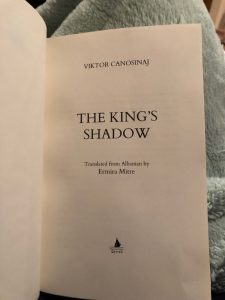
    Did you know that Ermira Mitre, library technician at Smith Library, is an accomplished writer, poet, and translator—both in the States and in her home country of Albania? Viktor Canosinaj’s The King’s Shadow, which Ermira translated from the original Albanian, is available on Amazon, and her poem “Dust from a Green Leaf” was recently published in the Montclair Write Group’s 2018 sampler.

    That’s Honorable!

    Kudos to Robeson librarians Bart Everts and Julie still, who will both be serving as judges for New Jersey History Day during the South Jersey regional competition at Rutgers–Camden this weekend. Congrats, Bart and Julie!

    Krista Gets Cinematic

    Krista White will give a talk at the Rutgers Cinema on March 12 at 7:30 p.m. for Douglass Residential College’s screening of Captain Marvel. Her talk will be called, “Further, Higher, Faster: Women as Action Heroes in Hollywood.”

    Hopper Expert Coming to Rutgers

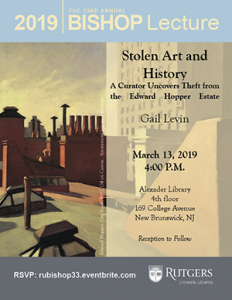
    The 33rd annual Bishop Lecture will be held at Alexander Library on March 13. Gail Levin, Distinguished Professor at the City University of New York and Rutgers alumna, is the acknowledged authority on the American painter Edward Hopper. Her lecture focuses on her discovery of a major theft from the Hopper estate before it reached the Whitney Museum, where she formerly served as curator of the Hopper Collection. RSVP on Eventbrite.

    New Databases

    Check out these new resources: Medieval Travel Writing and African American Communities.

    Just for Fun

    Check out this list of 12 Tales of Librarian Badassery from The Booklist Reader!

  • Self-Appraisal Reminder

    In anticipation of an announcement from University Human Resources regarding the performance appraisal program, managers and supervisors should remind URA-AFT staff to begin a self-appraisal. Managers and supervisors should also ensure that employees have a self-appraisal form that includes an accurate list of key duties. Self-appraisals should be completed and returned to supervisors by April 5, 2019. Managers and supervisors must complete performance evaluations and notify eligible employees of the appraisal by April 30, 2019.

    Here is a link to the UHR webpage to assist you in the appraisal process.

    If you have any questions, please do not hesitate to contact Libraries HR.

  • Ex Libris Implementation Project Update – March 2019

    quicksearch logoThis month, the Ex Libris Implementation Team welcomed back Megan Drake from Ex Libris for our follow up to the six-month health check. Following two days of meeting with representatives from various Ex Libris working groups, Megan provided some very actionable suggestions for improving our processes and making our workflow more efficient in Alma. The team is working hard to integrate her suggestions into our processes.
    Leganto Implementation

    This month also marked the kickoff of the Ex Libris Leganto project. Leganto is a course reserves platform that is integrated with both Alma and the course management systems we support at Rutgers, like Canvas, Sakai, Moodle, and Blackboard. This product will give instructors more control over developing their course reserves lists and put the power of the library directly in their course space to help them provide electronic resources and streaming video from our subscriptions, and realtime catalog information for physical reserves.

    Because faculty members are able to create their own course reading lists, Leganto will enable us to increase our course reserves services without creating additional work for reserves management in access services. Students will be able to access course reserves directly from their course management system on any device and Leganto will help faculty select clean pdfs from our subscription databases rather than scans of readings. The system also provides robust analytics and encourages faculty to use materials from within our subscription databases for course reserves, providing us with a more accurate understanding of usage. Ex Libris provides a good overview of the product in this video demo.

    Ex Libris expects that our implementation process will take 12 weeks and the team plans to conduct a pilot with several courses during the summer with an official launch in Fall 2019. Faculty engagement is important for the success of Leganto, so expect to hear soon from your campus Leganto Team representative about communication strategies and training.

  • University Librarian’s Report – March 2019

    As we learned in Lorcan Dempsey’s presentation in January, collections are one area where academic libraries face strategic choices along a continuum that ranges from cooperation (weakest) to consolidation (strongest), with collaboration in the middle. When does it make sense to consolidate infrastructure? What are the advantages of offering access collaboratively versus locally? And what are the tradeoffs that come with these decisions?

    It was somehow reassuring to see that libraries in general are grappling with these issues, since asking these questions is something we do every day at Rutgers. When Cabinet developed our Services and Planning Framework, we thought about what aspects of our work it would be beneficial to consolidate centrally, where our efforts would require shared coordination, and which services were best left to local discretion.

    At this point, the majority of our Foundational services are consolidated. These include activities related to acquisitions, cataloging, and discovery, for example, which are all handled centrally. Services that benefit from having a consolidated infrastructure are typically large-scale and have substantial startup and operation costs—especially in terms of faculty and staff time, with the recent Alma/Primo implementation being a prime example. Once implemented, changes to these services have wide ranging impact and need to be carefully planned and communicated.

    Of course, there are pros and cons to consolidation. On the plus side, it increases operational efficiency and lowers the long-term cost of providing the core services that reach the most faculty and students. The biggest drawback is that in order to gain efficiencies, some local features and specializations can be lost.

    In other areas, like reference and instruction, our activities are coordinated. We decide collectively on a tool or service like Credo or Leganto, but how it is deployed locally is up to the individual unit. Then there are the truly local activities. Education and consulting services, from workshops to systematic reviews, can be tailored to meet the specific needs of our local communities. There is a lot of freedom and flexibility in this area to use the available infrastructure in your own unique way.

    Whether in the BTAA or OCLC, the trending discussion is about these tradeoffs between efficiency and autonomy. At Rutgers, we’re fortunate to have experience navigating these same issues. As the larger academic library environment continues to evolve, we will be well-positioned to contribute meaningfully to these discussions.

  • Quick Takes on Events and News – January 2019

    Talking Gennett Records

    Congratulations to Elizabeth Surles, who was recently interviewed for The Music Makers of Gennett Records, a documentary for WTIU, Indiana Public Television. The Institute of Jazz Studies also provided photographs and archival materials for the film. You can view it on Facebook Live now for a limited time:

    Talking Tech with Mary Beth

    Mary Beth Weber was recently featured in an interview with ALCTS News, the Association for Library Collections & Technical Services blog. In it, she discusses her role at the Libraries, her leadership position in ALCTS, some of her personal interests, and her personal and professional philosophy: “Your best investment is yourself.”

    Robeson Library Helps Camden Kids in Need
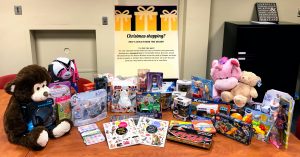
    Robeson Library continued its annual tradition of collecting toys for the Camden Rescue Mission this year. All gifts were personal contributions from faculty, staff, or retirees. “Some children in our community near Rutgers–Camden may have no toys to open during the holidays, but during this toy drive, we put a dent in those numbers,” said John Gibson, Robeson’s instructional technology specialist. “As a child, this particular toy drive meant a lot to me, and I know it means a lot to others today.” Cheers to our colleagues in Camden for their continued support of this worthy cause!

    Kudos to Kayo

    Congratulations are in order for Kayo Denda, head of the Margery Somers Foster Center and librarian for women’s, gender, and sexuality studies, who has two exciting news items to report. First, Kayo has been selected for an appointment as a Smithsonian Fellow in Museum Practice at the Smithsonian Center for Learning and Digital Access. Kayo’s project “Discovering American Women’s Histories: An Examination of Metadata Schema and Access Issues” will explore how libraries, museums and archives develop metadata relevant to the content of women in American history. The project will emphasize finding digital resources about women of color and appropriate metadata that describes the material and captures multidimensional relationships that increase access to diverse collections in support of ongoing projects on race, ethnicity, class, and gender inclusion. Kayo’s appointment (part-time) will start in mid-May and continue through September 2019.

    Next, Kayo reports that the “Women, Education and Leadership at Rutgers” portal is now live. Here, users can access a collection of interviews created by the award-winning filmmaker June Cross for the documentary From the Boarding House to the Board Room: 250 Years of Women at Rutgers, which was produced by the Institute for Women’s Leadership Consortium in celebration of Rutgers’ 250th Anniversary in 2016. The interviews with Rutgers faculty and alumnae, former deans of Douglass College, the dean of Douglass Residential College, and the director of the New Jersey State Federation of Women’s Clubs record and chronicle first-hand accounts of the history of women at Rutgers and serve as a unique resource to advance research and learning on women, gender, and leadership at Rutgers and beyond. It also affords to the world a glimpse at the significant work of women’s and gender studies scholars at Rutgers. With guidance provided by Rhonda Marker, two NBL graduate specialists based at the Margery Somers Foster Center created the metadata schema for each interview.

    New Resource for Promoting Your Next Event
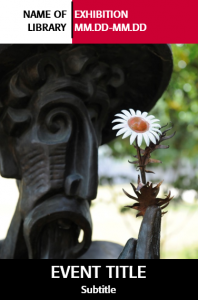
    Customizable postcard templates can now be downloaded from the Communications Department website. These 4”x6” postcards are available in portrait and landscape orientations and are a great resource for promoting your next exhibit, lecture, or workshop. Download them here and contact the Communications Department with any questions or suggestions for new templates.

    Rutgers Style Guide Quick Reference Sheet

    University Communications and Marketing recently released a Quick Reference Sheet that addresses common questions about editorial style at Rutgers. This is a great cheat sheet to have bookmarked if you do any sort of writing about Rutgers or the Libraries that is public-facing. It’s also a nice complement to the Libraries Style Sheet. If you have any questions about how to use these resources, please contact the Communications Department.

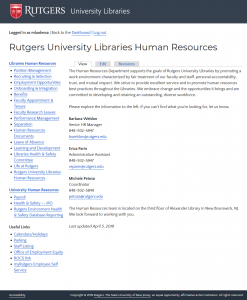
  • Introducing Libraries HR’s New Website

    I’m happy to announce the launch of Libraries HR’s new staff resources website at https://apps.libraries.rutgers.edu/hr.

    The goal of this page is to be your new one-stop shop for all things related to human resources at the Libraries. It contains need-to-know information for managers, from position management to onboarding and integration; guides to tenure, benefits, and applying for research leave; and a library of useful forms and other documents including CARFs and APPs. There is also a collection of links to resources available via UHR, such as the REHS reporting portal and the university’s holiday closing schedule.

    I hope you’ll have a look and let us know what you think. And don’t forget to update your bookmarks!

  • University Librarian’s Report – January 2019

    Happy New Year, everyone! I hope you’ve had a restful winter break and are ready to tackle all the challenges of the upcoming semester.

    Though we are between terms and the activity on campus may have slowed a bit, this is actually a busy time in the Libraries’ planning cycle. The library directors have just completed progress reports on their 2018-2019 plans, adjusting them to reflect progress as well as any changes in their goals for the rest of the year. In addition, the Discovery Working Group, Web Improvement Team, and Virtual Reference Group have updated their annual plans. We have now received news about our 2020 budget, so we will have solid information as we move into the 2019-2021 planning cycle.

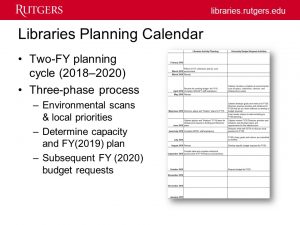
    We are also in Town Hall season. Last month the central units had a Town Hall, yesterday was Camden’s, later this week will be New Brunswick’s, and RBHS will hold theirs in February. This year, my Town Hall presentation has focused on our planning cycle. Although some of you have already seen the presentations, and others will soon, it is worth seeing a few times. Like all things Rutgers, the process is a bit complicated but the results are worth the effort. Here are the slides that I’ve been presenting:

    As you can see, the Libraries operate on a two-year planning cycle that is tied closely to the budget activities of the university overall. It’s a three-phase, iterative process that includes establishing local priorities, taking stock of central capacities to support those priorities, and looking ahead to solidify a plan and develop related budget requests. This helps us stay focused on our core services while maintaining the flexibility to respond to important new requests as they come in.

    Our priorities document for 2018-2020 has been added to our mission page and I invite you to read through to get a sense of where we’re headed in the months to come. And, if they haven’t already, your library director will soon be updating you on the local implications of the 2020 budget.

    I know that it seems like a lot to juggle all at once, but sound planning ensures that we continue to build on the momentum we’ve gained and can make the best choices on behalf of all our users. I look forward to seeing all we will accomplish together in 2019.