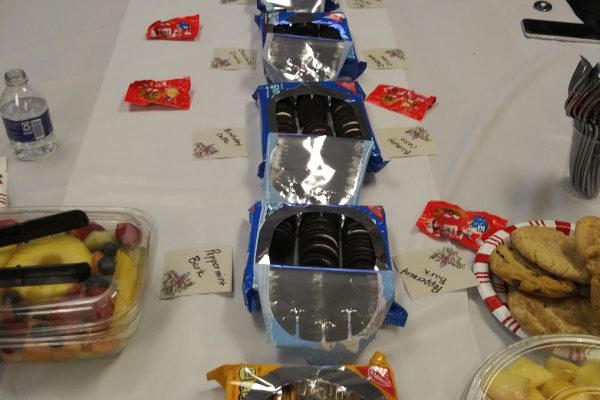
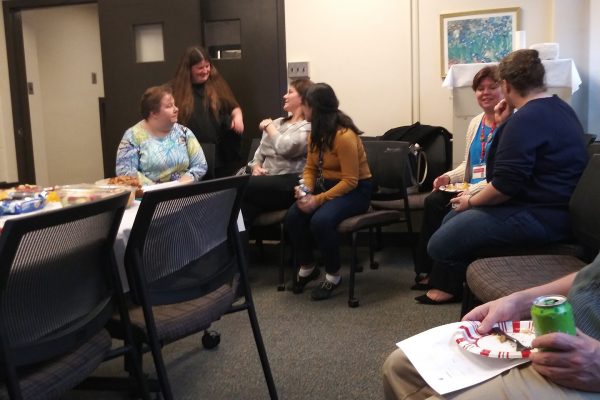
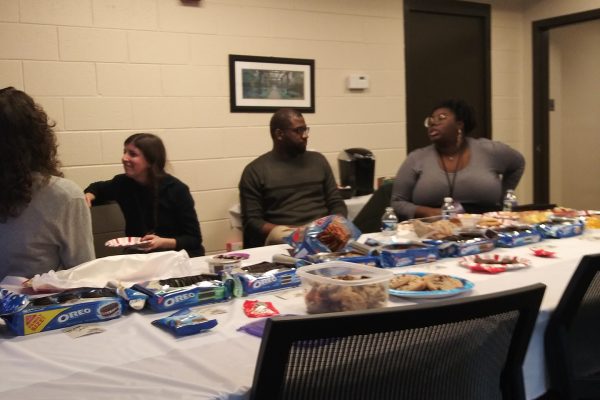
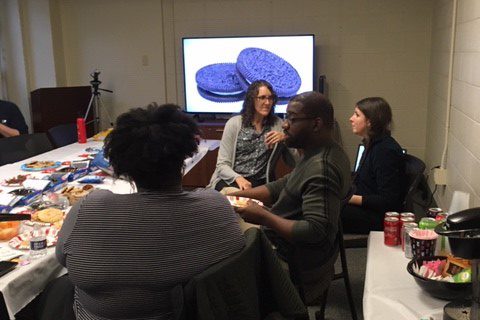
The Paul Robeson Library in Camden hosted an Oreo tasting and cookie exchange for libraries in the Camden area, on Tuesday, December 10. We worked with the Rutgers–Camden Law Library and Nilsa Cruz-Perez branch of the Camden Public Library. About 20 people from four different library systems attended. We tasted Oreos, talked about Alma as well as current and upcoming outreach efforts, and how we might work together on various projects. Julie Still and John Powell developed a logo (CAL for Camden Area Libraries) and made buttons for the event. All in attendance, and some who were unable to attend, indicated an interest in similar future events.
Category: Rutgers University–Camden
Faculty and staff news from the Paul Robeson Library at Rutgers University-Camden.
-
What’s Happening around Rutgers – November 2019
 “Top Girls” Theater Performance
Friday, November 1, 7:30 p.m.
Fine Arts Building, Walter K. Gordon Theater, CamdenThe Rutgers–Camden theater program presents Top Girls. Hilarious and haunting, Caryl Churchill’s feminist masterpiece set in Margaret Thatcher’s England is a wildly innovative play about a country divided by its own ambitions. Marlene has reached the pinnacle of success as the head of the Top Girls Employment Agency—but at what price? Purchase tickets. (Additional shows on Saturday and Sunday.)
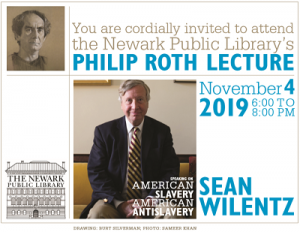 Philip Roth Lecture: Sean Wilentz
Monday, November 4, 6:00–8:00 p.m.
Newark Public Library, NewarkThis year’s lecturer is Princeton’s Sean Wilentz. Mr. Wilentz is the author of a wide range of books including The Rise of American Democracy, No Property in Man, Slavery and Antislavery at the Nation’s Founding, and Bob Dylan in America.
His lecture topic is American Slavery, American Anti-slavery. After retiring, Mr. Roth devoted most of his reading to the study of American history.
Professor Wilentz was Roth’s guide, helping him to make book selections and engaging in discussions of the material.
The event is free. Valet parking is available. Seating will be available on a first-come/first-served basis.
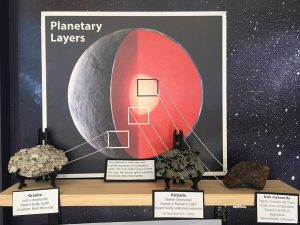 Planetary Science Late Night
Wednesday, November 6, 4:00–8:00 p.m.
Rutgers Geology Museum, New BrunswickVisit us on Wednesday, November 6th, and learn about our Solar System and all of its planetary bodies! Demonstrations, arts and crafts and educational activities will be set up around the museum for this event and people are welcome to come and go as they please. We encourage all ages to come participate and learn something new! More information.
-
Our Commitment to Diversity, Equity and Inclusion
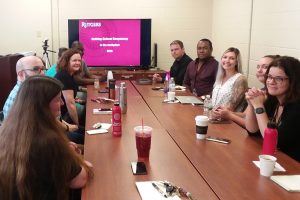
Robeson Library’s cultural sensitivity and diversity training in August. Diversity, equity, and inclusion are acknowledged as being fundamental values of the American Library Association and its members, and diversity is listed as one of ALA’s key action areas. The Libraries’ philosophy is that “as the intellectual commons of one the most diverse universities in the nation, Rutgers University Libraries advance and promote diversity in all its forms. We believe the Libraries are stronger and can more effectively support the mission of Rutgers when we are inclusive and equitable.”
Paul Robeson Library has reaffirmed its commitment to diversity, equity, and inclusion by creating a comprehensive action plan with strategic FY20-21 priorities. One of the initiatives from the Robeson priorities led to an all-staff, day-long training session in August on cultural sensitivity and diversity with Baseemah Ismail. Ismail is a senior human resources generalist, with experience in an array of HR functions including diversity strategy, training, talent acquisition and retention, and organizational development and design; a certified Development Dimensions International learning systems facilitator, as well as a DiSC Communication Styles and Myers-Briggs Type Indicator practitioner. The training addressed understanding cultural differences, awareness of biases, enhancing sensitivity to cultural sensitivities, and differences and strategies for fostering a cohesive workplace.
-
What’s Happening around Rutgers – July 2019
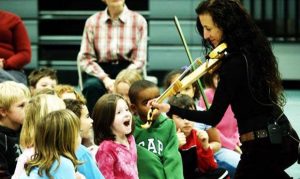 Bach 2 Rock: The Science of Sound
Thursday, July 11 | 10 a.m.
Walter K. Gordon TheaterThis multimedia presentation by Caryn Lin transforms sound with a five-string electric violin and a myriad of modern technology. Students journey from the classical days of Bach to today’s techno-wonders. Part of the Summer Arts at RCCA program. Performances are open to everyone, but are especially recommended for Camden City youth ages 4-18. Group size is generally limited to approximately 125 per performance. A supervisor is required for every ten students.
 Newark Gay Pride Festival and Flag Raising
Sunday, July 14 | Line up at 11 a.m. | March begins at noon
Lincoln Park at the intersection of Broad St. and Clinton Ave.
March with RUN faculty, staff, students and alumni to show your pride and support for the LGBTQ community! Be sure to wear comfortable shoes, light clothing, and a hat or sunglasses (and Rutgers gear if you have it). RSVP at https://tinyurl.com/RUNNWKPrideMarch.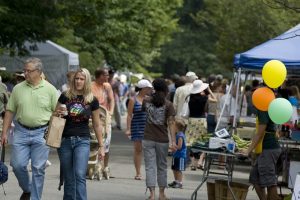 Summer Fest
Saturday, July 27 | 3 p.m. – 7 p.m.
Rutgers Gardens
Our annual Summer Fest, run by our Summer Interns, showcases all the Gardens has to offer! The festival celebrates Rutgers agricultural research and development. Join us for tours, tastings, games, and more! Find more information at https://rutgersgardens.rutgers.edu/event/summer-fest/. -
Institute for Research Design in Librarianship 2019
The Institute for Research Design in Librarianship is an IMLS-funded program “designed to bring together a diverse group of academic and research librarians who are motivated and enthusiastic about conducting research but need additional training and/or other support to perform the steps successfully.”
The institute started in 2014. My cohort (2019) is the last IMLS-funded year, but the creators will continue the project using a paid model in the future. Our cohort included 23 librarians from colleges and universities all over the country. Our interests, experiences, and areas of librarianship were varied.
The 2019 cohort kicked things off in June with a one-week research boot camp at Loyola Marymount University. In seven days, we received research instruction from Dr. Lili Luo and Dr. Greg Guest, as well as individual consultations with our instructors and the IRDL creators, Kris Brancolini and Marie Kennedy. We also relied on each other to get “fresh eyes” on our projects and to commiserate when our projects seemed bigger than we could handle!
After that first week, our cohort will continue working with Kris, Marie, and a research mentor (a previous IRDL scholar) throughout the coming academic year. We each committed to completing our research projects in that time. To stay on track, we have periodic check-ins with each other to update everyone on progress, ask questions, and get support. We also work with our mentors monthly to review our work and get feedback. Our cohort also created a Slack group for talking about the different research methods we are using and coordinating future meetups.
The boot camp covered sampling techniques, proper statistical measures, and strategies for doing qualitative analysis. This was especially useful because after we learned something in class, we could request a consultation with one of the instructors to see how we could best apply a technique to our research project. I found this incredibly helpful when considering what statistical tests I should use for my study. The goal of my project is to determine the effectiveness of augmented reality on students’ perception of the library and librarians when used as part of an orientation for incoming first-year students. I’ll be comparing pre and post-orientation questionnaires from a group of students taking an augmented reality orientation and a group participating in a traditional orientation.
IRDL has already had a major impact on my research design. The proposal I submitted to the Institute in January is much different from the one I will be submitting in July. My methodology, sampling technique, and survey instruments underwent a complete overhaul in the week I spent at the institute. My confidence as a researcher has also increased and I feel more comfortable making decisions about what and how I will research as a practicing librarian.
I’m looking forward to the coming year when I’ll be completing my research project and working closely with my cohort and mentor. One aspect of IRDL which the directors continually emphasize is that our fellow scholars are part of our lifelong research network. We can ask questions of each other, collaborate, generate ideas, and rely on each other for support as we research throughout our careers. This kind of support, along with the knowledge I gained at the institute, has been transformative by making me feel more confident in asking questions and making decisions.
-
University Librarian’s Report – July 2019
I’d like to start my article this issue by thanking all of you who attended our State of the Libraries meeting in June. It was a great opportunity for us to network with colleagues we don’t often get to see in person, celebrate our collective accomplishments from the past year, and look forward to the challenges ahead. I hope you found it a useful and productive event.
For those of you who stayed behind, I invite you to review the slides from my presentation as well as the videos from the poster session below.
As I reflect back on Kathleen Fitzpatrick’s presentation about Generous Thinking, a key takeaway for me was the challenges inherent to developing academy-driven, community-supported infrastructure that provides open access to scholarly material in a sustainable manner. In order to realize this vision, academic institutions need to commit in earnest to the idea of collaboration, and take seriously a sense of shared responsibility to our collective enterprise.
Deep collaboration is difficult. It requires trading control and specialization for efficiency. In a recent short essay appropriately titled “Library Collaboration is Hard; Effective Collaboration is Harder,” Lorcan Dempsey summarizes his recent presentations and blog posts and ends with the recommendation that “There should be active, informed decision-making about what needs to be done locally and what would benefit from stronger coordination or consolidation within collaborative organizations.” At Rutgers, we collaborate all the time, every day, all day. Nearly every project that we undertake involves collaboration across separate parts of our complex organization. We have talked about the importance of a collaborative approach in other contexts as well, such as Dempsey’s notion of the collective collection and how the continuum of consolidation applies to the Libraries’ services framework.
Recently, we’ve seen the fruits of collaboration bear initiatives like CADRE, the shared big data gateway we’ve partnered with Indiana University and others to develop, which is further evidence of what is possible when institutions work together to address common needs. We are also exploring a transformative license agreement of Oxford Scholarship Online backfiles and frontlists, the terms of which were negotiated by PALCI. Even more opportunities, such as shared infrastructure for journal publishing, are on the horizon as well, thanks to our membership in the Big Ten Academic Alliance.
With these examples in mind, it becomes clear to me that forward-thinking academic institutions need to be open to participating in these new, cooperative models in order to maximize our impact. And I believe the way forward for all libraries—including our own—is to accept this challenge to collaborate deeply across institutional boundaries. As we know from experience, there are bound to be some tradeoffs, and compromises will have to be made. But only by committing to working together in a meaningful way can we truly advance our mission of contributing to the public good.
-
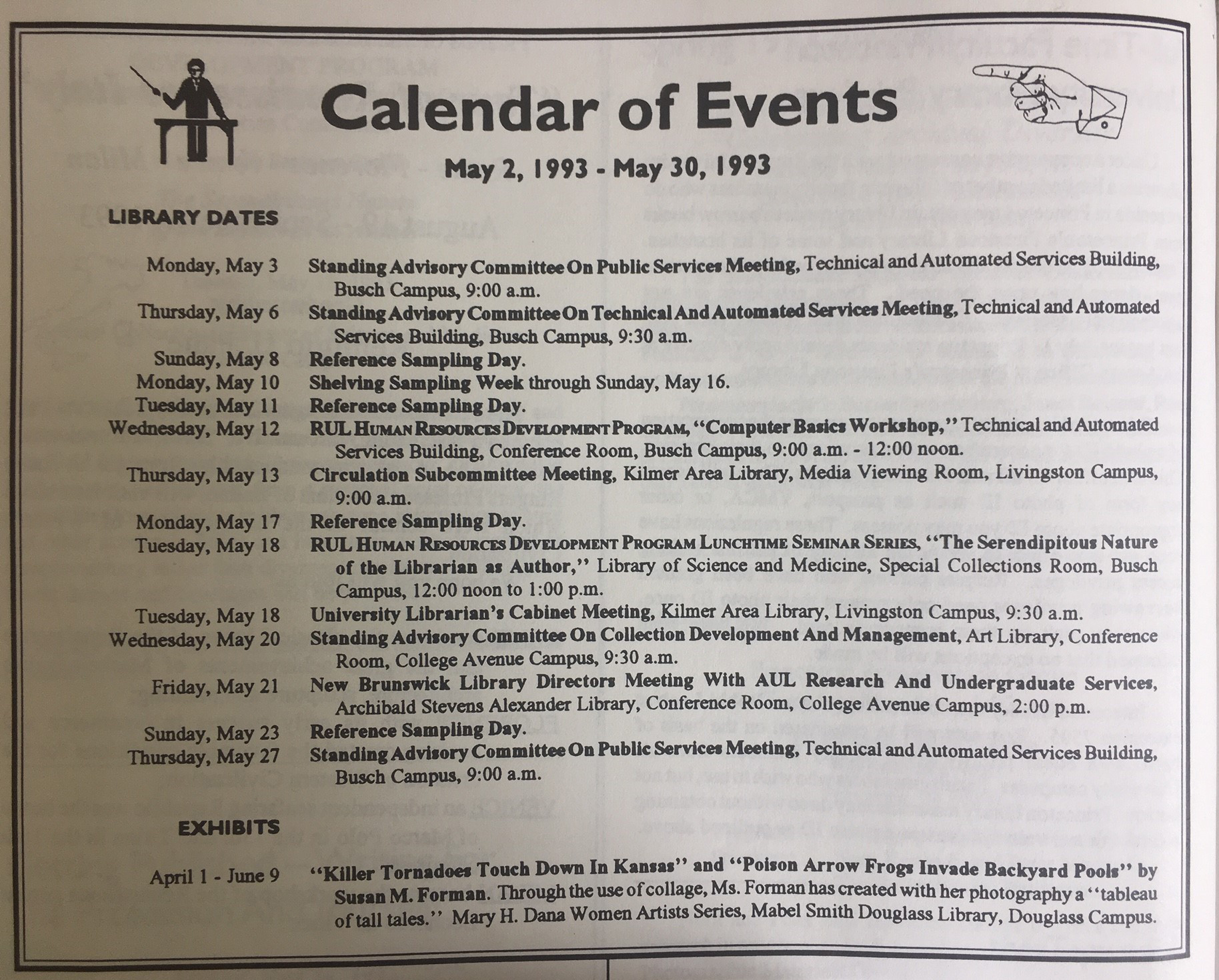
This Month in the Agenda – May 1993
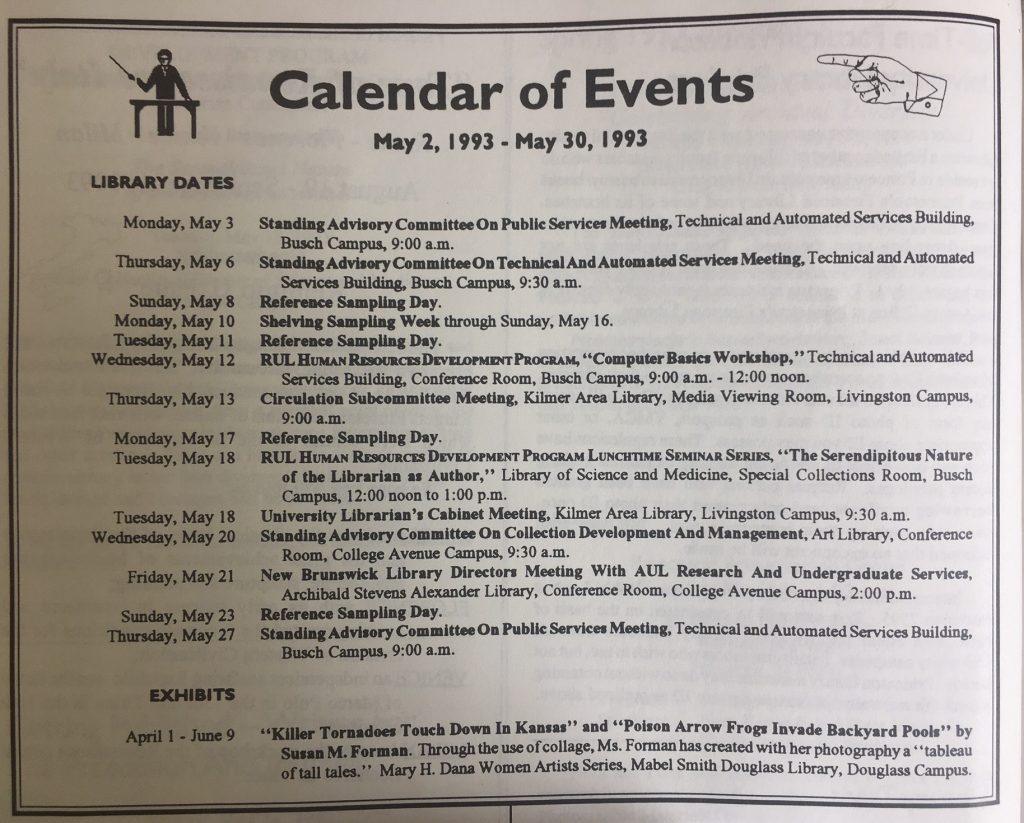
Calendar of Events, May 2 – May 30, 1993. How To
Mary Beth Fecko, Technical and Automated Services, has written Cataloging Nonbook Resources: A How-To-Do-It Manual for Librarians.
Cataloging is the starting point for access to nonbook materials, especially important for media which cannot be browsed in the manner of books. Cataloging Nonbook Resources offers the cataloger guidance and practice with nonbook materials. It covers the major formats: visual materials, sound recordings, maps, computer files, kits, and electronic resources. The text is meant to be used in conjunction with AACR2R. Each chapter includes examples of bibliographic records, examples of MARC tagging for various formats, and AACR2R rules for MARC tagged records along with Library of Congress Rule interpretations. This manual brings catalogers up to speed on “nontraditional” formats.
Congratulations, Mary Beth!
The Agenda 15, no. 9 (May 2, 1993)
Holdings and Pieces
The System and Database Management Department is scheduled for a major upgrade at the end of the summer. Because of the high interest in the upgrade the plans are as follows:
Holdings and Pieces Management is coming soon to our IRIS catalog. Why, you may ask, is Holdings and Pieces necessary? How will it affect our daily operations, and is the transition worth it?
Holdings and Pieces is Geac’s name for the software they developed to streamline management of individual items in the system, while retaining summary information. In this context, holdings refers to summary holdings, and pieces refers to the individual items.
Currently holdings information is kept in two separate sets of files: those for circulation and those for BPS. In the OPAC, information is drawn from both of these components. Holdings and Pieces Management (HPM) will integrate information that is now kept in separate files. For example, from either Circ or BPS, you will be able to determine circulation status and the date an item was added to the system. Staff will be able to change information in either function and will be able to record item-level notes.
The Agenda 15, no. 9 (May 2, 1993)
A Bit of Trivia
Patrons recalled 5,430 books from September to December, 1992. On average that’s 45 recalls placed per day!
The Agenda 15, no. 9 (May 2, 1993)
Phone-a-Friend
A special thank you is extended to all the volunteers from the library community who participated in the Annual Giving Phonothons for ’92 – ’93. By your volunteering to call alumni and parents you have helped to ensure the libraries continued growth as an intellectual resource for our Rutgers students.
Treadwell Atkins Alexander Library Karen Barrella Fiscal Control/Library Admin. Ron L. Becker Special Collections and Archives Renza Chendak Library Administration Amos Danube Library of Science and Medicine Rose Deland Technical and Automated Services James Doele Dana Library Margie Epple Library Administration Delores Evans Library Administration Betty Fry Technical and Automated Services Jeanne Garrison Robeson Library Marianne Gaunt Library Administration Gary Golden Robeson Library Bonita Grant Special Collections and Archives Harriette Hemmasi Music Library Michael Joseph Special Collections and Archives Marty Kesselman Library of Science and Medicine Linda Langschied Alexander Library Bobbi Loeb Library Administration Jackie Mardikian Library of Science and Medicine Sondra Marsh Robeson Library Nita Mukherjee Technical and Automated Services Stan Nash Alexander Library Judy Odom Robeson Library Carol Paszamant Alexander Library Francoise Puniello Douglass Library Halina Rusak Art Library Charlene Shults Alexander Library Ruth Simmons Special Collections and Archives Jane Sloan Douglass Library Gracemary Smulewitz Alexander Library Peter Stern Alexander Library Marilyn Tankiewicz Business Office/Library Admin. Ryoko Toyama Alexander Library Nancy Wiencek Library Administration Myoung Wilson Alexander Library Carole Wolfe Technical and Automated Services Connie Wu Library of Science and Medicine Beth Ann Zambella Kilmer Library The Agenda 15, no. 10 (May 16, 1993)
-
Rutgers Day 2019
Thank you to all the volunteers who braved the wind last weekend to work our Rutgers Day tents and spread the word about everything the Libraries have to offer. If you missed out on all the prize-wheeling, button-making, selfie-taking fun, enjoy this collection of #RutgersDay social media posts!
Happy Rutgers Day! Stop by the Dana Library table for FREE books, button-making, and even enter the raffle for an Echo Dot, Amazon Fire, and Starbucks gift cards! #danalibrary #rutgersnewark #rutgersday #rutgersday2019 pic.twitter.com/Hk4gJVPjpQ
— Dana Library (@RUNewark_Dana) April 27, 2019
We had so much fun hanging out with @RULibraries at #rutgersday. We made over 1,000 buttons and had great tours! #rutgers #RutgersLibraries #RutgersSCUA #RURAHRAH pic.twitter.com/qlISgelxFA
— Special Collections (@Rutgers_SCUA) April 27, 2019
People are loving are instagram frame! Come and take your own photos with it! #danalibrary #rutgersnewark #rutgersday #rutgersday2019 pic.twitter.com/PoMs53xCrO
— Dana Library (@RUNewark_Dana) April 27, 2019
Even puppers want to check out the free books! #danalibrary #rutgersnewark #rutgersday #rutgersday2019 pic.twitter.com/hv9XjH16ea
— Dana Library (@RUNewark_Dana) April 27, 2019
Our raffle was a resounding success! Congrats to all our winners! #danalibrary #rutgersnewark #rutgersday #rutgersday2019 pic.twitter.com/5cBHe2tClb
— Dana Library (@RUNewark_Dana) April 27, 2019
-
What’s Happening around Rutgers – May 2019
 Environmental Technology Late Night
Wednesday, May 1, 2019 4 p.m. – 8 p.m.
Rutgers–New Brunswick, Geology HallLearn how scientists use new and exciting technologies to study and solve important environmental issues! Demonstrations, arts and crafts, and educational activities will be set up around the museum for this event and guests are welcome to come and go as they please. Learn more at the Geology Museum’s website here.
 Brick City Comedy Revue
Friday, May 3, 2019 8:00 p.m.
Rutgers–Newark, Kilkenny Ale House, Off CampusFREE Monthly Comedy show at Newark’s Kilkenny Ale House! Bringing some of the best comics to the Brick City. First Friday of every month @ 8 p.m. Learn more at the Rutgers–Newark events calendar here.
 Spring Concert
Sunday, May 5, 2019 2:00 p.m.
Rutgers–Camden, Walter K. Gordon TheaterThe annual Rutgers–Camden music program’s spring concert showcases all the student ensembles as well as featured soloists. Admission is free. Learn more at the Rutgers–Camden events calendar here.
 The Magic Tree-House: Showtime with Shakespeare
Friday, May 31, 2019 7:00 p.m. to 10:00 p.m.
Rutgers–Newark, NJPAC (Victoria Theater), Off CampusTreat the entire family to this lively, new hip-hop musical based on the Magic Tree House adventure Stage Fright on a Summer Night by the New York Times best-selling author Mary Pope Osborne.
No matter what, the show must go on! That’s what Jack and Annie learn when the Magic Tree House transports them back to Elizabethan England. There, the daring sibling duo meet William Shakespeare himself—one of the greatest writers of all time! Learn more at the Rutgers–Newark events calendar here.
-
Ex Libris Implementation Project Update – May 2019

Rutgers Law Libraries to Join Alma/Primo
The Rutgers Law Libraries are joining our Alma and Primo instances in January 2020! Project planning for appending the Law libraries catalog has begun. We are currently participating in bi-weekly planning meetings with Ex Libris and the Law libraries. Progress will be communicated through the Ex Libris Implementation team. This is an exciting opportunity for us and the faculty and students that we serve.
Leganto Update
The Leganto implementation team is preparing to go live with 16 pilot courses from the School of Social Work. This summer, social work graduate students will be able to access their course reserves, including electronic course reserves, live links to the physical reserves holdings, and access to our journal and database subscription content, directly from their course in Canvas. The team is planning a soft launch for fall, so if you know of a department that would be interested in this comprehensive course reserves solution, please contact your campus representative to the Leganto team or the Ex Libris Team at exlibris@rutgers.libanswers.com.
FRBRization disabled for music materials
FRBRization refers to the process by which different versions of the same work are grouped together. Generally speaking, FRBRization is a useful feature that allows researchers to easily find and identify related works (e.g., different editions of the same book). However, in some cases, unrelated works are mistakenly grouped together, which causes confusion and makes these resources more difficult to find. This is especially true for musical scores and audio recordings where heavy use of generic titles, complex statements of responsibility, and variations of performance can lead to erroneous matches. Accordingly, FRBRization has been disabled for these materials. This decision was made in consultation with and based on feedback from experts in public services, cataloging, and the music department. The exemption applies to scores and audio recordings only. All other types of materials will continue to be FRBRized.
Improved metadata for Academic Video Online (AVON)
Academic Video Online (AVON) is a large streaming video collection of documentaries, interviews, performances, and feature films spanning a wide variety of subjects. However, the metadata provided by Ex Libris for this collection suffered from a number of limitations impacting its discoverability in QuickSearch. Accordingly, these records have been replaced with vendor-supplied MARC records. The new records are not only of higher quality but also offer more reliable linking, less duplication, and improved result filtering. However, in order to keep the collection up-to-date, the records must be reloaded every six months. Since record permalinks will change every time the records are reloaded, it is recommended that librarians and instructors who wish to link to this content use direct links to the platform rather than link to the record in QuickSearch. To do this, simply click “Embed/Link” below the video player in AVON (see screenshot).
Where did all the ISSNs go?
Standard identifiers such as ISBN, ISSN, and OCLC number are currently not being displayed in QuickSearch. This information typically appears in the “Identifier” field of the detailed record. Although this data is still searchable, it is currently not being displayed to the public. The issue has been confirmed by Ex Libris to be related to a known defect that is scheduled to be fixed in the July 2019 release. Until a fix is released, the only way to view this information in QuickSearch is to click the “View Source Record” link at the bottom of the record and look for it in the appropriate MARC field.
Primo 2019 Roadmap
Related reading? Citation trails? Enhanced personalization? Want to know what new features and functionality are coming to Primo this year? Check out the 2019 Primo Roadmap.