Category: Rutgers Biomedical and Health Sciences

Faculty and staff news from the libraries at Rutgers Biomedical and Health Sciences.

  • New Library Resources for a New Academic Year

    Like most other people, I cringe at the very thought that the fall semester is only a month away. Didn’t the summer just start? Where did all the time go? Why couldn’t we have a summer that is all year long? Oh well, such is life. But here is the good news, if there is good news in contemplating that the summer days are numbered: in September when tens of thousands of students return to or come to Rutgers for the first time, the Libraries will have a better collection of information resources waiting for them.
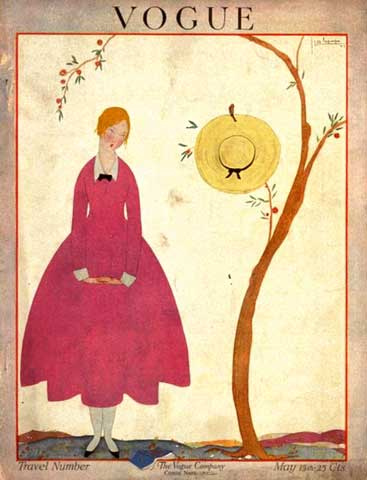
    Cover of 1917 Vogue
    Cover of the May 1917 issue. (American Vogue) https://commons.wikimedia.org/wiki/File:Vogue,_portada_de_mayo_de_1917.jpg

    Fiscal Year 2016 that ended on June 30 started off as a very challenging year for collection development, due to the loss of about $1 million of purchasing power in the collections budget in the previous year. Thanks to the strong support and guidance from the new Libraries administration and the tireless work of all the colleagues involved in collection development, we have more or less turned a corner. The University Librarian’s Report from the July issue of the newsletter includes a summary of major acquisitions that the Libraries made in FY16. Additionally, at the end of FY16 we purchased the British Periodicals collections and Vogue archive, two valuable humanities resources that have been on our wish list for a very long time. It is fair to say that, since last year, the Libraries have been making considerable progress to improve access to all kinds of scholarly resources (online journals, e-books, and primary sources) that the entire Rutgers community can benefit from.

    Our collection development program is continuing the upward trend that began last year. Since July 1, which is when the new fiscal year started, we have been focusing on acquiring and upgrading resources essential to the education mission of the University, in anticipation of the beginning of the new academic year. These new resources include:

    • ProQuest ebrary Academic Complete: a collection of about 140,000 current scholarly e-books on all academic subjects.
    • Springer Nature STM (Science, Technology, and Medicine) and social sciences frontlist e-books: over 7000 newly published titles from the largest STM e-book publisher, paid for with a funding increase from the universities.
    • Academic Video Online: Premium (AVON): over 50,000 videos on Social Sciences, Arts & Humanities, Science & Engineering, and Health Sciences topics from many reputable producers such as BBC and PBS.
    • ProQuest Dissertations and Theses (PQDT) Global: 1.7 million full-text dissertations and theses from both American and international institutions.
    • Clinical resources: In the spring, the Libraries received a funding increase from the universities for five new clinical resources. UpToDate and Bates’ Visual Guide are already available. VisualDx, DynaMed Plus, and JAMA Evidence will be added soon.

    Some of the resources are available now and others will be available later in the fiscal year. We are confident that these new resources will greatly enhance the Libraries’ support for undergraduate, graduate, and medical education at Rutgers. Yes, even when summer is ending, there will be a lot to look forward to in the fall!
  • A Two-day Cabinet Retreat Initiates Discussion of Libraries-wide Priorities

    We are at a strange point of the year where, like time travelers, we must work and plan in three different fiscal years. The close of FY16 necessitates the activities of closure and assessment; FY17 is already galloping along with its own demands; and in some circles, we are already planning for the priorities FY18 in anticipation of State of the Libraries meeting in November.

    In order to get a handle on that last item, I invited members of cabinet to join me for a two-day retreat to discuss where we see our priorities in the future. Over the course of two days, we reviewed SWOT analyses, LibQUAL+ survey results, budgets, previous State of the Unions, and on. We considered the impact of changes in the Libraries’ environment ranging from the master space plan to the needs of the Giddings collection. And we assessed the priorities we established at State of the Libraries in November 2015, asking what have we accomplished this year? And how do these accomplishments provide opportunity for further refinement and, in some cases, expansion of these priorities?

    While I don’t have a finalized list of priorities to share at this time, I want to give you a sense of the tone and the focus of these discussions. Much of our discussion centered on the priorities established at the last State of the Libraries:

    • Enhance undergraduate support
    • Conduct a holistic review of special collections
    • Optimize Collection development and management
    • Clarify communication and decision-making
    • Define the Libraries role in and identify resources for advanced research support

    We have made tremendous strides in each of these areas, but what became clear through our discussion was that each “accomplishment,” was also a new beginning. For example, we considered the report of the completed special collections holistic review (an executive summary is available here), but this brought up questions about strategy, resources, and next steps.

    So, I suspect when all is said and done, our priorities will fall into similar areas as last year, but with shifts in focus or additional avenues to explore. The one exception is that we will undoubtedly add a priority related to strengthening information control. Additional threads running through our conversations included the impact of the RCM budget model and the use of assessment in decision-making and planning.

    I anticipate sharing the outcome of this retreat with you all in the coming weeks. We will all benefit from a set of clearly articulated, aspirational, and achievable priorities to guide our activities in the following year. The discussions initiated during the retreat will continue in cabinet and within units before the priorities are finalized. I thank you in advance for your participation and support during this process.


  • Quick Takes on Events & News – July 2016

    Critical Thinking & Creative Decision Making

    July 15. 2016
    9 a.m. – 12 p.m.
    This course is ideal for staff, managers, supervisors, and administrators who recognize the need to improve their ability to generate ideas, see old ideas in new light, and make decisions that are innovative yet founded on strong grounds.

    Location:  Pane Room, 1st floor, Alexander Library with teleconference to Smith Library, Dana Library and Robeson Library

    RSVP: Erica Parin on behalf of the Professional Development Committee

    Leading Staff through Change & Transition

    July 21. 2016
    9 a.m. – 12 p.m.
    This course is ideal for managers, supervisors, and administrators who are experiencing departmental change and would like insight, guidance, models, and tools to assist them in moving their departments forward.

    Location:  Pane Room, 1st floor, Alexander Library

    RSVP: Erica Parin on behalf of the Professional Development Committee

    Digital Humanities Summer Institute

    Bart Everts attended the Digital Humanities Summer Institute at the University of Victoria in Victoria, BC June 12-16th and participated in a week-long workshop titled Critical Pedagogy and Digital Praxis in the Humanities. The workshop “built an open course as a playground, letting participants experiment with critical digital pedagogy in a class-created online course that [they] co-designed, built, deployed, promoted, and assessed.” Learn more at the website they designed: http://www.digitalpedagogylab.com/dhsi2016/.

    Dana Library Media Services Department Restructure

    The Dana Media Services department is transitioning from its location on the fourth to better concentrate on how today’s students access physical and online media. Photograph by Ed Berger.
    Photograph by Ed Berger.

    The fourth floor Dana Library Media Services Department is being restructured in recognition of how the library’s patrons access sound and video for education and entertainment. The transition will be completed by August 1 well in advance of the fall semester.

    Patrons will find a selection of some 1,700 DVDs, VHS tapes, and audio CDs currently available from Media Services publicly accessible on the lower level of the library, where the journals and bound periodicals are housed. Faculty requests to purchase new titles to support their teaching will continue to come through Dana’s department liaison librarians.

    Congratulations to Our Colleagues Who Worked on an Award-Winning Book!

    Rutgers: A 250th Anniversary Portrait received the Gold Award in the Circle of Excellence Awards given by the Council for Advancement and Support of Education (CASE).Many of our Libraries’ colleagues contributed to the success of this book: University archivist Tom Frusciano served as one of the primary authors, co-authoring the opening chapter on “History and Politics,” with GSE professor Benjamin Justice, constructing the extensive historical “Timeline” that appears in the back of the book, and writing—in partnership with archival associate Erika Gorder—many, many photo captions. This was a true group effort with dozens of contributors, including Gorder on musical concerts at Rutgers, archivist Fernanda Perrone on the activities of visiting Japanese students at Rutgers in the 1870s, David Fowler, an independent researcher with close ties to Special Collections and University Archives, on the life and impact of Henry Rutgers, and former university librarian Marianne Gaunt on, of course, the libraries themselves! Lastly, former associate director of the Institute of Jazz Studies Ed Berger contributed many photographs.

    Custom Buttons Now Available from the Communications Department

    Sample buttons v2
    Custom buttons are now available from the Communications Department.

    The Communications Department recently purchased a custom button maker and we are happy to now make buttons available to all of our colleagues for events or outreach activities. These 1.5 inch buttons feature a glossy, professional-quality finish and the designs can be customized to suit your needs. We are currently piloting a small “See You @ the Library” campaign for New Student Orientations in New Brunswick and welcome ideas for other ways to take advantage of this new equipment. Please contact us with project ideas or to request a sample.

  • Guidelines for Libraries’ Use of Photography and Photos in and of Libraries’ Facilities, Events, and People

    Cabinet recently approved a new set of guidelines for the use of photography at the Libraries. These guidelines endorse and support the guidelines for the university as a whole, but also add a few tweaks specifically for the Libraries. If you are photographing events, people, or spaces of the Libraries, it is important that you familiarize yourself with thees guidelines and obtain all the necessary model releases. Three groups of subjects require special attention: children, Rutgers student athletes, and medical patients.

    Also, if you are in the position of having your photograph regularly taken at Library events and wish to avoid having to sign a new release each time, we have made available an extended model release for library faculty and staff only. If you would like to complete this one-time form, please right click and download the Extended Model Release Template RUL Faculty and Staff only (also available on the new central drive: T:\CENTRAL\Procedures and Resources\Communications\model releases for photography), complete, sign, and return to the communications department.

    The guidelines also cover how to handle videotaping and photographing events. If you are taking photos that might be useful to your colleagues or for publication on our website or in our print materials, please be sure to upload the photos and scanned copies of the signed model releases to the Photos and Media network location, too.

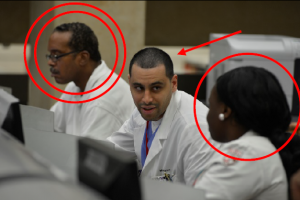
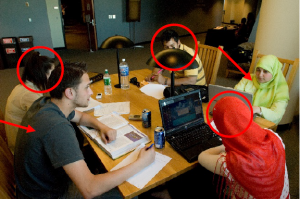
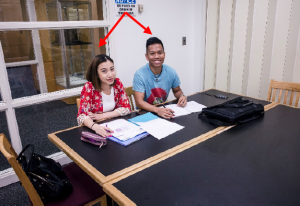
    There is a lot of confusion about when model releases are necessary. Some situations are clear–as when you are taking a photo of a single person or a group of people–but other scenarios aren’t as obvious.  A guiding mantra is that if you want to identify someone in the written caption for the photography, you will need a model release. Hopefully the examples below will help clarify how to deal with different types of situations.

    Model Release Examples (arrows require model release, circles are optional depending on circumstance)

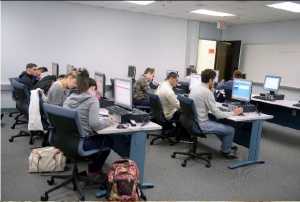
    1 No photo release would be necessary for this type of group photo as everyone is facing away.

    Before photographing this group, the photographer should announce that s/he is taking a photograph and provide time for people to move out of the frame if necessary.

    2 You would not need a photo release for a photo like this of a subject looking away and not identifiable.
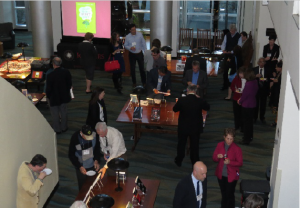
    3 Even though you might be able to pick out and identify individuals because you know them, this scene would not require any photo releases as there is no “subject” per se.

    However, there should be a notice in the program and a sign at the entrance indicating photography will take place and to notify the event staff if they don’t want to be included.

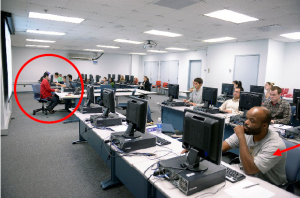
    4 You would get a model release from the gentleman in the foreground of the photo, but not from the others in the room. You would also need a model release if you want to mention the teacher by name.
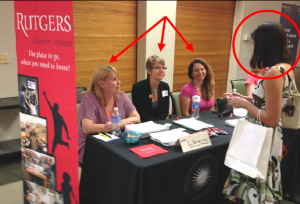
    5 In a photo like this, you would need releases from the library staff behind the table, but not from the standing person. However, this is a case, where you would likely want the name of the person for the caption, in which case you would need a release.
    6 The primary subject of the three is the man facing the camera. Even though the man in the back is blurred and facing sideways—a model release is required. The woman is facing away so a release is not required. If you planned to mention their names in the caption, then you would need model releases.
    7 This is a scenario where you would want to identify all subjects in the caption. So, even though only two people are identifiable and require a model release, you would want to get model releases from all five.
    8 A straightforward photograph that requires model releases even if these individuals work at the library or have given permission to use photographs on another occasion.


  • Announcing New Shared Drive – Central

    USA-NYC-Grand_Central_Terminal_Clock
    Image credit: IngfbrunoOwn work, CC BY-SA 3.0, https://commons.wikimedia.org/w/index.php?curid=27955753

    The Libraries now have a Central drive (T:\CENTRAL) where shared items of interest to all areas of the Libraries can be stored. The plan is to eventually store shared resources, information, procedures, and manuals in this location. Currently, it contains folders for Assessments, Collection Development and Management, Communications and Marketing, Photos and Media, Procedures and Resources, and Visual Identity, but more folders will be added as needed. Some of the folders are read-only, while others like Photos and Media are available to all for adding materials.

    Please take some time to peruse the folders:

    • Jeanne Boyle recently sent an invitation to view the LibQUAL+ survey results now stored in the Assessments folder.
    • Under Visual Identity, you will find resources that are useful if you are making flyers, advertisements, or website graphics, such as the colors, fonts, logos, and letterheads that are approved by University Communications and Marketing.
    • Photos and Media is a one-stop place to find images of our spaces, our events, and faculty & staff.
    • The communications department has also moved their folders from the ALEX drive to Central location Communications and Marketing.
    • Procedures and Resources currently holds the recent communications policies for photography and fielding requests to photograph in the Libraries, but will be populated with other materials, procedures, and FAQs in the future.

    These changes are partly philosophical–these are resources we all share and shouldn’t be housed on one of the unit server locations–but they are also intended to surface important materials and provide a single authoritative place to look for procedural information and guidance. If you have feedback, suggestions for how to further improve this shared drive, or materials you would like added to this drive, please speak with your unit director or supervisor.

  • Kicking off Annual Planning and Budget Process with LibQUAL+ Results

    Kicking off Annual Planning and Budget Process with LibQUAL+ Results

    Welcome to July!

    For me, summer has always been a time to catch up, tidy loose ends, reflect, and prepare for the upcoming academic year. As with so many other things, I am learning that at Rutgers things are different.

    As a cost-center, the summer is a time of planning. Our budgets and plans for the following fiscal year have to be ready by October. That means that our plans for 2018 have to be in place this summer. This month, there will be two Cabinet retreats to begin to establish priorities, look at potential projects, and consider budget requests. There will be many conversations in the coming months.

    As we move into planning, one of the most important issues that we will address is the LibQUAL+ results. I talked about these a bit at the Spring Town Hall, but since these will be at the heart of our planning efforts, it is worth spending more time studying these.

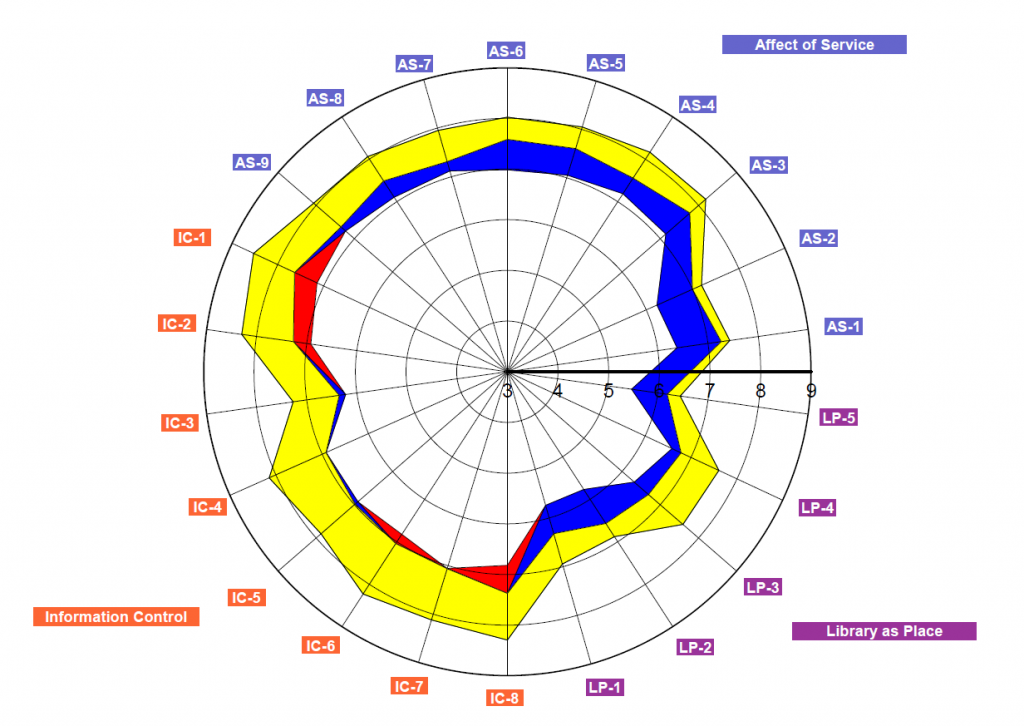
    Overall, our results were good. However, there was a consistent finding, across libraries and universities, that the Information Control dimension did not meet faculty expectations. This graph from the LibQUAL+ results shows the combined results for all 1,200 faculty respondents:

    lib qual survey graph
    This graph is from section 6.2 – Core Questions Summary for Faculty (page 73 of 13501-2 Rutgers University Libraries.pdf available on T:\CENTRAL\Assessments\LibQUAL 2016 Reports).

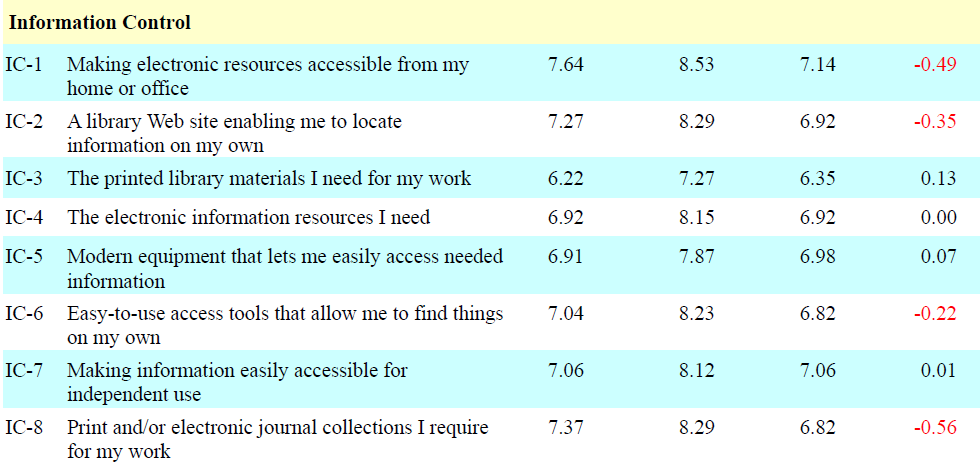
    Here is a table form of the same information:

    lib qual chart
    The first column represents the minimum mean, the second is the desired mean, the third is the perceived mean, and the fourth is the adequacy mean.

    But what does this mean? LibQUAL+ does a good job of showing us where we are doing well and where we might improve. However, LibQUAL+ doesn’t tell us why and understanding why is the first step in solving the problems.

    When we look at IC-1 and IC-8 together, it is not clear if the problem is lack of collections or difficulty finding the collections. How do the website (IC-2) and access tools (IC-6) contribute to the perception that our collections are below expectations? These are not problems that are simply solved by purchasing more collections or by making improvements to the search functions of our website. They require a multi-pronged approach that balance collections needs and ease of discovery.

    This year, using both one-time funding and new funding from the chancellors, we have made some substantial additions to our collections. These additions include:

    • SWANK Digital Campus subscription: 250 feature films selected by instructors
    • UpToDate: an evidence-based clinical resource
    • Sage Journals: Approximately 180 additional Social Sciences, Health Sciences and Science Journals
    • Wiley Journals: Approximately 880 Science, Technology, Medicine, Social Sciences and Humanities Journal
    • EBSCO e-books: 850 e-book titles selected by faculty and students
    • Springer e-books: Approximately 2300 Biomedical/Life Sciences, Engineering, and Medicine
    • American Institute of Physics (AIP) Digital Archive: Digital backfiles of 12 journals and conference proceedings
    • Oxford Journal Archive: Backfiles of about 150 Science and Medicine Journals
    • Wiley Journal: Digital backfiles of about 800 Science, Technology, Medicine, Social Sciences and Humanities Journals

    In addition, we eliminated the fees charged for requesting articles through ILL.

    In the coming year, we need to continue to make smart decisions about new collections and resources and I am confident that the Collection Analysis Group and the Selectors are moving in the right direction. But we must also look more deeply into our access infrastructure, making it easier for faculty to find the information they need. Moving in this direction will take a large amount of coordination, an effort kicked off by the new discovery working group charge.

    The LibQUAL+ results provide us with a tremendous amount of information and highlight opportunities for improvement. I expect that looking deeper at these issues will be a priority in the upcoming year and look forward to seeing what we can accomplish together.

    Save

  • Rutgers University Libraries at the American Library Association Meeting

    ALA logo

    The American Library Association Meeting will take place later this month in Orlando, Florida. Here are highlights from the program that feature our colleagues:

    Research, Writing, and Publishing Fair

    June 25. 2016
    10:30 a.m. – 11:30 a.m.
    Are you interested in publishing? Would you like to learn about a variety of opportunities to publish, resources to help you get started with writing an article or a book, and tools that will make research and writing for publication better and easier? Please join us for the Research, Writing, and Publishing Fair, where you’ll have the opportunity to meet with ALCTS editors, the Library Research Round Table, learn about publishing mentoring opportunities in ALA, and more. Sponsored by ALCTS Leadership Development Committee. Co-Sponsored by ALA Library Research Round Table (LRRT), ALCTS New Members Interest Group (ANMIG), and ALA New Members Round Table (NMRT).

    Speaker: Mary Beth Weber (Rutgers University Libraries)

    ACRL Arts Publications and Research Committee Annual Discussion Forum

    June 25. 2016
    3:30 p.m. – 4:30 p.m.
    Join ACRL Arts Publications and Research Committee for their Annual Discussion Forum! This year’s forum will feature the following presentations:

    • “Artists as Scholars: The Research Behavior of Dance Faculty” by Shannon Marie Robinson (Drexel University)
    • “Building Bridges, Creating Partnerships and Elevating the Arts: the Rutgers University Art Library Exhibition Spaces” by Megan Lotts (Rutgers University Libraries)
    • “You Say Tomato, I Say Tomato: Collection Format Preference of Music Faculty” by A. Carey Huddlestun (Kennesaw State University)


    If there are additional Rutgers University Libraries highlights I should include here, leave a comment below or let me know.

  • RBHS Librarians Present Eight Posters at Medical Library Association

    • Author: Yini Zhu

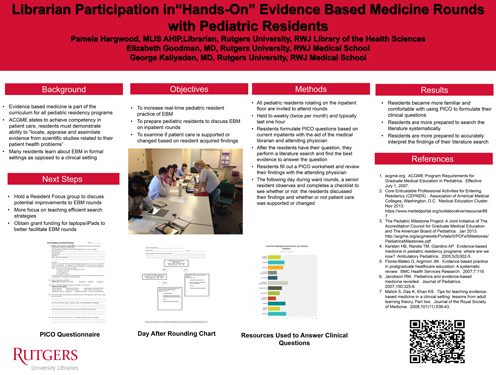
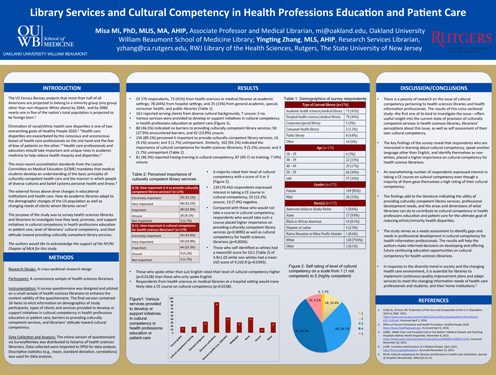
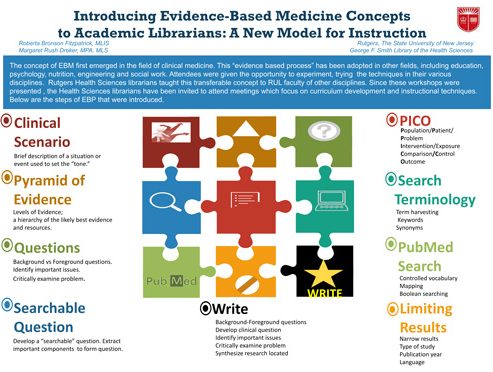
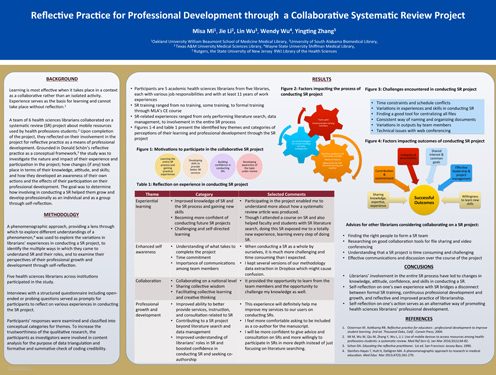
    Rutgers University Libraries were well represented at the poster session for the annual meeting of the Medical Library Association (MLA). A total of eight posters were presented by librarians from RWJ and Smith Libraries that capture a range of activities from access services and event assessment to systematic review and participation in medicine rounds. The posters were selected by juries comprised of association members and RBHS bears the distinction of having the most posters from a single library system in the show.

    Held from May 13 – 18, 2016, In Toronto, this year the meeting was a collaboration by MLA, the Canadian Health Libraries Association/Association des bibliotheques de la santé du Canada (CHLA/ABSC), and the Clinical Librarians Conference (CLC).

    Peruse the posters in the slideshow at the top of this page (click on the images to see PDFs). You can also view the posters & abstracts at the links below, on the meeting app, or in the official online program.


    RBHS Posters from MLA

    Title Author(s)
    Reflective Practice for Professional Development through a Collaborative Systematic Review Project Misa Mi, Jie Li, Lin Wu, Wendy Wu, Yingting Zhang
    Librarian Participation in “Hands-On” Evidence-Based Medicine Rounds with Pediatric Residents Pamela Hargwood
    Introducing EBM Concepts to Academic Librarians: A New Model for Instruction Roberta Bronson Fitzpatrick, Margaret Rush Dreker
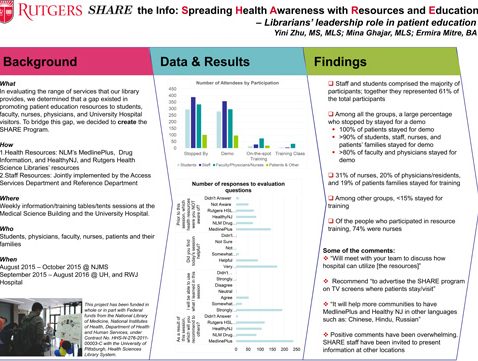
    SHARE the Info: Spreading Health Awareness with Resources and Education: A National Network of Libraries of Medicine-Funded Program Yini Zhu, Mina Ghajar, Ermira Mitre
    Library Services and Cultural Competency in Health Professions Education and Patient Care Misa Mi, Yingting Zhang
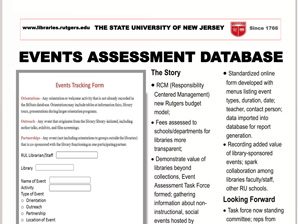
    Counting the Colorful: The Events Assessment Task Force Roberta Bronson Fitzpatrick, Leslin Charles, Ann Watkins, Zara Wilkinson, Megan Lotts
    Adding More Tiles to the Mosaic: The Library and EBM in a Time of Curriculum Revision Margaret Rush Dreker, Roberta Bronson Fitzpatrick
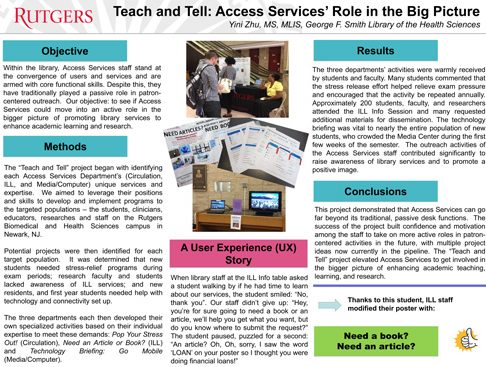
    Teach and Tell: Access Services’ Role in the Big Picture Yini Zhu


  • Smith Library Stressbusters: Anatomy Rare Book Show and Tell

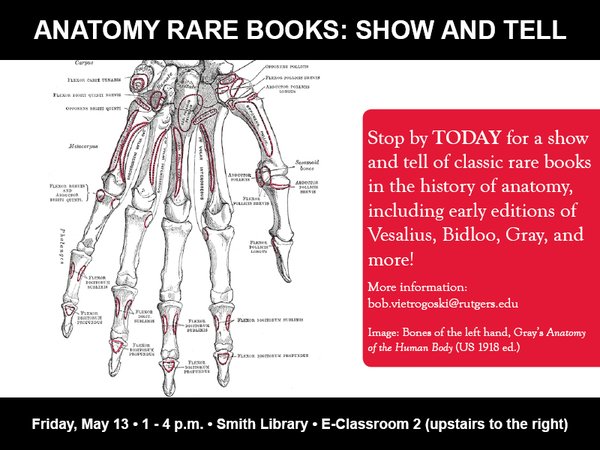
    anatomy inviteIn addition to bubble-popping and “make your own squeeze ball” stressbuster activities, the George F. Smith Library of the Health Sciences hosted its first “Anatomy Rare Book Show and Tell” on Friday, May 13. Over the afternoon, 18 attendees (15 students, 2 librarians, and a regular library visitor) dropped by to see, touch (supervised!), and learn about:

    • Andreas Vesalius, De Humani Corporis Fabrica (2nd edition, 1555 – a gorgeous book with renowned illustrations, with our copy featuring a magnificent 1572 binding)
    • G. Bidloo, Anatomia Humani Corporis (1st edition, 1685 – folio size with awesome and gruesome giant plates)
    • Henry Gray, Anatomy: Descriptive and Surgical (1st British edition, 1858, and 1st American edition, 1859 – fantastic pedagogical illustrations, and thanks to television, probably the best-known textbook title)

    Librarian lessons learned:

    Patron serendipity: A first-year medical student recently visited Special Collections and expressed interest in the rare books. She was concluding gross anatomy studies, and really liked the idea of a show and tell of classic anatomical works. She was happy to post news of the event on the private Facebook page of the first year students.  So if one patron is interested, it’s reasonable to conclude that maybe more than one will be interested!

    Location location location: Instead of using the Special Collections reading room, the books were displayed in E-Classroom 2, a recently renovated room closer to where students congregate on Smith Library’s upper floor.  A sign taped to a chair and an open door worked to draw some second-year students temporarily away from their USMLE Step 1 studies. Prompted by a Vesalian illustration, some even recalled which bone in the human body is the only bone not connected to another.

    If it works, do it again:  Attendees showed interest and stayed longer than originally anticipated. (By the end, my voice was shot.) So I intend to make similar rare book, manuscript, or even historical object show and tell events a regular end of semester activity.


  • National Library of Medicine Biomedical Informatics Fellows Named from Rutgers

    NLM
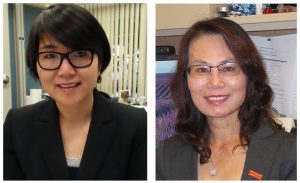
    Yingting Zhang from RWJ Library (l) and Yini Zhu from Smith Library (r) were both named to the prestigious Medicine Medical Informatics Fellowship.

    Yini Zhu (Smith Library) and Yingting Zhang (RWJ Library) were both named to the National Library of Medicine’s (NLM) Biomedical Informatics Fellow program through a competitive application process. Yini attended a week-long medical informatics workshop held at Augusta University, Augusta, GA, in April 2016. Yingting will attend the same program in fall 2016.

    This program introduces participants to the fundamental concepts and application areas of biomedical informatics with components including principles of controlled terminology/vocabulary, standards, mathematical modeling, bioinformatics, natural language processing, and more.

    NLM’s program recruits from health sciences educators, librarians, administrators, clinical practitioners, and faculty who can become agents of change in their respective institutions by becoming a “field force” to train other on these concepts.

    The benefits of attendance at the fellowship program were immediate. Following her participation in the NLM program, Yini Zhu joined Minglu Wang and Bonnie L. Fong to present a Data Management Plan workshop to a group of Rutgers Newark and RBHS faculty, researchers, and staff on May 3, 2016. Yini covered the fundamentals and best practices of data sharing plans required by the National Institutes of Health (NIH) while Minglu and Bonnie addressed data management plans.

    Click here to learn more about the Biomedical Informatics program.