Category: Units

  • Deep Dive: JAMAevidence

    Deep Dive will give a bit more insider’s info on some of our resources. Here, Roberta Fitzpatrick gives us some more information about JAMAevidence.


    In 1990, Dr. Gordon Guyatt, Internal Medicine residency program director at McMaster University in Canada began to teach using a new method which he called “Scientific Medicine.” He felt that many clinical decisions were not necessarily rooted in scientific fact and taught his residents to make such decisions based in part on evidence found in the published literature. It eventually evolved into what is currently called Evidence-Based Medicine (EBM) or Evidence-Based Practice (EBP) or Evidence-Based Health Care (EBHC), combining a clinician’s experiences, well as information about the specific patient with the best evidence from journal articles.

    JAMAevidence, an information resource new to Rutgers and found at https://www.libraries.rutgers.edu/indexes/jamaevidence, is a natural extension from Gordon Guyatt’s original ideas and educational program. In order to assist health professionals in the practice of evidence-based health care, JAMAevidence provides guides to the systematic consideration of validity, importance, and applicability of problems and outcomes in health care. It consists of three textbooks, user tools, and forms useful to the critical appraisal process. Textbooks contained in JAMAevidence are:

    • Users’ Guides to the Medical Literature: A Manual for Evidence-Based Clinical Practice, 3rd ed.
    • The Rational Clinical Examination: Evidence-Based Clinical Diagnosis
    • Care at the Close of Life: Evidence and Experience

    Contents of the first two textbooks have been published as an article series in JAMA, the Journal of the American Medical Association. The User’s Guides are key to understanding the process of critically appraising an article. The Tational Clinical Exam series and subsequent textbook walks the reader through the process of conducting a physical exam of a patient.

    Tools in JAMAevidence include Education Guides, which consist of a library of PowerPoint slides useful in providing instruction on evidence-based medicine concepts; a glossary of over 900 EBM terms; calculators; and two types of worksheets, ones for critical appraisal of articles and those for charting an information cycle.

    JAMAevidnce is simple to use; a navigation bar is located at the top of each page and allows the users to review the contents through pointing and clicking. There is also a search box that allows for retrieval of searched key words. The resources is available on a monthly basis.

    Those who are interested in learning more about EBM may want to consider a review of an article titled “History of evidence-based medicine” by Roger L. Sur and Phillip Dahm from the Division of Urology, UC San Diego, published in the open-access Indian Journal of Urology, https://www.ncbi.nlm.nih.gov/pmc/articles/PMC3263217/.


    Save

    Save

    Save

  • The Kopp Dataset Is Now Available in RUcore

    The Research Data Exploratory Team and members of the Software Architecture Working Group collaborated with Professor Robert Kopp and D.J. Rasmussen to ingest and provide access to an impressive collection of county-level climate change projection data that is now available in the RUcore Research Data Portal at http://dx.doi.org/doi:10.7282/T3SF2Z93.

    Rasmussen, Kopp, and collaborator Malte Meinshausen generated projections of future temperature, precipitation, and humidity by combining the probability of different global average temperature outcomes over the 21st century with spatially detailed projections from several state-of-the-art global climate models. The projections also include daily to multi-year weather variability, which is needed for economic models that estimate the impacts of climate change. The resulting data set is a 1.3 TB product that is freely available for use by researchers, decision makers, and climate change communicators. The need for local climate change projections is growing as decision makers are increasingly demanding estimates of the economic costs of future climate change and the value of avoiding associated damages.

    The climate projections from Rasmussen, Kopp, and Meinshausen were used in the book Economic Risks of Climate Change: an American Prospectus. This prospectus provides a climate risk assessment that estimates the economic impact of climate change on the U.S. and provides local estimates of economic risks in multiple sectors of the U.S. economy, including labor, agriculture, and energy. The complete dataset in RUcore provides open access to all data and methodology for the physical climate projections so that results can be reproduced and improved in future studies. The technical analysis in the prospectus was commissioned by the Risky Business Project. This effort was led by former New York City mayor Michael Bloomberg, former Bush administration treasury secretary Hank Paulson, and former hedge-fund manager Tom Steyer. The aim of these three business leaders was to inspire risk managers in the business community to incorporate climate change related financial risks in their decision making process.

    The RUcore repository architecture provides a set of unique features that enables researchers to easily access the parts of this dataset that are most important. Each major directory, of which there are twelve, has its own Digital Object Identifier and can be individually cited. Perhaps most useful is that file and directory names are preserved and the user can walk the directory tree to select individual files and directories for download. This feature is important since downloading a complete directory in the order of 200GB will take hours. As an alert to prospective users, we provide an estimate of how long it will take to download the requested files and directories. In addition, one of the directories includes the software for processing the data, enabling users to repeat or augment the original authors’ findings. As part of the Libraries’ exploratory process, we learned a great deal about how to ingest and manage large datasets greater than 100GB. We had to revise our memory management strategies to accommodate directories with thousands of files. As part of our process, we validated the transfer of the 1.3TB dataset from the original site to the RUcore server to insure that there were no corruptions in the transfer process. All in all, we believe that this dataset and the access to it provided by Libraries will significantly contribute to the ongoing research in climate science.

    Save

    Save

  • Excerpt from “Forgotten Heroes: New Jerseyans and Rutgers Alumni During the Great War” at What Exit?

    This month, What Exit? from Special Collections and University Archives featured two long forgotten New Jersey heroes, using materials from the Rutgers College War Service Bureau and the Terradell Family Papers.

    Excerpt:

    Portrait of Theodore Rosen. Undated, ca. 1926.

    With a growing number of Rutgers men in Uncle Sam’s olive drab, Earl Reed Silvers (RC 1913) established the Rutgers College War Service Bureau (RCWSB) in August 1917 to keep the 800 men in service up to date with frequent news of the college and each other. “As far as can be ascertained, no college or university in the United States kept in such close touch with her alumni and undergraduates in the army or navy,” reflected Silvers, “nor has any college the mass of material, war letters and relics, which were sent to old Rutgers by her appreciative sons.”

    Counted among the alumni who corresponded with Silvers and the RCWSB was Theodore “Theo” Rosen (1895-1940), Rutgers College Class of 1916, who served as First Lieutenant in the 315th Infantry, 79th Division.

    Creeping and crawling toward the German line in search of a machine gun nest on the early morning of November 4, 1918, Rosen found himself in the path of fire. One bullet rendered his right arm useless; the other tore through his left cheek, filling his mouth with blood and taking out seven teeth. The 23-year-old would lose the top of his left thumb, break his left wrist, have his right arm amputated, and suffer impaired hearing and vision before the onslaught was over. He only recovered consciousness as a P.O.W. on the operating table at Longwy, where he remained prisoner for the eight days before the Armistice in November 1918.

    Continue reading “Forgotten Heroes: New Jerseyans and Rutgers Alumni During the Great War” at What Exit?

    Save

    Save

  • Annual Celebrations for Staff and Faculty of Rutgers University Libraries (2017)

    The University is recognizing faculty and staff who are celebrating a decade increment of employment at Rutgers. We are delighted to announce that 14 of our colleagues were included in the festivities and hope you join us in congratulating them on these accomplishments:

    10 Joseph Abraham (NBL)

    Martha Barnett (Shared User Svs)

    Abigail DiPaolo (Admin Svc.)

    Jie Geng (TAS)

    James Hartstein (NBL)

    Robert Vietrogoski (Smith)


    20 Roman Frackowski (TAS)

    Stephen Modica (Smith)


    30 Tracey Meyer (TAS)

    Nita Mukherjee (NBL)

    Robin Pastorio-Newman (TAS)

    Jeffrey Teichmann (NBL)

    Drue Williamson (NBL)


    40 Dianne Hamlette (RBHS)


    Save

    Save

  • Rutgers Day in Photos

    Rutgers Day this year was a huge success thanks to the efforts of all the local committees. Each location put their own spin on the day’s events as you can see in the photos below. Whether they were strutting the red carpet in Camden, fishing for health with RBHS, learning about WWI with New Brunswick, building robots in Piscataway, or discovering jazz in Newark, our visitors were treated to spectacle, activities, and fun!

    Thank you to all the committee chairs and members who made this awesome day possible in five locations across four cities! This is one of the biggest events in which the Libraries participate and it requires a lot of hands on deck. If you didn’t participate this year, please consider volunteering to help out next time.

    If you like the photos here, there are more on our photo server (T:\CENTRAL\PHOTOS AND MEDIA\Event Photos\Rutgers Day\Rutgers Day 2017\).

    • The Voorhees Mall location highlighted the WWI Centennial and the new SCUA exhibit.


  • Rutgers Connect Tips and Tricks

    How to create a calendar appointment from an email message


    With so many events publicized via distribution lists like RUL_Everyone and other University-wide lists, it may be difficult to keep track of meetings, webinars, training sessions, speakers, and other events you might wish to attend.  The best way to make sure you do not miss these opportunities is to add them as appointments on your Rutgers Connect calendar.

    It is very easy to create an appointment on your Rutgers Connect (OWA or Outlook) calendar without having to retype the details from the email message. We have prepared step-by-step instructions to show you how.

    If you have questions, or need assistance with Rutgers Connect, please contact IIS via email at support@rulhelp.rutgers.edu, or by phone at 848-445-5896, option 7.


    Tracey Meyer, Information Specialist, Integrated Information Systems

  • The Results of Our Budget Request for FY2018

    The Results of Our Budget Request for FY2018

    In recent months, we have spent a lot of time talking about organizational changes and the advantages of breaking down silos. This month, I want to discuss a shining example of what we accomplish when we work together—the outcome of our FY2018 budget request.

    As noted in the meeting minutes for cabinet on April 11, we recently received our FY18 permanent budget allocation and there is a lot of good news to share. Overall our budget is increasing, even if the increases are small. There are, of course, also some disappointments, so let’s delve into the specifics.

    Let’s start with the very good news: we received a commitment of $500,000 to purchase Elsevier backfiles. This is a major collections purchase—possibly the largest in the Libraries’ history—and it required a lot of effort from Tao Yang, Gracemary Smulewitz, Abbey DiPaolo, and others to make it happen. Having these backfiles will dramatically expand our support for the university’s academic programs and bring us in line with our Big Ten peers.

    Each year, at minimum we ask for two budget items: funds to cover inflation for subscriptions to journals and databases and funding to cover negotiated salary increases. These items are areas where we have annual contractual increases in expenses. When our expenses increase in these areas and our budget does not, we must find other places to cut. The difficult problem is that both the contractual salary increases and inflation are ongoing, so we have to cut an ongoing expense. Here, we got a mixed response.

    We finally received funding for inflation. This is good news for us and even better news for our faculty and students. As you know, the costs of journal and database subscriptions go up each year, but in previous years, we have had to accommodate these increases within our existing budget. With inflation costs covered, we won’t have to have to cut existing subscriptions in order to cover the higher ongoing costs. We have new ongoing funding to cover the higher costs for materials.

    Unfortunately, we did not get funds to cover salary increases. This means that we will have to permanently use funding from some open positions. The total number of positions that will be affected is small with most having been open for a long time. The good news is that we remain committed to supporting salary increases for the excellent faculty and staff that we have, even if we have a small reduction in the number of employees.

    Lastly, a surprise! In addition to our requests to cover expenses, we also ask for additional funding to cover new services in the libraries. We limit these requests to items where the campus administrations have indicated support. This year we asked for funding for archives in Dana Libraries. Initially, we were disappointed to learn that our funding request was denied. However, we just received a revised budget from Rutgers University-Newark and they have decided to fund a full-time archivist and the renovations necessary to create an archive space. In addition, they are providing $100,000 to purchase new furniture for Dana Library

    This reversal is the result of the work of Consuella Askew and many of the faculty and staff in Newark in developing strong local relationships and an understanding of local needs, as well as their conscientious and creative use of earlier funds. The RU-N administration is committed to building an archive in Newark. Consuella recognized the need and was able to make a case for archives being in the library rather than in a separate unit. The resources that will come to Dana to create an archive will relieve some of the pressure that we have across the university for stewarding this important content. However, in order to benefit, all of the units with special collections must work together to create infrastructure that supports the broader system. I expect that this will be one of the priorities that come from our planning this year.

    Our initial budget request was deliberately targeted on items that would bring a demonstrable improvement or impact to our constituents. And as we continue to shift our priorities and strategies toward addressing the unique local needs of our libraries, it becomes more important than ever for us to find ways to work together to build common, reusable infrastructure that has noticeable benefits for our campuses.


  • Envisioning the Future: John Cotton Dana Library

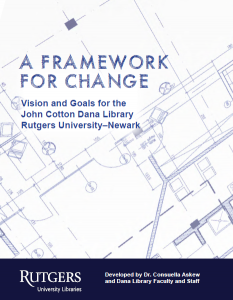
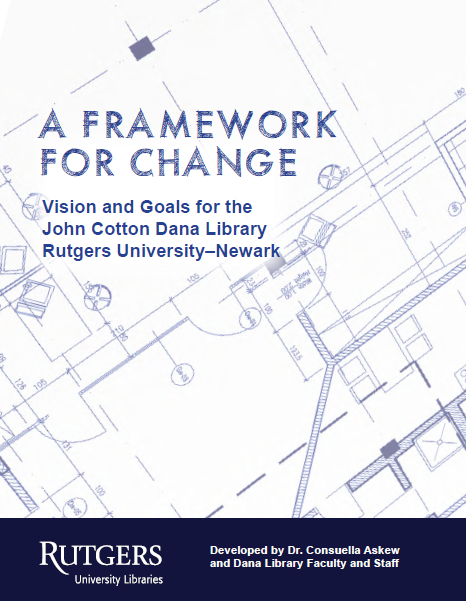
    As the nexus of a dynamic university in the midst of transforming and reinventing its brand, Dana Library/Institute of Jazz Studies is poised to move into its next iteration. Our goal is to become a user-centered library that can nimbly respond to our users’ continually changing needs in innovative ways. The Dana Library/IJS faculty and staff embarked on a six-month process in order to identify our priorities and objectives needed to achieve this goal.  The resulting document, Framework for Change: Vision and Goals for the John Cotton Dana Library Rutgers University–Newark, provides readers with a high-level view of our path to success.

    We began our work in spring 2016 by identifying three high priority focus areas–services, collections and space. These focus areas supported not only the Rutgers University Libraries priorities, but also the Rutgers University–Newark Strategic Plan. Each priority area was given individual attention and consideration by a dedicated group of Dana faculty and staff who volunteered to compile and consider available data about the area, add their valuable expertise on the area topic, and provide recommendations for how we can enhance these areas to better meet the needs of our users in the 21st century. The resulting compilation of this work led to a 30+ page document which detailed specific services enhancements, space needs, and collection management activities. This document will serve as our road map for next several years.

    The Framework for Change document presents a broad overview of the detailed steps necessary for us to achieve success. This document will be used as an advocacy tool for our local university administrators and could also be used as a fundraising tool for donors. No matter how this document might be used externally, Dana Library has charted its course and is ready to embark on a journey to success!

  • Quick Takes on Events and News — May 2017

    StressbustersThe New Brunswick Libraries announced their schedule of #Stressbusters events for the spring exam period. Highlights include a photo booth at the Math/Physics Library, button making at the Art Library, and pet therapy sessions at Alexander, Douglass, Kilmer, and LSM.


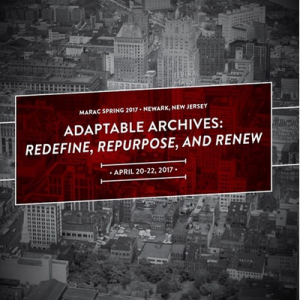
    MARAC Spring 2017 was held April 20–22 in Newark.

    Don’t despair if you happened to miss out on the recent Mid Atlantic Regional Archives Conference in Newark, as Tara Maharjan put together a comprehensive Storify of the event (titled Adaptable Archives: Redefine, Repurpose, and Renew) that’s the next best thing to having been there in person.


    Several new exhibits opened across the Libraries this past month:

    At the Art Library, a display of undergraduate student work from the Environmental Planning Studio of the Department of Landscape Architecture will be on view through May 31. Students in the studio were challenged to create a master plan for the Bergen County park system, and the exhibit communicates their creative solutions and work through large-scale posters.

    There's a Run in My Tights

    At Paul Robeson Library, There’s a Run in My Tights: Classic Comic Book Covers from the Golden Age and Beyond is on display through May 4. This display, which opened in advance of the 2017 Camden Comic Con, highlights superheroes such as Bat Girl, Aquaman, Luke Cage and the X-Men, as well as villains like Cat Woman and misunderstood monsters like Werewolf By Night.

    A group exhibition of works by students in the Women, Gender, and Creativity House of Douglass Residential College is on display now at Douglass Library. Students in this community explore topics of gender, sexuality, identity, creativity, perception, and visual communication of women in the arts. The exhibition highlights the self-portraits, sculptures, video performances, and written works produced by the student artists during the course of the academic year. It closes on May 1, so be sure to check this one out while you can.


    Finally, many new resources were announced in April:

    • The Andrew Hill Collection at the Institute of Jazz Studies contains the papers, music, and audiovisual recordings of acclaimed pianist, composer, bandleader, and educator Andrew Hill (1931–2007). The collection was processed as part of the 2016 Jazz Archives Fellows residency.
    • Attitude Check - Independent voices
      Attitude Check (vol. 1 no. 1, 1969) via Independent Voices.

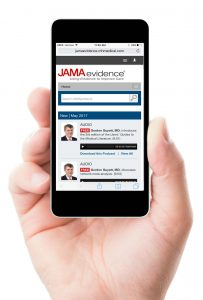
      JAMAevidence provides guides to the systematic consideration of validity, importance, and applicability of problems and outcomes in health care. It consists of three textbooks, user tools, and forms useful to the critical appraisal process. See more in our deep dive.

    • Academic Video Online Premium provides access to over 50,000 videos from reputable producers such as BBC and PBS, mostly on the subjects of social sciences, American history/American studies, music and performing arts, science and engineering, and health sciences.
    • Independent Voices is a full-text database of alternative press periodicals published in the U.S. in the second half of the 20th century. It includes publications like Aegis (1978-87), Death Ship Times (Fat Albert’s) (1972-74), The Feminist Voice (1971-72), Meatball (1969-71), Off Our Backs (1970-76), The People’s Voice (1980-1983), San Francisco Good Times (1969-72), Up from the Bottom (1971-74), Where It’s At (1968-70), the Yardbird Reader (1972-76), and Zeitgeist (1965-69), among dozens of others.

    Save

  • The Numbers Are in! Rutgers Giving Day Final Report

    Back in November, we reported on the preliminary Rutgers Giving Day results and the news was good. Now the final numbers from the Rutgers Foundation are in, and we are proud to say that the news is even better!

    Our initial goal was to roughly double our number of donors from the inaugural Rutgers Giving Day and reach 50 donors this year, but we wound up seeing an outpouring of support that greatly exceeded expectations—thanks in no small part to your support.

    According to the final reports, the Libraries raised a total of $16,544.22 with gifts from 172 donors—a 647% increase in the number of donors and an 829% increase in the total amount of funds raised over the previous year. These numbers include the early give phase, the day-of-phase, and the challenge money leaderboard.

    The leaderboard was used to determine how $80,000 in challenge money would be awarded across the university ($20,000 each for Rutgers–Camden, Rutgers–Newark, Rutgers–New Brunswick, and RBHS). A unit’s standing on the leaderboard was based on the number of individual donors for that unit during the day-of phase compared to the total number of donors for its “parent institution.” So, in other words, if there were 100 gifts total to Rutgers–Camden and Robeson Library received 10 gifts, it would receive a bonus 10% of the $20,000 in challenge money, or $2,000. Here’s how the leaderboard numbers broke down:

    Unit Total distinct donors Total dollars Percentage of “parent institution” leaderboard donors Challenge money awarded (of $20,000)
    Robeson Library 9 $170.00 1.66% $331.49
    Dana Library 19 $1,433.08 2.61% $521.26
    Institute of Jazz Studies 2 $65.00 0.27% $54.87
    New Brunswick Libraries 95 $11,609.99 3.21% $641.46
    RBHS Libraries 6 $300.00 0.78% $156.05

    As you can see, we have much to be proud of. Many thanks to everyone who went out of their way to set up a donation station, make support sheets available to their patrons, or give a gift of their own to support the Libraries. Our tagline for this year’s campaign was “We can do great things together,” and you’ve all made it abundantly clear that there is real meaning behind those words. Thank you!