The following resources are now available on the communications department website. We hope you find them useful. We’re trying to actively identified shared resources that we can supply to save our colleagues time and to create a cohesive visual identity for our libraries. If you have suggestions of new projects, please let me know.
New signage templates:
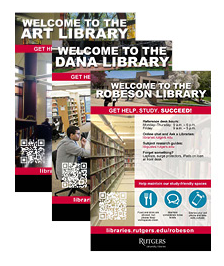 During our last signage inventory, we tried to identify signs that appear in multiple libraries, and we’ve added a bunch of new templates to the signage library. We now have some templates for quiet and collaborative study areas, guest and Net ID computers, reshelving books and shelving carts, and keep your belongings safe.
We also have Welcome to the Library signs prepared for all public library spaces (except for the Annex, which we will get to soon). These are available in two sizes – 24” x 36” large posters, and 8.5” x 11” in landscape and portrait orientation.
In the signage section, you will also find our policy sign toolkit, including icons for policy signs and welcome signs, and build your own signage templates. If you make a sign that might be useful for other libraries, please send it to us and we’ll post it in the sign library so others can access it.
link: https://apps.libraries.rutgers.edu/communications/signage-templates
Powerpoint templates:
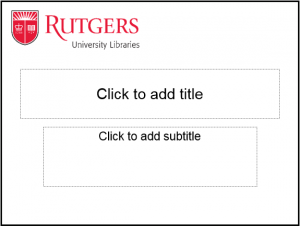 Complete Powerpoint templates, featuring the new shield logo, are now available. Please do not use the older Powerpoint templates with the Rutgers seal. The Rutgers informal seal is no longer part of the university’s visual identity and we should be using the shield wherever possible. There are two versions of the template – an all-white version, and one with a scarlet band. These templates include title pages and sub-pages and also have a color theme that includes Rutgers colors.
To edit the Optional Presentation Title area on the slide, go to “View,” select “Master,” and then choose “Slide Master.” You will then be able to double click on the Optional Presentation Title text and edit the area. The template must be resaved before creating a presentation.
To select the Rutgers color theme, go to “View,” select “Master,” and then choose “Slide Master.” Select Colors and scroll down to select Rutgers University Libraries under the Custom subheading.

link: https://apps.libraries.rutgers.edu/communications/visual-identity-resources
Video branding elements:
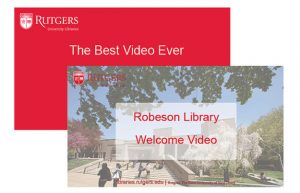 Video branding elements are also now available for you to use. These should be used in any video you make that promotes Library services, spaces, or resources. It is very important that the branding is used because it will make us compliant with the university visual identity policy for video standards, create greater visibility for the Libraries, and acknowledge our ownership of this material (very important when videos are being repurposed, embedded, or linked to from other users).
The visual identity policy for video standards is:
“The Rutgers logotype, with or without a signature, must appear prominently at or near the opening or closing of a Rutgers video. In addition, the appropriate Rutgers name (i.e., Rutgers, The State University of New Jersey; Rutgers University–New Brunswick; Rutgers University–Newark; Rutgers University–Camden; Rutgers Biomedical and Health Sciences) must appear somewhere in the course of the video.”
**Please note: we should use the full university name, “Rutgers, The State University of New Jersey,” and not a local university name since the libraries are a central unit.
The Communications Department is supplying four branding elements that can be personalized to some extent, depending on your project:
- Video sting (musical introduction or closing video clip, watch: https://www.youtube.com/watch?v=1J4o2Gvvsiw)
- Branded title page
- Static graphic
- Closing Captions background
These branding elements can be mixed and matched, appear at the beginning or the end of your video – just so long as you are compliant with the visual identity policy quoted above. If you have a special video project or series and would like a tailor-made branding element, please let us know. We’re happy to work with you to accommodate these requests.
link: https://apps.libraries.rutgers.edu/communications/visual-identity-resources
Revised Rutgers University Libraries editorial style guide:
The Libraries’ style guide has been updated to address issues particular to the Libraries that are not covered in the university’s guidelines and to offer quick tips for remaining consistent with the established Rutgers style. Our goal is to foster clear, consistent messaging in all of the Libraries’ official communication channels, including our website, blogs, social media, print and electronic newsletters, brochures, flyers, and so on. It is not intended to supplant the style guidelines of any academic journal or news outlet to which you may be contributing material.
link: https://www.libraries.rutgers.edu/rul/staff/pub_serv/procedures/stylesheet.shtml


 Nearly a year ago, the Libraries reorganized to form a central user services unit, Shared User Services. While we are still building, major structures are coming together. Here’s a progress report to let you know who we are, where you can find us, and some of the things we are up to.


 The FY 2017–2018 performance evaluation process for nonaligned employees (MPSC and Senior Administrators) is nearly upon us!