This week, Rutgers University Libraries and other New Brunswick institutions will welcome a delegation from Japan as part of the New Brunswick Sister Cities project. Fernanda Perrone is vice president of the group and has invited the delegation to visit Alexander Library and will give a presentation related to the Griffis Collection. The Global Experience Team is sponsoring refreshments after the presentation. If you are interested in learning more about this event, please contact Fernanda.
Seems like a good time to revisit this terrific video:
Sister Cities Project Press Release:
One hundred and fifty years ago, a young samurai from the province of Echizen (today Fukui prefecture) in the far west of Japan came to New Brunswick with the goal of entering Rutgers College. Kusakabe Taro arrived fired with the desire to “fulfill my duty to the Imperial realm by clarifying the defects in the relations between us Japanese and the foreigners in the light of the international law of all nations and universal principles.” Ranked number one in his class, Kusakabe became the first Japanese to graduate from Rutgers College, the first to become a member of Phi Beta Kappa, and, along with Niijima Jo at Amherst, the first to graduate from an American college. Tragically, Kusakabe died of tuberculosis on April 13, 1870, only weeks before commencement. He is buried in the Willow Grove Cemetery in New Brunswick along with seven other young Japanese. The following year, Kusakabe’s friend and classmate William Elliot Griffis traveled to Fukui to introduce Western-style educational methods into the local school system. Griffis would spend four years in Japan and a lifetime writing, teaching, and collecting information about Japan. His collection was bequeathed to the Rutgers University Libraries in 1928.
Indeed Rutgers was an important destination for international students from Japan during the nineteenth century. Many of those who studied at Rutgers returned to Japan to become leaders in education, industry, and commerce. Although the last of this early group of Japanese students attended Rutgers in the 1920s, the relationship between the university and Fukui was re-discovered in the late 1950s by Rutgers administrator and professor of political science Ardath Burks. Working closely with the city of New Brunswick, programs and exchanges were initiated, and the William Elliot Griffis collection was organized and made available to the public. Rutgers and Fukui Universities became sister universities in 1981, and in 1982 New Brunswick and Fukui became sister cities. As well as the 150th anniversary of Kusakabe’s arrival, 2017 marks the 35th anniversary of the sister cities relationship.
From October 4 to 7, New Brunswick will welcome a large delegation from the city of Fukui including the mayor and members of the City Council, members of the Junior Chamber of Commerce, and members of the Fukui International Citizens Association. Among the events planned are a Buddhist ceremony at Kusakabe’s grave on Thursday, October 5 and a lecture on “Kusakabe and His Friends,” which will held at Alexander Library on Friday, October 6. The delegation will also visit the Zimmerli Art Museum and the new Johnson and Johnson Museum and be entertained by the Rutgers Centers for Global Advancement and International Affairs, Rutgers Community Affairs, and Rutgers University Libraries at Rutgers University–New Brunswick. The Fukui Junior Chamber of Commerce will accompany two middle-school students who have written the best essays of the year about Kusakabe Taro. These children will have a chance to visit the New Brunswick Middle School and meet with their contemporaries there.
In November 2017, New Brunswick mayor James Cahill will lead a delegation from New Brunswick to visit Fukui.
This month, What Exit? from Special Collections and University Archives featured two long forgotten New Jersey heroes, using materials from the Rutgers College War Service Bureau and the Terradell Family Papers.
Excerpt:
Portrait of Theodore Rosen. Undated, ca. 1926.
With a growing number of Rutgers men in Uncle Sam’s olive drab, Earl Reed Silvers (RC 1913) established the Rutgers College War Service Bureau (RCWSB) in August 1917 to keep the 800 men in service up to date with frequent news of the college and each other. “As far as can be ascertained, no college or university in the United States kept in such close touch with her alumni and undergraduates in the army or navy,” reflected Silvers, “nor has any college the mass of material, war letters and relics, which were sent to old Rutgers by her appreciative sons.”
Counted among the alumni who corresponded with Silvers and the RCWSB was Theodore “Theo” Rosen (1895-1940), Rutgers College Class of 1916, who served as First Lieutenant in the 315th Infantry, 79th Division.
Creeping and crawling toward the German line in search of a machine gun nest on the early morning of November 4, 1918, Rosen found himself in the path of fire. One bullet rendered his right arm useless; the other tore through his left cheek, filling his mouth with blood and taking out seven teeth. The 23-year-old would lose the top of his left thumb, break his left wrist, have his right arm amputated, and suffer impaired hearing and vision before the onslaught was over. He only recovered consciousness as a P.O.W. on the operating table at Longwy, where he remained prisoner for the eight days before the Armistice in November 1918.
The New Brunswick Libraries announced their schedule of #Stressbusters events for the spring exam period. Highlights include a photo booth at the Math/Physics Library, button making at the Art Library, and pet therapy sessions at Alexander, Douglass, Kilmer, and LSM.
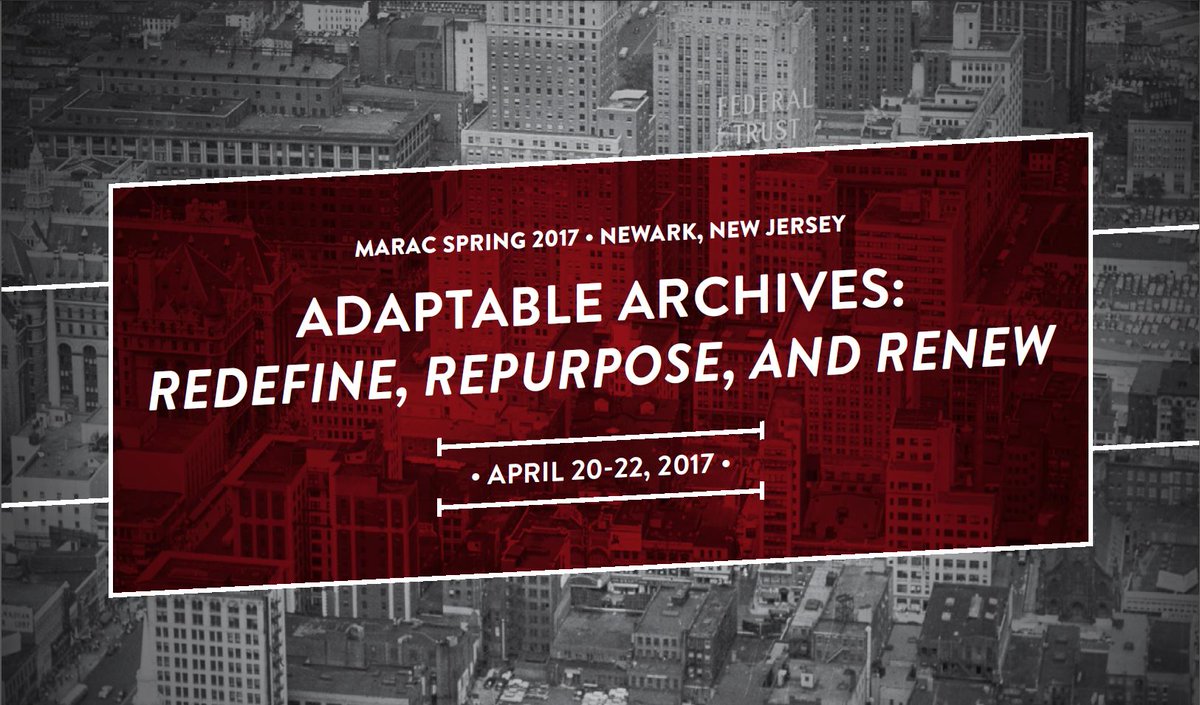
MARAC Spring 2017 was held April 20–22 in Newark.
Don’t despair if you happened to miss out on the recent Mid Atlantic Regional Archives Conference in Newark, as Tara Maharjan put together a comprehensive Storify of the event (titled Adaptable Archives: Redefine, Repurpose, and Renew) that’s the next best thing to having been there in person.
Several new exhibits opened across the Libraries this past month:
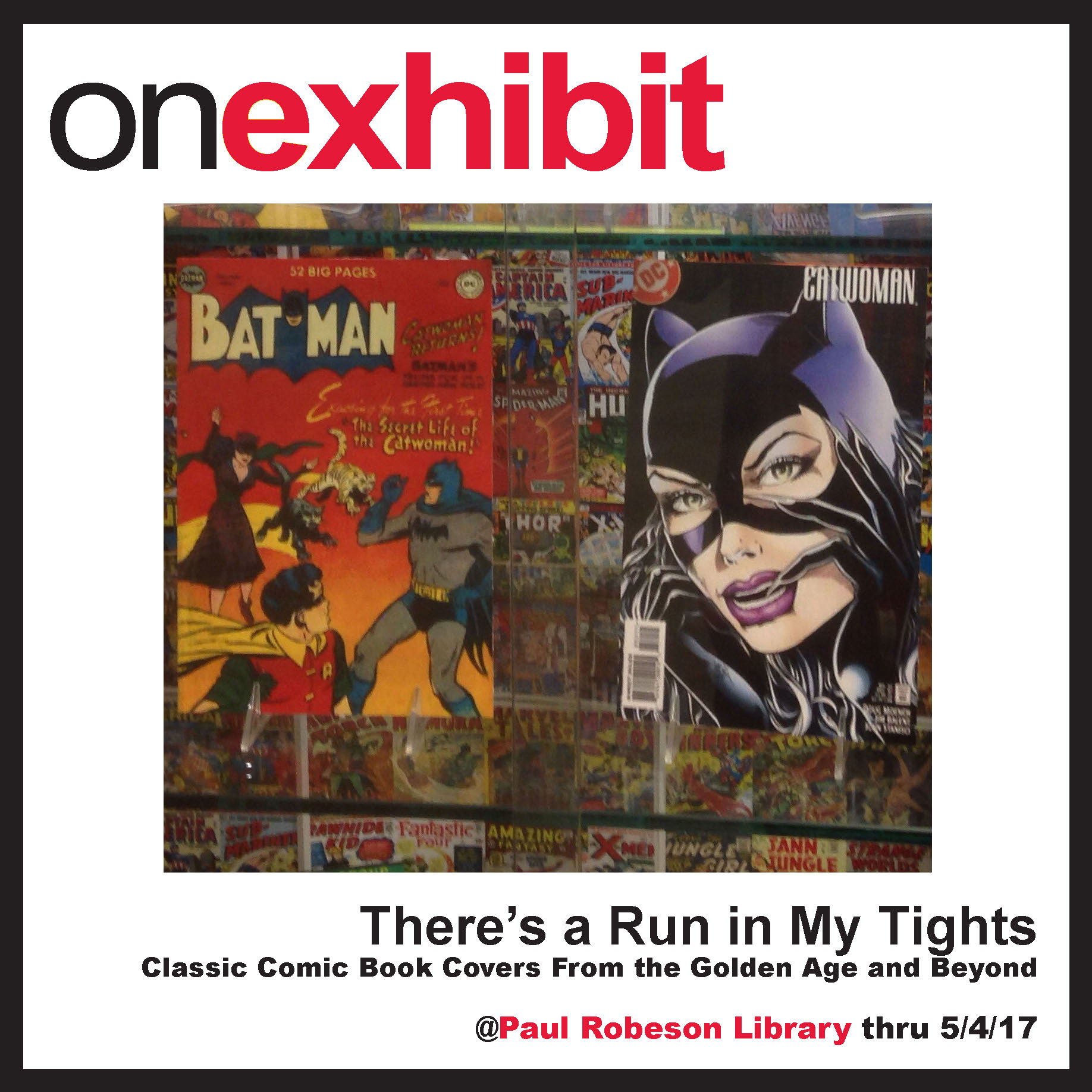
At Paul Robeson Library, There’s a Run in My Tights: Classic Comic Book Covers from the Golden Age and Beyond is on display through May 4. This display, which opened in advance of the 2017 Camden Comic Con, highlights superheroes such as Bat Girl, Aquaman, Luke Cage and the X-Men, as well as villains like Cat Woman and misunderstood monsters like Werewolf By Night.
A group exhibition of works by students in the Women, Gender, and Creativity House of Douglass Residential College is on display now at Douglass Library. Students in this community explore topics of gender, sexuality, identity, creativity, perception, and visual communication of women in the arts. The exhibition highlights the self-portraits, sculptures, video performances, and written works produced by the student artists during the course of the academic year. It closes on May 1, so be sure to check this one out while you can.
Finally, many new resources were announced in April:
The Andrew Hill Collection at the Institute of Jazz Studies contains the papers, music, and audiovisual recordings of acclaimed pianist, composer, bandleader, and educator Andrew Hill (1931–2007). The collection was processed as part of the 2016 Jazz Archives Fellows residency.
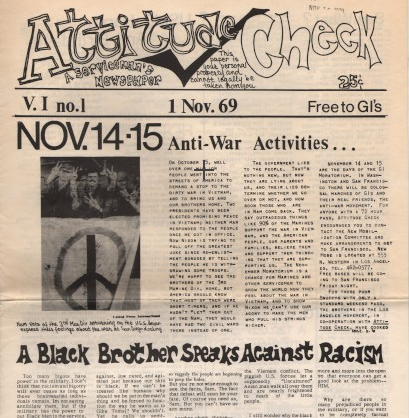
Attitude Check (vol. 1 no. 1, 1969) via Independent Voices.
JAMAevidence provides guides to the systematic consideration of validity, importance, and applicability of problems and outcomes in health care. It consists of three textbooks, user tools, and forms useful to the critical appraisal process. See more in our deep dive.
Academic Video Online Premium provides access to over 50,000 videos from reputable producers such as BBC and PBS, mostly on the subjects of social sciences, American history/American studies, music and performing arts, science and engineering, and health sciences.
Independent Voices is a full-text database of alternative press periodicals published in the U.S. in the second half of the 20th century. It includes publications like Aegis (1978-87), Death Ship Times (Fat Albert’s) (1972-74), The Feminist Voice (1971-72), Meatball (1969-71), Off Our Backs (1970-76), The People’s Voice (1980-1983), San Francisco Good Times (1969-72), Up from the Bottom (1971-74), Where It’s At (1968-70), the Yardbird Reader (1972-76), and Zeitgeist (1965-69), among dozens of others.
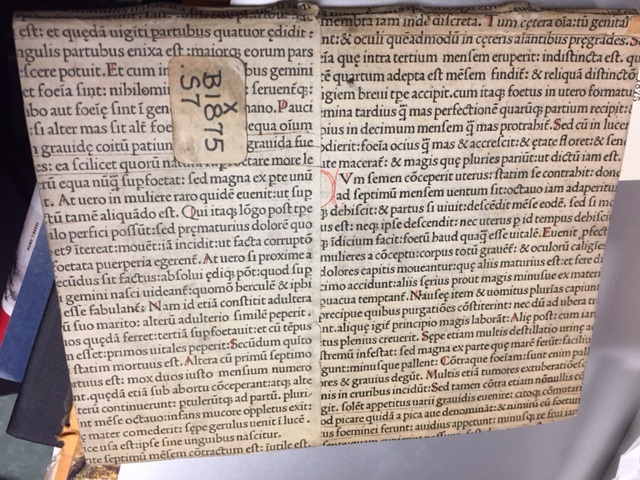
A request from the Spinoza Society sent us into the stacks in search of Baruch Spinoza’s René Descartes’ Principiorum Philosophiae. The Dutch philosopher’s response to René Descartes’ ontological arguments concerning substance (dualistic views that Spinoza, arguably a pantheist, sought to correct) was the first and only work of his to appear in print bearing his name, and Rutgers University Libraries’ copy, published in Amstelodami by Johannem Riewerts, is from the first edition. What particularly interested us was the binder’s waste on the covers, which clearly belonged to an early printed book.
It was a practice of book binders, dating back to the Medieval Period, to use whatever paper they had to hand to reinforce the strength of and to decorate a book’s covers. The paper covering the Libraries’ Principiorum Philosophiae included scribal marks (rubrications) and type that resembled the Roman types in other volumes in our rare book collection (specifically, in our copies of Nicolas Jenson’s Suetonius, and Vindelinus’s letters of Francesco Filelfo. It seemed highly possible that we had discovered leaves from an incunabulum we hadn’t recorded in our archives, but what we actually had proved to be even more exciting.
Working with our rare book cataloger, Silvana Notarmaso and Jeroen M.M. van de Ven, a postdoc researcher at Utrecht University in the Faculty of the Humanities, Department of Philosophy and Religious Studies, we determined that the leaves had once belonged to the editio princeps (first edition), of Aristotle’s De animalibus, a notable work in the history of Western philosophy inasmuch as it incorporates Aristotle’s thinking about the natural world, represents the first work on animal physiology, the first text on embryology, and includes a lengthy and quite graphic discussion on generation—with which Silvana notes our leaves are specifically concerned. Moreover, in identifying and classifying groups of animals and in explicating their functioning as a part of nature, Aristotle provided the basis for his philosophical analyses of relationships between structure, function, and purpose. De animalibus epitomizes Aristotle’s organizing principle.
Of course, we don’t know whether the binder of the Libraries’ copy of René Descartes’ Principiorum Philosophiae intended or even realized the intellectual connections he was drawing between cover and text (or the graphic nature of the reproductive passages), but Aristotle’s interest in relating natural specimens to a holistic system conceptually anticipates Spinoza’s central concern in his text, describing materiality and material objects as but modes of substance. Regardless of the binder’s intent or interests, we may claim that the Libraries’ Spinoza is one of those rare instances in which one can tell a book by its cover.
The Rutgers De animalibus (such as it was) was published in Venice by Johannes de Colonia and Johannes Manthen in 1476, a work translated by Theodorus Gaza and edited by Ludovicus Podocatharus. The printers Johannes de Colonia and Johannes Manthen were German merchants-turned-printers who acquired their printing material from Venice’s first printer (also a German immigrant), Vindelinus de Spira in 1473, during a slump in Venetian printing. Along with Nicolas Jenson, Colonia and Manthen dominated the highly-competitive Venetian printing business during the 1470s, producing 86 editions from 1474 to 1480, and merged their business with his in 1480. Intact copies of this edition of De animalibus are rare and highly valued. The last copy to go up to auction in 1998 sold for $96,000. While the Libraries own extraordinary samples of early Venetian printing in the form of intact works by Vindelinus, Jenson, and Aldus Manutius, these leaves are (as far as we know) the lone examples of work by Colonia and Manthem in our collection.
Note: The specific leaves covering the Libraries’ copy are from book 7, chapters 4 and 7 (sigs |1v, |2v, |3v and |4v).
In 2016, President Barchi asked the Libraries to pilot the OAT Project to address soaring textbook costs and to introduce more affordable materials into the classroom. The original plan was to provide 12 grants to faculty to incorporate low-cost course materials into their classes. Thanks to higher than expected faculty interest and the quality of their proposals, the Libraries quickly expanded the pilot program to 32 grants, impacting courses across the university in fields ranging from psychiatry, sociology, and public affairs to English, business, and physics. (For a complete list of grant recipients, please click here.)
Click here to read the news release, which includes reflections on the project from grant-winning professors Petros Levounis (Department of Psychiatry, Rutgers Biomedical and Health Sciences), Neil Sheflin (Department of Economics, Rutgers–New Brunswick), and Matthew Giobbi (Department of Psychology, Rutgers–Newark).
Kilmer Library Named in Honor of James Dickson Carr
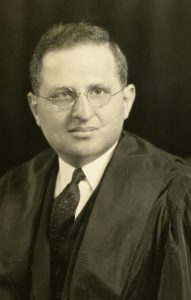
This month, the Board of Governors voted to rename Kilmer Library in honor of James Dickson Carr, Rutgers’ first African American graduate. He completed his degree in 1892, was a member of the Phi Beta Kappa honor society, and went on to attend Columbia Law School.
Chancellor Richard Edwards told Rutgers Today that the library’s new name will be a fitting tribute to Carr, who was a noted scholar.
“Having Mr. Carr’s name on a building that is a core part of academic life where students go to study and where research is conducted is an important way to recognize his accomplishments,’’ he said.
Following graduation from Columbia Law School, Carr went on to become an assistant district attorney of New York County and held other offices in New York City government. To learn more about this accomplished Rutgers alumnus, please read this article from the Journal of the Rutgers University Libraries.
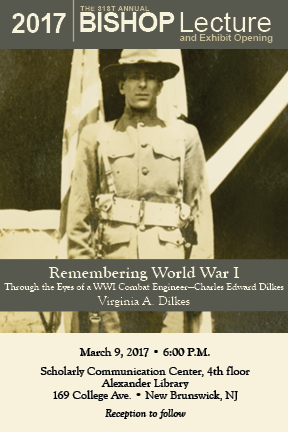
31st Annual Bishop Lecture: “Through the Eyes of a WWI Combat Engineer”
The 2017 Bishop Lecture will be presented by Dr. Virginia Dilkes, whose father served in WWI as a combat engineer.
Join Rutgers Special Collections and University Archives for the opening reception and the 31st annual Louis Faugères Bishop Lecture by Dr. Virginia A. Dilkes on the subject of “Through the Eyes of a WWI Combat Engineer,” at 6 p.m. on Thursday, March 9, 2017.
The lecture will also be the opening reception of the Rutgers University-New Brunswick Spring 2017 exhibition “Heaven, Hell, or Hoboken!”: New Jersey in the Great War. The exhibition, commemorating the Centennial of the Great War, will examine the storied history of our state during the Great War, showcasing one-of-a-kind documents, photographs, and artifacts from Rutgers University’s Special Collections and University Archives, the National Guard Militia Museum of New Jersey, and the Johnson & Johnson Archives.
Virginia Dilkes was born and raised in Iselin, New Jersey. She earned her doctoral degree from the University of Michigan. Her interest in World War I stems from her father, who was a combat engineer in WWI. She has edited and published her father’s World War I memoirs in the book Remembering World War I: An Engineer’s Diary of the War. She is a volunteer for the U.S. WWI Centennial Commemoration Commission.
Celebration of Scholarship Takes Place in March
The annual Celebration of Scholarship will take place this year from March 27 to March 31. There will be coordinated events and displays across the Libraries, a social media campaign, a website presence, and more.
We need your support in soliciting submissions from Rutgers faculty of works to include in our showcase. In a departure from years past, we are accepting projects of all different types, not just books.
The submission forms and event info for Camden, Newark/New Brunswick, and RBHS are all available on the Celebration of Scholarship webpage.
Dana Library to Participate in Women in Media-Newark’s Annual International Film Festival
From the Rutgers–Newark press release: “Women in Media-Newark will hold its eighth annual International Film Festival March 28 through April 6 in celebration of Women’s History Month. Working in conjunction with Rutgers University–Newark, their major partner, WIM-N will host film festival over nine days at six venues. All events are free and open to the public.
“On Mach 31 – April 1, a symposium on Tayari Jones’ acclaimed novel ‘Silver Sparrow’ will take place as part of the film festival, in collaboration with Rutgers University-Newark’ s John Cotton Dana Library, as part of the Essex County Library Directors ‘Big Read Film’ screenings. A natural hair care demonstration and panel discussions also will take place at this free event. Dr. Consuella Askew, director of the Dana Library, states, ‘The John Cotton Dana Library at RU-N is a proud partner of the WIM-N Film Festival and the Symposium on Dr. Jones’ novel ‘Silver Sparrow’. Libraries are by design culturally based organizations. We acquire and make accessible many resources – not just books – that foster an informed citizenry in an increasingly global world. By virtue of its mission, our partnership with the WIM-N organization helps us meet this objective by enabling us to connect with our community in an engaging and meaningful way. We look forward to strengthening our partnership with WIM-N in the future.’”
READ Club Meets at Rutgers Art Library
A recent news story in the Daily Targum highlighted the READ club–“Rutgers’ first and only book discussion group,” according to their website. This group meets each month to escape the rigors of textbook and classroom reading and discuss a work of fiction, ranging from contemporary novels and literary fiction to poetry and short story collections.
The club meets in the Art Library and will be discussing Selma, 1965: The March that Changed the South at its February meeting.
#WednesdayWisdom Rolls Out in March
Wednesday Wisdom kicks off in March with an inspirational quote by Greek writer Nikos Kazantzakis.
In response to a student’s suggestion on Instagram, we’re taking steps to add an inspirational flair to our library spaces and social media accounts. Each Wednesday starting on March 1, we will post a motivational quote to our social media channels using the popular hashtag #WednesdayWisdom. The quotes will also be provided in advance for posting throughout the libraries. Special thanks to Mary Hasaballa for the idea and to all the volunteers who are helping to bring a little positivity to the everyday lives of our students!
New Acquisitions in Special Collections and University Archives
The latest post on the What Exit? blog details acquisitions from fall 2016 to winter 2017. Highlights include titles such as The Mass Grave at the First Reformed Church, Scarlet and Black Volume 1: Slavery and Dispossession in Rutgers History, The Ironbound: An Illustrated History of Newark’s “Down Neck,” Runaway Dream: Born to Run and Bruce Springsteen’s American Vision, and The Southern Education of a Jersey Girl: Adventures in Life and Love in the Heart of Dixie.
University of Oklahoma Libraries Survey
The University of Oklahoma Libraries invite you to participate in a research study being conducted under the auspices of the University of Oklahoma Norman Campus, entitled “Faculty Status: The Next Generation,” IRB #654523.
The purpose of this study is to investigate whether faculty status and the opportunity to earn tenure are important considerations for recent graduates of MLS/MLIS programs who are seeking professional jobs in academic libraries.
If you received a master’s degree in library or information science in 2012 or later, you are eligible to participate in the study. The findings from this project will provide information that will shed light on the preferences of job seekers who are relatively new to the library and information profession.
Your participation will involve completion of an online survey and should take about 5 to 10 minutes of your time. Your involvement in the study is voluntary, and you may choose not to participate or to stop at any time. This survey is anonymous. No identifying information about you will be gathered.
If you have any questions about this research project, please feel free to call Karen Antell at 405-325-4142 or email kantell@ou.edu. Questions about your rights as a research participant or concerns about the project should be directed to the Institutional Review Board at the University of Oklahoma-Norman Campus by phone at 405-325-8110 or via email at irb@ou.edu.
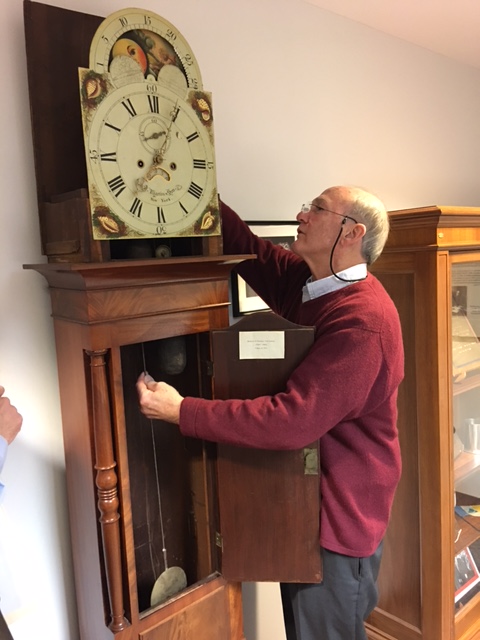
President Robert Barchi adjusts a tallcase clock in the Rutgers University Libraries Special Collections and University Archives.
A couple of weeks ago, Special Collections and University Archives hosted a special visitor — President Robert Barchi.
A big fan of tallcase clocks (AKA grandfather clocks), President Barchi saw all of four of the clocks in SCUA’s collection and even took a moment to perform an on-the-spot repair to an early nineteenth-century clock that was donated by the family of Wallace Todd Eakins (1889-1968), RC’11. After a quick adjustment, the clock was once again happily tick-tocking away.
In honor of this visit, we’re proud to highlight this collection of tallcase clocks. Read below for photos of the beautiful clock faces and information about their provenance and donation.
Movement: 8-day clock; square clock face not signed
Case: intended for a (later) clock movement with an arched clock face; attributed to Nicholas Williamson Parsell (1797-1877) by the donor and is likely the same clock cited by Margaret E. White in Early Furniture Made in New Jersey, 1690-1870 ([Newark, N.J.]: The Newark Museum Association, c1958): “A tall clock with case attributed to Nicholas Parsell is owned by Catharine Schneeweiss.”
Location: Special Collections and University Archives reading room (behind sign-in desk), Alexander Library
Donor: Ralph Heyboer (1918-2011) of Linden, New Jersey
Provenance: movement created in 18th century; case created in 19th century; evidently owned at one time by Catharine Hardenbergh Schneeweiss (1893-1977), the daughter of Henry P. Schneeweiss; per donor: “from estate of Henry P. Schneewiess family”
Note: per Somerset County Historical Quarterly (vol. 8): Nicholas W. Parsell had a daughter Mary who married F.M. Schneeweiss, the father of a Henry Schneeweiss. Per Rutgers University Biographical Files: Alumni (Class of 1877): Henry P[arsell] Schneeweiss (1856-1930), who served as the treasurer of Rutgers from 1915 to 1928, was the son of Franz Maxmillion Schneeweiss and Mary (Parsell) Schneeweiss. He married Mary Cornelia Hardenbergh, a descendant of the first president of Queens College [now Rutgers University], and resided at 56 College Avenue at the time of his death.
Received: 1992; acquired, from the same donor, with other items (e.g., monogrammed china, said to be from the Parsell family, and a mahogany secretary bookcase) identified as having the same provenance
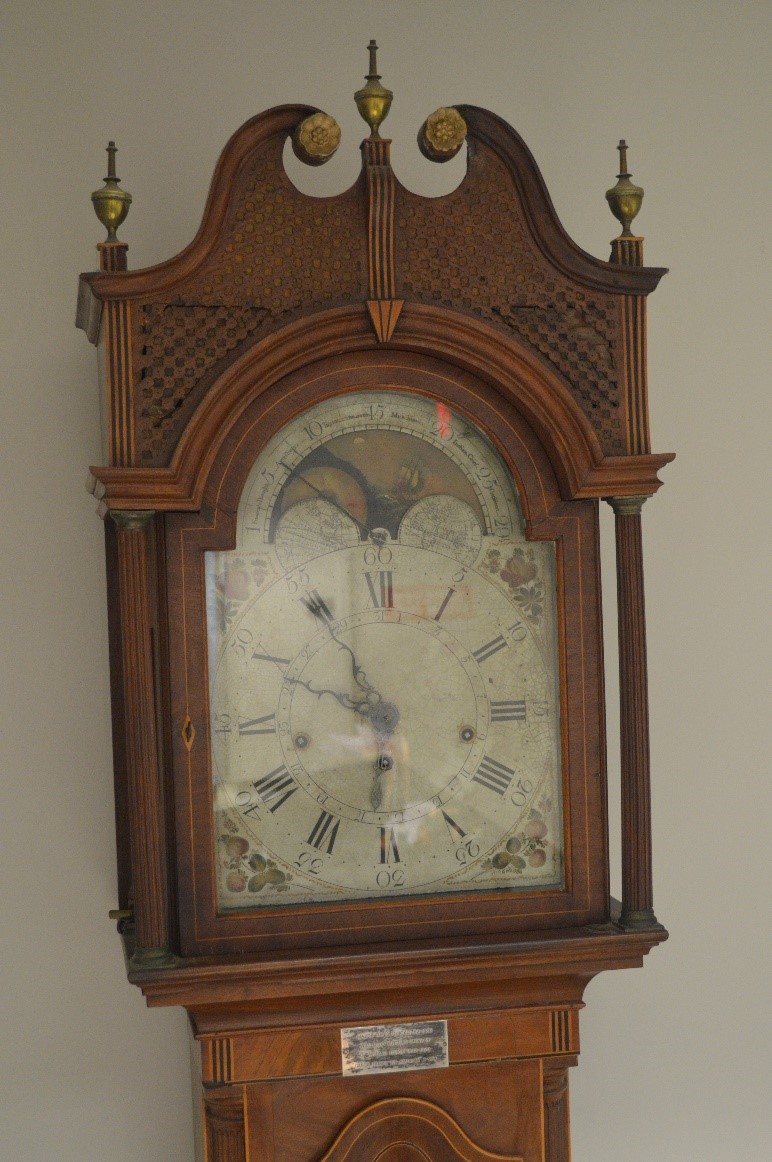
Movement: 8-day musical clock; arched clock face not signed, but movement perhaps by Leslie & Williams, per similar musical clock at Monmouth County Historical Association [see: William E. Drost, Clocks and Watches of New Jersey (c1966)]
Case: Federal era; includes linear inlay; attributed to Matthew Egerton, Jr., New Brunswick, N.J., per similar clock cases with cabinetmaker’s labels [in addition to Drost, see, for example: “Silver Jubilee Exhibitors,” Antiques, LX (October 1951)]
Location: Special Collections and University Archives office area, Alexander Library
Donor: G. Willard Quick (1892-1970) [bequest]
Provenance: per donor: belonged to Tunis Quick (1762-1836), Readington Township, Hunterdon County; per donor’s widow: “moved from the Quick home in Hunterdon County, New Jersey to Loudon County, Virginia, in 1871”
Note: Also per donor’s widow: “Restored to its present condition and put in running order, early in 1940.” Weights augmented at this time?
Received: December 1987 [from Florida, evidently following the death of the donor’s surviving spouse]
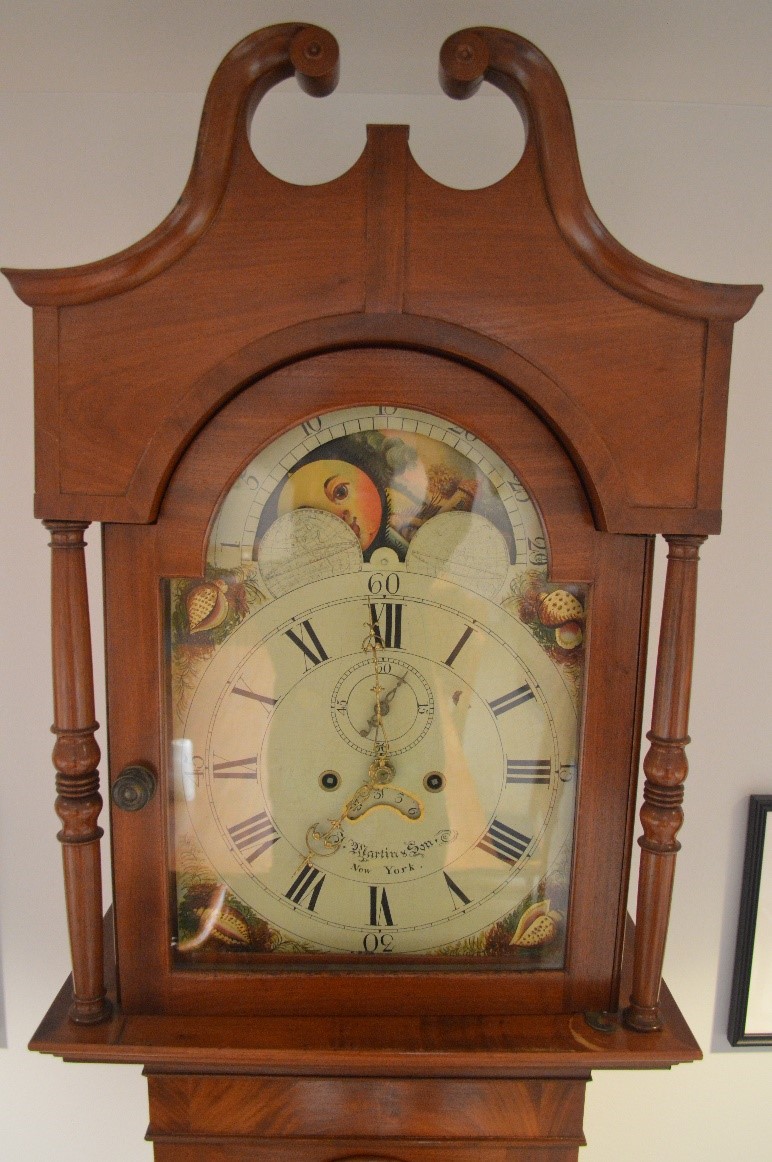
Movement: 8-day clock; presumably by “J. Martin & Son, New York” as stated on the arched clock face
Case: Mahogany?; maker unknown
Location: Clifford P. Case Room, Special Collections and University Archives, Alexander Library
Donor: Wallace Todd Eakins (1889-1968), a member of the Rutgers College Class of 1911 [bequest]
Provenance: created about 1825; “the Eakins family grandfather clock” per donor
Received: destined for or received in Special Collections by March 1970
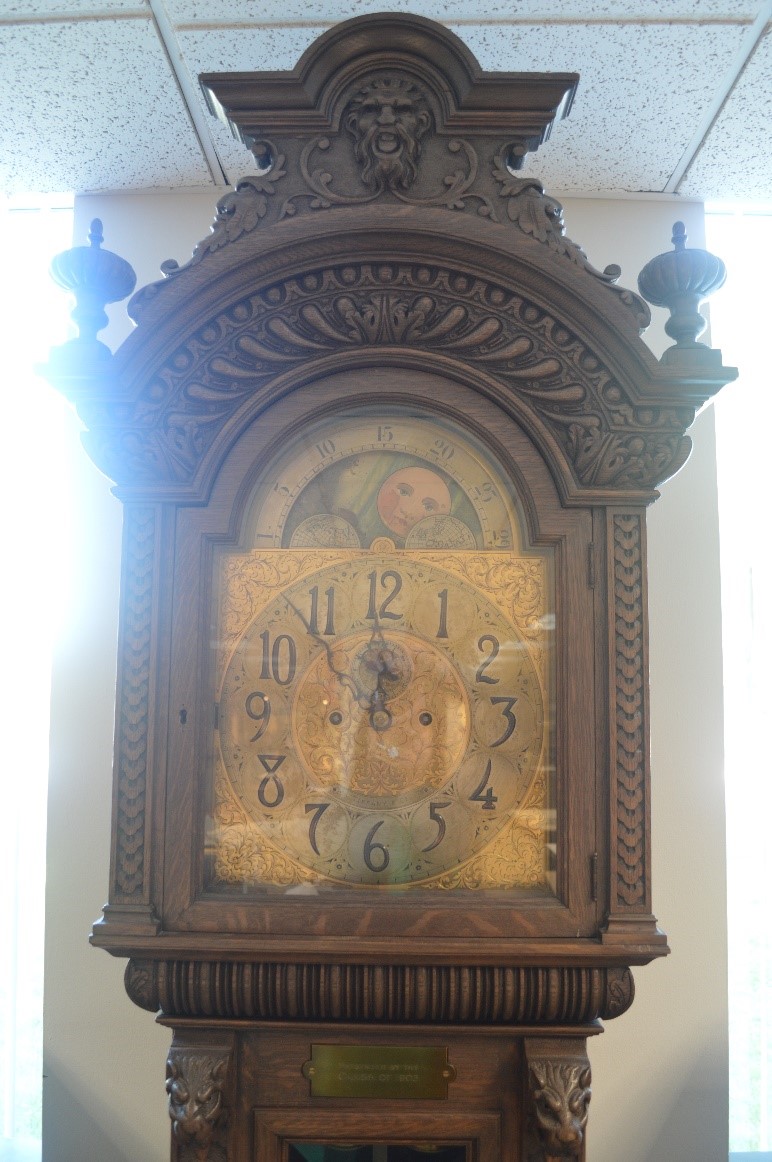
Movement: 8-day clock; arched clock face signed by retailer (Tiffany & Co.), but movement itself (likely to name a maker such as Korfhage) not examined
Case: likely German
Location: Special Collections and University Archives reading room (between windows), Alexander Library
Donor: per small metal plaque: “Presented by the Class of 1903”
Provenance: created about 1900; per Hand-Book of the Grounds and Buildings . . . of Rutgers College ([New Brunswick, N.J.]: The College, 1904): “presented to the College on Class Day, June 16th, 1903, on behalf of the Class of 1903. The clock is a large ‘grandfather’s’ clock, in an oak case, and is the work of Messrs. Tiffany & Company. It is placed in the reading room of the Ralph Voorhees Library” [a building dedicated in 1903]; presumably transferred to new library building [now Alexander Library] about 1956; in Libraries’ central administrative offices immediately prior to 2016 transfer to Special Collections and University Archives
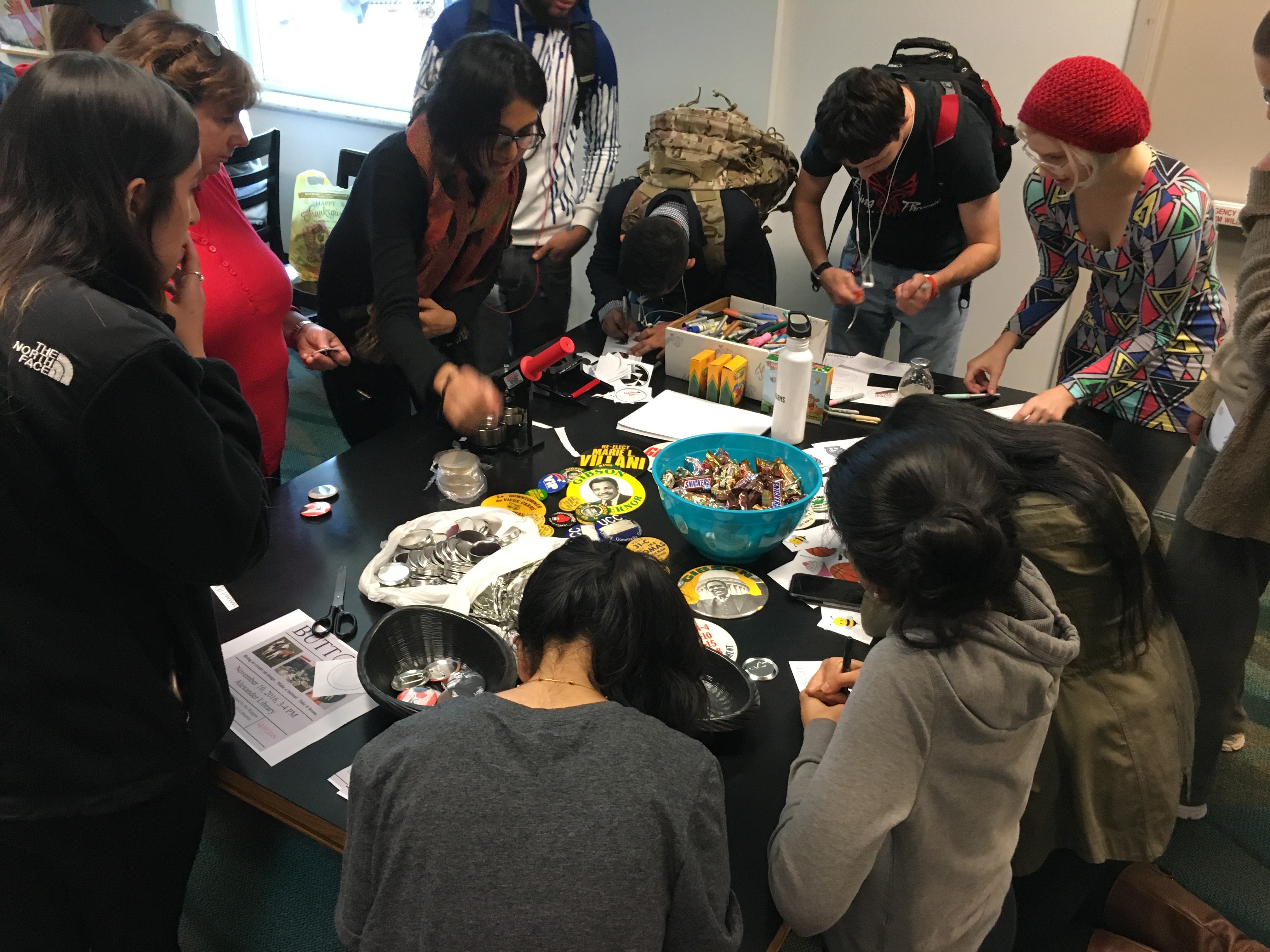
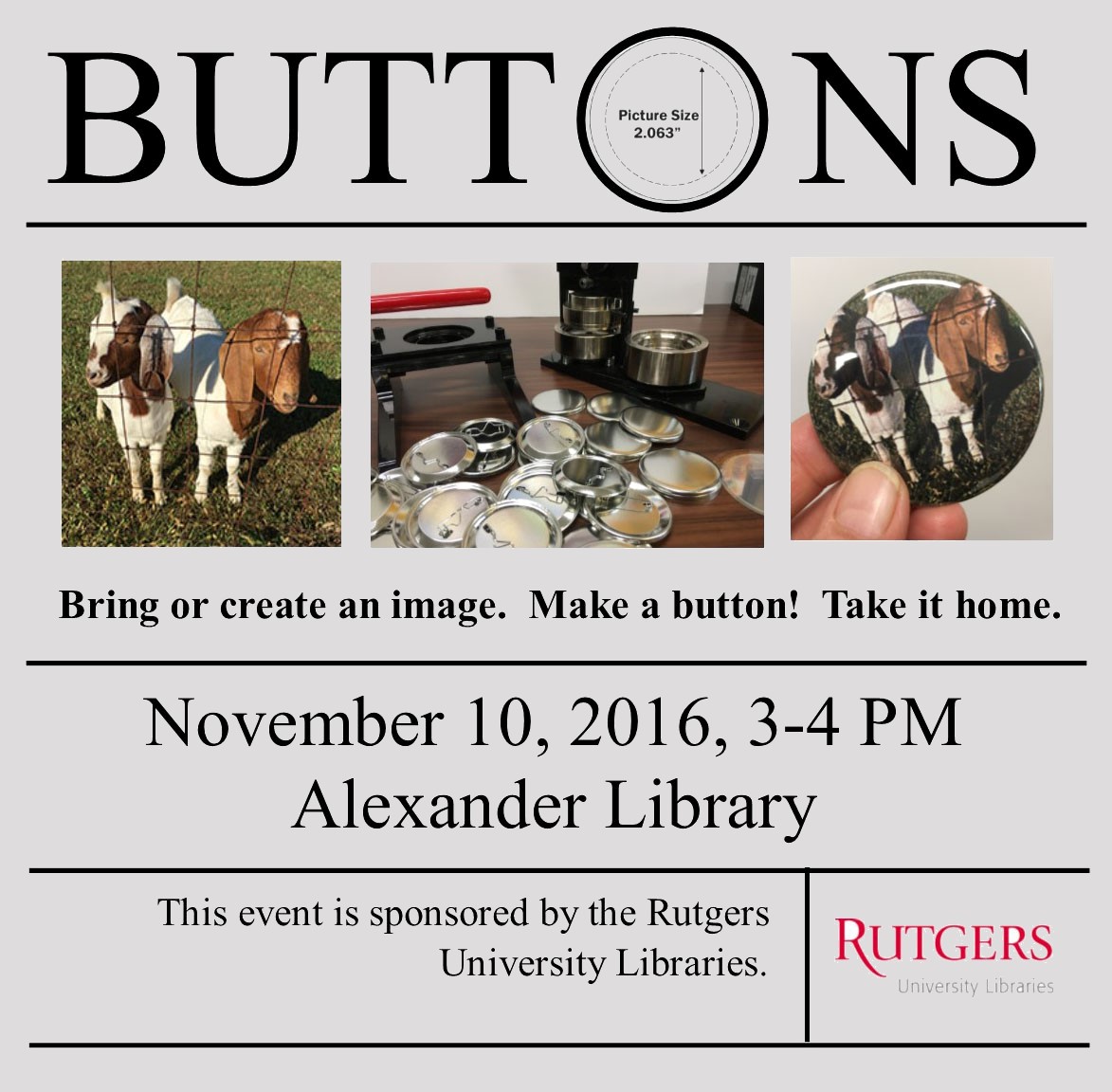
On Thursday, November 10th, 2016, Tara Maharjan, Processing Archivist, Janki Patel, Undergraduate, Art History & Art Library reference assistant, and Megan Lotts, Art Librarian, hosted a pop-up button making space in the lobby of Alexander Library. At this event patrons had the opportunity to create and make their own button, take a pre-made button of an image from Rutgers University Libraries Special Collections and University Archives, and view a vintage button collection, discovered in a basement, in Edison, NJ.
The inspiration for purchasing a button maker came from the Association of College & Research Libraries (ACRL) annual conference in 2013, when Char Booth, current Associate Dean, Library at California State University San Marcos, spoke about libraries building good will within their communities and noted that the button maker they purchased was worth its weight in gold.
Button making can be a low-cost pop up making space that addresses the idea of object, from concept to consumption. In the case of a button, a wearable item is the outcome. Creating a button can strengthen ones’ creative thinking and problem solving skills. Furthermore, it also addresses finding and using images and understanding copyright laws.
Throughout the event many positive comments were made by Rutgers students, faculty, staff, alum, and non-affiliate patrons. Multiple reference questions were asked, and a few patrons inquired about other making opportunities available at the Rutgers University Libraries. Also during the event, the hosts connected with a new student, who was uncertain about navigating the Rutgers systems, and we could share with her information about the libraries, the campuses in general, and what to do in the local area. Lastly, following the event a student reached out from a Rutgers Learning Living Communities (LLC), to ask for 23 Paul Robeson buttons. The LLC is currently researching Robeson, and they all wanted this image from the RUL collections to wear proudly.
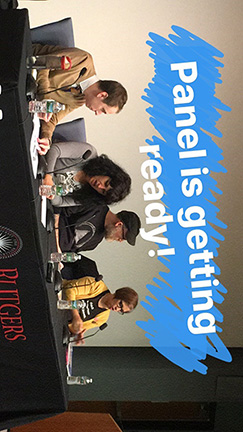
Back in August, Instagram announced a new feature called Stories. Similar to their counterparts on Snapchat, Instagram stories allow users to create a “slideshow” of images and/or videos that is viewable for 24 hours before disappearing.
As is suggested by their name, stories allow you to shape a narrative around your subject in a way that a single image or video may not.
Much like Snapchat stories, Instagram stories are well-suited to capturing action as it is happening. This allows you to leverage the “fear of missing out” to generate excitement around your programming.
When you post or update a story, your account appears in a list that runs across top of others’ Instagram feeds. This extra visibility is a welcome boon given recent changes to the platform’s timeline algorithm.
You can experiment with the story-based approach to social media without having to build a new audience from scratch on a different platform.
Cons
While you can download your story content to your camera roll as it is published, the preferred portrait orientation makes it difficult to repurpose your content elsewhere. Shooting in landscape orientation requires your viewers to either turn their heads awkwardly or rotate their phones, an inconvenience that puts your content at risk of being skipped over.
The 10 second limit on video clips presents some challenges. For example, a speaker’s comments can easily run over and get cut off, necessitating additional takes.
Viewing statistics disappear along with the image or video they are attached to, complicating assessment.
Instagram’s story editing tools (basic text and drawing) are limited compared to Snapchat’s, especially its robust filter system.
Next Steps
Identifying more story opportunities to allow for additional testing. (If you have any ideas, please get in touch!)
Incorporating stories into the Instagram content schedule.
Formalizing the procedure for recording and reporting story viewing statistics.
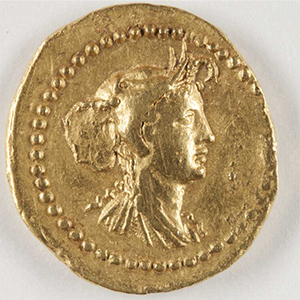
The Roman Coins project is a collaborative effort to bring the Rutgers’ Ernst Badian Collection of Roman Republican Coins fully into the digital realm and to contextualize its 1200+ items in such a way that students, researchers, and a broad section of the public can readily understand the general patterns of development in Roman money during its first 250 years.
The collection holds many coins that hold particular historic, economic, or artistic interest and is one of the largest of its type in North America. However, for a variety of reasons, the coins are not readily consulted in person. In order to make them broadly accessible for study and teaching, the Classics Department and Rutgers University Libraries are working together to create a web-based public portal and archive.
This summer with additional funding from the Classics Department and the dedicated efforts of three summer part-time employees, we were able to add another 200 coins to the portal, bringing the total to some 700 coins.
The portal features multi-faceted display of high-resolution images of individual coins and metadata specifically designed to render ancient numismatics comprehensible to non-specialists, while offering experts much in the way of original and unpublished research.
High-resolution digital imaging available in the Digital Curation Research Center was used to capture archival and presentation images for each coin in a format called Pyramid Tiff (or ptiff) that allows us to represent the same image at different spatial resolutions. This feature was developed for RUcore and is useful for viewing other formats such as maps.
To see ptiff in action, click on “view slideshow” below the coin image at https://rucore.libraries.rutgers.edu/rutgers-lib/47436/. Use the buttons to pan, zoom, and rotate the image. These are truly beautiful artifacts and the ptiff technology allows users to explore them like never before.
The user experience is further enhanced by specialized metadata detailing the legends and images found on the coins and newly implemented faceted browsing. Faceted browsing is available at the Coins portal where users can narrow searches by denomination, material, time period, moneyer, subject, and method.
To complete the digitization of the Badian collection, professor Corey Brennan (Classics Department) will apply for another grant from the Loeb Classical Library Foundation. These additional funds will enable us to image and ingest the remaining 500 coins into the RUcore portal. Professor Brennan will also use the Coins portal in a graduate seminar this Fall.
We take pleasure in announcing the 22nd annual New Jersey Book Arts Symposium. “From Here to . . . There: Concept and Technique in Artists’ Books,” will be held on November 4th, 2016, at the Alexander Library.
The full day program might be described as a carnivalesque, multi-media extravaganza for everyone curious about the field of artists’ books, including students, scholars, artists, librarians, writers, musicians, administrators, procrastinators, cowboys and farmers, fanboys and fangirls, private citizens, as well as the general public.
The program for “From Here to . . . There” is the most ambitious we–by which I mean the New Jersey Book Arts Committee–have ever planned in New Brunswick, consisting of brief illustrated presentations by nine accomplished artists, two morning workshops open to all attendees, an artists’ book registry organized by one of two artists-in-residence, two lunchtime readings by artist/writers, a book arts jam for everyone to show off, sell, barter, or donate their own book fabrications, an open mic for cultural announcements about ongoing or upcoming events (exhibitions, workshops, classes, projects, solo and collaborative performances) broadly pertinent to the field of book arts and artists’ books in New Jersey and environs, and a pop-up exhibit featuring examples of work by all participating artists. And there’s food!
All are welcome – students are free; discounted registration for staff and faculty.


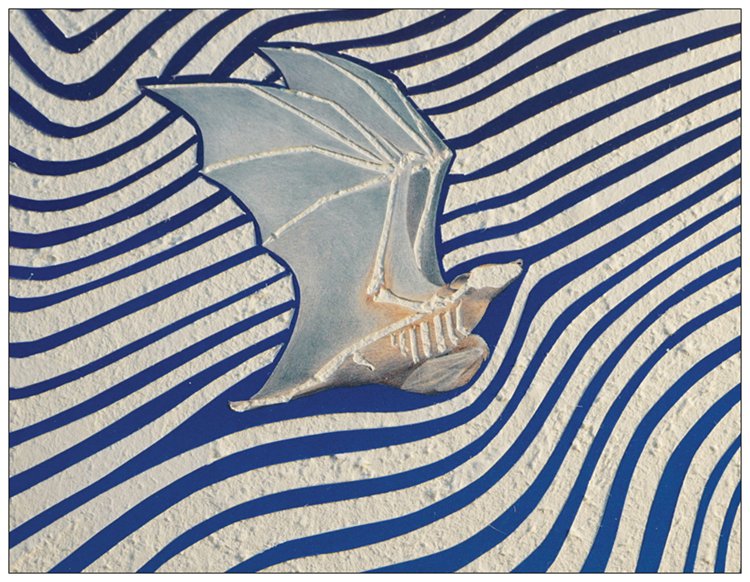
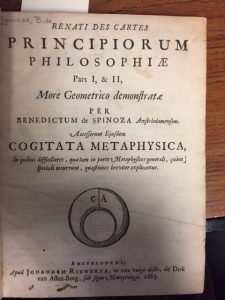 A request from the Spinoza Society sent us into the stacks in search of Baruch Spinoza’s
 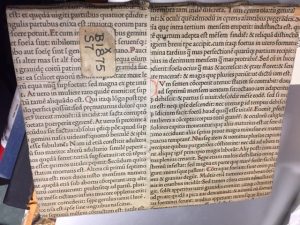 Moreover, in identifying and classifying groups of animals and in explicating their functioning as a part of nature, Aristotle provided the basis for his philosophical analyses of relationships between structure, function, and purpose. De animalibus epitomizes Aristotle’s organizing principle.
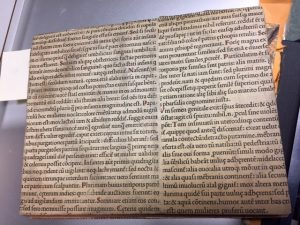 The Rutgers De animalibus (such as it was) was published in Venice by Johannes de Colonia and Johannes Manthen in 1476, a work translated by Theodorus Gaza and edited by Ludovicus Podocatharus. The printers Johannes de Colonia and Johannes Manthen were German merchants-turned-printers who acquired their printing material from Venice’s first printer (also a German immigrant), Vindelinus de Spira in 1473, during a slump in Venetian printing. Along with Nicolas Jenson, Colonia and Manthen dominated the highly-competitive Venetian printing business during the 1470s, producing 86 editions from 1474 to 1480, and merged their business with his in 1480. Intact copies of this edition of De animalibus are rare and highly valued. The last copy to go up to auction in 1998 sold for $96,000. While the Libraries own extraordinary samples of early Venetian printing in the form of intact works by Vindelinus, Jenson, and Aldus Manutius, these leaves are (as far as we know) the lone examples of work by Colonia and Manthem in our collection.

![Movement: 8-day clock; square clock face not signed Case: intended for a (later) clock movement with an arched clock face; attributed to Nicholas Williamson Parsell (1797-1877) by the donor and is likely the same clock cited by Margaret E. White in Early Furniture Made in New Jersey, 1690-1870 ([Newark, N.J.]: The Newark Museum Association, c1958): “A tall clock with case attributed to Nicholas Parsell is owned by Catharine Schneeweiss.” Location: Special Collections and University Archives reading room (behind sign-in desk), Alexander Library Donor: Ralph Heyboer (1918-2011) of Linden, New Jersey Provenance: movement created in 18th century; case created in 19th century; evidently owned at one time by Catharine Hardenbergh Schneeweiss (1893-1977), the daughter of Henry P. Schneeweiss; per donor: “from estate of Henry P. Schneewiess family” Note: per Somerset County Historical Quarterly (vol. 8): Nicholas W. Parsell had a daughter Mary who married F.M. Schneeweiss, the father of a Henry Schneeweiss. Per Rutgers University Biographical Files: Alumni (Class of 1877): Henry P[arsell] Schneeweiss (1856-1930), who served as the treasurer of Rutgers from 1915 to 1928, was the son of Franz Maxmillion Schneeweiss and Mary (Parsell) Schneeweiss. He married Mary Cornelia Hardenbergh, a descendant of the first president of Queens College [now Rutgers University], and resided at 56 College Avenue at the time of his death. Received: 1992; acquired, from the same donor, with other items (e.g., monogrammed china, said to be from the Parsell family, and a mahogany secretary bookcase) identified as having the same provenance](https://agenda.libraries.rutgers.edu/wp-content/uploads/2016/11/clock-schneeweiss.jpg)